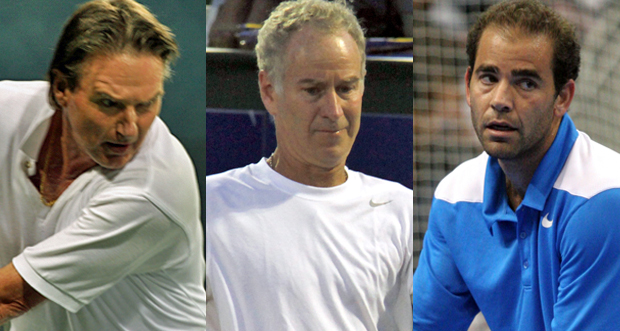
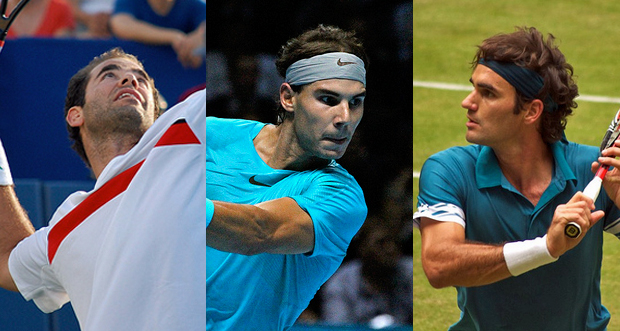
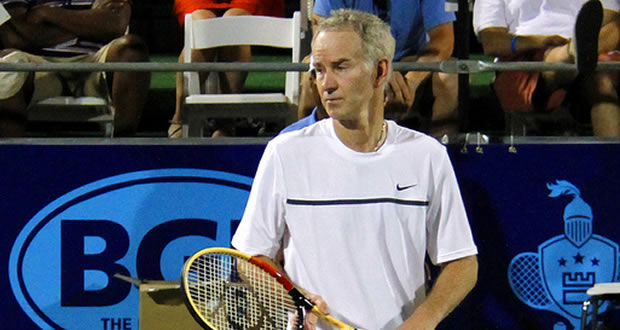
While the tennis of the 1970s was already quite different than the decade before it, both because of the Open Era but also a shift in the way the game was played, the 1980s saw even further change: namely through the transition to metal racquets as well as the rise of the Australian Open. By 1987 the competition at the AO was, if not quite on par with the other three Slams, very close. A few years later it would be equal.
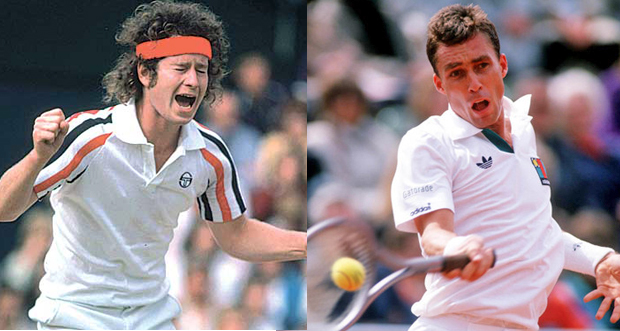
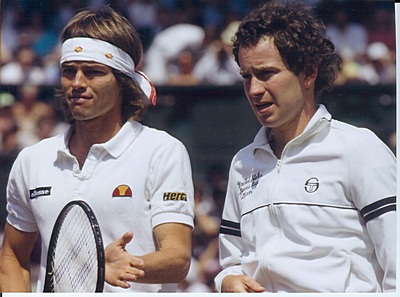
While the last three generations each had a singular dominant player, the 1959-63 generation is the first since the 1934-38 generation that saw two players vying for the top spot. In some ways John McEnroe, nicknamed “Superbrat” by the British press, seems more part of Borg’s generation, yet he is much closer in age to Ivan “the Terrible” Lendl. Their respective peaks are a bit different, only overlapping for a year or two; McEnroe was at his best from the late 70s until 1985, Lendl not peaking until well into the 80s and remaining an elite player into the 90s. They are, clearly, the twin crown princes of the generation and the two best players born between Bjorn Borg (1956) and Pete Sampras (1971).
Best Players by Birth Year 1959: John McEnroe (USA, 7), Eliot Teltscher (USA) 1960: Ivan Lendl (CZE, 8), Yannick Noah (FRA, 1), Andres Gomez (ECU, 1), Tim Mayotte (USA) 1961: Brad Gilbert (USA), Anders Jarryd (SWE) 1962: Juan Aguilera (ESP) 1963: Henri Leconte (FRA), Joakim Nystrom (SWE), Mikael Pernfors (SWE)
Discussion
Ivan Lendl is the only player of the Open Era with 6+ Slams who has a losing record in finals (8-11), but that speaks more to the strength of the era he played in than any lack of effort on his part. First of all, we should consider that he has played in more Slam finals than anyone in the Open Era other than Sampras, Federer, and Nadal (although Novak will almost certainly surpass him in 2016 – he’s just one behind). Consider also that Lendl’s career overlapped with the peaks of Connors, Borg, McEnroe, Wilander, Edberg, Becker, Courier, Agassi, and Sampras; there is really no other great player of the Open Era who faced such a multi-generational array of all-time greats, with the exception of Jimmy Connors and possibly Andre Agassi. The main tarnish on Lendl’s record, and his unfulfilled White Whale, was his inability to win the grandaddy of all tournaments: Wimbledon.
Johnny Mac is the most memorable player of the generation, and one of the most infamous players in tennis history, both because of his legendary temper tantrums, one of which made the title of the article famous, but also because of his intuitively brilliant play. He also has the honor of being the only player that could consistently beat Bjorn Borg. While their perhaps unparalleled rivalry yielded a 7-7 record (plus 4-4 in invitational matches), McEnroe held the edge over Borg the last couple years and had a 3-1 record in Grand Slams. The two provide us with an example of an interesting dynamic in discussing tennis greats: While Borg is generally ranked higher on all-time lists, by the time he retired McEnroe was a better player and McEnroe’s overall career accomplishments—aside from Slam titles—are better. This points to the ongoing developmental nature of the game. Regardless, the two are much closer than their Slam title totals (11 and 7) would imply.
Underachievers and Forgotten Players
This generation was so dominated by Lendl and McEnroe that it is hard to accuse any player of being an underachiever. I suppose Yannick Noah, who is probably more well-known than his career would entail, could have accomplished more. Noah is well-known not only for being the only French Slam winner of the Open Era, but the second black player to win a Slam, and also for his leadership in the Davis Cup.
Did You Know?
Yannick Noah has so many different angles on fame. Aside from his tennis accomplishments, he is also the father of NBA player Joakim Noah, and had a relatively successful music career.
Top Ten Players of the Generation
Ivan Lendl
John McEnroe
Yannick Noah
Andres Gomez
Henri Leconte
Brad Gilbert
Tim Mayotte
Anders Jarryd
Eliot Teltscher
Joakim Nystrom
Honorable Mention: Juan Aguilera
Some might take issue with my ranking Lendl over McEnroe, but Lendl’s record is just better. While McEnroe had a higher peak and was probably a more brilliant tennis player, with a level of dominance and a brilliance of play unmatched by the Czech, Lendl’s peak wasn’t that much lower and he sustained an elite level far longer than McEnroe.
Noah and Gomez—the only others to win Slams—are pretty easy to rank at No. 3 and No. 4, and then the rest taper off. Gomez is an interesting player in that he won his only Slam in 1990 at the age of 30, against a young Andre Agassi. Gomez—born the same year as Lendl and a year after McEnroe—won his lone Slam just after Lendl’s last and six years after McEnroe’s last, in 1984. He’s a good reminder for players like Jo-Wilfried Tsonga and Tomas Berdych that there’s always hope.
This Week’s “Hot on the Frontier” topic is “When will Novak lose the #1 ranking (and can he surpass Roger’s 302 weeks at #1)?” This topic was started by Tennis Frontier member El Dude. It certainly got a lot of fans thinking about how long Novak Djokovic would hang on to the No. 1 ranking and if were possible for him to break Roger Federer’s record. Come on in and take a look to see what the Frontier crowd had to say about Djokovic’s stay at No. 1! And thanks to El Dude for starting a great topic!
El Dude
Tennis Frontier Member since: April 2013
Some questions for El Dude:
1. Who is your all-time favorite tennis player?
Answer: Roger Federer. Has there ever been a player who played with such grace, elegance and beauty?
2. What is your biggest tennis pet-peeve?
Answer: I dislike the homogenization of courts, namely the slowing down of courts. I’d like to see a greater diversity of court types, which would in turn broaden the spectrum of players. I’m kind of tired of the dominance of “war of attrition tennis.”
3. If you could go watch any Grand Slam tournament, which one would you like to go to?
Answer: Wimbledon, of course! The US Open is closer and would be easier, but Wimbledon is–and likely always will be–the premier tennis tournament.
4. If you could slip back in time and see one match in tennis’ history, which match would it be?
Answer: Two things come to mind. First of all, one of the great Borg-McEnroe matches – maybe 1981 Wimbledon. Secondly, I would have loved to see a classic matchup of Rod Laver and Ken Rosewall, or maybe Pancho Gonzales and Rosewall.
5. Which two players would you like to see playing doubles together?
Answer: Rafa and Roger! Can you imagine that?!
6. Describe your affection for tennis in one word.
Answer: Impossible to do that. But a few words come to mind: elegance, brilliance, skill.
7. Your opponent bounces the ball 20+ times before serving. You would:
Answer: I would yell, “Vamos, Rafa!”
A message for everyone on Tennis Frontier (if you have one):
This is a great little community that is open to a diverse number of viewpoints. It has its share of generally minor squabbles, but there’s an underlying sense of camaraderie and community that makes it worth coming back to, again and again. Its like a parlor in which friends come and go and return again, and the conversation keeps going. Thank you all for making Tennis Frontier such a great place to hang out and talk tennis!
Thanks to everyone who always contributes to Tennis Frontier! Keep the topics coming and hopefully you’ll put the hottest topic on the Frontier out!
Imagine if each country had a tennis career. Rather than individual players, you have nationalities; rather than an individual career, you have a national one. As a thought experiment, I decided to compile the top Slam-winning countries in Open Era history, from the 1968 French Open to the 2015 French Open. How would these “national careers” look, as if they had careers spanning 48 years? What would their stories be? I looked at and compiled the best results from players of a given nationality, created a “national career chart” for the Open Era, and in doing so gained a deeper understanding of the history of men’s tennis. I’d like to share that research and understanding with you.
For this exercise I looked at the top five nations by Open Era Slams: The United States (51), Sweden (25), Spain (21), Australia (20), and Switzerland (19). Beyond those five, only Czechoslovakia/Czech Republic has double digits (12); Serbia (8), Germany (7), Argentina (6), Russia (4), and Brazil (3) all have more than two. The countries with two are Croatia, Romania, South Africa, and the United Kingdom; the countries with one are Austria, Ecuador, France, Italy, and the Netherlands.
This will be a six-part series, the first five articles covering the “Big Five” tennis nations, and the sixth part being a summarization, with a look at recent years and some thoughts about the game going forward. Look for further installments every few days to a week through June and July.
In each article I will briefly overview the trajectory of the nation during the Open Era, looking at the top players and compiling a Top 10 list for each nation. For these lists I am using a statistical system that takes into account Slam results, titles, and rankings. For the most part I am faithful to the system, although in one or two cases I add a subjective element – usually as a tiebreaker. Also, for these lists I am including some players who played before the Open Era, but only those players that played a significant portion of their careers in the Open Era. Finally, I will look at the current national players, including a glimpse at any potential up-and-comers.
On to the New World…
PART ONE: THE UNITED STATES
RISE AND FALL OF THE AMERICAN EMPIRE
The United States is the greatest tennis nation of the Open Era–actually, tennis history as a whole–and it isn’t particularly close: With 51 Slam titles during the Open Ea they have more than any other two nations combined, and include greats and multi-Slam winners such as Pete Sampras (14), Andre Agassi (8), Jimmy Connors (8), and John McEnroe (7), as well as lesser greats such as Jim Courier (4), Arthur Ashe (3), Stan Smith (2), and single Slam winners Roscoe Tanner, Vitas Gerulaitis, Brian Teacher, Michael Chang, and Andy Roddick.
Now let’s take a look at the performance timeline:
As you can see, there’s a build-up in the early years of the Open Era with Stan Smith and Arthur Ashe being among the best players in the sport, that blossomed with the first great American phase of Jimmy Connors and John McEnroe, who together won 15 Slams between 1974 and 1984.
After that there was a lull in the mid-to-late 80s as Connors and McEnroe declined, until Michael Chang won his lone Slam in 1989, the harbinger of the second great American era of Courier-Sampras-Agassi that dominated the 90s and into the new century. Finally we have a last gasp in 2003, with Agassi winning the Australian Open and Andy Roddick winning the US Open, and decline since then. Roddick retired in 2012 as the last Slam-winning American. His last Slam final appearance was the epic 2009 Wimbledon, and since then an American has only reached the second week of a Slam three times.
Top 10 Americans of the Open Era
Pete Sampras
Jimmy Connors
John McEnroe
Andre Agassi
Arthur Ashe
Jim Courier
Andy Roddick
Stan Smith
Michael Chang
Vitas Gerulaitis
Honorable Mentions: Roscoe Tanner, Brian Gottfried, Harold Solomon, Todd Martin, Eddie Dibbs, Cliff Richey, Brad Gilbert, Aaron Krickstein, Brian Teacher, Tim Mayotte, Gene Mayer, Bob Lutz, Jimmy Arias, Marty Riessen, Eliot Teltscher, Tom Gorman, James Blake, Steve Denton, MaliVai Washington, Bill Scanlon, Dick Stockton, Tim Gullikson, Mel Purcell, Mardy Fish, John Isner.
Determining the Top 10 greatest American players was relatively easy as there is a drop-off from Gerulaitis to the rest of the pack. That said, the Americans are so strong that there are several players not in the Top 10—namely Tanner, Gottfried, Solomon, and Martin—that would be in the Top 10 of any other nation, with the possible exception of Spain.
Clearly the Top 4 are relatively easy, although some might quibble about the order of Connors, McEnroe, and Agassi. But using my system, Connors is actually closer to Sampras than he is to the rest, while McEnroe just edges Agassi. Further down we become more controversial. Courier had a higher peak than Ashe, but Ashe was good for so long; those two are also very close, but the edge goes to Ashe. Roddick, Smith, and Chang are also very close and most might rank Smith higher than Roddick due to his better peak, but I ranked them according to my system, which acknowledges that despite being dominated by Roger Federer, Roddick was still one of the best players in the sport for a decade. Finally, Gerulaitis is a big step behind the first nine, but even further ahead of No. 11 (Roscoe Tanner).
Pre-Open Era Greats
American greatness in men’s tennis did not start with Jimmy Connors, or even his precursors, Arthur Ashe and Stan Smith. While this series focuses on the Open Era, it would be remiss on my part not to mention some of the best players before the Open Era: Bill Johnston, Bill Tilden, Ellsworth Vines, Don Budge, Jack Kramer, Tony Trabert, Bobby Riggs, Pancho Segura, Vic Seixas, and Pancho Gonzales. Tilden, Gonzales, and Budge are probably all among the dozen or so greatest players in tennis history, with Vines, Kramer, and Riggs not too far behind.
Pancho Gonzales in particular remains one of the most underrated all-time greats, perhaps mainly because he only won two Grand Slams. But he also won 12 Pro Slams and the Tournament of Champions three times, so essentially has 17 Majors to his name – as many as Roger Federer, and more than any player other than Ken Rosewall and Rod Laver. Gonzales was almost certainly the greatest player of the 1950s, just as Rod Laver was of the 1960s (with Ken Rosewall bridging the two decades as second fiddle to both). I place Gonzales, Tilden, and Sampras as the Trinity of greatest American tennis players, with Budge, Connors, McEnroe, and Agassi after them, then Vines, Kramer, Trabert, Riggs, Segura, Seixas, Ashe, and Courier following in some order.
But the key here is to get a sense that American greatness in men’s tennis goes back virtually to the beginning of the sport. Richard Sears won the first seven US Opens, from 1881 to 1887, although it wasn’t until 1908 that an American won a Slam outside of the US–John Alexander at the Australian Open–and not until 1920 when an American first won Wimbledon, the great Bill Tilden. The first American to win the French Open was Don Budge in 1938. The United States remained dominant through the 1950s, until a pair of Aussies led the way for dominance from Down Under…but more on that in a later installment.
Will the Empire Rise Again?
Other than Roddick, American tennis has been slim since the retirement of Andre Agassi. Consider also that in 1990 fully 35 of the Top 100 were Americans; today it is only six, and none in the Top 10. Players such as James Blake, Mardy Fish, and John Isner have been decent but unremarkable. Some players such as Donald Young, Sam Querrey, and Ryan Harrison have displayed varying degrees of promise but have all disappointed in different ways.
What about the future? Is there any hope? First of all, let’s look at the Americans currently in the Top 100, as of June 8:
18. John Isner (30)
31. Jack Sock (22)
39. Sam Querrey (27)
51. Steve Johnson (25)
57. Donald Young (25)
72. Tim Smyczek (27)
Given their ages, the only player who looks to have solid upside is Jack Sock, who is memorable for his solid run at Roland Garros this year, defeating Grigor Dimitrov, Pablo Carreno Busta, and Borna Coric before being defeated by Rafael Nadal in the fourth round. While it seems unlikely that Sock will become an elite player, he at least seems like a probable Top 20 regular, and perhaps could challenge for a spot in the Top 10. But it seems very unlikely that Sock will rise above the level of Fish, Isner, and Blake.
What about younger players? Beyond the Top 100 there are two that are especially worth taking note of: 18-year-old Jared Donaldson, currently ranked No. 152, and 17-year-old Francis Tiafoe, ranked No. 279. Clearly these two are a long ways from making a mark, but Donaldson is just around the corner, and Tiafoe has only just gone pro and is showing promise. Keep your eyes on these two. Also on the radar is 21-year-old Bjorn Fratangelo, ranked No. 144 – but he needs to move fast if he’s going to make his mark.
Summation
American men’s tennis clearly saw its golden age from the early 70s to the early 00s, but has really been in a slump for over a decade now. While it may be that American tennis will never regain its glory, it is worth mentioning that there have been slumps before. After dominance in the 1930s to 50s, from Bill Tilden to Pancho Gonzales, the Australians took the mantle during the late 50s and 60s before Ashe and Smith, and then more fully Jimmy Connors, took it back in the 1970s. Yet unlike that era, when fading great Pancho Gonzales played long enough–into his mid-40s–to see Jimmy Connors emerge, there are no elder statesmen to pass the mantle – Agassi is ten years gone; even lesser great Andy Roddick has been gone for almost three years now (can you believe it?).
So it seems that we’re left with a moderate view: that American tennis will probably not return to its dominant position in the sport any time soon, but that better days are ahead.
All good things come to an end. It is the inevitable tragedy of life, although of course it also allows for greater appreciation of the moments we do have. And so it is with tennis greats, whether the current twilight years of Roger Federer or, as is the focus of this piece, the inevitable decline of Rafael Nadal from an unstoppable force of nature to merely a great, but beatable, player.
Before you protest that all players have their ups and downs, let us consider the simple fact that Rafael Nadal is in an age window when most great players drop a notch; even if he’s not dropping yet, it is inevitable that at some point soon he will. But a notch from his peak level still makes him one of the best players in the game – just as in Roger’s “twilight years” he is still probably the third greatest player on tour.
Perhaps by understanding the career trajectories of other great players we can better understand where Nadal might be in his own career, and what might be ahead. For a player of Nadal’s stature there are few peers – we have to look at players who were for a significant portion of their careers considered the best in the game. Going back through Open Era history, we have Roger Federer, Pete Sampras, Ivan Lendl, John McEnroe, Bjorn Borg, and Rod Laver. With apologies to other dominant players such as Novak Djokovic, Andre Agassi, Boris Becker, Stefan Edberg, Mats Wilander, and Jimmy Connors, I’m looking at players who were the best for an extended period of time (Djokovic is close, but he’s younger than Nadal so doesn’t really qualify). Borg also has to be taken out of the equation as he retired at 25.
That leaves us with Federer, Sampras, Lendl, McEnroe, and Laver. Considering that Nadal turns 28 this year, let’s keep in mind the year those five turned 28 for a reference point:
Federer: 2009
Sampras: 1999
Lendl: 1988
McEnroe: 1987
Laver: 1966
As I’ve suggested elsewhere, most players follow a career pattern in four major phases (with general age averages): development (17-21), peak (22-26), plateau (27-31), and decline (32-). Obviously players veer out of those ranges, but those are typical. I would maintain that one way to define the peak phase is that it is the period of a player’s career in which their results, especially winning percentage, are solidly over their career average, while the plateau phase is more around the career average or a bit below. Now the question at hand in this context is whether or not Rafael Nadal is transitioning from his peak to plateau phase, which is a step below peak but still very high.
Let’s take a look at the five players and see at what point they transitioned from peak to plateau. To get a sense of that, we’ll be focusing on their Grand Slam results and match winning percentage.
Roger Federer
The Swiss Maestro was clearly in his peak from 2004 to 2007. When he actually dropped a notch into his plateau phase is a bit unclear, however. Many consider the great 2008 Wimbledon match as when Roger passed the baton to Rafa for greatest player in the game. But not only was that match a complete toss-up, but Roger went out and won the next Slam and four out of the next six. Rather, I would maintain that what the 2008 Wimbledon marked was Nadal joining Federer as the best in the game, a partnership which was maintained–some some passing of the baton back and forth–until 2010 when two things happened: Rafa had probably his best year and Roger dropped a notch, leaving Rafa as the sole king of the tour.
Regardless of when Federer’s skills began to erode, greatness is always defined relative to others, thus the results offer a reliable barometer for his drop in performance. Looking at the statistical record, Roger’s career definitely dropped a solid step after the 2010 Australian Open, his penultimate Slam victory (so far, at least). Whereas Roger won a remarkable 16 of 27 Grand Slams from Wimbledon 2003 to the 2010 Australian Open, playing in a perhaps even more remarkable 22 of 27 Finals, from 2010 Roland Garros to the present, Roger has won only 1 and played in 2 Finals of 16 Slams. He is still a very, very good player, but clearly a step down from his previous peak.
Looking at Roger’s winning percentage confuses the matter a bit, as he dropped quite a bit from 88% in 2007 to 81% in 2008, and then equalized in the 83-86% range from 2009 to 2012, and then plummeting to 73% in 2013 before rising to 87% (so far) in 2014. But winning percentage is only part of the equation, the other being Slam results, and Roger remained pretty dominant through the Australian Open in 2010 so I would argue that he entered his plateau phase around Roland Garros in 2010 – when he was 28 years old, turning 29 a few months later.
Pete Sampras
Pistol Pete was the No. 1 ranked player in the game for an unparalleled six years in a row, from 1993-1998, the year he turned 27. While Pete was No. 1 as late as November 2000 when he was 29 years old, his reign of dominance had clearly ended, or at least diminished.
In 1998, Pete’s last year at No. 1, his winning percentage had dropped for the second straight year and, at 78.2%, was about at his career average (77.4%). But then in 1999 it shot up again to 83.3%, the highest it had been since 1996 and the fourth highest of his career. Yet it dropped again in 1999 to 76.4% and continued to drop over his last couple years.
So in one sense we could say that Pete was as good as ever in 1999, the year he turned 28, yet on the other it was in far fewer matches than usual – he only played 48, the fewest he had played since 1989, and far fewer than his average of 81 per year from 1990-98.
Regardless, it seems clear that Pete entered his plateau phase sometime between 1998 and 1999. He lost the No. 1 ranking in late March of 1998 after holding it for 102 weeks straight. He did regain it again before the end of the year so that he still finished No. 1, but I think at that point the writing was on the wall. So I’d maintain that he transitioned into his plateau phase around age 27.
Ivan Lendl
Some might take issue with Lendl’s inclusion, as his early career was overshadowed by Borg, McEnroe, and Connors, and later on he vied with Wilander, Becker, Edberg, and then Sampras and Agassi. (Actually, as an aside, Lendl may be one of the most underrated players in tennis history because of all great players—at least during the Open Era—no one else played alongside other greats playing at or near their peaks, and Lendl held his own, and then some.) Let us remember that Lendl finished three years in a row, 1985-87, at No. 1, and a fourth year in 1989. He also finished in the Top 3 for nine straight years and the Top 8 for thirteen straight years, both of which only Roger Federer has equalled since (Fed finished in the Top 3 for ten straight years and assuming he finished 2014 in the Top 8, will equal Lendl’s thirteen straight years in the Top 8).
Lendl’s fall to his plateau is relatively easy to determine. In 1989, his last year finishing No. 1, he had a winning percentage of 92% which fell to his career average of 82% in 1990, which was also the last year he won a Slam, and then 75% in 1991. So the fall came between 1989 and 1990 – perhaps after his last Slam at the Australian Open in 1990, so when he was 29, almost 30 years old.
John McEnroe
Johnny Mac is a bit of an outlier to this group because his later career was marred by personal issues. But he was still a similarly dominant player as the others on this list during the first half of his 20s, ranked No. 1 for four years in a row, and the only player to be considered the great Bjorn Borg’s equal, even surpassing the great Swede towards the end of their rivalry.
Anyhow, McEnroe’s drop is quite clear. His very greatest year was 1984 when he had an amazing 96% winning percentage (82-3). Yet 1985—despite not winning any Slams—was also great, with an 89% winning percentage and far above his career average of 81.5%. But then he missed a lot of time in 1986-87 and never came back even close to peak form, so we could say that there’s a clear separation between peak and plateau/decline between the years 1985 and 1986. Johnny Mac turned 27 in early 1986, so the drop was at age 26-27.
Rod Laver
I include Laver with some hesitancy considering that he played in the mists of ancient tennis history. Yet he was a similarly dominant player to Nadal and Federer, and had his last great year in the Open Era.
It is more difficult to example the statistical records from before the ATP era (1973), but from what the statistical record shows us, Laver maintained a peak level of performance throughout his 20s and through his great year in 1969 when he won all four Grand Slams. He turned 31 that year.
Laver remained a good player for a few more years, but was never the same. So his peak ended quite late – at age 31.
Summary
So when we look at our five comparable greats to Nadal, we see the age that they transitioned from peak to plateau form as follows:
Federer: ~28
Sampras: ~27
Lendl: ~29
McEnroe: ~26
Laver: ~31
Looking back over the last year or so, Rafa was playing at a very high level through the summer of 2013. After dominating the North American section of the tour by winning the US Open and both the Canadian and Cincinnati Masters, Nadal slowed down a bit, not winning a tournament for the rest of the year. He started 2014 by winning the Qatar Open, although then lost in the Australian Open final, partially due to injury. He also won his second tournament of the year in Rio, but both his wins so far are relatively minor (an ATP 250 and 500, respectively), and he hasn’t won any of the three Masters and just lost in Barcelona in the quarterfinal. His 91% winning percentage in 2013 was the best of his career, while his 82% so far this year is actually a bit below his career average of 83.6%, so there is cause for concern.
Nadal will turn 28 years old in a little over a month, so he is certainly within range of the norm for transitioning from peak to plateau. Right now he is the same age that Roger Federer was when he won the 2009 Wimbledon and when Sampras won the 1998 Wimbledon. At Rafa’s current age, both Roger and Pete won three more Slams; Lendl won only two more, but had fewer total.
So if we want to guess what is before Rafa, we can look at Federer and Sampras in particular. If Rafa truly is transitioning from his peak to his plateau—and it seems likely, in my opinion—he still has many good years ahead of him. And if I were to guess how many more Slams he will win, like Federer and Sampras at the same age, three is as good a guess as any. Both Roger and Pete won two more at their best Slam (Wimbledon) and one more at another. Perhaps, then, an educated guess would be that Rafa will win two more French Opens and one more on another court, which would bring him to a total of 16 for his career – one shy of Roger Federer’s current total, but more than anyone else.
But of course there are always exceptions to the rule, and Rafa is as good a candidate to be one as any other. Every player has a different career trajectory; but if he follows the typical trajectory of a great player, while he would truly be transitioning into his plateau phase now, he also likely has a few good years—and a few Slam titles—left in him.
Photo provided by rainycat (Creative Commons license)
When looking at the different periods of tennis history, the late 1970s to early 1980s is often considered the “Golden Era,” highlighted by what must be the greatest rivalry in tennis history: Bjorn Borg versus John McEnroe. We could say that this era began in 1978 when the young American upstart McEnroe surprised the tennis world by beating Bjorn Borg at the Stockholm Open, the first of 14 matches they played against each other, each winning seven. The natural end of this era, then, would be their last match: the 1981 US Open, when McEnroe solidified his usurpation as the top player in the world by beating Borg in the final, and also Borg’s last Grand Slam contest.
So from the very end of 1978 to late into the 1981 season was a great era of men’s tennis, dominated by Borg and McEnroe, with older but still excellent Jimmy Connors and Guillermo Vilas rounding out the elite and, in the last half of that span, young Ivan Lendl coming onto the scene. Yet the question that arises is this: Was it the most talent-rich period of tennis history or merely the most celebrated? This set me to doing some research; for the sake of ease I stuck to the Open Era and, in particular, the period of ATP rankings, 1973 to the present. So we can fine-tune the question a bit and ask: How has “talent-richness” changed over the last 40 years of men’s tennis?
I decided to look at only those players who could be considered “all-time greats.” My criteria were flexible, but included all players who had won three or more Slams in the Open Era, or were likely to win three or more, and at more than one venue. This means that I excluded Gustavo Kuerten, who won three Slams at Roland Garros, but included Andy Murray, who has won two Slams at different venues, and seems likely to win at least one more.
I came up with a list of nineteen players; here is a chart that shows their year-end rankings (click on chart for better viewing):
Just looking at that chart gives us a sense of the ebbs and flows of upper echelon talent in men’s tennis, although of course it is important to point out that I’m only looking at the very greatest players and not the “near-elites” or players that might have been great for a short period of time (e.g. Lleyton Hewitt, Michael Stich, etc.). The purpose here is to focus on truly great talent and in what density it has shown up over the last four decades.
I then separated those nineteen players into three groups or tiers by their total Slam count, to differentiate levels of greatness:
Tier One (10+ Slams): Rosewall, Laver, Borg, Sampras, Federer, Nadal
Tier Three (5 or fewer Slams): Ashe, Vilas, Courier, Murray
I think we can safely say, without too much quibbling, that the above list represents the 19 greatest players of the Open Era, roughly arranged in levels of greatness. Strike that; I’m sure there will be quibbling, and I can imagine the protests of, say, Andy Murray’s inclusion but not Gustavo Kuerten’s or Marat Safin’s or Patrick Rafter’s or Ilie Nastase’s. But I think we can at least agree on most of that list; in other words, if we want to quibble about Murray or Ashe or Vilas or Courier, fine, but the other fifteen are clearly all-time greats, and of the four “Tier Three” players we can, at the least, say that they’re deserving of consideration and at least as deserving as anyone else.
That aside, I won’t go into exact numbers for the sake of avoiding complexity and confusion, but I then assigned different points for different rankings, with Tier One getting roughly twice the points of Tier Three, and Tier Two halfway in between. Players would get points for different levels of ranking – #1, #2-5, #6-10, #11-20, etc. Finally, I counted up the points from each year for the above 19 players, from 1973 to 2012, arriving at a number which is meant to indicate “talent-richness” of any given year.
Let me be clear and re-emphasize what I just wrote: This number indicates (or describes); it does not seek to definitively finalize or give us any more than a sense of talent-richness. To get a more accurate, comprehensive picture we’d have to look much deeper than the above nineteen players. What this does show us in a relatively accurate manner is how dense or rich the level of truly great talent has been in any given year. In other words, it tells us for any given year what level of all-time great talent was playing at a high level; it doesn’t tell us the total depth and breadth of talent.
The next chart shows us that number over time:
There are a few things that stand out for me:
One, there’s an interesting two-year window in 1974-75 which, according to this calculation, were the two most talent-rich years in the last 40 years. The reason for this is that a few of the top players of the 1960s—Laver, Rosewall, and Ashe—were still playing at a high level; at the same time, you had Newcombe in his prime, a young Connors and Vilas, and a teenage Borg establishing himself as an elite player. The number dropped as the older players faded away; in 1976, for instance, Laver finished the year at No. 76 compared to No. 10 the year before.
Secondly, we can see that the 1978-81 period—while talent-rich—is not as much so as the late 1980s when you had three generations all playing at or near their peaks. This is not to say that the ’78-81 period wasn’t talent rich; but this certainly supports the idea that its appellation as the “golden era” of men’s tennis has more to do with the great Borg-McEnroe rivalry than it does with a clear supremacy of talent over other periods.
Moving on, there is an obvious and massive decline in the mid-90s. Wilander and Connors were done as elite players by 1990, McEnroe retired in ’92, Lendl a couple years later, and then Edberg and Becker faded just after that, and Jim Courier—like Wilander—peaked and faded at a young age, so during the mid-to-late 90s there were only two clear elite players, Agassi and Sampras, and Sampras started fading in the late 90s.
The absolute nadir of Open Era talent seems to be 2000. The talent-level began to rise with the arrival of Roger Federer, and then jumped when Rafael Nadal stormed through Roland Garros in 2005. From 2008 through 2012 it has “flat-lined,” with four players dominating the field in a way previously unseen.
Before ending, allow me to indulge in some speculation. It seems clear that Roger Federer has slipped out of the elite; perhaps the best we can hope for is him hanging around the Top 10 for another couple years. Nadal, Djokovic, and Murray should be around for some time, but the big concern is that there are no obvious candidates to join the above list, to turn that list of 19 into 20 or more. Of course we will see more elite players, but it’s hard to imagine Milos Raonic or Jerzy Janowicz or Grigor Dimitrov winning three or more Slams and earning a spot on this list. Who knows? I could be wrong–I certainly hope I am!–but my sense is that for that next great player, we’re going to have to wait two to three years or more before we even know who he (or they) will be.
With Federer unlikely to finish in the Top 5, that number is going to drop for 2013. Not by much, but probably by five points. I could see it holding steady in the upper 40s for another year or two, but after that it all depends upon whether we start seeing signs of that next great player and/or how quickly the current Big Three will decline. The decline of all players is inevitable, and we’re likely going to start seeing signs of the decline of the Big Three within the next two or three years, as they enter their late 20s and are more frequently beaten by the hungry near-elite players below them.
In conclusion, talent ebbs and flows and no era is quite like any other. Neither of the above charts shows a clear pattern or cycle; it would seem that each new era is different and that all we can be certain of is change itself. One of the great joys of tennis, at least for myself, is waiting and watching for the next generation of talent to arise, to try to understand who the next great player will be, and what match – like Stockholm in 1978 – will signal the changing of an era. So I will continue to watch and wait. Meanwhile, we can sit back and enjoy the great tennis play of today.
Consider the following as an addendum, or second part, to the previous blog in which I looked at the decline of American men’s tennis. In this entry we’ll look at the big historical trajectory of men’s tennis, and from a slightly different perspective: that of mythology.
Various mythologies throughout the world – such as Greek, Indian, and Mesoamerican – hold that the world passes through great ages of time. While there are differences between these myths, they are also remarkably similar in that all start with some kind of paradisiacal “Golden Age” from which there is a “fall” and further decline into successively lesser ages. The Golden becomes the Silver, then the Bronze, and finally the Iron or Dark Age. Some of these mythologies hold that this process is cyclical, so that the Dark Age will eventually transition into a new cycle, even a new Golden Age.
It struck me how American men’s tennis has gone through its own cycle of ages over the last four decades (and perhaps before).
The Golden Age (1974-1984)had its beginnings in the early 70s with the elder statesmen Arthur Ashe and Stan Smith, but did not truly arrive until the peak of Jimmy Connors, the first truly dominant American male player since Pancho Gonzales. American men dominated the rankings from the mid-70s into the mid-80s. Perhaps the most dominant year was 1979 when the #2-5 players were all American (Sweden’s Bjorn Borg was #1), and seven of the top 10 were American. From 1974 to 1984, an American held the #1 ranking for all but two years, in 1979-80 when the great Swede was at the top of the game.
Photo by University of Salford (Creative Commons license)
There was a slight lull as the ages shifted when the two greatest players of the Golden Age, Jimmy Connors and John McEnroe, were in decline, and before the next generation of American greats arose. 1985-1988 saw no American man win a Grand Slam event, the first time since 1973 that at least one American man hadn’t won a Slam. While Connors and McEnroe were both in the top 5 in 1985, Connors was the highest ranked American in 1986 at #8, and no American male finished the year in the top 2 until Jim Courier in 1991.
The Silver Age (1989-1999) began when 17-year old Michael Chang won his first and only Grand Slam event in 1989 at the French Open. American men began another streak of years with Grand Slam winners. Chang was joined by Sampras in 1990, Courier in 1991, Courier and Agassi in 1992, and then the reign of Pete Sampras from 1993 and beyond. While American men’s tennis was still strong in the late 80s–at least relative to the current era–it returned to dominance in the early 90s. It was not the Golden Age of the late 70s and early 80s in that while Sampras and Agassi reigned, the field was not as deep. Thus the 90s were truly a Silver Age, with two Americans – Sampras and Agassi – the most dominant players of the decade.
Photo by pandemia (Creative Commons license)
I mark the end of the Silver Age as 1999, when Andre Agassi was #1 and Sampras had dropped to #3. Agassi remained a dominant player for a few more years but Sampras faded quickly.
The Bronze Age was, in some ways, a transitional era, and thus difficult to demarcate. But I’d offer that it began right after the end of the Silver Age, in 2000, which was the first year since 1991 that an American didn’t hold the #1 ranking. Sampras remained a strong player for a few years but was in obvious decline. Andre Agassi still played at a high level, even reaching #1 at the venerable age of 33 in 2003, the year that young Andy Roddick finished #1 and the last time an American held the #1 ranking. Americans hoped to see Roddick take the mantle from Agassi and Sampras, but it wasn’t to be – partially because his game was simply too one-dimensional to be a truly elite player, but also because of the rise of a Swiss player by the name of Roger Federer, who took the #1 ranking from Roddick in early 2004. Roddick went from being the top player for a short period of time at the end of 2003, to one of a few near-elites vying for the scraps left behind by Federer and, shortly after, Rafael Nadal.
The Bronze Age was a short period, fading in the mid-Aughties, suitably without a distinct ending. Perhaps it ended when it became clear that no active American male would win a Grand Slam or be #1. This could be 2006 when Roddick dropped out of the top 5, or it could be 2011 when he dropped out of the top 10 – or 2012 when he retired. No one stepped up to carry the mantle of American spokesman. I’m considering 2005 as the last year of the Bronze Age, for it was the final full season of the last truly great American tennis player, Andre Agassi, who finished the year at #7. Andre played a few tournaments in 2006 but didn’t win any and finished the year #150.
Photo by Keith Allison (Creative Commons license)
We are currently in the Dark Age of American men’s tennis, with no player in the top 10, and no elite player on the horizon. While the present and foreseeable future of American men’s tennis looks bleak, we must remember that the wheel turns and a new Golden Age may come around again. 1961 saw the last Slam win by Pancho Gonzales, the greatest American men’s tennis player of the couple decades before the Open Era, and probably the greatest overall player of the 1950s. In a way we could say that Gonzales was to the pre-Open Era what Sampras was to the Open Era – the leading player of a Silver Age. Early in his career and before him saw other American greats such as Jack Trabert, Pancho Segura, Jack Kramer, and Bobby Riggs, and some years before them you have Ellsworth Vines and Don Budge, and before them the great Bill Tilden.
The point being, American tennis did not begin with Jimmy Connors, but it was with Connors that it returned to dominance. The late 1950s to early 1970s was dominated by Australian greats Rod Laver, Ken Rosewall, Lew Hoad, Roy Emerson, and John Newcombe. When Arthur Ashe won the 1968 US Open he was the first American to win a Slam, amateur or pro, since Chuck McKinley won Wimbledon in 1963. So the mid-60s were a dark period for the Americans, and only slowly did that Dark Age transition into the new Golden Age. In other words, we could see a transitional, or “Dawn Age” from 1968 through 1973, when Arthur Ashe and Stan Smith were among the best in the game, but not dominant on the level of Gonzales in the 1950s or Connors in the 1970s.
So Americans can hope that this current Dark Age will transition into a Dawn Age. If history repeats itself, as it often does, then the first signs of transition will be the appearance of lesser luminaries akin to Arthur Ashe and Stan Smith – not truly dominant players, but winners, or at least serious contenders, of Grand Slams. So we will watch and wait for a 21st century Arthur Ashe to usher the way towards that next Golden Age of American men’s tennis. But we might have some time to go. And given the more international nature of the game and world, it seems likely that the next Golden Age of American men’s tennis will not be as dominant, not shine as brightly as even in the early 90s. Some relativity is involved and we must think modestly; the next Golden Age might not see the United States returning to dominance, just re-joining the elite of the game.
Mardy Fish retiring from the US Open got me thinking about the state of American men’s tennis. Here is a current list of the American men in the top 100, with their age in parentheses:
#14 John Isner (28)
#29 Sam Querrey (25)
#87 Jack Sock (20)
#92 Michael Russell (35)
#97 Ryan Harrison (21)
#100 James Blake (33)
From looking at that list, the near future of men’s tennis looks bleak. Blake and Russell have seen their best days. Isner is probably as good as he’s going to get. Querrey is an interesting case because five years ago he looked quite promising, finishing 2008 (age 21) at #39, but he was injured and has stagnated since, seemingly establishing himself as a #20-30 type player.
If Jack Sock and Ryan Harrison are the hope of American men’s tennis then, quite frankly, “Houston, we have a problem.” There are a few other players outside of the top 100 that have some promise, but none stand out as the next great American tennis player.
The focus of this blog is on statistics and historical trends, so I won’t speculate too much as to the why of this, but by looking at historical trends we can begin to get a sense of whether the current lack of top American talent is part of a cycle, or whether it’s something new and potentially lasting.
One speculative idea I do want to put forth is the question of how popular tennis is in the United States compared to prior decades, and whether or not this relates to how good the top American players are. Without having any proof other than anecdotal (which obviously doesn’t constitute proof), it is my sense that tennis is less popular today in the United States than it was during the hey-day of American tennis in the early 90s when you had Pete Sampras, Andre Agassi, and Jim Courier dominating the game. But not only is this just a guess, but correlation does not equal causation, and if there is causation it may be two-way – in other words, it could be that the game is less popular in the United States partially because there are no elite American players, and there are no elite American players partially because the game isn’t as popular as it once was.
Let us return to the historical trends. The question I want to answer is this: How dominant have American players been in men’s tennis over the years, and how does 2013 compare to prior years? To do this I looked at the year-end rankings for the entirety of ATP history, from 1973 to 2013, with a focus on American players. What I found was quite astonishing to me. What follows is a chart that depicts the way American rankings have changed over the last four decades, with some explanation and discussion.
The ATP website has a strange lack of rankings from 1980-82; I’m not sure exactly why it is. I can’t find any other source on the internet that has year-end rankings, so while I could find the top 10 rankings, the rest of the rankings will be empty for those years. But it doesn’t make that much of a difference for this study as the years just before and after that span were very similar.
Secondly, due to the lack of a good database for tennis statistics (although Tennis Abstract looks promising), I reserve the right to make errors! Hopefully they’ll be small, but chances are there will be one or two, hopefully small, errors along the way, but it wouldn’t change the overall weight of the statistics.
A briefer note on Ivan Lendl: Lendl became an American citizen on July 7 of 1992. Some records denote American status for earlier years because he lived in the United from 1981 on, for the sake of this study I’m considering him as a Czech for his entire career up to but not including 1992. I feel that it’s both kinder to the Czech Republic (then Czechoslovakia) to do so, but also considering that he was born and raised in the former Czechoslovakia, it’s more accurate to consider him as a Czech for the sake of this study.
American Rankings in ATP History
So let’s look at the rankings. The following chart depicts the number of American men in the year-end ATP top 100, 50, 20 and 10 over 41 years of ATP history (In the case of 1980-82, I just continued from 1979 for 80-81, and made 1982 the same as 1983).
(Please click on it to see a larger, more clear view)
When I put together this chart I was stunned by the results. I was expecting a drop off in recent years, but not to this extent. What I found particularly interesting is that the drop-off didn’t begin recently but actually back in the mid ‘80s and speeding up in the ‘90s.
I was also intrigued to find a rise in the mid-70s. Unfortunately we don’t have rankings before 1973, but if you think of the great names of the 1960s and before, few of them were American. Americans rose to prominence with Arthur Ashe and Stan Smith in the late 1960s and early ‘70s, but it was Jimmy Connors who became the first truly dominant American men’s tennis player, at least in the Open Era, and since the earlier greats of the 1940s and ‘50s: Tony Trabert, Jack Kramer, and Pancho Gonzales, and before them Don Budge, Bobby Riggs, Ellsworth Vines, and Bill Tilden. The Australians dominated men’s tennis in the 1960s, with names such as Ken Rosewall, Lew Hoad, Rod Laver, Roy Emerson, and John Newcombe.
Jimmy Connors changed that, ushering a new era of American tennis (with the help of Smith and Ashe). The baton (or racket, if you will) of men’s tennis was passed from Connors to John McEnroe, and then for a brief time to Jim Courier, then to Pete Sampras and Andre Agassi. And then from Andre and Pete to…Andy Roddick? James Blake? Robby Ginepri?
The decline in the number of American men in the top 100 has been relatively minor since 1995, but what has changed is the presence of a truly great American men’s player. Pete Sampras started declining in 1999 and then retired in 2002, and when Agassi retired a few years later we lost the last truly great American player. Roddick and James Blake carried the baton as best they could, but although Roddick finished 2002 as the #1 player, his reign was short-lived as he was surpassed by superior players Roger Federer and Rafael Nadal, and become one of the “best of the rest” in the field of the Aughties.
Andy Roddick is the last American man to have won a Slam, and also to have been #1. What may even more disturbing is that the only active American man to have been in the top 5 is James Blake, who is 33 years old and ranked #100 in the world. A couple years ago Mardy Fish – of the same generation as Roddick and a couple years younger than Blake – seemed to be a late bloomer, ranking as high as #7 in August of 2011, but a heart condition in the following year limited his play and he seems close to retirement.
With his big serve, John Isner remains a dark-horse candidate at many tournaments and has reached as high as #9 in the rankings in April of 2012. But at age 28 he is unlikely to improve.
Final Thoughts
American men’s tennis is in dire straits and there is no clear end in sight. American men’s tennis rose in the mid-70s, peaked in the late 70s to early 80s, but then began a long decline in the late ‘80s, with a startling drop in the mid-90s and continued slow decline since. We can hope that, like the Once and Future King (which is, ironically enough, of the British cultural mythos), a new great young player will rise up. But who he is, or will be, remains to be seen. The highest ranked American teenager is Christian Harrison, younger brother to Ryan, who is currently #389. The highest ranked American junior is #16, Macedonia-born Stefan Kozlov, who made it to the quarterfinals of the 2013 Boys’ Wimbledon at the tender age of 15.
Certainly, we are amidst a long winter in American men’s tennis.
Credits: Cover Photo: Mike McCune, (Creative Commons License)
Welcome to Down The T — a new regular blog slot where we interview an assortment of people from the world of tennis. In our first installment, we are delighted to welcome Chris Lewis, the 1983 Wimbledon runner-up. Chris was also the leading junior of his time – winning Junior Wimbledon and ranking Number One before turning pro in 1975. A native of New Zealand, Chris and family now live in California.
Owen caught up with Chris this week, who was very generous with his time, providing a great insight into his career and the world of tennis in the 70s and 80s.
Chris, we are delighted that you agreed to an interview with Tennis Frontier. I’ll begin by going back to your roots. At what age did you take up tennis, and what prompted you to first pick up a racquet?
I started when I was old enough to swing a racquet. Both my parents were very keen players who spent every weekend at the tennis club. By the time I was five, I was able to rally quite well, and was playing regularly in tournaments (12’s) by the time I was seven.
[divider]
Your two brothers (Mark and David) were pretty decent players. Was there much sibling rivalry back in the day, or was the age difference just enough to take the edge of it?
I am four years older than Mark, who, in turn, is four years older than David. The age difference was enough to take out the sibling rivalry as, growing up, we competed in different age groups.
As juniors, we did have a lot of fun together playing imaginary Wimbledon, US Open, French and Australian Open finals in the back yard.
As adults, there was one year where all three of us were in the New Zealand Davis Cup team, but even then there was no rivalry.
[divider]
You had a hugely successful junior career: making Number 1, winning Junior Wimbledon, making the US Open Final. Could you tell us a little more?
When I was growing up in New Zealand, the only contact I had with what was going on in the international junior tennis world was via my subscription to a US publication called World Tennis. By the time I was travelling full time at 17, I started playing all the juniors whose results I had followed from the time I was nine or ten. Even though I had never seen them, I felt I knew them.
Many of the top juniors I played around that time went on to become the number one players in their own countries. Ricardo Ycaza became number one in Ecuador. Jose Luis Clerc became number one in Argentina, Heinz Gunthardt became number one in Switzerland, and Shlomo Glickstein became number one in Israel. Yannick Noah became number one in France, and Leo Palin became number one in Finland. There were others like Brad Drewett (Australia) and Howard Schoenfield (US) who also went on to win pro tournaments.
As for turning pro, I had to make the choice between going straight into the pros or going to college. At 18, I was offered a full scholarship to UCLA, which was a major powerhouse in US tennis, with many of their players developing into hugely successful pros. As I was already starting to regularly beat players in the top 100, I decided to bypass college and go straight from the juniors on to the pro tour.
[divider]
When you were growing up and coming through the ranks, which particular pros did you enjoy watching or following and secondly, what was the coverage like in New Zealand back in the 60s/70s?
Because of limited TV coverage and no internet, I followed the game mainly through print. Although occasionally I did get to see a delayed telecast of a Wimbledon Final (in black and white).
In the 60’s and early 70’s, Australian and US players were ruling the tennis world, so one of the best memories I have is seeing live for the first time all the great players play in Auckland, New Zealand, in 1969 when I was 11 years old. It was one of the world’s first ever Open tournaments, and I saw Rod Laver, Tony Roche, John Newcombe, Pancho Gonzalez, Billie Jean King, Margaret Court, and many other top players. The tournament had such a profound impact on me that I made the conscious decision to make tennis my life.
[divider]
In the current era, we’re seeing junior players take a little longer to make an impact on the pro circuit. You turned pro in 1975. Could you describe how easy or difficult you found it to make the transition?
In my era, there were far fewer lower-level pro tournaments, and, subsequently, far fewer players. Imagine if, today, 75 per cent of the futures and challengers events were discontinued. You would see an immediate drop in the number of players pursuing a pro career as there wouldn’t be enough early opportunities to support them. I cannot tell you how many ambitious junior players in my time would have liked to chase a pro career, but weren’t able to as there just weren’t enough tournaments around.
In the seventies, it would take a really promising junior player approximately two to three years to make the transition from juniors into the pros. In my case it took me a year. I won a number of what were then called satellite tournaments, and qualified for pretty much every major tournament I entered.
My first big breakthrough was when I was twenty. I beat a number of seeded players to make the final of the South Australian Championships in Adelaide, losing to Tim Gullikson in five sets in the final. Today, because of the huge number of tournaments and the far greater number of players attempting the transition, on average, the process usually takes much longer.
[divider]
The late 70s and early 80s are regarded as a golden age in tennis, and you were mixing it with the likes of Borg, McEnroe, Connors, Lendl. Could you give us a few words on each of those players in respect of matches played and their general aura?
I first saw Bjorn play in Auckland in 1974. He was 17 and was already beating all the best players in the world. Aside from his age, what was extraordinary about his game is that it was unique. To see a young player revolutionizing the game with such a radically different style from the traditional serve & volley game played by virtually all the top players was astonishing. Here was a guy using a semi-western grip, staying at the baseline on grass courts, and beating the net rushers with their eastern and continental grips. The contrast in playing styles was extraordinary.
I saw John play for the first time at Wimbledon when he was 17. He was playing an early round at Wimbledon against a highly respected German pro, Karl Meiler, who was also a very competent grass court player. John tore him apart. Like Bjorn’s game, John’s game was unique. But it was unique in a very different way. Bjorn was all about zero emotion, patience, determination, predictability, heavy topspin, passing shots, defence, and counterpunching. John was all about volatility and super charged emotion, creativity, initiation, variety, unpredictability, short rallies, and an unusual combination of aggression and deft touch.
I saw Jimmy play for the first time in 1974, at Wimbledon, the same year I saw Bjorn play. He won that year beating the 39-year-old Ken Rosewall in the final. Jimmy’s game was also in a category of its own. He was an incredibly exciting slugger, who hit flat, hard, accurate, and penetrating groundstrokes that pinned his opponents in the corners. He would also come in to the net to finish points with volleys that were more like drives. This was in contrast to the traditional, compact volleys of players such as Rod Laver, John Newcombe, and Tony Roche of the previous era.
Ivan joined the tour when I was already established as a pro. He had more power than Bjorn, John, and Jimmy. His game was built upon a monstrous forehand that he hit with a reasonable amount of topspin, but at a much lower trajectory than Bjorn’s. Ivan also had a very accurate and hard first serve backed up by a deep and effective well-placed second serve. He also had a fantastic down-the-line backhand passing shot, which was underrated because of the obvious strength of his forehand. His game was that of an aggressive baseliner, who was hugely ambitious and competitive.
I played each of them at different times in my career: Bjorn in the quarterfinals in the Swedish Open; John three times — in the finals of Cincinnati, the semifinals of Queens, and the final of Wimbledon; Jimmy at Wimbledon; and Ivan a number of times, including the finals of the German Indoor Championships in Stuttgart.
At the time, all four of them were internationally recognizable superstars. In that era, the massive publicity that tennis received and the subsequent public interest in the game and the players was truly phenomenal.
It was a time when tennis players were accorded rock star status; a time where the late Vitas Gerulaitis, a charismatic, flamboyant personality, would turn heads everywhere he went, but especially in his home town of New York when driving his canary yellow, convertible Rolls Royce in the middle of Manhattan, perhaps on his way to or from the infamous Studio 54.
It was a time when Bjorn Borg emerged as a 17-year-old superstar who required heavy police protection at Wimbledon to prevent crazed throngs of teenage girls from mobbing him. In one incident, he was attacked on his way to the Wimbledon Village by hundreds of young girls who had him pinned to the ground for a good fifteen minutes before help arrived.
It was a time when, asked about his chances of winning the US Open, Jimmy replied, “Well, put it this way: there are 127 losers here … and me.” Jimmy won. Yes, it truly was a golden era, and I loved every minute that I was a part of it.
[divider]
Wimbledon 1983. You were unseeded and went all the way to the final. Before we touch on the final with McEnroe, could you give your own overview on your progression through the tournament.
My first round match was against Steve Denton, the 9th seed. Steve had a gigantic serve. In fact, it was so big, he hit 13 aces in a row in a doubles match in 1982 at the Stockholm Open against Frew McMillen and Sandy Mayer. I had just lost to him in a tight match at Queens two weeks before Wimbledon, so it wasn’t an ideal draw. He felt the same way. I ended up winning the match in a long five setter, 6-4, 4-6, 7-6, 4-6, 6-3. The turning point came in the 3rd set breaker. I was fitter than Steve so I knew that the longer the match went, the more it favored me. That turned out to be correct as I felt Steve faded a little in the fifth set.
In the second round, I beat Brod Dyke in three sets. Brod was a competent grass courter, who had beaten Guy Forget, the Frenchman, in the first round. I won 7-6, 6-1, 6-3. After a tight first set, in which we both had chances, I won the next two sets comfortably.
In the third round, I played Mike Bauer, who was a very dangerous, aggressive player. Mike had beaten Jimmy Connors earlier that year in Palm Springs. As it happened, Mike beat me in the same tournament in the next round. Obviously, I had a healthy respect for his ability. Mike, like Steve Denton, had a big serve and an aggressive game. The shape of the match was very similar to the one against Denton in the first round. I won 6-4, 3-6, 7-5, 6-7, 6-4. I had a break in the fourth but wasn’t able to close it out. Next thing, I’m down 0-2 in the fifth with Mike playing really well and things looking grim. I was told after the match that at this stage I switched gears. I can still remember the relief I felt after winning the match as it easily could have gone the other way.
At this stage of the tournament, the press starts taking a closer look at who is left in. I had started to generate much interest back in New Zealand with good luck telegrams flooding in. But I still wasn’t generating as much publicity as my next opponent, Nduka Odizor, a charismatic Nigerian with an unusual tennis background. He had beaten Guillermo Vilas on his way to the 16’s. Subsequently, he was receiving a huge amount of media attention. This suited me fine. What didn’t suit me was that I had a 100 percent sleepless night the evening before I played him. Let me tell you, the tantalizing prospect of making the Wimbledon quarters and beyond was more than exciting. So exciting, I didn’t get a wink’s sleep. Here was the dilemma: Did I stick to my one hour 10:00 A.M. warm up routine? Or did I forget about warming up and instead try and catch some morning sleep to make up for that which I didn’t get? I chose to practice. But I did manage to catch about 1 1/2 hours sleep on a bed of towels in one of the cubicles in the Wimbledon locker room.
Feeling like death, I served first and, wouldn’t you know it, “Duke” hit three clean winners on his first three returns, 0-40 in the first game. After that, whatever tiredness I felt just disappeared. I won 6-1, 6-3, 6-3 in less than 1 1/2 hours. I was now starting to see the ball like a football.
In the quarters, I had to play Mel Purcell, a very competitive American with a tricky, unpredictable game. He was extremely quick, was equally comfortable at the net as at the baseline, and he would make it difficult to get in any sort of rhythm. The first set was an up and down affair, and one which I felt I should have won had I capitalized on a couple of chances. After losing the first set 6-7, I played an almost flawless second set, winning it 6-0. I followed that by winning a tight 3rd set, 6-4, and then, after blowing a match point at 5-4 in the 4th, I won the set in a breaker for a 6-7, 6-0, 6-4, 7-6 win that put me into the semifinals.
By this time, I was not only on the front pages in New Zealand, but also in England. Everywhere I went, people recognized me. Whether it was asking for an autograph, wanting to take a picture with me, or just staring, people knew me everywhere I went. Although clearly this was not usual for me, it was not altogether unusual either as, being a recognizable figure in New Zealand, I was used to this type of attention, just not on such a scale.
Further, I was now receiving an enormous amount of fan mail and telegrams. I was literally receiving hundreds of them each day. The support was incredible. I would arrive at the courts, and my locker, which was large, would be full of mail from top to bottom. I made a point of reading every one of them. They served as motivational fuel.
By the time I had to play Kevin Curren in the semis, I was ready. I was now two matches away from winning the greatest tournament in the world. The tournament that my brothers and I, when we were growing up, would play the imaginary final of in the backyard. It was the tournament that I would stay up all night to listen to on the radio when I was a kid in New Zealand. It was the tournament where I had won the junior title eight years earlier. It was a dream two matches away from becoming a reality.
Kevin was Steve Denton’s doubles partner. They shared the same coach, Warren Jacques, a very savvy Australian who was one of the best coaches in the world. Having watched me play five sets against Steve, Warren knew my game inside out. Further, Kevin had beaten Jimmy Connors in the round of 16, so was obviously confident and in great form. I was also very confident and playing well. It was one of those matches that both of us thought he could win.
Kevin’s serve was his biggest weapon. I had trouble adjusting in the first set, in which there were no breaks, with Kevin winning the tiebreaker 7-3. As I slowly got more of a feel for his serve, I won the next two sets 6-4, 7-6. Early in the fourth, I started to get the better of him; however, he came back strongly, and, just like in the Bauer match, I quickly found myself down a break in the fifth. This time it’s 0-3 and I’m at break point to go down 0-4. Then things shifted my way. At 2-3, after five deuces, I pulled level at 3-3. We both held until 6-6. I then won four points in a row to break him to love.
But serving it out wasn’t as easy as I’d hoped. I had to fight back from 15-40 and then save another break point (with a diving forehand volley) before reaching my first match point. Before I served that point, I looked up at Tony Roche, my coach, and Jeff Simpson, my travelling coach, in the players’ box. It was to acknowledge their contribution to the role they had played in getting me to a Wimbledon final. When Kevin’s return went wide into the alley, for the first (and only) time in my career, I lifted my hands in triumph. The feeling of making a Wimbledon final was truly indescribable.
[divider]
The final. Centre Court Wimbledon. How did you prepare for the match after the gruelling Curren semi? And also your thoughts on the match itself, and a certain JP McEnroe?
After the semifinal, which finished around 9:00 P.M., I had just over 36 hours to prepare for the final against John. I was staying in the city, so by the time I arrived back at my hotel in Kensington, it was very late. The next morning, I headed back to Wimbledon to stick to my daily routine, which involved a 10:00 am practice and then, on days when I didn’t have a match, I would practice again in the afternoon.
Chris Lewis and John McEnroe Wimbledon
The night before the final, I had dinner with Tony Roche and his wife, Sue, and a few friends. However, behind the scenes, there was much going on. Back in New Zealand, my making the Wimbledon final dominated the news. After the semifinal against Curren, I received a call from the Prime Minister of New Zealand, Sir Robert Muldoon, who congratulated me and wished me the best for the final. I asked him if he had any advice for me, and he said, “Yes, just keep doing what you’ve been doing, and you’ll be fine!”
Unbeknown to me, my good friend, Paul McNamee, called my parents in Auckland and offered to arrange for them to fly to London so they could watch the final live. As it turned out, they didn’t come because there was a good chance that any delay would have meant them missing the final completely. The number of congratulatory telegrams that were streaming in were of biblical flood proportions. In fact, I was told by British Telecom that I had received more cables than any other player in the history of the tournament. When I arrived back at my hotel, there were countless messages from the press, who were trying to get hold of me. Everywhere I went, there was no escape from the attention I was receiving.
On the morning of the final, I had an early breakfast at the hotel, and then headed out to the courts in a Wimbledon courtesy car. I had my regular practice at 10:00 A.M. with Jeff Simpson, my travelling coach, and then spent the next couple of hours at Jeff’s apartment in Wimbledon where I started mentally preparing for the final.
I had played John on two previous occasions: the first, two years earlier in the final of Cincinnati, and the second, a year earlier, in the semis of Queens. In Cincinnati, it was a competitive match, which I lost 6-4 6-3. The thing I remember most about the match was that I had far more breakpoints than John, but was unable to convert a single one. John had two breakpoints — one in each set — and that was all he needed. In the semis of Queens a year earlier, he had beaten me badly.
A couple of weeks before Wimbledon, I had also practiced with John at Queens. Unlike the intensely fierce competitor he was in matches, John was a notoriously casual player on the practice court. Needless to say, as part of my mental preparation for the final, I visualized the outcome of the points that we had when I was practicing with him at Queens.
After six tough matches over the previous twelve days, three of them having gone the full, five-set distance, I wasn’t in the slightest bit physically or mentally tired. The final was now only a short time away, and the reality of playing on centre court at the most famous tennis stadium in the world against one of the greatest grass court players in tennis history in front of a global audience of over 200 million people tends to get your attention.
Immediately before the match, John and I were in the center court ante-room for about five minutes. For those five minutes, there was dead silence while both of us contemplated what lay ahead. The moment then arrived. We walked out onto the court to a massive ovation. The moment was surreal. I had an acute awareness of everything that was going on. The sense of occasion and the effect it has is something that needs to be experienced to really be understood. I was fortunate to have had Tony Roche as a coach and mentor for the previous two years. Tony was a truly great player, and was — and is — one of the most successful coaches in the game. He is even more impressive as a person. Having experienced the game at every level, including winning a Grand Slam, Tony’s advice and knowledge meant that there were no surprises for me. He had experienced everything that I was now feeling, and he had prepared me for it.
Hot off winning the semifinal and the five matches before that, and having trained as hard as anybody in the game for seven or eight years, I felt that making a Wimbledon final was something that I had not only earned, but also deserved. I had always — and still do — believed that you get out of something what you put into it. It appeals to my sense of justice.
It was now time to play. Walking onto the court to a tremendous ovation, I was acutely aware of my surroundings. It was if time were standing still. In the warm up, it felt as though everything was happening in slow motion, and that there was an importance attached to every ball that was hit. Absolutely surreal.
I served the first game. I can’t remember the exact point score, but I hit a mediocre mid-court volley from which I expected a passing shot. I was wrong. John hit the ball as hard as he could straight at me. The intention was to rattle me, to set the scene for later on by impressing on me that he wasn’t necessarily going to go for passes at every opportunity. I was fully aware of this. But what was really irritating was that in the course of reflexing the ball back for a winner, my racquet came into hard contact with the ground, cracking it badly. It was the racquet with which I had played every point of the tournament. I’d made a point of stringing it after every match in preparedness for the next one. Not for superstitious reasons, but for an entirely logical one; namely, all the racquets in those days were slightly different. Racquet customization hadn’t yet become the norm, so I liked the familiarity of playing with a racquet that was identical to the one I’d played with in the previous match.
Now, I don’t bring this up to suggest that it had the slightest impact on the match — it didn’t. John was just too good. Watching John play from the stands was one thing, playing against him was another. He was a tennis genius. He had the ability to do things with the ball that no player before, during, or since has been able to do. His ability to “hold” the ball was astonishing. I was fast with good anticipation, but so many times John would have me thinking in one direction and then he would hit in the other direction. He would hit balls that appeared to be behind him for crosscourt winners, he would look as though he was serving out wide and then hit down the “T”, he would set up to play what suggested a deep, penetrating volley and then hit a feather-like drop volley with the deftest touch. He was incredibly difficult to read.
After losing the match, I was disappointed, but only to a point. In a deeper sense, I had the satisfaction of knowing that my preparation and my commitment were the maximum possible. I was able to look back on the tournament without a single regret. I felt I had extracted the maximum amount possible from my game and that I’d expended every last ounce of effort attempting to win the tournament. Thirty years later, if I had the opportunity to do the same thing all over again, attitudinally speaking, I wouldn’t change a thing. Those two weeks were an unbelievable experience, and, as John Newcombe said to me one evening over dinner, “You really get to know yourself very well playing in a Wimbledon final.” He was right.
[divider]
Talking of McEnroe, Serve and Volley seems to have died a death in the modern era. What do you think the main reasons you’d attribute this to?
A number of factors, the main ones being:
Grips…The trend (started by Borg) toward the semi-western/western grips (unnatural to volley with)
Prevalence of two handed backhands (incompatible with backhand volley)
Slice backhand quite often not taught anymore, or if it is, it is taught badly (slice backhand/backhand volley go hand in hand.)
For juniors, lighter, far more powerful racquets make finishing a point with aggressive groundstrokes far easier and less risky than venturing to the net to close out a point (less incentive to develop approaches & volleys at a young age)
Strings…Luxilon and its equivalents allowing players to take giant swings, yet still able to maintain control of their shots (making it easier to pass & making it even more difficult to come to the net for fear of being passed)
Generally speaking, for a number of years, junior development coaches (many of whom now can’t volley themselves) have devoted far less time to teaching volley technique than in the past (far fewer junior players developing competent volleys).
Aside from the introduction of slower bouncing courts, there’s also been examples of the introduction of higher bouncing surfaces like Rebound Ace, a surface that was previously used at the Australian Open (far more difficult to hit a penetrating, low bouncing volley). In Australia, the impact of digging up most of the grass courts around the country had to have a massive impact on the way tennis is now played there.
[divider]
Your thoughts on the modern era? Federer, Nadal, Djokovic, Murray, and the game in general?
Projecting ahead, I wonder if thirty years from now the game will have changed as much as it has in the previous thirty.
In 2043, will we be looking back at today’s top players of Federer, Nadal, Djokovic, and Murray in the same way we now look back at Connors, McEnroe, Borg, and Lendl? I’m sure we will. It’s always fascinating to compare players of one era with players of a previous era.
In making such comparisons, I’m always asked how yesterday’s players would measure up against today’s players. How would McEnroe do against Nadal? How would Borg do against Djokovic? How would Navratilova do against Williams?
While it’s always fun to speculate, the answer comes down to a single word — context. The conditions that existed in the seventies and eighties were so different to the conditions that prevail today. The racquets, the strings, the courts, and the balls are so dramatically different that to attempt a comparison on an absolute basis is an exercise in futility.
To do so requires that you completely drop the context of each era’s unique circumstances, which is then the equivalent of attempting to compare an apple with an orange.
Of course, it is possible to measure such things as number of Grand Slams won, but then you have to factor in such things as two-time Grand Slam winner, Rod Laver, being banned from six years worth of Grand Slams during what were the best years of his career.
Having said all that, I do think that, today, we are seeing a particularly strong generation of players.
What Federer has achieved during his career is extraordinary. His athleticism, creativity, and all-around talent are out of this world. He has that innate ability to make everything look effortless. Outwardly, he doesn’t appear to possess the type of killer instinct required to dominate for so long in a confrontational, individualistic sport like tennis, but underneath the surface, there has to be a certain amount of ruthlessness that he never lets the public see.
On the other hand, when it comes to outwardly projecting a competitive streak a mile wide, Nadal is one of the game’s pin-up boys. He exemplifies the driven, hard-working individual with a steely determination and a will of iron. A predominantly one-dimensional style of player, Nadal has been the perfect contrast to and rival of Federer in a similar way that Borg was to McEnroe. As individuals, both Federer and Nadal have been great for the game. Together, they have been even better.
I’ve always thought that tennis has the most appeal to those who have very individualistic personalities. Not in every case; however, certainly in most cases. For instance, take Andy Murray. I don’t know him, but he has an undeniably individualistic approach to the game. A unique personality with a unique game, neither of which fits the standard mold. I think getting together with Ivan Lendl was a masterful idea. My guess is that there would only be a handful of people in the world with both the tennis expertise and the strength of character to earn the respect of Andy Murray. Ivan Lendl is one of them. Murray has an immense tennis IQ. He reads the game incredibly well, but has an instinctive tendency to counter rather than initiate. I think the more that balance continues to shift towards initiation and aggression, and away from reaction and defense, the better he is going to do.
As for Djokovic, he is brilliance personified. He has a formidable game with nothing that can be exploited. An incredibly good mover, impressive serve, fantastic return, great in the middle of the rally, equally good at defending and attacking — he’s almost the complete player. He’s the sort of player that really makes you wonder where the game can go from here.
Which brings me to my next point. The skill that’s required to play at the level of Federer, Nadal, Murray, and Djokovic is beyond belief. Further, when you look closely at the skill level of any of the players in the top 100, while not at the level of the greats, it is still unbelievably high. As a general proposition, given the depth and strength of today’s game, I think that there is a marked imbalance between the demand for a rewarding career and the supply of such. Outside of the top few players, who are rewarded fairly, I think there should be more players who are able to make a really good living from the game.
Of all the thousands of talented young players who want to pursue a tennis career, the percentage who will be successful is less than minuscule. There are more players playing than ever before, and even though there are far more international junior tournaments and entry level pro events than there were in my day, I don’t think there are any more players today making a good living compared to when I was playing.
Not for a second am I suggesting that the answer is an egalitarian approach whereby prize money is taken from those ranked higher and distributed to those ranked lower. The top players deserve every cent they make. My contention is that the number 100 ranked player, who has acquired an incredibly high level of skill, should be making much more.
At the end of the day, though, tennis, like any sport or business, is market driven. But I think the market gives tennis and tennis players a raw deal. When you compare the level of skill of those in team sports with the level of skill of tennis players, and then compare the average salaries of each, I think that it amounts to a triumph for mediocrity. I put it down to the fact that the average person just doesn’t have the ability to evaluate properly the enormous achievement of a tennis player ranked 100 in the world.
To me, it’s almost as much as an injustice as the latest rap star having far greater appeal than the musical virtuoso whose genius goes virtually unnoticed by the lumpen masses. If there was anything that was in my power to change, I would love to be able to provide more careers to more players by generating more spectator interest in the sport. Imagine if tennis had as much appeal to the average Joe as mindless video games do. But given the state of the culture today, there’s about as much chance of that as today’s equivalent of a Mozart having wider appeal than Justin Bieber. In other words, none.
[divider]
Chris, what are you up to these days?
I’m living in California and own Tennis-Experts, which is located in Irvine. Our store — The Woodbridge Tennis Club Pro Shop — has served the community for the last 16 years. I know what a difference equipment can make to your game. My livelihood depended on it. And it still does today.
I grew up playing with classic racquets like the wooden Wilson Jack Kramer Pro Staff. I was in the stands when Jimmy Connors used his aluminum Wilson T2000 to beat Ken Rosewall in the 1974 Wimbledon Final. I was playing the Wimbledon Junior final the following year in 1975 (I won) at the same time Arthur Ashe used his famous Head Competition composite racquet to beat Jimmy Connors in the Men’s Final.
I was right in the middle of the radical technological changes that changed the game in the early eighties. As it turned out, I was the first male player to reach a Grand Slam final with an oversize racquet, the Prince Original Graphite, a modern classic that is still made and sold today (yes, right here in this store) — and I was also one of the first players to wear custom-made grass court shoes at Wimbledon. (Bjorn Borg was the first.)
The site is e-commerce enabled. You can buy all the gear online. It’s packed with a wide range of kit: racquets, strings, bags, balls, shoes, and much much more. With Chris’s background, you will know you are in very safe hands!
[divider]
Chris, it’s been a pleasure. Thank you for being so very generous with your time.
All roads point to West Virginia for tennis legends Pete Sampras, John McEnroe and Ivan Lendl as they confirmed participation in the White Sulphur Springs exhibition at the Greenbier Resort.
The trio will be joined by Tommy Haas – still active on the ATP circuit and currently enjoying a rich vein of form.
Haas will face off against 14 time major titleist Sampras, whilst McEnroe will renew hostilities with old adversary Lendl.
The following day will see a doubles match between the quartet.
It is the second successive year that Sampras and McEnroe have been invited to the tournamount.
The two day exhibition is scheduled to begin on the 21 September.