Tag: johan kriek

  • Open Era Generations, Part Seven: Gen 5 (1954-58) – Borg and Some Other Guys

    Open Era Generations, Part Seven: Gen 5 (1954-58) – Borg and Some Other Guys

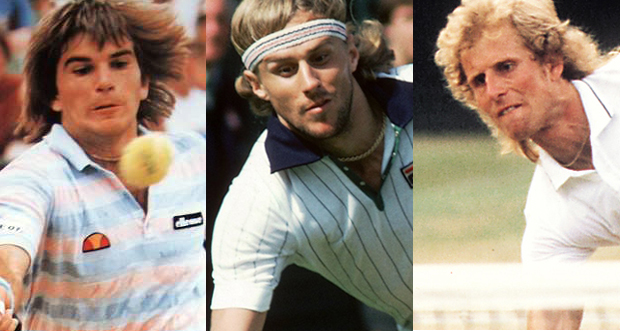
    Johan Kriek Bjorn Borg Vitas Gerulaitis

    The Greatest Swede
    If you take this generation’s best player out of the mix, it would be one of the weakest. In fact, we could say that more than any other generation with a premier talent in it, this generation is the weakest with only five Slams to players other than Bjorn Borg. But of course the generation does include Borg, who is still considered one of the best players in tennis history, and is a candidate for the best young player in the history of the game, with 11 Slams before his 25th birthday. Borg was also the first and greatest of three great Swedish players, followed by Mats Wilander and Stefan Edberg in the golden era of Swedish tennis that was the late 70s into the early 90s.

    Best Players by Birth Year
    1954: Vitas Gerulaitis (USA, 1), Brian Teacher (USA, 1), Mark Edmondson (AUS, 1), John Lloyd (UK)
    1955: Victor Pecci (PAR), Peter McNamara (AUS)
    1956: Bjorn Borg (SWE, 11), Gene Mayer (USA), John Sadri (USA), Steve Denton (USA)
    1957: Chris Lewis (NZ)
    1958: Johan Kriek (SFA, 2), Jose Luis Clerc (ARG), Kevin Curren (SAF)

    Discussion
    As you can see, there are no true standouts after Borg. In some ways this era echoes Ashe’s, although Borg was a much greater player than Ashe, and there is a bit more talent beyond its premier player; but it is a similar one-man show. The only other multi-Slam winner, Johan Kriek, won this two Slams at the Australian Open, a few years before it became as competitive as the other Slams.

    As for Borg, what to say? He was an amazing talent, the premier player in the game during the late 70s, and was the overall best player during that decade, winning almost twice as many Slams (8) than runners-up John Newcombe and Jimmy Connors (5 each). He reached a high level at a very young age in an era when tennis was still dominated by men in their late 20s. Consider that when Borg finished 1974 as the No. 3 player in the world, at the tender age of 18, the only other members of the Top 10 who were younger than 27 were Jimmy Connors and Guillermo Vilas, both 22. With those two Borg took the tennis world by storm in the mid-70s and changed the game.

    Borg was a superstar in the full sense of the word. With his long-haired good looks and cool demeanor he was a welcome counterpoint to the fiery brashness of the other great star during the mid-70s, Jimmy Connors. Though Borg didn’t finish as the No. 1 player until 1979, it is clear that he had surpassed Connors at least a year prior and was deserving of the No. 1 ranking in 1978. But his reign at the very top was short-lived compared to his talent; an even brasher young American by the name of John McEnroe appeared on the tour in the late 70s giving Borg troubles, in what is undoubtedly the most storied and competitive rivalry in tennis history. By 1981 McEnroe had supplanted Borg as the premier player; it was Borg’s last year to play a Slam, after losing the Wimbledon and US Open finals to McEnroe. A contemporary comparison would have been if Rafael Nadal had retired after Novak Djokovic stole the No. 1 ranking from him in 2011; Nadal was the same age as Borg, 25. Borg didn’t play another Slam although didn’t announce his retirement until a year later, in January of 1983. He retired from the game for a variety of reasons, most especially being tired of various squabbles with the tour organizers, and losing the drive required to compete at the highest level. Regardless, he retired too soon for tennis fans and tennis history.

    As an aside, there is an interesting harmonic between this era and more recent years. Just as Connors dominated the mid-70s with the rising young baseliner Borg in his rearview mirror, so too did Roger Federer dominate the mid-00s with a rising young Rafael Nadal behind him. Borg finally overtook Connors in 1979, just as Nadal overtook Federer in 2008. But just as Borg only held the No. 1 ranking for a couple years before being surpassed by McEnroe, Rafa’s reign was marred by injury and then the rise of Novak Djokovic in 2011. (Even the fourth wheel, Ivan Lendl, later became the coach to the fourth of the Big Four, Andy Murray). Borg’s retirement after 1981 would have been echoed in recent years if Rafa had retired after 2011, but as you know Rafa rose again.

    Underachievers and Forgotten Players
    Vitas Gerulaitis was a notorious partier, called the “ultimate tennis playboy.” He was a very talented player, and for about six years—1977-1982—was a Top 10 player, and probably overall the sixth best player in the sport during that span after Borg, Connors, McEnroe, Lendl, and Vilas. His most comparable recent player is probably David Nalbandian, if the latter had won a Slam. Both players could have been more than they were in terms of their raw ability, but didn’t have the focus and mentality required to be true greats.

    If you look at it in a certain way, Borg could also be considered an underachiever. As said before, he won 11 Slams before his 25th birthday – that’s more than Nadal (10), Federer (8), and Sampras (7). One of the biggest “What If?” questions in tennis history is “What if Borg hadn’t retired at such a young age?” The question is unanswerable, especially considering the fact that when he retired he had just been surpassed by John McEnroe as the best player in the game, and was seemingly losing interest in the relentless grind of the tour and tennis politics. But if Borg had somehow managed to rediscover his passion for the game, it seems a certainty that he would have finished his career with 15+ Slams and be mentioned in the same breath as Laver and Federer. But, in the end, his career is what it was.

    Did You Know?
    Bjorn Borg made several failed comeback attempts in 1991, ’92, and ’93. He did not win a match out of twelve played, and only won a set in each of the three matches played in 1993.

    Top Ten Players of the Generation

    1. Bjorn Borg
    2. Vitas Gerulaitis
    3. Johan Kriek
    4. Jose Luis Clerc
    5. Mark Edmondson
    6. Brian Teacher
    7. Kevin Curren
    8. Gene Mayer
    9. Victor Pecci
    10. Peter McNamara

    Honorable Mentions: John Lloyd, John Sadri, Chris Lewis, Steve Denton.

    Yet another generation with a clear No. 1 (this will change shortly). Kriek is an interesting player to rank. On one hand it is hard to argue with two Slams. On the other, those two Slams were the 1981 and 1982 Australian Opens against Steve Denton, who never won a title. Despite winning half as many Slams, Gerulaitis was a far more prolific and successful player. For instance, Kriek never ranked higher than No. 7, and never finished in the year-end Top 10, while Gerulaitis ranked as high as No. 3, and finished six straight years in the Top 10. Gerulaitis was clearly the better player.

    After that it falls sharply. Teacher and Edmondson both won Slams, but we run into the same problem: taking complete careers into account, Cleric was probably better than Edmondson, and Curren better than Teacher. But Nos. 4-8 are very close and somewhat interchangeable.

    Pecci is best known for being by far the best Paraguayan player ever, but also for defeating Guillermo Vilas and Jimmy Connors en route to losing to Bjorn Borg in the 1979 French Open.
  • How to Overcome the Almost Impossible in Tennis

    How to Overcome the Almost Impossible in Tennis

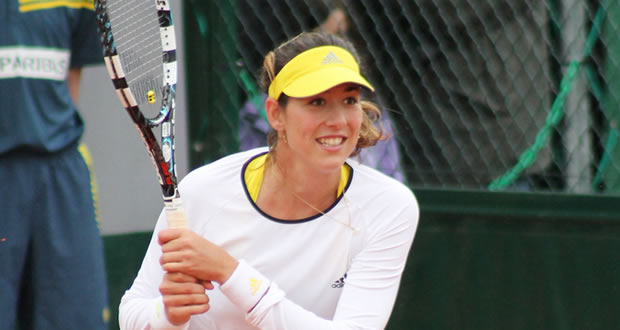
    Garbine Muguruza

    Johan Kriek on Muguruza’s success over Serena Williams at Roland Garros

    Serena Williams, World No. 1 and reigning French Open champion, was severely trounced today by a fairly unknown Spaniard Garbine Muguruza. Muguruza played almost the same type of tennis Ana Ivanovic played against Williams at the Australian Open, where Ana trounced Williams as well. These two matches should be on every WTA player’s iPad to see how it is done. And these two losses in Majors should be a lesson for Serena on how to combat such situations that she has rarely faced, but now will face more and more.

    I watched both matches and the approach to beating Serena was identical. Here are some very important facts to know for players and coaches:

    1. Study your opponent. This means knowing her/his strengths and if she/he has any weaknesses to design a strategy on how to take advantage of those. Every player has “weaknesses”.

    2. Find a way to watch your opponent either in person, have the coach do it, or scout his/her videos online. It is very important in today’s world to use technology.

    3. Work on play patterns on your own serve and also play returns in practice to emulate how hard and where to return serves, especially second serves, which are great opportunities to sting the opponent. Clobbering second serves and putting your opponent on the defense immediately is a great way to boost confidence but also it puts tremendous pressure on the server, no matter who the server is.

    4. Do NOT give up on your game plan. Yes, you have to play “as it comes to you” but you have to stick to a strategy and game plan even if you make some mistakes. Do not give up on it and all of sudden begin to play “safe and not to lose”.

    5. Keep points shorts and “compact”. Against tough opponents you are better off having them hit as few balls as possible.

    6. Stay aggressive in court positioning, which requires courage, quick feet, and very quick reflexes in preparation for the groundstrokes. Move to the ball.

    7. Focus on staying on task with execution. Do not let any mistakes bother you. Go through rituals and stay positive at all times to execute.

    8. Focus on the process vs. the “result”. One is not on court to lose! That is a given. So focus on each point, think it through clearly, and then go for it!

    9. Absolute concentration. No looking at the coach, mom, or the Grand Slam players’ box! It is up to you out there to make it all happen.

    10. Enjoy the challenge and pour on the “turbos” when closing out the set or the match. Be absolutely convinced that it is your “day”.

    So, here is what I saw happen today between Serena and Muguruza.

    Serena started the French Open convincingly. There were no “hiccups” and she was clearly still at the top of her game. But being always at the top perhaps let her be a little too complacent. I have rarely seen Serena being pushed around and made to look slow and awkward in her movement on the court. However, it has already happened twice this year: Ivanovic beating Serena at the Australian Open, and now Muguruza at the French Open.

    Obviously, Muguruza “took it to her”. She was totally concentrated, she kept her composure no matter what, she stood her ground right on the baseline, and swung freely on her groundstrokes and went for it. It also helped that she served well especially down the middle on the deuce court, and she jammed Serena quite often on her forehand. Serena rarely misses her backhand returns so Muguruza served a lot to her forehand and it paid off. When pressure is applied relentlessly we can see that even the toughest opponents out there get frustrated and will start missing. Muguruza knew that she needed to keep the pressure on no matter how many mistakes she made, and she did not allow Serena any time to regroup. That frustrated Serena to no end, and Muguruza was aware of that happening. The Spaniard also drilled groundstrokes down the middle of the court forcing Serena to change directions off very deep and fast groundstrokes, and Serena kept missing her shots. That was a very smart strategy by Muguruza and she kept at it.

    Serena is not used to getting thumped and one could see the resignation on her face at 1-4 down in the second set. It happens to the best at times. Again, great strategizing by team Muguruza!

    When I started playing the pro tour, Vitas Gerulaitis beat me twice in the quarters of the US Open. By the third match in Europe I had decided to completely change my game plan and instead of “managing as I go along” I decided to attack him from start to finish, beat him to the net, hit hard and often from the baseline, and keep him off balance (mostly mentally) because he was one of the fastest and smoothest movers out there. I said to myself over and over, “no fear” and stick to it no matter how much my “panic button” is buzzing. I did not care if he beat me 0 and 0; I was going to play “my way” or go home. I beat him easily and never lost to him again. I did the same thing against John McEnroe and although he won most of the big matches against me, I got to beat him many times. One of the best matches I have ever played was against McEnroe in San Francisco where I beat him 7-6, 6-1. I played flawless tennis. Everything was “on” and from then on I knew I could beat him as long as I focused on the right stuff and played to win.

    It takes bravery to think this way. You have to first do it before the match and then apply it on the court. Not easy to do but it may be the only way to beat a much higher ranked player. As they say: “No guts, no glory!”

    [divider]

    Cover Photo: si.robi (Creative Commons License)

  • Johan Kriek on Progress and Regress in Tennis

    Johan Kriek on Progress and Regress in Tennis

    Junior tennis mentoring is very challenging even in the best of times. The kids’ brains are not yet fully developed, and we, as coaches, are trying to instill beliefs and knowledge that require high-level thinking. But it has to be done from an early age. I am going to touch on a subject that I think is important for coaches, kids, and parents to understand. Every kid is different, and some mature early and some not. Everyone is different!

    I just came back from a tournament and watched girls in my academy play in the 10′s, 12′s, 16′s, and 18′s. The older kids are definitely more polished in their thinking and execution of shots, but one fundamental fact remains across the board: the inability to read what is happening on the court, and the lack of know-how to take advantage of opportunities.

    I force my 12-year-old players to practice serve and volley in doubles. At least on first serves to learn the attacking game. I also make them do it on second serves in practice to learn to overcome fear of the return, etc. They are getting really good at it. At first it was pretty pathetic, but as they have become used to running forward and volleying off the deck, half volleys, high floaters, etc., they are not only learning to move forward into the court better, but they also play with better instincts already. It is all a process and it takes a couple of years from age 12 to get the hang of it.

    But here is what I saw happen this past weekend at a tournament. Three of my academy kids in the 12′s doubles served and volleyed ONLY once and when each of them lost that point they completely went back to the old ways – the entire tournament! All three missed the volley and shut down 100% the rest of the weekend. Went back to playing crosscourt singles in the hopes of the other player missing. One dimensional playing that got them some wins but IMHO not really furthering their tennis knowledge.

    That is NOT what we practiced! The concept of “process driven” vs. “result driven” is understood very well under a roof with a notebook in front of them but come a third-set tiebreak, and all I see is crosscourt singles play in doubles which is fruitless. One of the hardest things to instill in kids ages 12-14 is to become brave. It takes a certain determined player to risk more which is hard since they are not used to it because in the 10′s and a lot of the 12′s these runner/looper/defenders with nothing but groundstrokes and a loopy serve have been getting the best of them.

    But in the long run nearly all of the looper kids disappear from the semis and finals at ages 14 (second year) and the 16′s. I am not saying that a loop is a bad shot. It is by all means a great type of shot to reset a point if you were pulled way wide and back at the fence and to throw a kid off their power game but all I saw was hours of mind-numbing looping with parents cheering for mistakes after 25-30 ball rallies. As if that is just great play. It is really crap and we wonder what is happening to tennis.

    In order to get good at this game, one must be able to accept that to learn new techniques, new grips, new tactics, and to employ those tactics under severe stress is very difficult, and the chances you will lose that third-set tiebreak because you were not yet totally solid with the techniques or nervous to execute, etc. is very likely. You will lose quite a lot but if you stick to it, then in a couple of years you will be way ahead of kids that just sat back on the baseline and trench walked for years.

    To teach a kid not to fear failure but to accept it as part of learning the game the right way is very trying to say the least. We as a society value winning so much that parents, coaches, and players lose sight of the fact that tennis is not a short-term sport in terms of learning. It takes a long time, no matter how talented you are. I see kids coming off the court all jubilant that they have won. No clue that their tennis is actually barely O.K. in winning right now but their skill levels outside of “looping” are so poor in many that I can guarantee you, these kids will be out of tennis by age 16, frustrated and unable to compete with the all-court smart player.

    I am not saying that every kid needs to be an all-court player. All I am saying is that one needs to have skills in all facets of the game, no matter what tactic you employ but to only play from the baseline with almost zero skills in moving forward, proficient at the volley and overhead, not to mention “reading skills” on what type of shot is expected to come back, etc. For example, Nadal plays mostly from the baseline. His strength is his forehand and his mind. His backhand is excellent, too, but he uses it more as a “complimentary” shot. Besides that his serve is good but not super great like an Isner but he knows that he is great at the net even if he gets to the net six times in a match. All I see is baseline bashing and looping in junior tennis right now. Very little else.

    So in short, one may have to swallow many losses in order to get better. There is no progress without a certain amount of risk – period! I view top tennis juniors quite similar to the way the Navy SEALs approach their training. Many, many enlist and then the weeding out begins. Pretty soon out of thousands enlisted there are only 200 left, and at the end of training there are but a handful of truly super specimens left. Tennis is no different in its outcomes. There will be very few that make it at a high level. But it takes a lot more than just hitting a ball into that box than meets the eye. Accept that in order to learn, a player may very well be losing a lot, maybe for a few years even or more. But if you stick with a great coach, a great work ethic, and you believe you’re making progress, it will most likely come true.

    I was watching CBS’s 60 Minutes last night and saw the guy who founded the organization Robin Hood. What an amazing guy, and an incredible organization. He had a marvelous quote when the interviewer asked him about his initial failures even though all his intentions were there to do good: “Out of terrible failure a flame is ignited that forges the necessary steel to make the best sword.”

    He couldn’t be more right!

  • Johan Kriek on Confidence

    Johan Kriek on Confidence

    What is it and how does one become confident and keep it when competing in tennis?

    As a former Top 10 player now coaching kids in my academy in Charlotte, NC, from ages 6-24, I deal with this “factor” every day.

    We are all born with character traits. These are inherited from our parents and forebears. Some people just have “it”, whatever “it” is. I can quickly spot a kid who has confidence and a kid who does not. Kids who are always scared to try things will almost never excel as much or go as far as a kid who is open to learn and try things, even if they fail! Many times these kids will fail, but they learn quickly not to do the same mistakes and will excel again. So yes, in my opinion, certain character traits lend themselves to a better athlete, in any sport.

    The type of kids who sleep, eat, and drink his sport from a young age are the ones who excel the most and will risk more. They typically are very self-motivated, love the grind in practice, the long distance runs, the boring yet necessary practices at times to perfect a new grip, or learning a new stroke. It is a joy and a privilege to work with such kids.

    I teach my kids from my gut instincts, which has served me extremely well over my 24-year pro-career. I read up on the latest techniques, I watch tennis on TV constantly, or go to the major events often to stay current and see what the best in the world do. I talk to fellow coaches, I listen to what the top pros say and do during their practices on back courts at Wimbledon, the US Open, and many other venues I go to. This way, I am confident as a coach that I know what I am talking about when I coach the kids.

    To be a “complete tennis warrior” one has to check off a lot of boxes. These boxes are extremely important to check constantly. Here are some examples of boxes.

    Each stroke in tennis is a box. Each stroke has even subcategory boxes. Let me explain it this way with the serve as an example. I think most people would agree that the serve is the most important stroke in tennis. Arguably, those with the best serves in the game make it pretty easy for them to do well.

    I teach my boys and girls everything there is to know about the serve: toss positions, grips, racket-head speed, how and when to kick serve, slice serves out wide on the deuce court, flatter hard serves at the body, etc.; anticipation of the most likely return expected and how to act on it, etc.; how to “challenge” the returner with a type of serve; how to switch things up not just in speed, but in spin and positioning of the stance. So, just in this one box there are many things to technically get proficient at, but also, how to read what the returner does with whatever serve you throw at them. A second serve kick used as a first serve is a very good alternative to serving lots of second serves that can result in your opponent running around their backhand ripping forehand returns for winners or near winners all over the court!

    The same box is true for the forehand. Most top pros have big forehands now because the wrist is just stronger and better positioned to rip forehands. Most top pros “protect” the backhand side by standing left of center on the baseline for right-handers and right of center on the baseline for left-handers. They leave the forehand area as their favorite area to hit from and hope players will go there. Watch the court positions of Nadal, Federer, Murray, and Djokovic next time they serve. Even on the forehand side there are many sub-boxes one must check off if you have mastered that side. For instance, hitting big top-spins on the rise, hitting slices when the ball is extremely low, and running for drop shots to name but a few. I can go on and on about each stroke for many pages but for the sake of discussing the confidence issue here, I will leave it at what I just said.

    Only when a kid has mastered 100% of the strokes will he/she have a real possibility of achieving 100% confidence in his/her stroke production. If, for instance, a kid has not mastered how to move backwards after attacking the short ball, and gets lobbed over the backhand side and cannot hit a backhand angle overhead, or cannot control the ball off that side, then he or she may never have 100% confidence in approaching the net. So in my academy we practice shots you may sometimes never even use in a match, but what if you need the one-time backhand overhead to win on match point and you miss it because you never practiced it? That would stand out in your head as a big ol’ red flag constantly and will shy away from the net because now you are forgetting all the other good strokes you have between volleys and regular overheads, but instead you will focus on hoping they will not lob over the backhand side. That mindset is not instilling confidence.

    So yes, character trait is a good indication of confidence in many instances, but strokes are taught and that takes a long time to master. Once mastered, the mental aspect of this sport becomes more and more important, the older the kid becomes and the higher the ranking becomes. It makes absolutely no sense if a kid is taught all the shots and then is never taught how to use them, in what combinations, and how to freak the opponent out by “sneak attacks”, mixing up shots that are risky but can mean the difference between winning or losing against an equally good opponent.

    I find this aspect the most neglected area of junior tennis in America! Do not expect kids to acquire the mental edge they need by osmosis — by standing on a tennis court and hitting balls for eight hours a day. Mental IQ is taught. It is a must! One of the hardest things to teach great kids is for them to be able to “self-medicate” on the court. I see countless matches where a kid starts stomping, crying, cheating, and whatever else on the court, and it is all because they feel helpless. They look at mom and dad and the coach sitting there watching and pretty soon it all goes downhill.

    I teach my kids not to look for help. They still make mistakes quite often but over time when their maturity at age 15-18 sets in, they start to look like pros on the courts. No more looking around for help. They throw a towel over their head at changeovers and they think about what is happening and what to do to get out of trouble. They know what I expect them to do with their body language when they are serving for the match at 6-5 in the third set. They know what to do when they see a kid starting to chirp at him or herself after being quiet for over two hours. They know what I expect them to do when they play a cheater. They know what I want them to do when things are going badly for them. They are taught to THINK! I have been there many, many times on the biggest stages of tennis against the biggest and best of that era. I wish now I had somebody of my knowledge and experience to tell me what to expect from age 12 onward. I can only imagine which big matches and events I could have added to my career resume.

    Once an equilibrium is achieved with a kid in the technical, physical, tactical, and mental departments of their tennis development, the potential is limitless for this kid. Only then will I feel that true “confidence” is now achievable!

    It takes knowledge, a very willing participant, time and patience to create that confident kid. A confident kid is a kid with lots of knowledge. Experience just adds to their knowledge base.

  • The Wave of New Coaches on the ATP Tour: A Breath of Fresh Air for 2014

    The Wave of New Coaches on the ATP Tour: A Breath of Fresh Air for 2014

    Edberg and Federer

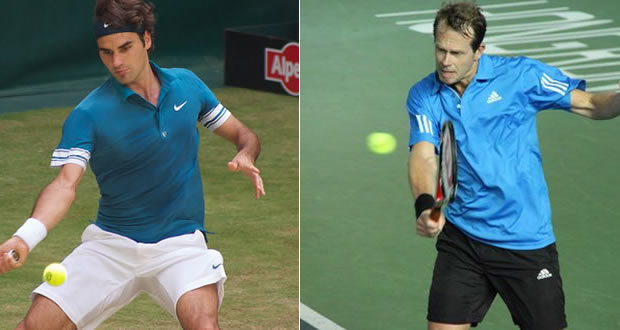
    It is with lots of interest in all media especially social media that we read of the new additions on the men’s side. What is striking is the fact that all of the coaches that are hired were superstars from the 80′s and 90′s. It started with Murray hiring Ivan Lendl and we can clearly see the improvement since Lendl joined the Murray camp. Now Roger Federer has hired Stefan Edberg, former number 1 serve and volley expert from Sweden, and Boris Becker is hired by Novak Djokovic, another specialist at the serve and volley game. Connors was hired some years back by Roddick and lately Connors briefly worked with Sharapova.

    As a former Top 10 player, I have firsthand knowledge of all of these guys since I played them many, many times. In fact, I predicted that Boris Becker will win Wimbledon in 1985 after he beat me in the finals of Queens in London. He did. I beat Stefan Edberg at Wimbledon when he was making his debut from the juniors, although that win was in five sets and one of my best ever comebacks from two sets down. I lost to Lendl in the 1986 semis at the French Open so I have intimate knowledge of their games and being around them for decades, one gets to know their thinking…

    You may ask yourself, why are these top guys hiring guys who played totally different styles than them? Here are my answers:

    1. Besides a new fresh pair of eyes, it is exciting to have a new guy at your side, which brings the desire up to perform and that is hugely important. Desire is a must!

    2. The men’s tour has become so brutally physical that players are thinking about how to shorten points. These coaches played 90% of their points “short”. Meaning serve and volley, chip and charge, etc. That was their state of mind. Roger and Novak are looking for some of that. (More on this aspect later in this blog.)

    3. Publicity for the “team” brings a whole new flavor to their camp. It is all good! Their sponsors like it, the fans like it, and with the explosion of “immediate news” on social media, it is all good!

    I will break down the different “celebrity” coaches here from Connors to the sudden hiring of Edberg and Becker.

    Connors is an absolute icon in our sport. A tough guy, with a very hard edge, who won more ATP tournaments than any man on this planet! It was the perfect “American story” for Andy Roddick to have hired Jimmy when Andy was on the verge of being more dominant. The heartbreaking final against Roger at Wimbledon was perhaps the moment that extinguished that “flame”. None of us will know when it happens but I suspect that match really affected Andy. That type of relationship has very little to do with a new “technical improvement” rather the player is looking for that extra mental boost that may help them reach a little higher. No guarantees that would happen.

    Ivan Lendl joining Andy Murray was the perfect fit in my opinion. Andy Murray was “bridesmaid” to Roger and Rafa for a number of years, and it was beginning to look like he would not be able to get “over the hump” mentally at Majors in particular.

    Ivan was in that same position for years. He was in the finals of eight Majors before he won his first! Remember Brad Gilbert, who coached Andre Agassi with great success and was hired by Murray via the LTA in England to help Murray? It did not work! Why? Murray did not have the same respect for Gilbert as he has for Lendl. It was so obvious that it was embarrassing at times at tournaments and the relationship ended shortly after that. Lendl helped Murray understand what it will take mentally to get his first Major win and he did! Now Murray has a US Open, an Olympic gold medal, and a Wimbledon title under his belt. Murray also just came off back surgery so he has issues physically. He may have to start thinking about shortening points…

    Federer hiring Stefan Edberg is another smart move after a long stint with another serve and volley expert, Paul Annacone. But since Roger slid in the rankings to No. 7, it was the right time for a change of scenery. It happens all the time. Edberg is the consummate gentleman of our sport. An eight time Grand Slam champion, he knows how to move forward to the net and is a very cool cucumber. A perfect mental fit to help Roger understand how to shorten points and what it takes to perhaps serve and volley a little more. It is all about finding that “little edge”. None of these coaches are hired for a new forehand or backhand, but certainly could be of great assistance in the volley area, movement, and reading skills at the net, and how to be a little smarter about attacking at the right time and the surprise effect of coming to the net. This is a great fit for Roger. I think Roger bends his elbow too much on his backhand volley and gives it too much “chop” at contact. It would be interesting to see if Edberg helps him shorten his backhand volley preparation to be more solid. There, I criticized Roger!… 🙂

    Djokovic hiring Becker was another surprise! I was with Becker and Edberg at Richard Branson’s fundraiser on Necker Island a few weeks ago, and had a conversation with both of them. None of them let on what they were up to for 2014.

    Novak is an incredibly gifted athlete that has all the stuff physically and mentally. His volleys are not his stronger shots but again, I think him hiring Becker points to a “fresh” start with new excitement in trying to be more aggressive with a new team member. It is all about finding that extra mental edge at this high level. Novak is looking to be No. 1 again after Rafa snatched it back at the end of the season.

    David Ferrer just fired his longtime mentor/coach. Perhaps the best player out there today who may never win a Major unless he adds a little more risk in coming to the net. Ferrer has all the stuff mentally. His serve has improved but I think he can still improve on his serve a little and coming forward will be necessary. Like they say, no risk, no reward. I am a huge fan of Ferrer. I certainly hope he can add a Major to his mantle. But it will require him to risk a lot more and to throw the “kitchen sink” at those moments in big matches where he used to play “not to lose” and then did lose. Perhaps play closer in to the baseline and risk blistering shots down the line from closer in and follow it in… Again, no guarantees but that is the only way to get the rewards.

    Rafa needs no “celebrity” coach. He is a simple thinker, is perhaps the best “self-motivator” out there. Uncle Toni is there and I do not see any changes in the family set-up. They “tinker” with his game all the time, and I suspect that if the Nadal camp see improvements from Roger and Novak in shortening points, they will follow suit.

    I, for one, will be watching closely in 2014. Adding these coaches will be interesting to see if any changes “sank in” and will bear fruit! Go at it, guys!

  • Johan Kriek On His Coaching Philosophy

    Johan Kriek On His Coaching Philosophy

    Johan Kriek Coaching
    My coaching philosophy…

    If one thinks there is just “one right way” to hit a shot, a serve or he/she is playing too flat, too much topspin or he/she is playing too defensively or too aggressively, etc. I say it is shortsighted. If a coach wants kids to play like he/she did, I say it is shortsighted and will shortchange the student’s tennis development.

    I was very aggressive as a player, and it showed in my fines!… Lol! Although that is what I liked to do as a pro, as a tennis coach and mentor to my academy kids, I really study a kid’s “tennis persona” and coach accordingly. However, I also teach my students every shot imaginable. Some shots we work on a weekly basis I call “specialty shots” such as clay court sliding low and close to the net drop-shot gets, drop-shot get lobs, topspin volleys off both sides, backhand and forehand topspin lobs in every direction, backhand jump overheads while moving backwards down the line and crosscourt, etc. My reason is that I would like to send my kids into the tennis battlefield with as many “tennis tools in their tennis toolbox” as I can. Only then will I be comfortable, regardless if they win or lose, that I have done my job. Obviously, the mental side is a huge factor in executing everything in the match, starting with the shots, then the tactics, etc. But I will talk about mental issues in later articles. It is the most neglected part in US kids’ tennis development. I see a lot of “mental midgets” (just like I was at that age) running around playing tournaments.

    Let’s return to my previous comment about a kid’s “persona.” I have girls in the under 12′s that hit quite flat and parents asked me if I should change their shots. Heck no! I will, however, make sure they understand that to be a little bit more effective and safer with their groundstrokes, is to dip the racket a little more in the “rally mode,” to use the forearm/wrist a little more in creating topspin, aim a little higher over the net, and keep the same good intensity in footwork, reading skills and look for that opportunity to attack, be it an outright winner with their favorite “flatter” shot or to come in and attack the short ball or put away the volley or overhead.

    Just listen to the commentators talk about Nadal and his “flatter shots” suddenly magically appearing, as if it were the biggest thing since sliced bread! I know they gear their commentary mostly towards a “low information” tennis public, but it is so clear that all sorts of spins and flat shots have their place in a match. A very clear example of spin is Stosur’s kick serve that puts a lot of pressure on right handers especially returning Stosur’s second serves on the ad court. Another super topspin that is in the history of our sport — probably the biggest and most effective shot — is Rafa’s forehand. He pins Federer in the ad corner with huge high and heavy topspins, especially on clay, and then plays ping-pong from there. Winners start popping everywhere off his forehand.

    However, I also saw James Blake beat Nadal some years ago twice in a row by hitting flat! Blake hit his forehand to Nadal’s forehand so hard that Nadal could not create the same power or topspin to neutralize Blake’s penetrating and skidding forehand. That was very smart! Blake was so confident doing that over and over that he ended playing incredible tennis in all other areas of his game. As we say it, he played “in the zone.” Pretty simple concept but to execute it well all together to win is another story.

    In closing, I teach my kids all the shots they may need in a battle. But I also know some like to play more baseline-based tennis, be it a runner retriever, or an aggressive runner and a big hitter while others are more aggressive moving to the net quicker. But all need to know what to do in all situations. It all comes down to executing the right shots for the right application in a particular situation. The rest is “luck of the draw”…

  • Johan Kriek on Character in Tennis

    Johan Kriek on Character in Tennis

    As an owner/operator of an elite tennis academy in Charlotte, NC, I would like to talk about character. It matters the most in my book. We all make mistakes, but it is the person with character who realizes they have made a mistake and can fess up and truly feel sorry, say so, and apologize and try not to make the same mistake again. That is a person with good character.

    Character also plays a huge role in becoming successful in tennis. It is so refreshing to see our kids listen and truly try new things which we coach all the time because tennis coaching is a step-by-step process with ever increasing demands in “execution” of shots as well as the building of maturity in the mental side of the game. Needless to say, there are so many “boxes” to check off to learn to play this game at the best of our ability, it takes a lot of time, huge effort, and dedication coupled with a limitless “thirst” to do better every day. It would be easy for me to try and focus on getting a “player” from the top ranks in the world. Would be a great “feather in my cap”, however, I truly enjoy seeing a kid start to bloom from a very early age and create their own “look” and build their tennis character. That, to me, is by far the most satisfying aspect of the academy business. I can’t wait to see where some of these 8-16 year olds will be in the next decade, etc.

    So how does one break out of the “pack” of all these boys and girls playing ITF Futures and Challenger events, such as the older boys we are working with the past few weeks? There are thousands of very good players out there, all trying to make it on the ATP or the WTA tours. It takes one tough character to “stand out”. Having talent and weapons is great, but if you are not one tough character, talent will only take you so far. It is the person with a strong character who will leave no stone unturned to achieve their goals. Setbacks will be there, no doubt. Failures will pop up aplenty. Losing will make one feel like a failure. But it is the person with a strong-willed character, a never-say-die attitude, even if the odds seem overwhelming, that eventually makes it.

    [divider]

    Discuss with fellow tennis fans on our message boards.

  • Down the T #2: Johan Kriek Interview

    Down the T #2: Johan Kriek Interview

    We’re joined on our latest installment of “Down The T” by Johan Kriek, the two time Australian Open champion and a winner of multiple singles and doubles titles on the men’s tour.

    Johan, Thank you so much for taking the time out to share your views with the Tennis Frontier.

    Beginning with your roots, when did you first pick up a racquet and what was the driving force that encouraged you to take up the sport?

    I started playing at the age of four as my parents were weekend tennis players.

    I was impossible to babysit so they took me with them most of the time!

    [divider]

    How did you find the the junior scene in South Africa?  Did any anti-apartheid policies from other nations encroach on your development as a junior (or cause issues when you later turned pro)?

    I was not impeded in any way during my formative years by apartheid per se but since I was an Afrikaner boy with rugby in my veins and tennis was my hobby, I always had to “over perform” to show my talents. I also grew up on a sugar farm 400 miles from Johannesburg which was the junior tennis Mecca so the belief was that NOBODY speaking Afrikaans will ever come out from such a small town to play great tennis in the history of the continent. So the belief was he will be gone soon.

    I did however begin to feel the brunt of the apartheid era as I and other players like Kevin Curren were not allowed to play Davis Cup or the Olympics due to the apartheid policies in the late 70’s and the 80’s. It was very unfortunate since we were both in the top ten of the world. Sometimes we were asked to not enter certain tournaments due to the security issues, etc. Horrible time actually since I left SA to go live in Austria in 1975 to train with my coach Ian Cunningham who had emigrated.

    Politics followed me all the way to America as I was asked by Arthur Ashe to play Davis Cup for America in 1984-1985, and somehow I was met with stone silence after Arthur had called me to ask if I was ready to play. I said to him that I was but I never heard back from him ever.

    [divider]

    We recently talked with 1983 Wimbledon finalist Chris Lewis about how long it’s taking top juniors in the present era to make the transition to the pro tour in comparison to the 1970s and 1980s.  Chris was of the opinion that it’s largely down to increased competition and greater numbers playing the sport.  Bearing in mind you were winning majors within three years of turning pro, would you also subscribe to that view?

    Yes and no. It is absolutely correct that it is much harder to break in now as a junior but in my opinion it is because the tennis has become so much more physical now and these juniors have not “matured” physically yet.

    We see the top men pros mature in physical and the mental department now much later into their twenties. I think the days of seeing phenoms like Borg, Wilander, Agassi, Chang, and Becker winning majors at ages 17-19 won’t happen again. It has just become that more physical. I was incredibly fit and mature body-wise at age 19, so I was right there very quickly.

    [divider]

    You won the Australian Open in 1981 and 1982. Could you tell us a little about winning those titles? 

    Winning a Grand Slam title is the final exclamation mark in anybody’s career.

    You work all your life dreaming about playing at the top but winning one is so nearly impossible that when it actually happens it is like a dream. And to do it back to back is just amazing.

    I love Australia. It is just such a happy and fun place I always seem to play well there, maybe not always winning but Australians are just like South Africans in a way: very outgoing, fun, and always willing to help or just have fun. Great country!

    [divider]

    You had a long career, spanning a number of years, eras, and an array of great champions.  Could you tell us a little about some of the players you faced?

    I was very fortunate to have played in 4 very distinct eras of top players.

    Ashe, Smith, Connors, Borg, Vilas, Gerulaitis; then Lendl, McEnroe, Wilander, Clerc; then Edberg, Becker; then Agassi, Chang, Sampras.

    I beat just about everyone in my career which was just such a thrill. Beating McEnroe several times when he was number 1 in the world in my career was always a high.

    Borg and Lendl were probably the hardest types for me to play. They were so steady and could pass you on a dime. I loved playing shotmakers like Gerulaitis and McEnroe because it required me to invent shots which were so much more fun to play.

    [divider]

    You had one of the most impressive records in five set matches among your peers.  Did you put this down to conditioning, clutch play, or both?

    I had no idea I had the best 5 set record in the last 40 years until I read it in a tennis publication. I would say three things made me achieve this:

    1. I was very fit, could run all day, and could execute at the best of my ability after 4-5 hours on the court.

    2. I played very aggressive tennis and attacked my opponents relentlessly.

    3. Foot speed and quick hands were my trademarks, and I could hit impossible shots which surprised most players at the worst times for them.

    [divider]

    You’ve been fairly vocal about adopting a zero tolerance approach to doping in tennis.  There seem to be a wide range of views on how prevalent doping might be in the sport, so I’d like to ask how prevalent do you think it is? Secondly, I’d be interested in how much actual difference you think it could make and how to tackle it?

    I am not privy to “insider” information anymore in tennis but I am not liking what I am seeing happening in other American and international sports.

    Tennis has some very strict drug testing rules in place, and I am sure players are suspended for being caught. It is not as bad as, say, baseball or even the steroid use in American football, but I believe there are players trying to gain an edge, and they will try anything to do so.

    Here is what I think is happening. The biggest issue for players now is the fact they need to recover from a tough 5 setter maybe lasting around 4 or more hours, and having to play a day or two later. With the increased physicality of men’s tennis, we will see doping issues crop up! It is humanly virtually impossible to recoup within 24-36 hours from a match like Isner and Mahut which played an 11 hour singles match at Wimbledon two years ago. To combat PED’s in our sport the ATP and the majors need to adopt a zero policy towards this. If you get caught you are thrown out for life. I don’t see how our sport can even begin to stay clean unless the penalty is so severe that it will be a huge deterrent to use PED’s.

    The ATP and the majors need to have a serious discussion about a possible rule change at majors! The women play best of three sets, perhaps we can have best of three sets all the way through, too! One still has to win 7 matches to win! Or perhaps use best of three sets until the finals then a best of five for the finals only. But the testing must be done for even more athletes, perhaps top 200, not just the top 100. It is a very complex issue but zero tolerance in my opinion is a must.

    [divider]

    The modern era is often labelled as a golden era with the likes of Federer, Nadal, Djokovic, and Murray competing. Do you subscribe to that view? Or do you feel the courts and styles of play have become a little too homogenized? Of the top players, who do you particularly enjoy watching?

    I think we are witnessing a very special time in this era of top pros because we have actually 4 guys now doing major combat and winning and beating each other with lots of drama and fanfare, and it is great for our sport.

    I like to watch them all but because Roger Federer is such a classic and kind of “old school” player, I appreciate his way of playing more. But in terms of sheer heart and fight there are few as good as David Ferrer. He absolutely epitomizes a pro who gives it his all, and knows exactly his limitations, etc. Every era has its own superstars, and it is no different now. The difference is we have 4 guys at the top instead of 2. Fascinating time so we may as well enjoy it!

    [divider]

    What are you doing currently?

    I run my own tennis academy in Charlotte, NC.

    We have kids ages 8-25 and a very good mix of boys and girls at different levels.  Some of the older kids are on the ATP Tour and ITF tours, and some are here to get better to get a better scholarship to a college, etc., but what interests me the most is to build a talent from age 8 or so to age 18. That is what makes me the happiest is to see a young talent blossom and develop into a serious competitor. It takes a lot of time and effort to do that.

    We already have state and nationally ranked juniors in our academy, and we look forward to growing into one of the best academies in the world.

    [divider]

    Any young juniors we should be keeping a specific eye out for?

    I have not seen all the top juniors in the world but the Canadians have suddenly popped out.

    Peliwo is doing great and moving up. Pospisil just did really well in the Canadian Open, and then Raonic made a big jump to the top ten rankings by getting to the finals, so I expect Raonic to keep climbing to start challenging the very top guys, too. He has a huge serve and is a big hitter like Tsonga but perhaps a little more motivated at this time.

    Tennis is just very exciting right now, and I look forward to the rest of the summer events.

    [divider]

    Johan, thanks for your time. Appreciated.

  • Johan Kriek on Drugs in Sport

    Johan Kriek on Drugs in Sport

    Last week, Johan was asked by two different radio hosts about his thoughts on drugs in tennis.

    MY TAKE: and I hope this sparks a serious debate about drugs in tennis before it is TOO LATE!

    Back in 1979 and 1980 there were discussions within the ATP and its leadership on how to keep tennis clean from pros using drugs (my feeling was that there were just too many “rumors” of drug use, specifically “recreational drugs”). Remember Studio 54, Miami Vice, etc….etc? All so glamorous and fun….

    The ATP in the summer of 1980 (if my memory serves me correctly) had a big meeting at the Gloucester Hotel in London the weekend before Wimbledon, and it was unanimous that any player could be randomly picked for a drug test at that time. We were the first pro sports in the history of sports to implement such drug testing rules.

    After my 5 set loss to Bjorn Borg in the 1980 US Open semifinals I was escorted by security to the Marriott Hotel at La Guardia airport to be drug tested which was strictly a urine test. I was told I was the first pro player to be tested randomly under the rules. I was perfectly happy to do so since I had absolutely nothing to hide. I never heard back from anybody which confirmed I was no drug user of any kind. But doesn’t it suck to know you are clean to be “proven innocent”…..but this was the beginning of the ATP’s drug testing path.

    With Alex Rodriguez’s situation and the decades long baseball drug suspensions, and Pete Rose’s ridiculously over the top suspension for betting while others still play who use PED’s, the NFL steroid history, and many, many deaths most likely caused by the abuse of steroids (this is all very well documented), plus the pro-cycling tour’s doping scandals, and the fact that the names of pro tennis players are starting to pop up more and more in papers. I am very concerned as a former top ATP player that this kind of publicity is going to “kill the goose that lay the golden egg.” But that is just one concern….

    I know, there are people — many, in fact — who don’t care that there are PED’s (Performance Enhancing Drugs) and openly think it is OK to let athletes use whatever they want, and let it go on like that. But here is my argument: If an athlete then decides the risks are too high, and wants to stay “clean” and compete as such, such athlete will not be competitive! Is that fair? Of course not! What about the results physically long term on a body? We know a lot of it is very bad and some may get away with being OK, but too many will suffer very negatively. I am no scientist but I hope some scientist will comment and tell us what each of these drugs can do to a body, short term and long term.

    The second argument for me is, how do I tell my own flesh and blood kids that if they want to be competitive, you better start using HGH at age 8 so you can become taller. Or that they will have to use PED’s for as long as they want to be competitive on the pro tennis tours! What kinda world will we live in? Sure, those that like to see car and train wrecks will not give a damn and will probably not mind if somebody has a ”roid-rage” episode on court or on TV in front of millions and decapitate a linesman or skewer a fan with the sharp end of a “smithereened” racket since he did not like his “cheering”!

    I don’t pretend to have the answers to this. It is a vexing and very difficult subject since it has so many issues coming with it. I see juniors in tennis and I wonder why is this girl or boy 6 foot 4 and only 14 years old, and the parents are 5’8″? Must be from the grandparents … Yeah, right …

    To what length will some of these crazy parents go to get an “advantage” for their child? And more importantly, should there be drug testing in juniors and if so, at what age should they be randomly tested? It is just mind-boggling to me to even think in these terms but that is where it is heading! What about the issue of a kid who “unknowingly” is being “fed” stuff and maybe knows and doesn’t want to do it — what then? How sickening is that! And it has happened in junior sports!

    Here is a thought for at least the ATP Tour (I cannot speak for the WTA Tour but perhaps they have issues, too):

    Have random drug tests, lots of them, for the top 250 to 500 players. Make it an industry! You drop into any of those rankings for a minute you are “fair game”. Test each person at any time, at any tournament, while on vacation, in Richard Branson’s spaceship…I don’t care. If you cannot do it, immediate suspension for two years. You refuse, lifetime suspension. You fail the test first time, lifetime suspension. Period! Make drug issues a NON-ISSUE this way. I don’t care if you are number 1 in the world or number 500, everybody gets treated the same. In order to safeguard against “influences”, spread these drug testing centers all around the world. Only very few people will know where all of them are. Perhaps switch testing centers constantly so there will not be any chance of “meddling” with results. Maybe have a minimum of 5 drug testing facilities, maybe even more. One gets a result back and it is 3-2? Adios!

    I liken this scourge of drugs in sports to a slow growing cancer. Eventually it will kill, so it is better to ”cut it out” early when noticed and treat it aggressively.

    BTW….I know I will never be asked to head the ATP so being a wishy washy politician is never going to be my philosophy. I tell it the way I see it..

    I am very worried. You may ask me why am I worried…..

    “You are done playing so why inject yourself in this, you old fart!”

    Because my whole life was/still is TENNIS! I was always told that hard work, fair play, and honor are qualities needed to succeed. Now you tell me it is irrelevant??!!

    On top of it, I am coaching future college kids, maybe even future champions! I am changing lives and now I am to feel like if I keep doing this and pros are openly using drugs all I stand for is in FULL ASSAULT and I will be IRRELEVANT in the near future!! That is completely UNACCEPTABLE!!

    Here is another issue — look what happened to a situation like Southern chef Paula Dean who had used a racial slur. She lost a HUGE amount of MONEY, companies dropped her like a hot potato, and her reputation is tarnished, perhaps for life! For a “word” she used and her life and business are destroyed!

    I sincerely hope the 4 Majors and ALL ”powers that be” in our wonderful sport start dealing with this as the HIGHEST priority in sorting this out ASAP. SPONSORS all around the world should say to the ATP Tour leaders, if this continues to “crop up” we will WALK!

    Maybe it is easier to hit them (players) hard in the “pocketbook” than it is “morally”. But that is what modern man feels the most. Sad but true: we value money more than “values” themselves…

    I hope this sparks a HUGE debate……”

    Reposted from the Johan Kriek Tennis Academy website

    [divider]

    Discuss Johan’s blog post and the subject of doping in sport/tennis on our discussion forums.

  • Johan Kriek on serve-and-volleying at Wimbledon

    Johan Kriek on serve-and-volleying at Wimbledon

    “During Wimbledon last year I did a lengthy interview with a fellow South-African commentator, Robbie Koenig. Afterwards we went for lunch at the press center. It is an amazingly diverse area…. very cool. Robbie and I discussed the lack of serve-and-volley being employed at Wimbledon in modern times and in tennis in general. We had a very interesting discussion that brought us both to the following conclusions:

    1. The serve-and-volley game has been impacted by big men now hitting much harder.

    2. The new graphite rackets have made it easier to hit much harder due to them being lighter, the sweet-spot is bigger but the most impact is actually from strings, especially the Luxilon brand that imparts more spin on the ball. (Kids! Stay away from these hard strings!)

    3. Because balls dip quicker, players feel that hitting volleys consistently deep and effectively is diminished…

    4. The new, younger, “modern technique” coaches are teaching big hitting with bigger swings etc. etc. with almost zero volleying…

    I agree on the points above but look what happened today…shall I call it ” weird, wacky, wonderful, whodat Wednesday”??…;)

    Federer lost to a guy with a great serve-and-volley game! Brown beat Leyton Hewitt with a very aggressive style of serve, volley and quick hands.

    What cracked me up was that the commentators are acting like this “type” of play is so alien, they are surprised somebody would actually go back and find it in the dusty crevices of and old Wimbledon manuscript at the museum and use it!! Well done to SOMEBODY finally having the “balls” and try what is very obvious, that on grass, the slice, the slice approach and serve and volley CAN be used effectively…..hooray !!!”

    Reposted from the Johan Kriek Tennis Academy website