
Test your knowledge of the Rogers Cup! See if you can name every champion since 1969!
[divider]
Cover Photo (Creative Commons License): Marianne Bevis / Dave Rubenstein
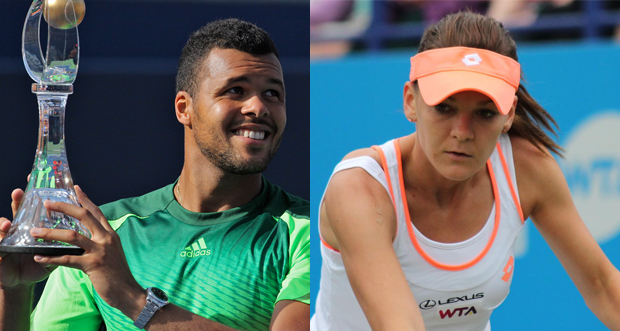
Test your knowledge of the Rogers Cup! See if you can name every champion since 1969!
[divider]
Cover Photo (Creative Commons License): Marianne Bevis / Dave Rubenstein
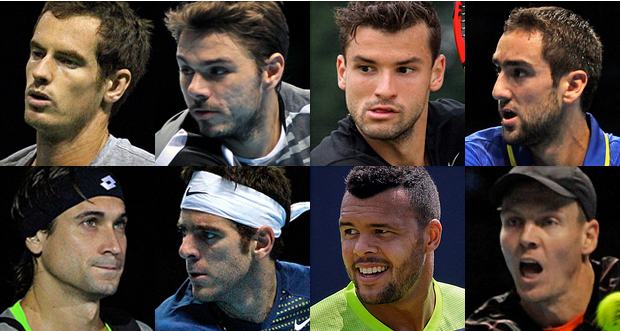

Most tennis fans, whether casual or serious, tend to follow the elites – the best players in the game who are perennial contenders for Grand Slams, ranked in the Top 5, and assemble resumes for the history books. Think Roger Federer, Rafael Nadal, Novak Djokovic, and, at times, Andy Murray. Serious fans of the game might extend their radar to the Top 100 and even a bit beyond, especially for long-time veterans and up-and-coming players. Your average serious fan – which I’d define as someone who follows the tour on at least a weekly basis and generally knows what tournaments are occurring, at least the bigger ones – probably could scan the Top 100 and recognize the names of most of them (perhaps another criteria for “serious fan”).
Federer, Nadal, and Djokovic are household names – they have all been to the top of their sport and are all-time greats. Andy Murray is borderline, but after that it gets dicey. A casual fan of tennis knows the names Juan Martin Del Potro, David Ferrer, Tomas Berdych, Jo-Wilfried Tsonga, and, after 2014, Stan Wawrinka and Marin Cilic, and depending upon where one lies on the casual-to-serious scale, it starts tapering off after the Top 10. But those names – bonafide Top 10 players, but generally not Slam winners – aren’t all that well known among the general public.
The purpose of this thread is to look at those “second tier” players – players who are not all-time greats, not multi-Slam winners, not No. 1’s, but still very good players. In fact, let’s define a few criteria for what I’m calling a “second tier” player:
What differentiates a second tier player versus a “third tier” and the rest of the pack? Some general guidelines might be:
Who fits the bill among active players? Let’s take a look at the players, with a brief overview of their careers.
[divider]
Click here to discuss “Second Tier Players” in the discussion forum.
[divider]
David Ferrer is an interesting case, because on one hand he’s a bit of a tragic figure – he’s made it to the final of nine big tournaments (one Slam, one WTF, and seven Masters) and won only a single one, perhaps the weakest of the lot—the Paris Masters in 2012, and only then arguably because he didn’t have to face any of the erstwhile Big Four (his opponent in the final was Jerzy Janowicz).
On the other hand, he’s a testament to hard work and thus is perhaps the definition of over-achiever. In other words, Ferrer has made the most of what he has and has come away with an impressive resume. He’s won 21 titles and finished in the Top 10 eight years in a row, the Top 20 ten years in a row, ranking as high as No. 3. He’s had his best two years in 2012-13, at the age of 30-31. In a way he’s as good as you can be without being great. There’s no shame in that.
[divider]
Of all the players on this list, del Potro might be the biggest “could have been.” A promising young player he finished 2008, the year he turned 20, at No. 9. Then, in 2009—at a time when the tour was dominated by two players, Federer and Nadal, with everyone else lining up to try to get a piece of the pie—he took the tennis world by storm by defeating Federer in the US Open final. He was not yet 21, and it looked like tennis had a new superstar, or at least someone to complete with Djokovic and Murray for “best of the rest.” After finishing the year No. 5 at the tender age of 21, the sky seemed the limit.
Then, in an exhibition match in January of 2010, disaster struck: del Potro’s wrist began to hurt, and it kept on hurting. He entered the Australian Open with an ailing wrist, eventually losing in the fourth round to Marin Cilic. He then proceeded to miss nine months and only came back for a couple small tournaments late in the year, his ranking dropping to No. 258. He seemed healthy (or healthy-ish) in 2011, but wasn’t the same player. He did win a couple ATP 250 tournaments but could not make it into the second week at any Slam, although still finished the year No. 11. 2012 and 2013 saw further improvement, years in which he finished No. 7 and No. 5, respectively, but he could not quite match his 2009 glory. In early 2014 disaster struck again, and del Potro was out for most of the year, finishing at No. 138. We can only hope that “Delpo” will come back strong in 2015; he is only 26 years old and still in his prime, but he is clearly a brittle player.
[divider]
Berdych is another player with elements of disappointment to his career (see a pattern here?). The Czech rose quickly in 2005, winning his first, and so far only, big tournament – the revolving door that is the Paris Masters. Not to take that away from him, but it is worth noting that neither of the top two players in the game – Roger Federer and Rafael Nadal – played in the 2005 Paris Masters. Anyhow, Berdych finished that year at No. 24 and seemed poised to challenge for a place among the elite. Yet he stagnated, finishing the next four years in the No. 13-20 range, making the quarterfinal of only one Slam.
Yet something seemed to click for Tomas in 2010 and, since then, he’s been one of the more consistent players on tour – finishing either No. 6 or No. 7 in each of the past five years, a span of time in which he’s made it to the second week (quarterfinal or later) in half of all Slams, once making the final – losing to Rafael Nadal in the 2010 Wimbledon, although not before defeating Roger Federer and Novak Djokovic.
Berdych remains an excellent player and a fixture, for the time being, in the Top 10. But he does turn 30 years old in 2015, so the window is closing for him.
[divider]
It is easy to pair Berdych and Tsonga, for not only were they born in the same year (1985), but they’ve haunted similar territory in the lower half of the Top 10 for the last half decade or so, and their career accomplishments are quite similar, although with Tsonga’s win at the Canada Masters this year he’s pulled ahead a bit.
Tsonga was a successful junior player, winning the 2003 Junior US Open over Marcos Baghdatis. He suffered through a series of injuries before rising quickly on the tour in 2007 and 2008, finishing that year at No. 6. For the last seven years he’s finished No. 13 or higher, five of those years in the Top 10. Tsonga has been deemed an underachiever; he’s got a big game, but doesn’t seem to have the big match mentality. Like Berdych he turns 30 next year, so the hourglass is about to turn.
[divider]
The “Stanimal” was born the same year as Berdych and Tsonga and, if you look at his career through 2012, could be viewed as an underachiever and disappointment – yet as of this writing, he’s the only one of the Class of ’85 who has come away with a big prize. He rose to No. 54 in 2005, No. 30 in 2006, and then crept up to No. 13 in 2008, but floundered for a few years – looking more like a third tier and perennial Top 20 player, but only just grazing the Top 10 for a few months in 2008. But something seemed to click in 2013 – his results were more consistent as he regularly went deeper into tournaments, including his first Slam semifinal at the US Open and making it to the final of four tournaments, although winning only one, an ATP 250 (the Portugal Open). Stan finished the year at No. 8 after a not-embarrassing performance at the ATP World Tour Finals where he defeated David Ferrer and Tomas Berdych to make it to the semifinals where he lost to eventual champion Novak Djokovic.
At the beginning of 2014 it seemed that Wawrinka was coming off a career year. He began the year well by winning the Aircel Chennai Open. But it was the Australian Open that proved the shocker: After defeating Novak Djokovic in the quarterfinals, and Tomas Berdych in the semifinals, Stan faced off against No. 1 Rafael Nadal. No one really gave him a chance, but he ended up defeating Rafa in four sets (it is easy to call this a cheap win for Wawrinka as Rafa was injured in the second set, but let us not forget that Stan won the first set and Rafa was well enough to win the third; certainly Rafa’s injury was a major factor, but the focus should be on Stan’s accomplishment). It was easy to consider that a fluke win, but Stan ended up also winning his first Masters, defeating Roger Federer in the Monte Carlo final and improving upon his 2013, finishing No. 4.
What’s next for Stan? It is hard to imagine a quick drop-off, but it is also hard to imagine him repeating his 2013 performance – especially his Slam. But he’s likely going to remain a Top 10 player for at lest another year or two.
[divider]
Talk about a surprising player. After a surge into the Top 10 in early 2010, after making it to the semifinals of the Australian Open at the age of 21, Cilic was erratic for the last few years, settling in as a third tier player. Then he was suspended for nine months (which was reduced), which seemed to serve as a wake-up call, or perhaps merely inspiration, as he rose quickly through the rankings in 2014, winning three minor tournaments before his surprising win at the US Open.
Cilic is not the worst player ever to win a Slam, but there are better players in terms of overall career level, and thus is a good example of both how a single Slam does not equate with greatness, but also how tenacity can pay off. But he is a Slam winner and finished his second year in the Top 10, so is now a bonafide second tier player. It will be interesting to see whether he can maintain it.
[divider]
You might quibble with my choices, but in my mind none of them are true second tier players. Some have vied for a spot in the second tier; for instance, Tommy Robredo finished 2006-07 in the Top 10, but for most of his career he’s been more of a third tier No. 20-30-type player. The same could be said for the others. Gasquet is an interesting one because in some sense he’s been the “gatekeeper” between the second and third tier for the last few years, or at least for 2012-13 when he finished No. 10 and No. 9. Gasquet would consistently beat everyone below him and lose to everyone above; previously other players like Janko Tipsarevic, perhaps Almagro, and before both, Fernando Verdasco, filled this role.
Among this group, or at least those mentioned, the one who stands out as the “could have been more” (and perhaps still can be) is Gael Monfils. He is a player whose reputation and ability far exceeds his usual ranking, mainly due to seemingly being injury prone and perhaps a non-championship mentality. Monfils is a second tier talent with a third tier career–in a sense, the inverse of David Ferrer—and thus is the type of player who could surprise us and win a big tournament. The 2015 Paris Masters?
[divider]
Kei in particular might deserve to be a second tier player by virtue of his No. 5 finish this year. He’s won six titles but consider that he has not yet won a big tournament (he made the final of both a Slam and Masters this year), nor has he finished in the Top 10 more than once. But if he finished in the Top 10 a second year in a row and/or wins a big tournament, he’s in.
Similarly with Raonic and Dimitrov. It only seems a matter of time. With Dimitrov there may even be a chance that he becomes a lesser first tier player along the likes of Andy Murray, but the clock is ticking.
[divider]
It is hard to feel bad for someone with two Grand Slam trophies, 31 titles overall, not to mention an impending marriage to the beautiful Kim Sears. Andy will forever be beloved in the United Kingdom for being the first British player to win a Grand Slam title in the Open Era, and the first since Fred Perry in 1936 to take Wimbledon. But Andy comes off, at least in the press, as disgruntled, surly, and forever unhappy with his standing. Just as Novak Djokovic was the third wheel on the Fedal bicycle for four years in a row, Andy has been the “best of the rest/worst of the best” for just about his entire career. Unlike Novak, Andy didn’t break through the players ahead of him and rise to No. 1. He did win two Grand Slams within one calendar year, being a true member of the Big Four for at least that year, but he couldn’t maintain it.
That said, Andy Murray is no second tier player. He is a truly great player, the third greatest of a generation that has produced what should turn out, when all is said and done, two of the ten or so greatest players of all time in Nadal and Djokovic. If Andy were born ten years earlier and peaked in the weak era of the late 90s to early 00s, he would undoubtedly have many more Slams than two. But every player has a “what if” story, and in the end, Andy’s career is what it is – and not only is it not over yet, it has been a stellar one so far. My opinion is that Andy is the greatest player of the Open Era with less than four Slams – greater than Kuerten, Hewitt, Safin, even Ashe. (What I mean by “greatness,” in this context, is a combination of peak level and career accomplishment).
In some ways Andy is the Guillermo Vilas of the current era. Vilas was born in the same year as Jimmy Connors and peaked alongside Connors, Bjorn Borg, John McEnroe, and, to a lesser degree, Ivan Lendl. That’s what I’d call a “raw deal.” Yet Vilas still managed to win four Slams and 62 titles and was ranked in the Top 6 for nine years in a row, but—like Andy so far—he never did rank higher than No. 2, despite arguably being the best player in 1977.
Career-wise, despite currently stalling out in his Slam count, Andy is closing in on four-Slam winners Vilas and Jim Courier, who are the gatekeepers to the true elites of the Open Era. I’d say he probably needs at least one more Slam to join them, but still has the possibility of surpassing him. Wouldn’t it be appropriate if Andy finished his career with four or five Slams, and became the historical “best of the rest, worst of the best?”
[Note: At some point I’d like to write a “Part Two – Second Tier Players of the Past,” but there are a few articles on the burner, so stay tuned.]
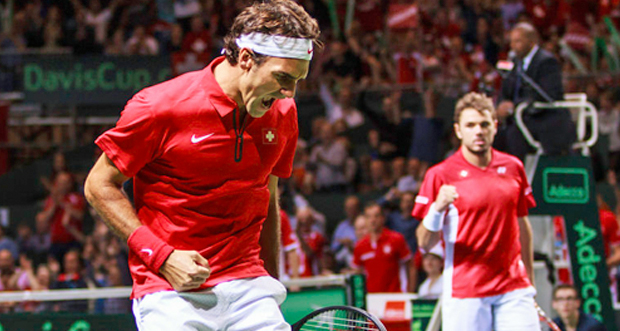

With his 6-4, 6-2, 6-2 victory over France’s Richard Gasquet, Roger Federer secured Switzerland’s historic first Davis Cup win.
Switzerland beat France 3-1: on Friday, Stan Wawrinka beat Jo-Wilfried Tsonga (6-1, 3-6, 6-3, 6-2), then Federer lost to Gael Monfils (6-1, 6-4, 6-3); on Saturday, Federer and Wawrinka teamed up to defeat the French team of Julien Benneteau and Richard Gasquet (6-3, 7-5, 6-4); and finally on Sunday, Federer demolished Gasquet (6-4, 6-2, 6-2).
[divider]
Click here to discuss the Davis Cup Final in the discussion forum.
[divider]
Cover Photo (Creative Commons License): O.Cartu.
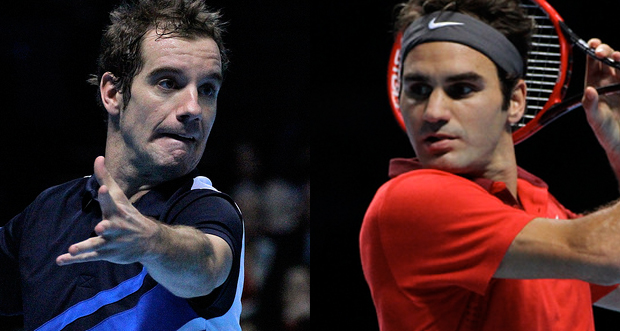

The 2014 Davis Cup Final concludes on Sunday, November 23. The Swiss are up 2-1 after Roger Federer and Stan Wawrinka teamed up to beat the French doubles team of Julien Benneteau and Richard Gasquet. Now it’s down to the remaining singles matches: Federer will take on Richard Gasquet; if Gasquet wins, then Stan Wawrinka will face Gael Monfils.
[Scores added as known. All times are local.]
[divider]
1:00 P.M.:
Federer d. Gasquet — 6-4, 6-2, 6-2
Wawrinka vs. Monfils [Not Played]
[divider]
Click here to discuss the Davis Cup Final in the discussion forum.
[divider]
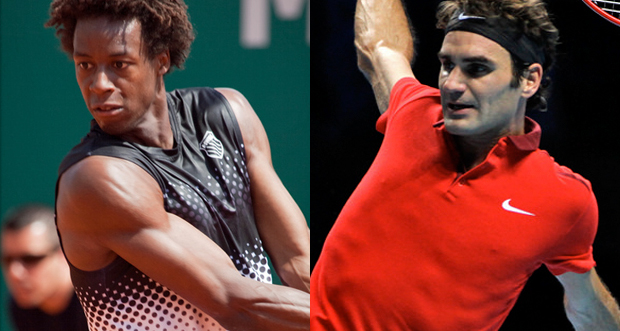

Day 1 of the 2014 Davis Cup Final will feature two singles matches. First up will be Jo-Wilfried Tsonga, of France, vs. Stan Wawrinka, of Switzerland. They will be followed by Gael Monfils, of France, vs. Roger Federer, of Switzerland.
[Scores added as known. All times are local.]
[divider]
2:00 P.M.:
Wawrinka d. Tsonga — 6-1, 3-6, 6-3, 6-2
Monfils d. Federer — 6-1, 6-4, 6-3
[divider]
Click here to discuss the Davis Cup Final in the discussion forum.
[divider]
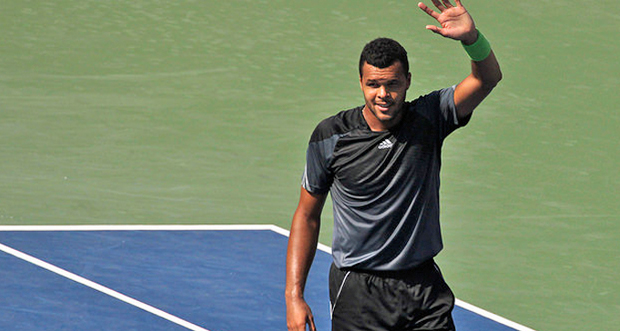

Jo-Wilfried Tsonga capped an amazing run in Canada by besting Roger Federer (2) in the final of the Rogers Cup, 7-5, 7-6(3). Including his win over Federer today, Tsonga had to defeat four Top-10 players to grasp the trophy: Novak Djokovic (1), Andy Murray (9), and Grigor Dimitrov (8). This second win at the Masters 1000 level (he won Paris in 2008) puts Tsonga back in the Top 10. Although his year to date had been disappointing, he came into this tournament looking very fit, focused, and combining his power game and big serve with good shot selection and a steely determination that hasn’t always been a hallmark of his game.
The Frenchman struggled early with his first serve, but both players stayed on serve in the first, with Tsonga’s first serve percentage improving and his holds becoming easier. As Federer served at 5-6 to force a tiebreak, the great Swiss champion made some wild unforced errors to hand the Frenchman the break and the first set. In the second, Tsonga’s service games were more solid, while Federer, who marked his 33rd birthday during the tournament, struggled through several long games just to hold. Serving at 4-5, Tsonga had a championship point, though Federer eked out the hold, eventually forcing the tiebreak. But when Tsonga had three more championship points at 6-3 in the tiebreak, he converted the first to take the match.
For fans and admirers of Tsonga, he has often been frustrating to follow, with injuries and strings of inconsistent play undermining his natural gifts. But this week showed a resurgent and mature player. If he continues this form, he will likely pose a real danger in the draw at the US Open. With even a decent run at the Western and Southern Masters 1000 in Cincinnati, which begins today, no one will be interested in facing him in Flushing Meadows.
[divider]
Cover Photo (Creative Commons License): Marianne Bevis
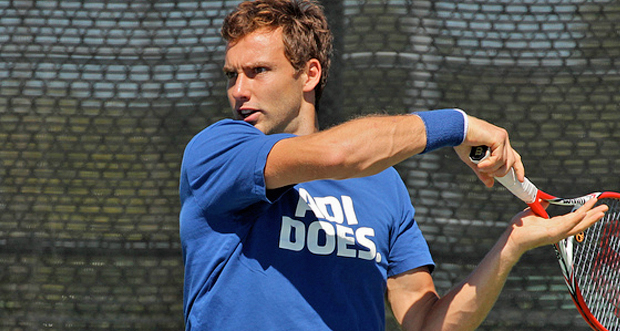

Marseilles, Final
(3) Gulbis d. (2) Tsonga, 7-6(5), 6-4
It is a strange quirk that Ernests Gulbis, that least reliable of professional tennis players, somehow boasts a perfect record in tour finals, a record he kept intact today in Marseille. He has now won five ATP titles without losing one, a kind of scruffy yin to so many proven yangs, such as Gael Monfils or Julien Benneteau. Gulbis didn’t get to play either Monfils or Benneteau this week, though that wasn’t his fault, since the former wasn’t here and the latter was defeated early on in another part of the draw. As the truism goes, you don’t get to choose which Frenchmen you face in tennis. You can only defeat the ones who are placed in front of you.
It was, fittingly, a non-Frenchman Gulbis struggled with. His toughest test came against Roberto Bautista Agut in the second round, although this wasn’t strictly a surprise. (The surprise was that having eluded defeat the Latvian went on winning.) Bautista Agut has distinguished himself this season with several scrapping, aggressive, and defiant efforts, though this week he also distinguished himself by being just about the only Spanish man with a tennis racquet who didn’t show up in Rio. Consider this: there were more Spaniards in Rafael Nadal’s half of the Rio draw than there were Frenchmen in the entire Marseille draw. Once Gulbis had survived that early round struggle, he set about beating any locals he could lay his hands on, starting with Nicolas Mahut, continuing with Richard Gasquet, and concluding today with Jo-Wilfried Tsonga.
It wasn’t a particularly exciting final as these things are measured, and certainly not compared to last year’s decider between Tsonga and Tomas Berdych. As you’d imagine when two big men face each other on a fast indoor court, the service dominated, though better returning would have helped it dominate less. Gulbis had not been broken since the second round, and Tsonga today could engineer only two opportunities, which he characteristically flubbed. Gulbis, on the other hand, was in plenty of the Frenchman’s service games, although he was no more effective at converting break points, ending the match with a rather memorable 1/11. The Frenchman generally saved them with muscular play, and managed to do the same with a few match points in the second tiebreak. Gulbis served it out with an ace, before commencing a victory routine from which he’d carefully expunged any trace of exaltation. It made Marat Safin’s celebrations look flamboyant by comparison. You’d think Gulbis wins these things every other week.
Actually, that’s not far off. He usually wins these things in this week every other year. Last year he won Delray Beach as a qualifier, and his maiden title came at that tournament in 2010. It may seem surprising that he hasn’t returned to Florida this year, but his failure to show up for title defences is another of the few infuriatingly consistent things about him. So far in his career he has never once graced a tournament the year after he has won it. Look for him in Rio next year, or at least anywhere but Marseille.
Rio de Janeiro, Final
(1) Nadal d. Dolgopolov, 6-3, 7-6(3)
Owing to a minor calendar shake-up, Nadal will next week find himself in the rare position of having two titles to defend, in Acapulco and Sao Paulo. Taking a leaf from Gulbis’ playbook, he has chosen to skip both, preferring instead to win this week’s inaugural Rio event. After all, opportunities to be the first name on a new trophy don’t come round every week, presuming there’s a trophy upon which names can be inscribed.
Nadal almost surprised us all by not winning the tournament, though got there in the end. The direst moment came against Pablo Andujar in the semifinal, a match that saw the world No. 1 recover from a set down, and finally take it in a mighty third set tiebreak, saving a pair of match points along the way. For once the bromidic phrase “he found a way to win,” usually uttered at the first faint whiff of adversity, was actually merited. Usually the way he finds entails being better at tennis than his opponent, but against an inspired Andujar there were stretches of the match in which Nadal was emphatically outplayed. Indeed, Andujar won more points overall. Alas for him, he lacked either the savagery or the cold precision necessary to claim the points that mattered most. He has thus been relegated to a statistical anomaly – this was the first time Nadal has won from match point down since beating Troicki in Tokyo in 2010.
Alex Dolgopolov’s half of the Rio draw had, for a wonder, boasted only two Spaniards, but they were two of the toughest in David Ferrer and Nicolas Almagro, although the latter has lately learned to be as disappointing on South American clay as he perennially is on the European variety. Throw in Fabio Fognini, and plenty of reasons to be distracted by events back home, and Dolgopolov’s run to the Rio final proved to be a minor masterpiece of tightrope-sprinting. He’d been marvellous, in his dicey weird way. I wouldn’t go so far as to say that there’s no better player to watch when he’s on. Indeed, to say that would be to confess to fetishism. He has a game only a mother could love, but there’s no denying the excitement he delivers, especially for those of us drawn to unpredictable, aggressive tennis.
Regardless, the betting markets, history, and the general opinion of the person on the street were unanimous in believing that it wouldn’t be enough to get by Nadal in the final. The only exceptions were those subsets of Nadal fandom which insisted that Nadal’s flat performance against Andujar would be sustained into the final: a passionately misguided belief in Nadal’s frangibility has meant some fans fail to absorb the lesson that he very rarely plays badly, and almost never plays badly twice in a row. As ever with Dolgopolov the interest lay in discovering whether the strobes of brilliance could be spaced with sufficient proximity so as to provide consistent luminescence. So far this week they had. His only real chance for the final, however, was to hope they joined up to form a band of light so incandescent it might sear the retinas from Nadal’s head. Dolgopolov lacks anything resembling a bread-and-butter game. Whether through technique or temperament, he appears incapable of sustaining discernible, or at any rate reliable, patterns of play. He is hell to play when he’s playing well. The trick, as far as I can tell, is to force him to have to play well or else, thus ensuring that he probably won’t.
Nadal, as ever, had the luxury of being able to achieve this by deploying any number of established patterns, knowing that most, if not all, of these would likely guarantee him victory. Today’s patterns involved nothing fancier than the judicious application of just enough pressure to provoke Dolgopolov into over-hitting. This was particularly apparent in the first set, in which Nadal himself hit only one winner, which was the ace he served to seal it. The Spaniard broke early in the second set (as he had in the first), and looked likely to coast it out. Dolgopolov, after all, had not broken Nadal, not merely in this match, but in any of the four other matches they’ve contested.
It therefore came as something of a surprise when an apparently nervous Nadal lost his way while trying to serve it out at 5-4, the break sealed with yet another scything Dolgopolov crosscourt backhand into the top seed’s forehand corner. I recall how effective this tactic was for Troicki in Tokyo three years ago, thus providing a lesson that Novak Djokovic subsequently learned by rote. You can go crosscourt to Nadal’s forehand, but you have to take the ball very early, and go there flat and with tremendous pace. Dolgopolov went there time and again today with great success, but it’s a dicey way to live, especially on clay, where Nadal is inexorable. He was certainly inexorable in the eventual tiebreak, and Dolgopolov proved all over again that risky tennis only looks good when it comes off. The flashes of light were now spaced too far apart, and soon they went out entirely.
Nadal won’t be the last Rio champion, but he’ll always be the first. The trophy, worthy of a European indoor event in its determination to reference anything but a trophy, was handed over by the universally beloved Gustavo Kuerten. It’s a kind of lattice-worked wave arrangement, and thus provided plenty of spots for Nadal’s teeth to find purchase. (Marseille, ironically, has a perfectly ordinary trophy, which Gulbis did not bite.) Both men brought up Ukraine’s current situation in their speeches, Nadal graciously and Dolgopolov with all his heart.
[divider]
Cover Photo (Creative Commons License): Marianne Bevis
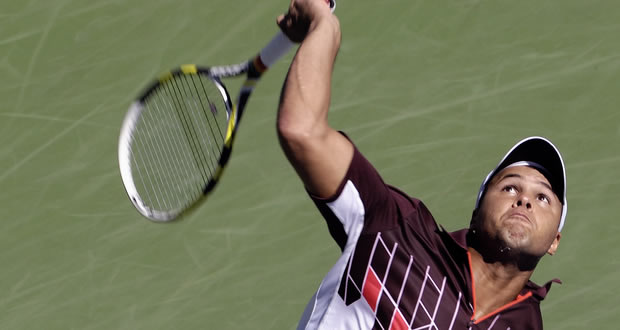

Jo-Wilfried Tsonga and Alize Cornet clinched a maiden Hopman Cup triumph for France as they prevailed over the Polish pair Grzegorz Panfil and Agnieszka Radwanska 2-1 in a titanic tussle.
The final at Perth Arena lasted until the early hours of Sunday evening with France finally prevailing in the mixed doubles 6-0, 6-2.
In the earlier matches, Tsonga defeated Panfil 6-3, 3-6, 6-3, and Radwanska defeated Cornet 6-3, 6-7 (9-7), 6-2.
[divider]
Cover Photo: Yann Caradec, Creative Commons License
[divider]
Court Philippe Chatrier – 1:00 PM
Rafael Nadal (ESP) (3) def. Novak Djokovic (SRB) (1) 6-4 3-6 6-1 6-7(3) 9-7
David Ferrer (ESP) (4) def. Jo-Wilfried Tsonga (FRA) (6) 6-1 7-6(3) 6-2
[divider]
Court Suzanne Lenglen – Not Before: 1:00 PM
Ekaterina Makarova (RUS) (4) / Elena Vesnina (RUS) (4) def. Andrea Hlavackova (CZE) (2) / Lucie Hradecka (CZE) (2) 6-4 7-5
Not Before: 3:00 PM
Sara Errani (ITA) (1) / Roberta Vinci (ITA) (1) def. Nadia Petrova (RUS) (3) / Katarina Srebotnik (SLO) (3) 6-3 5-7 6-3
[divider]
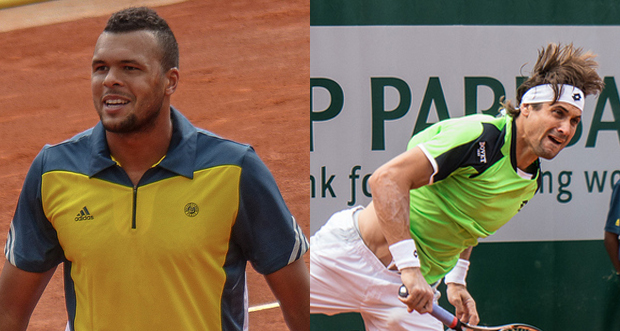
David Ferrer, the No. 4 seed from Spain, ended Tommy Robredo’s historic run at Roland Garros, beating his fellow countryman 6-2, 6-1, 6-1.
In the previous three rounds, Robredo came back each time from two sets to love down, winning in five sets, a feat which hadn’t been done since 1927.
The Frenchman Jo-Wilfried Tsonga, the No. 6 seed, pulled off the upset, beating Roger Federer 7-5, 6-3, 6-3.
Tsonga and Ferrer will play on Friday to determine who will advance to the final.
[divider]
Click here to discuss the Tsonga/Ferrer SF on our discussion boards.