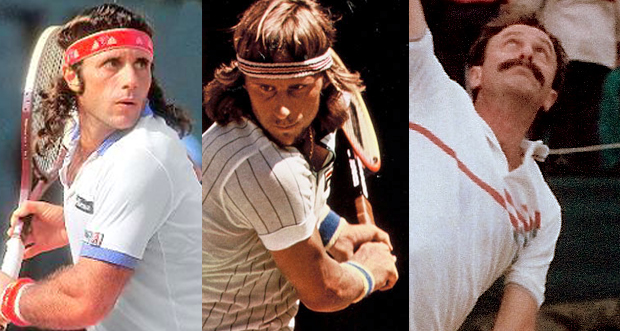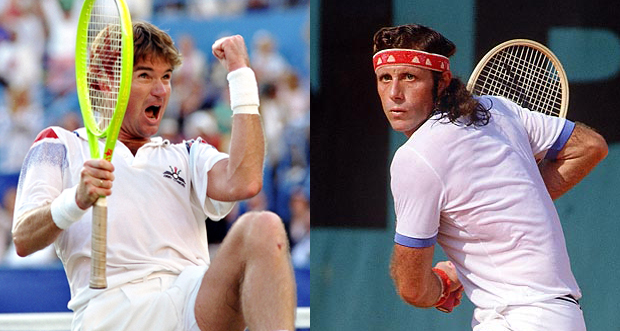

Open Era Natives
Once we get to the generation of players born from 1949 to 1953, we are firmly in the Open Era. The oldest players of this generation were still teenagers when the Open Era began. Take generation elder statesman Manuel Orantes, born at the very beginning of the timespan in February of 1949: his first Slam was the 1968 Australian Open, the last of the amateur era.
With apologies to Stan Smith, this generation also saw the first American superstar since Pancho Gonzales in Jimmy Connors. Pancho was the greatest tennis player of the 1950s but was past his prime and in his 40s when the Open Era began, although still ranking in the Top 10 as late as 1968. He played long enough to pass the baton to Jimmy Connors, their careers overlapping for a few years (more on that in a moment).
[divider]
[divider]
Best Players by Birth Year (Country, Slam Count)
1949: Manuel Orantes (ESP, 1)
1950: Adrian Panatta (ITA, 1), Phil Dent (AUS)
1951: Roscoe Tanner (USA, 1), Eddie Dibbs (USA), John Alexander (AUS), Dick Stockton (USA)
1952: Jimmy Connors (USA, 8), Guillermo Vilas (ARG, 4), Brian Gottfried (USA), Harold Solomon (USA), Wojtek Fibak (POL), John Marks (AUS), Kim Warwick (1952)
1953: Raul Ramirez (MEX), Jose Higueras (ESP), Corrado Barazzutti (ITA)
Discussion
This generation, that owns a rather middle-of-the-road 15 Slam titles—the same as the previous generation—was dominated by hot-headed American Jimmy Connors, who was the first superstar that belonged entirely to the Open Era. In a way Jimmy had two careers, known equally for both: his peak in the 70s and his incredible longevity that saw his career stretch past two decades and into the 90s. Jimmy was a Top 10 player from 1973 to 1988, a remarkable span of 16 years. Only Andre Agassi has surpassed this span by a single year, from 1988 to 2005, although Andre dropped out of the Top 10 twice while Jimmy’s streak was unmarred (if you’re wondering, Roger’s streak is at 14, so will equal Jimmy if he remains in the Top 10 through 2017).
I like to think of Guillermo Vilas as the gatekeeper to all-time greatness: if you’re better than Vilas, you’re a true all-time great. Vilas was in a way the Andy Murray of his era; he played alongside the peaks of better players like Connors, Borg, and then McEnroe and Lendl. Yet Vilas has a special record to his name: He still holds the most titles for a single year in the more fully documented ATP era (1973 to present), with 16 in 1977 (Rod Laver won 18 titles in 1969, the most in the Open Era). 1977 remains a controversial year as he finished No. 2 behind Connors in the ATP rankings, despite those sixteen titles and two Slams compared to Connors’ eight titles and zero Slams. It is the general consensus that Vilas had the better year and deserved the No. 1 ranking, but in a recent ruling the ATP decided not to reverse previous calculations, so Guillermo will remain the greatest player of the Open Era never to be ranked No. 1.
The rest of the generation is not as well remembered, but includes some strong players, including the lone Italian Grand Slam winner of the Open Era, Adrian Panatta (who is also only one of two Italian Grand Slam winners in tennis history, along with two-time French Open champion Nicola Pietrangeli). Other Slam winners were hard-hitting Roscoe Tanner, whose 153mph serve in 1978 was the fastest recorded until Andy Roddick’s 155mph at the 2004 Davis Cup, and Manuel Orantes, who defeated a peak Connors at the 1975 US Open.
Underachievers and Forgotten Players
There’s no clear underachiever in this generation; no player who seemingly should have won more Slams, no Slam-less player who should have won one. That said, this category is also for forgotten players and I would like to mention Brian Gottfried, Harold Solomon, and Raul Ramirez as the “Slam-less three” of this generation – the three best players of this generation not to win a Slam. These three combined for 67 titles (or 25, 22, and 19, respectively), and 5 Masters equivalents among them. All three are among the twenty or so best Slam-less players of the Open Era; Gottfried could be in the Top 5.
Did You Know?
Jimmy Connors’ first final was at the age of 19 in the 1971 Los Angeles Open, equivalent to a Masters tournament today. His opponent? 43-year-old Pancho Gonzales, who beat Jimmy 3-6, 6-3, 6-3. They had actually played earlier that year at a lesser tournament, which Pancho also won.
Top Ten Players of the Generation
- Jimmy Connors
- Guillermo Vilas
- Manuel Orantes
- Roscoe Tanner
- Brian Gottfried
- Harold Solomon
- Adrian Panatta
- Raul Ramirez
- Eddie Dibbs
- Jose Higueras
Honorable Mentions: John Alexander, Phil Dent, Dick Stockton, Wojtek Fibak, Corrado Barazzutti.
As with the generations before it, the top of the list is easy – no one would argue against Connors and Vilas, and Orantes is a pretty easy No. 3. Tanner gets the edge for No. 4 over Gottfried, Solomon, and Ramirez, but the “Slam-less Three” are relatively close – they were the Tomas Berdychs and Jo-Wilfried Tsongas of their era. I rank Adrian Panatta behind Gottfried and Solomon in a similar way that I will rank Marin Cilic behind Tsonga and Berdych (at least for now). While we all know that a single Slam title is more coveted than any number of lesser titles, when ranking overall career greatness, Slams titles must be contextualized with other factors—non-win Slam results, other titles, and rankings. Panatta simply wasn’t as good as the players ranked ahead of him. Dibbs and Higueras round out the Top 10.