Tag: Grigor Dimitrov

  • Dimitrov Outlasts Anderson in Acapulco

    Dimitrov Outlasts Anderson in Acapulco

    Grigor Dimitrov

    Grigor Dimitrov won his first 500-level ATP title at the Abierto Telcel Mexicano, defeating Kevin Anderson of South Africa in a nearly three-hour match that went into the wee hours of Sunday, 7-6(1), 3-6, 7-6(5). The 22-year-old Bulgarian had won only one previous title, in Stockholm last year, though he is deemed one of the bright future stars, and this win gives some encouragement to that notion. For Anderson, the loss was his second consecutive in a final, having lost in Delray last week, though both players will see a rise in the rankings on Monday, Anderson most likely to a career high 17-18.

    The two players were fairly evenly matched through the first set, though Dimitrov sprinted through the tiebreak to take the first set, but the young Bulgarian faded a bit in the second, and Anderson went up 3-0. He won the second at 3, and went up an early break in the third, needing only to hang onto his big serve to win his first 500 title, but he double-faulted to give the break back in the eighth game, and the momentum shifted back to Dimitrov. The second tiebreak was a much tighter affair, but the Bulgarian took the title on his first match point.

    It was an unexpected final match-up, in a tournament that this year included a rather new cast of characters due to a surface change. The Abierto Mexicano has switched to hard courts and become appealing as a tune-up to the Masters 1000 in Indian Wells. But even considering the change, it was a surprise final line-up. Dimitrov had taken out No. 2 seed Andy Murray the day before, and Anderson had seen off the top seed, David Ferrer, by retirement.

    [divider]

    Cover Photo (Creative Commons License): Marianne Bevis

  • Lessons Learned

    Lessons Learned

    Australian Open, Quarterfinals

    (8) Wawrinka d. (2) Djokovic, 2-6, 6-4, 6-2, 3-6, 9-7

    It presumably surprised no one when Channel 7’s hype-department went into overdrive at the prospect of another blockbuster match between Novak Djokovic and Stanislas Wawrinka. As with all commercial television networks, Australia’s tennis broadcaster subscribes to the crude conceit that any memorable event must inevitably be repeated if even a few of its defining conditions are present. In this case the defining conditions were the players involved and the best-of-five format. These men played two five-set classics last year, and according to Channel 7 this ensured their next effort was destined to be another. Being steadier and wiser, I wasted no opportunity to inform anyone near me – family members, buskers, stalkers – that there is more to professional tennis than the Majors, and that Djokovic easily dispatched Wawrinka twice at the end of last year, in Paris and London. Only an unredeemed ignoramus, I maintained, would expect another classic. Djokovic would win easily. My son, who has decided that he and Djokovic are going to become friends, was particularly thrilled by this news. As it transpired, the match was a classic. Channel 7 was right, and I was wrong. That may not be the hardest sentence I’ve ever had to write – “Mr Becker, I regret to inform you that your brain condition is inoperable.” – but it’s certainly on the shortlist.

    At least for the first set, it looked as though I’d be proved right. Djokovic was looking exactly like the guy who hadn’t lost a match of any kind since the US Open final in September, who was currently enjoying the second longest Grand Slam semifinal streak in the Open Era. Wawrinka, meanwhile, looked like he couldn’t quite work out where his baseline was, or why it was important that he position himself closer to it. He figured it out in the second set, however, though it still came as a surprise to everyone in the stadium when he finally broke Djokovic, and served it out.

    Crowd sympathy within Rod Laver Arena had slightly favoured Djokovic as the players sauntered on to court, though it could have been that the Serbian fans were more punctual. By the time Wawrinka broke in the third set, twice, there was no doubt which man the crowd preferred. Djokovic was too content to rally with the Swiss, especially crosscourt on the backhand, and rediscovered that this shot doesn’t break down the way other single-handers can. Nonetheless, Djokovic took the fourth comfortably, and broke at the start of the fifth. A reprise of their US Open appeared more likely than their extravagant 12-10 effort from Melbourne last year.

    Then, for reasons ungraspable by rational minds, Djokovic compiled a service game of cosmic awfulness, sturdily mounted on four forehand errors, and was broken back. Both men settled into a long sequence of holds, interrupted briefly by a rain delay. Djokovic went back to holding comfortably. Wawrinka did it harder, but, somehow, legs and mind constricted, he did it. Blithely ignoring the concept of momentum, he finally broke Djokovic with the Serb serving to stay in the match for the fourth time, at 7-8. Djokovic’s brain-wave to serve-volley on match point down has already blossomed into legend. To volley was, to put it mildly, a rash choice, and it was rashly played. He swung at it, pushed it wide, and the three-time defending champion was out. He left the court to a wave of warm regard, which heated to radiant affection once Wawrinka took his chance to speak. He pronounced himself “very, very, very, very happy.” He’d proved me wrong, but in the moment I found it hard to begrudge him his joy. My son was less impressed when I told him the result, but learned a vital first lesson in parental fallibility. It had to happen some time. I won’t complain if he gains something of Djokovic’s perfect grace in defeat, but I do dream he’ll somehow acquire a backhand like Wawrinka’s.

    (1) Nadal d. (22) Dimitrov, 3-6, 7-6(3), 7-6(7), 6-2

    If he falls in with a bad crowd, he may end up with a backhand more like Grigor Dimitrov’s, a doom no parent would wish upon their child. For the first set of today’s match between Dimitrov and Rafael Nadal, the Bulgarian did an excellent job of shielding his backhand wing from the Spaniard’s merciless attention. Mostly he did this by breaking early and serving well.

    This was an unusual match, easily the strangest of the round; not particularly enjoyable to watch, nor, from what I could tell, to play. It boasted little of the drama of Djokovic’s loss to Wawrinka, and none of the quality. Nadal began poorly and never hit full stride. Dimitrov began well, but immediately subsided into woeful inconsistency. He broke early, but thereafter could barely land a return, and saw out the first set on the strength of his first serve alone. Breaks were donated and whimsically re-gifted in the second set. Nadal sought to fire himself up, and succeeded in whipping the crowd into some sort of startled frenzy through the sheer force of his personality, or at any rate the lustiness of his bellows, which for duration and incongruity were a fitting homage to the departed Djokovic. Either man could have taken the second set, but naturally only Nadal did, with a lovely combination of passes.

    The third set was more or less the second set with all the settings dialed up. Breaks each way, flailing inefficiency from both men – Nadal’s serve in particular was heavily affected by a blister on his left hand, which Channel 7 took great delight in showing in dynamic detail, with Spidercam swooping in – an expertly curated selection of beautifully framed forehands, and the inability of both men to sustain pressure. This point from the third set tiebreak encapsulates the overall dynamic quite perfectly: Dimitrov’s tweener lob is the brilliant moment fated to resonate, but observe how once he has re-established himself in the rally he undoes his good work with a sequence of weak, short backhands. Nevertheless, Dimitrov had three set points in total, including one on his own serve. It was a big serve, too – 205kph out wide – leaving him with an attractively pristine acre of court to hit into, or out of, as it transpired. That forehand miss will certainly stay with him for a long time. It was certainly still on his mind in the press conference, as he shed hot tears of frustration. Nadal later admitted to Jim Courier that he’d simply been lucky in that moment, with a relief that had hardly faded in the intervening hour. The fourth set saw Dimitrov fade in the usual manner. He hadn’t played especially well, though he had fought well, and his tournament was over. If he’d been able to land those forehands it might have been a different match, though probably not a different result. If he’d been able to regulate the depth on his backhand better, it certainly would have been.

    (6) Federer d. (4) Murray, 6-3, 6/4, 6/7(7), 6/3

    Nadal will face Roger Federer in the second semifinal, another installment in the most famous rivalry in the sport, an exalted status reflected in its recourse to Roman numerals. This will be their XXXIIIth meeting. Whereas last year’s matches were dominated by Nadal, there is some reason to believe that Friday’s meeting will be more competitive. Federer, with his new racquet and mended back, is back to playing the kind of aggressive tennis he was once famed for, at least for the opening sets of each match. After that his boldness erodes sharply. Two rounds ago he tore through Blaz Kavcic in fearsome fashion, before the third set devolved into an unnecessary dogfight. The same pattern threatened to recur in the fourth round against Jo-Wilfried Tsonga; that it didn’t owed mostly to the Frenchman’s sense of timing, which is not commensurate with his sense of occasion. Tsonga left his run too late, and Federer was permitted to coast over the line. Andy Murray almost committed the same mistake, only coming truly to life as Federer served for the match at 5-4 in the third set.

    Federer commenced in majestic fashion, his forehand and serve both devastating, his backhand impenetrable, and his excursions into the forecourt frequent and decisive. Murray had ambled to the quarterfinals thanks to the most generous draw since, well, his last Australian Open. Federer was thus his first true test, not only of the tournament, but since last year’s US Open. He missed four months of tennis, and last night appeared fatally short of big match practice. I’m not sure anyone besides those ardent Federer fans who exist in a state of perpetual anxiety truly expected Murray to maintain a high level for long enough, in perfect contrast to last year’s semifinal. On paper it was the most appealing of all the men’s quarterfinals, but when it came down to it the stakes somehow didn’t feel very high.

    The Scot finally found his feet in the second set, like Wawrinka the night before forcing himself to venture up onto his baseline. Federer continued to be aggressive, and this was probably the best period in the match, until Murray threw in a poor game to be broken. We can put this lapse down to shortage of match play, but Djokovic had already proved that even the best players don’t really need a reason. Federer served out the set. The third was much the same, with the Swiss entirely untouchable on serve, at least until he stepped up to serve for the match, and thoughtfully reminded us that pressure has internal obligations of its own. Federer tried to coast over the line, but Murray, to his enormous credit, was having no part of it. Invited to step in, he did, heavily augmenting the pace on his groundstrokes, and forcing Federer into error. Federer gained a couple of match points in the tiebreak, and once more reverted into passivity, and was made to pay.

    The fourth set began in much the same manner – Murray’s first service game lasted about a quarter of an hour, and saw Federer gain half a dozen break points, which he mistook for an ideal opportunity to work on his sliced forehand returns. His personal challenge appeared to be to see how many of them he could bunt onto Murray’s service line. It turned out to be a lot. Murray by this point was largely spent, his first serve shorn of pace, and his movement to the forehand corner sluggish. But he was rarely stretched, and made the most of his opportunities to move forward. Federer finally attacked a forehand return on a break point late in the set, and was presumably the only person surprised to learn that this markedly enhanced his chance of winning the subsequent rally. Obliged once more to serve it out, he fell quickly to 0-30, but extricated himself with a bold rally and a brave second serve, before taking the match a few points later.

    Afterwards, forced to explain himself to Courier, he sounded about as relieved as Nadal had, though one was left to wonder if he realises just how weighed-down he lately seems by pressure. At times this tournament he has looked like his old self, not merely the statesman who returned to No. 1 in 2012, but the reckless youth who dominated the world in 2006. At other times, however, he has looked exactly like a man who has learned by heart the lesson that all things must pass, that one’s moments of greatness don’t become less precious the more of them you’ve accumulated, but more precious the fewer of them you have left.

  • The Curious Case of Grigor Dimitrov: Is “Baby Federer” (Finally) Growing Up?

    The Curious Case of Grigor Dimitrov: Is “Baby Federer” (Finally) Growing Up?

    9077226103_3e45fbc8aa_b

    I can’t help but cheer for Grigor Dimitrov. Maybe it is his fluid grace that is reminiscent of a certain great Swiss player (in style, although not potency). Maybe it is his blasé demeanor which is often interpreted as not caring, but also could be indicative of a happy-go-lucky attitude which, while admirable as far as his seeming amiability is concerned, may prove detrimental to the resolve needed for a championship attitude. Regardless, I like young Mr. Dimitrov and want to see him succeed.

    Over the last year Grigor has established himself as one of the premier talents of his generation, rising from No. 46 at the end of 2012 to No. 23 as 2013 comes to a close.  Just a couple weeks ago, Dimitrov finally won his first ATP title at Stockholm, an ATP 250 event. That win, coupled with his overall improvement in 2013, has led to a response that seems to be cautiously optimistic, that this could be the breakthrough that the talented but seemingly listless young player needs to start actualizing the potential and smooth play on the court that has earned him the appellation “Baby Federer.”

    But not so fast. Let us not forget that Grigor is already 22 and part of a generation that has been either slow to develop, or lacks elite talent.

     A Lost Generation?

    It is well known that there aren’t many highly ranked young players on tour at the moment; in fact, above Grigor’s rank of No. 23 there are only two players—Milos Raonic at No. 11 and Jerzy Janowicz at No. 21—that were born in the 1990s (Kei Nishikori, at No. 17, misses the cut by a few days), and both Janowicz and Raonic turn 23 years old later this year. After Dimitrov, the players born in the ‘90s are few and far between; here is a complete list of those players in the Top 100:

    11. Milos Raonic (22)

    21. Jerzy Janowicz (22)

    23. Grigor Dimitrov (22)

    32. Vasek Pospisil (23)

    52. Bernard Tomic (21)

    56. Federico Delbonis (23)

    65. Pablo Carreno Busta (22)

    79. Evgeny Donskoy (23)

    82. Jiri Vesely (20)

    91. Jack Sock (21)

    Perennial disappointment Ryan Harrison (21), Denis Kudla (21), and David Goffin (22) have all slipped just outside of the Top 100, with quite a few others in the No. 101-200 range.

    Jiri Vesely is the youngest player in the Top 100 at age 20. To get to the first teenager, you’ve got to go all the way to promising 18-year-old Nick Kyrgios ranked No. 181.

    It is clear that the rankings—especially the Top 50—are light with young players. The question is why – and there are two general theories. One is that players are simply maturing later, perhaps due to the more physical nature of the game. If this is true we won’t know for another year or two, as the players listed above enter their mid-20s. So we’ll leave that one aside for the time being.

    The second is that we’re in a bit of a generational lull; meaning, the young players on tour—which we can loosely define as anyone born in the 1990s—are not a very talented generation, perhaps harkening back to the generation of players born in the late 70s, of whom Gustavo Kuerten was probably the best.

    As an aside, I’m defining a “tennis generation” as a span of five years. I am dividing generations by half-decades; this is obviously arbitrary but I’m not sure if there’s any way around that.

    Anyhow, Kuerten’s generation – those players born from 1975-79 – won only a total of seven Grand Slams. Compare that to other generations of the Open Era:

    1985-89:  22 (Nadal 13, Djokovic 6, Murray 2, Del Potro 1)

    1980-84: 23 (Federer 17, Hewitt 2, Safin 2, Roddick 1, Ferrero 1)

    1975-79: 7 (Kuerten 3, Moya 1, Gaudio 1, Johansson 1, Costa 1)

    1970-74: 34 (Sampras 14,  Agassi 8, Courier 4, Bruguera 2, Kafelnikov 2, Rafter 1, Chang 1, Krajicek 1)

    1965-69: 15 (Becker 6, Edberg 6, Muster 1, Korda 1, Stich 1)

    1960-64: 18 (Lendl 8, Wilander 7, Cash 1, Gomez 1, Noah 1)

    1955-59: 20 (Borg 11, McEnroe 7, Kriek 2)

    1950-54: 16 (Connors 7, Vilas 4, Edmondson 1, Gerulaitis 1, Panatta 1, Tanner 1, Teacher 1)

    Going back further, you’ve got Stan Smith, Jan Kodes, Tony Roche, and Ilie Nastase born in the late 40s; John Newcombe and Arthur Ashe born in the early 40s; Rod Laver and Roy Emerson born in the late 30s; Ken Rosewall in the early 30s, etc.

    The generation born in the late 70s is easily the worst of the Open Era, and probably going back much further. This new generation born in the 1990s could very well vie for that honor.

    Either way, they’re both theories. What we do know is that this younger generation is not—yet, at least—as strong as past generations.

    Back to Grigor. In the same way that we won’t be able to answer the questions above, at least not for another couple years when the top players in the early 90s generations start reaching age 24 and 25, so too can we not know if Grigor’s win at Stockholm is the beginning of an elite player coming into his own. Grigor has been lauded as one of the few of his generation with the talent to win Grand Slams, yet it is also true that most No. 1 players and Grand Slam winners are already playing at a very high level by the time they are Dimitrov’s age.

    What Does History Tell Us?

    What we can do is look at historical precedent. If Dimitrov’s generation is peaking later, then this information is less useful – but it still gives us a starting place.

    I’ve created a few criteria to look at:

    • Active players who have won at least 2 ATP title events of any level
    • Active Players who have won an ATP 500 or higher in their careers
    • All players who have won an ATP 1000, WTF, or Grand Slam in the 21st century (2000-present)

    This gave me a list of 67 players, ranging from the greats of the 1990s like Pete Sampras and Andre Agassi, to young players like Raonic and Janowicz.

    I then looked at the first tournament each player won, and the age they were when they won it.  Finally, I accounted for each title they won, giving “points” for them as follows:

    • 8 Grand Slam
    • 5 WTF/Masters Cup, Olympics Gold
    • 4 ATP 1000
    • 2 ATP 500
    • 1 ATP 250

    You will note that a point is equal to 250 ATP points, except for the case of the WTF, Masters Cup, and Olympic Gold, all of which I somewhat arbitrary gave 5 points for – because I feel like they are all of similar difficulty to win and thus roughly equal in value, for the sake of this study at least. Anyhow, the point is not to quibble with the particularities of the system; it is only a means to an end, which is to look for similar players to Dimitrov and see how they did.

    Of the 67 players, 27 of them won their first title at age 22 or later. Using my point system, of those 27 players the highest point totals were Thomas Johansson, Gaston Gaudio, Ivan Ljubicic, Tim Henman, and Jo-Wilfried Tsonga. To put it another way, if Grigor Dimitrov follows historical precedents for recent players, he will not have a career greater than any of those five players.

    Johansson and Gaudio are the only players of the 67 who won a Slam and didn’t win their first titles until age 22 or later. The ten multi-Slam winners of the 67 all won their first ATP title before turning 22 years old; actually, all 10 won their first title before turning 21, and only one – Gustavo Kuerten – didn’t win their first title before turning 20. Lleyton Hewitt was 16 when he won his first title, Agassi 17; Nadal, Sampras, Murray, Roddick, Ivanisevic, Enqvist, Berdych, Gasquet, and Nishikori were all 18; and Federer, Djokovic, Kafelnikov, and Safin were all 19.

    Now, of the 27 players who won their first title at age 22 or later, the highest ranking any attained was Ivan Ljubicic at No. 3; Tim Henman and Sebastian Grosjean were No. 4; Gaudio, Tsonga, and Cedric Pioline were No. 5.

    Furthermore, none of the 27 players won more than a single ATP 1000 level event – and only 9 of the 27 (33%) did so. None won more than 2 ATP 500s, and only 4 of them won two (15%). That said, only 4 of the 27 only won ATP 250 events – Nicolas Mahut, John Isner, Albert Montanes, and Janko Tipsarevic (although, remember that these 67 are all multi-titlists and/or players who won an ATP 500 or higher; so Grigor has to win at least one more title before he’s officially in the demographic).

    Final Thoughts

    Putting all of that together, we see a rather clear picture. If Dimitrov holds to historical norms – that is, if he doesn’t break new territory and have a more successful career of any player to have won their first title at age 22 – then his upside is that of a Top 10 player, perhaps a Top 5 player, and just maybe someone who wins a single Slam (although this is very unlikely, in terms of historical precedents) and/or an ATP 1000 event.

    But again, history is being re-written all of the time. And it could be that the first theory discussed above – that the younger generation is taking longer to mature – will support new horizons being reached. Couple that with the complexity of Grigor’s game, and the possibility that it might have just taken this long for everything to start to click together. But let us be cautious in our optimism; right now Grigor’s upside looks like that of a second tier player, someone like Berdych or Tsonga – and there is certainly no shame in that. Further, unlike Berdych and Tsonga, Dimitrov has no elite-talent peers; as Nadal (27), Djokovic and Murray (both 26) start to show signs of age, opportunities may arise for Dimitrov–and Janowicz, Raonic, and perhaps one or two others–to surprise and sneak out a Grand Slam title. Yet it also may be that he turns into someone more like Gasquet or Cilic, neither of whom have (yet) won a tournament above an ATP 250.

    2014 Prediction: I think Grigor will continue his upward trend and is a good bet for an ATP 500 title, and a dark horse candidate for an ATP 1000. Where in 2012 he established himself as a Top 50 player and in 2013 he ended on the cusp of the Top 20, in 2014 he’ll establish himself as a perennial Top 20 player – and on the upper half of that range, even with a chance to challenge for the “soft bottom” of the Top 10, the spots that players like Tipsarevic, Gasquet, and Wawrinka vie for – and which he, Janowicz, Raonic, and Nishikori will fight for in 2014. He won’t yet challenge the near elites for a spot in the Top 8 – that will come in 2015.

    In the long-term, I like Grigor’s chances of winning a Slam some day. I don’t see it in 2014, and probably not 2015, but come 2016 – the year Nadal turns 30 and Djokovic and Murray 29, while Dimitrov will be in his prime at 24-25 – anything is possible.

    Photo by Marianne Bevis (Creative Commons license)
  • Grigor Dimitrov Wins First ATP Tour Title in Stockholm

    Grigor Dimitrov Wins First ATP Tour Title in Stockholm

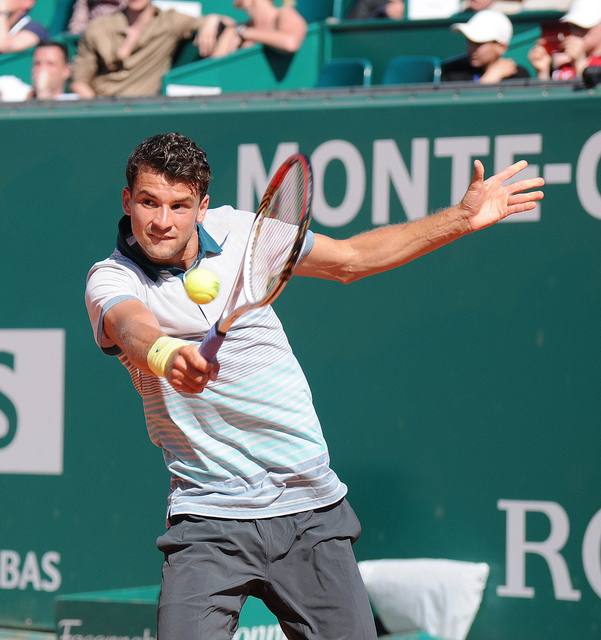
    Dimitrov at Monte Carlo

    Highly touted Bulgarian star-in-waiting Grigor Dimitrov has won his first tournament on the ATP World Tour by defeating Spanish veteran David Ferrer, 2-6, 6-3, 6-4, at the If Stockholm Open.

    [divider]

    Cover Photo: Carinoe06, Creative Commons License

  • Living in a Blue World

    Living in a Blue World

    Stockholm, Final

    (7) Dimitrov d. (1) Ferrer, 2-6, 6-3, 6-4

    It is consistent with the ATP’s belated commitment to greater coherence that the European indoor season, which began this week in Moscow, Vienna, and Stockholm, now wastes so little time getting to the point. It was a move long overdue. If the season as a whole still makes little sense, constrained as it is by the timing of the Majors, at least the little mini-seasons that comprise it can achieve some internal logic. Now the European indoors is structured just like the Asian swing, as a three-week escalation from 250 level events, through a pair of 500s, and culminating in a Masters. The clay season and the US Summer are vaguely like that, too, and presumably the grass season would be as well if it only had more time.

    Nevertheless, I confess I miss the more amorphous proportions that the indoor season used to have. Whereas now it is crisply marketed and boasts a discernible shape, it was once baffling and went on seemingly forever, filling the back-end of the season with an indeterminate number of ghoulishly-lit, interchangeable events differentiated only by their trophies, which strove to surpass each other in their nightmarish modernism. It was kind of wonderful. You could tune in at any point and know what you were getting, yet rest assured that none of it mattered very much.

    Along with Basel’s dusted pink – now a confected memory – the hyperborean gloom of Stockholm was the season’s highlight, if that’s the word. It was thus with some disappointment that I tuned in earlier this week, and discovered that the Swedish tournament’s overall look has been sharpened. Since before I can remember it has been so unrelievedly blue that it left viewers in no doubt that the spectacle before them was taking place somewhere very northern and very cold. The way the image seemed to darken and grow fuzzy at the edges helpfully evoked the sensation of freezing to death. Perhaps it was merely an issue with the coverage, not helped by the time difference that ensured I was always watching in the smaller hours of the following morning. Sadly, although the court is still blue, the colour has deepened, and the space around it has been recoloured green, thus helping it look rather like a lot of other tennis courts. Thankfully Stockholm’s other trimmings have remained untrimmed, including the net contraptions used by the ball kids – why are these not used everywhere? – and a trophy that looks like one of Dr No’s discarded doomsday devices.

    This device – I am assured its depleted palladium core has been removed – is now in the possession of Grigor Dimitrov, his reward for becoming the first Bulgarian supervillain ever to win a tour title. His victory also completed a rare day of triumph for one-handed backhands and vindication for the select group of men who’ve rightly or wrongly been dogged by comparisons with Roger Federer. Dimitrov is merely the latest to be burdened by the title “Baby Fed”. The original Baby Fed, you will recall, was Richard Gasquet, who an hour earlier recovered to defeat Mikhail Kukushkin in the Moscow final. Tommy Haas was spared the dubious Baby Fed accolade through being older than Federer. Instead, for large parts of the last decade he was held up as an example of stylish potential untapped, of what Federer might have been had it not all worked out so well. The irony, if we can even call it that, is that Haas this year has won twice as many titles as Federer: two. Maybe it isn’t irony, but it is somewhat miraculous, given Haas’s age. During the trophy presentation Robin Haase remarked that he himself might have been the thirty-five year old, while the German could pass for twenty-five. “If you only knew,” replied Haas.

    Both Gasquet and Haas recovered from a break down in the final set against sporadically inspired opponents, eventually claiming their titles within about ten minutes of each other. Initially it appeared unlikely that Dimitrov would reprise this pattern. He and David Ferrer commenced the Stockholm final in the traditional manner of fast indoor tennis, by breaking each other constantly. Dimitrov quickly wearied of this, though Ferrer didn’t, and soon won the first set. Mostly this was achieved through the universally-applied tactic of directing everything at the Bulgarian’s backhand, though it would be unfair to suggest that it ever truly broke down. Indeed it held up admirably through the tighter second set. Ferrer had by now tired of breaking as well, though he was developing a fondness for unforced errors, and lost his serve late, and then the set. The stage was thus set for Dimitrov to fall down an early break in the deciding set, and then storm heroically back. Sadly, for Ferrer and for those of us pointlessly hoping that all three finals would play out almost identically, Dimitrov was never quite broken, though it was a near-run thing. Instead, again, it was the top seed Ferrer who found the crucial error at the worst moment, and double-faulted to give away the break. Dimitrov served it out, and commenced his celebration routine.

    He began his year by reaching his first tour final in Brisbane, then characteristically lost his way. I was sitting with his old coach and manager as he fell dismally to Julien Benneteau in the first round of the Australian Open – a meticulously rendered example of a backhand crumbling apart – and could hardly have imagined that of the two men Dimitrov would be the first to win a maiden title. One of course should not underestimate Benneteau’s capabilities in this area, especially after Kuala Lumpur. The real risk is that after Stockholm we’ll overestimate Dimitrov. He has always attracted heightened expectations, especially in an era in which the next big things have proven slow to appear.

    Presumably his new coach will help with that. Stockholm was Dimitrov’s first tournament with the ineffable Roger Rasheed, “ineffable” in this case denoting that species of incomprehensibility that contrives to sound meaningful. Rasheed’s gift for impenetrable neologism is of course legendary, and certainly hasn’t gone unexamined in these pages. In the case of Dimitrov, however, I can see its legitimate value: by having to focus so hard on deciphering what Rasheed is saying he ensures that his mind remains empty of whatever it is usually filled with. Rasheed thus stands revealed as a kind of Zen master, with corporate-calibre motivational aphorisms taking the place of Om.

    Beyond his capacity to spout claptrap, though, Rasheed is nothing if not a taskmaster, and notoriously intolerant of any player giving less than his best. His true value will be in addressing those periods, altogether too common, when Dimitrov decides not to bother. Everyone looks good when he’s playing well, and Dimitrov looks better than most. It’s what happens when you’re playing badly that counts. Yesterday in the semifinal he came back from a set down, though admittedly that was against Benoit Paire. But today he recovered from a poor start against Ferrer, and held his nerve admirably through a tight final set. Afterwards Dimitrov insisted that he was happier with his perseverance and resilience than with the actual silverware. I can’t say how true that is – it sounds like the kind of sentiment Rasheed would endorse, although he’d certainly use different words – but I suspect it is at least partially the case. In any case, one can hope.

  • Reliably Inspirational

    Reliably Inspirational

    A fine third day at the Cincinnati Masters yielded the best selection of professional men’s tennis matches in months. As ever in North America this wondrous congregation of talent was witnessed by a formidable array of half-empty stands. Even by the night-match, which featured Roger Federer, the stadium appeared barely two-thirds full. For some reason, Americans collectively find it hard to get excited by a tennis tournament until the later rounds, an apathy shared by their main television networks. CBS doesn’t even show up to the US Open until the last weekend, which it then more or less ruins for everyone. It won’t grace Cincinnati until the last Sunday, while even ESPN won’t trouble itself until Thursday. In the meantime there’s the redoubtable Tennis Channel, as ever a mixed blessing. On the one hand live coverage is hard to fault. On the other hand there’s Justin Gimelstob.

    It could be that the long decades of dominance have taught the American sporting public to assume that their countrymen will always feature in the later stages. Why trouble yourself earlier? We Australians long ago learned to cease making such assumptions. If we want to see our compatriots, we tune in early, preferably for qualifying. Now that there are no American men inside the top twenty, it might be wise for them to do the same. Of course, it could be that from my current vantage, precisely one Pacific Ocean and half a continent away, I’m totally misreading it and Cincinnati’s stands are actually jam-packed. Perhaps it’s merely a trick of the telecast: as well as adding twenty pounds, the camera subtracts a thousand spectators.

    [divider]

    Dimitrov d. Baker, 6-3, 6-2

    CBS and ESPN viewers certainly won’t catch any sight of the reliably inspirational Brian Baker, who today went down easily to Grigor Dimitrov. This is a shame, since he’s worth watching and hasn’t been spotted in months. Having cruelly fallen in the second round of this year’s Australian Open – on a day of sustained carnage his injury was at once the worst and the least surprising – Baker was away from professional tennis for almost seven months. Numerically-gifted readers will note that this is the same amount of time that Rafael Nadal missed. Baker’s absence generated considerably less interest. Of course, Baker being absent from the men’s tour is hardly remarkable; it has been one of the constants of professional tennis for the last decade, like top four domination, or the microwave radiation that saturates the cosmos. The anomaly wasn’t that Baker was away, but that he had – and has – returned.

    Naturally, I’m pleased he has, since I enjoy the way he plays: at his best slightly reminiscent of Nikolay Davydenko in a way that Davydenko himself rarely is anymore. Beyond that, though, I enjoy the way Baker encourages me in my fantasy that he’s a club player on history’s greatest roll. The truth of the matter is decidedly different, if not completely opposite – he is a talented pro who has had to do everything the hardest way, and whose body boasts only slightly less metal than Wolverine’s. But I still experience a slight thrill every time he puts away a simple volley. Good for him, I think, knowing I might well have duffed it into the back fence.

    Sadly today he missed too many simple volleys against Grigor Dimitrov, along with just about everything else. It was probably to be expected. Given his modest earnings over the years, it’s not as though he could afford authentic adamantium for his metal joints. He was compelled to go with cheaper base metals. Rust was thus inevitable. As is often the case it doesn’t cause a consistent loss of quality so much as wildly oscillating inconsistency. Baker comfortably saw off Denis Istomin yesterday, but might not have today given the chance. Instead he faced Dimitrov, for whom the phrase “wildly oscillating inconsistency” might well have been coined. Still, he was on his game today, and looked a clear class above his opponent. Baker will get better. For now it’s just a pleasure to see him back, and a pleasant surprise to see he still boasts a full complement of limbs. His matches are only ever one mishap away from recreating the Omaha Beach scene from Saving Private Ryan.

    [divider]

    (3) Ferrer d. Harrison, 7-6(5), 3-6, 6-4

    Speaking of Private Ryan, or at any rate Senior Cadet Ryan, Harrison managed to lose his nineteenth straight match to a top ten opponent a short while later, against a curiously vulnerable David Ferrer. The Spaniard’s lofty ranking was only apparent from the number next to his name, and not from the quality of his play. The Spaniard has been injured for some time, and has barely looked himself since Roland Garros. If ever Harrison was going to beat him, it was today. Still, the American might take some solace from getting so close: he led by a break in the third set, and was briefly magnificent in breaking back late in the match. One doubts whether he will be consoled by that, however, since he continues to give a strong impression that he hates losing far too much to find it merely instructive. The game in which Harrison was broken back in the final set featured an ace clocked at 152 mph, as they measure such things in the Cayman Islands, or 244 kph as measured elsewhere. If this was an accurate reading, then it would be the seventh fastest serve of all time. But I doubt whether it was an accurate reading. The serve even had topspin on it.

    [divider]

    (5) Federer d. Kohlschreiber, 6-3, 7-6(7)

    Roger Federer rounded out the schedule by defeating Philipp Kohlschreiber for the seventh time, so far without a loss. Neither man appeared to be brimming with confidence, and based on their combined unforced error of sixty-five they had every reason not to be. Federer thoughtfully commemorated each of his previous six victories over Kohlschreiber with a squandered break point early in the first set: performance art of the very highest order, as Robbie Koenig might say. But he mostly served well himself, and broke in Kohlschreiber’s next game. Even if Federer somehow defends his Cincinnati title, he won’t be reprising last year’s heroic effort, in which he took the event without ever dropping serve. He gifted a non-crucial break away in the second set, a favour the ever-courteous German repaid immediately. They went back to scrappy holds. Mercifully this couldn’t continue indefinitely, and the tiebreak came around. A match that had been defined mostly by forehand errors thus found its apotheosis. Federer led by 5-2, then saved a set point at 7-8 with an out serve. He finally took the match on his second match point, ironically with a forehand that landed in, a development so miraculous in the circumstances than Kohlschreiber could merely stare at it, dumbfounded.

    [divider]

    In other news, Feliciano Lopez won his first Masters level match this year, over Kei Nishikori. Milos Raonic, the first Canadian player ever to enter the top ten, nearly became the first top ten player to lose to Jack Sock. Mikhail Youzhny and Ernest Gulbis turned up dressed identically, a deplorable faux pas that left the crowd aghast. All twenty-five of them.

  • Dimitrov shocks Djokovic in Madrid

    Dimitrov shocks Djokovic in Madrid

    Twenty-one-year-old Bulgarian Grigor Dimitrov defeated World Number 1 Novak Djokovic in the second round of the Mutua Madrid Open, prevailing 7-6 (8-6), 6-7 (8-10), 6-3 in a shock upset.

    A tight first set saw the young Bulgarian save a set point at 5-4, with Djokovic sportingly challenging a poor line call on behalf of his opponent. Dimitrov held serve before going on to clinch the tiebreaker, where he had to save further set points coming from 4-6 down to win the breaker 8-6.

    The second set was equally hard fought, with both players exchanging breaks before the Serb #1 won a closely contested tiebreak (10-8).

    Heading into the third set decider, the momentum was with Djokovic, but only very briefly. Roared on by the Spanish crowd, Dimitrov made his big statement, breaking Djokovic early, and hanging on to take the set 6-3, claiming his biggest career scalp to date.

    Dimitrov, an accomplished junior who won both the US Open and Wimbledon junior titles in 2008, has long been considered a future star of the sport. Recently, he laid down a marker of intent by pushing Rafael Nadal all the way in a tough match in Monte Carlo.

    Today he went one better, in what will be seen as a significant breakthrough.

    Click here to discuss this and more with fellow tennis fans on our discussion board.

  • Young Guns, Players to watch in 2013

    Young Guns, Players to watch in 2013

    Below are ten players age 24 or younger that could be risers in the rankings and bear watching. They are ordered by current official ATP ranking (as of March 4th), and thus before Indian Wells. I’m also including their birth month and year in parentheses.

    #16 – Kei Nishikori (12/89) – Kei made a big leap in 2011, going from #98 to #25, but his rise was slower in 2012, finishing the year just six ranks higher at #19. But remember that he missed the French Open, as well as Madrid and Rome, so any points in those three tournaments should help his ranking. Like Milos Raonic, Kei is a good candidate to challenge Janko Tipsarevic and Richard Gasquet for a spot in the top 10 this year and should at least become a player regularly ranking the #10-15 range.

    #17 – Milos Raonic (12/90) – Milos cruised up the rankings last year, from #31 to #13. He’s been holding steady in the mid-teens so far this season and hasn’t quite had that breakthrough performance, making it the 4R at the last two Slams and never going past the QF at an ATP 1000. Milos has played seven finals, winning all four ATP 250s and losing all three ATP 500s. Raonic is as good a candidate as any to play spoiler at a Slam or even contend for an ATP 1000, but he doesn’t seem to be able to get over the hump…yet. When he does he could be a similar player to Juan Martin Del Potro at his best.

    #22 – Alexandr Dolgopolov (11/88) – Talk about an enigma. Alexandr looked like he was going to rise quickly when he made it to the QF of the 2011 Australian Open, but has been erratic since. Sometimes he looks like a top 10 player, sometimes he goes out in the first round of a tournament. He finished 2011 at #15 and 2012 at #18; he’s now #22, so the trajectory is not a good one. He needs to straighten things out – he’s going to turn 25 at the end of the year, so he should be playing at his best by now. That said, I see him more in the Gasquet/Cilic mold – very talented, but probably not a regular in the top 10.

    #24 – Jerzy Janowicz (11/90) – Jerzy bust on the scene last year by making it to the final of the Paris Masters, plowing through Andy Murray and a few other top 20 players before David Ferrer taught the youngster a lesson. He followed up with a solid Australian Open, losing in the 3R to Nicolas Almagro. Jerzy is somewhat similar to Milos Raonic: A big man with a big serve, although his serve isn’t as good as Milos’s. That said, his overall game might be as good or better. Like Raonic, he could be a spoiler this year. I think he’ll have his ups and down but will finish the year in the top 20, maybe higher, and have a chance for big things in 2014.

    #29 – Martin Klizan (7/89) – Martin Klizan, you ask? Well, he had a strong performance at the US Open last year – making it to the 4R – and then following it up with an ATP 250 win in St Petersburg, defeating Fabio Fognini. Klizan won’t be an elite player but he could be a perennial top 20 player.

    #31 – Grigor Dimitrov (5/91) – Ah, Grigor, what a tease. He still hasn’t gone past the 2R at a Slam, but has risen about 30 spots in each of the last two years, finishing 106, 76, and 48 in 2010-12, and already has risen half that in this early season. Baby Fed is talented, although probably not talented enough to live up to his nickname. But I can’t help but like him – he DOES have some of Roger’s smoothness, and he’ll occasionally offer a backhand and/or dropshot reminiscent of the Great One. But let’s look at Dimitrov for what he is: A rising talent, but probably not an all-time great. At almost 22, it may be a bit too late for that. But I do have high hopes for Grigor. I think he could be one of a few players–along with Raonic, Janowicz, and Tomic, maybe one or two others–that will start taking tournaments from the Big Four in the next two or three years as they begin to age. In other words, a 21-year old Dimitrov might not be a challenge for a 25-year old Djokovic, but a 24-year old Dimitrov might challenge a 28-year old Djokovic.

    Expect Grigor to firmly place himself in the top 20 by the end of this year, and perhaps vie for the top 10 next year. He may not be a future #1, but in another two or three years he could be one of the 5-10 best players in the game.

    #40 – Benoit Paire (5/89) – For some reason I pair Paire (pun intended) with Klizan. Both will turn 24 in a few months, both seem to have similar upside – top 15-20 at best. Paire hasn’t won a tournament yet, although has made it to two ATP 250 finals, most recently losing to Richard Gasquet in Montpellier. Paire has yet to make it past the 3R at a Grand Slam and most recently went out in the 1R in Australia, so he needs to up his game a bit at the Slams.

    #45 – Bernard Tomic (10/92) – The second great tease of this list. Bernard is one of the few players on this list that actually took a slight step back in the rankings, finishing 2011 at #42 and 2012 at #52. But that’s largely due to the fact that he made it to the QF of 2011 Wimbledon, although had an overall slightly better year in 2012 – and certainly played a fuller schedule. i think Tomic is ready to rise up the rankings and, like Dimitrov, could end the year in the top 20. He could suprise, though, and make it to another Slam QF this year.

    #54 – David Goffin (12/90) – I can’t help but like David Goffin. He started on the tour late, but made his mark last year by making it to the 4R at the French Open and the 3R at Wimbledon. But he only played in three ATP 1000 tournaments, and only made it past the qualifications once, so this year could see a lot of points added. I don’t see an elite player but, like Klizan and Paire, he could find himself a regular place in the top 20.

    #83 – Evgeny Donskoy (5/90) – He’ll be 23 soon, but he bears watching. Why? Well, in his first Slam that he made it past the Qualifications, he made it to the 3R, defeating Adrian Ungur and then Mikhail Youzhny before losing to Kei Nishikori. Yesterday he defeated Tatsumo Ito and will face Andy Murray in the 2R at Indian Wells, so his journey likely ends there. But again, he bears watching. He could rise quickly and enter the top 40-50 in short time.

    Bonus player…

    #330 – Nick Kyrgios (4/95) – Nick Kyrgios? Well, he’s 17 years old and is the highest ranked teenager in the ATP Race Ranking right now, which isn’t saying much but says something. He won the boys event at the AO and is now on the men’s tour. I know nothing about his skills but it is hard not to take notice of a 17-year old on the tour…let’s hope he does well!

    Honorable Mentions – Ryan Harrison, Jack Sock, Rhyne Williams, Matthew Barton.