Tag: french open

  • Nadal Wins Record 11th French Open Title

    Nadal Wins Record 11th French Open Title

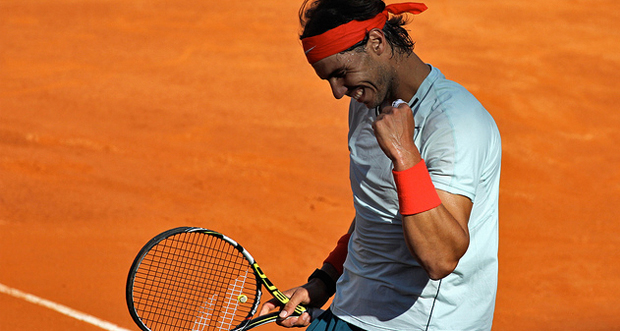
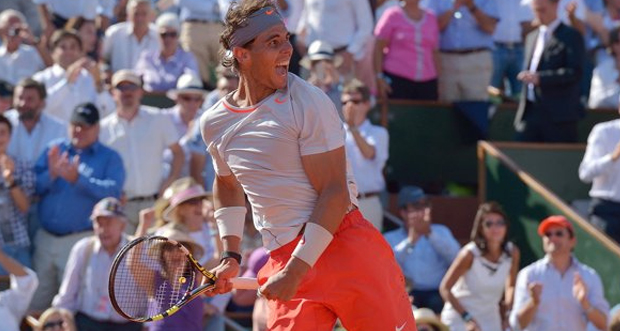
    Rafael Nadal’s unprecedented domination of the French Open continues with a 6-4, 6-3, 6-2 win over Austrian Dominic Thiem.

    Thiem, playing his first major final had the toughest assignment in tennis – beating Nadal on the hallowed dirt of Roland Garros over five sets. The Austrian entered the match with 3 previous wins on clay over Nadal, and while still a heavy underdog, was regarded as the best available contender.

    http://gty.im/971468832

    The 25 year old Austrian made a valiant attempt but was ultimately second best in all departments as Nadal extended his grip on the Roland Garros to 11 wins.

    Nadal leaped out to a 2-0 lead before Thiem battled back with a break of his own to level the score at 2-2. The set stayed on serve until Thiem was serving at 4-5. A poor game littered with unforced errors handed Nadal the first set. Losing the first set was not a good omen for the Austrian. Nadal has a 95-0 record when capturing the opener on clay in a best of five format.

    With the first set in the bag, Nadal loosened up and won the second set fairly convincingly. The biggest test for him came early in the third set with the onset of cramp in the left thumb. A massage and a salt pill helped put him back on track to see out the match and claim another historic title. The Spaniard wrapped proceedings up in two hours and 42 minutes.

    http://gty.im/973492918

    The win meant Nadal matched Margaret Court’s record of majors at a single event but the Spaniard’s is the more impressive. Court’s major title wins took place at the Australian Open in an era where some of the top players elected not to travel Down Under.

    The title gives Nadal a total of 17 majors, moving to within 3 of long-time rival Roger Federer. The Swiss elected to miss the clay court season and hostilities will be renewed at Wimbledon.

    http://gty.im/971537056


    Featured Image Photo by Marianne Bevis

  • My Journal Essay: Andy Murray

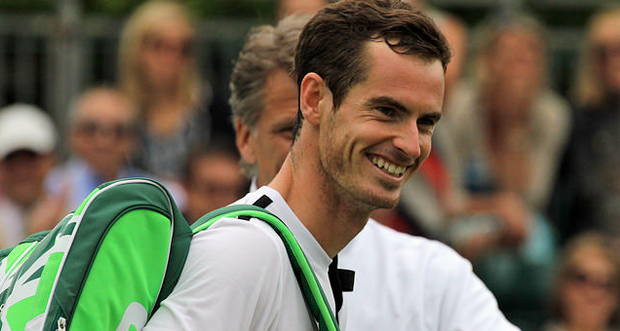
    My Journal Essay: Andy Murray

    Andy Murray

    By Martin Young

    While the dust settles on the remarkable milestone of Novak Djokovic winning the French Open and thus becoming one of only 5 men in the modern era to win all 4 major titles, and being the first man since Rod Laver to hold all 4 at the same time it would be easy to overlook the relative achievements of his opponent at Roland Garros and his own story and legacy, not least because it is actually likely to be one the key factors in Djokovic’s own story and legacy…

    Let me explain!

    Ever since Murray had a breakthrough summer in 2008, the most pertinent question from analysts and tennis fans is to ask whether or not there was such a thing as the ‘big 4’ or a ‘big 3 + 1’ in men’s tennis.

    Whilst to those outside the inner sanctum of the game, this might seem like a pointless discussion for board posters to debate, to those who live and breathe the sport it is absolutely at the heart of how Murray and his legacy will be remembered long after he retires and crucially how we will order Djokovic, Nadal and Federer and everyone else worthy of inclusion.

    For Murray, at face value 2 slam titles an Olympic Gold and a Davis Cup win, suggests a player who on his day was able to produce the goods but in the main was never really a force to be reckoned with. Since the mid to late 70’s and early 80’s right through today, the players we remember with such fond nostalgia are all players with multiple slam titles across various surfaces and define themselves and their era not just with the titles they won, but who they beat to win those titles. The list is a who’s who of men’s tennis and seamlessly demonstrates the evolution of the game across the sporting generations and evokes memories of rivalries and their names are synonymous with greatness. From Connors, Borg, Vilas, McEnroe, Wilander, Lendl, Edberg, Becker, Courier, Sampras, Agassi, Federer, Nadal through to Djokovic, 40 years of Tennis evolutionary history is appropriately defined just by this roll call of names.

    So why is Murray important to this discussion? His record of wins certainly does not merit inclusion in the above roll call but when you look beyond just the win column you realise that here lies a unique player who deserves a wide lensed appraisal of his career, not only as stated for helping to decide where Djokovic sits but also to ensure that Murrays own place in history is understood and appreciated appropriately.

    So how to go about this? Stats? References? Technical appraisal? Even gut? Perhaps a mixture of all, or perhaps none – I mean as I write this it is clear to me that I have formed my own opinion already but am I doing this for you the reader to agree and to convince you of some unknown truth or am I using this piece to help me justify what I already believe???? It is important at this point to make you aware that I am a big Andy Murray fan and have been since he won the US Open Junior title in 2004. As a Scotsman who was more of a watcher than player, I’d actually heard of the Murray brothers even before this win – there really was not much a precedent of any kind of success in Scottish tennis so naturally among those that were involved we invested early and at every stage through the Junior ranks he continued to deliver and “we” (“we” being the collectively small band of tartan tennis fans – and when I say “fans”, I mean the true fans like you !!!) continued to invest. This very day I sit dejected after watching Murray being well and truly defeated by Djokovic but instead of lamenting his play in sets 2 & 3, or bemoaning his bad luck to be playing in this era I feel compelled to get under the bonnet (or hood if you are not Anglicised) of what I have thought for a long time and that is, the feeling that the world of tennis continues to ‘under-appreciate’  Murray the tennis player, Murray the man and thus the legacy he will leave on the sport in a global sense.

    The complexities of sport often boil down to the binary and in 1 vs 1 tennis this truly is the case – there are probably fewer sports where this is more pronounced – even in the top individual athlete sports, there are few that really follow the seeding/ranking like men’s tennis where the best are the best and they have to prove it by beating the best with so little room to hide. So when you boil down the numbers: 2 GS, 1 Olympic Gold, 1 Davis Cup and a career high ranking of 2, it makes the case for Murray being considered for the era defining list much much harder.

    So beyond the emotional investment that I made early in this Scottish sportsman, there has to be something else that leads me to believe that he has a place amongst the pantheon of evolutionary defining tennis greats? Or am I gripped with blinkered fandom? Am I seduced by nationalistic pride? Is it that I feel some kind of need to protect the now not so young man from the cruelty of tennis fans who I believe under-appreciate his tennis but also don’t appreciate the virtues of the man himself?

    Well clearly it is all these things, but to understand it and admit it is not to say my argument is wrong. Before delving deeper into the tennis, I feel the need to exhort the virtues of the man and to counter his critics. Humility, awareness, preparation and his insatiable work ethic are all on display and known by most. His humour is perhaps less obvious to the casual observer as he is quite introverted when in public, due in part to his nature and also in part to being very unfairly portrayed as anti-English by UK tabloid media when still a teenager – but still to those in the inner sanctum of the game his humour and likability is no secret. The biggest virtue that perhaps gets missed or misunderstood with Murray is his honesty. This honesty can easily be seen through his work ethic, his preparation and that insatiable need to get better and better but it is honesty on the court that actually makes him very appealing to me and very unappealing to many people. He shouts at those in his box, he berates them when things are not going well (even when things in the grand scheme of things are actually going pretty well!). But herein lies the absolutely stripped bare honesty of the man. He is not berating those in his box, he is 100% berating himself – they are merely the face of his own self-loathing and his fear that he is not able or worthy to execute the detailed plans they have collectively agreed on and put in place. There are many who are put off by his ‘antics’ on account of taste and decency; there are many who are put off as it is seen as disrespectful to those on the team. I am not saying anyone is wrong if they feel like this but they perhaps don’t appreciate that this is pure honesty and it is all directed at his own need to try and be the best he can be. The manifestation of this virtue is actually something that many in Scotland and the UK actually understand and ultimately appreciate – it’s the raw and obvious human imperfections that draw us in.

    It is actually something that is acutely juxtaposed with Novak Djokovic and is very interesting as he also pursues his legacy. Has a top tennis player ever tried as hard to be liked on the court as much as Novak Djokovic? He works the crowd so beautifully (apart from the now very occasional outburst) when playing and being interviewed (very often in local tongue), he is polite, humble and in the case of the rare defeat is always very gracious in praising the good play of his opponent – You could construe me mentioning this as being the juxtaposition of Murrays honesty and think in some way I am calling what Djokovic does as fraudulent. This is absolutely not the case instead it is actually a reflection of how 2 men playing the same sport born a week apart are at very different points in their career and pursuit of legacy. Murray probably feels like he has under-achieved, not necessarily because he has, but because he pursues perfection and does so not to enjoy winning but because of the hatred of losing. Novak on the other hand has moved on from this and instead of being driven by a fear of losing he fights a different battle. That is because no matter how hard he has worked, what talent he has displayed and what wonderful achievements he has to date, there probably hasn’t been a commensurate amount of love and recognition thrown his way from the casual fan right through to the diehard tennis fan. That he isn’t Federer or Nadal is not his fault, but you can sense it is actually what drives him. Murray will get the love when playing in the UK and that is obviously a boost, but love is not what he seeks – he seeks his own perfection and unless that comes in the next few years it will not be the pursuit of love but the honest management of his own self-loathing that will drive him on.

    So that’s Murray the man, and although it is cathartic to write this and to perhaps offer a view of him that makes people think differently it really doesn’t do anything in isolation to make a case for his place in the pantheon of greats… So what about Murray the player? Technical advances in equipment and surfaces make comparisons across the eras difficult (and potentially foolhardy – I have no doubt that the vast majority of people taking the time to read this actually have better appreciation of technique than I have)!   Nonetheless I will forego the fear of ridicule and give it a go!

    He possess incredible reflexes and anticipation on the return of serve, so often getting the ball in and deep off first serve.  His ability to immediately take the upper hand on second serve makes him a physical and mental nightmare for a lot of players. His defensive positioning and anticipation are perhaps only ever bettered by Djokovic himself. His 2 handed crosscourt backhand has depth, bite and metronomic reliance – these skills allied to a very good in-match tennis brain makes him make a top player in this era and I believe would match up very well with any player in that list above. Like any top player of any era he has no major weaknesses in his game though his DTL forehand and recently his DTL backhand (a previous strength) can go missing at big moments – and he also has a huge differential between his A game serving and his B/C game serving (perhaps more so than most at the top level) – but again these are not particularly new or insightful observations and again don’t help me make or break the central case, merely they help in painting the landscape.

    So what really underpins the central argument has to come down to the numbers, but instead of boiling them down to the bones, perhaps I can sway the argument with a gentle reduction to bring out the hints of flavour.

    There are perhaps more elegant ways to portray the numbers, but to you the sports fan I think I can just as easily and effectively list the salient achievements and key points to articulate his legacy beyond what we know from above:

    • 10 Slam finals reached – In all finals he has either faced Roger Federer (0-3) or Novak Djokovic (2-5) unarguably 2 of the greatest players to have ever played the game. This has him equal 12th in the open era with Boris Becker
    • Equal 10th all-time on the number of semi-finals at 19 (with McEnroe, Edberg, Emerson and Crawford) – Equal 8th in the Open era
    • Finalist at all 4 slams – Only 10th man to do so
    • 10th on the Open era list of Masters series titles with 12 when reaching a Masters series final (18 times), he has only been beaten 6 times (5 by Djokovic and once by Nadal – exactly the same winning record against each opponent in reverse – beaten Djokovic 5 times and Nadal once)
    • The ‘weight of a nation’ factor though difficult to judge, clearly had some kind of effect on him – his conversion rate of Masters finals (though clearly not as important as slams) of 12-6 vs his slam success rate of 2-8 suggests that he has not fulfilled his potential at the crucial points in those biggest of big matches and that some demons exist.
    • All of this at a time when his main competitors are not just fighting for their legacy to be considered alongside the very best, they have fought and continue to fight to be considered the very best of the best. Perhaps the challenge of this era has spurred Murray onto a performance level that he otherwise would never have reached or perhaps being part of this era has deprived him from the wins that he otherwise would have got? Who knows?

    Perhaps this is the appropriate moment to summarise the argument and come full circle back to the question that I think is rightly posed by many about Murray and his position in the ‘Big 4’. It is perhaps that inability to have done it enough times at the biggest of big moments that will ultimately define Murrays place in tennis history. Just 2 or 3 more conversions and there wouldn’t really be the need to debate – instead there is a pantheon of open era greats with 14 tennis gods inside and Murray, as has so often been the case in all of these hypothetical discussions, is leading the charge of those on the porch banging the door to get in. In other words there is not an open era ‘big 15’, there is instead the big 14 + 1, but 1 who perhaps still has some time left to get a few more slams and force through the door to take his place with everyone else or else could always remain that unique outlying enigma as the best of the rest…

    So where does that leave Novak? Ok this piece is clearly about Murray, but when Novak’s career does come to an end it is likely that the majority of his achievements will have come at a time when Murray will be his primary challenger. And should he get close to, equal or surpass Roger Federer’s titles it might just be that Murray’s inability to have won more against Djokovic, might ironically actually be the most compelling argument against his own place at the very top of that list. That is to say the success of Andy Murray is arguably the most important factor in where Djokovic sits in terms of overall greatness.
  • French Open Final: Djokovic The Favorite But Don’t Rule Out Wawrinka

    French Open Final: Djokovic The Favorite But Don’t Rule Out Wawrinka

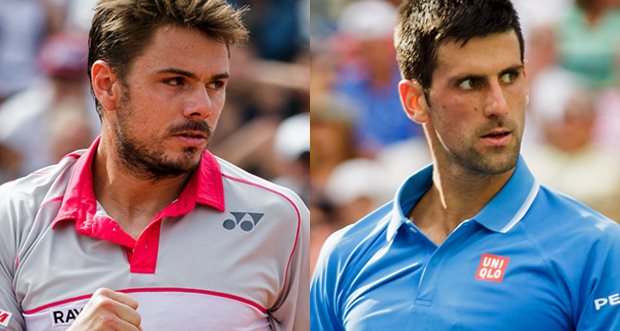
    Novak Djokovic Stan Wawrinka Roland Garros Final

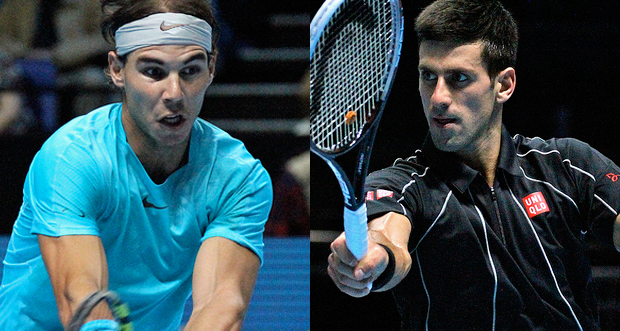
    The men’s French Open singles final will have the first-seed Novak Djokovic facing the eighth-seed Stan Wawrinka. Djokovic is playing his third final at Roland Garros, and is aiming for his first title there, completing the Career Grand Slam. And he’s already defeated the nine-time French Open champion Rafael Nadal, the man who ended his title dreams the last three years. So, this is maybe his best chance to finally win the French Open; surely the World No. 1, who is undefeated on clay this year, must be the favorite.

    After a dominant three-set win over Nadal in the quarterfinal, Djokovic had a tricky semifinal match against Andy Murray. After two sets it seemed like it was going to be an easy win for the Serb but Murray fought hard and leveled the match at 2-2 before playing a weak fifth set that Djokovic won 6-1. Murray’s great defense was causing trouble for Djokovic as it was hard to hit through or try to approach the net.

    [divider]

    Click here to discuss the Djokovic/Wawrinka Roland Garros Final in the discussion forum.

    [divider]

    The final opponent, Stan Wawrinka, is a completely different player to Murray. Wawrinka doesn’t have the defense of Murray but he hits heavy groundstrokes and will test Novak’s defense. And despite that he’s usually lost, Stan has played some of his best matches against Novak. Since 2013, they’ve met four times at slams, on the hard courts of the Australian Open and the US Open. All those meetings were five-setters with Stan winning the 2014 Australian Open quarterfinal, his first win against Novak since 2006.

    I think the situation here is ideal for Wawrinka. The surface plays into Stan’s hands. A slow hard court like at the Australian Open is Novak’s best surface and Stan has troubled him there. Clay, on the other hand, is the most comfortable surface for Stan. And despite Novak having eight Grand Slam titles compared to Stan’s one, it’s Novak with the big pressure here. Stan is playing “only” for his second Grand Slam title; no matter what happens, he will still be a Grand Slam champion. Novak, on the other hand, is playing for the Career Grand Slam that he’s missed out completing the last three years. This may be mentally one of the toughest matches in Novak’s career. Compared to his two previous finals at Roland Garros, Novak is now the clear favorite, yet still he is facing a tricky opponent.

    The expectations for Wawrinka were high last year after winning the Australian Open. But he wasn’t able to play his best tennis, except only occasionally. Now he seems to be in a good form: he made the semifinals in Rome by beating Nadal in the quarters, and he’s been solid at Roland Garros, beating Roger Federer, for example. The semifinal against Jo-Wilfried Tsonga showed some of his inconsistency when he lost the second set from 4-3 up a break. But he also performed well under pressure, for instance saving all of Tsonga’s break points in the third set before taking it in the tiebreak. I believe Stan is capable of playing a good match in the final, forcing Novak to play his best tennis to win it. We’ll see how Novak can deal with Stan’s game. Of the big names he’s faced at Roland Garros so far, Nadal and Murray are completely different players to Wawrinka. Earlier this year on clay, Djokovic dropped a set to another big-hitter Tomas Berdych. Wawrinka’s power game requires Djokovic’s defense to be as great as it’s been this year.

    I am expecting Djokovic to win the final — he is simply the best player in the world now, also on clay courts, and very consistent. But if Wawrinka plays his best tennis, he’s dangerous. He feels comfortable on clay and can also hit through in slower conditions. We haven’t seen this match-up on clay in a long time so it will be interesting to see it tomorrow. If Stan plays his best tennis, Novak needs to bring his best to win.

    [divider]

    Cover Photo (Creative Commons License): mirsasha

  • TENNIS QUIZ: French Open Champions

    TENNIS QUIZ: French Open Champions

    7366883948_187559a62f_b

    Test your knowledge of the French Open! See if you can name every French Open champion since the Open Era began in 1968! You have to have all 48 champions in order! (For those of you who need to cheat a little bit, if you click on the year you can answer, the quiz will accept it. 😉 )

    French Open Men’s Champions
    French Open Women’s Champions

    [divider]

    Cover Photo (Creative Commons License): rocor

  • Unforgettable Forever

    Unforgettable Forever

    2014 RG Winner - Nadal III

    2014 Roland Garros Mens Final

    [1] Rafael Nadal def. [2] Novak Djokovic 3-6, 7-5, 6-2, 6-4

    Once, years ago, I heard a horse racing enthusiast quip that races aren’t really decided by the horses, or even the trainers or the jockeys, and certainly not by the owners, but by the finish line. Give that line a little nudge one way or the other, and you’ve crowned a new winner. Saturday, at Belmont Park, this moveable finish line was too far away for California Chrome, the horse trying to become the first to claim American horse racing’s illustrious Triple Crown since Affirmed won it back in 1978. It’s been a decade since a horse has even come close. In 2004 Smarty Jones won the Kentucky Derby and the Preakness, only to finish a heartbreaking second-place at the third and final race, the Belmont Stakes.

    Racing is hard on horses, even when they’re bred for it. Three months after his Belmont loss, at the ripe old age of three-years-old, Smarty Jones retired due to chronic bruising on his ankle bones, and has been happily siring expensive children ever since. The same spring that Smarty Jones first stood stud at Three Chimneys Farm in Midway, Kentucky—reportedly occupying the stall that once housed legendary Triple Crown winner Seattle Slew—Rafael Nadal won his first French Open. It’s uncanny to consider how long a single player has been winning at one of the world’s most elite tennis tournaments. As of today, the King of Clay’s record on the Roland Garros dirt stands at a whopping 66-1. Even if it turned out that all of the bones in his body are bruised and Nadal had to retire tomorrow, his record cannot be broken in less than a decade. It’s not difficult to imagine it standing forever. The finish line keeps moving, and—somehow— the Spaniard keeps crossing it.

    Unlike the five-set 2013 French Open semifinal contest between the then World No. 3 Rafael Nadal and World No. 1 Novak Djokovic, today’s match was not an unforgettable thriller. (It was, however, a good sight more engaging than last year’s final, even without the glow of the roadside flares.) Lasting four sets and three-and-a-half-hours, Nadal’s defeat of Novak Djokovic revealed no new secret plan of attack from either player. Apart from a fistful of break points near the end of the first set, the match wasn’t especially well-stocked with dramatic tension either. Each set was won by the man who played the better set, and that man was not difficult to identify. The match did feature its fair share of those time-warping ‘amazing gets’ and brilliantly angled forehands (Nadal) and backhands (Djokovic) that we’ve come to expect from the Rafole mash-up, but it also offered plenty of nervous errors and gloomy low patches. (In a combined effort, the world’s top two tennis players racked up 82 winners, 92 unforced errors, and 24,830 ATP rankings points.)

    For those entertained by impossible hypotheticals, today’s Roland Garros final made for good evidence that the best slam finals are often played in earlier rounds of the tournament, such as in last year’s semifinals, or this year in the first round, when the Frenchman Julien Benneteau lost to Facundo Bagnis 16-18 in the fifth. (By the by, if you’ve ever felt sympathy for Julien Benneteau—a 32-year-old player who has contested nine ATP finals and lost all of them—you’d do well to watch his reaction to winning Saturday’s doubles title with countryman Edouard Roger-Vasselin.) As commentator Mary Carillo put it, both Nadal and Djokovic were “feeling the burden of the pressure,” which is akin to feeling the pressure of the burden, or even the pressure of the pressure. (The burden of the burden?) However you describe it, the feeling is a heavy one, and can drag a tennis match down with it.

    Rafael Nadal, as we all know, was trying to defend his eighth Roland Garros title by winning his ninth, while Novak Djokovic was trying to earn his seventh slam title and complete the illusive Career Grand Slam. Aside from feeling the pressure, both men were, at one time or another during the match, feeling plain bad. Djokovic was in ill-humor, by which I mean his tummy appeared to be filled with nothing but bile, as was demonstrated to television viewers in an (unnecessarily) extreme slow-motion close-up shot at the beginning of the fourth set. [So etched in my mind was the image of the Serb vomiting bubbles onto the terre bateau, that I was startled to learn from John McEnroe’s interview of Nadal afterward that Rafa hadn’t even noticed Djokovic’s upset tummy. Such is the high-level of his internal-bloodless-warrior focus.] Furthermore, Djokovic is still tending to a wrist injury he earned some weeks ago, while Nadal has had kinesio tape running the length of his lower back for months. I wouldn’t be surprised to learn both men also suffer from chronic bruising on their ankle bones.

    Nadal’s back didn’t appear to hamper his play at all through the first three-and-a-half sets. In fact, Rafa appeared to be moving and hitting more freely as the match wore on. There were patches in the second and third sets where two-thirds of the Spaniard’s forehands looked to be kicking off the dirt within two or three inches from whichever line was farthest from his opponent (according to my sophisticated measurements). And his body serves were actually hitting Djokovic in the body (which could not have been good for the tummy). But then, midway through the fourth set, Nadal’s back did seem to seize up—either that, or he was, as he seemed to say later, seized by a sudden bout of nervous body-cramping exhaustion. Whatever it was, it caused him to serve poorly, double-fault, and stuff up an overhead on his way to returning his early break advantage to Djokovic.

    Then, two games later, after holding serve for 5-4, Rafa nearly caused himself grievous bodily harm with a vigorous, twisty fist-pump. His fans began to fear, and vigorously tweet, the likelihood of a fifth-set breakdown. But, despite almost upending himself on his way to his chair, Nadal’s body proved sound enough to win four of the next six points, enough to claim his ninth Coupe des Mousquetaires, his fourteenth major title. The Spaniard has now pulled even with Pete Sampras on the slam-title leader board, second only to Roger Federer.

    Twenty-four hours earlier, back in Elmont, New York, California Chrome finished the Belmont Stakes in a dead heat for fourth place. Horse racing is a brutal sport for many reasons, one of which is that only one horse is celebrated in the winner’s circle. Finishing second means nothing. Fourth means even less. The leaden hush that fell over the thousands of fans who’d gathered excitedly to watch history make itself in under two-and-a-half minutes was eventually broken by the bitter sound one of California Chrome’s distraught owners, Steve Coburn. When asked to say a few words after the race, Coburn succumbed to an all-too-human impulse to rail against the unfairness of life. His horse had worked so hard to win back-to-back races, and had been upset in the end by fresher, better-rested beasts who hadnt even run the earlier races. Non-contenders. Cowards. The rules, he said, at unfortunate length, ought to be changed.

    But, a part of the essence of sports is to provide a way for us humans to process the joy and heartbreaks of reality—which rarely proffers anything approaching a level playing field. Nadal and Djokovic are defensive-minded players who excel, as Carillo noted, at hitting “big shots from bad positions.” Tennis is hard on the body as it is. The way Nadal and Djokovic play makes it even harder, which is why it’s so impressive to see them reaching big tournament finals over, and over again. I’m not sure if it’s a testament to skill, or heart, or will, or talent, or what—but it’s, well, a big deal. And, unlike Coburn, as much of their essence as they put into crossing the finish line first, neither man is less than gracious in defeat.

    Today was no exception. Novak Djokovic must have been devastated to lose this final, especially since he has bested Nadal in the past four, one of which was on Rafa’s favorite surface. He must also have felt disappointed by the way it ended, with a double-fault. It’s a deflating point on which to finish a slam, even if it wasn’t an unfitting way to end that particular set of tennis. When Djokovic’s final serve was called long, the disappointment from the crowd in Philippe Chatrier was palpable. It was nothing like the grim silence that fell across Belmont Park when the well-rested Tonalist crossed the wire three horses ahead of the Triple-Crown-hopeful—Nadal does have some fans in Paris—but the crowd had thrown their full-throated support behind the Serb, and their man had fallen short. The match had come up short.

    But—and this was one of those moments in sports that I love, sentimental as it might be—the crowd moved beyond the match and into the moment. When Djokovic was awarded his runner-up plate he was given a massive ovation. It seemed to go on forever, and it brought the Serb to tears. Today wasn’t his day, but, he’s given tennis almost all his days, and there have been so many good ones. It was nice to see this greater effort recognized, and made me think of how few words there are in the English language express the bittersweet nature of reality; living and losing are so closely intertwined. Maybe there are more of these words in French, and maybe Djokovic used some of them when he delivered his poised speech to an appreciative crowd in that same language.

    The French crowd also gave Nadal—nine years their conqueror— a warm applause when he was awarded his trophy, complete with conveniently bite-able wings. After Novak Djokovic double-faulted on championship point, Rafael Nadal did as Maria Sharapova and Julien Benneteau had before him—he fell to his knees and he cried. It was an attitude of release as much as ebullience. Later, on the podium, before making his thank-yous in his signature admixture of English, French, and Catalan, Nadal listened to his national anthem and sobbed his heart out. This one clearly meant much. In words that gestured to the pressured burden, and burdensome pressure, of becoming a major champion fourteen times over, Rafael Nadal called the experience of winning his ninth Roland Garros title “unforgettable forever.”  It’s a redundant phrase, but l like it. (Sounds like a perfect name for the next Triple Crown winner.) And for Rafa’s sake, I hope it’s true. 

    Cover Photo (Creative Commons License): Marianne Bevis

  • Nadal Wins Record 9th French Open

    Nadal Wins Record 9th French Open

    2014 RG Winner - Nadal II

    Rafael Nadal won a record 9th French Open on Sunday, beating Novak Djokovic in the final, 3-6, 7-5, 6-2, 6-4.

    The first set went by the familiar script: nervy, anxious play from both in the first half dozen games. With Nadal serving at 3-4, Djokovic broke serve, then served for the set at 5-3. Despite going down break points, he finally held to get the first set 6-3.

    In the second set, they again held serve the first several games, until Nadal broke Djokovic when serving at 2-3. As happens so often with these two, Djokovic broke right back. After both holding serve the next few games, with Djokovic serving to stay in the set at 5-6, Nadal broke, and took the set 7-5.

    Gaining confidence, Nadal held, then easily broke Djokovic at the beginning of the third, quickly taking a 3-0 lead. Djokovic finally held in the fourth game, and had a break point in Nadal’s next service game, but the Spaniard held to take a 4-1 lead. After a long seventh game, involving multiple deuces and break points saved, Nadal finally held. In the following game, Nadal broke Djokovic’s serve, winning the set 6-2.

    By the beginning of the fourth set, Djokovic had become visibly ill, even being shown getting sick. Despite that, he held his opening two service games. After a series of errors when serving at 2-3, Djokovic lost serve. A straightforward next service game was expected for Nadal, however with his back showing signs of acting up, he lost serve, then Djokovic quickly held for 4-4. After a tough game to hold for 5-4, Nadal broke Djokovic’s serve one final time, with the Serb double faulting on championship point.

    It was Nadal’s record 9th French Open, and 14th Major, tying him in second place with Pete Sampras (Roger Federer has 17).

    [divider]

    Cover Photo (Creative Commons License): In Mou We Trust

  • Sharapova Wins French Open

    Sharapova Wins French Open

    2014 RG Winner - Sharapova

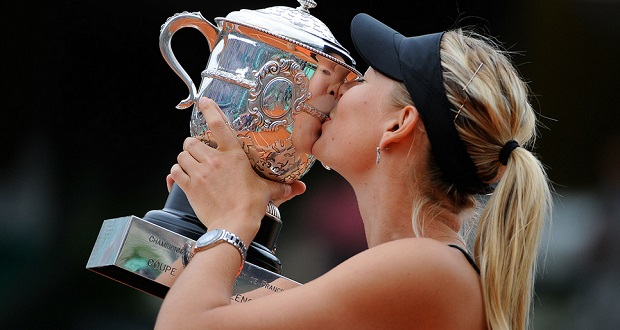
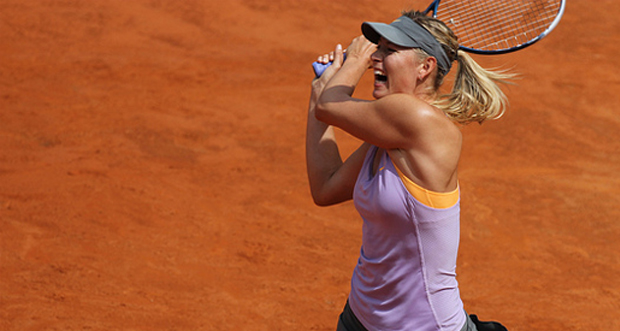
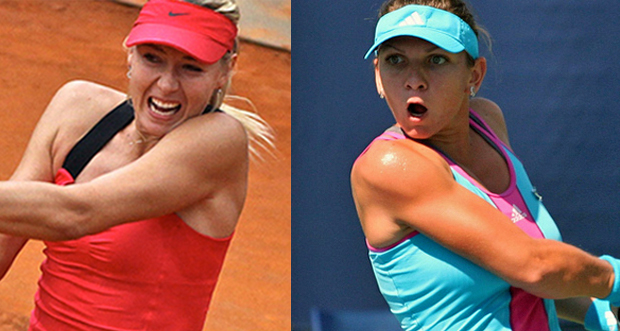
    In one of the best and most competitive women’s finals in recent Roland Garros history, Maria Sharapova defeated Simona Halep of Romania in Paris, 6-4, 6-7(5), 6-4.  It was Sharapova’s second victory at the French, her fifth Major title, but only the first one where she has repeated. (She won here three years ago.)

    For the 22-year-old Halep, it was her first Major final in a year where she has won seven titles and risen from No. 57 to No. 4 in the rankings. At the start of the match, it was the younger woman who seemed more calm and poised, where the veteran Sharapova showed signs of nerves. Simona broke Maria in the first game of the match, though the Russian broke back to level at 2-2. For all the excellent shot-making in the match and thrilling rallies, the serving was not especially fine, and the women traded five breaks of serve in the first set, six in the second, and the opening two games of the third.

    The young Romanian demonstrated a great deal of bravery and guile playing her opponent, but Sharapova is a fierce competitor. When the defending champion, Serena Williams, went out of the tournament in the second round, Sharapova became the favorite, and she is not one to let an opportunity pass her by. Less than a year ago, Maria had shoulder surgery, so the comeback from injury makes the victory even sweeter.

    [divider]

    Cover Photo (Creative Commons License): Marianne Bevis

  • Roland Garros French Open Day 15: Men’s Final

    Roland Garros French Open Day 15: Men’s Final

    2014 RG F - Men

    Day 15 of the French Open, at Roland Garros, features the Men’s Singles Final, and the Women’s Doubles Final.

    The day begins with the doubles final. The top two-seeded teams will face off on Court Philippe Chatrier.

    Next up, eight-time champion and World No. 1 Rafael Nadal plays World No. 2 Novak Djokovic in their second Roland Garros final. History will be made no matter who wins: For Nadal, the chance to become the only man in the Open Era to win a Major nine times; for Djokovic, the chance to complete the Career Grand Slam.

    [divider]

    Court Philippe Chatrier – 12:00 P.M.

    Women’s Doubles – Final
    Su-Wei Hsieh (TPE) (1) / Shuai Peng (CHN) (1) d. Sara Errani (ITA) (2) / Roberta Vinci (ITA) (2) — 6-4, 6-1

    Not Before: 3:00 P.M.

    Men’s Singles – Final
    Rafael Nadal (ESP) (1) vs. Novak Djokovic (SRB) (2)

  • Roland Garros French Open Day 14: Women’s Final

    Roland Garros French Open Day 14: Women’s Final

    2014 RG F - Women b

    Day 14 of the French Open, at Roland Garros, features the Women’s Singles Final, and the Men’s Doubles Final.

    First up on Court Philippe Chatrier is the women’s final. The finalists are four-time Major winner Maria Sharapova (7), who won here in 2012 and was last year’s finalist, and Simona Halep (4), the rising star from Romania, in her first Major final.

    The men’s doubles final will pair off a French team against a Spanish team. Julien Benneteau and Edouard Roger-Vasselin, of France, will play Marcel Granollers and Marc Lopez, of Spain.

    [divider]

    Court Philippe Chatrier – 3:00 P.M.

    Women’s Singles – Final
    Maria Sharapova (RUS) (7) d. Simona Halep (ROU) (4) — 6-4, 6-7(5), 6-4

    Men’s Doubles – Final
    Julien Benneteau (FRA) (11) / Edouard Roger-Vasselin (FRA) (11) d. Marcel Granollers (ESP) (12) / Marc Lopez (ESP) (12) — 6-3, 7-6(1)

  • Roland Garros French Open Day 13: Men’s Semifinals

    Roland Garros French Open Day 13: Men’s Semifinals

    2014 RG SF - Men

    Day 13 of the French Open, at Roland Garros, presents the men’s singles semifinals, and the women’s doubles semifinals.

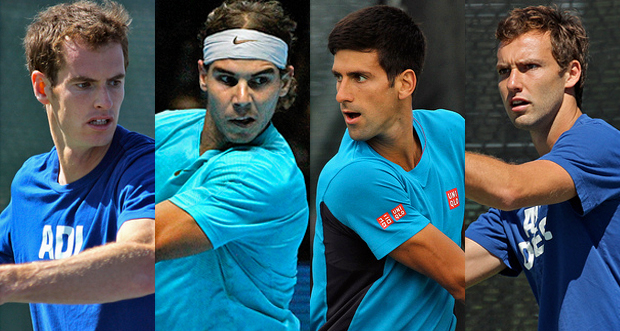
    On Court Philippe Chatrier, world No. 2 Novak Djokovic faces the big-hitting Latvian Ernests Gulbis (18), playing in his first Major semifinal. Following them will be eight-time champion and world No. 1 Rafael Nadal, who plays the 2013 Wimbledon champion Andy Murray (7).

    The women’s doubles semifinals will be played on Court Suzanne Lenglen. First up is the No. 1 seeded team of Su-Wei Hsieh and Shuai Peng, playing the Spanish team of Garbine Muguruza and Carla Suarez Navarro. The second semifinal features the No. 2 team, the Italians Sara Errani and Roberta Vinci, against the unseeded team of Lucie Hradecka and Michaella Krajicek.

    The full schedule for Day 13 is listed below (Results to follow)…

    [divider]

    Court Philippe Chatrier – 1:00 P.M.    

    Men’s Singles – Semifinals
    Novak Djokovic (SRB) (2) d. Ernests Gulbis (LAT) (18) — 6-3, 6-3, 3-6, 6-3

    Men’s Singles – Semifinals
    Rafael Nadal (ESP) (1) d. Andy Murray (GBR) (7) — 6-3, 6-2, 6-1

    [divider]

    Court Suzanne Lenglen – Not Before: 1:00 P.M.

    Women’s Doubles – Semifinals
    Su-Wei Hsieh (TPE) (1) / Shuai Peng (CHN) (1) d. Garbine Muguruza (ESP) / Carla Suarez Navarro (ESP) — 6-2, 5-7, 6-2

    Women’s Doubles – Semifinals
    Sara Errani (ITA) (2) / Roberta Vinci (ITA) (2) d. Lucie Hradecka (CZE) / Michaella Krajicek (NED) — 6-2, 6-1