Tag: ernests gulbis

  • 15 Up-and-Coming Players to Watch in 2015 / Jonathan Northrop

    15 Up-and-Coming Players to Watch in 2015 / Jonathan Northrop

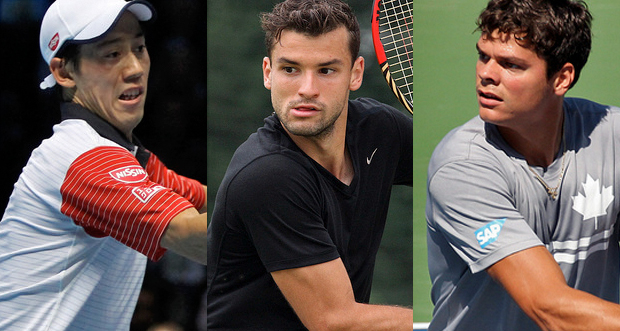
    Kei Nishikori Grigor Dimitrov Milos Raonic

    As the first tournaments of 2015 wrap up, it is almost shocking to think that the Australian Open is just around the corner on January 19. As always, we’ll all be watching the top players with the usual questions: How healthy will Rafael Nadal be and will it be enough to supplant Novak Djokovic at the top of the rankings? Can Novak maintain his focus? Will Father Time catch up with Roger Federer, who turns 34 later this year? Can Andy Murray find his 2012-13 form again? Will Juan Martin del Potro be healthy enough to rise again? And so on.

    But what about the rest of the pack? We focus so much on the “Big Four” and a few dark-horse candidates, while there are a lot of interesting stories and players beyond the big name elite. Let’s take a look at these other players, in particular those who bear watching in 2015 for whatever reason – but mainly as players poised to rise in the rankings. Some may be knocking at the door of the elite, while others may simply be establishing themselves as players to know, while others yet might be potential future stars.

    There are, of course, many other players worth watching – but I wanted to highlight these fifteen as particularly interesting, for a variety of reasons. Let’s take a look.

    [divider]

    Click here to discuss “15 Up-and-Coming Players to Watch in 2015” in the discussion forum.

    [divider]

    THE ALMOST BIG THREE
    Grigor Dimitrov

    Let’s start with Grigor Dimitrov, who may have been so overrated in the past in terms of expectations that he’s now being underrated (although his recent Brisbane demolishing at the hands of Federer is not exactly encouraging). Let us not forget that Grigor has improved in each year he’s been on tour; consider his year-end rankings since 2008: 493, 288, 106, 76, 48, 23, 11. Notice the trend? If Grigor keeps it up in 2015 he will possibly make it as high as the edge of the Top 5. But of course at some point he’s going to even out, and it is hard to imagine him supplanting Novak, Rafa, or even Roger. But it seems that he can beat anyone else, or at least remain competitive among the rest of the near-elites of the game. The problem with Grigor seems to be that, while he’s very good at almost every facet of the game, he doesn’t have any truly killer weapons – and seemingly lacks a killer instinct altogether.

    Prediction: The book is still open for Grigor. He needs something else — a killer shot and perhaps more of a killer instinct — to fully actualize his potential, otherwise he’ll remain more of a pretty player to watch, but not a true elite. In 2015 I think we’ll see continued incremental gains as Grigor creeps into the Top 10. He’ll continue to go deeper in Slams, being relevant at Masters tournaments, with a chance of winning one late in the year (Paris?), eventually earning his way to the World Tour Finals next November.

    Kei Nishikori
    On one hand, we may have seen the best of Kei in 2014. On the other, he seems to keep getting better and better, and of the rest of the field seems like he has what it takes to upset one of the Big Three. Kei is now a legit candidate to win a Masters and a dark horse at the Slams. Whether he has the stamina to make it through remains to be seen; despite his strong year, it should be remembered that he still only made it to the second week once.

    Prediction: Kei settles in within the second half of the Top 10. For some reason Nikolay Davydenko comes to mind – a player that never really challenged at Slams, but won a couple Masters and was always around. Perhaps Kei will have a similar peak.

    Milos Raonic
    At first I excluded Mighty Milos from this list but then I decided that it would be unfair. The big Yugo-Canadian is, quite frankly, a bit underrated at this point. Like Dimitrov it is hard to imagine him beating any of the Top 3 when it really counts, but he did just that versus Roger Federer at the Paris Masters. Milos continues to make small gains, as evidenced by his year-end rankings: 373, 156, 31, 13, 11, 8. If the pattern holds he’ll finish 2015 in the No. 5-6 range. At the least, though, I think Milos is a fixture to hand out in the latter half of the Top 10 for years to come, playing a similar role in the next half decade as Tsonga and Berdych have for the last half decade.

    Prediction: Something good for Milos in 2015. Will it be a Masters? A Slam even? Hard to imagine, but he’s knocking at the door. I think he wins several titles in 2015, maybe even a Masters. He feels close.

    DON’T FORGET ABOUT THE OTHER TWO
    Jiri Vesely & Dominic Thiem

    For some reason I pair these two players. Well, the reasons are pretty clear: they’re of a similar age, on the younger side of “Generation Raoshitrov”; Vesely’s advancement was steady but perhaps a bit disappointing, going from No. 85 to No. 66, while Thiem jumped 100 ranks from No. 139 to No. 39.

    Prediction: I expect continued steady progress from both. Both, I think, will fully establish themselves in the Top 40, and Thiem might even challenge for the Top 20. I think we’re still a couple years away from their peaks, but both should eventually be fixtures in the Top 20 and may even challenge for the Top 10 as players like Ferrer, Berdych, Wawrinka, and Tsonga age themselves out of it. But that’s probably a couple years away.

    THE BOYS ARE GROWING UP
    Nick Kyrgios

    The first of two up-and-comers to beat Rafael Nadal in 2014. Nick Kyrgios is a big kid (6’4”) with a big game and a big serve (14.8 ace %, good for No. 6 among the Top 50); I can’t help but think of Juan Martin del Potro when I see him out there. Ironically enough, the last time a teenager upset the world No. 1 at a Grand Slam was Rafa over Roger Federer at the 2005 French Open. Anyhow, great things are ahead for the Australian – he finished the year at No. 52 up from No. 182 in 2013, so he made quite a jump. He turns 20 years old in April, so still has some room to grow.

    Prediction: Nick makes steady progress but doesn’t quite jump into the elite. That said, he fights for, and at least comes close to, a year-end Top 20 ranking. While he may play the spoiler in 2015 again, he probably won’t be in the mix for big titles until 2016.

    Borna Coric
    No young player has me quite as excited as Borna Coric. I just see him having the highest upside of any player currently on the radar (that is, in the Top 300 or so). We all know him for taking out Rafael Nadal at Basel, but let’s not forget that he also beat Ernests Gulbis in that tournament and lost to red-hot David Goffin in three sets. Coric is for real and his advancement should be steady from here on, although at this point we should remain patient – he did just turn 18 a couple months ago, after all.

    That said, it is important to note that most truly elite players were ranked somewhere in the second half of the Top 100 or so at Coric’s age, and most jumped into the Top 20 the year after. Compare the year-end rankings for recent all-time greats at age 18 and 19:

    Djokovic: 78, 16
    Nadal: 51, 2
    Federer: 64, 29
    Sampras: 81, 5
    Agassi: 3, 7

    (Prior greats – starting with Agassi, but including Becker, Edberg, Wilander, etc., tended to have their break-out a year earlier, with age 17 being the first in the Top 100 and age 18 the big jump; one could speculate that perhaps we’re going ahead another year, with Nick Kyrgios’ trajectory being closer to the norm for elite players – first year in the Top 100 at age 19, big jump at age 20).

    Now compare the next tier down:
    Del Potro: 92, 44
    Murray: 65, 17
    Roddick: 156, 14
    Hewitt: 25, 7
    Kuerten: NA, 188
    Kafelnikov: 275, 102
    Courier: 43, 24

    As you can see, the next tier tends to rise a bit later, or at least more slowly.

    The point here is that if Coric is going to be great—as in an all-time great—then he needs to rise fast. Given the fact that players seem to be taking longer to develop these days with later peaks, I think we can go a bit easier on him and not expect a Rafa-like or Pete-like rise, but for me the benchmark would be a Top 40 or 50 ranking by year’s end. If he makes it into the upper half of the Top 100, then I think it is a sign that he has a chance to be special, even a truly great player. If he sticks around No. 100 or slips out of the Top 100, then we might need to temper our expectations a bit.

    Prediction: Borna will continue to rise, with some bumps in the road, but his overall trajectory will be clear. He finishes somewhere in the No. 40-50 range, although I would be surprised if he wins anything more than maybe an ATP 250.

    Alexander Zverev
    The second youngest player on this list, 17-year-old Zverev finished the year ranked No. 136. That might not sound all that impressive, but consider that of the active players who have ranked in the Top 10, only Tomas Berdych (No. 103), Lleyton Hewitt (No. 100), and Rafael Nadal (No. 49) ranked higher at the end of the year they turned 17. Novak was No. 186, Roger No. 301, and many players weren’t even on tour yet. While we should be moderate in our expectations at this point, it is hard not to get excited about this kid. If Nick Kyrgios and Borna Coric are the top two candidates to be the next elite players, then Zverev is No. 3 and not far behind.

    Prediction: Baby steps. Zverev doesn’t turn 18 until April, so has a lot of room to grow – both as a human body and as a player. I think he has a good shot at the Top 100 this year, but I wouldn’t expect much more than a year-end No. 80-100 ranking.

    OTHERS TO KEEP AN EYE ON
    Ernests Gulbis:
    Long viewed as an underachiever, Ernests (named after Hemingway) had his best year, challenging at one point for the Top 10. But questions remain: After an erratic career, can he maintain his current level? Can he take it a step higher? Or is he in the vein of up-and-down perennial underachievers like Alexandr Dolgopolov and Richard Gasquet? Who knows with Ernests. I suspect he’ll have more upsets like the fourth round French Open victory over Roger Federer, but not be consistent enough to break into the elite. That said, I think he’ll flirt with the Top 10 and maybe dip into it briefly, but then fall back and finish somewhere in the latter half of the Top 20. I’d prefer not to be so specific in my predictions, but for some reason No. 15-18 sounds about right.

    Jack Sock: While it is hard to become too excited about a 22-year old ranked No. 42 and with no titles to his name, consider that Sock is now the fourth highest ranked American and only one of five in the Top 100. Not only that, he’s the youngest American ranked in the Top 200, just a month younger than No. 121 Denis Kudla, and a few months younger than No. 190 Ryan Harrison. But here is where there is some hope: Sock’s rise has been strong and steady – consider his year-end rankings from 2010 to the present: 878, 381, 150, 102, 42. We probably can’t expect Sock to be the next Andy Roddick, but he could be the next John Isner or Mardy Fish.

    Stefan Kozlov: Stefan who? Well, a year or two from now he could be front and center in our minds. Who is Stefan Kozlov, you ask? He’s the youngest player to finish in the Top 500 this year at No. 468. No. 468?! Who cares? Well, I care – because Stefan Kozlov was born in 1998. Yes, 1998. Kozlov is 16-years old, turns 17 in February. He hasn’t done much yet, but he did play in the qualification rounds of the US Open, defeating his first round opponent, Mitchell Frank, before losing in three sets to “old man” Borna Coric. Kozlov is a long way away, but I wanted to introduce him as he’s a player worth keeping an eye on. Oh yeah, and best of all, while he’s Macedonia-born, he’s technically American (I know, it feels like cheating – but tell that to the Canadians re: Milos).

    Yoshihito Nishioka: In the shadow of similarly named (at least to a Westerner) top-ranked and fellow Japanese player, Kei Nishikori, Nishioka is 19 years old and ranked No. 156, and could be a real sleeper to break into the Top 100 next year and a player to watch.

    Thanasi Kokkinakis: Another member of the “Class of ’96,” which is turning out to have some talent. Kokkinakis is the third highest ranking teenager at No. 150, behind only Coric and Zverev. Another Australian to watch.

    Jared Donaldson: Ranked all the way down at No. 261, 18-year-old Jared Donaldson is worth mentioning not as much because he’s the sixth highest ranking teenager, but mainly because he’s the highest ranking American teenager; actually, he’s the highest ranking American age 21 or younger, which makes him arguably America’s Great Hope to return to relevance. But let’s check in next year to see where he is.

    Hyeon Chung: Korean-born, the fourth member of the Class of ’96 on this list (along with Coric, Kokkinakis, and Donaldson). I don’t know what his upside is but at No. 173 he’s the highest ranked Korean by a good margin, and well-situated on the career trajectory towards a strong career.

    ADDENDUM: Another 15 to the Mix
    I’d like to add a few more names to keep an eye on. Again, remember that the above list is not meant to be comprehensive, but a the same time I’d be remiss not to give at least an honorable mention to a few others.

    Roberto Bautista Agut: A surprising rise from No. 58 to No. 15 in 2014, can he maintain a top 20 ranking for a few years?
    David Goffin: After a disappointing 2013, Goffin had a tremendous rise in 2014, going from No. 110 to No. 22.
    Jerzy Janowicz: Let’s not forget about Jerzy, but’s he fast becoming a cautionary tale, a least for those of us that got excited a year or two ago. He’s still young enough to turn it around.
    Pablo Carreno Busta: It seemed that he was a cult favorite to be excited about a year ago, but after only a moderate rise in 2014–to a solid No. 49–I think expectations have cooled. Still, he’s a name to get used to as he could be a regular in the top 40 for years to come.
    Dusan Lajovic: Best known for making it the 4R at Roland Garros where he lost to Rafa, but not before beating Delbonis and Sock to get there. I think he’s a sleeper to be a solid player.
    Bernard Tomic: Oh Bernie, it is hard to root for you. You’re like a playboy superstar that isn’t a star. Time to grow up if you want a decent career.
    Victor Estrella Burgos: In contrast to Tomic, how can we not cheer for this guy? Starting on the ATP tour at age 33-34, and he made it as high as No. 65! Who knows what’s ahead but I’m cheering him on.
    Lucas Pouille: Another sleeper – seems talented.
    Luke Saville: Ditto. These guys aren’t future elites, but they are probably future top 50 players.
    Diego Schwartzman: At 5’7″ you’ve got our attention. Seems like another sleeper.
    Elias Ymer, Christian Garin, Roman Safiullin, Andrey Rublev, Gianluigi Quinzi: More young ‘uns to keep an eye on, all born in 1996-97.

    OK, that’s it. The problem with trying to be semi-comprehensive with this second list is that there is no way to draw the line. No Vasek Pospisil? Federico Delbonis? Well, I had to draw the line somewhere and it is “15 + another 15.”
  • Roland Garros French Open Day 13: Men’s Semifinals

    Roland Garros French Open Day 13: Men’s Semifinals

    2014 RG SF - Men

    Day 13 of the French Open, at Roland Garros, presents the men’s singles semifinals, and the women’s doubles semifinals.

    On Court Philippe Chatrier, world No. 2 Novak Djokovic faces the big-hitting Latvian Ernests Gulbis (18), playing in his first Major semifinal. Following them will be eight-time champion and world No. 1 Rafael Nadal, who plays the 2013 Wimbledon champion Andy Murray (7).

    The women’s doubles semifinals will be played on Court Suzanne Lenglen. First up is the No. 1 seeded team of Su-Wei Hsieh and Shuai Peng, playing the Spanish team of Garbine Muguruza and Carla Suarez Navarro. The second semifinal features the No. 2 team, the Italians Sara Errani and Roberta Vinci, against the unseeded team of Lucie Hradecka and Michaella Krajicek.

    The full schedule for Day 13 is listed below (Results to follow)…

    [divider]

    Court Philippe Chatrier – 1:00 P.M.    

    Men’s Singles – Semifinals
    Novak Djokovic (SRB) (2) d. Ernests Gulbis (LAT) (18) — 6-3, 6-3, 3-6, 6-3

    Men’s Singles – Semifinals
    Rafael Nadal (ESP) (1) d. Andy Murray (GBR) (7) — 6-3, 6-2, 6-1

    [divider]

    Court Suzanne Lenglen – Not Before: 1:00 P.M.

    Women’s Doubles – Semifinals
    Su-Wei Hsieh (TPE) (1) / Shuai Peng (CHN) (1) d. Garbine Muguruza (ESP) / Carla Suarez Navarro (ESP) — 6-2, 5-7, 6-2

    Women’s Doubles – Semifinals
    Sara Errani (ITA) (2) / Roberta Vinci (ITA) (2) d. Lucie Hradecka (CZE) / Michaella Krajicek (NED) — 6-2, 6-1

  • So Many Yangs

    So Many Yangs

    Ernests Gulbis

    Marseilles, Final

    (3) Gulbis d. (2) Tsonga, 7-6(5), 6-4

    It is a strange quirk that Ernests Gulbis, that least reliable of professional tennis players, somehow boasts a perfect record in tour finals, a record he kept intact today in Marseille. He has now won five ATP titles without losing one, a kind of scruffy yin to so many proven yangs, such as Gael Monfils or Julien Benneteau. Gulbis didn’t get to play either Monfils or Benneteau this week, though that wasn’t his fault, since the former wasn’t here and the latter was defeated early on in another part of the draw. As the truism goes, you don’t get to choose which Frenchmen you face in tennis. You can only defeat the ones who are placed in front of you.

    It was, fittingly, a non-Frenchman Gulbis struggled with. His toughest test came against Roberto Bautista Agut in the second round, although this wasn’t strictly a surprise. (The surprise was that having eluded defeat the Latvian went on winning.) Bautista Agut has distinguished himself this season with several scrapping, aggressive, and defiant efforts, though this week he also distinguished himself by being just about the only Spanish man with a tennis racquet who didn’t show up in Rio. Consider this: there were more Spaniards in Rafael Nadal’s half of the Rio draw than there were Frenchmen in the entire Marseille draw. Once Gulbis had survived that early round struggle, he set about beating any locals he could lay his hands on, starting with Nicolas Mahut, continuing with Richard Gasquet, and concluding today with Jo-Wilfried Tsonga.

    It wasn’t a particularly exciting final as these things are measured, and certainly not compared to last year’s decider between Tsonga and Tomas Berdych. As you’d imagine when two big men face each other on a fast indoor court, the service dominated, though better returning would have helped it dominate less. Gulbis had not been broken since the second round, and Tsonga today could engineer only two opportunities, which he characteristically flubbed. Gulbis, on the other hand, was in plenty of the Frenchman’s service games, although he was no more effective at converting break points, ending the match with a rather  memorable 1/11. The Frenchman generally saved them with muscular play, and managed to do the same with a few match points in the second tiebreak. Gulbis served it out with an ace, before commencing a victory routine from which he’d carefully expunged any trace of exaltation. It made Marat Safin’s celebrations look flamboyant by comparison. You’d think Gulbis wins these things every other week.

    Actually, that’s not far off. He usually wins these things in this week every other year. Last year he won Delray Beach as a qualifier, and his maiden title came at that tournament in 2010. It may seem surprising that he hasn’t returned to Florida this year, but his failure to show up for title defences is another of the few infuriatingly consistent things about him. So far in his career he has never once graced a tournament the year after he has won it. Look for him in Rio next year, or at least anywhere but Marseille.

    Rio de Janeiro, Final

    (1) Nadal d. Dolgopolov, 6-3, 7-6(3)

    Owing to a minor calendar shake-up, Nadal will next week find himself in the rare position of having two titles to defend, in Acapulco and Sao Paulo. Taking a leaf from Gulbis’ playbook, he has chosen to skip both, preferring instead to win this week’s inaugural Rio event. After all, opportunities to be the first name on a new trophy don’t come round every week, presuming there’s a trophy upon which names can be inscribed.

    Nadal almost surprised us all by not winning the tournament, though got there in the end. The direst moment came against Pablo Andujar in the semifinal, a match that saw the world No. 1 recover from a set down, and finally take it in a mighty third set tiebreak, saving a pair of match points along the way. For once the bromidic phrase “he found a way to win,” usually uttered at the first faint whiff of adversity, was actually merited. Usually the way he finds entails being better at tennis than his opponent, but against an inspired Andujar there were stretches of the match in which Nadal was emphatically outplayed. Indeed, Andujar won more points overall. Alas for him, he lacked either the savagery or the cold precision necessary to claim the points that mattered most. He has thus been relegated to a statistical anomaly – this was the first time Nadal has won from match point down since beating Troicki in Tokyo in 2010.

    Alex Dolgopolov’s half of the Rio draw had, for a wonder, boasted only two Spaniards, but they were two of the toughest in David Ferrer and Nicolas Almagro, although the latter has lately learned to be as disappointing on South American clay as he perennially is on the European variety. Throw in Fabio Fognini, and plenty of reasons to be distracted by events back home, and Dolgopolov’s run to the Rio final proved to be a minor masterpiece of tightrope-sprinting. He’d been marvellous, in his dicey weird way. I wouldn’t go so far as to say that there’s no better player to watch when he’s on. Indeed, to say that would be to confess to fetishism. He has a game only a mother could love, but there’s no denying the excitement he delivers, especially for those of us drawn to unpredictable, aggressive tennis.

    Regardless, the betting markets, history, and the general opinion of the person on the street were unanimous in believing that it wouldn’t be enough to get by Nadal in the final. The only exceptions were those subsets of Nadal fandom which insisted that Nadal’s flat performance against Andujar would be sustained into the final: a passionately misguided belief in Nadal’s frangibility has meant some fans fail to absorb the lesson that he very rarely plays badly, and almost never plays badly twice in a row. As ever with Dolgopolov the interest lay in discovering whether the strobes of brilliance could be spaced with sufficient proximity so as to provide consistent luminescence. So far this week they had. His only real chance for the final, however, was to hope they joined up to form a band of light so incandescent it might sear the retinas from Nadal’s head. Dolgopolov lacks anything resembling a bread-and-butter game. Whether through technique or temperament, he appears incapable of sustaining discernible, or at any rate reliable, patterns of play. He is hell to play when he’s playing well. The trick, as far as I can tell, is to force him to have to play well or else, thus ensuring that he probably won’t.

    Nadal, as ever, had the luxury of being able to achieve this by deploying any number of established patterns, knowing that most, if not all, of these would likely guarantee him victory. Today’s patterns involved nothing fancier than the judicious application of just enough pressure to provoke Dolgopolov into over-hitting. This was particularly apparent in the first set, in which Nadal himself hit only one winner, which was the ace he served to seal it. The Spaniard broke early in the second set (as he had in the first), and looked likely to coast it out. Dolgopolov, after all, had not broken Nadal, not merely in this match, but in any of the four other matches they’ve contested.

    It therefore came as something of a surprise when an apparently nervous Nadal lost his way while trying to serve it out at 5-4, the break sealed with yet another scything Dolgopolov crosscourt backhand into the top seed’s forehand corner. I recall how effective this tactic was for Troicki in Tokyo three years ago, thus providing a lesson that Novak Djokovic subsequently learned by rote. You can go crosscourt to Nadal’s forehand, but you have to take the ball very early, and go there flat and with tremendous pace. Dolgopolov went there time and again today with great success, but it’s a dicey way to live, especially on clay, where Nadal is inexorable. He was certainly inexorable in the eventual tiebreak, and Dolgopolov proved all over again that risky tennis only looks good when it comes off. The flashes of light were now spaced too far apart, and soon they went out entirely.

    Nadal won’t be the last Rio champion, but he’ll always be the first. The trophy, worthy of a European indoor event in its determination to reference anything but a trophy, was handed over by the universally beloved Gustavo Kuerten. It’s a kind of lattice-worked wave arrangement, and thus provided plenty of spots for Nadal’s teeth to find purchase. (Marseille, ironically, has a perfectly ordinary trophy, which Gulbis did not bite.) Both men brought up Ukraine’s current situation in their speeches, Nadal graciously and Dolgopolov with all his heart.

    [divider]

    Cover Photo (Creative Commons License): Marianne Bevis

  • Curious About Pleasure

    Curious About Pleasure

    Roger+Federer+2014+Australian+Open+Day+4+5TYQ1KH1Qakl

    Australian Open 2014, Second Round, Days 3 and 4

    Florian Mayer def. [14] Mikhail Youzhny 6-4, 3-6, 6-3, 3-6, 6-3

    Sam Querrey def. Ernests Gulbis 6-2, 6-3, 6-4

    [3] Maria Sharapova def. Karin Knapp 6-4, 3-6, 10-8

    [6] Roger Federer def. Blaz Kavcic 6-2, 6-1, 7-6

    Back when I was gearing up for my visit to Melbourne, when I bought my copy of Australia: The Continent so Hot it Melts Concrete, I also purchased a pretentious hardcover book about coffee: The Blue Bottle Craft of Coffee, by James Freeman. Because reading about the comparative merits of pour-over versus siphon extraction is perfect preparation for international travel. (The flight attendants on New Zealand Air were thrilled when I demanded to know whether their on-board brew was made with wet- or dry-process beans.) Also, it was an impulse buy. The photo of the cup of coffee on the book cover happened to look exactly like the cup of coffee I wanted to be drinking at the time. Amazon knows these things about us.

    Anyway, the book turned out to be absorbing. Its subject-matter—growing, roasting, and drinking a caffeinated beverage—is held in highest regard, and discussed with utmost gravity. Freeman describes the lonesome, creative suffering of a career as a coffee roaster with the same level of seriousness usually reserved for heart surgery or saving babies. Or sports-writing. But, if you like excellent coffee, or hoity-toity cafes, or luxury gadgetry, it’s a goldmine of fascinating details. And it reminded me of tennis.

    Freeman, who is the founder of Blue Bottle, one of Northern California’s most respected—borderline fetishized— coffee-roasting companies, might inflate the importance of coffee in the grand scheme of life, but he isn’t wrong about the strange satisfaction to be found in the repetitive loneliness of trying to do something unnecessary, unnecessarily well. Roasting the perfect blend of coffee beans is not unlike the Sisyphean suffering involved in playing tennis devotedly, and even in watching tennis devotedly—or, at any rate, in wilting in the concrete-busting afternoon heat while one of your favorite players loses a fifth set of tennis.

    On my first day at Melbourne Park, I watched Mikhail Youzhny and Florian Mayer play a midday five-set match on Court 8. The match eventually went the way of the German, who was stepping gingerly on his tender, booted ankle, and sculling away at his double-handed backhand slice, but who also played mostly well and almost always aggressively. Youzhny, by contrast, played well occasionally, mostly when his back was against the wall in the fourth set, or down break points in the fifth. Otherwise, the Russian spent the hottest part of a searingly hot afternoon slapping an endless series of groundstrokes and serves into the tape, excoriating himself emphatically in his mother tongue, and clenching his square jaw in rage until his tanned complexion turned the color of cooked lobster. At no point during the match did Mikhail Youzhny look like he found the competitive process fun.

    Later, in Margaret Court Arena, Ernests Gulbis quickly got down to the business of making tennis look like a truly wretched way to spend time. The Latvian lost in straight sets to American Sam Querrey, who executed his special brand of morose excellence with a level-headedness that neatly juxtaposed his opponent’s decompensating ego. The crowd looked for any and every excuse to get behind Gulbis, cheering enthusiastically for each wing-flapping forehand winner, and cooing sympathetically after every drop shot that dropped, mortally wounded, onto the wrong side of the net. But the most exciting moment of the match turned out to be when Gulbis launched his racquet vaguely in the direction of a ball-child and exactly toward the ground. The racquet head snapped in half on court, where Gulbis left it for dead. After shucking his sweaty wristband into the stands, Gulbis slowly unwrapped a new racquet, gestured imperiously for a child to fetch his designer vibration dampener off his broken stick, and sauntered back to the baseline to continue spraying forehand errors.

    My first day at the Happy Slam seemed intent on reminding me that playing tennis for a living is less about playing than it is about hard, virtually liquefying, work. Even Alexandr Dolgopolov, usually content to at least grin in the face of defeat, looked thoroughly miserable to be losing to a determined Jeremy Chardy in the humid early evening breeze. (I’ll spare Matt Ebden the ignominy of describing the purgatory that was his loss to an injured Vasek Pospisil during the night session on Rod Laver Arena.) And on Day 4, the tennis suffering seemed to be, if anything, worse. The heat—extreme western heat, if you will— continued on being relentlessly hot, but there was less cloud cover than on the day before, and sunlight poured over the blue courts like so much molten gold. 

    Despite her stylish changeover ice-vest, Maria Sharapova looked heat-stricken and muddle-headed on Rod Laver Arena as she dragged herself—and her straining vocal cords—to a victory over Karin Knapp, 10-8 in the third. Carla Suarez Navarro also needed three sets and over three hours under the cruel sun to defeat her opponent, Galina Voskoboeva. And then the tournament itself was forced to deploy the “extreme heat rule,” which decrees that all coffee served on the grounds must be thoroughly iced—and also that people stop playing tennis outdoors. 

    Speaking of coffee, I thought about Freeman’s book on crafting the perfect cup on Wednesday, as I watched Youzhny try to coax forth something like his best tennis on a seriously off day while I, my spectating self, struggled to avoid slipping into a full-on heat-stupor.* In The Craft of Coffee Freeman described, at length, the necessity of vigilant attention to detail, not to mention the overall tedium involved in learning to make coffee-making look effortless. But he also wrote lovingly of the finished product, saying, among other things, that coffee makes us curious about pleasure. This was a declaration that stuck with me, and I think it applies to almost anything in life—person, place, or thing—into which we project our emotional experience of potential. If it doesn’t make us curious about the good things in life, it should. 

    It was this curiosity that came to mind as I realized Youzhny was not going to bounce back against Mayer in the fifth set as he had bounced back in the fourth. The match was not a pleasure for me to watch, and I imagine it was not a pleasure for the Russian to play – or for the German either, for that matter. But although watching all those sets of tennis, only to see my guy lose in the end was dreary, and cost me most of the salt reserves in my body, it wasn’t a disappointing disappointment. (If that makes sense.) Instead, it felt a part of the larger experience—a low note to emphasize the high ones to come, to use Freeman’s language. It was still tennis, and it made me curious about pleasure.

    As fortune would have it, a high note wasn’t far away. Within 24 hours of Youzhny’s loss I found myself with an excellent seat on Hisense, underneath a closed roof in an air-conditioned stadium, cradling a dish of affogato, and watching Roger Federer unfurl two sets of sleek tennis on his way to a 6-2, 6-1, 7-6(4) victory over a game, clean-hitting, and occasionally bold Blaz Kavcic. It was all very posh—like a siphon-brewed cup of Ethiopia Yirgacheffe on a leisurely (and temperate) Sunday morning. That is, if a leisurely Sunday morning included the cracking sound of swiftly struck forehand winners and the cheers of a few thousand sports fans.

    Roger Federer, the sixth seed, was having a pretty good night. He displayed an unerring attraction to the open court, as well as an affinity for break point conversions and the happy ability to please a crowd that loved nothing more than to Ooh and Ah at his shot-making prowess. People tend to say that Federer makes it—tennis, perfection— look easy. I’m not so sure about that. A better way to put it might be that Federer, when he’s playing well, makes it look unattainable. There was a fantastic, and fantastically long point on Federer’s serve at 3-0 in the second set wherein the Swiss managed to get to several balls he had no business arriving at, and then doing things with those shots that he had no business doing. He eventually won the point, while Kavcic was left shaking his head in disbelief. Only Federer.

    But as many times as Kavcic was left with nothing but a wry grin of frustration, he didn’t give up. Just after that long, magic point from Federer, the Slovenian broke the Swiss for 1-3. Federer responded by hitting four winners and breaking right back. For two solid sets of tennis, it was that kind of night for the Rolex Brand Ambassador. Still, it wasn’t a perfect performance. In the third set Kavcic lifted his game, primarily via gutsy serving, and Federer’s level dropped to somewhere between fair-to-middling and just-plain-passive. There were several interesting shanks. But the Swiss regained some rhythm as the third set aged, earning match point in the tiebreaker, which he won after forcing Kavcic to dive for not one, but two, volleys in a row. Carlos Bernardes called “game, set, match” while the Slovenian was still coming out of his second roll on the concrete. It was an absolute pleasure. And it made me very curious about how Rafa was doing over on Laver. 


    *At some point during the fourth set I worried I might be succumbing to heat-induced auditory hallucinations because I imagined I heard live accordion music. Further investigation—in the form of directing my gaze to the stands of Court 13—proved that it was only Damir Dzumhur’s loyal fans, who’d come thoroughly equipped to help the Bosnian defeat Ivan Dodig. Besides a few dozen Bosnian flags and a catalog of traditional Bosnian tennis folk-chants, they’d also brought a piano-accordion to play during changeovers.

  • Gulbis Stages Dramatic Comeback to Win St. Petersburg Open

    Gulbis Stages Dramatic Comeback to Win St. Petersburg Open

    Ernests Gulbis fought back from a set down to overcome Spaniard Guillermo Garcia-Lopez 3-6, 6-4, 6-0 in the final of the St. Petersburg Open.

    Gulbis, ranked 36, was broken three times in the opening set (he broke Garcia-Lopez once) and fell behind 4-1 in the second set before staging a dramatic comeback to win 11 consecutive games to seize the second set, and administer a third set bagel to the stunned Spaniard.

    “The main key why I’m not yet a top player is the consistency. Everybody knows I can play well for a tournament or a match and then I go downhill. I just need to bring this consistency to bigger tournaments, especially Grand Slams. Then I believe I am a Top 20 player for sure, and not so far from Top 10,” said Gulbis after the match.

    It was the Latvian’s fourth career title and earned him $78,000.

    [divider]

    Discuss this story with fellow tennis fans on the Tennis Frontier message board.

    [divider]

    Cover Photo: Kenneth Hong, Creative Commons License.

  • Luck of the Draw: US Open 2013

    Luck of the Draw: US Open 2013

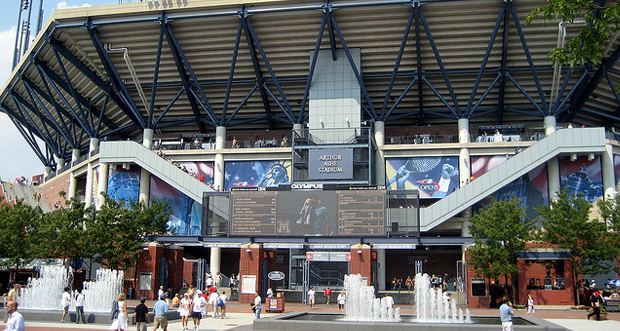
    The draw for the US Open has been released in the traditional fashion, which is to write the names of every eligible player on little slips of paper, place them all in an antique cannon in the middle of Arthur Ashe Stadium, and fire them straight up. From there the strong prevailing winds take over, and a player’s placement is determined by where in the tri-state area his name flutters to rest. It is for this reason, one presumes, that the year’s final Major is always contested during hurricane season. Sadly, the USTA has announced that in 2017 there will be roofs over the main stadiums at the Billy Jean King National Tennis Center. The US Open will have to find a new way of conducting the ceremony (since it is unthinkable that something as momentous as populating a tournament draw could be achieved without due pomp). It’s always a shame when old traditions disappear.

    [divider]

    Discuss this article, the match and lots more with fellow tennis fans in the forums.

    [divider]

    Of subsidiary interest, the placement of the very highest seeds is decided by where their names fall in relation to David Ferrer’s. As it happened, Rafael Nadal was the luckiest one. We can safely ignore scurrilous rumours that the slips of paper bearing the two Spaniards’ names had been stuck together with adhesive. Meanwhile, Novak Djokovic’s name turned up in Stamford, Connecticut. It could have been worse, I suppose.

    Once again we’re invited to marvel at the vagaries of the ATP rankings, especially the situation whereby Andy Murray, reigning US Open (and Wimbledon) champion and eternal saviour of British tennis, is ranked number three in the world. This is one place lower than Nadal, who holds only a single Major (Roland Garros), lost in the first round at Wimbledon, and didn’t even play at the others. It is two places lower than Novak Djokovic, who holds only the Australian Open. As a result the Scot is seeded lower than both those men at the upcoming US Open. As far as the population of the small island positioned off the extreme western coast of the Eurasian landmass is concerned, this is nothing short of a cosmic injustice.

    Although Sky Sports have never attained the febrile derangement of their compatriots at the Daily Mail, they have nonetheless elevated cheerleading on Murray’s behalf into something of an art form, and will reliably ascend to heights of outrage when they feel he’s been hard-done-by. While raucous advocacy presumably doesn’t reflect management’s official position, it certainly isn’t discouraged, and any failure to address Britain’s top player in sufficiently rapturous terms presumably results in disciplinary action. (This policy, incidentally, isn’t limited to Sky: word is that John McEnroe received a stern talking-to from ESPN after he repeatedly excoriated American players on air during last year’s US Open. He and his brother really did go to town on Donald Young one evening. Here in Australia, failure to sing the praises of either Lleyton Hewitt or Bernard Tomic will earn the offender a baleful visit from John Newcombe.) Anyway, Peter Fleming pronounced the latest rankings to be “crazy”. Marcus Buckland suggested it “seemed unfair”. Others were less circumspect, in each case betraying a deliberate ignorance of how the rankings actually work. It is understandable that the average punter’s knowledge of the sport ends with the Majors – we shouldn’t necessarily be thrilled at this, and American coverage in particular can grow pathetically grateful at any public interest at all – but for those paid good money to follow professional tennis from week to week, the Majors should merely be the start. There is no mystery why Nadal is ranked higher than Murray: there’s more to tennis than Grand Slam events.

    Anyway, the reason why the second and third seedings matter so much at this US Open is that David Ferrer is seeded fourth. There are probably kinder ways to say it, but the reality is that even when Ferrer was in decent form he represented a more benign semifinal opponent than whomever the alternative happened to be. Right now, however, he is in execrable form, and still troubled by a lingering injury. Not only that, but these are the potential quarterfinal match-ups based on seedings:

    • Djokovic – del Potro
    • Murray – Berdych
    • Nadal – Federer
    • Ferrer – Gasquet

    Which of these is not like the others? Any one of Berdych, del Potro, or Federer could have fallen in Ferrer’s quarter, and in each case would have been favoured to reach the last weekend. Alas, it wasn’t to be. So it goes. Let’s just call Ferrer’s quarter a grand opportunity for someone. There are nine qualifiers in this quarter, and four of them are facing each other. I’m going to venture out on an especially shaky limb, and suggest that Dmitry Tursunov’s time has arrived. Seeded thirty-two, the Russian won’t encounter anyone ranked higher until the third round at the earliest. By wisely choosing to be drawn in Ferrer’s quarter, he has ensured that he won’t face anyone truly terrifying until the semifinals. So pencil him in for that. Gasquet is in there, too, of course, seeded eighth. I could pencil him in for a quarterfinal, but history suggests that would be a waste of graphite. On the small chance that Tursunov doesn’t push all the way through to Super Saturday, I suspect either Milos Raonic or Jerzy Janowicz will. Or Ernests Gulbis, who is now seeded and can thus stop thinking of himself as the world’s most dangerous floater, since it was frankly getting him nowhere. But really it’s anyone’s guess.

    Ryan Harrison’s appalling luck at Grand Slam level continues. He has once again drawn a lofty seed early on, in this case Nadal in the opening round. Last year in New York he faced Juan Martin del Potro in the second round. The upshot is that even last year’s modest points will almost certainly go undefended. It’s rotten luck, undoubtedly, though one shouldn’t pretend there aren’t other reasons why Harrison isn’t ranked high enough to elude this kind of misfortune. It’s bound to be a featured night match, and thus a test of McEnroe’s generosity. It’s hard to imagine either Nadal or Federer will suffer upsets before they meet in the quarterfinals, unlike at Wimbledon, where I totally foresaw those early losses to Steve Darcis and Sergiy Stakhovsky, but didn’t want to spoil the surprise.

    Only one first round match really stands out – setting to one side the possibility that those qualifiers will entertainingly pulverise each other in fifth set tiebreaks – which is the one between Lleyton Hewitt and Brian Baker. Joints creaking and metal pins clanking, they’ll contest the chance to play del Potro. Whoever comes out of all that, it’ll be a triumph for medical science.

    Credits: Cover Photo: Wallyg, (Creative Commons License)