Why the Name?
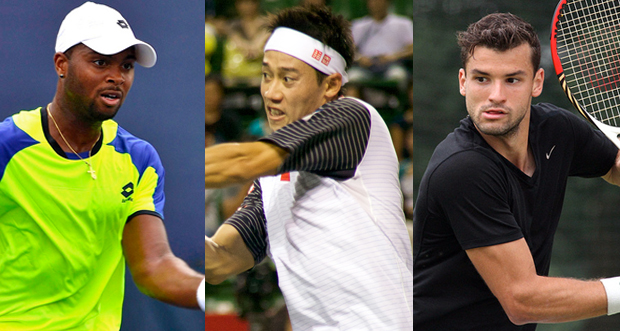
Donald Young is not among the best players of this generation, but to me he exemplifies it, one of the very first of what is looking to be the weakest generation that the Open Era has seen thus far.
Aside from the clever-ish title, why Donald Young? Well, his trajectory displays the disappointment and weakness of this generation. A two-time Junior Grand Slam winner, Young finished 2007 ranked No. 100 at the age of 18, looking poised to eventually inherit the mantle of the premier American player from Andy Roddick. But he floated for several years, not reaching the Top 100 again until 2011 when he was 22 years old, no longer a tennis prodigy. And even that wasn’t the first year of a breakout; he dropped again in the rankings, failing to even qualify for the 2013 Australian Open and Wimbledon. He’s played a bit better of late, finishing 2015 at No. 57, largely due to a fourth round appearance in the US Open – his best result since 2011. But Young, no longer young at 26, is a far cry from what he was expected to be some eight years ago and is a cautionary tale of how not all highly-regarded prospects turn out. He isn’t alone among his generation, as we shall see.
I also call this the “Lost Generation” because it has a chance of being the only five-year generation—in the year spans that I’m using—that will not win a Grand Slam, in all of tennis history. Even if a player of this generation does eventually win one, it will almost certainly be a lower amount than any of the Open Era, with Ashe’s generation being the current lowest total at five.
Best Players by Birth Year
1989: Kei Nishikori (JPN), Benoit Paire (FRA), Martin Klizan (SLO), Joao Sousa (POR), Donald Young (USA), Steve Johnson (USA), Aljaz Bedene (UK)
1990: Milos Raonic (CAN), David Goffin (GER), Vasek Pospisil (CAN), Jerzy Janowicz (POL), Guido Pella (ARG), Andrey Kuznetsov (RUS), Dusan Lajovic (SERB), Evgeny Donskoy (RUS)
1991: Grigor Dimitrov (BUL), Denis Kudla (USA), Pablo Carreno Busta (ESP)
1992: Bernard Tomic (AUS), Jack Sock (USA), Diego Schwartzman (ARG), Ryan Harrison (USA), Damir Dzumhur (SERB)
1993: Dominic Thiem (AUT), Jiri Vesely (CZE)
Note that my bar for this generation is a lot lower in the list above, both because it is a weaker generation but also because it is contemporary right now, so it’s difficult to say who will end up being the best players by year.
Consider that we have still not yet seen either a Slam or a Masters title from this generation, and only a handful of ATP 500’s: six from Nishikori, and one each from Klizan, Raonic, Dimitrov, and Thiem.
Given that this group of players turned 22-26 last year, this is the generation that should be peaking right now. Consider the years that great players turned 22: 2003 for Roger Federer, 2008 for Rafael Nadal, 1993 for Pete Sampras, etc. There really has been no great player in the Open Era who was not an elite by the year they turned 22, and even lesser greats are usually pretty good by this age.
Here’s a telling statistic: if we go back every five years (2010, 2005, etc), the generation with the No. 1 player was the same age as this one, age 22-26…until 2015, when the No. 1 player was 28-years old and only one player from the 89-93 generation finished in the Top 10, a downturn from 2014 when three players finished No. 11 or better. As great as Novak is, his reign should be challenged by the younger generation and there’s simply no player that is good enough to do so. And even if Novak weren’t around, there are still plenty of players who are.
Also, consider that 2015 is equivalent age-wise to the previous generation in 2010, or 2005 for Federer’s generation. Compare the number of players in the Top 20 in 2015, compared to the previous two generations in the equivalent year:
1989-93 Gen in 2015: Nishikori No. 7, No. 14, No. 16, No. 18-20
1984-88 Gen in 2010: Nadal No. 1, No. 3-6, No. 12-15, No. 18-20
1979-83 Gen in 2005: Federer No. 1, No. 3-6, No. 8-9, No. 11, No. 13, No. 15-16, No. 18, No. 20
Part of the problem is that this generation has followed after two strong ones which include three players amassing 42 Slams and counting. This is not unlike the situation that Arthur Ashe’s generation faced after following the great 1934-38 generation that included Rod Laver, Ken Rosewall, Roy Emerson, and Lew Hoad, not to mention four-Slam winners like Ashley Cooper and Manuel Santana. This is further compounded by the fact that Novak Djokovic is maintaining a peak level into his late 20s, Roger Federer is still formidable in his mid-30s, and Andy Murray still remains better than any player younger than him (except for Novak, of course).
Yet we’re approaching a point where this generation may have a window of opportunity. While Djokovic and Murray remain strong, it is inevitable that both start to slip a bit at some point in the next couple years. Roger isn’t getting any younger, and even if Rafa bounces back during the upcoming clay season, it is unlikely we’ll see another 2013. The next generation, players born 1994-98, looks much stronger, but they are probably still at least a year or two away from entering their peak years, and several years from dominance.
So consider this possibility: 2016 could be the last year in which Djokovic’s generation completely dominates. In 2017, Novak and Andy will turn 30, Rafa 31, and Roger 36, not to mention players like Stan Wawrinka, Tomas Berdych, and Jo-Wilfried Tsonga turning 32. Gen 12 will be turning 24-28, still prime years, while Gen 13 will be turning 19-23 – starting to come into their own, but probably not quite peak level. For a couple years, say 2017-18, all titles might be up for grabs and we could see a similar environment as we saw in the late 90s and early 00s. I would guess that we see at least one or two Slams and Masters fall to players like Nishikori, Raonic, Dimitrov, and Thiem, or even a Goffin, Sock, Tomic, Klizan, Paire, or Vesely, if the stars align correctly.
There are also glimmerings of hope. Consider that so far this year we’ve completed four ATP 500s and thirteen ATP 250s. Here is how those tournaments breakdown by generation in 2016, through the end of February:
79-83 Gen: 1 ATP 250
84-88 Gen: 2 ATP 500s, 8 ATP 250s
89-93 Gen: 2 ATP 500s, 4 ATP 250s
94-98 Gen: 1 ATP 250
Not even counting the Australian Open, the 84-88 still holds the crown, but so far this year the 89-93 generation is second, with the other generations quite a bit behind. Compare to last year at this point, when the 89-93 generation had not yet won an ATP 500 and had only won a couple ATP 250s.
It is also worth noting that the “elder statesmen” 79-83 generation has started much slower, although this is partially due to Federer’s injury and a slower start by Ferrer; that generation is pretty much dependent upon those two (although Estrella Burgos has the only title this year from that generation, repeating his Quito title). But given that generation’s age, turning 33-37 this year, it is only a matter of time before they dwindle away completely. The previous generation, born 1974-78 (e.g. Gustavo Kuerten, Yevgeny Kafelnikov, etc) was at the same point age-wise in 2011 as Federer’s is in 2016, and won only four more titles from 2011 on: an ATP 500 (Radek Stepanek at Washington in 2011) and three ATP 250s (all by Tommy Haas, in 2012 and 2013). Even the great 1969-73 generation which included Pete Sampras and Andre Agassi and was at the equivalent point in 2006, only won two more ATP 250s, both by Fabrice Santoro (Newport 2007 and 2008).
The point being, the 1979-83—which won 16 titles last year, including a Masters and six ATP 500s—is phasing out and, if nothing else, the 89-93 generation should be able to pick up some of the slack. It is probably already happening.
Underachievers and Forgotten Players
Well, all of them, which is why I still have not discussed particular players in any depth – I was saving them all for this section. OK, that’s a bit harsh, but not entirely untrue.
The player that stands out the most to me is Grigor Dimitrov, because he was the player of this generation with probably the highest upside and most expectations. He’s still only 24, so has half a decade of potentially peak years left, but his chances of being a great player have declined to the point of being nonexistent. Consider, for instance, that his 2015 is the equivalent age-wise with Federer’s 2005 or Djokovic’s 2011. I recently made the observation that “Baby Federer” looks a bit like Roger Federer on the practice court: he is smooth and elegant, but lacks the “teeth” needed to compete on the big stage.
Grigor is also in danger of being surpassed by younger, hungrier players like Dominic Thiem, Nick Kyrgios, Borna Coric, Alexander Zverev, and Taylor Fritz. He’s got time, but the field isn’t going to get less crowded. While the chances that Dimitrov will become a great player are slim at best, I still hold out hope that we’ll see a Masters title or two, maybe even a Slam. He’s got a complete game and is a good candidate to win some bigger titles once the current elites slip if he develops the necessary mindset.
Kei Nishikori also seems like an underachiever in that he is capable of truly brilliant tennis but doesn’t seem to have the fortitude to take home a big title. Still, with six ATP 500 titles – by far the most among active players without a Masters – he is the most accomplished player of this generation (so far), and it seems only a matter of time before he wins a Masters.
Among forgotten players, there are two that come to mind: Ryan Harrison and Cedrik-Marcel Stebe. A few years ago Harrison was one of two players of this generation in the Top 100, along with Bernard Tomic. But he never rose higher than No. 43 and that was almost four years ago. Stebe won several Challengers and Futures in 2009-11 and finished 2011 No. 81 at the age of 21, but then his career was derailed by injury. One more to mention is Ricardas Berankis, who won the 2007 Junior US Open and was the highest ranked player under 21 in 2010, at No. 87. Berankis pretty much stalled out at that level, his ranking never going higher than No. 67. He’s a good reminder that a Top 100 ranking at a relatively young age isn’t an automatic ticket to the Top 20.
Did You Know?
Despite the unprecedented weakness of this generation, there is one strange anomaly by which it outperformed the previous, far greater generation. The first title won by a player of this generation was in 2008 by an 18-year old Kei Nishikori, at Delray Beach. The equivalent year for the previous generation was 2003; it wasn’t until 2004 that the 84-88 generation won titles, when Rafael Nadal, Robin Soderling, and Tomas Berdych all won ATP 250s. But the title did prove to be a bit of an anomaly, as no player of this generation would win another until 2011, when Milos Raonic won San Jose.
Ten Highest Ranked Players (as of week of 2/29)
6. Kei Nishikori
13. Dominic Thiem
14. Milos Raonic
17. David Goffin
20. Bernard Tomic
22. Benoit Paire
23. Jack Sock
26. Grigor Dimitrov
28. Martin Klizan
35. Steven Johnson
The good news is that almost one-third of the Top 30 are players of this generation. The bad news is that they’re mainly clustered in the lower half. Expect this to change over the next year or two; right now, only six 89-93 players are in the Top 20—my prediction is that, by year’s end, 8-10 will be in the Top 20, and 2-3 will be in the Top 10.
Top Ten Players of the Generation (So far)
1. Kei Nishikori
2. Milos Raonic
3. Grigor Dimitrov
4. Dominic Thiem
5. Martin Klizan
6. Bernard Tomic
7. David Goffin
8. Jack Sock
9. Jiri Vesely
10. Benoit Paire
Honorable Mentions: Federico Delbonis, Vasek Pospisil, Pablo Carreno Busta, Jerzy Janowicz.
This list is mainly based upon accomplishment so far and is always changing, but right now Nishikori has the best career by a good margin. No player has won even a Masters tournament, but Nishikori has made it to a Slam final, has won 11 tournaments in all, including six ATP 500s. No other player has won more than a single ATP 500.
Milos Raonic remains a dark horse at any fast court, although the limitations of his game makes it seem unlikely that he has what it takes to get past the elites at a big tournament. But if he sticks around his time may come. At least he’ll probably have a career somewhere between Tomas Berdych and John Isner.
A few years from now this list could look quite different. When I wrote down notes for every generation of this series last fall, I used the word “dark horse” for Dominic Thiem. Now it seems inappropriate as his star is rising fast, with two titles under his belt so far this year. He is on the verge of surpassing Dimitrov, and only needs better success at Slams to be considered the more accomplished player. In fact, Thiem could be first or second on this list by year’s end.
The rest on the list could be interchangeable. Vesely and Sock are still rising, although the best case scenario looks more like Top 10 players than Top 5, and maybe more likely Top 20 types – as with Goffin and Tomic.
Grigor Dimitrov remains the dark horse of the generation. He could go the way of an Ernests Gulbis, or he could be a late-bloomer and win a Slam or three in his late 20s. While I have given up my earlier hope that he would be a great, I still find him a fascinating player to watch and think he has the talent to bring home a big trophy someday.
There is some talent in this generation, but it really is similar to the 1939-43 and 1974-78 generations, both in terms of the reduced talent from prior generations, but also the fact that it is coming at the back-end of a golden age of tennis greats. It is a hard context to play in.
[divider]
Cover Photo (Creative Commons License): stevenpisano / angelicalbite / Marianne Bevis