The 2014 Australian Open Finals
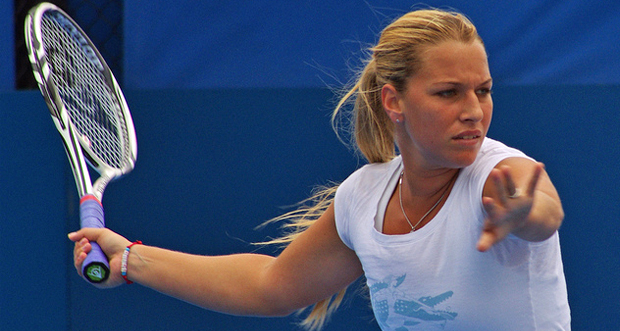
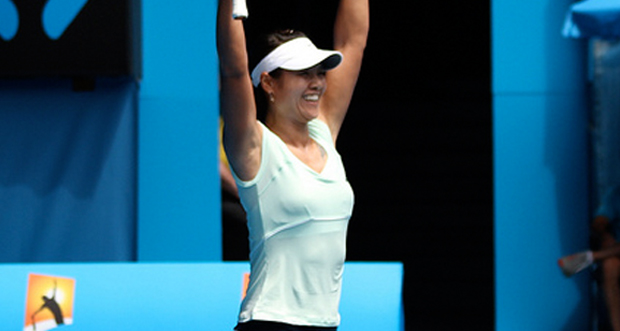
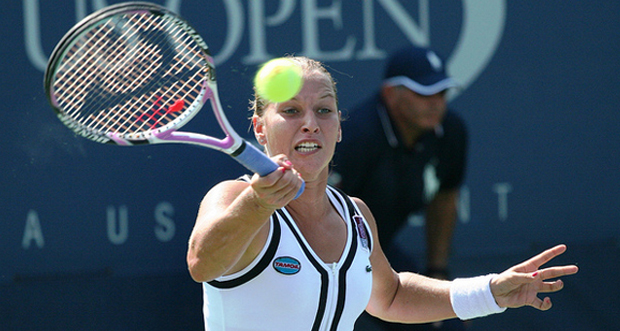
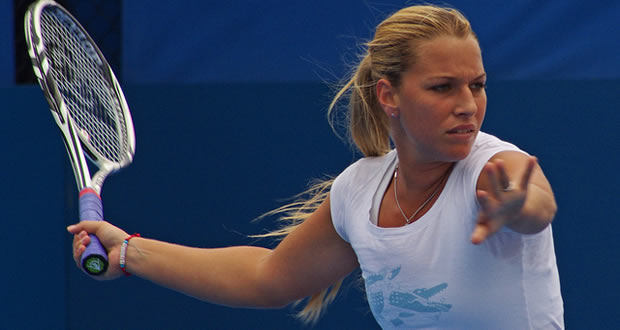
Li Na [4] def. Dominika Cibulkova [20] 7-6(3), 6-0
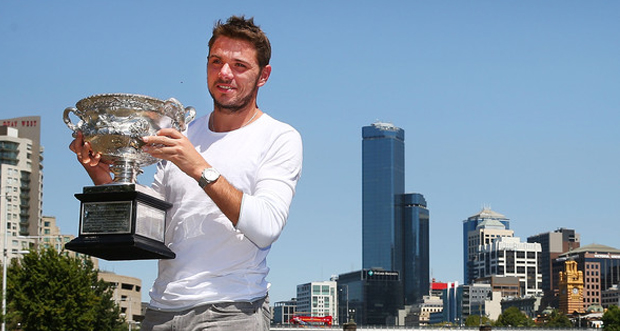
Stanislas Wawrinka [8] def. Rafael Nadal [1] 6-2, 6-3, 3-6, 6-3
At some point in the twelve months between the day Swiss player Stanislas Wawrinka lost a five-set, five-hour tennis match to defending champion Novak Djokovic at the Australian Open, and the night when he won a five-set Australian Open match against the again-defending champion Djokovic, Wawrinka got a tattoo on his forearm. A motivational tattoo courtesy of Samuel Beckett’s Worstward Ho: “Ever tried. Ever failed. No matter. Try again. Fail again. Fail better.”
Tennis players see a lot of their forearms. If Wawrinka ever forgot to try, or forgot how important it is to fail in life, all he had to do was glance downward and Mr. Beckett could remind him of the game plan. Keep going! I remember deploying the same passage on my site, Extreme Western Grip in early 2012, after Rafael Nadal lost a grueling six-hour Australian Open final, also to Novak Djokovic. After falling to Djokovic in umpteen straight finals, Nadal had, I believed, finally failed better—a lot better. And, indeed, next time Djokovic and Nadal met in a tournament final, Rafa won. But that’s Rafa; getting badly burned and then rising majestically, muscularly from the ashes—fist-pumping and vamos-ing in six directions at once—is what he does. He almost did it this past Sunday, despite carrying a back injury so severe he required a medical timeout and repeated visits from the trainer.
I ought to have realized, from the evidence of the permanent marker he’d injected into his very being, that Stanislas Wawrinka was very also serious about rising like a scruffy phoenix from the ashes. Instead, I was surprised when he pulled himself together, after a very shaky first set against Djokovic in last week’s quarterfinal match, to win in five. I was impressed to see the Swiss force himself, time and time again, to cling to the baseline when it was clear as the stripes on Berdych’s T-shirt that his instinct was to retreat to the comparative emotional safety of the backcourt. I was relieved when he didn’t let down in the next round, defeating Tomas Berdych and earning his first chance to play for a slam title. But he’d never taken a set off Rafael Nadal, not in 26 tries, so all I expected—hoped—for him was that he keep trying again, and again. I hoped he’d get a set, or maybe even two. I hoped the loss wouldn’t hurt too much.
In fact, I suspected that the match might unfold in much the way the women’s final did, with the underdog putting up an admirable fight but succumbing in the end to the better, more experienced player. Despite being billed on Channel 7 as a Bond-girl-esque battle between “Lethal Li and Dominika the Dominator,” the attention during coverage of the women’s match remained, and fittingly so, on the tennis. (So far as I can recall, Eugenie Bouchard’s impending marriage to Justin Bieber was not mentioned even once.) It was good tennis, with a happy ending. During the trophy speeches, Li Na’s comic timing was, as usual, impeccable—much like her backhand in the second set— and the smile on her face was unguarded and wonderful to see. But Cibulkova, despite the tears coursing down her face, also seemed honestly happy to be there. It’s not that she was “just” happy to be there, Cibulkova obviously wanted to win. (And if she can keep playing the kind of tennis she played throughout the Open, win she will.) Yet her 6-7(3), 0-6 loss—that second set was closer than it sounds—hadn’t obliterated her awareness of how much she’d accomplished before it.

Watching the two pose for trophy photos, I was hard-pressed to remember another time when the person left holding the runner-up plate looked so, well, radiant. It’s a shame it doesn’t happen more often. Being No. 2 out of 128 is an achievement to be proud of, but tennis doesn’t work that way. It’s a psychologically harsh sport. Take a tune-up tournament for example. Thirty-two players enter the Sydney draw, but only one gets to go on to the Australian Open with a victory fresh on her mind. Others might win a match or two, or possibly even three, but the last experience will be of loss. No wonder it’s the nihilistic Samuel Beckett and not, say, Ram Dass, to whom tennis players turn to for their inspirational tattoos.
After watching Wawrinka defeat Djokovic, I expected that Wawrinka, like Cibulkova, would put up a good fight in the final. I didn’t think he would win. But more important, I didn’t think he’d win playing the way he did: first, so spectacularly, and then so very anxiously. The first set and a half from Wawrinka—regardless of whether Nadal was already injured or not—was magnificent on all fronts. After the match he called it the best tennis he’s ever played. He served well, returned well, and drove his backhand down the line in a way that made Roger Federer look almost frail. Wawrinka’s forehand might be the stroke most vulnerable to a dip in form (he occasionally forgets he has knees to bend), but the winners he strikes off that side are likely to cause sharp, admiring intakes of breath from onlookers. (Or, at least from me.) If only he’d kept it up after he knew Nadal was hurt, like Rafa would have done himself.
For all that Nadal is kind to children, afraid of puppies, and modest on the podium, he’s ruthless when it comes time to drive the dagger home. Stanislas Wawrinka, on the other hand, is more like the rest of us. As he said after the match, it was hard for him to know that his friend and rival was hurting, hard to stay focused on what he needed to do. Well, it was also hard for me to watch. I was at Indian Wells in 2013 when Wawrinka managed to lose to an injured Roger Federer in much the same way that Wawrinka played the third set of the Australian Open final. He obligingly hit half-paced balls directly to his opponent’s racquet so that the poor guy with the bad back didn’t have to run. It was painful to watch. The next round, which pitted the wounded Federer against Rafael Nadal wasn’t a barrel of fun either, but it was a relief to see Rafa move swiftly to put his ailing opponent out of his misery.
There is another passage from Beckett, this time from Molloy, which could describe the spiral of psychological struggle that became the men’s final: “I did my best to go in a circle, hoping in this way to go in a straight line.” It was difficult to watch Wawrinka wrestle with himself to keep his aggressive game turned outward against his opponent, and not against himself. It was difficult to watch Nadal struggle to keep himself in the match, knowing that he would (or should) lose, and painful to see his tears when it was done. It would have been Rafael Nadal’s 14th slam title, equaling Pete Sampras’ tally, and the American was on hand to present the trophy. If there was ever doubt about the psychological law of diminishing returns, all that needs to be done is to compare the crestfallen face of Rafael Nadal to the brimming smile of Dominika Cibulkova. Success is nothing if not relative.
But if the 2014 Men’s Final was messy, Wawrinka’s joy at winning it was sublime. With this title he becomes the new Swiss No. 1 and World No. 3, and he, like many of us, couldn’t quite believe it, saying he’d find out the next morning whether or not he was dreaming. For me, the disappointment of the final two sets gave way to a vicarious experience of Wawrinka’s happiness in a matter of hours. By the early hours of Monday morning, as I waited in line at the airport to board my flight to New Zealand, it was not only the pleasure of the smiles of two new Australian Open champions, and two wonderful weeks spent in Melbourne that was on my mind, but also the loss of an ending. I didn’t want it to be over. Samuel Beckett once wrote, “tears and laughter, they are so much Gaelic to me.” It’s a sad sentence, not suitable for inspirational body art. Tears and laughter are without clear meaning, and of the past. But I mention it now because tears and laughter are also of a piece. In tennis, there’s no winner without a runner-up plate. And there’s no beginning to a holiday down under without its ending.
I’ll see you all back in California.