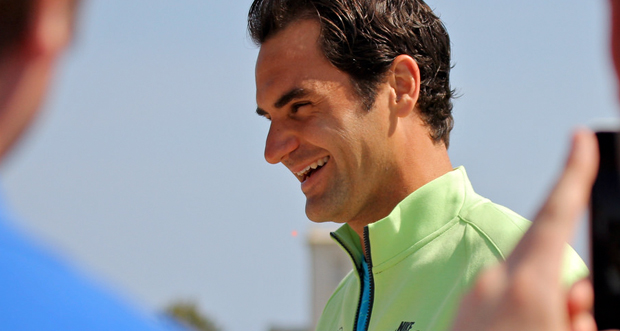
Tag: david nalbandian

  • Open Era Generations, Part Twelve: Gen 10 (1979-83) – Generation Federer

    Open Era Generations, Part Twelve: Gen 10 (1979-83) – Generation Federer

    Roger Federer

    Why the name?
    What else could it be called? Roger Federer dominated his peers unlike any player since at least Bjorn Borg. Consider that he is the only player born in the fourteen-year span of 1972-85 who has more than three Slam titles; he is probably the number one reason why this is the case. Federer won 17 of his generation’s 23 Slam titles, or 74%, more than Borg’s 69% (11 of 16). “Weak Era Theory” aside, Roger simply owned his peers. More on that in a moment.

    Best Players by Birth Year
    1979:  Ivan Ljubicic (CRO), James Blake (USA), Juan Ignacio Chela (ARG), Ivo Karlovic (CRO), Nicolas Massu (CHI), Michael Llodra (FRA), Albert Montanes (ESP)
    1980: Marat Safin (RUS, 2), Juan Carlos Ferrero (ESP, 1), Fernando Gonzalez (CHI), Xavier Malisse (BEL)
    1981: Roger Federer (SWZ, 17), Lleyton Hewitt (AUS, 2), Nikolay Davydenko (RUS), Feliciano Lopez (ESP), Mardy Fish (USA), Jarkko Nieminen (FIN), Julien Benneteau (FRA)
    1982: Andy Roddick (USA, 1), David Ferrer (ESP), David Nalbandian (ARG), Tommy Robredo (ESP), Mikhail Youzhny (RUS), Guillermo Coria (ARG)
    1983: Fernando Verdasco (ESP), Phillip Kohlschreiber (GER), Dmitry Tursunov (RUS), Alejandro Falla (COL)

    I’ve been a bit more liberal with the names included, as this is a generation still active, or at least fresh in memory. Birth years 1980-82 is the heart of the generation, with 1979 and ’83 being far weaker.

    Imagine being Lleyton Hewitt or Andy Roddick: 2003 ends and you’re playing well, both with a Slam and year-end No. 1 or 2 under your belt while still in your early 20s. Then this soft-spoken Swiss guy rises up and utterly dominates tennis, while you toil away, year after year, never able to get past him and win another Slam. This scenario is particularly telling for Andy Roddick, who lost four Slam finals to Federer and won only 3 matches out of 24. Despite that fact, Roddick had an excellent career, finishing every year from 2002-10 in the Top 10, with 32 titles to his name including one Slam and five Masters. Andy retired relatively young by today’s standards, just after turning 30 in 2012, but he saw the writing on the wall–falling from No. 8 in 2010 to No. 14 in 2011 and No. 39 in 2012.

    In 2001, at the age of 20, Lleyton Hewitt was the youngest player to reach the No. 1 ranking since the ATP computerized rankings began in 1973. He was No. 1 for 80 weeks — more than Stefan Edberg, Jim Courier, Gustavo Kuerten, Ilie Nastase, Mats Wilander, and Boris Becker. After two year-end No. 1 rankings in 2001 and 2002, Hewitt entered 2003 on top of the world. Yet it soon became clear that a couple of his peers were surpassing him: Andy Roddick and Roger Federer. He remained a top player for a few more years, but by 2006 he had slipped out of the elite, unable to compete with the newer, bigger, more powerful generation that was coming up. As of this writing, Hewitt just played his last Grand Slam, going out in the second round of the Australian Open. Though he hasn’t been in the Top 20 for seven years, he will be missed.

    As for the Swiss Maestro himself, it is difficult to say anything that hasn’t already been said. But to return to the topic of his dominance over his generation, consider his head-to-head against peers (born 1979-83) who were Top 10 players: 195-36, or 84.4% – which is better than his overall winning percentage against all players. Of all players in Federer’s generation, the only two who were able to win more than three matches against him were Lleyton Hewitt (9-18) and David Nalbandian (8-11).

    Federer’s fans occasionally bemoan the fact that he’s no longer the player he was during his absolute peak, from 2004-07. While this is undoubtedly true, we should not lose sight of the player he is now, still ranked No. 3 halfway between his 34th and 35th birthdays. The vast majority of all-time greats were either long retired or fading out at Roger’s age.

    Maybe Roger will buck the trend and remain an elite player into his late 30s, but it seems unlikely. While he is showing no signs of further decline—yet—any setbacks, such as his current knee injury, could damage his momentum. Regardless, we should appreciate the great player while he’s around.

    Underachievers and Forgotten Players
    David Nalbandian and Marat Safin come most readily to mind. These two challenged Federer in terms of talent, but neither had the mentality and focus to be a perennial champion. Nalbandian is on the short list of most talented player never to win a Slam in the Open Era, and Safin is often mentioned as an almost-great who should have been an all-time great.

    Nalbandian was the most competitive peer of Federer’s, winning 8 of 19 matches (42.1%) and their first five matches. After those five, Roger seemed to figure out Nalbandian, with an 11-3 record from the 2003 Tennis Masters Cup onward. The only players with a better percentage against Federer in 10 or more matches are Tim Henman (46.2%), Rafael Nadal (67.6%), Novak Djokovic (51.1%), and Andy Murray (44%), all either significantly older or younger. Regardless of his level of disappointment, Nalbandian had a solid career, the highlight of which was his victory over Roger Federer in the 2005 World Tour Finals, as well as his two Masters in 2007.

    Safin was the No. 2 player in the sport at the age of 21 in 2000, a year in which he spent nine weeks as the No. 1 player in the world, defeated Pete Sampras in straight sets to take the US Open title, and won two Masters. It looked like tennis finally had a new, young elite player to join the aging Agassi and Sampras. Yet he was to finish only two other years in the Top 5, 2002 and 2004, and he won only one more Slam and three more Masters. A fine career, but not an all-time great.

    Another to consider is Guillermo Coria, who was ranked in the Top 8 from 2003-05, then saw his career collapse in 2006 – for a variety of reasons, including service issues, marital problems, and injury.

    Lesser-known Joachim Johansson deserves mention as someone who looked like at least a second-tier player but saw his career destroyed by injury. At the end of 2004, it looked like Sweden would have have an heir to Thomas Enqvist and Thomas Johansson in the “If not quite Borg/Wilander/Edberg, then at least Nystrom/Jarryd” category. Joachim finished the year No. 11, at age 22, including a Slam semifinal appearance and an ATP 500 title, but couldn’t recover from a variety of injuries.

    Did You Know?
    Roger Federer’s 2006 was widely considered the best season of the Open Era since Rod Laver’s great 1969, only recently surpassed by Novak Djokovic’s 2015. He won three Slams, was the finalist in the fourth, won the World Tour Finals, four Masters, 12 titles overall, and a ridiculous 91-5 record. Four of those five losses were to his nemesis, Rafael Nadal, and the other to Andy Murray. But here is what is interesting: in all but one of those matches, Nadal was still 19-years old, as was Andy Murray, who was ranked No. 21 when he beat Federer at the Cincinnati Masters. When Nadal defeated Federer in the French Open final, he had just turned 20; it was his fourth and last win over the No. 1 player that year (Roger would beat him at Wimbledon and the World Tour Masters).

    So think about that for a moment: The best player in the sport, and one of the best all time, lost four times to two teenagers during his best season, and a fifth time to one of them a few days after he turned 20. In his best season. Other than that, Roger was 91-0.

    Top Ten Players of the Generation

    1. Roger Federer
    2. Lleyton Hewitt
    3. Andy Roddick
    4. Marat Safin
    5. Juan Carlos Ferrero
    6. David Ferrer
    7. David Nalbandian
    8. Nikolay Davydenko
    9. Tommy Robredo
    10. Mikhail Youzhny

    Honorable Mentions: Fernando Gonzalez, Guillermo Coria, Fernando Verdasco, Ivan Ljubicic, James Blake, Feliciano Lopez, Mardy Fish, Jurgen Melzer, Ivo Karlovic, Juan Ignacio Chela, Philipp Kohlschreiber.

    Number one is easy, as Federer was (and is) to his generation what Borg was to his. I also feel reasonably confident with my No. 2-4 rankings, although Hewitt, Roddick, and Safin could be arranged in a variety of ways. While Safin was the most talented of the three, and Roddick the most consistent over a long period of time, I give Hewitt the edge because he’s the only one who had a sustained period of time as No. 1, even if it was in the “soft spot” of 2001-02 when men’s tennis was seeing a regime change.

    After that, it gets tricky. If you changed Ferrero’s Slam win to a runner up, he would probably rank behind Ferrer, Davydenko, and Nalbandian, all of whom had better overall careers aside from one match. The “Mosquito” wasn’t the worst player to win a Slam, and was an elite player for several years but like many of his peers, he saw his career drop off in his mid-20s. He slipped out of the Top 10 in 2004 and never returned, with a later career similar to Hewitt’s. But he did win a Slam and attain the No. 1 ranking for a short period of time, things that Ferrer, Davydenko, and Nalbandian never did.

    David Ferrer has had an unusual career path, peaking in his late 20s and early 30s. Other than Federer, he is the most consistent player of his generation and will go down as one of the greatest players never to win a Slam, along with his contemporary Nikolay Davydenko, who filled a similar role before Ferrer’s peak. Ferrer has the reputation of a player who maximized his modest talents – was not a great player, but a consistently very good one. While he has winning records against similarly ranked players like Tomas Berdych (8-5) and Jo-Wilfried Tsonga (3-1), unlike those two there is a sense that it would have been (and is) impossible for him to win a Slam because Ferrer’s “A game” simply cannot touch the “B games” of Djokovic, Nadal, or Federer.

    There’s a steep drop-off after Davydenko, with Robredo and Youzhny earning their way into the Top 10 through longevity. Guillermo Coria, Fernando Gonzalez, Ivan Ljubicic, and James Blake were all better peak players, but none had the overall career accomplishments of Robredo and Youzhny.

    Addendum: Twelve Highest Ranked Players of Gen 10 (as of 2/8/16)
    3. Roger Federer
    6. David Ferrer
    25. Feliciano Lopez
    26. Ivo Karlovic
    32. Philipp Kohlschreiber
    34. Guillermo Garcia Lopez
    39. Tommy Robredo
    40. Gilles Muller
    52. Paolo Lorenzi
    54. Nicolas Mahut
    56. Victor Estrella Burgos
    57. Fernando Verdasco

    As you can see, this generation still has quite a few players around, although only two in the Top 10. Considering that this generation will turn 33 to 37 in 2016, expect almost all to be gone within another year or two, with maybe a few hold-outs playing into their late 30s.

    [divider]

    Cover Photo (Creative Commons License): Marianne Bevis
  • Best Players Never to Win a Slam

    Best Players Never to Win a Slam

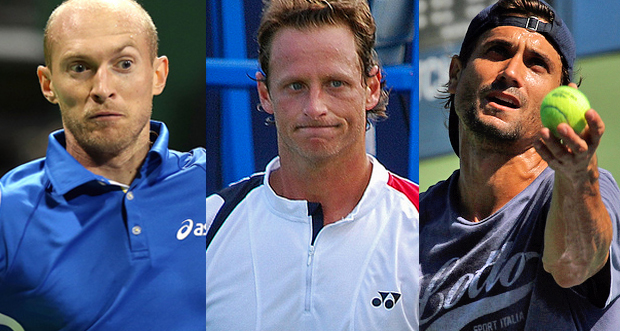
    Nikolay Davydenko David Nalbandian David Ferrer

    A couple weeks ago there was some talk about who was the best player ever never to win a Slam – people were using an acronym, which I can’t remember. I don’t quite have the time or patience right now to put it into an article, but I thought I’d at least do some cursory research and share it with this forum.

    I tried to look at all players who had been in Grand Slam finals and/or been in the Top 5 during the Open Era – this gave me a group of just over fifty players.

    I then assigned points for Slam results and wins in other tournaments, using their total titles as a base and then adding points like so:

    Base: total titles
    Slams: 3 Final, 2 Semifinal, 1 Quarterfinal
    Other tournaments: WTF/Cup 3, Olympics 2, Masters 2, ATP 500 1

    This was problematic because data is limited on a lot of older tournaments, but I did the best I could.

    I then sorted the total rankings and gave tie-breakers to the highest career rank (in parentheses). Here’s the list of players with at least 20 points.

    52 David Ferrer (3)
    45 Nikolay Davydenko (3)
    44 Tom Okker (3)
    40 Marcelo Rios (1)
    40 Alex Corretja (2)
    37 Harold Solomon (5)
    35 David Nalbandian (3)
    35 Miroslav Mecir (4)
    35 Raul Ramirez (4)
    34 Brian Gottfried (3)
    33 Tommy Haas (2)
    32 Thomas Enqvist (4)
    32 Jo-Wilfried Tsonga (4)
    30 Andrei Medvedev (4)
    30 Tim Henman (4)
    30 Tomas Berdych (5)
    29 Todd Martin (4)
    27 Greg Rusedski (4)
    25 Henri Leconte (5)
    24 Robin Soderling (4)
    24 Guillermo Coria (5)
    24 Mark Philippoussis (9)
    23 Brad Gilbert (3)
    22 Guillermo Canas (3)
    22 Cedric Pioline (5)
    21 Magnus Norman (2)
    21 Fernando Gonzalez (5)

    That’s about half of the total players. Just missing the cut are players like Jose Luis Clerc, Sebastian Grosjean, Kei Nishikori, and Gene Mayer. There were two players who played in two finals each that I didn’t have enough information to adequately rank – Steve Denton and Kevin Curren – but from what I could tell, both have points in the low 20s at most.

    Now I’m not saying that this definitely states that David Ferrer is the greatest player never to win a Slam. One thing I noted is that more recent second tier players tend to go deeper into more Slams than in past eras; I’m not sure why this might be. But looking at second week Slam results, Tsonga has 10, Ferrer 15, Berdych 11. Compare that to similarly great Thomas Enqvist 3, Alex Corretja 6, Marcelo Rios 5, etc.

    There are also specialist players, like Tim Henman–who is one of the very best Wimbledon players never to win it. Poor time made it to 4 Wimbledon SF, and 4 QF.

    One thing that this list does help us do, I think, is narrow the choices – it gives us a “first round” of candidates, so to speak. While I’m not ready to commit to the “second round,” I’m thinking that it would involve a closer look at weighing total titles won vs. big titles, as well as Slam results, H2Hs against top players, longevity, etc.

    What do you think? Who was the best player never to win a Slam?

    On yeah, what about the worst player to play in a Slam final? By ranking I came up with two names: John Marks, who never won a title in his career but lost in the 1978 Australian Open to Guillermo Vilas. Marks actually lost the first set of his 1R match to 2nd seed Jose Luis Clerc, but Clerc had to retire after the first set. Marks’ highest career ranking was #44.

    The other is Chris Lewis, who lost to John McEnroe in the 1983 Wimbledon final. Lewis’ highest ranking was #46, but he did win three career titles. I’d give the “honor” to Marks.

    Click here to discuss “Best Players Never to Win a Slam” in the discussion forum.

    [divider]

  • David, Rafa and Nole’s Excellent Adventure in South America

    David, Rafa and Nole’s Excellent Adventure in South America

    Adventure

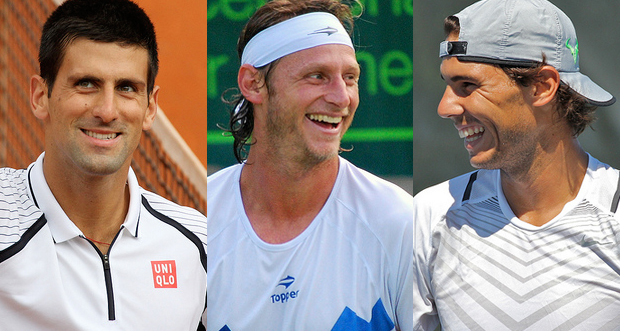
    This part of the off-season is about sending off David Nalbandian, and to a lesser extent, Nicolas Massú. Nadal and Djokovic, the world’s numbers 1 and 2, have joined in for exhibition matches and festivities. Here’s some of the news from the front in the Spanish-language press.

    The red-carpet was rolled out in Chile. The tennis players were received by President Sebastian Piñera. Nicolas Massú, who has also retired this year, was quoted as saying, “To have the honor of sharing this with Rafa, Novak, and David is a pleasure for anyone who cares about tennis.” Massú has now signed on as the Chilean Davis Cup captain. Chilean future hopeful Christian Garin was also in attendance. Also while in Chile, during a presser with Djokovic, Nalbandian, and Massú, Rafael Nadal offered to translate for Novak, and, hilariously, started restating what Nole said…in English. He had to be reminded that he was speaking English. He excused himself in Spanish, then saying, “At this point, I think English is my first language.” Likely it’s his first “press-conference” language, anyway.

    [divider]

    They also played some tennis in Córdoba, Nalbandian’s home town. Massú beat Nalbandian, 6-4, 6-2, and Djokovic got it over Nadal 7-6(3), 6-4. According to the Chilean press: “That never seemed like an exhibition, except for in the second set, where they joked about some fantastic points.” Otherwise the press in Spanish reckoned that they took it very seriously, for a “friendly.” The only break of serve came in the penultimate game of the second set. Interesting. I guess it’s not so easy for them to leave all the competitiveness aside.

    In his home town, Nalbandian also beat Nadal 6-4, 7-6(6).

    This is a particularly great point from the match:

    [divider]

    In between the exhibitions, Nalbandian and Nadal appeared together on the Susana Gutierrez show, a major talk show in Argentina. King David looked tanned and relaxed, and sartorially resplendent in a navy shirt, pink jacket, and red shoes. Nadal, according to the hostess, looked surprising tall. (“They always tell me that,” he said.) The conversation was light and full of humor. When asked about some of the longest matches they’d ever played, Nalbandian mentioned the six-and-a-half hour doubles match he’d played vs. Russia in Davis Cup. “Even I got bored,” said Nalbandian, to much laughter. Nadal said his was in Australia, lasting six hours, vs. Djokovic. “You must have won,” says la Susana. “No, I lost,” admitted Nadal, with a smile.

    When the hostess told David that everyone was heartbroken that he was retiring, he said, “Don’t be sad. Anyway, it was a great excuse to get Rafa to Argentina.” The two do seem to be very genial friends.

    You can see the videos of their appearance on the show here:

    [divider]

    Before everyone got back together in Buenos Aires, Nadal and Djokovic met in Patagonia for a hit-around with the glaciers as background. They took part in an exhibition on Friday, hitting on a barge in front of the Perito Moreno Glacier, near the southern extremity of Argentina. From Nadal: “I’ve just been in one of the most spectacular places that I’ve ever seen before, the Perito Moreno! Really amazing!”

    [divider]

    Novak and Rafa also got to hit goals in the Boca stadium in Buenos Aires. Not sure why River couldn’t get their attention, but:

    In the rematch between Nadal and Djokovic in Buenos Aires, Nadal prevailed, 6-4, 7-5.

    (Listening to Djokovic’s speech in Spanish, it seems clear he was coached by Rafa, because he used the Spanish idioms!)

    Nadal and Djokovic then combined to play doubles against Nalbandian and Monaco. By all accounts, they had a very good laugh. At one point, Djokovic threw himself to the ground so as not to be hit by Rafa’s serve. Nalbandian feigned arguments with the chair, and Monaco tried to hit his opponents at the net.

    Clearly, Nalbandian was well sent-off. The Chilean and Argentinian fans were greatly entertained, and Rafa and Novak seemed to have more-than-a-little fun. An Excellent Adventure, indeed.

  • Down the T #4:  David Nalbandian Interview

    Down the T #4: David Nalbandian Interview

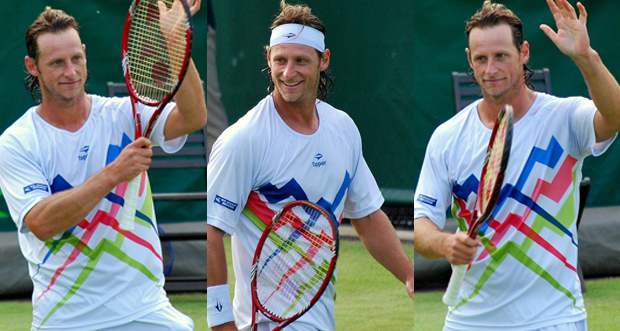
    Nalbandian Collage II

    Our latest “Down the T” features an interview with David Nalbandian, the 2002 Wimbledon finalist, winner of the 2005 Tennis Masters Cup, and numerous other titles, including the 2007 Madrid and Paris Masters.

    [divider]

    Tennis Frontier:  So to start, after a very successful junior career, you turned pro in 2000, and won Basel and Estoril in 2002, by age 20. What was it like to attain such early success, and have you noticed that it’s very rare now?

    David Nalbandian:  The truth is that at that time I wasn’t very aware of the magnitude of the things that were happening to me in my first steps of my career. Nowadays I look back and I remember those times with pride and affection.

    [divider]

    TF:  You have played across several different eras of the game, by your own description. How would you characterize the evolution of the game in the time you played it?

    DN:  When I started playing, the game was less physical. Today the players are more skilled, meaning hit the ball from both sides with almost the same accuracy. Back then, players used to have a good serve or a good back hand or a good fore hand. What I see now is that players are much better from this perspective.

    [divider]

    TF:  What are your most memorable wins/losses?

    DN:  The win that I remember with greatest pride is the final match of the Masters in 2005, when I won against Federer in 5 sets.

    And the most painful losses I remember are all the series of the Davis Cup that we couldn’t achieve, especially the final series we played in Mar del Plata against Spain. That was the one that hurt me the most.

    [divider]

    TF:  Our members tend to cite Madrid and Paris 2007 as an apex of your career. You became the first player ever to defeat Federer and Nadal in back to back tournaments. You also beat players such as Berdych, del Potro, Djokovic, and Ferrer on the way to those titles. It was an amazing run. Up until then your year hadn’t been stellar. What happened? And what happened just after, in terms of capitalizing on those wins?

    DN: At that time I was playing my best tennis. It was an exceptional end of the year. Besides I finally could play without injuries at all.

    [divider]

    TF:  What was it like to play Federer and Nadal in their prime form? Not many have found the solution for them, and you have. Notably, you beat Federer at the YEC, when you were down 2 sets to love. Can you talk about that?

    DN:  Winning against Federer and Nadal is a very difficult task; they are two of the best of all times. To win against them it is important to play perfectly throughout the game, and during those years I was playing my best tennis. The truth is that it was very satisfactory; I remember those years with a lot of pride.

    Regarding the Shanghai Masters final, even though I had lost the first two sets, I knew that I could have won those sets, so I felt pretty close. When the first set began, I knew that I could turn up side down the score, and I did it.

    [divider]

    TF:  What players have you enjoyed playing the most?

    DN:  The truth is that I enjoyed playing with almost every player in the circuit. I had the luck to play in an era in which there are great players, the best in history. I remember many matches with Roger, Rafa, Marat Safin, etc.

    [divider]

    TF:  Many of our posters have mentioned the beauty of your back-hand. Do you have an opinion about the greatest back-hands of all-time? And how do you rate Djokovic’s?

    DN:  I think it’s very effective. He hits the ball naturally, and the ball bounce is also very hard to read.

    [divider]

    TF:  What was your favorite Slam? And despite best results at Wimbledon, do you think you might have done better at Roland Garros?

    DN:  Even though I reached semifinals in all four Grand Slams, it was at Wimbly where I reached the final game. So I have a good memory of those days.

    [divider]

    TF:  Do you believe that the surfaces have been slowed down to the detriment of the game? Do you regret that carpet has been eliminated from the calendar?

    DN:  Yes, I do, even in Wimbledon. Regarding carpet surfaces, I loved playing indoors on those surfaces.

    [divider]

    TF:  When you see what Ferrer is doing at his age, and Tommy Haas and others, do you consider that you might come back from retirement?

    DN:  After many years playing on the circuit I have decided to retire, since after the operation, the shoulder isn’t allowing me to train with the requirement which the circuit demands. I’m not going to play professionally any more, I plan to devote myself to my family.

    [divider]

    TF:  Is there coaching in your future? Do you see yourself coaching Davis Cup? You have to know that there is a huge groundswell of notion that you should.

    DN:  I suppose that I will continue linked to tennis, but I still don’t know how. I don’t see myself as a coach.

    [divider]

    TF:  As you leave off your career in tennis, do you have any regrets? What will you miss? What will you not miss?

    DN:  I don’t regret anything in my career; I always tried to give the best of me. I know I will miss the trips, being with other tennis players, the tournaments and the competition, but I’m also happy to be able to spend more time with my family, my daughter and friends. Not winning the Davis Cup is the only thing hard to swallow.

    [divider]

    Cover Photo (Creative Commons License): Carine06

  • David Nalbandian – Career Highlights

    David Nalbandian – Career Highlights

    The Argentine press is in a swoon over the announcement that David Nalbandian, “King David,” as he is known there, is retiring.  Nalbandian has undergone several surgeries in the last few years, so it’s not actually a shock, but the popular player with the magnificent backhand and the sharp angles of a physicist will be missed.  Local press mentioned some of his career highlights:

    Sept. 1988:  At 16, he won the US Open Juniors title, beating Roger Federer, the reigning Wimbledon Juniors champ: 6-3, 7-5.

    March 2000:  Made his ATP debut in Key Biscayne.  Made it through the qualifying rounds, only to fall to Jim Courier.

    April 2002:  Won his first ATP title in Estoril on clay over Nieminen, beating Coria and Moyà along the way.

    July 2002:  After a great fortnight, lost in the Wimbledon final to then-world No. 1, Lleyton Hewitt.

    Sept. 2002:  Made his Davis Cup debut.  Nalbandian beat (along with Lucas Arnold) Safin/Kafelnikov in doubles, and Safin in straights in his singles tie, though Argentina eventually fell to Russia.

    July 2005:  Again in Davis Cup, Nalbandian beats Hewitt on grass in Australia to give Argentina the win over the Aussies.

    November 2005:  Wins Shanghai Masters

    March 2006:  Reaches No. 3 in the world rankings, behind Roger Federer and Rafael Nadal.  He is the third Argentine to do so, after  Vilas and Coria.

    December 2006:  In a losing effort against Russia, Nalbandian beats Davydenko and Safin.

    October 2007:  A career high.  At the Paris Masters 1000, he beat Federer in the quarterfinals, then Nadal in the final to take the title.  He was the first player to beat both champions in one tournament.  And two weeks later, he won the Madrid Masters by beating Nadal in the quarterfinal, Djokovic in the semifinal, and Federer in the final.

    August 2010:  Wins his last professional title in Washington, over Marcos Baghdatis, 6-2, 7-6.


  • David Nalbandian Retires from Tennis

    David Nalbandian Retires from Tennis

    David Nalbandian

    David Nalbandian has retired from the ATP Tour. The 31-year-old Argentine announced it at a press conference Tuesday, citing long-term injuries as the main reason.

    Nalbandian is a former world No. 3 who won 11 ATP singles titles and represented Argentina in three Davis Cup finals.  He also reached the semifinal of all four Majors, and won the runner-up trophy at the 2002 Wimbledon championships.

    [divider]

    Discuss with fellow tennis fans on the Tennis Frontier message board forums.

    [divider]

    Cover Photo: Carine06 (Creative Commons License)