Order of Play – Saturday, November 2 (Scores added as known.)
COURT CENTRAL — Not Before 2:30 P.M.
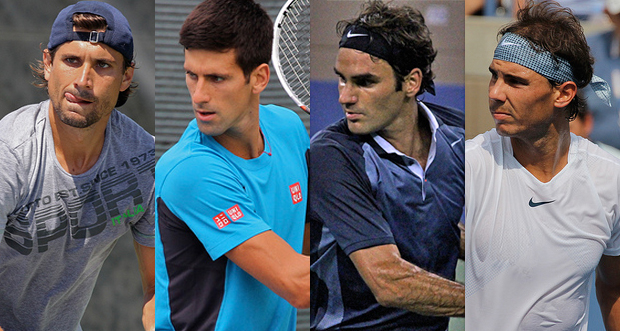
[2] Novak Djokovic (SRB) d [5] Roger Federer (SUI) — 4-6, 6-3, 6-2
Not Before 5:00 P.M.
[3] David Ferrer (ESP) d [1] Rafael Nadal (ESP) — 6-3, 7-5
Order of Play – Saturday, November 2 (Scores added as known.)
COURT CENTRAL — Not Before 2:30 P.M.
[2] Novak Djokovic (SRB) d [5] Roger Federer (SUI) — 4-6, 6-3, 6-2
Not Before 5:00 P.M.
[3] David Ferrer (ESP) d [1] Rafael Nadal (ESP) — 6-3, 7-5

Basel, Final
(1) Del Potro d. (3) Federer, 7-6(3), 2-6, 6-4
Roger Federer this afternoon enjoyed the unusual sensation of entering Basel’s St. Jakobshalle as the underdog, although perhaps “enjoyed” isn’t the word. In truth he probably enjoyed it about as much as the Swiss crowd, which for the better part of a decade had been sustained on easy brilliance, but must now seek additional nourishment in hope, a notoriously fickle dietary supplement. It has been that kind of season, and in Juan Martin del Potro he was facing a fine player who has transformed himself into a fearsome contender on every surface, roofed or not.
Last year in Basel Federer performed about as patchily as he has this year, and eventually fell to del Potro in a reasonable three-set final. At that time he was the world No. 1, and all the commentary centred on his doomed bid to retain his ranking until the end of the year. His return to No. 1 had been masterful, and apparently entailed visiting an unusual number of dispiriting losses on del Potro, indeed rather more than seemed necessary. As a consequence, Federer was still the strong favourite for last year’s final. This year he certainly wasn’t. Before the final, he hadn’t defeated another member of the Top 10 since the quarterfinal of the Australian Open, and was now ranked lower than del Potro. After the final, both those facts are still true. The interest this year lies in wondering whether he will qualify for the World Tour Finals, an event he has won six times. Sky Sports’ resident math-whiz Barry Cowan has run the sums, and reassured us that Federer will be there. Even so, it has, to put it mildly, been a horrible season.
Even that is misleading, though, since the concept of a single season in professional tennis is mostly meaningless. The suggestion that Federer is having a bad season glosses over the reality that he has been playing quite poorly for much longer than that. In fact, though I might be courting a measure of disapproval by saying so, I don’t think he has looked truly impressive since last year’s Olympics. This may seem a contentious point, given that soon after the Games he claimed the Cincinnati Masters without dropping serve, bagelling Novak Djokovic in the final. To the already potent mixture of injury and slumping form, one cannot help but add the question of desire. Overall, his hunger no doubt remains as undiminished as he insists when asked, but at those crucial moments in important matches when every choice must be razor sharp and execution flawless, his instinct lately seems blunted, the old audacity dulled. Perhaps it is merely an issue of confidence, the least tangible casualty of injury and prolonged poor form, and always the last to recover.
Still, Federer looked amply committed today, and wasn’t all that far from winning, and far from sanguine when he didn’t. It was a decent final, and tangentially diverting for how the shape of the whole match was thoughtfully captured in the first set, the way a tree’s form is reprised in each leaf, or the entire idiocy of pop culture is present in a single Kardashian. Nature’s wonder truly is eternal. Anyway, both players looked good early, before del Potro broke and moved ahead, but was broken back to love as he served for the first set. They reached a tiebreak, and Federer’s level plummeted while the Argentine’s didn’t. Federer stormed back in the second, as del Potro conducted an ill-conceived experiment to ascertain how well he’d do without a first serve. Not very well, it turned out.
Having satisfied himself of this, he set about proving the corollary in the third set, winning sixteen of the seventeen first serves he put into play. On the slick Basel court, this rendered him all but unbreakable. If only Federer had been. Alas, the key moment came early in the set, as Federer forwent several chances of maintaining his second set momentum, and was laboriously broken. His only opportunity to break back came immediately, but del Potro held steady when it counted. The rest of the match turned out to be a long coda. Del Potro, afterwards, was ecstatic. Look for him in Paris, and London. Look for Federer, too.
[divider]
Valencia, Final
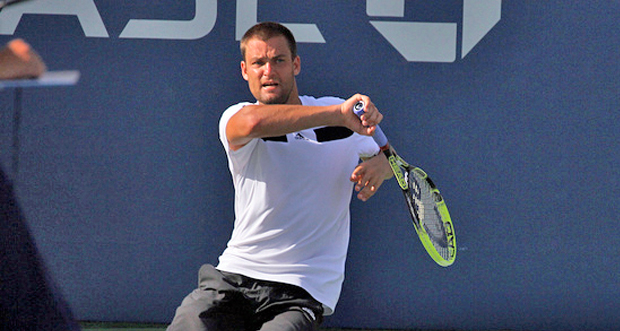
Youzhny d. (1) Ferrer, 6-3, 7-5
Mikhail Youzhny won’t feature in London, although by claiming the title in Valencia a short while later he has reinserted himself back into the Top 20, displacing a few others, and settling at No. 15. Ferrer, meanwhile, will be in London, since despite losing today he remains comfortable at world No. 3. I cannot help but think this lofty position does not reflect his current form.
Unlike Federer, the last twelve months have been the finest of Ferrer’s career, including a maiden Masters title, a Roland Garros final, and a career-high ranking. Again I’ll court perversity, this time by arguing that Ferrer has achieved these results in spite of his form and not because of it. If anything this renders his achievement greater still, although I also suspect he has enjoyed a healthy slice of luck, which at the right dosage is hard to gainsay. Consider this: he won the Bercy title last year without playing a match in which he was not the clear favourite, which is a pretty unlikely scenario when you think about it. He reached the Australian Open semifinal only by the grace of Nicolas Almagro’s brain, while the Jo-Wilfried Tsonga whom Ferrer encountered in the Roland Garros semifinal was a mere shade of the majestic Frenchman who’d trounced Federer the round before. A similar case can be made for Ferrer’s run to the Miami final. I’m not one of those who take pleasure in deriding Ferrer. He’s likeable, is rightly commended for the extent to which he maximises his gifts, and all any player can do is take advantage of situations that fall his way. But I do think he was a much better player last year.
That being said, I also thought he would beat Youzhny in the Valencia final. For all that victories over Almagro shouldn’t be considered a form guide for anything – even allowing for the degree to which match-ups between compatriots can go haywire – it seemed that Ferrer’s inherent advantages over Youzhny would only be rendered overwhelming by the environment. People euphemistically call Basel Federer’s court, but Valencia really is Ferrer’s court. He co-owns the event, which is staged in the Agora, an attractively stylised bone-cathedral that helps it feel like a novelty level from Topspin 4. One presumes Ferrer’s interests are at least partly responsible for the chemical miracle of Valencia’s surface, so far the world’s most successful attempt at rendering molasses into so striking a shade of cobalt. Unlike Stockholm where the court rewards excellent value for shots, a fact Grigor Dimitrov eventually exploited by hitting a few of his in, the Valencia surface is notoriously difficult to penetrate. Like Ferrer, this court is built for retrieval. For an aggressive yet self-destructive player like Youzhny, whose passage through the draw had mostly entailed outlasting even flakier men than himself, it was a tough proposition.
However, while I maintain that there’s more that can go wrong with an attacking game than a defensive one, Ferrer this year is living proof that inherently defensive tennis still requires more than a pair of legs. He remains as quick as ever, but his retrieving lately has been nowhere near as accomplished as one might expect. Youzhny was superb, bold from the very beginning, from all parts of the court, varied in his approach, and fearless when pressed. Once he finds his groove there are few players more attractive, although his recurrent issue is that he can be de-grooved so readily by a really tenacious opponent. Often the one extra shot is one too many, but today Ferrer only sporadically forced the Russian to come up with it.
There was a brief period in the second set when it felt like Ferrer would tear the match away. Youzhny could barely win a point, the local crowd found its voice as their man pulled ahead. But Ferrer’s momentum mysteriously flagged, and a poor service game saw him repeatedly out-rallied and broken back. Soon he was broken again, and Youzhny stepped up to serve for the title, after spending a precious minute pre-visualising it under his towel at the changeover. I cannot say whether it went as he’d planned, but it went as well as he could have hoped. His backhand up the line is unorthodox and beautiful, and today it was instrumental. The last point was thus an appropriate summary: Youzhny launched an attack, Ferrer scrambled desperately, and finally managed to get the ball safely up high to the Russian’s single-hander. The Russian, despite many excellent reasons to grow timid, launched a fearless backhand up the line. Ferrer could reach it, but not control it, and that was the match. Youzhny’s smile afterwards as he saluted the Valencia crowd – far more civilised than Madrid’s – was immense, but exceeded easily by that of his coach. Boris Sobkin doesn’t smile often, but it’s always worth the wait.
Cover Photo (Creative Commons License): Marianne Bevis
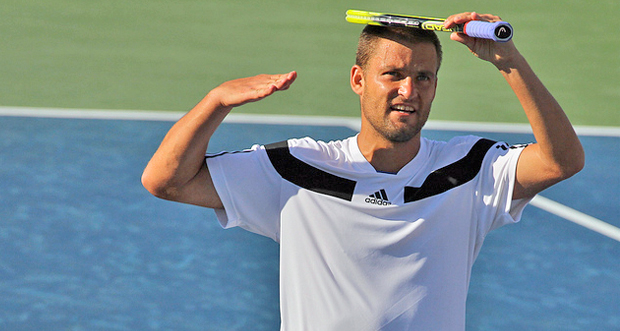

In a battle of the 31-year-olds, Russian Mikhail Youzhny, ranked No. 15 in the world, overcame local boy David Ferrer, world No. 3, to snag a surprising, and surprisingly dominant win over the three-time previous winner by a score of 6-3, 7-5. The win gave Youzhny his tenth career title, and only his second at the ATP 500 level, and his second of the season, having also won in Gstaad. 2013 has been something of a renaissance for the Russian, who was ranked as high as No. 8 in 2010, but has slumped around the 20-30s for the past couple of years.
Ferrer had been having a very fine week, and was doing away handily with most of all comers. However, he encountered a very motivated Youzhny today and failed to find the answers.
“It was a great week for me and a great tournament,” Youzhny said. “It was a great atmosphere. I felt nobody was against me, of course they were for David, but when I played well they applauded me.”
[divider]
Photo credit: Marianne Bevis (Creative Commons License)
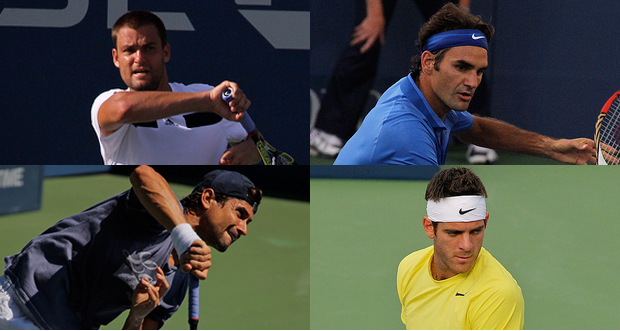

Roger Federer, Juan Martin Del Potro, David Ferrer, and Mikhail Youzhny have advanced to the finals of Basel and Valencia.
In Basel, the Argentine Del Potro beat the Frenchman Edouard Roger-Vasselin in three sets, 6-4, 4-6, 6-2. In the next semifinal, the Swiss Roger Federer won a hard-fought contest against the young Canadian Vasek Pospisil, finally winning in three sets, 6-3, 6-7(3), 7-5.
In Valencia, the first semifinal was an all-Russian affair, with Mikhail Youzhny knocking out Dmitry Tursunov, 6-2, 6-4. Up next, No. 1 seed David Ferrer, of Spain, beat countryman Nicolas Almagro, 6-2, 6-3, to advance to the final.
On Sunday, the Basel final will take place not before 14:30 P.M. (local time); the Valencia final is scheduled for not before 16:00 (local time).
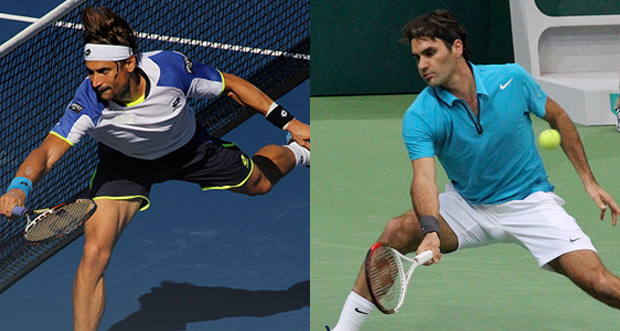

Latest Scores – Friday, October 25
Basel:
Roger-Vasselin d Brands — 6-3, 4-6, 6-3
Pospisil d Dodig — 7-6(11), 6-4
(3) Federer d (8) Dimitrov — 6-3, 7-6(2)
(1) Del Potro d Mathieu — 6-4, 6-4
[divider]
Valencia:
(1) Ferrer d (5) Janowicz — 6-4, 4-6, 6-0
(3) Almagro d (7) Fognini — 7-6(6), 6-2
Tursunov d Chardy — 6-3, 6-3
Youzhny d Nieminen — 7-5, 6-7(4), 6-4
[divider]
Basel Schedule of Play — Saturday, October 26:
CENTER COURT — Not Before 14:30
[1] Juan Martin Del Potro (ARG) v Edouard Roger-Vasselin (FRA)
[3] Roger Federer (SUI) v Vasek Pospisil (CAN)
[divider]
Valencia Schedule of Play — Saturday, October 26
AGORA — Not Before 16:00
Dmitry Tursunov (RUS) v Mikhail Youzhny (RUS)
Not Before 20:00
[1] David Ferrer (ESP) v [3] Nicolas Almagro (ESP)
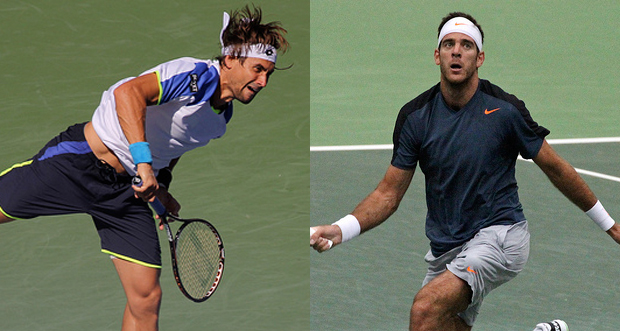

Latest Scores – Thursday, October 24
Basel:
(1) Del Potro d Baghdatis — 6-1, 6-2
Roger-Vasselin d Kamke — 7-5, 6-3
Mathieu d Llodra — 6-4, 6-3
(8) Dimitrov d Dolgopolov — 6-3, 6-2
Pospisil d Karlovic — 6-3, 6-4
Brands d Kubot — 6-2, 6-4
[divider]
Valencia:
(1) Ferrer d Benneteau — 6-2, 6-1
Youzhny d Kohlschreiber — 6-4, 6-3
(3) Almagro d Przysiezny — 6-4, 7-5
Chardy d (4) Isner — 7-6(7), 6-3
Nieminen d Falla — 6-2, 6-3
(5) Janowicz d Sousa — 6-2, 7-5
[divider]
Basel Schedule of Play — Friday, October 25:
CENTER COURT — Start 14:00
Edouard Roger-Vasselin (FRA) v Daniel Brands (GER)
Not Before 16:00
Ivan Dodig (CRO) v Vasek Pospisil (CAN)
Not Before 18:00
[1] Juan Martin Del Potro (ARG) v [Q] Paul-Henri Mathieu (FRA)
Not Before 20:00
[8] Grigor Dimitrov (BUL) v [3] Roger Federer (SUI)
[divider]
Valencia Schedule of Play — Friday, October 25
AGORA — Start 13:00
Jarkko Nieminen (FIN) v Mikhail Youzhny (RUS)
Dmitry Tursunov (RUS) v Jeremy Chardy (FRA)
[1] David Ferrer (ESP) v [5] Jerzy Janowicz (POL)
Not Before 20:00
[3] Nicolas Almagro (ESP) v [7] Fabio Fognini (ITA)
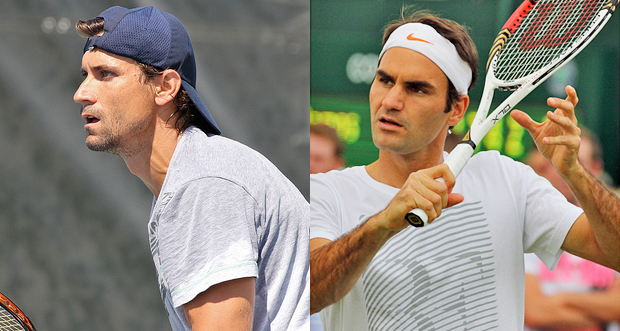

Latest Scores – Wednesday, October 23
Basel:
(3) Federer d Istomin — 4-6, 6-3, 6-2
(1) Del Potro d Laaksonen — 6-4, 6-4
Llodra d (5) Gasquet — 6-4, 6-2
(8) Dimitrov d Stepanek — 6-3, 6-3
Mathieu d Kudla — 6-4, 7-5
Dodig d (6) Nishikori — 6-1, 6-2
Pospisil d Haase — 6-4, 6-4
[divider]
Valencia:
(1) Ferrer d Monfils — 6-3, 6-2
(4) Isner d Gulbis — 7-6 (4), 7-6 (2)
Kohlschreiber d (2) Haas — 3-6, 6-3, 6-3
Tursunov d Bautista Agut — 6-2, 7-6 (3)
(7) Fognini d Granollers — 6-3, 6-2
Chardy d Mayer — 4-6, 7-5, 6-3
Nieminen d Paire — 6-3, 6-3
[divider]
Basel Schedule of Play — Thursday, October 24:
CENTER COURT — Start 14:00
Edouard Roger-Vasselin (FRA) v [Q] Tobias Kamke (GER)
Not Before 16:00
[Q] Paul-Henri Mathieu (FRA) v Michael Llodra (FRA)
Not Before 18:00
[1] Juan Martin Del Potro (ARG) v Marcos Baghdatis (CYP)
Not Before 20:00
[8] Grigor Dimitrov (BUL) v [WC] Alexandr Dolgopolov (UKR)
COURT 2 — Start 14:00
Vasek Pospisil (CAN) v Ivo Karlovic (CRO)
Not Before 16:00
Lukasz Kubot (POL) v Daniel Brands (GER)
[divider]
Valencia Schedule of Play — Thursday, October 24
AGORA — Start 13:00
Jeremy Chardy (FRA) v [4] John Isner (USA)
Mikhail Youzhny (RUS) v Philipp Kohlschreiber (GER)
[1] David Ferrer (ESP) v Julien Benneteau (FRA)
Not Before 20:00
[3] Nicolas Almagro (ESP) v [Q] Michal Przysiezny (POL)
PISTA 1 — Start 13:00
[Q] Alejandro Falla (COL) v Jarkko Nieminen (FIN)
[Q] Joao Sousa (POR) v [5] Jerzy Janowicz (POL)
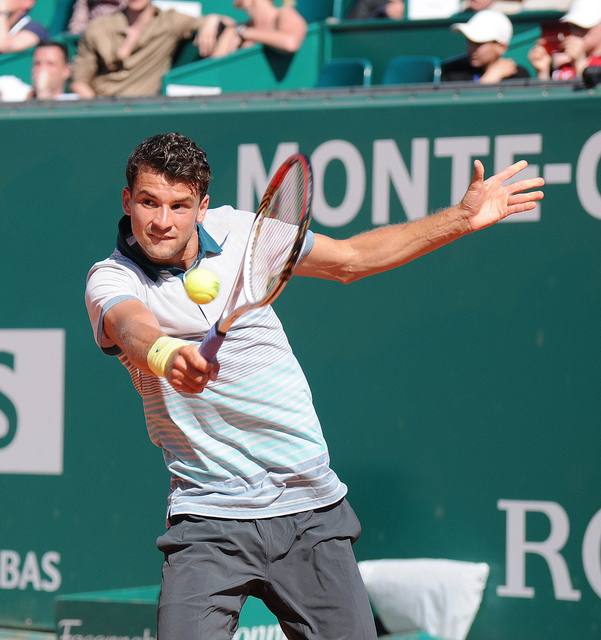

Highly touted Bulgarian star-in-waiting Grigor Dimitrov has won his first tournament on the ATP World Tour by defeating Spanish veteran David Ferrer, 2-6, 6-3, 6-4, at the If Stockholm Open.
[divider]
Cover Photo: Carinoe06, Creative Commons License
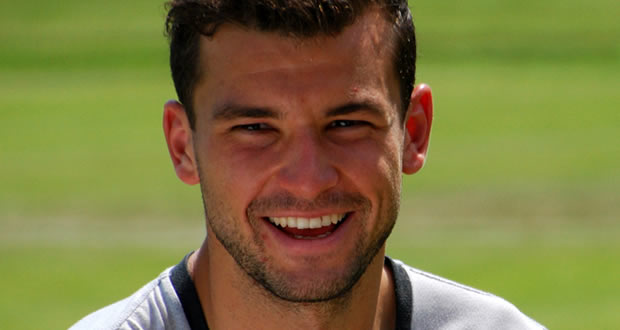
Stockholm, Final
(7) Dimitrov d. (1) Ferrer, 2-6, 6-3, 6-4
It is consistent with the ATP’s belated commitment to greater coherence that the European indoor season, which began this week in Moscow, Vienna, and Stockholm, now wastes so little time getting to the point. It was a move long overdue. If the season as a whole still makes little sense, constrained as it is by the timing of the Majors, at least the little mini-seasons that comprise it can achieve some internal logic. Now the European indoors is structured just like the Asian swing, as a three-week escalation from 250 level events, through a pair of 500s, and culminating in a Masters. The clay season and the US Summer are vaguely like that, too, and presumably the grass season would be as well if it only had more time.
Nevertheless, I confess I miss the more amorphous proportions that the indoor season used to have. Whereas now it is crisply marketed and boasts a discernible shape, it was once baffling and went on seemingly forever, filling the back-end of the season with an indeterminate number of ghoulishly-lit, interchangeable events differentiated only by their trophies, which strove to surpass each other in their nightmarish modernism. It was kind of wonderful. You could tune in at any point and know what you were getting, yet rest assured that none of it mattered very much.
Along with Basel’s dusted pink – now a confected memory – the hyperborean gloom of Stockholm was the season’s highlight, if that’s the word. It was thus with some disappointment that I tuned in earlier this week, and discovered that the Swedish tournament’s overall look has been sharpened. Since before I can remember it has been so unrelievedly blue that it left viewers in no doubt that the spectacle before them was taking place somewhere very northern and very cold. The way the image seemed to darken and grow fuzzy at the edges helpfully evoked the sensation of freezing to death. Perhaps it was merely an issue with the coverage, not helped by the time difference that ensured I was always watching in the smaller hours of the following morning. Sadly, although the court is still blue, the colour has deepened, and the space around it has been recoloured green, thus helping it look rather like a lot of other tennis courts. Thankfully Stockholm’s other trimmings have remained untrimmed, including the net contraptions used by the ball kids – why are these not used everywhere? – and a trophy that looks like one of Dr No’s discarded doomsday devices.
This device – I am assured its depleted palladium core has been removed – is now in the possession of Grigor Dimitrov, his reward for becoming the first Bulgarian supervillain ever to win a tour title. His victory also completed a rare day of triumph for one-handed backhands and vindication for the select group of men who’ve rightly or wrongly been dogged by comparisons with Roger Federer. Dimitrov is merely the latest to be burdened by the title “Baby Fed”. The original Baby Fed, you will recall, was Richard Gasquet, who an hour earlier recovered to defeat Mikhail Kukushkin in the Moscow final. Tommy Haas was spared the dubious Baby Fed accolade through being older than Federer. Instead, for large parts of the last decade he was held up as an example of stylish potential untapped, of what Federer might have been had it not all worked out so well. The irony, if we can even call it that, is that Haas this year has won twice as many titles as Federer: two. Maybe it isn’t irony, but it is somewhat miraculous, given Haas’s age. During the trophy presentation Robin Haase remarked that he himself might have been the thirty-five year old, while the German could pass for twenty-five. “If you only knew,” replied Haas.
Both Gasquet and Haas recovered from a break down in the final set against sporadically inspired opponents, eventually claiming their titles within about ten minutes of each other. Initially it appeared unlikely that Dimitrov would reprise this pattern. He and David Ferrer commenced the Stockholm final in the traditional manner of fast indoor tennis, by breaking each other constantly. Dimitrov quickly wearied of this, though Ferrer didn’t, and soon won the first set. Mostly this was achieved through the universally-applied tactic of directing everything at the Bulgarian’s backhand, though it would be unfair to suggest that it ever truly broke down. Indeed it held up admirably through the tighter second set. Ferrer had by now tired of breaking as well, though he was developing a fondness for unforced errors, and lost his serve late, and then the set. The stage was thus set for Dimitrov to fall down an early break in the deciding set, and then storm heroically back. Sadly, for Ferrer and for those of us pointlessly hoping that all three finals would play out almost identically, Dimitrov was never quite broken, though it was a near-run thing. Instead, again, it was the top seed Ferrer who found the crucial error at the worst moment, and double-faulted to give away the break. Dimitrov served it out, and commenced his celebration routine.
He began his year by reaching his first tour final in Brisbane, then characteristically lost his way. I was sitting with his old coach and manager as he fell dismally to Julien Benneteau in the first round of the Australian Open – a meticulously rendered example of a backhand crumbling apart – and could hardly have imagined that of the two men Dimitrov would be the first to win a maiden title. One of course should not underestimate Benneteau’s capabilities in this area, especially after Kuala Lumpur. The real risk is that after Stockholm we’ll overestimate Dimitrov. He has always attracted heightened expectations, especially in an era in which the next big things have proven slow to appear.
Presumably his new coach will help with that. Stockholm was Dimitrov’s first tournament with the ineffable Roger Rasheed, “ineffable” in this case denoting that species of incomprehensibility that contrives to sound meaningful. Rasheed’s gift for impenetrable neologism is of course legendary, and certainly hasn’t gone unexamined in these pages. In the case of Dimitrov, however, I can see its legitimate value: by having to focus so hard on deciphering what Rasheed is saying he ensures that his mind remains empty of whatever it is usually filled with. Rasheed thus stands revealed as a kind of Zen master, with corporate-calibre motivational aphorisms taking the place of Om.
Beyond his capacity to spout claptrap, though, Rasheed is nothing if not a taskmaster, and notoriously intolerant of any player giving less than his best. His true value will be in addressing those periods, altogether too common, when Dimitrov decides not to bother. Everyone looks good when he’s playing well, and Dimitrov looks better than most. It’s what happens when you’re playing badly that counts. Yesterday in the semifinal he came back from a set down, though admittedly that was against Benoit Paire. But today he recovered from a poor start against Ferrer, and held his nerve admirably through a tight final set. Afterwards Dimitrov insisted that he was happier with his perseverance and resilience than with the actual silverware. I can’t say how true that is – it sounds like the kind of sentiment Rasheed would endorse, although he’d certainly use different words – but I suspect it is at least partially the case. In any case, one can hope.
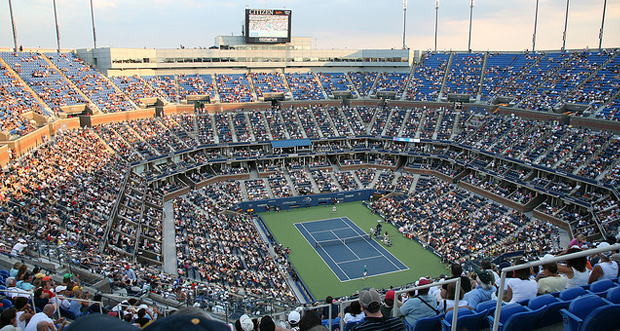
US Open, Quarterfinals Recap
The US Open, an entity which I contend boasts not only impish sentience but an eye for proportion, thoughtfully balanced a pair of men’s quarterfinals that more or less lived down to expectations with two others that could have hardly conformed less. Two predictable blowouts and two extravagant upsets: what could be more formally elegant? There was a brief period in the last of these encounters, as Mikhail Youzhny stole a set from a momentarily unfocussed Novak Djokovic, when I feared this graceful symmetry might be fractured, or, more worryingly, that I might have to rewrite this opening paragraph. Fortunately the world number one steadied magnificently, and I was able to salvage my broader point, such as it is. For all that I would have enjoyed an audacious comeback from Youzhny almost as much as the tennis-starved punters in Arthur Ashe Stadium, I’d prefer it didn’t cost me whole minutes of work.
[divider]
Click here to discuss “All Manner of Absurdity” and more in our discussion forum.
[divider]
It’s a nice question whether Richard Gasquet defeating David Ferrer in five sets constitutes a more surprising upset than Stanislas Wawrinka beating Andy Murray in straights, leaving to one side the question of which was the more upsetting surprise. If one were writing a screenplay, which result would cause viewers suddenly to rediscover their disbelief, and simply walk out? Cinema audiences will put up with all manner of absurdity – midi-chlorians, Nicholas Cage – but there are limits. This is the US Open, not Wimbledon. It would probably be more convincing had the scores been swapped: Wawrinka might have prevailed in a tough grind, while an incandescent Gasquet might conceivably have swept the formless Ferrer aside quickly.
(2) Nadal d. (19) Robredo, 6-0, 6-2, 6-2
It was always likely that Rafael Nadal would make short work of his quarterfinal, given his exalted hardcourt form and Roger Federer’s exit in the fourth round. But the fact that he was facing a veteran who’d never progressed beyond this stage of a Major in several dozen attempts put it almost beyond doubt. Realisation that this veteran was a compatriot of Nadal’s removed even that modicum of uncertainty. Add in a single-handed backhand and it was hard to see how the encounter would stretch far beyond eighty-minutes. The opponent was Tommy Robredo, who’d done such a sterling job two days earlier in providing a sturdy platform for Federer to ritually disembowel himself on. Robredo brought a similar commitment into his match with Nadal – standing way back, looping groundstrokes, and retrieving like a terrier – with the result that he won five whole points in the opening set. These points sadly weren’t clumped such that they equated to a whole game. Forget eighty minutes — maybe it wouldn’t last the hour.
The next two sets were marginally more competitive, but such terms are relative, and it was never a contest. Before the match Nadal had somehow maintained a straight face while declaring that in order to have any chance at beating Robredo he’d have to play his best. As it happened Nadal did play somewhere near his best, with the result that Robredo had no chance whatsoever. Nadal has moved through to the semifinals, an outcome he subsequently described as “unbelievable”, which I think translates as “very believable”, considering he has made it at least that far in New York every year since 2007, apart from last year when he didn’t reach the first round.
For a refreshing contrast he will next face a tour veteran to whom he has never lost, who employs a single-handed backhand, and prefers to operate ten feet behind the baseline. This player is Richard Gasquet, and to say that Nadal has never lost to the Frenchman is slightly misleading. Gasquet actually beat Nadal fourteen years ago, in juniors. This result has no material bearing on their upcoming US Open semifinal except that Gasquet brought it up in his press conference, thereby proving that it’s no longer possible for a professional sportsperson to make a joking aside without having it over-analysed to death. Nadal was naturally quizzed about this during his post-match interview, and astonished everyone by recounting the match in granular detail. Even Brad Gilbert was left momentarily speechless. Jason Goodall reliably wasn’t, joking, “I suppose he’s out for revenge in the semifinal, then.”
(8) Gasquet d. (4) Ferrer, 6-3, 6-1, 4-6, 2-6, 6-3
It is hard to imagine he won’t get it, but then it’s pretty hard to believe that Gasquet is there at all. Even to reach the quarterfinals he required five sets, and had to overcome one of the worst fourth round Major records in history (0-11 since Wimbledon 2007). Admittedly that was only against Milos Raonic, who himself had never progressed beyond the round of sixteen. In the quarterfinal Gasquet faced the fourth seeded David Ferrer, thus pitting a man who rarely beats those ranked above him against a guy who seldom loses to those ranked lower, a guy whose constant presence in Major semifinals has ceased to elicit surprise even if it is destined never to gain acceptance. Ferrer will presumably drop out of the top four long before everyone stops wrongly assuming that his quarter of the draw is the one fated to collapse. It was once again to everyone’s chagrin that the only quarterfinal match-up that panned out according to seedings was Ferrer’s, although I do maintain that it was only by the grace of Dmitry Tursunov’s delicate thighs that this was possible.
Gasquet took the first two sets in fairly convincing fashion, and it seemed likely that a perfunctory upset was underway. This would have been surprising in a sense, though hardly in the league of Federer’s loss to Robredo. Ferrer has been horribly short on form, and sometimes Gasquet is simply unplayable. It happens. But then Ferrer fought back, and levelled the match at two sets each. Gasquet was no longer anything like unplayable, and Ferrer wasn’t playing that badly. The scene – an idyllic French farm setting circa 1917 – was precisely the kind of one into which the Frenchman will typically plummet in a tangle of flaming wreckage. But somehow he remained aloft, mostly due to his serve. Despite his appalling record in fourth rounds, Gasquet has also never lost in the quarterfinals. But nor has he won a semifinal.
(9) Wawrinka d. (3) Murray, 6-4, 6-3, 6-2
Murray’s seppuku was only marginally less extravagant than Federer’s, though it was characteristically louder, and given he was facing a superior opponent on a bigger stage, it all worked out looking about the same. By losing to Wawrinka, Murray has failed to reach the final at a Major for the first time since Roland Garros last year (he didn’t play Paris this year). Indeed, aside from last year’s French Open he had reached at least the semifinals at the last nine Majors he had entered, going back to the 2010 US Open, where he lost in the third round to, as fortune would have it, Wawrinka. A mere coincidence, of course, though Murray’s many fans are no doubt right to be dismayed by the connection, since their man is supposed to have moved on from flaccid efforts like this.
Perhaps they can find some comfort in the suggestion that this new Wawrinka is a categorically superior version to the old one. The addition of Magnus Norman to his team appears to have worked a similar trick for the Swiss that it did for Robin Soderling a few years ago, although it’s worth bearing in mind that Wawrinka was still coach-less when he almost beat Djokovic in Melbourne, so far the season’s finest match. Any changes that Norman has wrought in Wawrinka’s game – the focus appears heavily to be on buttressing his sense of self-belief more than anything technical – are a refinement to the course he’d already set. Wawrinka’s faith in his own capacity to match top ten players was amply displayed against Tomas Berdych in the last round, and reprised today.
History, in the guise of countless mid-match collapses against Federer, had previously taught all discerning fans that it is rarely a question of whether Wawrinka will collapse in a high-stakes tennis match. It is merely a question of when, which in turn propels one onward to the gasping query of why (for the love of god). So it was today, when Eurosport’s English commentators tirelessly awaited a reversal that never came, even to the end. Wawrinka opened his final service game with a double-fault, then watched unperturbed as Murray smacked a return winner past him. From there it was all Wawrinka, all aggression – including a tremendous bounce-smash winner from the baseline – all the way to the end.
The defending champion is out.