Tag: david ferrer

  • 2015 ATP World Tour Finals Preview

    2015 ATP World Tour Finals Preview

    15612895007_1565dcee0d_z

    ‘The end is here’ ‘The Final showdown’ ‘The Stage Is Set’ ‘Insert overdramatic cliché’. Yes, ATP overkill at its finest. But cynicism aside, I am of course looking forward to the season ending shindig in London. It is a pleasure to see the best players in the world battle it out for a colossal sum of money and ranking points. Not bad for a week’s work, that’s for sure.

    There is little change in the line-up since last year’s event, with Nadal and Ferrer replacing Milos Raonic and Marin Cilic in the eight man field, although Ferrer was an alternate last year. The event is a great yardstick of both season long consistency, but even more so of longevity. This shall be Berdych’s sixth straight year of qualification, Ferrer’s fifth, Djokovic’s ninth and one Mr Roger Federer’s fifteenth. The other four meanwhile have all made multiple appearances, again a testament to the depth and quality atop the men’s game.

    On the subject of depth and quality, Novak Djokovic stands a head higher than even his closest competitors at the event, and as I breakdown the draws and offer my thoughts, it becomes clear: All roads pass through Novak in the quest to haul in the trophy a week from Sunday.

    Group A

    This group, consisting of Djokovic, Federer, Berdych and Nishikori, is for me the more likely of the two to see the big names advancing.

    Novak leads Berdych a lopsided 20-2 in their head to head, never having lost to the Czech on a hard court. Berdych has enjoyed some form this autumn, but even his biggest shots seem to make little indentations in the Serb’s defences. Nishikori has enjoyed a bit more success against Djokovic, winning two of their six matches, including at the US Open last year. In addition, Nishikori pushed Novak at the World Tour Finals last year in one of the few matches that weren’t duds. With Kei’s lack of matches lately though, and Djokovic’s imperious form, I suspect Djokovic to come through these two hassle free.

    Federer, although not as dominant over the afore mentioned pair as Djokovic, still enjoys healthy head to heads against both. Against Berdych the Swiss leads 14-6. Berdych does not seem to have as big a block against Roger compared to the more defensive members of the ‘big four’, his big game when clicking can overcome him, including twice in Slams. Federer has not lost to Tomas though since an injury plagued 2013, winning the last three matches. I think Berdych could trouble the Swiss, especially when one looks at his recent loss to the big hitting Isner in Paris, but the court in London has in recent years yielded a slower bounce, which should aid Federer in nullifying Berdych’s power.

    What of the marquee matchup between the two most successful players of the season? It seems strange for Novak and Roger to meet in the round robin stage of the tournament, but that is the nature of rolling rankings and contributes towards the excitement of this unique event. There is little to choose between the pair going into the tournament, Federer triumphing in Basel, Djokovic a week later in Paris. Both are in fine fettle, and play some of their best indoors. Based on his sheer dominance in the last few months, Novak for me edges their encounter.

    Group Winner: Djokovic

    Group Runner Up: Federer

    Group B

    The other group, consisting of Murray, Wawrinka, Nadal and Ferrer, offers more in the way of unpredictability and intrigue than the first.

    Murray is in a rich vein of form, reaching the Paris Masters final before falling tamely to Djokovic. He will benefit from home crowd support, and is a fine indoor player. Although trailing Nadal 6-15 in their head to head, this is not the same Nadal of late, Murray beating him on the home clay of Madrid in their last meeting this year. Murray has had a better season, and I think in terms of speed, fitness and form the Scot starts out as favourite against Rafa. In his last meeting with Ferrer, recently in Paris, he overcame him in two straight forward sets, and leads their series 11-5, as well as having won their last three indoor meetings. Ferrer has enjoyed a successful autumn, but Murray would start as a clear favourite. Murray’s match with Wawrinka should prove to be the hardest. While he leads the Swiss 8-4, Stan won their last two encounters in 2013, and they have not met since in a period where he became a two time slam winner. I would not be surprised to see Wawrinka power through the Scot, as he did last time they met.

    Stan Wawrinka comes to London having enjoyed the best year of his career. Nadal was long a nemesis for him, leading their head to head 13-3. Stan has put things to rights in recent years however, winning three of their last four meetings,  including on Nadal’s beloved clay earlier this year, and then in two pulsating sets in Paris in similar conditions to London last week. If Wawrinka hits his offensive stride, I see him edging the Spaniard. Against Ferrer meanwhile, Stan, whilst trailing 6-7, he has won their last three meetings. Ferrer can certainly hang in there with the more powerful Swiss, still prone to bouts of inconsistency, but Stan remains the favourite.

    Nadal has done well in making the finals in London, having a rather modest year by his lofty standards, winning just three minor titles. He has qualified the hard way, but qualified all the same. He has shown some good form in the indoor season, stretching Federer, perhaps the greatest indoor player in history, to three sets in the Basel Final, before falling in a tight quarterfinal last week in Paris. I have already above given two opponents an edge over Nadal in his group, and I struggle to see him making the semi-finals this year. All the same, it would be a great end to the year for Nadal to score a win against his friend and rival, the dogged David Ferrer. Rafa enjoys a 23-6 lead in their matches, and won their sole meeting this year in Monte Carlo. Ferrer is nevertheless an effective indoor player, coming into London with two trophies at indoor events. Furthermore, four of his six wins against his compatriot were on hard courts, two of them indoors. This match represents both men’s best chances of a win in London, and the accompanying $167,000 and 200 ranking points. Expect an entertaining slugfest in their final encounter of the year.

    Group Winner: Murray

    Group Runner Up: Wawrinka

    Semi-Finals

    Federer Defeats Murray

    Djokovic Defeats Wawrinka

    Final

    Djokovic Defeats Federer

    [divider]

    Link to author Daniel Edwards’ blog

    Cover Photo (Creative Commons License): Marianne Bevis

  • National Tennis Careers – Part Three: Spain

    National Tennis Careers – Part Three: Spain

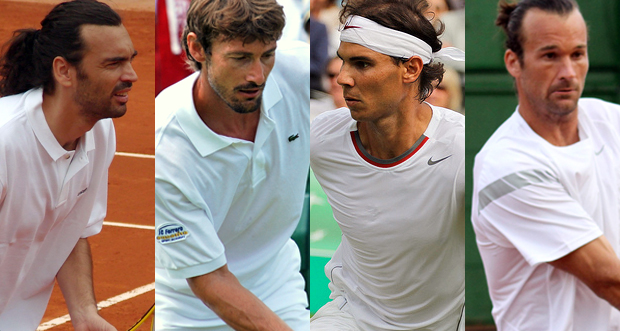
    Sergi Bruguera Juan Carlos Ferrero Rafael Nadal Carlos Moya

    Rafa & The Conquistadores

    Among the five greatest tennis nations in this series, Spain and Switzerland share something in common: they are completely dominated by a single player, one who is head and shoulders above the rest of the field. These two players will be forever linked, not only as two of the greatest ever to play the game, but because of their evocative (albeit lopsided) rivalry.

    [divider]

    Click here to discuss “National Tennis Careers – Part Three: Spain” in the discussion forum.

    [divider]

    Before getting to Rafa, let’s look at Spanish tennis before the King of Clay. Before the Open Era, only three Spanish players appeared in Slam finals, Pro or Amateur: Manuel Santana, Andres Gimeno, and Juan Gisbert Sr. The first two are well known as top players of the 1960s, but Gisbert Sr is not so well known – he lost to William Bowrey in the 1968 Australian Open final, the last Slam before the Open Era began. Santana won four Amateur Slams in the 1960s and was ranked No. 1 among Amateurs in 1966 when he won Wimbledon, but never entered the professional circuit, so didn’t play the top players in the game.

    Andres Gimeno was one of the best players from the 60s that wasn’t Australian. He had a long career, beginning as an amateur in 1956, turning pro in 1961, and playing until 1973. While he never won a Pro Slam, he played in four finals – losing to Rod Laver three times, Ken Rosewall once. He is perhaps best known for winning the 1972 French Open at the ripe age of 34.

    Spanish tennis became stronger during the Open Era, but didn’t see its first truly great player until Rafael Nadal emerged from the clay of Manacor, fully formed like some Mediterranean deity. Let’s take a look at the Open Era Slam record:

    Spain Career

    As you can see, before Nadal seven Slams were won by Spanish players: one each by Gimeno, Manuel Orantes, Albert Costa, Carlos Moya, and Juan Carlos Ferrero, and two by Sergi Bruguera. The weakest era for Spain was the 1980s, after Manuel Orantes retired, but then picked up in the 90s with Bruguera, then later Moya and Ferrero, among others. It is also worth noting that of the seven Spanish Slam winners of the Open Era, only Orantes and Nadal won Slams on a surface other than clay.

    Ten Greatest Spanish Players of the Open Era
    1. Rafael Nadal
    2. Manuel Orantes
    3. Juan Carlos Ferrero
    4. Carlos Moya
    5. Sergi Bruguera
    6. David Ferrer
    7. Andres Gimeno
    8. Alex Corretja
    9. Albert Costa
    10. Tommy Robredo

    Honorable Mentions: Jose Higueras, Emilio Sanchez, Felix Mantilla, Carlos Costa, Albert Berasategui, Francisco Clavet, Feliciano Lopez, Fernando Verdasco, Nicolas Almagro, Albert Portas, Juan Aguilera.

    Number one is easy, but after that it gets really dicey. Orantes, Ferrero, Ferrer, Moya, Bruguera, and Gimeno could be ranked in any number of ways. Gimeno would probably be second if we counted his whole career, but his Open Era career wasn’t as impressive as the others. Albert Costa is, along with Thomas Johansson and Gaston Gaudio, a one-Slam wonder who benefited from playing in the weak early years of the 21st century. Alex Corretja is among the better players never to win a Slam – along with later countryman David Ferrer.

    Spanish tennis has been strong over the last ten years, although with one player dominating. But David Ferrer, Feliciano Lopez, Tommy Robredo, Fernando Verdasco, and Nicolas Almagro have all had very good careers.

    A bit on Rafael Nadal. There is little doubt that he is the most dominant clay court player in the history of the game, and there has been no harder task than beating Rafa at Roland Garros where he holds a 70-2 record. Rafa was the clear World No. 2 for 2005-07 but then stole not only Wimbledon but the No. 1 ranking from Roger Federer in 2008. He has struggled with injury through much of his career, so there’s an element of “what if” to Rafa’s career. Some say that if he had been healthy he’d have surpassed Federer’s Slam count by now, while others say that we cannot separate Rafa’s penchant for injury from his greatness due to his style of play. Either way, his record is what it is: Regardless of what his future accomplishments might be, right now he is one of the greatest players in tennis history.

    The Future
    Troubled times may be ahead for Spain. Consider the Spanish players current (as of July 6) in the Top 100 with their ages:

    7. David Ferrer (33)
    10. Rafael Nadal (29)
    16. Feliciano Lopez (33)
    19. Tommy Robredo (33)
    22. Roberto Bautista Agut (27)
    32. Guillermo Garcia-Lopez (32)
    37. Pablo Andujar (29)
    43. Fernando Verdasco (31)
    63. Daniel Gimeno-Traver (29)
    65. Albert Ramos (27)
    67. Pablo Carreno Busta (23)
    72. Marcel Granollers (29)

    Notice something? Nine of the twelve players are 29 or older. We could chalk this up to the way of things these days, but there’s a disturbing lack of young players on that list. In other words, of those twelve players only Carreno Busta and possibly Bautista Agut and Ramos have room to improve, however none of them are likely to be future elite players.

    There is also the question of Rafa’s decline. Clearly he is not the player he was in 2008-13, his peak range. Rafa has a tendency to play well, get injured, then surge back to the top again – a cycle that has repeated itself a few times. But this latest round hasn’t seen a surge (yet), and we’re now almost eight months from his appendicitis surgery. Does Rafa have another surge him? Who knows? Many, including myself, have long speculated that when the end comes for Rafa it will come quickly. But I, for one, am not ready to relegate him to the history books. Not yet. I doubt we’ll see another 2013, but we could see a lesser version.

    But other than the players listed above, is there a future for Spanish men’s tennis? Let’s take a look at the youth.

    Highest Ranked Player By Age
    23: Pablo Carreno Busta (No. 67)
    22: Roberto Carballes Baena (No. 169)
    21: David Perez Sanz (No. 305)
    20: Albert Alcaraz Ivorra (No. 481)
    18/19: Jaume Munar (No. 690)
    17: Carlos Taberner (No. 970)

    So consider that – the highest ranked Spanish teenager is No. 481 in the world. Even the United States has three teenagers ranked higher. History has shown us that great players are usually pretty good while still in their teens – meaning in or near the Top 100 – and there’s no player even close to that. Even if we say that players are starting their peaks more in the 23-25 range rather than 20-22, as in the past, there’s no young Spanish player who looks to be on the trajectory for greatness. Surprise weather patterns happen, but the forecast as of right now is not positive for Spanish men’s tennis – at least not over the next few years. What we are likely going to see is a gradual and then quick diminishing of Spanish tennis as Nadal, Ferrer, Lopez, Verdasco, Robredo, and Almagro all fade away and then retire, with perhaps only Bautista Agut and Carreno Busta carrying the torch as Spanish players in the Top 20-30 range in a few years time. Whether they can carry that torch long enough to pass to the next great Spaniard remains to be seen.

    [divider]

    Cover Photo (Creative Commons License): bourgol / Carine06 / Marianne Bevis / conson

  • Second Tier Players

    Second Tier Players

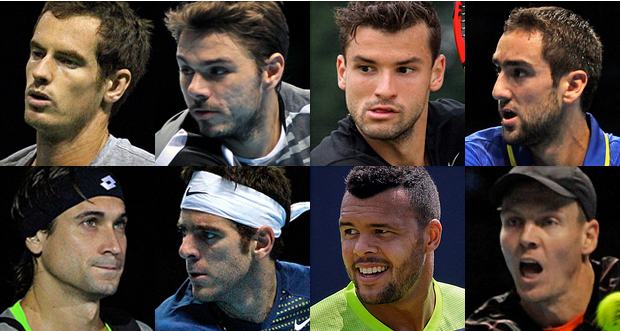
    Andy Murray Stan Wawrinka Grigor Dimitrov Marin Cilic David Ferrer Juan Martin Del Potro Jo-Wilfried Tsonga Tomas Berdych

    Most tennis fans, whether casual or serious, tend to follow the elites – the best players in the game who are perennial contenders for Grand Slams, ranked in the Top 5, and assemble resumes for the history books. Think Roger Federer, Rafael Nadal, Novak Djokovic, and, at times, Andy Murray. Serious fans of the game might extend their radar to the Top 100 and even a bit beyond, especially for long-time veterans and up-and-coming players. Your average serious fan – which I’d define as someone who follows the tour on at least a weekly basis and generally knows what tournaments are occurring, at least the bigger ones – probably could scan the Top 100 and recognize the names of most of them (perhaps another criteria for “serious fan”).

    Federer, Nadal, and Djokovic are household names – they have all been to the top of their sport and are all-time greats. Andy Murray is borderline, but after that it gets dicey. A casual fan of tennis knows the names Juan Martin Del Potro, David Ferrer, Tomas Berdych, Jo-Wilfried Tsonga, and, after 2014, Stan Wawrinka and Marin Cilic, and depending upon where one lies on the casual-to-serious scale, it starts tapering off after the Top 10. But those names – bonafide Top 10 players, but generally not Slam winners – aren’t all that well known among the general public.

    The purpose of this thread is to look at those “second tier” players – players who are not all-time greats, not multi-Slam winners, not No. 1’s, but still very good players. In fact, let’s define a few criteria for what I’m calling a “second tier” player:

    • No more than a single, “stray” Slam
    • No more than five “big” titles (Slams, Masters, World Tour Finals)
    • Never ranked No. 1

    What differentiates a second tier player versus a “third tier” and the rest of the pack? Some general guidelines might be:

    • Must have ranked in the Top 10 at least for a week, and/or
    • Must have won a big tournament
    • Must have at least five career titles
    • Multiple years finishing in the Top 20

    Who fits the bill among active players? Let’s take a look at the players, with a brief overview of their careers.

    [divider]

    Click here to discuss “Second Tier Players” in the discussion forum.

    [divider]

    David Ferrer

    David Ferrer is an interesting case, because on one hand he’s a bit of a tragic figure – he’s made it to the final of nine big tournaments (one Slam, one WTF, and seven Masters) and won only a single one, perhaps the weakest of the lot—the Paris Masters in 2012, and only then arguably because he didn’t have to face any of the erstwhile Big Four (his opponent in the final was Jerzy Janowicz).

    On the other hand, he’s a testament to hard work and thus is perhaps the definition of over-achiever. In other words, Ferrer has made the most of what he has and has come away with an impressive resume. He’s won 21 titles and finished in the Top 10 eight years in a row, the Top 20 ten years in a row, ranking as high as No. 3. He’s had his best two years in 2012-13, at the age of 30-31. In a way he’s as good as you can be without being great. There’s no shame in that.

    [divider]

    Juan Martin del Potro

    Of all the players on this list, del Potro might be the biggest “could have been.” A promising young player he finished 2008, the year he turned 20, at No. 9. Then, in 2009—at a time when the tour was dominated by two players, Federer and Nadal, with everyone else lining up to try to get a piece of the pie—he took the tennis world by storm by defeating Federer in the US Open final. He was not yet 21, and it looked like tennis had a new superstar, or at least someone to complete with Djokovic and Murray for “best of the rest.” After finishing the year No. 5 at the tender age of 21, the sky seemed the limit.

    Then, in an exhibition match in January of 2010, disaster struck: del Potro’s wrist began to hurt, and it kept on hurting. He entered the Australian Open with an ailing wrist, eventually losing in the fourth round to Marin Cilic. He then proceeded to miss nine months and only came back for a couple small tournaments late in the year, his ranking dropping to No. 258. He seemed healthy (or healthy-ish) in 2011, but wasn’t the same player. He did win a couple ATP 250 tournaments but could not make it into the second week at any Slam, although still finished the year No. 11. 2012 and 2013 saw further improvement, years in which he finished No. 7 and No. 5, respectively, but he could not quite match his 2009 glory. In early 2014 disaster struck again, and del Potro was out for most of the year, finishing at No. 138. We can only hope that “Delpo” will come back strong in 2015; he is only 26 years old and still in his prime, but he is clearly a brittle player.

    [divider]

    Tomas Berdych

    Berdych is another player with elements of disappointment to his career (see a pattern here?). The Czech rose quickly in 2005, winning his first, and so far only, big tournament – the revolving door that is the Paris Masters. Not to take that away from him, but it is worth noting that neither of the top two players in the game – Roger Federer and Rafael Nadal – played in the 2005 Paris Masters. Anyhow, Berdych finished that year at No. 24 and seemed poised to challenge for a place among the elite. Yet he stagnated, finishing the next four years in the No. 13-20 range, making the quarterfinal of only one Slam.

    Yet something seemed to click for Tomas in 2010 and, since then, he’s been one of the more consistent players on tour – finishing either No. 6 or No. 7 in each of the past five years, a span of time in which he’s made it to the second week (quarterfinal or later) in half of all Slams, once making the final – losing to Rafael Nadal in the 2010 Wimbledon, although not before defeating Roger Federer and Novak Djokovic.

    Berdych remains an excellent player and a fixture, for the time being, in the Top 10. But he does turn 30 years old in 2015, so the window is closing for him.

    [divider]

    Jo-Wilfried Tsonga

    It is easy to pair Berdych and Tsonga, for not only were they born in the same year (1985), but they’ve haunted similar territory in the lower half of the Top 10 for the last half decade or so, and their career accomplishments are quite similar, although with Tsonga’s win at the Canada Masters this year he’s pulled ahead a bit.

    Tsonga was a successful junior player, winning the 2003 Junior US Open over Marcos Baghdatis. He suffered through a series of injuries before rising quickly on the tour in 2007 and 2008, finishing that year at No. 6. For the last seven years he’s finished No. 13 or higher, five of those years in the Top 10. Tsonga has been deemed an underachiever; he’s got a big game, but doesn’t seem to have the big match mentality. Like Berdych he turns 30 next year, so the hourglass is about to turn.

    [divider]

    Stan Wawrinka

    The “Stanimal” was born the same year as Berdych and Tsonga and, if you look at his career through 2012, could be viewed as an underachiever and disappointment – yet as of this writing, he’s the only one of the Class of ’85 who has come away with a big prize. He rose to No. 54 in 2005, No. 30 in 2006, and then crept up to No. 13 in 2008, but floundered for a few years – looking more like a third tier and perennial Top 20 player, but only just grazing the Top 10 for a few months in 2008. But something seemed to click in 2013 – his results were more consistent as he regularly went deeper into tournaments, including his first Slam semifinal at the US Open and making it to the final of four tournaments, although winning only one, an ATP 250 (the Portugal Open). Stan finished the year at No. 8 after a not-embarrassing performance at the ATP World Tour Finals where he defeated David Ferrer and Tomas Berdych to make it to the semifinals where he lost to eventual champion Novak Djokovic.

    At the beginning of 2014 it seemed that Wawrinka was coming off a career year. He began the year well by winning the Aircel Chennai Open. But it was the Australian Open that proved the shocker: After defeating Novak Djokovic in the quarterfinals, and Tomas Berdych in the semifinals, Stan faced off against No. 1 Rafael Nadal. No one really gave him a chance, but he ended up defeating Rafa in four sets (it is easy to call this a cheap win for Wawrinka as Rafa was injured in the second set, but let us not forget that Stan won the first set and Rafa was well enough to win the third; certainly Rafa’s injury was a major factor, but the focus should be on Stan’s accomplishment). It was easy to consider that a fluke win, but Stan ended up also winning his first Masters, defeating Roger Federer in the Monte Carlo final and improving upon his 2013, finishing No. 4.

    What’s next for Stan? It is hard to imagine a quick drop-off, but it is also hard to imagine him repeating his 2013 performance – especially his Slam. But he’s likely going to remain a Top 10 player for at lest another year or two.

    [divider]

    Marin Cilic

    Talk about a surprising player. After a surge into the Top 10 in early 2010, after making it to the semifinals of the Australian Open at the age of 21, Cilic was erratic for the last few years, settling in as a third tier player. Then he was suspended for nine months (which was reduced), which seemed to serve as a wake-up call, or perhaps merely inspiration, as he rose quickly through the rankings in 2014, winning three minor tournaments before his surprising win at the US Open.

    Cilic is not the worst player ever to win a Slam, but there are better players in terms of overall career level, and thus is a good example of both how a single Slam does not equate with greatness, but also how tenacity can pay off. But he is a Slam winner and finished his second year in the Top 10, so is now a bonafide second tier player. It will be interesting to see whether he can maintain it.

    [divider]

    Just Missing the Cut: Richard Gasquet, Nicolas Almagro, Gilles Simon, Tommy Robredo, John Isner, Feliciano Lopez, Gael Monfils.

    You might quibble with my choices, but in my mind none of them are true second tier players. Some have vied for a spot in the second tier; for instance, Tommy Robredo finished 2006-07 in the Top 10, but for most of his career he’s been more of a third tier No. 20-30-type player. The same could be said for the others. Gasquet is an interesting one because in some sense he’s been the “gatekeeper” between the second and third tier for the last few years, or at least for 2012-13 when he finished No. 10 and No. 9. Gasquet would consistently beat everyone below him and lose to everyone above; previously other players like Janko Tipsarevic, perhaps Almagro, and before both, Fernando Verdasco, filled this role.

    Among this group, or at least those mentioned, the one who stands out as the “could have been more” (and perhaps still can be) is Gael Monfils. He is a player whose reputation and ability far exceeds his usual ranking, mainly due to seemingly being injury prone and perhaps a non-championship mentality. Monfils is a second tier talent with a third tier career–in a sense, the inverse of David Ferrer—and thus is the type of player who could surprise us and win a big tournament. The 2015 Paris Masters?

    [divider]

    On the Cusp: Milos Raonic, Kei Nishikori, Grigor Dimitrov, Ernests Gulbis.

    Kei in particular might deserve to be a second tier player by virtue of his No. 5 finish this year. He’s won six titles but consider that he has not yet won a big tournament (he made the final of both a Slam and Masters this year), nor has he finished in the Top 10 more than once. But if he finished in the Top 10 a second year in a row and/or wins a big tournament, he’s in.

    Similarly with Raonic and Dimitrov. It only seems a matter of time. With Dimitrov there may even be a chance that he becomes a lesser first tier player along the likes of Andy Murray, but the clock is ticking.

    [divider]

    Addendum: The Question of Andy Murray

    It is hard to feel bad for someone with two Grand Slam trophies, 31 titles overall, not to mention an impending marriage to the beautiful Kim Sears. Andy will forever be beloved in the United Kingdom for being the first British player to win a Grand Slam title in the Open Era, and the first since Fred Perry in 1936 to take Wimbledon. But Andy comes off, at least in the press, as disgruntled, surly, and forever unhappy with his standing. Just as Novak Djokovic was the third wheel on the Fedal bicycle for four years in a row, Andy has been the “best of the rest/worst of the best” for just about his entire career. Unlike Novak, Andy didn’t break through the players ahead of him and rise to No. 1. He did win two Grand Slams within one calendar year, being a true member of the Big Four for at least that year, but he couldn’t maintain it.

    That said, Andy Murray is no second tier player. He is a truly great player, the third greatest of a generation that has produced what should turn out, when all is said and done, two of the ten or so greatest players of all time in Nadal and Djokovic. If Andy were born ten years earlier and peaked in the weak era of the late 90s to early 00s, he would undoubtedly have many more Slams than two. But every player has a “what if” story, and in the end, Andy’s career is what it is – and not only is it not over yet, it has been a stellar one so far. My opinion is that Andy is the greatest player of the Open Era with less than four Slams – greater than Kuerten, Hewitt, Safin, even Ashe. (What I mean by “greatness,” in this context, is a combination of peak level and career accomplishment).

    In some ways Andy is the Guillermo Vilas of the current era. Vilas was born in the same year as Jimmy Connors and peaked alongside Connors, Bjorn Borg, John McEnroe, and, to a lesser degree, Ivan Lendl. That’s what I’d call a “raw deal.” Yet Vilas still managed to win four Slams and 62 titles and was ranked in the Top 6 for nine years in a row, but—like Andy so far—he never did rank higher than No. 2, despite arguably being the best player in 1977.

    Career-wise, despite currently stalling out in his Slam count, Andy is closing in on four-Slam winners Vilas and Jim Courier, who are the gatekeepers to the true elites of the Open Era. I’d say he probably needs at least one more Slam to join them, but still has the possibility of surpassing him. Wouldn’t it be appropriate if Andy finished his career with four or five Slams, and became the historical “best of the rest, worst of the best?”

    [Note: At some point I’d like to write a “Part Two – Second Tier Players of the Past,” but there are a few articles on the burner, so stay tuned.]
  • Age-Related Discussion

    Age-Related Discussion

    Feliciano Lopez
    One of my favorite topics is the relationship of age and career performance, questions such as: What are the different phases of a career? When is the most common peak range? Are players peaking later now? Etc.

    For the sake of context and perhaps a taxonomy that would be useful for discussion, as I’ve written quite a few times before, I’ve posited that the historical norm has four general phases:

    Developmental Phase: Age 17-21. Player rises towards peak level.
    Peak Phase: Age 22-26. Player maintains highest level of career.
    Plateau Phase: Age 27-31. Player remains at a very high level, but slightly below peak, with gradual decline.
    Decline Phase: Age 32+. Player declines rapidly and/or retires.

    Again, these are the norms, or the averages if you will. Every player is different – but historically, those are the general ranges that most players fall into, or near to.

    Now what is interesting in recently years is that quite a few players seem to be peaking later, more in what would normally be their plateau phase. David Ferrer is an example, with his best years being 2012-13 when he turned 30 and 31. Despite beating Andy Murray today, Ferrer has showed signs of slowing this year, so he may be entering his decline phase – or he could simply be dropping to a plateau.

    And then we have the inspiration for this thread, Feliciano Lopez, who is 33 years old and possibly having the best year of his life. While his highest ranking was achieved a couple years ago in 2012 (No. 15), he’s at No. 14 in the live rankings now and has a good chance of having his best year-end ranking (which is currently No. 20 in 2011).

    And then of course there is Stan Wawrinka, who won his first Grand Slam at age 28 and is amidst his best year at age 28-29, and will probably finish the year ranked No. 4, better than last year’s career best of No. 8.

    Marin Cilic is still in what is normally the Peak Phase, but he won his first Slam just before turning age 26 – on the older side.

    And then we have young players like Milos Raonic and Grigor Dimitrov. Grigor is 23 years old, having his best year, but there’s also the sense from many that he’s another year or so away from his peak. Milos is also 23, turning 24 in December, and may or may not be at his peak.

    One thing that strikes me is that these outliers from the career norms are all non-elite players. Roger Federer’s career follows the averages quite closely, as does Nadal’s, Djokovic’s, and Murray’s – although it is still too soon to tell if and when they’ve entered their Plateau. Certainly it seems that Rafa and Andy have; Novak had his best year in 2011 at age 23-24, but I’d have a hard time saying that he’s not still in his Peak phase (that is, best year shouldn’t be equated with Peak phase; the best year usually comes within the peak).

    Those are just some examples. A few questions to consider/discuss:

    • Are players really peaking later?
    • If so, why?
    • Is there a historical precedent for players having their best years in their 30s (e.g. Ferrer and Lopez)?
    • Is it only “second tier” talents that are peaking later? (As it certainly seems like we’ve seen the best of Nadal, Djokovic and Murray)

    And so forth. Any thoughts?

    [divider]

    [divider]

    Cover Photo: Kiu Kaffi, Tennis Frontier Correspondent

  • Best Players Never to Win a Slam

    Best Players Never to Win a Slam

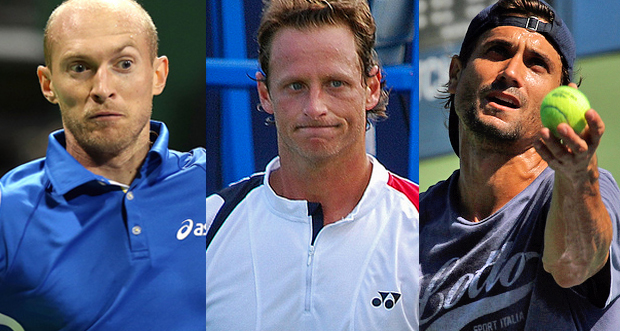
    Nikolay Davydenko David Nalbandian David Ferrer

    A couple weeks ago there was some talk about who was the best player ever never to win a Slam – people were using an acronym, which I can’t remember. I don’t quite have the time or patience right now to put it into an article, but I thought I’d at least do some cursory research and share it with this forum.

    I tried to look at all players who had been in Grand Slam finals and/or been in the Top 5 during the Open Era – this gave me a group of just over fifty players.

    I then assigned points for Slam results and wins in other tournaments, using their total titles as a base and then adding points like so:

    Base: total titles
    Slams: 3 Final, 2 Semifinal, 1 Quarterfinal
    Other tournaments: WTF/Cup 3, Olympics 2, Masters 2, ATP 500 1

    This was problematic because data is limited on a lot of older tournaments, but I did the best I could.

    I then sorted the total rankings and gave tie-breakers to the highest career rank (in parentheses). Here’s the list of players with at least 20 points.

    52 David Ferrer (3)
    45 Nikolay Davydenko (3)
    44 Tom Okker (3)
    40 Marcelo Rios (1)
    40 Alex Corretja (2)
    37 Harold Solomon (5)
    35 David Nalbandian (3)
    35 Miroslav Mecir (4)
    35 Raul Ramirez (4)
    34 Brian Gottfried (3)
    33 Tommy Haas (2)
    32 Thomas Enqvist (4)
    32 Jo-Wilfried Tsonga (4)
    30 Andrei Medvedev (4)
    30 Tim Henman (4)
    30 Tomas Berdych (5)
    29 Todd Martin (4)
    27 Greg Rusedski (4)
    25 Henri Leconte (5)
    24 Robin Soderling (4)
    24 Guillermo Coria (5)
    24 Mark Philippoussis (9)
    23 Brad Gilbert (3)
    22 Guillermo Canas (3)
    22 Cedric Pioline (5)
    21 Magnus Norman (2)
    21 Fernando Gonzalez (5)

    That’s about half of the total players. Just missing the cut are players like Jose Luis Clerc, Sebastian Grosjean, Kei Nishikori, and Gene Mayer. There were two players who played in two finals each that I didn’t have enough information to adequately rank – Steve Denton and Kevin Curren – but from what I could tell, both have points in the low 20s at most.

    Now I’m not saying that this definitely states that David Ferrer is the greatest player never to win a Slam. One thing I noted is that more recent second tier players tend to go deeper into more Slams than in past eras; I’m not sure why this might be. But looking at second week Slam results, Tsonga has 10, Ferrer 15, Berdych 11. Compare that to similarly great Thomas Enqvist 3, Alex Corretja 6, Marcelo Rios 5, etc.

    There are also specialist players, like Tim Henman–who is one of the very best Wimbledon players never to win it. Poor time made it to 4 Wimbledon SF, and 4 QF.

    One thing that this list does help us do, I think, is narrow the choices – it gives us a “first round” of candidates, so to speak. While I’m not ready to commit to the “second round,” I’m thinking that it would involve a closer look at weighing total titles won vs. big titles, as well as Slam results, H2Hs against top players, longevity, etc.

    What do you think? Who was the best player never to win a Slam?

    On yeah, what about the worst player to play in a Slam final? By ranking I came up with two names: John Marks, who never won a title in his career but lost in the 1978 Australian Open to Guillermo Vilas. Marks actually lost the first set of his 1R match to 2nd seed Jose Luis Clerc, but Clerc had to retire after the first set. Marks’ highest career ranking was #44.

    The other is Chris Lewis, who lost to John McEnroe in the 1983 Wimbledon final. Lewis’ highest ranking was #46, but he did win three career titles. I’d give the “honor” to Marks.

    Click here to discuss “Best Players Never to Win a Slam” in the discussion forum.

    [divider]

  • Federer Reigns Again Over Cincinnati

    Federer Reigns Again Over Cincinnati

    Roger Federer  won his 6th title at the Western and Southern Open in Ohio, beating David Ferrer of Spain, 6-3, 1-6, 6-2.  The win was his 80th career title, but his first at the Masters 1000 level since his last win here in 2012, thus ending a bit of a drought for the 17-time Slam winner in important tournaments.

    Federer broke Ferrer, who has never beaten him, in the 8th game of the first set, when the Spaniard double-faulted.  In the second set, Ferrer survived a long game on his serve where the Swiss had multiple break point chances.  Federer’s subsequent service game also went very long, and Ferrer broke through.  It seemed that the late semi-final match of the night before may have taken its toll on Federer, who only finally held serve at 0-5.  Ferrer served the set out at 5-1.

    In the fourth game of the deciding set, Federer broke Ferrer, and broke him again in the last game, to win the set and the championship.

    [divider]

    Cover Photo (Creative Commons License): Marianne Bevis

  • Western & Southern Open Finals – Sunday, August 17 – Day 7: Schedule of Play & Results

    Western & Southern Open Finals – Sunday, August 17 – Day 7: Schedule of Play & Results

    Western & Southern Open

    On Sunday, the Western & Southern Open features the men’s and women’s finals. Up first are the women. No. 1 seed Serena Williams will play Ana Ivanovic (9). They will be followed by the Spaniard David Ferrer (6), who will face the No. 2 seed, Roger Federer.

    The full schedule is below. Results posted as known.

    [divider]

    Center Court Start 2:00 P.M.

    (1) Serena Williams (USA) d (9) Ana Ivanovic (SRB) — 6-4, 6-1

    Not Before 4:00 P.M.

    (2) Roger Federer (SUI) d (6) David Ferrer (ESP) — 6-3, 1-6, 6-2

    [divider]

    Grandstand Start 12:15 P.M.

    (1) Bob Bryan (USA) / Mike Bryan (USA) d Vasek Pospisil (CAN) / Jack Sock (USA) — 6-3, 6-2

    Not Before 2:45 P.M.

    (7) Raquel Kops-Jones (USA) / Abigail Spears (USA) d (6) Timea Babos (HUN) / Kristina Mladenovic (FRA) — 6-1, 2-0 (Ret.)

    [divider]

    Cover Photo (Creative Commons License): Kiu Kaffi

  • Leonardo Mayer Wins First ATP Title in Hamburg

    Leonardo Mayer Wins First ATP Title in Hamburg

    Leonardo Mayer

    Argentine Leonardo Mayer claimed the first ATP title of his career by defeating top seeded David Ferrer in three sets, 6-7(3), 6-1, 7-6(4), at the Bet-at-Home Open in Hamburg, Germany.

    Mayer, 27, had a break in the first set and a chance to serve it out at 5-4 before being broken by Ferrer and losing the subsequent tiebreak.

    The second set was a more decisive affair with 46th ranked Mayer brushing off his earlier nerves and dominated proceedings to take the second stanza 6-1.

    The third set was another close affair with Mayer again being broken back when serving for the set (and in this case, the match). Unlike the opening set, Ferrer wasn’t able to capitalize and the Argentine was able to close out victory in 2 hours 20 minutes to take the €272,300 winner’s cheque.

    [divider]

    Cover Photo: carine06 (Creative Commons License)

  • Roland Garros French Open Day 11: Quarterfinals

    Roland Garros French Open Day 11: Quarterfinals

    2014 RG QF 02

    Day 11 of the French Open features the remaining men’s and women’s quarterfinals. First up on Court Philippe Chatrier is the Italian Sara Errani (10), the 2012 Roland Garros finalist, and Andrea Petkovic (28), from Germany. Two-time Major winner Andy Murray (7) will then face off against local favorite Gael Monfils (23).

    On Court Suzanne Lenglen, 2009 champion Svetlana Kuznetsova (27) will play the rising Romanian star Simona Halep (4). Eight-time champion and World No. 1 Rafael Nadal and his Spanish compatriot David Ferrer (5) will conclude the day’s action.

    The full schedule for Day 11 is listed below (Results to follow)…

    [divider]

    Court Philippe Chatrier – 2:00 P.M.  

    Women’s Singles – Quarterfinals
    Andrea Petkovic (GER) (28) d. Sara Errani (ITA) (10) — 6-2, 6-2

    Men’s Singles – Quarterfinals
    Andy Murray (GBR) (7) d. Gael Monfils (FRA) (23) — 6-4, 6-1, 4-6, 1-6, 6-0

    [divider]

    Court Suzanne Lenglen – 2:00 P.M.    

    Women’s Singles – Quarterfinals
    Simona Halep (ROU) (4) d. Svetlana Kuznetsova (RUS) (27) — 6-2, 6-2

    Men’s Singles – Quarterfinals
    Rafael Nadal (ESP) (1) d. David Ferrer (ESP) (5) — 4-6, 6-4, 6-0, 6-1

    [divider]

    Court 1 – Not Before: 2:30 P.M.

    Mixed Doubles – Semifinals
    Anna-Lena Groenefeld (GER) / Jean-Julien Rojer (NED) d. Yaroslava Shvedova (KAZ) (3) / Bruno Soares (BRA) (3) — 3-6, 7-6(4) [10-5]

    Not Before: 5:00 P.M.

    Women’s Doubles – Quarterfinals
    Garbine Muguruza (ESP) / Carla Suarez Navarro (ESP) d. Kveta Peschke (CZE) (4) / Katarina Srebotnik (SLO) (4) — 6-4, 6-4

    [divider]

    Court 2 – Not Before: 2:30 P.M.

    Mixed Doubles – Semifinals
    Julia Goerges (GER) (8) / Nenad Zimonjic (SRB) (8) d. Timea Babos (HUN) / Eric Butorac (USA) — 6-2, 6-2

    Not Before: 5:00 P.M.

    Women’s Doubles – Quarterfinals
    Lucie Hradecka (CZE) / Michaella Krajicek (NED) d. Marina Erakovic (NZL) (16) / Arantxa Parra Santonja (ESP) (16) — 7-5, 6-3

  • Roland Garros French Open Day 3

    Roland Garros French Open Day 3

    On Day Three of the French Open, Wimbledon champion Andy Murray will play his first round match against Andrey Golubev (KAZ). World No. 5 David Ferrer, of Spain, faces off against Igor Sijsling, of the Netherlands. Local favorite Richard Gasquet (12) plays the young Australian Bernard Tomic.

    On the women’s side, the Romanian Simona Halep (4) will meet Alisa Kleybanova, of Russia. The 2008 Roland Garros champion Ana Ivanovic (11) plays Caroline Garcia (FRA). Li Na (2), the 2001 champion, and winner of this year’s Australian Open, will face Kristina Mladenovic, of France.

    The full schedule for Day 3 is listed below (Results to follow)…

    [divider]

    Court Philippe Chatrier – 11:00 A.M.

    Women’s Singles – Round 1
    Simona Halep (ROU) (4) d. Alisa Kleybanova (RUS) — 6-0, 6-2

    Men’s Singles – Round 1
    David Ferrer (ESP) (5) d. Igor Sijsling (NED) — 6-4, 6-3, 6-1

    Women’s Singles – Round 1
    Ana Ivanovic (SRB) (11) d. Caroline Garcia (FRA) — 6-1, 6-3

    Men’s Singles – Round 1
    Gael Monfils (FRA) (23) d. Victor Hanescu (ROU) — 6-2, 4-6, 6-4, 6-2

    [divider]

    Court Suzanne Lenglen – 11:00 A.M.

    Women’s Singles – Round 1
    Kristina Mladenovic (FRA) d. Na Li (CHN) (2) — 7-5, 3-6, 6-1

    Men’s Singles – Round 1
    Richard Gasquet (FRA) (12) d. Bernard Tomic (AUS) — 6-2, 6-1, 7-5

    Men’s Singles – Round 1
    Andy Murray (GBR) (7) d. Andrey Golubev (KAZ) — 6-1, 6-4, 3-6, 6-3

    Women’s Singles – Round 1
    Sara Errani (ITA) (10) d. Madison Keys (USA) — 7-5, 3-6, 6-1

    [divider]

    Court 1 – 11:00 A.M.

    Men’s Singles – Round 1
    Ivo Karlovic (CRO) d. Grigor Dimitrov (BUL) (11) — 6-4, 7-5, 7-6(4)

    Women’s Singles – Round 1
    Sloane Stephens (USA) (15) d. Shuai Peng (CHN) — 6-4, 7-6(8)

    Men’s Singles – Round 1
    Fernando Verdasco (ESP) (24) d. Michael Llodra (FRA) — 6-2, 7-6(4), 7-6(3)

    Women’s Singles – Round 1
    Lucie Safarova (CZE) (23) d. Mandy Minella (LUX) — 6-3, 7-5

    [divider]

    Court 2 – 11:00 A.M.

    Women’s Singles – Round 1
    Anastasia Pavlyuchenkova (RUS) (24) d. Kimiko Date-Krumm (JPN) — 6-3, 0-6, 6-2

    Men’s Singles – Round 1
    Juan Monaco (ARG) d. Lucas Pouille (FRA) — 6-3, 6-1, 6-4

    Women’s Singles – Round 1
    Yanina Wickmayer (BEL) d. Caroline Wozniacki (DEN) (13) — 7-6(5), 4-6, 6-2

    Men’s Singles – Round 1
    Jan-Lennard Struff (GER) d. Albano Olivetti (FRA) — 6-1, 6-4, 6-4

    [divider]

    Court 3 – 11:00 A.M.

    Women’s Singles – Round 1
    Svetlana Kuznetsova (RUS) (27) d. Sofia Shapatava (GEO) — 6-3, 6-1

    Men’s Singles – Round 1
    Philipp Kohlschreiber (GER) (28) d. Pere Riba (ESP) — 7-5, 6-4, 6-1

    Men’s Singles – Round 1
    Jurgen Zopp (EST) d. Tommy Haas (GER) (16) — 2-5 Ret.

    Women’s Singles – Round 1
    Ekaterina Makarova (RUS) (22) d. Shelby Rogers (USA) — 6-2, 6-3

    [divider]

    Court 4 – 11:00 A.M.

    Women’s Singles – Round 1
    Camila Giorgi (ITA) d. Bojana Jovanovski (SRB) — 6-4, 6-3

    Men’s Singles – Round 1
    Denis Istomin (UZB) d. Sergiy Stakhovsky (UKR) — 6-3, 6-4, 2-6, 6-3

    Women’s Singles – Round 1
    Dinah Pfizenmaier (GER) d. Estrella Cabeza Candela (ESP) — 4-6, 6-3, 6-3

    Women’s Singles – Round 1
    Coco Vandeweghe (USA) d. Iveta Melzer (CZE) — 7-6(6), 6-2

    [divider]

    Court 5 – 11:00 A.M.

    Women’s Singles – Round 1
    Teliana Pereira (BRA) d. Luksika Kumkhum (THA) — 4-6, 6-1, 6-1

    Men’s Singles – Round 1
    Andreas Haider-Maurer (AUT) d. Daniel Brands (GER) — 4-6, 4-6, 6-2, 6-3, 6-4

    Men’s Singles – Round 1
    Marinko Matosevic (AUS) d. Dustin Brown (GER) — 7-6(5), 6-4, 6-7(1), 7-5

    [divider]

    Court 6 – 11:00 A.M.

    Women’s Singles – Round 1
    Heather Watson (GBR) d. Barbora Zahlavova Strycova (CZE) — 6-3, 6-4

    Men’s Singles – Round 1
    Kevin Anderson (RSA) (19) d. Stephane Robert (FRA) — 7-5, 6-3, 6-4

    Men’s Singles – Round 1
    Jack Sock (USA) d. Nicolas Almagro (ESP) (21) — 5-0 Ret.

    Women’s Singles – Round 1
    Maria-Teresa Torro-Flor (ESP) d. Klara Koukalova (CZE) (30) — 7-6(4), 6-2

    Women’s Singles – Round 1
    Casey Dellacqua (AUS) d. Lourdes Dominguez Lino (ESP) — 7-5, 6-3

    [divider]

    Court 7 – 11:00 A.M.

    Men’s Singles – Round 1
    Carlos Berlocq (ARG) d. Lleyton Hewitt (AUS) — 3-6, 6-2, 6-1, 6-4

    Women’s Singles – Round 1
    Jelena Jankovic (SRB) (6) d. Sharon Fichman (CAN) — 5-7, 6-1, 6-3

    Women’s Singles – Round 1
    Kirsten Flipkens (BEL) (21) d. Danka Kovinic (MNE) — 7-6(6), 6-2

    Men’s Singles – Round 1
    Steve Johnson (USA) vs. Laurent Lokoli (FRA) — Postponed

    [divider]

    Court 8 – 11:00 A.M.

    Women’s Singles – Round 1
    Sorana Cirstea (ROU) (26) d. Aleksandra Wozniak (CAN) — 6-7(3), 7-5, 6-2

    Men’s Singles – Round 1
    Simone Bolelli (ITA) d. Andrea Arnaboldi (ITA) — 6-4, 6-4, 6-2

    Women’s Singles – Round 1
    Magdalena Rybarikova (SVK) d. Urszula Radwanska (POL) — 4-6, 6-4, 3-0 Ret.

    Men’s Doubles – Round 1
    Nicholas Monroe (USA) / Simon Stadler (GER) d. Martin Klizan (SVK) / Dominic Thiem (AUT) — 6-3, 7-5

    [divider]

    Court 10 – 11:00 A.M.

    Women’s Singles – Round 1
    Alison Riske (USA) d. Mirjana Lucic-Baroni (CRO) — 7-6(2), 6-3

    Women’s Singles – Round 1
    Polona Hercog (SLO) d. Jana Cepelova (SVK) — 6-2, 6-3

    Men’s Singles – Round 1
    Pablo Cuevas (URU) d. Matthew Ebden (AUS) — 6-1, 6-2, 6-3

    Men’s Doubles – Round 1
    Mate Pavic (CRO) / Andre Sa (BRA) d. Ken Skupski (GBR) / Michael Venus (NZL) — 6-2, 6-3

    [divider]

    Court 11 – 11:00 A.M.

    Men’s Doubles – Round 1
    Henri Kontinen (FIN) / Jarkko Nieminen (FIN) d. Juan Sebastian Cabal (COL) (10) / Robert Farah (COL) (10) — 6-4, 6-3

    Men’s Doubles – Round 1
    Marcel Granollers (ESP) (12) / Marc Lopez (ESP) (12) d. Johan Brunstrom (SWE) / Frederik Nielsen (DEN) — 7-5, 6-2

    Men’s Doubles – Round 1
    Santiago Gonzalez (MEX) / Scott Lipsky (USA) d. Colin Fleming (GBR) / Ross Hutchins (GBR) — 7-6(6), 6-4

    Men’s Doubles – Round 1
    Jeremy Chardy (FRA) / Oliver Marach (AUT) d. Mathias Bourgue (FRA) / Paul-Henri Mathieu (FRA) — 6-1, 7-5

    [divider]

    Court 14 – 11:00 A.M.

    Women’s Singles – Round 1
    Kiki Bertens (NED) d. Alexandra Cadantu (ROU) — 7-6(5), 6-1

    Women’s Singles – Round 1
    Silvia Soler-Espinosa (ESP) d. Chanelle Scheepers (RSA) — 6-2, 6-3

    Men’s Singles – Round 1
    Dusan Lajovic (SRB) d. Federico Delbonis (ARG) — 6-3, 6-2, 6-3

    Men’s Doubles – Round 1
    Jamie Murray (GBR) (15) / John Peers (AUS) (15) d. Vasek Pospisil (CAN) / Rajeev Ram (USA) — 6-1, 4-6, 7-6(2)

    [divider]

    Court 16 – 11:00 A.M.

    Men’s Singles – Round 1
    Andreas Seppi (ITA) (32) d. Santiago Giraldo (COL) — 6-3, 7-5, 6-3

    Women’s Singles – Round 1
    Elina Svitolina (UKR) d. Petra Martic (CRO) — 5-0 Ret.

    Men’s Doubles – Round 1
    Jean-Julien Rojer (NED) (13) / Horia Tecau (ROU) (13) d. Adrian Mannarino (FRA) / Benoit Paire (FRA) — 6-4, 6-0

    Men’s Doubles – Round 1
    Teymuraz Gabashvili (RUS) / Mikhail Kukushkin (KAZ) d. Bradley Klahn (USA) / Neal Skupski (GBR) — 7-6(5), 6-4

    [divider]

    Court 17 – 11:00 A.M.

    Men’s Singles – Round 1
    Axel Michon (FRA) d. Bradley Klahn (USA) — 6-1, 6-7(4), 5-7, 6-1, 6-4

    Women’s Singles – Round 1
    Julia Glushko (ISR) d. Donna Vekic (CRO) — 7-5, 2-6, 6-4

    Men’s Doubles – Round 1
    Julien Benneteau (FRA) (11) / Edouard Roger-Vasselin (FRA) (11) d. Benjamin Becker (GER) / Yen-Hsun Lu (TPE) — 6-3, 4-6, 6-0