Tag: carlos moya

  • Open Era Generations, Part Eleven: Gen 9 (1974-78) – A Transitional Era

    Open Era Generations, Part Eleven: Gen 9 (1974-78) – A Transitional Era

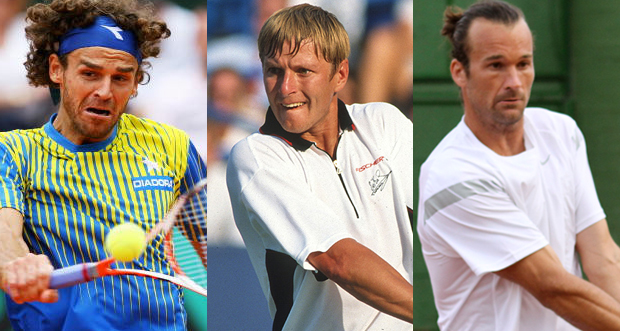
    Gustavo Kuerten Yevgeny Kafelnikov Carlos Moya

    While one of the weakest generations of the Open Era — by my account, third after Gen 2 (1939-43) and Gen 12 (1989-93) — I personally find this one of the most interesting. I’m not exactly sure why, but I think it has to do with the fact that it is hard to define, with no clear stars. It is the generation that was at its peak in the late 90s and early 00s, between the dominance of Sampras-Agassi and Federer.  The generation has an interesting balance of players – no real standouts or all-time greats, but several excellent players.

    Best Players by Birth Year
    1974: Yevgeny Kafelnikov (RUS, 2), Alex Corretja (ESP), Thomas Enqvist (SWE), Andrei Medvedev (UKR), Tim Henman (UK)
    1975: Marcelo Rios (CHIL), Thomas Johansson (SWE, 1), Jiri Novak (CZE), Albert Costa (ESP, 1)
    1976: Gustavo Kuerten (BRA, 3), Carlos Moya (ESP, 1), Mark Philippoussis (AUS), Rainer Schüttler (GER), Magnus Norman (SWE)
    1977: Nicolas Kiefer (GER), Guillermo Canas (ARG)
    1978: Gaston Gaudio (ARG, 1), Tommy Haas (GER), Radek Stepanek (CZE), Sébastien Grosjean (FRA), Michael Russell (USA)

    [divider]

    Click here to discuss “Open Era Generations, Part Eleven: Gen 9 (1974-78) – A Transitional Era” in the Discussion Forum.

    [divider]

    This generation is responsible for only 9 Slams, the lowest since the 1939-43 generation (4). There are no all-time greats, merely a couple almost-greats, and a handful of very good players.

    The two best players of the generation were Gustavo Kuerten and Yevgeny Kafelnikov, who accounted for five of the nine Slams. Kuerten was a clay-court specialist who won the French Open three times, as well as four clay Masters. But he also won the 2000 Tennis Masters Cup, defeating Pete Sampras and Andre Agassi – the only player to defeat both in the same tournament –  and the hard-court Cincinnati Masters, so could play well off clay.  “Guga” was only a Top 5 player for three years (1999-2001), and only finished in the Top 40 for eight years (1997-2004); his “near-greatness” was largely due to his lack of longevity, which was largely because of injuries starting in 2002. The second half of his career is one of the great What-If stories of the last couple decades.

    Kafelnikov was less brilliant at his best, but had a longer peak than Guga, ranking No. 11 or better from 1994 to 2001. The third most accomplished player of the generation, Carlos Moya, ranked No. 61 or higher for fourteen straight years, from 1995 to 2008, including thirteen years No. 43 or better, and five years No. 7 or better – a consistently very good player.

    Single-Slam winners Thomas Johansson, Albert Costa, and Gaston Gaudio are the definition of one-Slam wonders. Johansson had a long career, including eleven years in the Top 100, but he never finished a year in the Top 10; imagine if someone like Nicolas Almagro won a Slam and you get a sense of Johansson’s feat. Costa was a clay-court specialist, probably similar in talent to someone like Feliciano Lopez, but happened to play between the reins of Kuerten and Rafael Nadal, and thus able to win a French Open (in 2002). Gaudio could be the worst player in the Open Era ever to win a Slam, the 2004 French Open against Guillermo Canas. He finished No. 10 in 2004 and 2005, but never finished another year in the Top 20.

    This is the oldest generation to still have players on tour, but it won’t be much longer. After a resurgence in 2012-13, 37-year-old Tommy Haas has slipped the last couple years and seems like he’s winding down. Haas started on the ATP tour in 1996, losing his first Slam match to Sergi Bruguera at the US Open in the first round. 2015 makes it 20 years on tour. Haas has been around so long that his first year was the last year Boris Becker won a Slam (although he never played Becker).

    Radek Stepanek is also ranked around No. 200, which would be the first year on tour that he hasn’t finished No. 68 or higher – going back to 2002. Michael Russell, also from that 1978 birth year, just retired.

    Underachievers and Forgotten Players
    There’s a reason I didn’t mention Marcelo Rios above, as I was saving him for this category. In 1998 he looked like the heir apparent to Pete Sampras as the premier player in the game, taking the No. 1 ranking in late March and winning three Masters that year, as well as the Grand Slam Cup. Yet Rios’s relatively mediocre second half of the year led to a loss of the No. 1 ranking to Sampras, and while he remained a Top 10 player in 1999, he slipped and stumbled in 2000 and never regained his elite status, largely due to injuries.

    Another player who had a disappointing career is Andrei Medvedev, who was the first of the generation to rank in the year-end Top 10, finishing 1993 ranked No. 6 at age 19. While he would go on to win four Masters, he would never rank in the Top 10 again and made a Slam final only once.

    There are several other players who fit the category of “close, but no cigar” as far as Slams go – Alex Corretja was 0-2 at French Open Slam finals, Thomas Enqvist was meant to revive Swedish tennis but–along with Johansson–instead ended up being a kind of dead-cat bounce after the great 1970s-80s era, and Tim Henman goes down as one of the greatest grass court players never to win Wimbledon. And boy did he try – eight out of nine years from 1996-2004 making the quarterfinals or later, including four semifinals but never a final. Mark Philippoussis also comes to mind in this category.

    Did You Know?
    I first came across Roberto Carretero’s name when looking at Masters winners of the 90s. Carretero has quite a story: he won the Hamburg Masters in 1996 as a virtual unknown, ranked No. 143 and defeating Yevgeny Kafelnikov en route to a final win against rising young Spanish star, Alex Corretja. He never ranked higher than No. 58 and never made it past the second round in a Slam, retiring in 2001. But he does have that Hamburg Masters title.

    Top Ten Players of the Generation

    1. Gustavo Kuerten
    2. Yevgeny Kafelnikov
    3. Carlos Moya
    4. Marcelo Rios
    5. Alex Corretja
    6. Tim Henman
    7. Tommy Haas
    8. Albert Costa
    9. Thomas Enqvist
    10. Andrei Medvedev

    Honorable Mentions: Mark Philippoussis, Thomas Johansson, Sebastian Grosjean, Magnus Norman, Gaston Gaudio, Radek Stepanek.

    This is actually a hard generation to rank. I feel confident about the top four, although think Moya and Rios could be swapped, and I went back and forth on Kuerten and Kafelnikov, but in the end prefer Kuerten’s higher peak to Kafelnikov’s greater longevity. After the “biggish four,” Corretja is probably the best of the rest, with Henman, Haas, Costa, and Enqvist not far behind, but that tenth spot could go to any of Medvedev, Philippoussis, Johansson, or Grosjean.
  • National Tennis Careers – Part Three: Spain

    National Tennis Careers – Part Three: Spain

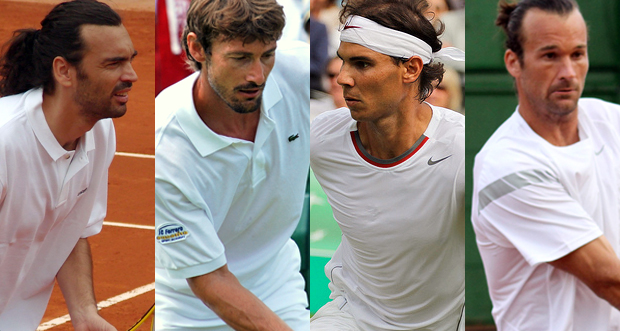
    Sergi Bruguera Juan Carlos Ferrero Rafael Nadal Carlos Moya

    Rafa & The Conquistadores

    Among the five greatest tennis nations in this series, Spain and Switzerland share something in common: they are completely dominated by a single player, one who is head and shoulders above the rest of the field. These two players will be forever linked, not only as two of the greatest ever to play the game, but because of their evocative (albeit lopsided) rivalry.

    [divider]

    Click here to discuss “National Tennis Careers – Part Three: Spain” in the discussion forum.

    [divider]

    Before getting to Rafa, let’s look at Spanish tennis before the King of Clay. Before the Open Era, only three Spanish players appeared in Slam finals, Pro or Amateur: Manuel Santana, Andres Gimeno, and Juan Gisbert Sr. The first two are well known as top players of the 1960s, but Gisbert Sr is not so well known – he lost to William Bowrey in the 1968 Australian Open final, the last Slam before the Open Era began. Santana won four Amateur Slams in the 1960s and was ranked No. 1 among Amateurs in 1966 when he won Wimbledon, but never entered the professional circuit, so didn’t play the top players in the game.

    Andres Gimeno was one of the best players from the 60s that wasn’t Australian. He had a long career, beginning as an amateur in 1956, turning pro in 1961, and playing until 1973. While he never won a Pro Slam, he played in four finals – losing to Rod Laver three times, Ken Rosewall once. He is perhaps best known for winning the 1972 French Open at the ripe age of 34.

    Spanish tennis became stronger during the Open Era, but didn’t see its first truly great player until Rafael Nadal emerged from the clay of Manacor, fully formed like some Mediterranean deity. Let’s take a look at the Open Era Slam record:

    Spain Career

    As you can see, before Nadal seven Slams were won by Spanish players: one each by Gimeno, Manuel Orantes, Albert Costa, Carlos Moya, and Juan Carlos Ferrero, and two by Sergi Bruguera. The weakest era for Spain was the 1980s, after Manuel Orantes retired, but then picked up in the 90s with Bruguera, then later Moya and Ferrero, among others. It is also worth noting that of the seven Spanish Slam winners of the Open Era, only Orantes and Nadal won Slams on a surface other than clay.

    Ten Greatest Spanish Players of the Open Era
    1. Rafael Nadal
    2. Manuel Orantes
    3. Juan Carlos Ferrero
    4. Carlos Moya
    5. Sergi Bruguera
    6. David Ferrer
    7. Andres Gimeno
    8. Alex Corretja
    9. Albert Costa
    10. Tommy Robredo

    Honorable Mentions: Jose Higueras, Emilio Sanchez, Felix Mantilla, Carlos Costa, Albert Berasategui, Francisco Clavet, Feliciano Lopez, Fernando Verdasco, Nicolas Almagro, Albert Portas, Juan Aguilera.

    Number one is easy, but after that it gets really dicey. Orantes, Ferrero, Ferrer, Moya, Bruguera, and Gimeno could be ranked in any number of ways. Gimeno would probably be second if we counted his whole career, but his Open Era career wasn’t as impressive as the others. Albert Costa is, along with Thomas Johansson and Gaston Gaudio, a one-Slam wonder who benefited from playing in the weak early years of the 21st century. Alex Corretja is among the better players never to win a Slam – along with later countryman David Ferrer.

    Spanish tennis has been strong over the last ten years, although with one player dominating. But David Ferrer, Feliciano Lopez, Tommy Robredo, Fernando Verdasco, and Nicolas Almagro have all had very good careers.

    A bit on Rafael Nadal. There is little doubt that he is the most dominant clay court player in the history of the game, and there has been no harder task than beating Rafa at Roland Garros where he holds a 70-2 record. Rafa was the clear World No. 2 for 2005-07 but then stole not only Wimbledon but the No. 1 ranking from Roger Federer in 2008. He has struggled with injury through much of his career, so there’s an element of “what if” to Rafa’s career. Some say that if he had been healthy he’d have surpassed Federer’s Slam count by now, while others say that we cannot separate Rafa’s penchant for injury from his greatness due to his style of play. Either way, his record is what it is: Regardless of what his future accomplishments might be, right now he is one of the greatest players in tennis history.

    The Future
    Troubled times may be ahead for Spain. Consider the Spanish players current (as of July 6) in the Top 100 with their ages:

    7. David Ferrer (33)
    10. Rafael Nadal (29)
    16. Feliciano Lopez (33)
    19. Tommy Robredo (33)
    22. Roberto Bautista Agut (27)
    32. Guillermo Garcia-Lopez (32)
    37. Pablo Andujar (29)
    43. Fernando Verdasco (31)
    63. Daniel Gimeno-Traver (29)
    65. Albert Ramos (27)
    67. Pablo Carreno Busta (23)
    72. Marcel Granollers (29)

    Notice something? Nine of the twelve players are 29 or older. We could chalk this up to the way of things these days, but there’s a disturbing lack of young players on that list. In other words, of those twelve players only Carreno Busta and possibly Bautista Agut and Ramos have room to improve, however none of them are likely to be future elite players.

    There is also the question of Rafa’s decline. Clearly he is not the player he was in 2008-13, his peak range. Rafa has a tendency to play well, get injured, then surge back to the top again – a cycle that has repeated itself a few times. But this latest round hasn’t seen a surge (yet), and we’re now almost eight months from his appendicitis surgery. Does Rafa have another surge him? Who knows? Many, including myself, have long speculated that when the end comes for Rafa it will come quickly. But I, for one, am not ready to relegate him to the history books. Not yet. I doubt we’ll see another 2013, but we could see a lesser version.

    But other than the players listed above, is there a future for Spanish men’s tennis? Let’s take a look at the youth.

    Highest Ranked Player By Age
    23: Pablo Carreno Busta (No. 67)
    22: Roberto Carballes Baena (No. 169)
    21: David Perez Sanz (No. 305)
    20: Albert Alcaraz Ivorra (No. 481)
    18/19: Jaume Munar (No. 690)
    17: Carlos Taberner (No. 970)

    So consider that – the highest ranked Spanish teenager is No. 481 in the world. Even the United States has three teenagers ranked higher. History has shown us that great players are usually pretty good while still in their teens – meaning in or near the Top 100 – and there’s no player even close to that. Even if we say that players are starting their peaks more in the 23-25 range rather than 20-22, as in the past, there’s no young Spanish player who looks to be on the trajectory for greatness. Surprise weather patterns happen, but the forecast as of right now is not positive for Spanish men’s tennis – at least not over the next few years. What we are likely going to see is a gradual and then quick diminishing of Spanish tennis as Nadal, Ferrer, Lopez, Verdasco, Robredo, and Almagro all fade away and then retire, with perhaps only Bautista Agut and Carreno Busta carrying the torch as Spanish players in the Top 20-30 range in a few years time. Whether they can carry that torch long enough to pass to the next great Spaniard remains to be seen.

    [divider]

    Cover Photo (Creative Commons License): bourgol / Carine06 / Marianne Bevis / conson

  • Flavia Pennetta – “Straight to the Heart”

    Flavia Pennetta – “Straight to the Heart”

    Flavia-Pennetta-dalla-racchetta-alla-penna_v_gdv

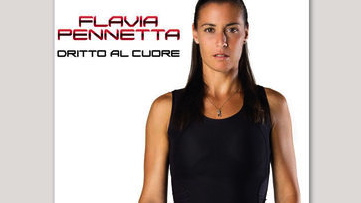
    Recent Indian Wells champion Flavia Pennetta has written about her trials and heartbreaks in the very honest and personal memoir “Dritto al Cuore” (“Straight to the Heart”), published last November by Mondadori.

    Asked why she wrote the book, Pennetta said,  “I was tired of the usual interviews, where I always said the same things: I talked about sport, which doesn’t have anything to do with who I really am. I come off as cold, less spontaneous. People watch me play tennis and they often had no idea how I got here, what was inside of me, how much I counted on my family …. I wrote the book so the people could really know me, in all my fragility and my emotions. So that they could know that we athletes are real people. I might have chosen not to reveal so much, but the book would have been less true.”

    She’s very frank about her relationship with Carlos Moyá, and how much their break-up hurt her. For Flavia, her relationship with Moyá “was one of the most important in my life.”  After three years together, and having discussed becoming a family, Flavia discovered that Carlos was cheating on her with the Spanish actress Carolina Cerezuela (with whom he is now involved and has a child). He admitted it only when it came out in the gossip columns. It was a hard blow for Flavia. She lost 10 kilos (22 pounds) in a short space of time, as well as all strength and motivation to get back on the courts.

    Pennetta describes their relationship as less than equally balanced. “Perhaps the one I lost was not Carlos, but me. He’s a bastard, what more can I say, but if I made a mistake it was in dedicating myself too much to him, at the loss of myself.

    “I had created a reality completely full of Carlos: our friends were Carlos’s, we lived where Carlos wanted to, when we saw family it was Carlos’s. We even spoke Carlos’s language. Carlos has a problem? I’m there. Carlos wants to go out to eat? Even if I’m dead tired, fine, out we go. Carlos is playing Playstation and he doesn’t want to go out with me to see a match, have dinner, or a drink? OK, I’ll stay home.”

    She also says of the relationship: “I thought that the rare times we were able to be together were beautiful, sharing our profession. I closed the door to Flavia and opened it to [being in a couple]. After three years I thought I’d arrived: a complete woman and ready to take on a family.”

    However, that all fell apart when Moyá’s infidelity came to light.

    “You feel pain, and you have to confront it, like everyone,” Flavia told the Italian magazine Grazia“But at a certain point, it’s not a private problem: the whole world knows. And the public face of pain is strained. People tried to pity me, and I couldn’t even defend myself against that. It was as if I’d lost joy in everything. I tried to anesthetize myself from encounters in life, so as not to invite pain.” She said she’d even lost the ability to feel physical pain.

    In difficult times, her therapist told her, “Draw a line in the sand. Move past it, then draw another one. Look inside yourself: you’ll see that the situation is not so bad. It’s you who wants to see it that way.” Pennetta told herself, “I’m twenty-five years old and I have a lot to give. Because of Carlos, I’ve distanced myself from Italy, from my family, from my friends. He was my passion, I gave myself completely, and I lost my balance. I have to get it back. I have to start over from there. I have no boyfriend, no home, no dreams, no future plans. The only certain thing is all the work I’ve done to get to a really good place on the circuit. I’ve played tennis since I was five years old, [been professional] since fifteen, for what? To lie on the couch suffering for some bastard? Never. Finally, the right thing. Finally me, finally my arm, or what was left of it, again free to move. Time to pack my bags. To go back to America to take back my life.

    “I was betrayed, but I betrayed myself [too].” As to the notion of loving again, she says she looked into the mirror and told herself, “Flavia, sooner or later the right person will come along, until then, you’re better off alone than with the wrong one!”

    She adds a note about the current state of her love life. “I’m in a relationship that’s [in the early stages], with a person I’ve known for a long time. But I’m not prepared to make it public. I’ve learned that I want a man who completes me, but without swallowing me up …. I don’t want to make that mistake again. Even if I come off as a bit of an asshole.”

    Flavia also talks tennis, of course:  “I live on airplanes: I’ve had to have my passport reissued in Tokyo because there weren’t enough pages for the stamps. The only advantage is … tournaments are nearly always played in heat. I live in a permanent summer.”

    Part of her resurgence came from her partnership with Gisela Dulko of Argentina. “[She] and I got dumped within a few months of each other, by two handsome tennis players who were all-too media-prominent.” (Dulko had been seeing Fernando Verdasco of Spain.) “We were suffering at the same time, we talked for hours and then figured it was just time to laugh. We decided to play doubles together, even getting to number 1 in the world.” Dulko/Pennetta won the WTA Tour Championships in doubles in 2010, and the Australian Open Women’s Doubles in 2011.

    Pennetta talks also about beating Serena Williams in an exhibition in Milan in 2011, saying that Williams is a player who “never loses concentration, who has no fear,” and calls the win a watershed for her career. However, she says the greatest pleasure was the Fed Cup win for Italy in 2010.

    In her book she writes: “At the introductions, I was white as a ghost, I couldn’t get over my anxiety. Before the match I was weeping with tension …. tight as a drum, I went out onto the court.” Italy was playing the US in the final. Pennetta won her opening match, and sealed the win for Italy in the fourth round.

    “At match point against Oudin I tell myself, ‘Don’t mess up, don’t mess up, don’t mess up ….’ I win and the Cup is ours. My father starts to cry in the stands. It’s only the second time I’ve ever seen him cry. And I, the woman who always exhibits perfect control, had a choice to make: I let go of a few big, fat tears before pulling myself together to flash my tried and true smile.”

    [divider]

    Excerpts from “Dritto al Cuore”