Tag: australian open

  • Down the T #7: An Interview with Troy Deighton, Lines Umpire / Margaret McAleer

    Down the T #7: An Interview with Troy Deighton, Lines Umpire / Margaret McAleer

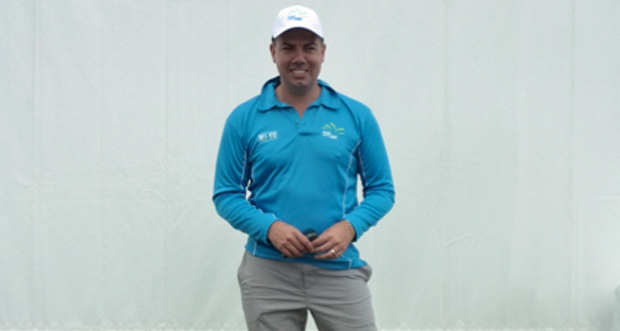
    Troy Deighton

    “Team work is the key to becoming a successful lines umpire. Not only do they call all shots related to their assigned line, they also work together with the Chair Umpire so that the match is played in a professional manner.”

    I would like to introduce Mr Troy Deighton, a lines umpire, to the readers of Tennis Frontier. I interviewed him at Apia International, Sydney, on the 12th of January.

    Mr Deighton has been umpiring tennis professionally since 1999-2000 — approaching fifteen years. In that time he has worked his way up through junior tennis, amateur tournaments at NSW level in Sydney, Australia, right up to Grand Slams. He has officiated at one dozen Australian Open finals, the last two U.S. Open finals in New York, as well as many Davis Cup and Fed Cup ties. I had the pleasure of posing many questions to him regarding the role of a lines umpire. He gave his opinion on Hawkeye, and the foot fault rule, giving informed and insightful answers, as the readers of Tennis Frontier will no doubt find out, when they read the full interview.

    [divider]

    Question: Can you explain the training for becoming a lines umpire?

    Deighton: The training is not overly extensive. It’s a matter of knowing if a ball is in or out. Obviously that depends on how good your eyesight is, to be honest. You need to understand the basic rules of tennis, go through an introductory course about the basics, in terms of the rules. When you are first starting out, it’s more about learning the technique of calling lines, whether you are on the side lines, or the cross lines on the court. There are differences in the way you call lines, knowing whether the ball is in or out to start with, and what constitutes the ball being in or out, is what you need to know when you are starting out.

    [divider]

    Question: How does a lines umpire work his/her way up to be able to work at Master Series and Grand Slam tournaments?

    Deighton: You start out with your national association. Here in Australia it’s Tennis Officials Australia, which is separate to Tennis Australia. Tennis Australia obviously pour a lot of money into developing officials, but there is also Tennis Officials Australia which is basically for nurturing new recruits and developing umpires at the early stage, and you work your way through the tournaments. Once you have done your introductory course, you become a lines umpire at a local level doing junior tournaments, amateur adult tournaments, you work your way through Australian money tournaments, Pro tours, Pro circuits, Challengers. After maybe twelve months or two years you might get a gig like this at the Apia International, in Sydney. After a couple more years you might get into your first Grand Slam, being the Australian Open. Then it is just a matter of developing your skills, your techniques, developing your grades. When your grades are good enough you may get selected for other professional events like Fed Cup and Davis Cup and other Grand Slams.

    [divider]

    Question: Do lines umpires at Master Series and Grand Slam tournaments get paid well? Do they have to cover their own traveling and accommodation costs?

    Deighton: The conditions which lines umpires work vary from tournament to tournament. At a local level, when you are starting out, you might make enough money to cover your petrol to and from that tournament for the day. So there is not a lot of money when you are first starting out. It’s more about being a hobby; if you are interested in tennis it’s a good way to get involved. Not everyone can hit a tennis ball, but they love tennis and find this sort of work as a way to get involved, being in the game that they love. It’s not all about the money, even at the top end of the sport, when you have been on the circuit traveling the world for many years; many umpires find it very hard to break even. So they are basically paying their way around the world. Yes, you could probably make money out of it, if you are very good and stick at it for a while, but most people see it as a second job or a hobby. You can get some cool tennis clothes out of it and shoes at tournaments. There is a little bit of money which I guess is nice as well.

    [divider]

    Question: Is there any age when a lines umpire has to retire?

    Deighton: Not in Australia. I can’t speak for other tournaments around the world. We have lines umpires from mid-teens to their eighties here in Sydney. The gentleman who is in his eighties is calling the ball as well as anyone else at the tournament. It goes on your ability. We have off-court assessors who watch our technique and monitor our accuracy, as well as the chair umpires who evaluate you from the chair as well. So long as you are performing and up to scratch in Australia at least there is no reason why you can’t continue working to a ripe old age.

    [divider]

    Question: I have noticed lines umpires spend a lot of time bending over. Do you personally suffer from a bad back? Do you have some sort of fitness program in place?

    Deighton: I don’t have a fitness program to be a lines umpire, especially on days like yesterday when you are sitting around all day and you tend to eat a lot because there is not much to do at tournaments, while you are waiting for the rain to stop and getting on court. I sort of hit the fitness regime after the summer of tennis when I have a few kilos to shed. You do bend over a lot and it can get quite uncomfortable. If you are on the cross lines, base lines, service lines you tend to be sitting down a lot as well. I think it just goes with the territory and I don’t have a program that I follow.

    [divider]

    Question: Can you tell us who assigns the lines umpires’ positions on the tennis court? Have you a favourite position?

    Deighton: The lines umpires’ positions again comes down to their grading. There are three different grades you have as a lines umpire. You get graded on the long line, which are the side lines of the court. The far line being the furthest from the chair, the near line being the closest to the chair. So you have an overall long line grading, a service line grading, and a baseline grading. Depending on how your grades are and what your rating is on those lines, you are more likely, if you have a high grading on serve or base, you are more likely to get assigned those lines. When you are starting out, usually you start on the near line which is nearest the chair umpire. Obviously it is easier for the chair umpire to call that line and overrule if you make a mistake, then move to the far line and then the cross lines on the court. My favourite line, I like doing serve. You get more involved in a match having to do the ball changes; you are the point of contact for the chair umpire if they need something, so there is more responsibility, in terms of your role in the match. You call the serve and you get to enjoy the rest of the rally. It’s a good line to be on.

    [divider]

    Question: I believe one of the requirements of a lines umpire is to have excellent eye sight. Are lines umpires allowed to wear glasses or contact lenses on court?

    Deighton: The requirement for lines umpires in Australia is to have 20/20 vision and every couple of years we are required to undergo eye test and to provide a certificate to say that we have either 20/20 vision or corrected vision. Yes, you are allowed to wear glasses on court, or prescription sunglasses or contact lenses.

    [divider]

    Question: One of your duties is to go with a player who takes a bathroom break or changes of attire break, to ensure the player does not use the break for any other purpose. In your experience have there been any unusual incidents that you can recall?

    Deighton: No. I haven’t encountered any unusual incidents or behaviour during a toilet break or alike. It’s unusual when you see a player dart off the court during the television coverage with a lines umpire in tow. You think, Why is that person running after the player? It is just to make sure that the bathroom break is used for what it is, therefore to go to the toilet and nothing else — the players not receiving coaching or doing anything else which is out of sorts. Usually at Major tournaments like Grand Slams you will have a Tour Supervisor or a Grand Slam Supervisor there as well. Your job as a lines umpire is there to report any suspicious activity or irregular behaviour back to the chair umpire. It is up to them to determine when any further action is to be taken.

    [divider]

    Question: What is your opinion on Hawkeye?

    Deighton: I love Hawkeye. I think there was a lot of angst and I guess worry from lines umpires, and possibility chair umpires as well, when it was first introduced. I remember my first encounter with Hawkeye; it was the first year it was introduced in Melbourne, at the Australian Open. I was standing on the far line and it was either the first or second match on Rod Laver Arena. Andy Roddick challenged one of my calls on the far line, and then came back and stood shoulder to shoulder to me, as we watched the big screen to see whether I was right or not. It turned out that my call was correct, and he sort of gave me a pat on the back and said, “Oh, well done.” Hawkeye takes a bit of the pressure out of the matches, and I think players used to dwell on calls that they were unsure about for a few further points on. Now they have the ability to challenge, see what the result was, and then they can move on. So it takes a bit of the heat out and relieves a bit of the tension on court.

    [divider]

    Question: Have you ever been overruled by Hawkeye?

    Deighton: Yes, I have. It’s not good to be wrong, I guess, but it happens to everyone. We accept that and just as the players do, you accept that and move on. You’re only as good as your next call.

    [divider]

    Question: There has been a lot of discussion of late to use Hawkeye on clay courts, your opinion?

    Deighton: I am probably not the best to talk about clay courts because we don’t have many clay courts in Australia, and I haven’t really officiated on anything, or any professional event on clay. In terms of Hawkeye on hard courts or Rebound Ace, I think it is great. From my experience on clay and watching clay court tennis the ball mark is there for all to see. So I think it’s just doubling up. I don’t see the need.

    [divider]

    Question: Do you think with the technology we have, you are going to be obsolete soon, or do you think there will always be room for a lines umpire, even with technology?

    Deighton: I tend to think that the lines umpires are a part of professional tennis. I think the players respect them, I think the crowd respect the job they do. I think if we were to go to a system where the players were calling their own lines, relying on Hawkeye more — more than we are now — the game, in general, would just slow down completely. We would be forever going to the video. Replacing lines umpires would be to the detriment of the sport.

    [divider]

    Question: The Foot Fault Rule clearly states, “A player who is serving must stand behind the baseline, between the centre mark and the sideline. A foot fault takes place when your foot touches the ground on — or forward of — the service line before you strike the ball.”

    There has been a lot of controversy in our game with the foot fault rule. The most famous incident to date would be Serena Williams at the 2009 U.S Open, with her outburst towards the lines umpire over being foot faulted. In your opinion is it just a lack of focus and concentration, and, say, lazy footwork that causes a player to foot fault at times?

    Deighton: I think foot faulting comes down to technique and if a player is foot faulted, constantly or regularly, or even occasionally, possibly, when it is occasionally it may be a lack of concentration. It is obviously their technique that needs to be reviewed. As a lines umpire on the baseline, you can be foot faulted across the centre service line. The important thing is to call a foot fault when you see it, when you’re certain it is a foot fault — if they’re touching the line, or they have crossed the line, and at no other times. If there is any doubt in your mind that the foot fault is touching the line, you don’t call it. That saves the controversy. The rule is there. It’s there to be enforced and unfortunately for Serena that was the call that was made against her.

    [divider]

    Question: What is personally the best match you’re been a part of as a lines umpire?

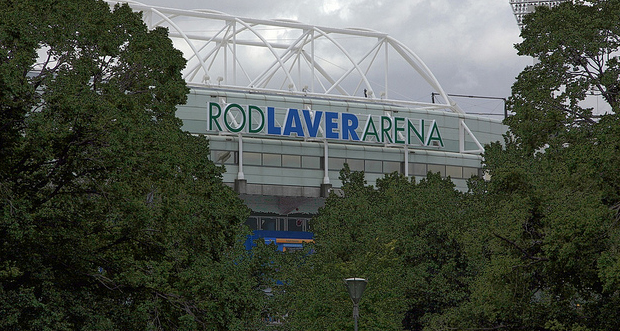
    Deighton: I have been blessed. I have been doing this for fifteen years or so. I have had enormous opportunities. I have been to South Africa for an ATP event, all expenses paid, and I was very lucky to have that opportunity. I have been to Samoa for a Davis Cup tie — again, everything was covered. That event was just a great event to be a part of. Most recently I have been to three U.S. Opens and done the last two women’s finals, on the baseline on Arthur Ashe stadium. I love Melbourne Park. I don’t think there is anything better than walking through the gates of Melbourne Park on the first day at the Australian Open. Seeing tens of thousands of people pouring through the gates. It’s just a buzz. Compare that to walking onto Arthur Ashe Stadium in New York. I remember the first time I went out on Arthur Ashe for a night match three years ago, I was too scared to look up into the crowd, because my heart was racing. I was sitting on the service line and I didn’t want to look up. It took me about three games before I actually had the courage to, like, look at the chair umpire and acknowledge them, let alone look up into the stands, and they just seem to go up into the sky forever. It is an amazing spectacle, and looking down onto the court from the top, it’s just amazing. I also think American tennis fans are just unlike any others in the world. They tend to constantly talk, there is a constant buzz in the stadium, where we in Australia seem to be more mindful of the tennis etiquette. Where it is dead silent while the rallies are going on and then the stadium erupts. I love the buzz of going to the Australian Open and Melbourne Park every year. I love Rod Laver Arena under a closed roof, but there is just something special about New York and Flushing Meadows and being on Arthur Ashe.

    [divider]

    Question: In your opinion, in general, do players treat lines umpires well on court?

    Deighton: I think gone are the days where a player will launch a tirade at the lines umpire. I think we have seen it in occasional incidents where a player has erupted. I think they are very few and far between these days. I think Hawkeye has a lot to do with that. I think Hawkeye takes a lot of heat out of the moment and instead of erupting over a questionable call, at a crucial point in the match, the players are able to challenge, should they have any left, to resolve that situation there and then, and get on with the match. I also think that Hawkeye has a lot to do with the fact we don’t see as many lines umpires being verbally abused by players anymore. I also think the Code of Conduct is also being enforced a bit more, so players aren’t allowed to get away with as much as they used to. I think that the ITF, WTA, and ATP have a lot to be thanked for.

    [divider]

    Question: Final question, what is the best part of being a lines umpire in your opinion?

    Deighton: I will be completely honest with you and say it has nothing to do with tennis. It has nothing to do with what happens on court. What has sustained me for the past fifteen years umpiring, you know, after having done many Grand Slams and many Davis Cup and Fed Cup ties, ATP and WTA events and the like, are the friends that I have made, and the friends from around the world. You might see once every year, but you know when they walk through the door at the tournament, at the start of January and you haven’t seen them for twelve months, it just feels like you haven’t been apart. I think it is the friends. There is a real camaraderie between officials, particularly here in Australia. I think our typical Aussie laid-back attitude, the visiting officials from overseas, really love that and that is why they keep coming back. I think the Australian Open is known globally as The Happy Slam or The Friendly Slam, and it really is. Not just for the players who love coming here; the officials as well. I have had some amazing times on court, so many wonderful experiences and opportunities, but it is the friendships I have made from all around the world I really cherish.

    [divider]

    I would like to thank Troy Deighton for graciously giving his time in between his on-court duties at Apia International, Sydney for this interview.

    To Nicola Abercrombie: my thanks to you, for all your help in my initial request for interviewing a lines umpire and organizing my media pass. I would also like to thank Mr Glenn Toland, President of ANSW and Assistant Chief of Officials, Apia International, Sydney for choosing such an informative and affable lines umpire in Troy Deighton for me to interview.

    Margaret McAleer
  • Australian Open Final Review: Wawrinka v Nadal

    Australian Open Final Review: Wawrinka v Nadal

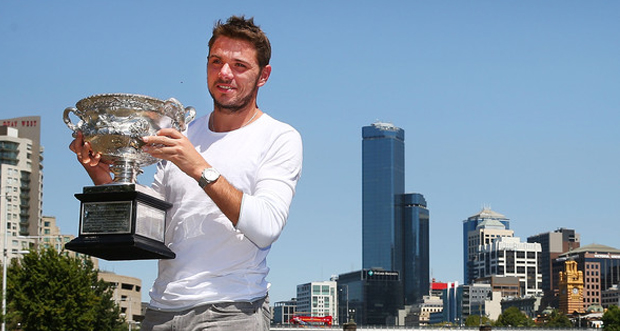
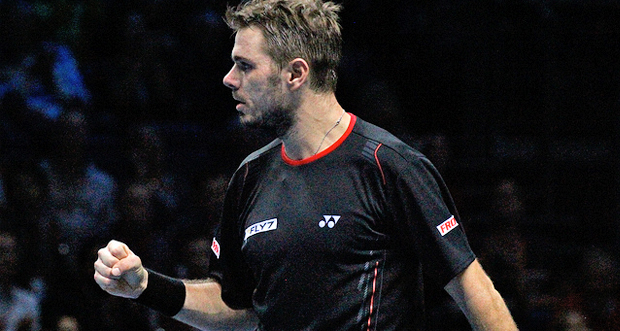
    AO ATP Winner - Stan 2

    What an amazing final it was. I know it wasn’t such an epic on court. More of a drama of sorts but as a culmination of an amazing path to glory it was a real feat of Tennis.

    Stan swept past three Top 10 players to clinch the trophy. Beating the No. 1 and 2 players in the world. En route he overcame the reigning champion of three years and swept aside a former champion in the final. He weathered the extreme heat and changeable conditions like everyone else but he managed to do all this without getting injured. Still standing and strutting until the end.

    What I had forgotten was that I was at their last match at the World Tour Finals. I know exactly what it is like to see both men in full flight. I can appreciate just what Stan has achieved and how he did it.

    I had been wondering over Christmas just how close Stan had come to the Top 4. I had completely forgotten the score line at the O2. Had I not then I really would have favoured Stan much more given his consistent progress during 2013.

    The seeds were there in the Millennium Dome. Stan pushed Rafa as hard as he possibly could without winning a set, with the score being 7-6(5), 7-6(6) to Rafa. It truly was one of those results where the score does not reflect the story of the match. Stan broke Rafa twice. At times he literally owned him. You could see he was starting to realise that the very top players like Rafa actually fear him because their strength plays into his strength.

    Rafa particularly likes to get the ball high to an opponent through his spin. That troubles most people but not Stan. That is just where he wants it. Put it high to his backhand and he couldn’t thank you enough. You’ve served him his favourite opportunity on a platter.

    Stan doesn’t need to run around his backhand like his colleagues in the Top 10. He loves a chance to express his creative skills with his beautifully-crafted technique. He just steps up to it and releases his aggression through the ball, trusting his well-honed technique. The rest is just a blur.

    So from this spectacular experience in London I can testify to how big Stan hits. Only Berdych rivals him in the Top 8 for pure power. They’re both just powerhouses. The type that have had wins against Rafa his whole career. It is only now that they are both realising just what this could mean for them in their best years.

    So the result on Sunday wasn’t as much as a surprise to those who have seen Stan play, particularly those who still remembered last year’s match against Novak. He pushed the eventual winner of this trophy right to the wire. If he had won the match then a route to the final was open. This time he did and it was. So let us see where this leads.

    Nadal still impressed me and I think won many new followers. Clearly injured he pressed on. I’ve always wondered what is best in this case. Should he just surrender and proclaim Stan champion? Does he have that right? I’ve read many of the debates with the issue getting cloudier and more complex instead of clearer.

    Though now, if Tennis is to proclaim itself a profession then I like to draw parallels from other professions to gain some perspective. If a chief executive were struggling during negotiations with a migraine, severe back trouble or whatever, then they would take painkillers or anything prescribed to get through. Taking a rest some other time. Peoples’ jobs and the future of the company are at stake. What is the difference here with a tennis player?

    This of course isn’t an answer; it’s more a question. Yet it simply places each player as CEO of their brand providing a performance for their company on the biggest stage possible. The fans have played their part, paying their money and making their own sacrifices to be there. They have a right to see the match they paid for.

    That is what made Nadal’s effort respectful. He gave all he could. Enough to win a set, in fact. He gave the crowd and his opponent the best of himself. Getting on with his job and doing it as best he could.

    I learnt a lot more about Rafa from this match and I liked it. I still don’t know what is best when a player is injured, but I am learning that the show must go on. Rafa didn’t steal the limelight and showed deep respect throughout, by treating others as he would like to be treated. He was professional.

    On his worst days as much as on his best he is a professional to admire. He, and the band of brothers he tours the globe with on this Tennis tour, are bringing an impressive breed of professionalism to the tour. As a professional myself it’s nice to see.

    A truly exciting time for the tour. An exceptional start to 2014.

    Cover Photo (Creative Commons License): Marianne Bevis

  • Tears and Laughter

    Tears and Laughter

    Stanislas+Wawrinka+Australian+Open+2014+Men+eaKRCvehVMHl e

    The 2014 Australian Open Finals

    Li Na [4] def. Dominika Cibulkova [20] 7-6(3), 6-0

    Stanislas Wawrinka [8] def. Rafael Nadal [1] 6-2, 6-3, 3-6, 6-3

    At some point in the twelve months between the day Swiss player Stanislas Wawrinka lost a five-set, five-hour tennis match to defending champion Novak Djokovic at the Australian Open, and the night when he won a five-set Australian Open match against the again-defending champion Djokovic, Wawrinka got a tattoo on his forearm. A motivational tattoo courtesy of Samuel Beckett’s Worstward Ho: “Ever tried. Ever failed. No matter. Try again. Fail again. Fail better.”

    Tennis players see a lot of their forearms. If Wawrinka ever forgot to try, or forgot how important it is to fail in life, all he had to do was glance downward and Mr. Beckett could remind him of the game plan. Keep going! I remember deploying the same passage on my site, Extreme Western Grip in early 2012, after Rafael Nadal lost a grueling six-hour Australian Open final, also to Novak Djokovic. After falling to Djokovic in umpteen straight finals, Nadal had, I believed, finally failed better—a lot better. And, indeed, next time Djokovic and Nadal met in a tournament final, Rafa won. But that’s Rafa; getting badly burned and then rising majestically, muscularly from the ashes—fist-pumping and vamos-ing in six directions at once—is what he does. He almost did it this past Sunday, despite carrying a back injury so severe he required a medical timeout and repeated visits from the trainer.

    I ought to have realized, from the evidence of the permanent marker he’d injected into his very being, that Stanislas Wawrinka was very also serious about rising like a scruffy phoenix from the ashes. Instead, I was surprised when he pulled himself together, after a very shaky first set against Djokovic in last week’s quarterfinal match, to win in five. I was impressed to see the Swiss force himself, time and time again, to cling to the baseline when it was clear as the stripes on Berdych’s T-shirt that his instinct was to retreat to the comparative emotional safety of the backcourt. I was relieved when he didn’t let down in the next round, defeating Tomas Berdych and earning his first chance to play for a slam title. But he’d never taken a set off Rafael Nadal, not in 26 tries, so all I expected—hoped—for him was that he keep trying again, and again. I hoped he’d get a set, or maybe even two. I hoped the loss wouldn’t hurt too much. 

    In fact, I suspected that the match might unfold in much the way the women’s final did, with the underdog putting up an admirable fight but succumbing in the end to the better, more experienced player. Despite being billed on Channel 7 as a Bond-girl-esque battle between “Lethal Li and Dominika the Dominator,” the attention during coverage of the women’s match remained, and fittingly so, on the tennis. (So far as I can recall, Eugenie Bouchard’s impending marriage to Justin Bieber was not mentioned even once.) It was good tennis, with a happy ending. During the trophy speeches, Li Na’s comic timing was, as usual, impeccable—much like her backhand in the second set— and the smile on her face was unguarded and wonderful to see. But Cibulkova, despite the tears coursing down her face, also seemed honestly happy to be there. It’s not that she was “just” happy to be there, Cibulkova obviously wanted to win. (And if she can keep playing the kind of tennis she played throughout the Open, win she will.) Yet her 6-7(3), 0-6 loss—that second set was closer than it sounds—hadn’t obliterated her awareness of how much she’d accomplished before it.

    Dominika+Cibulkova+2014+Australian+Open+Day+pMzpaSOaaYKl

    Watching the two pose for trophy photos, I was hard-pressed to remember another time when the person left holding the runner-up plate looked so, well, radiant. It’s a shame it doesn’t happen more often. Being No. 2 out of 128 is an achievement to be proud of, but tennis doesn’t work that way. It’s a psychologically harsh sport. Take a tune-up tournament for example. Thirty-two players enter the Sydney draw, but only one gets to go on to the Australian Open with a victory fresh on her mind. Others might win a match or two, or possibly even three, but the last experience will be of loss. No wonder it’s the nihilistic Samuel Beckett and not, say, Ram Dass, to whom tennis players turn to for their inspirational tattoos. 

    After watching Wawrinka defeat Djokovic, I expected that Wawrinka, like Cibulkova, would put up a good fight in the final. I didn’t think he would win. But more important, I didn’t think he’d win playing the way he did: first, so spectacularly, and then so very anxiously. The first set and a half from Wawrinka—regardless of whether Nadal was already injured or not—was magnificent on all fronts. After the match he called it the best tennis he’s ever played. He served well, returned well, and drove his backhand down the line in a way that made Roger Federer look almost frail. Wawrinka’s forehand might be the stroke most vulnerable to a dip in form (he occasionally forgets he has knees to bend), but the winners he strikes off that side are likely to cause sharp, admiring intakes of breath from onlookers. (Or, at least from me.) If only he’d kept it up after he knew Nadal was hurt, like Rafa would have done himself.

    For all that Nadal is kind to children, afraid of puppies, and modest on the podium, he’s ruthless when it comes time to drive the dagger home. Stanislas Wawrinka, on the other hand, is more like the rest of us. As he said after the match, it was hard for him to know that his friend and rival was hurting, hard to stay focused on what he needed to do. Well, it was also hard for me to watch. I was at Indian Wells in 2013 when Wawrinka managed to lose to an injured Roger Federer in much the same way that Wawrinka played the third set of the Australian Open final. He obligingly hit half-paced balls directly to his opponent’s racquet so that the poor guy with the bad back didn’t have to run. It was painful to watch. The next round, which pitted the wounded Federer against Rafael Nadal wasn’t a barrel of fun either, but it was a relief to see Rafa move swiftly to put his ailing opponent out of his misery.

    There is another passage from Beckett, this time from Molloy, which could describe the spiral of psychological struggle that became the men’s final: “I did my best to go in a circle, hoping in this way to go in a straight line.” It was difficult to watch Wawrinka wrestle with himself to keep his aggressive game turned outward against his opponent, and not against himself. It was difficult to watch Nadal struggle to keep himself in the match, knowing that he would (or should) lose, and painful to see his tears when it was done. It would have been Rafael Nadal’s 14th slam title, equaling Pete Sampras’ tally, and the American was on hand to present the trophy. If there was ever doubt about the psychological law of diminishing returns, all that needs to be done is to compare the crestfallen face of Rafael Nadal to the brimming smile of Dominika Cibulkova. Success is nothing if not relative.

    But if the 2014 Men’s Final was messy, Wawrinka’s joy at winning it was sublime. With this title he becomes the new Swiss No. 1 and World No. 3, and he, like many of us, couldn’t quite believe it, saying he’d find out the next morning whether or not he was dreaming. For me, the disappointment of the final two sets gave way to a vicarious experience of Wawrinka’s happiness in a matter of hours. By the early hours of Monday morning, as I waited in line at the airport to board my flight to New Zealand, it was not only the pleasure of the smiles of two new Australian Open champions, and two wonderful weeks spent in Melbourne that was on my mind, but also the loss of an ending. I didn’t want it to be over. Samuel Beckett once wrote, “tears and laughter, they are so much Gaelic to me.” It’s a sad sentence, not suitable for inspirational body art. Tears and laughter are without clear meaning, and of the past. But I mention it now because tears and laughter are also of a piece. In tennis, there’s no winner without a runner-up plate. And there’s no beginning to a holiday down under without its ending. 

    I’ll see you all back in California.

  • Speechless Saying That

    Speechless Saying That

    Australian Open, Final

    (8) Wawrinka d. (1) Nadal, 6/3 6/2 3/6 6/3

    Stanislas Wawrinka has won the 2014 Australian Open, thereby proving wrong those who’d maintained he couldn’t, a group in which he himself was often prominent. At a single broad stroke, which began in his coiled shoulders and uncurled through that mighty backhand, he has become a Major champion, soared into the top three, and stopped Rafael Nadal from becoming the first man in the Open Era to claim a career Grand Slam twice. Due in part to the circumstance and in part to the innate preposterousness of what he had achieved, Wawrinka’s initial reaction was one of muted disbelief, a response that he managed to sustain through the trophy ceremony, and the endless interviews he subsequently granted to all of the world’s main broadcasters. For all I know he is still wearing an expression of bemused incredulity. He wouldn’t be the only one. It was with unabashed wonder that Brad Gilbert on ESPN declared that Wawrinka actually was the Australian Open champion, adding that he was ‘still kinda speechless saying that.’

    To say that Wawrinka was a little lucky is a little redundant. No one wins a Major without some luck, least of all those who aren’t lucky enough to be Roger Federer, Nadal, Novak Djokovic or Andy Murray, collectively known as the big four. Since the 2004 French Open, only three men besides those four have contrived to win a Major – a sequence of thirty-nine tournaments – and in no case was the eventual winner permitted to amble through a wide open draw. At the 2005 Australian Open Marat Safin defeated the first (Federer) and third (Hewitt) seeds. At the 2009 US Open, Juan Martin del Potro also beat the first (Federer) and third (Nadal) seeds. Wawrinka is the first man to see off the first (Nadal) and second (Djokovic) seeds to win a Major since Sergi Bruguera at the 1993 French Open.

    Boris Becker insisted when probed that he would never concede any side of a draw is easier than the other, but then the words that tumble out of Becker’s mouth often bear no trace of a supervising intellect. Perhaps they should have probed him more thoroughly, or with a sharper implement. Wawrinka’s half of the draw was certainly friendlier than the other half, and he was unquestionably helped by a retirement in the first round (Golubev) and a walkover in the third (Pospisil), especially since it limited his exposure to the apocalyptic conditions of the first week. But that merely helped him survive the early rounds, and no draw is benign that brings one up against Djokovic, especially in Melbourne.

    From the quarterfinal until the second set of the final, when events lurched into a strange place, Wawrinka was mostly majestic. As he did with Robin Soderling, Magnus Norman has performed wonders with Wawrinka, and in a relatively short time has ensconced himself among the coaching elite. Unfortunately, even Norman hadn’t anticipated the sharp dip the final would take – a slow turn through the S-bend – and thus couldn’t have known to prepare his charge accordingly. Perhaps he’d figured that the concept of hitting the ball away from an immobile opponent was too obvious to need saying. It turns out nothing is too obvious in a Slam final. It might have been worth a professional code violation to belatedly deliver this complicated message. Marching onto court and smacking Wawrinka upside the head probably would have risked a default, but Norman must have been sorely tempted. I know I was. I suspect even Nadal was by the end.

    Nadal’s back injury inevitably obliges one to wonder what might have transpired had he remained fit, though I confess I don’t find such speculation worthwhile. There was one set in which both players looked fine, and Wawrinka dominated it, but this was his first Major final and there is little reason to think he could have sustained that level indefinitely. One suspects Nadal eventually would have pegged him back. In any case, Nadal’s injuries are a misted, shifting quagmire in which even well-provisioned expeditions are liable to be waylaid and careen over a precipice. Mountains spring from molehills, or at any rate, blisters become volcanoes. Writers who toil hard to maintain a veil of impartiality can fall to anxious weeping the moment Nadal stumbles. There was a moment when he might have twisted his ankle against Kei Nishikori. It soon turned out that he hadn’t, though not soon enough for some alleged professionals to demonstrate that there are in fact fifty-four stages of grief, and that they’re all boring. By the same token, those insisting that Nadal was not injured are certainly wrong, and in many cases have taken their insistence to contemptible lengths. They are also beyond convincing, being possessed by a special kind of mania. As I say, a quagmire, and not worth the trouble.

    Others have insisted they noticed something awry with Nadal early in the first set, if not in the hit-up. Perhaps I’m obtuse, or I was busy staring awestruck at the fearless guy up the other end, but I confess I didn’t see anything wrong. I did remark to my companions that Nadal appeared to have fallen into the trap he used to with David Nalbandian, which was to pay a famous backhand too much respect. Wawrinka’s backhand is, without doubt, a superb shot, one by which I am often reduced to envy. But his forehand remains the more potent shot, and it’s from that wing that most of his groundstroke winners originate. The semifinal was an especially fine showcase for this. Tomas Berdych heard countless forehands hum past. I suppose it hardly mattered, Wawrinka was fearsome from both sides through the first set. It’s worth remembering that this was the first set he ever took from Nadal, though he nearly didn’t. He fell down 0-40 while serving for it, halfway through a sequence of six missed first serves. Nadal then failed to put another second serve return into play, and it’s easy enough to belief his later claim that his back was already bothering him. Something was wrong somewhere.

    The matched changed completely in the second set, which Wawrinka opened in grand fashion by breaking to love. It wasn’t long after this that Nadal evinced clear signs of distress, leaning over and clutching his back, and at 1/2 availed himself of a long off-court medical timeout. Wawrinka, left in the dark on the bright court, took his frustration out on Carlos Ramos, and was only slightly mollified when tournament referee Wayne McKewan emerged with an explanation. There was some concern that the Swiss was thereby squandering valuable energy. Magnus Norman looked on serenely. Nadal re-emerged, encountering lusty boos from the Rod Laver Arena crowd, behaviour that what won’t go down as its finest. (Nadal later said he understood their frustration, though unlike Bernard Tomic he didn’t call a separate press conference to explain himself.) Nadal’s face looked exactly the way it had in the 2011 Australian Open quarterfinal, when an injury early in the first set combined with a ruthless David Ferrer to destroy his at chance at the ‘Rafa Slam’. Wawrinka worked out his vestigial frustration with a brace of aces, while Nadal commenced lobbing serves over at about 140kmh. Before long Wawrinka had won his second set against Nadal. There was speculation that Nadal would default. I didn’t think he would, but believed that the match was essentially over, assuming Wawrinka would do the smart thing and make the Spaniard run.

    This turned out to be a rather large assumption to make. Although physicists have yet to isolate the mechanism by which this process works, injured players will sometimes transform into a kind of localised gravity-well, drawing every ball inexorably towards them. The only reliable way for the opponent to avoid this effect is to launch their shots ten feet out. For the next set and a half Wawrinka tried both these approaches, with limited success. It recalled Albert Montanes’ flailing and dispiriting loss to a crippled Fabio Fognini at Roland Garros three years ago, and Mikhail Kukushkin’s near-implosion against Gael Monfils at the Australian Open. In both cases the latter player could barely move, and was reduced to windmilling his arms at any ball that strayed within reach, generally to devastating effect. In much the same mood, Nadal hardly bothered running for any ball more than a few metres away, but swung lustily at any that landed nearby, which, somehow, was nearly all of them. Thus we discovered yet again that the world number one in a reckless mood is perfectly capable of striking fabulous winners off both sides from neutral balls, leaving some of us to wish that he’d play like this more often. Nadal still missed plenty, however, enabling Wawrinka to achieve multiple breakpoints in every other game, whereupon Wawrinka’s return would explore the bottom of the net or the unscuffed part of the court beyond the Melbourne sign. Nadal’s pace and mobility began gradually to improve, and he won the third set. Wawrinka took to shouting at himself, but not in English. Magnus Norman looked on serenely.

    A match that began electrifyingly for Wawrinka, and continued dismally for Nadal, now spiralled into absurdity for both. Nadal, by his own admission, was mainly continuing for the fans who’d paid a lot of money to be there, but he must have wondered if he wouldn’t be doing them a kindness to end it immediately. Then again, I imagine by this time he was harbouring a few desperate dreams of victory. Aside from his first serve, which Wawrinka could barely return anyway, the Spaniard was starting to play a great deal better. On the other hand, Wawrinka, aside from his serve, had lost all coherence, and his eyes grew clouded with dread. The 2004 French Open final was invoked – always a sure sign that the ropes binding reality together had begun to fray. Jim Courier in commentary pointed out, astutely, that Wawrinka could have lost the final in straight sets and still regarded the tournament as a triumph, but to lose it from this point would be a fiasco. Wawrinka was playing like someone aware of no other fact. He somehow broke, but followed up this accomplishment, monumental in the circumstances, with the worst service game of the modern era, and lost his serve to love. He broke again, more decisively. The crowd went crazy – demented might be a better word – having stared once too often into the abyss. Wawrinka served it out to love, the way exactly no one assumed he would. In deference to his wounded opponent, his celebration was diffident. Magnus Norman leapt to his feet, exultant, and threw his arms around Severin Luthi. Nadal had been granted an unlooked-for hour on court to come to terms with the near-certainty of defeat, but he still looked quite stricken, a look he retained throughout the trophy ceremony.

    Thomas Oh, Kia Motor’s ineffable representative, was so moved by what he’d seen that he kept his speech down to a few minutes, instead of its usual hour. Both players spoke well, though their efforts hardly compared to Li Na’s masterpiece from the night before. Where before they’d booed him, the RLA crowd now hurled their adoration down on Nadal, who fought to quell his tears but lost. Pete Sampras was on hand to dole out the silverware. The official reason for this was because it is the twentieth anniversary of his first Australian Open title. No one failed to grasp the deeper significance, however, which was that, had Nadal won, the world number one would have equalled the American’s Major tally of fourteen. It brought to mind the 2009 final, in which Federer failed to win his expected fourteenth Major. We were in turn reminded that the French Open is only months away. I doubt whether anyone believes Nadal won’t surpass Sampras before long.

    For now, however, the important number isn’t fourteen, but one. Stan Wawrinka, who at some point regressed down the evolutionary chain from being ‘Stan the Man’ to became the ‘Stanimal’, has won his first Major, and has earned his place among the sport’s elite. I, too, feel kind of speechless saying that.

  • Stunner Down Under – Wawrinka Wins Australian Open

    Stunner Down Under – Wawrinka Wins Australian Open

    AO ATP Winner - Stan

    Stan Wawrinka, erstwhile Swiss No. 2, shocked Rafael Nadal and the tennis world by taking the trophy in Melbourne over the world No. 1:  6-3, 6-2, 3-6, 6-3. In doing so, he became the rare player to win a Major outside of the Top 4 in what has otherwise been nearly decade of dominance by (mostly) Federer and Nadal, an ardent Djokovic, and a sprinkling of Murray.  (Oh, yes, and one by Juan Martin del Potro.)

    Wawrinka was ranked No. 8 going into the tournament, and will be No. 3 when the rankings come out on Monday. He’s spent a good deal of his career under the shadow of Roger Federer, but he has emerged into the sunshine today. He toppled the defending champion, Novak Djokovic, in the quarterfinals, and bested the top seed today, becoming the only man to beat Djokovic and Nadal in the same Slam.

    He started the match with a great calm and focus, and took the first set handily, despite not having a great first serve percentage. Then he broke Nadal at love in the first game of the second. He held for a 2-0 lead, when, on his own service game, Nadal seemed to tweak his back. He held serve, but went off the court for a medical timeout. When he came back, his movement and serve were clearly compromised. Speculation rose as to whether the Spaniard might retire. Wawrinka won the set 6-2.

    However, in the third set, Nadal loosened, while Wawrinka tightened. The Swiss had 19 unforced errors when the set was done, and had basically handed it to Nadal:  6-3.

    The fourth set was on serve until Wawrinka broke in the sixth game, but Nadal broke straight back, raising the stakes, and the hopes that it might actually go the distance. But Wawrinka found his nerve, and broke again for 5-3, then served out the match.

    Nadal had been gunning for a lot of history in this final, but it was not to be. Stan the Man, as he’s known, or the “Stanimal,” made his own bit of history today.

    Photo credit:  Marianne Bevis (Creative Commons License)

  • Li Na Third-Time Lucky in Australia

    Li Na Third-Time Lucky in Australia

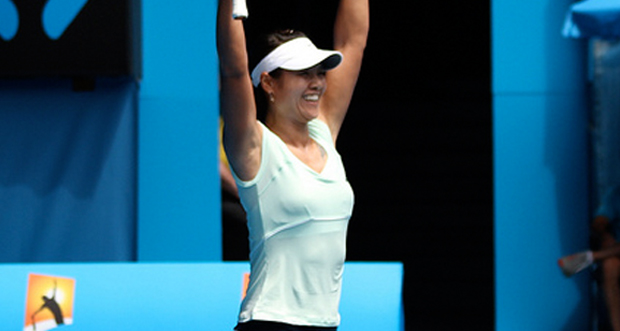
    AO WTA Winner Li Na

    The Chinese superstar and world No. 4 Li Na won her first Australian Open title on her third try, defeating Dominika Cibulkova, 7-6(3), 6-0.  This is the second Major title for Li, 31, who won the French Open in 2011. Li is the first player from China to win the Australian Open, and Cibulkova is the first Slovakian to reach the final of any Major.

    Cibulkova, 24, ranked 21, and standing just 5’3″, was a surprise finalist. After the tournament saw off the top-seeded Serena Williams and Victoria Azarenka, Li’s draw opened up. But Cibulkova had to personally dispense with Maria Sharapova, rising star Simona Halep, and the tricky Agnieszka Radwanska to reach the final.

    Li broke the Slovakian in the first game of the match, but a low first serve percentage and too many unforced errors kept Cibulkova in the hunt. She proved a worthy opponent in a competitive and entertaining first set, which eventually went to a tiebreak. The veteran proved too much for the first-timer, however, whose serve let her down in the crunch. With the first set in hand, Li found her form and never looked back, closing the second set at love.

    Photo credit:  globalite (Creative Commons License)


  • Wabi-Sabi and Spider Bites

    Wabi-Sabi and Spider Bites

    Roger+Federer+2014+Australian+Open+Day+12+Wn7S9KclWuCl

    The Australian Open 2014 Men’s Semifinals

    Stanislas Wawrinka [8] def. Tomas Berdych [7] 6-3, 6-7(1), 7-6(3), 7-6(4)
    Rafael Nadal [1] def. Roger Federer [6] 7-6(4), 6-3, 6-3
     

    The redback spider, Latrodectus hasselti, is a species of venomous spider indigenous to Australia. By way of dinner preparation, the redback uses her fangs to inject a neurotoxin into the vulnerable flesh of her prey, liquefying its insides before binding it thoroughly in silk and sautéing it lightly under the hot Australian sun. Lucky for me, I was able to see a redback—at delightfully close range— on my very first evening in Australia, right about dinnertime, in fact. There she was: sleek and elegant, with a bright red stripe running down her back, and lethal as hell. My Australian hosts took no small pleasure in explaining that recent research indicates the people who’ve been killed by a redback bite actually died from the pain, not the venom. But not to worry, they cheerfully reassured me, should I be bitten by a redback, I’d simply be rushed to hospital, injected with an anti-venom serum, and then pumped full of morphine for a few days to prevent pain-induced organ failure. Easy.

    Now, I won’t go so far as to compare World No. 1 Rafael Nadal to the Latrodectus hasselti, but I will go so far as to say that beating him at tennis isn’t easy, and losing to him looks like it hurts. Both these points were amply demonstrated by Grigor Dimitrov in his 6-3, 6-7(3), 6-7(7), 2-6 quarterfinal loss to the Spaniard. The Bulgarian shed tears after the match. But, at 22 years-of-age, Dimitrov is still very much a player in-process. The 32-year-old Roger Federer, on the other hand, has been declared dead, buried, and resurrected at least a dozen times by now. He already is who he will be, at least on the tennis court. (But after he retires, Federer might want to consider a second career in necromancy.) Maybe this is why it can be so painful to watch the Swiss superstar lose, yet again, to Nadal. There is a sense that instead of getting closer to deciphering the trick to making Rafa’s forehand disappear, Federer’s chances are getting ever more remote.

    This is not to say that Federer will never beat Nadal again. He probably will, possibly soon. But he will never discover the magic serum that allows him to avoid the pain of fending off a fusillade of Rafa forehands—all exploding into his backhand corner like hollow-point bullets—with only one hand on his tennis racquet. (And he will especially not discover the special serum if he persists on approaching into Nadal’s lethal side.) Roger Federer will never gain anything like ownership over their head-to-head, which Nadal now leads 23-10.

    There is not much new to say about this latest encounter, which was a comprehensive and familiar-feeling victory for the Spaniard, though it was Nadal’s first win in straight sets at a major since the French Open in 2008. As anticipated, Nadal arrived with almost none of the unsettled confusion he showed against Dimitrov two days earlier. From his serve, to his forehand, to his clenched jaw, Rafa looked muscular in his determination. Yes, he was blistered, but he was also callous. [Sorry, couldn’t help it.] There are those of us who imagine it causes Rafael Nadal some degree of internal pain to pummel the great Roger Federer. But that doesn’t stop him from doing it. And, really, those forehands are so much fun to see. 

    Watching Federer, I wasn’t quite sure what I felt. Wabi-sabi comes to mind, The Japanese aesthetic wherein impermanence, incompleteness, and imperfection are prized. The flaw highlights the beauty, and objects become more treasured as they become more worn. Besides, he’ll always have those 17 Major titles, 300-odd weeks at No. 1, and et cetera, et cetera on which to rest his weary, single-handed laurels.

    Watching the other Swiss semifinalist, the new Swiss No. 1, I knew exactly how I felt: “really happy,” just as Stanislas Wawrinka described himself. Considering this was the first Australian Open semifinal for either Wawrinka or the Czech seventh-seed Tomas Berdych, and that three of their four sets were decided by tiebreakers, the match was oddly flat. This might have had something to do with the fact that while Berdych and Wawrinka own no major titles, the players in the other semifinal have thirty between them. It might also have something to do with the fact that Wawrinka and Berdych took turns tightening up abysmally in the breakers. Stan went first, losing all but one point of the second set tiebreak. Then it was Berdych’s turn, and he double-faulted left and right in the second set breaker, which could be seen as ironic, since his tremendous serve was the whole reason the set had reached a tiebreak in the first place.

    But the real problems started for Berdych when he failed to remember, at the very end of the fourth set—which turned out to be the end of the match— that it was meant to be Wawrinka’s turn to screw up the tiebreak. So, after selfishly mishitting the same volley twice, Berdych went on to miss some more serves, make a few errors off the ground, and before we knew it—but not before three-and-a-half hours had elapsed—the match was over. Stanislas Wawrinka had done what no ATP player has done since Tomas Berdych did it at Wimbledon in 2010. He’d earned himself a spot in a slam final while seeded outside the top four. In fact, Wawrinka became the first No. 8 seed to reach the Australian Open final since Brian Teacher did it 34 years ago, which was so long ago, even Roger Federer wasn’t born.

    I don’t want to give the impression that this semifinal, which almost felt like an undercard show compared with the hype surrounding Fedal XXXIII, wasn’t a quality match. It was, and one aggressively played; it just wasn’t a great one. The contest had its moments: Wawrinka hit approximately twelve dozen exciting forehand winners, and exactly two even-more-exciting backhand winners down the line (or possibly three, stats is not my strong suit). Berdych did serve exceptionally, except for when it counted most. And, beginning in the second set, Wawrinka also developed an interesting, slightly frustrating habit of ceding the first 15 points of his service games to his opponent. So, his games were infused with a little extra tension, thus giving the crowd more reason cry out Stanimal! in loving, pleading tones.

    But the real outpouring of emotion came directly after match point was won. The stadium went all warm and loudly fuzzy with joy. Wawrinka earned the affection of the Australian crowd last year, with his valiant five-set loss to the 2013 champion, Novak Djokovic. He doubled that affection by beating Djokovic in five in the quarterfinals this week. The Swiss also happens to be modest, open-hearted, and articulate in his interviews. In the on-court interview after Thursday’s match, Jim Courier asked Wawrinka if Stan’s young daughter understands what her father does for a living. Wawrinka replied she only understands that if he loses, she gets to see him sooner. Then he apologized to her, on camera, that he wouldn’t be home for another couple days yet. He was brimming over with emotion, and I admit, when he said the bit about his daughter, I got a little teary, too.

    Rafael Nadal defeated a series of one-handed backhands—Philipp Kohlschreiber, Tommy Robredo, and Richard Gasquet—to reach the most recent major final, the 2013 US Open. Now, in 2014, he’s already defeated Dimitrov and Federer, and will get a shot at a third one-handed backhand and a second Australian Open title on Sunday. It’s likely he’ll win it. But, I hope, not too easily.

  • An Emotional Feeling

    An Emotional Feeling

    AO Fedal

    Australian Open, Semifinal

    (1) Nadal d. (6) Federer, 7-6(4), 6-3, 6-3

    The Australian Open provides those of us who otherwise avoid commercial television with plenty of excellent reasons not to alter our viewing habits for the rest of the year. Sadly, infrequent exposure means we have built up little tolerance for the unrelenting vibe of ecstatic anticipation, whereby even the most mundane events must be imbued with an unrealistic level of excitement, like a North Korean parade. Thus tonight’s semifinal between Rafael Nadal and Roger Federer was promoted as the most unmissable spectacle since the Normandy landings.

    Worse still are the promos for the shows the networks will inflict upon their loyal viewers in the coming weeks and months. My only exposure to these shows, or even these kinds of shows, comes at this time of year, therefore my grasp of their intricacies may be limited, assuming there are intricacies. Certainly the reality shows seem to feature arcane rule-sets, whilst conforming perfectly to the traditional mission of commercial TV, which is to bring people into your lounge room that you wouldn’t otherwise allow in your house. Indeed, one of the shows – My Kitchen Rules, which sounds like a pun but might not be – bases its format on this very idea. Its conceit is to have a pair of contestants invite the other contestants and judges into their homes and serve them a meal. We are thereby afforded the twin pleasures of watching people prepare food we’ll never eat, which is then consumed by people we’ll never meet. This last is a shame, because some of the table talk is sparkling. One guy does a serviceable impersonation of Jack Nicholson. There are some twins who by their own admission share a single brain, despite being physically separate. Last year’s champion described winning as ‘such an emotional feeling’.

    Some of these contestants and judges periodically turn up in the crowd at the Australian Open, where they’re expertly picked out by cameramen trained for that purpose. Bruce McAvaney and Todd Woodbridge clearly know which side their cross-promotional bread is buttered on, and are diligent in explaining who these nonentities are. Jim Courier does a serviceable job of feigning interest. But his job isn’t to hype Australian television shows; his job is to hype the latest installment of the rivalry between Rafael Nadal and Roger Federer. They have now played thirty-three times, and Federer hasn’t won a match in any format in almost two years, and a match in this format since 2007. Nevertheless, a range of factors led nearly everyone to believe that their latest Grand Slam match might be closer. There was a sentimental desire in some quarters for an all-Swiss final. There was ecstatic concern elsewhere that Nadal’s blister was infinitely more severe than the blisters that the rest of us somehow put up with. There was Federer’s recent form, and Nadal indifferent performances against Kei Nishikori and Grigor Dimitrov.

    As is often the case, the betting markets told the real tale. Nadal was the clear favourite to win, despite early reports that money was flowing for Federer, some of it in response to reports that the Rod Laver Arena roof might be closed. The widespread belief is that Federer, when insulated from the elements, transforms into an ungovernable colossus. Being in Melbourne, I had the advantage of being able to look out my window, and knew that rain was unlikely, and that the roof would therefore be open. News came through that the RLA roof had malfunctioned. It wouldn’t open, or had gained the capacity to love, or something. Leaden quips plummeted dangerously from the sky. Roger Rasheed suggested that Federer had deliberately broken the roof. The latest vapid trend on Twitter is to declare ‘you can’t make this up’ in reference to events that anyone with a modicum of imagination could make up quite easily. It turns out you can’t make up something as wondrous as a stadium roof getting stuck. (There’s conceivably a reference I’m missing, or a substratum of irony. Or it’s just one of those Twitter things, like prefacing a backdoor brag with the phrase ‘that awkward moment’.) Anyway, the roof eventually did open, ensuring Federer stayed at a manageably human scale.

    The breakdown of the Nadal – Federer matchup is by now so well-known that it barely requires reiteration. Nadal hits the ball with enormous topspin to Federer’s backhand, until Federer makes either an error or delivers a shot ball, which Nadal duly puts away. Nadal has proven his capacity to sustain this pattern of play indefinitely without discernible risk. Meanwhile, Federer can only break out of this pattern at enormous risk. This means that their matches are almost always played on Nadal’s terms. What is really remarkable is how rarely this dynamic has actually determined the outcome of their recent matches. What was surprising about tonight’s result was how readily it did. Even last year, a bad year, it was notable how well Federer’s backhand withstood the barrage. This fortnight, finally comfortable with his new racquet, his backhand has been as solid as one could hope for, without hoping for too much. Tonight, however, it was already falling apart when he arrived on court, and Nadal was masterful in denying Federer any opportunity to reassemble it.

    Naturally this isn’t the only dynamic at play. Arguably as important is Nadal ability to ‘reset’ any rally that threatens to spiral away, especially if it threatens to drain away through his forehand corner. Whenever Federer went hard into that corner, almost without exception Nadal would respond with a high looping forehand of his own, moderately paced but very deep, keeping his opponent pinned behind the baseline, and ensuring that Federer could gain no progress within the point. There was also the latent threat of Nadal’s forehand pass. The basic rule when coming to the net is that one should never approach to Nadal’s forehand if he can run at it, stand near it, sight it, or if he is lying handcuffed on a hospital bed in traction to the side of the court. There are no exceptions. All the coaching manuals agree on this. There is nothing wrong with his backhand pass, but at least there’s a chance he’ll miss it. Federer broke this cardinal rule a few times, including in the final game. Whenever he was in trouble, at least through the early going, he approached solely to the backhand, thus delaying defeat for a time.

    One doesn’t thereby wish to imply that Federer approached the net recklessly, or even particularly frequently. He was often given no opportunity to move forward, but even so one searched in vain for the new ideas Stefan Edberg has apparently brought with him. Federer was arguably more aggressive last season when facing Nadal, at least in Rome (suicidally so), Cincinnati (judicious), and the World Tour Finals. Tonight looked more or less like any number of their matches over the last half a decade, only more so, and with due allowance for their respective levels on the night.

    Federer on the night played quite poorly, not quite at the subterranean level of the Brisbane final, but certainly not up to the standard he has maintained through this Australian Open. His serve in particular was less potent than he might have hoped, and all but deserted him in the first set tiebreak, though this more determined its shape than its outcome. Meanwhile, Nadal played well – afterwards he conceded it was his best match of the tournament – which meant that a match that was already his to lose didn’t detain us beyond three sets. There were of course many flashes of brilliance, the brightest of which was a reflexed sliced pass he produced after being wrong-footed by a fine Federer volley, which in turn shocked Federer into a coarse volley error. There were others, such as the backhand return winner in the final game, but what really drove the result wasn’t Nadal’s audacity but the long sequences of bread-and-butter rallying, in which the top seed could build pressure without ever growing incautious.

    After the match Nadal said all the right things, including kind words about how much playing Federer still means to him. ‘When I go on court I have very, very emotional feelings,’ he declared, proving that facing down the mighty Swiss is about as thrilling as winning a reality cooking show. (In Nadal’s defence, English is not his first language, whereas My Kitchen Rules contestants merely speak like it isn’t.) He also neatly admonished Courier for implying that he’d already won the title. He’d watched Wawrinka and Tomas Berdych slug out the other semifinal last night, and was well aware that while both men had erred, it was never on the side of caution. Wawrinka is playing very well, striking the ball with supreme authority, and is now, for the first time, the Swiss No. 1. All the same, the new Swiss No. 1 fares even worse against Nadal than the old one does. Wawrinka has never taken a set from Nadal in twelve attempts. If, as Courier and everyone else anticipates, Nadal does win the final, he’ll become the only man in the Open Era to win all four Majors twice. Imagine how emotional that feeling will be.

  • Nadal Bests Federer – Into the Australian Open Final

    Nadal Bests Federer – Into the Australian Open Final

    AO ATP Finalist - Rafa

    In a much anticipated semifinal, and in the 33rd meeting of their storied rivalry, Rafael Nadal once again took down Roger Federer.  The final score was 7-6(4), 6-3, 6-3.

    This was the most anticipated of their recent matches. While Nadal is the world No. 1, and has the prohibitive edge in their head-to-head, Roger Federer was looking resurgent, with a new racquet and a new coach, Stefan Edberg. He had dropped only one set, against Andy Murray, going into the semifinal.  Nadal, for his part, was sporting a grotesque blister on his racquet hand, and had had a couple of unimpressive rounds against Kei Nishikori and Grigor Dimitrov. And while a semifinal is unusual for their rivalry, it suddenly became again one of those rubber-meets-the-road matches between them. Novak Djokovic, the defending champion, was out. The bottom-half of the draw has produced a new finalist in Stanislas Wawrinka. With Federer the all-time leader in Major titles, at 17, and Nadal pressing, with 13, the match took on heavyweight significance in their rivalry, for the first time in a few years.

    In the first set, Federer pressed, and capitalized on net play. They stayed on serve, and got to a tiebreak, which was where Nadal started to break away. Federer never had a break point in the first set.

    Nadal broke in the fifth game of each of the subsequent sets, and that was all he needed. While it did provide flashes of past brilliance, it fell short of the desired additional volume to their series of classics.

    [divider]

    Photo credit:  Marianne Bevis (Creative Commons License)

  • Australian Open Day 12 Federer/Nadal Semifinal Schedule of Play / Scores: Friday, January 24

    Australian Open Day 12 Federer/Nadal Semifinal Schedule of Play / Scores: Friday, January 24

    [Scores added as known.]

    Rod Laver Arena — 3:00 P.M.    

    Mixed Doubles – Semifinals
    Jarmila Gajdosova (AUS) / Matthew Ebden (AUS) d. Sania Mirza (IND) (6) / Horia Tecau (ROU) (6) — 2-6, 6-3 [10-2]

    Not Before: 4:00 P.M.

    Women’s Doubles – Final
    Sara Errani (ITA) (1) / Roberta Vinci (ITA) (1) d. Ekaterina Makarova (RUS) (3) / Elena Vesnina (RUS) (3) — 6-4, 3-6, 7-5

    Not Before: 7:30 P.M.

    Men’s Singles – Semifinals
    Rafael Nadal (ESP) (1) d. Roger Federer (SUI) (6) — 7-6(4), 6-3, 6-3

    [divider]

    Margaret Court Arena

    Mixed Doubles – Semifinals
    Kristina Mladenovic (FRA) / Daniel Nestor (CAN) d. Jie Zheng (CHN) / Scott Lipsky (USA) — 6-3, 6-1

    Cover Photo (Creative Commons License): Marianne Bevis