Tag: atp

  • We Might Run Out Of Words

    We Might Run Out Of Words

    Cincinnati Masters, Final

    (4) Nadal d. Isner, 7-6(8), 7-6(3)

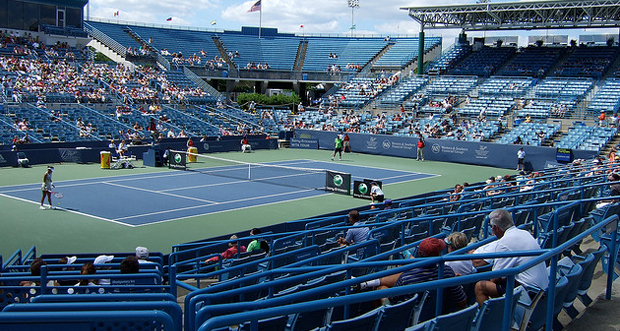
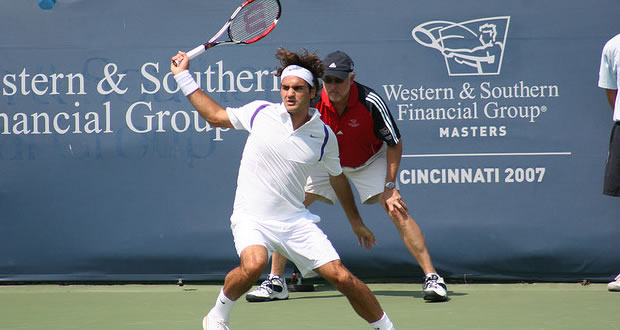
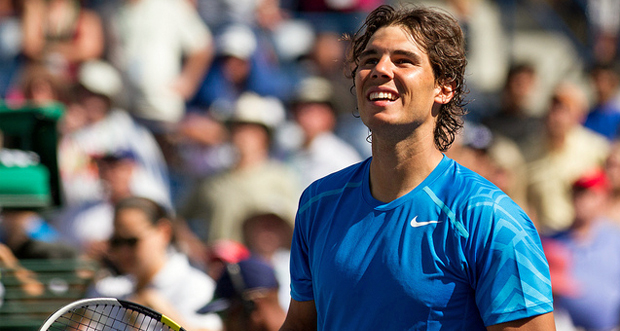
    Rafael Nadal has won the Cincinnati Masters, defeating John Isner to claim his second Masters event in two weeks, and his third hardcourt Masters of the year. Prolonged domination by a single player presents a writer with peculiar difficulties, assuming the writer is at all disinclined to repeat themself. This was a real problem in 2011, when Novak Djokovic refused to stop winning. I was not writing about tennis at the time, but I assume it must have been an issue in 2005 and 2006, when Roger Federer was nearly unbeatable, and very nearly unbeaten. Wimbledon aside, so it is proving this season with Nadal. I’d suggest there’s no higher compliment than to concede that if he keeps going on like this, we might run out of words.

    For example, there was little that could usefully be said after Nadal’s Rome triumph that hadn’t been said following the Madrid final a week earlier. His new Swiss opponent had greater pedigree, but won even fewer games. Similarly, today’s victory over a towering North American with a frightening serve and maneuverability on par with the Exxon Valdez more or less reprised last week’s. Last week it was local favourite Milos Raonic, whose trip to the Montreal final propelled him into the top ten. This week it was local favourite John Isner, whose passage to the final was if anything more impressive, and had the laudable effect of ensuring the United States has a man inside the top twenty for their home Grand Slam. Both giants progressed to the final after defeating Juan Martin del Potro in memorable fashion. Raonic, you will recall, generating fleeting controversy by delivering a series of roundhouse kicks to the net while cackling that he was “above the law.” Meanwhile Isner, more conventionally, saved a match point in a marathon. Isner also beat Raonic this week. The similarities mount, but ultimately amount to little. What really matters is that Nadal beat everyone. Again.

    Today’s final wasn’t the most memorable example we’ve witnessed this year, or even today, given that it was entirely upstaged by the women’s final that followed. Had it been a quarterfinal it would have already faded into the sepia backdrop of general forgetting: yet another example of a monstrous serve guaranteeing tiebreakers, which were then decided by the better player’s superior fortitude and technique. But it was a final, and so gains some luster by default, and thus bears recounting.

    If for no other reason, it was an interesting study in how two sets can be numerically similar yet end up feeling totally different. The first set was quite exciting, featuring multiple set points for both men, mostly in the fraught tiebreaker. Isner saved those he faced with typically muscular points on serve, but failed utterly to impose himself on return. Mark Petchey was correct in commentary when he remarked on the strange contrast that Isner presents us with. On serve he has an “all-American attacking game,” yet on return is “negative and pushy.” He did get an impressive number of Nadal’s serves back, yet they never had much on them, and thereafter he won very few points. It didn’t help that he facing one of the most punishing baseliners ever to heft a racquet. Nadal finally got a set point on his own serve, and duly took it.

    The second set, on the other hand, was frankly dull. If the first set demonstrated that tiebreakers are considerably more interesting when their arrival isn’t necessarily inevitable, the second set proved the corollary. Both men continued to serve magnificently, and return ineffectively. Nadal was more or less guaranteed a point whenever he switched up his serve wide to the deuce court, since the undeniable lethality of the American’s forehand requires that his feet are set. Nadal lifted and played a smart tiebreaker, and never looked in trouble. After victory he collapsed onto his back, and generally made it apparent just what winning Cincinnati means to him. It seems this tournament had featured on more bucket-lists than Serena Williams’s. The strange vase that Cincinnati passes off as a trophy proved every bit as awkward to bite as Montreal’s silverware had been.

    This was, of course, Nadal’s first strange vase. One can essay complicated reasons why he has never won this title before, including surface speed and bounce, opponents, balls, proximity to the US Open, and the misfortune a couple of years ago to combine with Fernando Verdasco to thrash out one of the worst tennis matches in living memory. All of these factors have merit, and combined meant that no one was surprised at his lack of success here (as opposed to Federer’s oddly dismal record at Bercy until 2011). Nadal characteristically offered the simpler explanation that he’d simply never played well in Cincinnati, and that this week he did. It was a salutary reminder that complicated rationales aren’t necessarily wrong so much as unnecessary, and that elite athletes generally operate with a savant-like eschewal of nuance. This is how Roger Rasheed can function effectively as a coach while employing the discursive range of an inspirational fridge magnet. The manner of Nadal’s progress this week certainly bore his contention out. There was no match in which he wasn’t the clear favourite – including the quarterfinal against the defending champion Federer – in which playing to his strengths would more than likely ensure victory. He just had to play well.

    This isn’t to suggest he didn’t have his difficulties. Federer came within a couple of games of winning, and Grigor Dimitrov boldly grabbed a set when Nadal allowed his focus to waver. However, this meant that in addition to savouring their hero’s triumph, the more martially-inclined portions of Nadal’s fan base could indulge themselves in their most cherished conceit, which is that of the Spaniard as el guerrero imparable. After what amounted to a fairly unremarkable defeat of Dimitrov there was no shortage of chest-beating proclamations that Nadal had not been at his best, yet had “found a way to win.” Insofar as the “way” consisted of “being better than his opponent at nearly every aspect of tennis,” I suppose it’s not inaccurate. What’s false is the emphasis. He didn’t win because of his warrior spirit, but because he’s a very good tennis player.

    Indeed, anyone still insisting Nadal isn’t the very best tennis player in the world right now sounds increasingly deluded. He will arrive in New York determined to become the first man to sweep the US summer since Andy Roddick ten years ago, and only the third man to do so ever (Pat Rafter also managed it in 1998, to Pete Sampras’s unstinting disgust). He will return to the number two ranking tomorrow, and could well return to number one if he sustains his current form for a few weeks in New York. Although the bookmakers in their wisdom have retained Djokovic and Andy Murray as US Open favourites ahead of the Spaniard, it will take a reckless punter to bet against him.

    But that’s all in the future. For now, Nadal has won twenty-six Masters 1000 titles, including a record-equalling five this season. It’s an accomplishment that is only enhanced by recalling that none of the five were Monte Carlo, which otherwise exists only that he might augment his tally by one each year. Aside from that, the only other Masters event Nadal hasn’t won this year was Miami, which he didn’t play. In order to break the record, which was only set two years ago by Djokovic, Nadal will have to win either Shanghai or Paris. History suggests that he is unlikely to do so. Then again, the Spaniard has already spent the season showing history just where it can shove its suggestions.

    [divider]

    Discuss this article, the match and lots more with fellow tennis fans in the forums.
  • The Curious Case of Rafael Nadal’s Absence and Incredible Comeback Continues

    The Curious Case of Rafael Nadal’s Absence and Incredible Comeback Continues

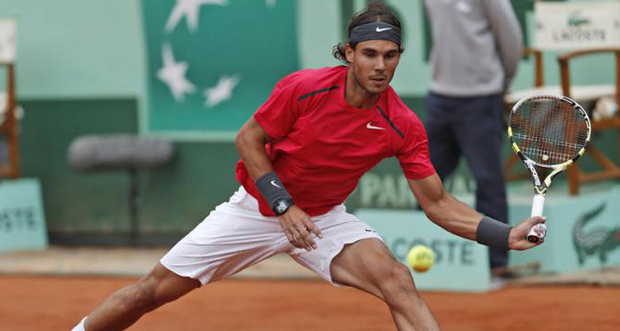
    The Curious Case of Rafael Nadal’s Absence and Incredible Comeback Continues and in tonight’s quarterfinal he faces defending champion and 5 time Cincinnati titlist, Roger Federer.

    Even though Nadal has won twice as many matches against Federer as he has lost, most of those wins have been on clay, and normally, many would have favored Federer against Nadal on the speedier hard court surface of Cincinatti.

    Just one year ago in Cincinnati, Roger Federer established a Masters 1000 record by being the first player to win a Masters 1000 tournament without being broken in any game. Along the way, the #1 player in the world, Federer, beat a very good Mardy Fish on that day, an excellent Stan Wawrinka the following day, and in the final, dismantled the #2 in the world, Novak Djokovic, with a bagel set and a tiebreak set to win his record 5th Cincinnati title.

    In the meantime Rafael Nadal was in the early stages of his what would be a prolonged 7 month absence from the tour. Prior to Cincinnati last year, he had to withdraw from the 2012 Olympics at Wimbledon and the Toronto edition of the Rogers Cup.

    As the months dragged on, many players and fans were wondering not only how long it would take for Nadal to return to action on the tennis court, but how long it would be before he would be competitive with the top players in the game.

    During the 2013 Australian Open, former world #1 and 8 time major winner Andre Agassi said:

    I found whatever time you take away from the game you need that time to double to be fully where you were when you left, that’s my experience.”

    ”If he comes back in the first half of the year, you won’t see him at his best, historically speaking with my experience, until this tournament next year.” — Read more

    A good example would be the 2009 US Open winner, and world #4 Juan Martin Del Potro, who went out of action after the Australian Open in 2010, not returning until almost October that year after injuring his wrist. But he only played two tournaments in what remained of the year. His ranking dropped down to a low of #485 at the 2011 Australian Open, and he finally returned to the top 10 a year later at the 2012 Australian Open, close to the time frame Andre Agassi indicated.

    But incredibly, and some would say miraculously, Rafael Nadal returned to action in early February of 2013 in South America, where he had only fallen to #5 in the world during his absence, and since then has stormed his way through the tour with 8 titles and 2 finals in 11 tournaments, including his eighth Roland Garros, and 4 masters, 2 on hard courts and 2 on clay. His only real “blip” during this time was on the fresh grass of Wimbledon where he was upset in the first round by Steve Darcis. A little over a year after he left the tour, and about 6 months after his return, he has returned to #3 in the world. It is theoretically possible for him to ascend to #1 in the world if he wins in Cincinnati and the US Open.

    American veteran Mardy Fish, who is relatively early in his comeback after his heart problems forced him to stop, had this to say after losing to Philipp Kohlschreiber in the first round of Cincinnati this year:

    Fish:

    I feel all right, I just have an awful long way to go tennis wise,” said Fish. “It just kind of shows you how amazing Rafa (Nadal) has been coming back after seven months off. To do what he’s done is just not normal.” — Read More

    So we have a clearly above normal Nadal playing against a Federer who has said that this is a transition year for him, and who has won a only a single title this year on the grass in Halle and lost in his last 3 tournaments to players ranked 116, 114, and 55.

    What will the result of tonight’s match be?

    A Roger Federer win in Cincinnati would normally not be considered surprising, but this year is anything but normal. Roger will have to conjure up last year’s form to have a good chance of beating Rafa, or Rafa will have to suddenly fall apart. I don’t see either happening, but on any given day in tennis, anything is possible. If this year’s happenings are any indication, the match should be anything but normal, but one hopes it is entertaining.

    [divider]

    Dicuss the Nadal/Federer Quarter-Final at the Cincinnati Masters on our tennis forum.

  • Strong Believers

    Strong Believers

    Western & Southern Open, ATP Third Round

    [1] Novak Djokovic def. [Q] David Goffin 6-2, 6-0
    [5] Roger Federer def. [11] Tommy Haas 1-6, 7-5, 6-3
    [2] Andy Murray def. Julien Benneteau 6-2, 6-2
    [4] Rafael Nadal def. Grigor Dimitrov 6-2, 5-7, 6-2

    ESPN, Inc., formerly the Entertainment and Sports Programming Network Rulers of the Universe, has a way of making its fellow cable network, The Tennis Channel, look like it has the earnings potential of an independent bookseller—an independent used-bookstore with a leaky roof and a big CD section. I could watch Cincinnati tennis on two different ESPN stations today, while the Tennis Channel was stuck re-airing the Kooyong Classic from 2004. But, I could watch ESPN today, because today was a happy work-at-home paperwork-day. (This is a special kind of day, similar to a holiday. Sadly, it is also a type of day that has become all too rare in recent months.)

    Aside from making the Tennis Channel feel bad about itself, ESPN also has a way of reminding American tennis fans exactly how unimportant their sport-of-choice is in the grand scheme of chosen sports. Today they managed it by regulating Rafael Nadal and Grigor Dimitrov to ESPN3, an online stream, while airing Little League on television. Yes, a 1000-level ATP tournament contested on U.S. soil (specifically in the Western & Southern portion of the U.S.) took a back seat to eight-year-olds standing in a meadow chewing bubble gum. A match featuring one of the best players in tennis history versus the only active player on tour to be nicknamed after one of the other best players in tennis history was shunted aside by actual baby athletes.

    But I digress. Hmm. Why was I telling you about the ESPN programming schedule? Oh yes, for metaphorical purposes! And I’ll come to those in a moment, I promise. Everybody loves a metaphor. But first, since I’m on the subject of ESPN, I want to say a few words about ESPN commentator, Darren Cahill.

    In fact, you can consider this post my formal petition for Darren Cahill to take full coaching responsibility for Marion Bartoli’s post-retirement commentary career. Because, really, with Cahill in the booth, the video stream is almost optional. It isn’t simply that Darren Cahill mostly confines his commentary to the match at hand; it’s that his comments are so sensible. Indeed, when he has nothing sensible to say, he seems to say nothing at all. (Psychotherapists love this trait in their sportscasters.)

    For instance, during set one of Roger Federer’s three-set victory over Tommy Haas, Cahill wasted little time in the usual speculation about whether Roger was actually Federer, or if this Roger might not be an imitation version of the Swiss who had never learned to play tennis. Instead, he commented that Federer was more than typically nervous, rushing himself into poor decisions, mostly involving losing points at the net. Cahill also noted that Tommy Haas’s court position on the return was taking the out-wide serve from Roger forcing him into uncomfortable choices, and that Haas’s returns—flat and hard, down the middle of the court—were the best strategy to draw errors from Papa Fed.

    At some point in the middle of Nadal/Dimitrov match— the point when the Bulgarian ran down a drop shot, hit a winner, and then jumped into the air with glee—Darren Cahill chortled warmly, saying, “Goodness me, he’s fun to watch.” With Cahill in the ESPN booth, it’s also fun to listen.

    OK. That turned out to be an official second digression, which might be some type of digressive record, if such records were tracked. (I tried to keep track once, but I kept getting distracted.) So, without further ado, the metaphorical section of the post, wherein I compare the Big Four—defined herein as Djokovic, Nadal, Murray and Federer*— to ESPN, or perhaps Amazon.com, and their opponents to a cross between the Tennis Channel and various indie booksellers.

    [divider]

    Novak Djokovic d. David Goffin 6-2, 6-0

    The first men’s match on Center Court today was Novak Djokovic versus David Goffin. During Djokovic’s match, morning-time for me, I listened to my voicemail, ate a bagel, and blinked, twice. By the time I’d finished, it was all over. The second set took approximately five minutes and Goffin won exactly zero games. Djokovic, on the other hand, won six. Every time I had the opportunity to glance at my monitor I was treated to the sight of a blonde Belgian standing roughly fifty feet behind the baseline, and lunging in the general direction of a tennis ball.

    Goffin made his way to the third round via a 6-1, 6-1 win over Mackenzie McDonald, who is the first non-ranked ATP player to qualify for the main draw in Cincinnati. Ever. Mackenzie hails from Piedmont, California, an American hill-town so wealthy that it seceded from its surrounding city-state, which is a rough-and-tumble place called Oakland. Piedmont has a very tidy set of public courts. It is doubtful Mackenzie makes much use of them. In the second round, David Goffin bested last week’s Rogers Cup semifinalist Vasek Pospisil, 7-5, 1-6, 7-6. Neither of these victories offers exquisite insight into Goffin’s current form. Nor did today’s loss. Djokovic didn’t let him near the tennis ball. The Serb is looking fearsome.

    Djokovic has never won the Western & Southern Open. Conquering Mason, Ohio, would make him the only ATP player to win all nine of the Masters titles. I Googled No. 9 and it turns out to be – according to the internet’s most reputable numerology sites — “the number of destiny.” Wikipedia also defines nine as the number that follows eight and precedes ten. Make of that what you will.

    [divider]

    Roger Federer d. Tommy Haas 1-6, 7-5, 6-3

    Given that Federer spent a goodly portion of his third round match looking as if he were concerned that sustained rallies might damage his antique tennis racquet, you might be surprised that I’ve listed him among the metaphorically ESPN-esque players of the day. But—and I think I’m right about this—part of the reason Federer was able to come back and win the match from 1-6, 1-3 down is precisely because he is Roger Federer, or RF, Inc., for short. No matter how low the RF stock plunges, there is always a chance that his opponents will remember that they are up against a 17-time slam champion. (Sometimes, there is even opportunity for Federer to remember this, too, especially when he’s not wearing his special “warming shirt” and is therefore capable of hitting serves.)

    In Tommy Haas’s case, he must have also been aware of his 3-11 (now 3-12) career head-to-head against Federer. A tennis fan doesn’t need a numerology site to tell her that numbers like that can get in a player’s head. Nonetheless, the German got off to a stellar start, and looked as if he could continue being outstanding all day. Meanwhile, Federer proceeded to go from OK, to distinctly not OK, to much worse than that. By the end of the first set even his serve had abandoned him, protesting its owner’s wild net-rushing ways.

    But, midway through the second set the Cincinnati fans got to witness one of the marvels of today’s interdependent tennis economy. At very nearly the same moment in time, Federer began to produce his money shots, while Tommy’s currency took a sudden nosedive. Haas started his descent by re-gifting an early break back to Roger, leveling the set at 4-4. Federer consolidated, making one small fist pump in the process. Haas then gave away three straight points, which turned out to be set points, so he changed his mind and took them back. The set was still level at 5-5, but the momentum now rested with Federer.

    By the time the No. 5 seed closed out the match—an excellent drop shot to bring up match point, and a forehand winner to end it—Roger Federer looked like he had some measure of his aura back. (If you looked closely, you could even see it, shimmering in the Cincy sun — a pretty cornflower blue.) After the match, Federer was quoted as saying he is a “strong believer” he’s on the right path. Should Federer lose in the quarters, there’s still no proving him wrong. Even the most vintage version of Roger Federer could be excused for losing to Rafael Nadal at his most passionate™.

    [divider]

    Andy Murray d. Julien Benneteau 6-2, 6-2

    OK, I admit I did not see one ball of Murray’s win over Julien Benneteau. (I had to do some actual work today.) Andy Murray had to do some work, too — exactly one hour, nine minutes, and two seconds’ worth. Since I have no observations to make about this match, I’ll guess (blogger prerogative): the Scot is much improved this week from last. He is also the reigning Wimbledon Champion and the defending US Open Champion. He is a factor, whether he is happy about it or not.

    [divider]

    Rafael Nadal d. Grigor Dimitrov 6-2, 5-7, 6-2

    Nadal’s three-set defeat of Grigor Dimitrov was an exciting match, or might have been if I weren’t watching it while also trying to cook dinner for four. It is not easy being a Rafa fan, chopping vegetables, and watching a 6-2, 5-3 lead slip entirely away. In such moments one needs to be especially careful not to accidentally include small pieces of oneself in with the chopped kale and beans. (It’s what people like to eat in Northern California, I swear.)

    At some point during the first set, Darren Cahill said (sensibly), that, under pressure, Grigor Dimitrov had a tendency to abandon a winning strategy. As if Dimitrov knew he was being discussed, he demonstrated the truth of Cahill’s observation by gaining a hard-fought advantage in a long rally and proceeding to back it up by backing up, way up—deep into Goffin territory—losing the point because he couldn’t track down an inside-out forehand from Nadal. Case in point.

    However, when the Bulgarian made a mighty last stand, which came, as last stands will do, near the end of the second set, it turned out to be Nadal who abandoned his winning strategy. Instead of aggressively going for winners off his forehand, backhand, serves, and volleys, he mostly did not go for winners off all those same shots. When he did, he missed. Grigor, meanwhile, became good fun to watch.

    Fortunately for Rafa, he is, at the moment, well in touch with his trademark inner-passion for the game. As with Federer, you can see it in his aura, which shines bright yellow, and looks not unlike an incandescent tennis ball in the shape of a T-shirt. Even at night, the brilliant glow helps Rafa find anything from a moth resting its wings on the service-line to an aggressive baseline strategy. Having located his strategy Rafael Nadal, being Rafael Nadal, broke to open the third set. There were close games and see-saw moments in Set No. 3, but Nadal never relinquished the break. Why should he? He’s Rafa.

    [divider]

    At the beginning of Roger Federer’s match he was pronounced by many (many times over) to appear “not at all like Federer.” By the time he won, his play was dubbed “vintage Federer.” True Federer. (Though he was still far from full-flow-Federer, which is even truer than truth.) It fascinates me how often top players are defined as playing “like themselves.” It isn’t just linguistic laziness, or I don’t think it is. The technique is descriptive. If you tell me Djokovic was playing like Djokovic, I don’t picture baseline errors. No, I think it’s to do with how frequently the Big Four are able to channel their best selves, which — and this applies to all of us — is the truest version of the self. I am a strong believer in that.

    And because I’ve used up my entire allotment of words, including half my allowance for next week, I’ll end with mentioning players who deserved more mention: John Isner, Dmitry Tursunov, Juan Martin del Potro, and Tomas Berdych. Each man won a match today, and tomorrow they play Novak Djokovic, each other, and Andy Murray, respectively. I wish every one of them strong belief. I also wish tomorrow were another special stay-at-home-paper-work-day. So I could watch.

    *The Top Four (as opposed to the Big Four) includes Djokovic, Murray, Nadal, and David Ferrer, who is having a terrible time moving around tennis courts lately. I have to think it’s at least partly due to the damage done to his ankle at Wimbledon. The Spaniard tried so hard to give his second round match away to Ryan Harrison, but the American refused to take it. (Respect for his elders, and whatnot.) As a consequence, David Ferrer has now been Tursunoved twice this season. But it’s worth noting that last time he lost to the Russian was in Barcelona, mere weeks before he reached the French Open final.

  • Reliably Inspirational

    Reliably Inspirational

    A fine third day at the Cincinnati Masters yielded the best selection of professional men’s tennis matches in months. As ever in North America this wondrous congregation of talent was witnessed by a formidable array of half-empty stands. Even by the night-match, which featured Roger Federer, the stadium appeared barely two-thirds full. For some reason, Americans collectively find it hard to get excited by a tennis tournament until the later rounds, an apathy shared by their main television networks. CBS doesn’t even show up to the US Open until the last weekend, which it then more or less ruins for everyone. It won’t grace Cincinnati until the last Sunday, while even ESPN won’t trouble itself until Thursday. In the meantime there’s the redoubtable Tennis Channel, as ever a mixed blessing. On the one hand live coverage is hard to fault. On the other hand there’s Justin Gimelstob.

    It could be that the long decades of dominance have taught the American sporting public to assume that their countrymen will always feature in the later stages. Why trouble yourself earlier? We Australians long ago learned to cease making such assumptions. If we want to see our compatriots, we tune in early, preferably for qualifying. Now that there are no American men inside the top twenty, it might be wise for them to do the same. Of course, it could be that from my current vantage, precisely one Pacific Ocean and half a continent away, I’m totally misreading it and Cincinnati’s stands are actually jam-packed. Perhaps it’s merely a trick of the telecast: as well as adding twenty pounds, the camera subtracts a thousand spectators.

    [divider]

    Dimitrov d. Baker, 6-3, 6-2

    CBS and ESPN viewers certainly won’t catch any sight of the reliably inspirational Brian Baker, who today went down easily to Grigor Dimitrov. This is a shame, since he’s worth watching and hasn’t been spotted in months. Having cruelly fallen in the second round of this year’s Australian Open – on a day of sustained carnage his injury was at once the worst and the least surprising – Baker was away from professional tennis for almost seven months. Numerically-gifted readers will note that this is the same amount of time that Rafael Nadal missed. Baker’s absence generated considerably less interest. Of course, Baker being absent from the men’s tour is hardly remarkable; it has been one of the constants of professional tennis for the last decade, like top four domination, or the microwave radiation that saturates the cosmos. The anomaly wasn’t that Baker was away, but that he had – and has – returned.

    Naturally, I’m pleased he has, since I enjoy the way he plays: at his best slightly reminiscent of Nikolay Davydenko in a way that Davydenko himself rarely is anymore. Beyond that, though, I enjoy the way Baker encourages me in my fantasy that he’s a club player on history’s greatest roll. The truth of the matter is decidedly different, if not completely opposite – he is a talented pro who has had to do everything the hardest way, and whose body boasts only slightly less metal than Wolverine’s. But I still experience a slight thrill every time he puts away a simple volley. Good for him, I think, knowing I might well have duffed it into the back fence.

    Sadly today he missed too many simple volleys against Grigor Dimitrov, along with just about everything else. It was probably to be expected. Given his modest earnings over the years, it’s not as though he could afford authentic adamantium for his metal joints. He was compelled to go with cheaper base metals. Rust was thus inevitable. As is often the case it doesn’t cause a consistent loss of quality so much as wildly oscillating inconsistency. Baker comfortably saw off Denis Istomin yesterday, but might not have today given the chance. Instead he faced Dimitrov, for whom the phrase “wildly oscillating inconsistency” might well have been coined. Still, he was on his game today, and looked a clear class above his opponent. Baker will get better. For now it’s just a pleasure to see him back, and a pleasant surprise to see he still boasts a full complement of limbs. His matches are only ever one mishap away from recreating the Omaha Beach scene from Saving Private Ryan.

    [divider]

    (3) Ferrer d. Harrison, 7-6(5), 3-6, 6-4

    Speaking of Private Ryan, or at any rate Senior Cadet Ryan, Harrison managed to lose his nineteenth straight match to a top ten opponent a short while later, against a curiously vulnerable David Ferrer. The Spaniard’s lofty ranking was only apparent from the number next to his name, and not from the quality of his play. The Spaniard has been injured for some time, and has barely looked himself since Roland Garros. If ever Harrison was going to beat him, it was today. Still, the American might take some solace from getting so close: he led by a break in the third set, and was briefly magnificent in breaking back late in the match. One doubts whether he will be consoled by that, however, since he continues to give a strong impression that he hates losing far too much to find it merely instructive. The game in which Harrison was broken back in the final set featured an ace clocked at 152 mph, as they measure such things in the Cayman Islands, or 244 kph as measured elsewhere. If this was an accurate reading, then it would be the seventh fastest serve of all time. But I doubt whether it was an accurate reading. The serve even had topspin on it.

    [divider]

    (5) Federer d. Kohlschreiber, 6-3, 7-6(7)

    Roger Federer rounded out the schedule by defeating Philipp Kohlschreiber for the seventh time, so far without a loss. Neither man appeared to be brimming with confidence, and based on their combined unforced error of sixty-five they had every reason not to be. Federer thoughtfully commemorated each of his previous six victories over Kohlschreiber with a squandered break point early in the first set: performance art of the very highest order, as Robbie Koenig might say. But he mostly served well himself, and broke in Kohlschreiber’s next game. Even if Federer somehow defends his Cincinnati title, he won’t be reprising last year’s heroic effort, in which he took the event without ever dropping serve. He gifted a non-crucial break away in the second set, a favour the ever-courteous German repaid immediately. They went back to scrappy holds. Mercifully this couldn’t continue indefinitely, and the tiebreak came around. A match that had been defined mostly by forehand errors thus found its apotheosis. Federer led by 5-2, then saved a set point at 7-8 with an out serve. He finally took the match on his second match point, ironically with a forehand that landed in, a development so miraculous in the circumstances than Kohlschreiber could merely stare at it, dumbfounded.

    [divider]

    In other news, Feliciano Lopez won his first Masters level match this year, over Kei Nishikori. Milos Raonic, the first Canadian player ever to enter the top ten, nearly became the first top ten player to lose to Jack Sock. Mikhail Youzhny and Ernest Gulbis turned up dressed identically, a deplorable faux pas that left the crowd aghast. All twenty-five of them.

  • Back to the Future! Roger reverts to his old racquet and wins in Cincinnati.

    Back to the Future! Roger reverts to his old racquet and wins in Cincinnati.

    Five-time winner of the Cincinnati Masters event, Roger Federer proceeded into the third round of the Western & Southern Open by defeating Philipp Kohlschreiber in straight sets (6/3 7/6).

    Federer had been testing a new 98-square-inch head racquet following an early Wimbledon exit, but reverted to his usual 90-square-inch Wilson for his opening match against Kohlschreiber.

    “I’m going to do more racquet testing when I have, again, some more time after the US Open. I was playing for a month with the black one, but it’s a prototype. At the end, I just felt like, you know what, right now I feel like I need to simplify everything and just play with what I know best,” stated Federer in the post-match interview.

    The former world number 1 and 17-time major winner also announced he’d got through the match without any back pain. He has been suffering from recurrent back spasms during the year.

    [divider]

    Discuss the Cincinnati Open with fellow tennis fans in our discussion forum.

  • Jack Kramer Explains Federer’s Fade

    Jack Kramer Explains Federer’s Fade

    Jack Kramer’s “The Game” with Frank Deford is one of the finest tennis books you’ll ever lay your hands on. Jack Kramer was a grand master of the sport, winning everything there was to win. With that kind of tennis success comes an expertise that only a select few can acquire.

    Kramer, now deceased for several years, could analyze and breakdown any match, any player, the mental side of the sport in a way that educates the reader.

    Discussing Stan Smith and his sudden rapid decline from the top, Kramer’s description seemed to also fit the current Federer situation…

    “When you reach a certain plateau in tennis, you do almost everything automatically,” wrote Kramer. “I would hit down the line at a certain moment without really knowing that I had made a choice and carried it out. When things start to go bad for a player, the first thing he loses is that spontaneity. He starts to think a little, which is bad enough, but then he starts to overthink. That’s what happened to (Stan) Smith. And then after a certain number of losses, he couldn’t march about with that air of confidence. Listen, let me assure you that you play better as Number l because most players cannot forget that fact, and thus they play worse. Once Stan was an ex-champion, the others wanted him all the more – which made it that much more difficult for him.”

    Kramer added some more thoughts: “He was reaching the peak of his career; he was still only 26, Number l in the world. And I think it is possible to speculate that had he played that (boycotted) Wimbledon, had he won it – which was the best guess – he might not have declined so spectacularly in the years that followed. The week after (boycotted) Wimbledon there were two tournaments on the continent, and the one at Gstaad in Switzerland had a much stronger field. So we asked Stan if he would switch to the other tournament, at Bastad, Sweden. As always, he promptly agreed to help. The tournament there was played on clay – hardly Smith’s favorite surface – but he won, which gives a pretty good hint that he was primed for Wimbledon.

    “But then he came back home from Wimbledon as an ex-champion, somehow he had lost the ability to win. Smith didn’t win another tournament for something like two years. It was not like he collapsed overnight though. A whole year later in the semifinals at Wimbledon ’74, he was serving for the match against Rosewall, up two sets to love, when he completely fell apart. That was the last nail in the coffin. That and Connors. He couldn’t stand Connors, and that made it all the worse that he couldn’t beat him.”

    Maybe Federer losing to Djokovic at the U.S. Open, with the two match points was one of the final nails in the coffin, though Federer did rebound, unlike Smith, to win Wimbledon last year.

    We’ll never know for sure the exact roots of a great champion’s decline. But it sure makes for an interesting discussion, where every pundit and fan, even an expert like Jack Kramer, has an idea.

    “first thing he loses is that spontaneity”

    [divider]

    Discuss this and more on the tennis community message boards.

  • Johan Kriek on Drugs in Sport

    Johan Kriek on Drugs in Sport

    Last week, Johan was asked by two different radio hosts about his thoughts on drugs in tennis.

    MY TAKE: and I hope this sparks a serious debate about drugs in tennis before it is TOO LATE!

    Back in 1979 and 1980 there were discussions within the ATP and its leadership on how to keep tennis clean from pros using drugs (my feeling was that there were just too many “rumors” of drug use, specifically “recreational drugs”). Remember Studio 54, Miami Vice, etc….etc? All so glamorous and fun….

    The ATP in the summer of 1980 (if my memory serves me correctly) had a big meeting at the Gloucester Hotel in London the weekend before Wimbledon, and it was unanimous that any player could be randomly picked for a drug test at that time. We were the first pro sports in the history of sports to implement such drug testing rules.

    After my 5 set loss to Bjorn Borg in the 1980 US Open semifinals I was escorted by security to the Marriott Hotel at La Guardia airport to be drug tested which was strictly a urine test. I was told I was the first pro player to be tested randomly under the rules. I was perfectly happy to do so since I had absolutely nothing to hide. I never heard back from anybody which confirmed I was no drug user of any kind. But doesn’t it suck to know you are clean to be “proven innocent”…..but this was the beginning of the ATP’s drug testing path.

    With Alex Rodriguez’s situation and the decades long baseball drug suspensions, and Pete Rose’s ridiculously over the top suspension for betting while others still play who use PED’s, the NFL steroid history, and many, many deaths most likely caused by the abuse of steroids (this is all very well documented), plus the pro-cycling tour’s doping scandals, and the fact that the names of pro tennis players are starting to pop up more and more in papers. I am very concerned as a former top ATP player that this kind of publicity is going to “kill the goose that lay the golden egg.” But that is just one concern….

    I know, there are people — many, in fact — who don’t care that there are PED’s (Performance Enhancing Drugs) and openly think it is OK to let athletes use whatever they want, and let it go on like that. But here is my argument: If an athlete then decides the risks are too high, and wants to stay “clean” and compete as such, such athlete will not be competitive! Is that fair? Of course not! What about the results physically long term on a body? We know a lot of it is very bad and some may get away with being OK, but too many will suffer very negatively. I am no scientist but I hope some scientist will comment and tell us what each of these drugs can do to a body, short term and long term.

    The second argument for me is, how do I tell my own flesh and blood kids that if they want to be competitive, you better start using HGH at age 8 so you can become taller. Or that they will have to use PED’s for as long as they want to be competitive on the pro tennis tours! What kinda world will we live in? Sure, those that like to see car and train wrecks will not give a damn and will probably not mind if somebody has a ”roid-rage” episode on court or on TV in front of millions and decapitate a linesman or skewer a fan with the sharp end of a “smithereened” racket since he did not like his “cheering”!

    I don’t pretend to have the answers to this. It is a vexing and very difficult subject since it has so many issues coming with it. I see juniors in tennis and I wonder why is this girl or boy 6 foot 4 and only 14 years old, and the parents are 5’8″? Must be from the grandparents … Yeah, right …

    To what length will some of these crazy parents go to get an “advantage” for their child? And more importantly, should there be drug testing in juniors and if so, at what age should they be randomly tested? It is just mind-boggling to me to even think in these terms but that is where it is heading! What about the issue of a kid who “unknowingly” is being “fed” stuff and maybe knows and doesn’t want to do it — what then? How sickening is that! And it has happened in junior sports!

    Here is a thought for at least the ATP Tour (I cannot speak for the WTA Tour but perhaps they have issues, too):

    Have random drug tests, lots of them, for the top 250 to 500 players. Make it an industry! You drop into any of those rankings for a minute you are “fair game”. Test each person at any time, at any tournament, while on vacation, in Richard Branson’s spaceship…I don’t care. If you cannot do it, immediate suspension for two years. You refuse, lifetime suspension. You fail the test first time, lifetime suspension. Period! Make drug issues a NON-ISSUE this way. I don’t care if you are number 1 in the world or number 500, everybody gets treated the same. In order to safeguard against “influences”, spread these drug testing centers all around the world. Only very few people will know where all of them are. Perhaps switch testing centers constantly so there will not be any chance of “meddling” with results. Maybe have a minimum of 5 drug testing facilities, maybe even more. One gets a result back and it is 3-2? Adios!

    I liken this scourge of drugs in sports to a slow growing cancer. Eventually it will kill, so it is better to ”cut it out” early when noticed and treat it aggressively.

    BTW….I know I will never be asked to head the ATP so being a wishy washy politician is never going to be my philosophy. I tell it the way I see it..

    I am very worried. You may ask me why am I worried…..

    “You are done playing so why inject yourself in this, you old fart!”

    Because my whole life was/still is TENNIS! I was always told that hard work, fair play, and honor are qualities needed to succeed. Now you tell me it is irrelevant??!!

    On top of it, I am coaching future college kids, maybe even future champions! I am changing lives and now I am to feel like if I keep doing this and pros are openly using drugs all I stand for is in FULL ASSAULT and I will be IRRELEVANT in the near future!! That is completely UNACCEPTABLE!!

    Here is another issue — look what happened to a situation like Southern chef Paula Dean who had used a racial slur. She lost a HUGE amount of MONEY, companies dropped her like a hot potato, and her reputation is tarnished, perhaps for life! For a “word” she used and her life and business are destroyed!

    I sincerely hope the 4 Majors and ALL ”powers that be” in our wonderful sport start dealing with this as the HIGHEST priority in sorting this out ASAP. SPONSORS all around the world should say to the ATP Tour leaders, if this continues to “crop up” we will WALK!

    Maybe it is easier to hit them (players) hard in the “pocketbook” than it is “morally”. But that is what modern man feels the most. Sad but true: we value money more than “values” themselves…

    I hope this sparks a HUGE debate……”

    Reposted from the Johan Kriek Tennis Academy website

    [divider]

    Discuss Johan’s blog post and the subject of doping in sport/tennis on our discussion forums.

  • Rogers Cup – Montreal/Toronto – ATP & WTA Results – Friday, August 9

    Rogers Cup – Montreal/Toronto – ATP & WTA Results – Friday, August 9

    Today’s ATP matches [See below for WTA] Scores added as known.

    (WC) V Pospisil (CAN) d N Davydenko (RUS) — 3-0 Ret.
    (11) M Raonic (CAN) d E Gulbis (LAT) — 7-6(3), 4-6, 6-4
    (1) N Djokovic (SRB) d (7) R Gasquet (FRA) — 6-1, 6-2
    (4) R Nadal (ESP) d (Q) M Matosevic (AUS) — 6-2, 6-4

    [divider]

    Today’s WTA matches. Scores added as known.

    (3) A Radwanska (POL) d (5) S Errani (ITA) — 7-6(1), 7-5
    (4) N Li (CHN) d D Cibulkova (SVK) — 7-6(1), 6-2
    S Cirstea (ROU) d (6) P Kvitova (CZE) — 4-6, 7-5, 6-2
    (1) S Williams (USA) d M Rybarikova (SVK) — 6-1, 6-1

    [divider]

    Click here to discuss the Men’s results with fellow tennis fans in our discussion forum.

    Click here to discuss the Women’s results with fellow tennis fans in our discussion forum.

  • Rogers Cup – Montreal/Toronto – ATP & WTA Results – Thursday, August 8

    Rogers Cup – Montreal/Toronto – ATP & WTA Results – Thursday, August 8

    Today’s ATP matches [See below for WTA] Scores added as known.

    (4) R Nadal (ESP) d (15) J Janowicz (POL) — 7-6(6), 6-4
    (Q) M Matosevic (AUS) d B Paire (FRA) — 7-6(7), 6-7(10), 6-3
    E Gulbis (LAT) d (2) A Murray (GBR) — 6-4, 6-3
    (WC) V Pospisil (CAN) d (5) T Berdych (CZE) — 7-5, 2-6, 7-6(5)
    N Davydenko (RUS) d (Q) A Bogomolov Jr. (RUS) — 6-4, 6-3
    (11) M Raonic (CAN) d (6) J Del Potro (ARG) — 7-5, 6-4
    (7) R Gasquet (FRA) d (9) K Nishikori (JPN) — 1-6, 6-3, 6-3
    (1) N Djokovic (SRB) d D Istomin (UZB) — 2-6, 6-4, 6-4

    [divider]

    Today’s WTA matches. Scores added as known.

    (3) A Radwanska (POL) d (14) S Stephens (USA) — 6-1, 7-6(2)
    (4) N Li (CHN) d (16) A Ivanovic (SRB) — 3-6, 6-1, 7-6(5)
    M Rybarikova (SVK) d (7) (WC) M Bartoli (FRA) — 7-6(5), 1-0 Ret.
    (5) S Errani (ITA) d A Cornet (FRA) — 7-5, 7-6(3)
    (1) S Williams (USA) d (13) K Flipkens (BEL) — 6-0, 6-3
    S Cirstea (ROU) d (15) J Jankovic (SRB) — 6-3, 6-4
    D Cibulkova (SVK) d (10) R Vinci (ITA) — 6-3, 7-6(4)
    (6) P Kvitova (CZE) d (12) S Stosur (AUS) — 6-3, 6-3

    [divider]

    Click here to discuss the Men’s results with fellow tennis fans in our discussion forum.

    Click here to discuss the Women’s results with fellow tennis fans in our discussion forum.

  • Rogers Cup – Montreal/Toronto – ATP & WTA Results – Wednesday, August 7

    Rogers Cup – Montreal/Toronto – ATP & WTA Results – Wednesday, August 7

    Today’s ATP matches [See below for WTA] Scores added as known.

    (2) A Murray (GBR) d M Granollers (ESP) — 6-4, 7-6(2)
    (Q) M Matosevic (AUS) d (10) T Haas (GER) — 5-0 Ret.
    (WC) V Pospisil (CAN) d R Stepanek (CZE) — 6-2, 6-4
    (5) T Berdych (CZE) d A Dolgopolov (UKR) — 6-3, 6-4
    E Gulbis (LAT) d (13) F Fognini (ITA) — 6-3, 1-6, 6-1
    B Paire (FRA) d (8) S Wawrinka (SUI) — 6-2, 7-6(2)
    (4) R Nadal (ESP) d (WC) J Levine (CAN) — 6-2, 6-0
    D Istomin (UZB) d (WC) F Peliwo (CAN) — 6-3, 3-6, 6-3
    (15) J Janowicz (POL) d (WC) F Dancevic (CAN) — 7-6(5), 3-6, 6-4
    (11) M Raonic (CAN) d M Youzhny (RUS) — 6-4, 6-4
    N Davydenko (RUS) d P Andujar (ESP) — 6-1, 4-6, 6-3
    (Q) A Bogomolov Jr. (RUS) d (3) D Ferrer (ESP) — 6-2, 6-4
    (6) J Del Potro (ARG) d I Dodig (CRO) — 6-4, 4-6, 7-5

    [divider]

    Today’s WTA matches. Scores added as known.

    (4) N Li (CHN) d A Pavlyuchenkova (RUS) — 6-1, 6-4
    (14) S Stephens (USA) d M Barthel (GER) — 6-3, 4-6, 6-3
    A Cornet (FRA) d (11) M Kirilenko (RUS) — 7-5, 7-5
    M Rybarikova (SVK) d V Lepchenko (USA) — 6-4, 6-2
    (7) (WC) M Bartoli (FRA) d (Q) L Davis (USA) — 6-0, 6-3
    (10) R Vinci (ITA) d E Makarova (RUS) — 6-0, 6-4
    (5) S Errani (ITA) d K Zakopalova (CZE) — 6-2, 7-6(2)
    (15) J Jankovic (SRB) d (WC) S Fichman (CAN) — 6-4, 7-6(6)
    (13) K Flipkens (BEL) d (Q) K Bertens (NED) — 7-5, 3-6, 6-2
    (16) A Ivanovic (SRB) d F Pennetta (ITA) — 6-4, 6-4
    (1) S Williams (USA) d F Schiavone (ITA) — 6-3, 6-2
    (12) S Stosur (AUS) d C Suarez Navarro (ESP) — 1-6, 6-2, 6-3
    (6) P Kvitova (CZE) d (WC) E Bouchard (CAN) — 6-3, 6-2
    S Cirstea (ROU) d (9) C Wozniacki (DEN) — 5-7, 7-6(0), 6-4

    [divider]

    Click here to discuss the Men’s ATP results with fellow tennis fans in our discussion forum.

    Click here to discuss the Women’s WTA results with fellow tennis fans in our discussion forum.