Tag: atp

  • Federer Wins 98th Title In Stuttgart

    Federer Wins 98th Title In Stuttgart

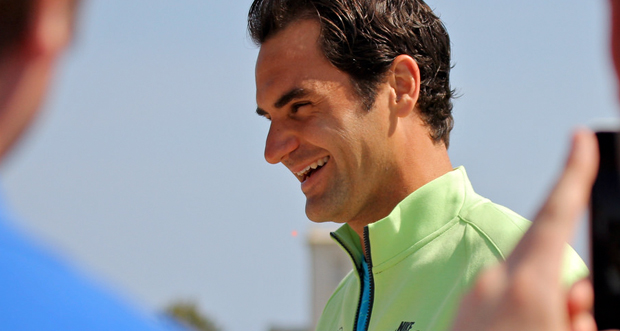
    Roger Federer secured his 98th ATP title in Stuttgart with an impressive straight-sets victory over Milos Raonic of Canada 6-4 7-6(3).

    It was a first title on the grass courts of Stuttgart for Federer, who had been beaten here by Tommy Haas (2017) and Dominic Thiem (2016).

    Federer, who turns 37 in August will now travel to Halle to defend his title at the Gerry Weber Open before launching his Wimbledon campaign.

    Match Highlights:

    Post Match Interview:

    The veteran Swiss also returns to Number One in the World Rankings and spoke with the media after the match.

    It’s been a lot of fun this week. I played great in the in the big moments. I was there especially against Kyrgios and Raonic so I’m very pleased you know.

    The fans were absolutely amazing – they came up in big numbers and really supported me all week and at the end.

    I played some of my best tennis already right away you know on my comeback so it’s a great feeling.

    I’m first of all very pleased that I can go as a world number one to Halle, a place where I’ve enjoyed so much success and where I have such a close relationship to the tournament and the family and the fans over there. So I’ll be travelling there tomorrow and then get ready for my match. I think I’m playing already on Tuesday so only one day off with the travelling so it’s gonna be quite hectic you know from now till then. But no problem, I signed up for it and I can’t I can’t wait to play again actually.

    Federer was presented with a Mercedes-Benz CLS 450 4MATIC Coupe in addition to his prize money.

    http://gty.im/976921186


    Click to discuss the Stuttgart Open in the Forum.

  • Rafael Nadal discusses the Barcelona Open (Interview)

    Rafael Nadal discusses the Barcelona Open (Interview)

    rafael nadal photo Photo by y.caradec

    Rafa, welcome back to Barcelona. You arrived here straight off the back of yet another win in Monte Carlo how much of a high are you one right now?

    Well, thank you very much. Yes very happy with what happened last week of course. It’s been a great week and I enjoyed a lot the way that I played Monte Carlo and always playing in Monte Carlo is special and pleasure you know?

    So, yeah – here I am at Barcelona again. It’s a tournament I know very well and I feel a little bit like home even if my home is Majorca. I am from this club and I enjoyed the fact that I can play here in front of my people.

    You say you feel like home here you turn up here you get ready to play on a court which has your name. Is there much
    more homely feeling anywhere else on the tour?

    Well this part of the season all the events are so special for me now so I really enjoy playing every week and this week is not an exception and now having two weeks in a row at home – Barcelona and Madrid, this is a special two weeks back to back, so happy for everything and I’m just trying to to be ready for the tournament again.

    …and of course here last year you did “La Decima”, what are your memories of winning a tenth title here and how great a feeling was it?

    Yeah was fantastic now and was an unforgettable moment when I received a present on the on the centre court with a video after winning the tenth. Yeah was so special and just can say thanks to all the members here of the
    club. It made me feel like this last year – victory against a very tough opponent in the final. It was a great final …so yeah

    A great moment and you’ve already had it last week and you’ve got it again this week. You turn up here needing to perform to keep hold of the number one spot. Is that extra motivation for you now?

    No, for me that the extra motivation is justing playing the tournament. If I’m playing Monte Carlo, for me like a love story and here almost the same and yes… My real motivation is just playing Monte Carlo last week, now playing Barcelona. That’s a tournament that I had a lot of success that I really feel the passion for playing on it so that’s all.

    [divider]

    Click for Tournament Draws, Scores, Updates and Discussion in the Forum.


  • Nadal reflects on win over Nishikori to set more records in Monte Carlo

    Nadal reflects on win over Nishikori to set more records in Monte Carlo

    Nadal wins in Monte Carlo

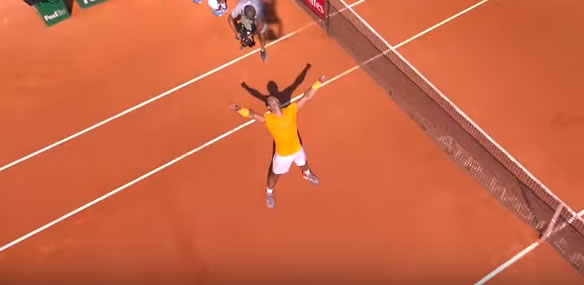
    Monte Carlo: Rafael Nadal powered to a straight sets 6-3, 6-2 victory over Kei Nishikori in 93 minutes to lift a record eleventh Monte Carlo crown.

    The Spaniard bettered his own records in the following categories:

    • Most consecutive sets won on clay (36)
    • Most titles on clay in the Open Era (54)
    • Most Masters Final Appearances (47) – tied with Roger Federer
    • Most Masters Final Titles (31) – overtaking Novak Djokovic

    http://gty.im/950029690

    He reflected on his record-breaking day during an interview with Sky Sports:

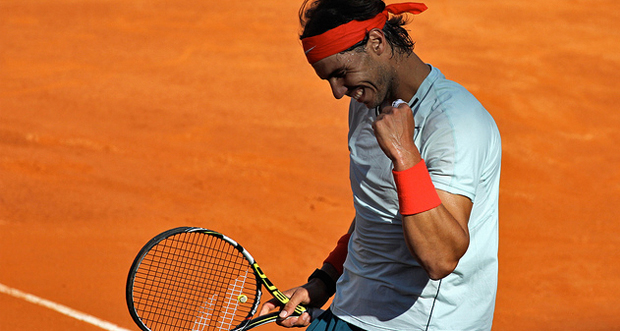
    Nadal:It’s so special no? and yeah it doesn’t matter if it’s the 11th. Every year is different feelings, and yeah especially coming back from injury it is so special for me. The history of this tournament with me is something difficult to describe now since the first time that I came here in 2003 it was so special.

    So very happy with everything and the great news that I have had the chance to finish a week and playing so well during the whole week.

    It was a very special day for you today. The first three games were pretty tight and you were down a break in that first. How did you completely take control of the match?

    Nadal:From there yeah I had an opportunity to be 2-0 in the first – but I miss a forehand on the line and yeah I think I have it but you know that game – always I make few mistakes tactically now and then he had the break.

    But mainly I think I changed it a little bit. Now I try to start to move him more than and what I was doing was opening the court and then I see more space. I open up the court with the backhand and then the match completely changes now it opened full possibilities for me and then yeah…

    It was important to close that first set I had the tough game in at 5-3 and then in the second I started with advantage so that was big for confidence.

    You are now on your 54th clay court title. How does this set things up for you for the rest of the clay court season and how excited are you for things up ahead?

    Nadal:Well today is the moment to enjoy Monte Carlo, no? and then tomorrow we’re going to start thinking about Barcelona. I have a very difficult draw so I’ll just enjoy this day and of course it is a great feeling to start the clay court season in this way – winning five straight matches here and two last week in the Davis Cup so yeah, great feelings but it’s day by day and today the only thing that matters is to have this trophy with me again

    Match Highlights:

    Highlights: Nadal Clinches 11th Monte-Carlo Crown

    Watch as Rafael Nadal defeats Kei Nishikori to win his 11th Rolex Monte-Carlo Masters title and a record 31st overall ATP World Tour Masters 1000 crown. Photo: Realis/Rolex Monte-Carlo Masters. Watch live tennis at tennistv.com. Watch matches live at http://tnn.is/streamlive.

    [divider]

    Discuss Nadal’s triumph in the Tennis Frontier Discussion Forum

  • Another record breaking opportunity for Nadal in Monte Carlo.

    Another record breaking opportunity for Nadal in Monte Carlo.

    Kei Nishikori has his work cut out on Sunday when he faces off against Rafael Nadal on the red clay of Monte Carlo. A foregone conclusion? Not quite, but a huge ask of the Japanese ball striker.

    Nishikori might take some heart from the fact that he beat Nadal in their last encounter (a third-place playoff match in the 2016 Olympics) but that was on hard court and Nadal was playing through injury. Another positive he might take comes from a performance on clay back in 2014 where he won a set in Madrid before retiring injured in the deciding stanza.

    Aside from that, the omens aren’t good. Nadal has been imperious all week. In particular, the 6-0, 6-2 thrashing of Dominic Thiem sent a huge statement to the locker room.

    He’s been playing amazing, dominating all the matches” was Nishikori’s blunt assessment of Nadal’s progress. The Spaniard has only lost here once in the last twelve years.

    Another finals victory would extend a record Nadal already owns. Last year in Monte Carlo, he became the first male player in Open era tennis to win the same tournament ten times. The smart money says he makes it eleven.

    Who was Nadal texting after the match?

    Some of you might have caught Nadal texting on his mobile phone straight after the Dimitrov match. The recipient?

    I was texting Carlos to tell him that we need to book a court quick, I just wanted to hit some forehands winners that I think I need for tomorrow” Nadal explained.

    Nadal texting Moya

    The Historical Head to Head

    Rafael Nadal Kei Nishikori

    Nadal leads 9-2

    2016 Olympic Tennis 0 Hard Kei Nishikori Rafael Nadal 6-2 6-7(1) 6-3
    2016 Barcelona F Clay Rafael Nadal Kei Nishikori 6-4 7-5
    2016 Indian Wells Masters QF Hard Rafael Nadal Kei Nishikori 6-4 6-3
    2015 Canadian Masters QF Hard Kei Nishikori Rafael Nadal 6-2 6-4
    2014 Madrid Masters F Clay Rafael Nadal Kei Nishikori 2-6 6-4 3-0 Ret’d
    2014 Australian Open R16 Hard Rafael Nadal Kei Nishikori 7-6(3) 7-5 7-6(3)
    2013 FO – RG R16 Clay Rafael Nadal Kei Nishikori 6-4 6-1 6-3
    2012 Miami Masters R16 Hard Rafael Nadal Kei Nishikori 6-4 6-4
    2011 Miami Masters R64 Hard Rafael Nadal Kei Nishikori 6-4 6-4
    2010 Wimbledon R128 Grass Rafael Nadal Kei Nishikori 6-2 6-4 6-4
    2008 Queen’s R16 Grass Rafael Nadal Kei Nishikori 6-4 3-6 6-3

    [divider]

    Discuss the tournament and more in the Tennis Frontier Forum

  • Indian Wells-Miami Double. The Fifth Grand Slam?

    Indian Wells-Miami Double. The Fifth Grand Slam?

    Indian Wells Masters

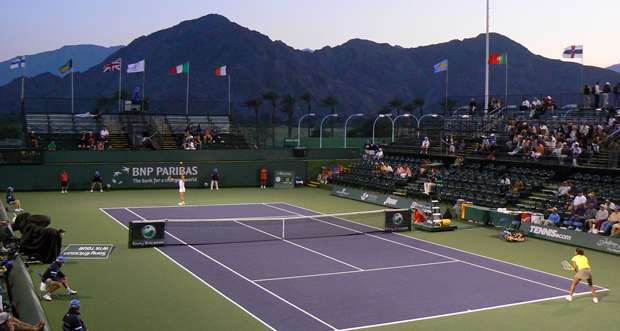
    In recent years the Indian Wells tournament in California, the first Masters event of the tennis season, has been regarded in some circles as the fifth Grand Slam.

    The tournament boasts state of the art facilities, a giant stadium and has recently been voted by male players as their favourite Masters event out of the nine they play, no small part of this being down to billionaire investor Larry Ellison’s investment. Further still, the tournament is dual gender and boasts a draw of 96 in each field, second along with Miami which follows after to the 128 player fields at the Slams and extending the tournament to eleven days. All this has contributed towards Indian Wells being the premier event just below the Slams.

    It was not so very long ago however that Indian Wells’ aforementioned cousin, Miami, was considered the fifth Grand Slam. Andy Murray hailed it as such after winning the event in 2009 against Djokovic. The reason for this turnaround is down to several factors. Firstly, Indian Wells has better facilities as a result of more investment. One just has to look at the different stadiums and show courts to see that Indian Wells trumps Miami; the latter looking dated and cramped. Secondly, pros prioritise the event for the most part, either after a deep run at the event pulling out of Miami, which follows immediately after, or skipping altogether due to factors such as age and avoiding fatigue, like Federer last year aged 33. Finally, and this is more gut feeling, Miami is awkwardly placed on the calendar, barely finishing before many minds are focused on the fast approaching clay court season, sticking out like a sore thumb, another week and a half slog on slow hard courts in an event that mirrors its more prestigious Indian Wells cousin.

    I am not trying to dump on Miami. I love the event, which has boasted some of the matches I am more emotionally tied to. Federer’s win in a best of five hard court against Nadal win in 2005, Djokovic’s final set triumph against Nadal in 2011, having bested him previously the fortnight before in Indian Wells, Roddick’s third and final win against Federer in 2012, the year of his retirement. The fact remains that they are not held in equal regard by many players.

    I myself however do hold them in equal measure, and I think winning both events back to back is the fifth hardest achievement in tennis after the Slams. Slow hard court events in hot conditions, played one after another. A top player who receives a bye in the first rounds who goes on to win both will still have to play twelve matches in three weeks against the best players in the world. Such is the toughness of this only seven players in the men’s game have achieved it, including retired all time greats Sampras and Agassi, and active ones Federer and Djokovic, both of whom have achieved the feat twice.

    For me then neither of the two events in isolation, with a 96 player draw and best of three set matches can be viewed as a fifth Slam. Winning both in the same year however for me ranks as a de facto fifth Slam; such are the requirements of physical and mental application and skill to achieve this rare feat.

    All of this is of course ultimately academic. One can argue endlessly if neither, one, or both qualify as a fifth Major or not. The most important thing about the tournaments of Indian Wells and Miami is that they gather most of the best players in the world in the same places, alleviating the dullness of mid March to early April for the dedicated tennis fan.

    [divider]

    Cover Photo (Creative Commons License): askbal

  • FRITZMANIA!

    FRITZMANIA!

    Taylor Fritz

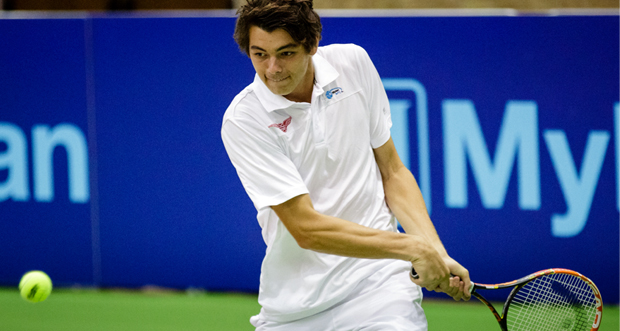
    I’m starting to get a bit excited about one Taylor Harry Fritz. Who is Taylor Harry Fritz? He’s an 18-year old American who just lost to Kei Nishikori in the final of the Memphis Open. OK, the Memphis Open is an ATP 250 – small potatoes on the tour. Why am I excited about Fritz? Is it only so I can come up with such a ridiculous term as Fritzmania? (You heard it here first, by the way.) And aren’t I jumping the gun?

    Well, let’s consider a few things. As of Monday, February 15, 2016, here are the dozen highest ranked Americans with their current age:

    11. John Isner (30)
    23. Jack Sock (23)
    31. Steve Johnson (26)
    58. Donald Young (26)
    61. Sam Querrey (28)
    65. Denis Kudla (23)
    89. Rajeev Ram (31)
    102. Taylor Fritz (18)
    103. Austin Krajicek (25)
    129. Tim Smyczek (28)
    130. Ryan Harrison (23)
    147. Bjorn Fratangelo (22)
    148. Dennis Novikov (22)

    [divider]

    Click here to discuss FRITZMANIA! in the Discussion Forum.

    [divider]

    As you can see, Fritz is not only the highest ranked American teenager, but the highest ranked American who is not legal to drink alcohol, or even yet 22-years old. After Fritz, here are the next six highest ranked American teenagers:

    159. Jared Donaldson (19)
    177. Francis Tiafoe (18)
    245. Noah Rubin (19)
    249. Tommy Paul (18)
    334. Ernesto Escobedo (19)
    341. Stefan Kozlov (18)

    Donaldson, Tiafoe, and Rubin have all gotten some buzz, but as of right now Fritz is the only young American who is on the move and within striking distance of a spot within the Top 100. Donaldson is almost exactly a year older,  and has been stagnating for a bit in the 101-200 range, first breaking into the Top 200 a year ago; Tiafoe, on the other hand, is steadily moving up. Kozlov is another who has received some recognition as a prospect, but he’s not playing much. Plus, he (and Tiafoe) only turned 18 just a couple weeks ago, so we can forgive them if they don’t start demanding attention this year.

    Who is Taylor Fritz? Well, he played his first ATP tour at the Aegon Open event in June of 2015 at the tender age of 17, winning his first match against Pablo Carreno Busta before losing to Feliciano Lopez. He officially turned pro in September after winning the Junior US Open against Tommy Paul, and then quickly rose hundreds of positions within the rankings by winning multiple Challenger events, finishing his first year at No. 174 in the world.

    This year he is showing lots of promise. He beat No. 100 Dudi Sela in the Happy Valley Challenger final, then made it through the Australian Open qualification rounds, losing to No. 22 Jack Sock in the first round, although in five sets. Finally, he just made it to the Memphis Open final, although lost to No. 5 Kei Nishikori.

    Understand that this is a kid who is 18 years and 4 months old. Fritz is listed as 6’4”, 185 lbs – a tall kid, although not quite in the range that often entails physical issues (knock on wood). Steve Tignor say of Fritz that he “has an aggressive mindset and his shots have a natural pop,” but also warns that “he doesn’t move or hit as smoothly as [Alexander] Zverev,” comparing him to the German 18-year old prospect.

    In my mind, that “aggressive mindset” is particularly encouraging, a quality lacking not only in recent American players, but young players in general. I can live with him not being fully polished at 18, but we’ve seen a lot of talented and smooth-playing young players over the last few years without the requisite mindset to be a champion – Grigor Dimitrov comes most readily to mind, but consider other and older underachieving talents like Ernest Gulbis, Richard Gasquet, and David Nalbandian.

    The other aspect that excites me is the American factor. We have not seen a Top 5 American player since Andy Roddick, and he couldn’t quite live up to the great Americans of the 90s – namely Pete Sampras, Andre Agassi, and Jim Courier. Since the retirement of Agassi, American men’s tennis has been a shadow of its former dominance in the 70s, 80s, and 90s. After Roddick we’ve seen Mardy Fish, John Isner, and disappointments like Sam Querrey, Donald Young, and Ryan Harrison. But no perennial Top 10 players and no Slam winners since Roddick’s 2003 US Open title.

    Fritz is actually now No. 98 in the live rankings and poised to move up with a good showing at the Delray Beach ATP 250. If he wins the tournament he’s on the verge of the Top 50. But let’s not get ahead of ourselves yet.

    Regardless, the point is that Fritz is rising fast. Even if he goes out early at Delray, he’s still situated where he is likely to continue rising quickly. Being in the Top 100 means more than just bragging rights; it also means a player bypasses qualifications and enters the first round of Grand Slam events.

    Let’s assume that Fritz not only makes it into but stays in the Top 100. He would do so at the age of 18, although would end the year at age 19. Here are the American teenagers who have finished the year in the Top 100 during the ATP rankings era (1973-present):

    2011: Ryan Harrison (#79, 19)
    2007: Donald Young (#100, 18)
    2001: Andy Roddick (#14, 19)
    1991: Michael Chang (#15, 19)
    1990: Pete Sampras (#5, 19), Michael Chang (#15, 18)
    1989: Michael Chang (#5, 17), Andre Agassi (#7, 19), Jim Courier (#24, 19), Pete Sampras (#81, 18)
    1988: Andre Agassi (#3, 18), Michael Chang (#30, 16), Jim Courier (#43, 18), Pete Sampras (#97, 17)
    1987: Andre Agassi (#25, 17)
    1986: Aaron Krickstein (#26, 19), Andre Agassi (#91, 16)
    1985: Aaron Krickstein (#29, 18)
    1984: Aaron Krickstein (#12, 17), Jimmy Brown (#100, 19)
    1983: Jimmy Brown (#45, 18), Aaron Krickstein (#94, 16)
    1982: Jimmy Brown (#97, 17)
    1978: John McEnroe (#4, 19), Eliot Teltscher (#42, 19)
    1977: John McEnroe (#21, 18)

    That list covers 43 years of ATP rankings and includes 11 American players who have ranked in the year-end Top 100 as teenagers. As you can see, a promising American teenager wasn’t uncommon from the 70s into the 90s, but after the great 90s generation of Agassi, Sampras, Courier, and Chang, we’ve only seen a few – and only Roddick turned into an elite player.

    Fritz will almost certainly be the 12th American teenager to finish a year in the Top 100, with at least Tiafoe having a good chance of being the 13th.

    Of those 11, we have:

    3 All-time Greats: McEnroe, Agassi, Sampras
    3 Slam winners: Courier, Chang, Roddick
    2 Good Players: Teltscher, Krickstein
    3 Mediocre Players: Brown, Young, Harrison

    So of those 11, most (6) have gone on to win at least one Slam and three won 7 or more; 8 of the 11 were at least good players, with only three being mediocre.

    It should go without saying that we cannot really predict Fritz’s future performance based simply upon his ranking relative to his age. By that logic, he could just as easily be another Ryan Harrison as he could be Pete Sampras, or more likely somewhere in-between. But what we can say is that Fritz is joining a small group of Americans, most of whom went on to be at least good players and more than half of whom won Slams. So just on that there’s room for optimism. And perhaps most of all, Taylor Harry Fritz is – as of this writing – the most promising young American men’s tennis player since Andy Roddick.

    Finally.

    Addendum
    Fritz is one of several young players—including Zverev—who I’m watching and am excited about. After I finish up my Open Era Generation series, look for a blog or two about this new generation, and the quest for the next great men’s tennis player.

    [divider]

    Cover Photo (Creative Commons License): mirsasha

  • Open Era Generations, Part Twelve: Gen 10 (1979-83) – Generation Federer

    Open Era Generations, Part Twelve: Gen 10 (1979-83) – Generation Federer

    Roger Federer

    Why the name?
    What else could it be called? Roger Federer dominated his peers unlike any player since at least Bjorn Borg. Consider that he is the only player born in the fourteen-year span of 1972-85 who has more than three Slam titles; he is probably the number one reason why this is the case. Federer won 17 of his generation’s 23 Slam titles, or 74%, more than Borg’s 69% (11 of 16). “Weak Era Theory” aside, Roger simply owned his peers. More on that in a moment.

    Best Players by Birth Year
    1979:  Ivan Ljubicic (CRO), James Blake (USA), Juan Ignacio Chela (ARG), Ivo Karlovic (CRO), Nicolas Massu (CHI), Michael Llodra (FRA), Albert Montanes (ESP)
    1980: Marat Safin (RUS, 2), Juan Carlos Ferrero (ESP, 1), Fernando Gonzalez (CHI), Xavier Malisse (BEL)
    1981: Roger Federer (SWZ, 17), Lleyton Hewitt (AUS, 2), Nikolay Davydenko (RUS), Feliciano Lopez (ESP), Mardy Fish (USA), Jarkko Nieminen (FIN), Julien Benneteau (FRA)
    1982: Andy Roddick (USA, 1), David Ferrer (ESP), David Nalbandian (ARG), Tommy Robredo (ESP), Mikhail Youzhny (RUS), Guillermo Coria (ARG)
    1983: Fernando Verdasco (ESP), Phillip Kohlschreiber (GER), Dmitry Tursunov (RUS), Alejandro Falla (COL)

    I’ve been a bit more liberal with the names included, as this is a generation still active, or at least fresh in memory. Birth years 1980-82 is the heart of the generation, with 1979 and ’83 being far weaker.

    Imagine being Lleyton Hewitt or Andy Roddick: 2003 ends and you’re playing well, both with a Slam and year-end No. 1 or 2 under your belt while still in your early 20s. Then this soft-spoken Swiss guy rises up and utterly dominates tennis, while you toil away, year after year, never able to get past him and win another Slam. This scenario is particularly telling for Andy Roddick, who lost four Slam finals to Federer and won only 3 matches out of 24. Despite that fact, Roddick had an excellent career, finishing every year from 2002-10 in the Top 10, with 32 titles to his name including one Slam and five Masters. Andy retired relatively young by today’s standards, just after turning 30 in 2012, but he saw the writing on the wall–falling from No. 8 in 2010 to No. 14 in 2011 and No. 39 in 2012.

    In 2001, at the age of 20, Lleyton Hewitt was the youngest player to reach the No. 1 ranking since the ATP computerized rankings began in 1973. He was No. 1 for 80 weeks — more than Stefan Edberg, Jim Courier, Gustavo Kuerten, Ilie Nastase, Mats Wilander, and Boris Becker. After two year-end No. 1 rankings in 2001 and 2002, Hewitt entered 2003 on top of the world. Yet it soon became clear that a couple of his peers were surpassing him: Andy Roddick and Roger Federer. He remained a top player for a few more years, but by 2006 he had slipped out of the elite, unable to compete with the newer, bigger, more powerful generation that was coming up. As of this writing, Hewitt just played his last Grand Slam, going out in the second round of the Australian Open. Though he hasn’t been in the Top 20 for seven years, he will be missed.

    As for the Swiss Maestro himself, it is difficult to say anything that hasn’t already been said. But to return to the topic of his dominance over his generation, consider his head-to-head against peers (born 1979-83) who were Top 10 players: 195-36, or 84.4% – which is better than his overall winning percentage against all players. Of all players in Federer’s generation, the only two who were able to win more than three matches against him were Lleyton Hewitt (9-18) and David Nalbandian (8-11).

    Federer’s fans occasionally bemoan the fact that he’s no longer the player he was during his absolute peak, from 2004-07. While this is undoubtedly true, we should not lose sight of the player he is now, still ranked No. 3 halfway between his 34th and 35th birthdays. The vast majority of all-time greats were either long retired or fading out at Roger’s age.

    Maybe Roger will buck the trend and remain an elite player into his late 30s, but it seems unlikely. While he is showing no signs of further decline—yet—any setbacks, such as his current knee injury, could damage his momentum. Regardless, we should appreciate the great player while he’s around.

    Underachievers and Forgotten Players
    David Nalbandian and Marat Safin come most readily to mind. These two challenged Federer in terms of talent, but neither had the mentality and focus to be a perennial champion. Nalbandian is on the short list of most talented player never to win a Slam in the Open Era, and Safin is often mentioned as an almost-great who should have been an all-time great.

    Nalbandian was the most competitive peer of Federer’s, winning 8 of 19 matches (42.1%) and their first five matches. After those five, Roger seemed to figure out Nalbandian, with an 11-3 record from the 2003 Tennis Masters Cup onward. The only players with a better percentage against Federer in 10 or more matches are Tim Henman (46.2%), Rafael Nadal (67.6%), Novak Djokovic (51.1%), and Andy Murray (44%), all either significantly older or younger. Regardless of his level of disappointment, Nalbandian had a solid career, the highlight of which was his victory over Roger Federer in the 2005 World Tour Finals, as well as his two Masters in 2007.

    Safin was the No. 2 player in the sport at the age of 21 in 2000, a year in which he spent nine weeks as the No. 1 player in the world, defeated Pete Sampras in straight sets to take the US Open title, and won two Masters. It looked like tennis finally had a new, young elite player to join the aging Agassi and Sampras. Yet he was to finish only two other years in the Top 5, 2002 and 2004, and he won only one more Slam and three more Masters. A fine career, but not an all-time great.

    Another to consider is Guillermo Coria, who was ranked in the Top 8 from 2003-05, then saw his career collapse in 2006 – for a variety of reasons, including service issues, marital problems, and injury.

    Lesser-known Joachim Johansson deserves mention as someone who looked like at least a second-tier player but saw his career destroyed by injury. At the end of 2004, it looked like Sweden would have have an heir to Thomas Enqvist and Thomas Johansson in the “If not quite Borg/Wilander/Edberg, then at least Nystrom/Jarryd” category. Joachim finished the year No. 11, at age 22, including a Slam semifinal appearance and an ATP 500 title, but couldn’t recover from a variety of injuries.

    Did You Know?
    Roger Federer’s 2006 was widely considered the best season of the Open Era since Rod Laver’s great 1969, only recently surpassed by Novak Djokovic’s 2015. He won three Slams, was the finalist in the fourth, won the World Tour Finals, four Masters, 12 titles overall, and a ridiculous 91-5 record. Four of those five losses were to his nemesis, Rafael Nadal, and the other to Andy Murray. But here is what is interesting: in all but one of those matches, Nadal was still 19-years old, as was Andy Murray, who was ranked No. 21 when he beat Federer at the Cincinnati Masters. When Nadal defeated Federer in the French Open final, he had just turned 20; it was his fourth and last win over the No. 1 player that year (Roger would beat him at Wimbledon and the World Tour Masters).

    So think about that for a moment: The best player in the sport, and one of the best all time, lost four times to two teenagers during his best season, and a fifth time to one of them a few days after he turned 20. In his best season. Other than that, Roger was 91-0.

    Top Ten Players of the Generation

    1. Roger Federer
    2. Lleyton Hewitt
    3. Andy Roddick
    4. Marat Safin
    5. Juan Carlos Ferrero
    6. David Ferrer
    7. David Nalbandian
    8. Nikolay Davydenko
    9. Tommy Robredo
    10. Mikhail Youzhny

    Honorable Mentions: Fernando Gonzalez, Guillermo Coria, Fernando Verdasco, Ivan Ljubicic, James Blake, Feliciano Lopez, Mardy Fish, Jurgen Melzer, Ivo Karlovic, Juan Ignacio Chela, Philipp Kohlschreiber.

    Number one is easy, as Federer was (and is) to his generation what Borg was to his. I also feel reasonably confident with my No. 2-4 rankings, although Hewitt, Roddick, and Safin could be arranged in a variety of ways. While Safin was the most talented of the three, and Roddick the most consistent over a long period of time, I give Hewitt the edge because he’s the only one who had a sustained period of time as No. 1, even if it was in the “soft spot” of 2001-02 when men’s tennis was seeing a regime change.

    After that, it gets tricky. If you changed Ferrero’s Slam win to a runner up, he would probably rank behind Ferrer, Davydenko, and Nalbandian, all of whom had better overall careers aside from one match. The “Mosquito” wasn’t the worst player to win a Slam, and was an elite player for several years but like many of his peers, he saw his career drop off in his mid-20s. He slipped out of the Top 10 in 2004 and never returned, with a later career similar to Hewitt’s. But he did win a Slam and attain the No. 1 ranking for a short period of time, things that Ferrer, Davydenko, and Nalbandian never did.

    David Ferrer has had an unusual career path, peaking in his late 20s and early 30s. Other than Federer, he is the most consistent player of his generation and will go down as one of the greatest players never to win a Slam, along with his contemporary Nikolay Davydenko, who filled a similar role before Ferrer’s peak. Ferrer has the reputation of a player who maximized his modest talents – was not a great player, but a consistently very good one. While he has winning records against similarly ranked players like Tomas Berdych (8-5) and Jo-Wilfried Tsonga (3-1), unlike those two there is a sense that it would have been (and is) impossible for him to win a Slam because Ferrer’s “A game” simply cannot touch the “B games” of Djokovic, Nadal, or Federer.

    There’s a steep drop-off after Davydenko, with Robredo and Youzhny earning their way into the Top 10 through longevity. Guillermo Coria, Fernando Gonzalez, Ivan Ljubicic, and James Blake were all better peak players, but none had the overall career accomplishments of Robredo and Youzhny.

    Addendum: Twelve Highest Ranked Players of Gen 10 (as of 2/8/16)
    3. Roger Federer
    6. David Ferrer
    25. Feliciano Lopez
    26. Ivo Karlovic
    32. Philipp Kohlschreiber
    34. Guillermo Garcia Lopez
    39. Tommy Robredo
    40. Gilles Muller
    52. Paolo Lorenzi
    54. Nicolas Mahut
    56. Victor Estrella Burgos
    57. Fernando Verdasco

    As you can see, this generation still has quite a few players around, although only two in the Top 10. Considering that this generation will turn 33 to 37 in 2016, expect almost all to be gone within another year or two, with maybe a few hold-outs playing into their late 30s.

    [divider]

    Cover Photo (Creative Commons License): Marianne Bevis
  • Open Era Generations, Part Eleven: Gen 9 (1974-78) – A Transitional Era

    Open Era Generations, Part Eleven: Gen 9 (1974-78) – A Transitional Era

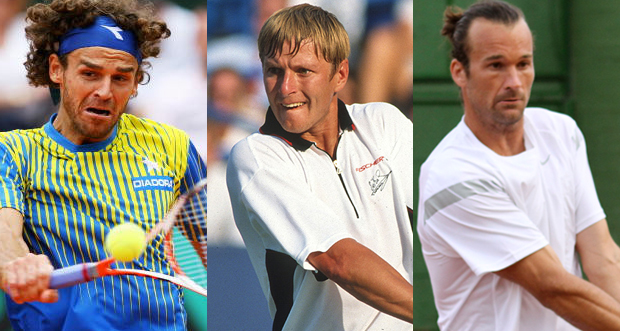
    Gustavo Kuerten Yevgeny Kafelnikov Carlos Moya

    While one of the weakest generations of the Open Era — by my account, third after Gen 2 (1939-43) and Gen 12 (1989-93) — I personally find this one of the most interesting. I’m not exactly sure why, but I think it has to do with the fact that it is hard to define, with no clear stars. It is the generation that was at its peak in the late 90s and early 00s, between the dominance of Sampras-Agassi and Federer.  The generation has an interesting balance of players – no real standouts or all-time greats, but several excellent players.

    Best Players by Birth Year
    1974: Yevgeny Kafelnikov (RUS, 2), Alex Corretja (ESP), Thomas Enqvist (SWE), Andrei Medvedev (UKR), Tim Henman (UK)
    1975: Marcelo Rios (CHIL), Thomas Johansson (SWE, 1), Jiri Novak (CZE), Albert Costa (ESP, 1)
    1976: Gustavo Kuerten (BRA, 3), Carlos Moya (ESP, 1), Mark Philippoussis (AUS), Rainer Schüttler (GER), Magnus Norman (SWE)
    1977: Nicolas Kiefer (GER), Guillermo Canas (ARG)
    1978: Gaston Gaudio (ARG, 1), Tommy Haas (GER), Radek Stepanek (CZE), Sébastien Grosjean (FRA), Michael Russell (USA)

    [divider]

    Click here to discuss “Open Era Generations, Part Eleven: Gen 9 (1974-78) – A Transitional Era” in the Discussion Forum.

    [divider]

    This generation is responsible for only 9 Slams, the lowest since the 1939-43 generation (4). There are no all-time greats, merely a couple almost-greats, and a handful of very good players.

    The two best players of the generation were Gustavo Kuerten and Yevgeny Kafelnikov, who accounted for five of the nine Slams. Kuerten was a clay-court specialist who won the French Open three times, as well as four clay Masters. But he also won the 2000 Tennis Masters Cup, defeating Pete Sampras and Andre Agassi – the only player to defeat both in the same tournament –  and the hard-court Cincinnati Masters, so could play well off clay.  “Guga” was only a Top 5 player for three years (1999-2001), and only finished in the Top 40 for eight years (1997-2004); his “near-greatness” was largely due to his lack of longevity, which was largely because of injuries starting in 2002. The second half of his career is one of the great What-If stories of the last couple decades.

    Kafelnikov was less brilliant at his best, but had a longer peak than Guga, ranking No. 11 or better from 1994 to 2001. The third most accomplished player of the generation, Carlos Moya, ranked No. 61 or higher for fourteen straight years, from 1995 to 2008, including thirteen years No. 43 or better, and five years No. 7 or better – a consistently very good player.

    Single-Slam winners Thomas Johansson, Albert Costa, and Gaston Gaudio are the definition of one-Slam wonders. Johansson had a long career, including eleven years in the Top 100, but he never finished a year in the Top 10; imagine if someone like Nicolas Almagro won a Slam and you get a sense of Johansson’s feat. Costa was a clay-court specialist, probably similar in talent to someone like Feliciano Lopez, but happened to play between the reins of Kuerten and Rafael Nadal, and thus able to win a French Open (in 2002). Gaudio could be the worst player in the Open Era ever to win a Slam, the 2004 French Open against Guillermo Canas. He finished No. 10 in 2004 and 2005, but never finished another year in the Top 20.

    This is the oldest generation to still have players on tour, but it won’t be much longer. After a resurgence in 2012-13, 37-year-old Tommy Haas has slipped the last couple years and seems like he’s winding down. Haas started on the ATP tour in 1996, losing his first Slam match to Sergi Bruguera at the US Open in the first round. 2015 makes it 20 years on tour. Haas has been around so long that his first year was the last year Boris Becker won a Slam (although he never played Becker).

    Radek Stepanek is also ranked around No. 200, which would be the first year on tour that he hasn’t finished No. 68 or higher – going back to 2002. Michael Russell, also from that 1978 birth year, just retired.

    Underachievers and Forgotten Players
    There’s a reason I didn’t mention Marcelo Rios above, as I was saving him for this category. In 1998 he looked like the heir apparent to Pete Sampras as the premier player in the game, taking the No. 1 ranking in late March and winning three Masters that year, as well as the Grand Slam Cup. Yet Rios’s relatively mediocre second half of the year led to a loss of the No. 1 ranking to Sampras, and while he remained a Top 10 player in 1999, he slipped and stumbled in 2000 and never regained his elite status, largely due to injuries.

    Another player who had a disappointing career is Andrei Medvedev, who was the first of the generation to rank in the year-end Top 10, finishing 1993 ranked No. 6 at age 19. While he would go on to win four Masters, he would never rank in the Top 10 again and made a Slam final only once.

    There are several other players who fit the category of “close, but no cigar” as far as Slams go – Alex Corretja was 0-2 at French Open Slam finals, Thomas Enqvist was meant to revive Swedish tennis but–along with Johansson–instead ended up being a kind of dead-cat bounce after the great 1970s-80s era, and Tim Henman goes down as one of the greatest grass court players never to win Wimbledon. And boy did he try – eight out of nine years from 1996-2004 making the quarterfinals or later, including four semifinals but never a final. Mark Philippoussis also comes to mind in this category.

    Did You Know?
    I first came across Roberto Carretero’s name when looking at Masters winners of the 90s. Carretero has quite a story: he won the Hamburg Masters in 1996 as a virtual unknown, ranked No. 143 and defeating Yevgeny Kafelnikov en route to a final win against rising young Spanish star, Alex Corretja. He never ranked higher than No. 58 and never made it past the second round in a Slam, retiring in 2001. But he does have that Hamburg Masters title.

    Top Ten Players of the Generation

    1. Gustavo Kuerten
    2. Yevgeny Kafelnikov
    3. Carlos Moya
    4. Marcelo Rios
    5. Alex Corretja
    6. Tim Henman
    7. Tommy Haas
    8. Albert Costa
    9. Thomas Enqvist
    10. Andrei Medvedev

    Honorable Mentions: Mark Philippoussis, Thomas Johansson, Sebastian Grosjean, Magnus Norman, Gaston Gaudio, Radek Stepanek.

    This is actually a hard generation to rank. I feel confident about the top four, although think Moya and Rios could be swapped, and I went back and forth on Kuerten and Kafelnikov, but in the end prefer Kuerten’s higher peak to Kafelnikov’s greater longevity. After the “biggish four,” Corretja is probably the best of the rest, with Henman, Haas, Costa, and Enqvist not far behind, but that tenth spot could go to any of Medvedev, Philippoussis, Johansson, or Grosjean.

  • Australian Open Final Preview: The Tilted Mirror

    Australian Open Final Preview: The Tilted Mirror

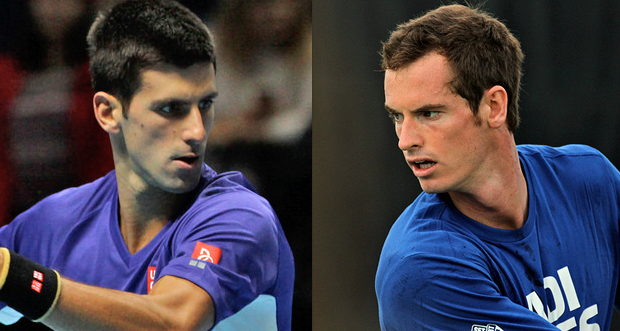
    Novak Djokovic Andy Murray

    When Novak Djokovic and Andy Murray contest a tennis match, it brings to mind to me Djokovic staring at a tilted mirror. Both players are in essence counterpunchers. Both rely on superior movement, low error rates, and superior defensive skills to confound most opponent’s efforts. Novak looks across the net and will see much of himself reflected back in Andy. It is a tilted reflection, though, as Murray will often seem further back than Djokovic in their baseline exchanges, Novak’s own strokes sending the ball farther than those that are being sent back. That is the essence of the matchup: The offensive counterpuncher in Djokovic doing pretty much everything the defensive counterpuncher Murray can do, only better.

    [divider]

    Click here to discuss the Djokovic/Murray Australian Open final in the Discussion Forum.

    [divider]

    Djokovic is perhaps playing the best tennis the men’s tour has witnessed in many years. He looks untouchable. Although he lacks the flare of Federer in his prime, the explosiveness of Nadal in his heyday, he looks somehow more complete than either in their own periods of domination, less liable to upsets or struggles on a specific surface. Nadal could always be counted upon to trouble Federer, whilst a Davydenko or Blake could make Rafa look amateur on a hard court at times. Nobody comes to mind that can be a regular thorn in Novak’s side, rather the current status quo of a Wawrinka pummelling him on rare occasions, or Federer seizing the initiative on fast courts in the Middle East or North East America.

    Seizing the initiative sums up rather nicely what Djokovic is doing. Though a counterpuncher, he is continuing to show his natural ability as an offensive baseliner. He is serving big, stepping into the court, and unloading on balls with natural and seemingly increasing power. He is not content to ride out storms against Federer or Nadal; he is actively seeking to deny their like of getting any momentum at all by attacking with controlled aggression.

    Needless to say this presents Murray with an instant uphill climb. He will be able to stay with Djokovic physically better than arguably anyone else on tour. Little separates the two in terms of speed and conditioning, but Murray I believe will suffer on two counts of positioning. Firstly, Murray does not hog the baseline, rather stands well behind it. This allows Novak to dictate from the off, sending his man into the far reaches of the court and opening up space for easy winners, regardless of Murray’s speed. The other is the position of Murray’s shots. Unlike the Lendl days, Murray is content again to revert back to rallying mode. The shots are often pushed into play, particularly with his weaker forehand, sitting up in the centre of the court where the Serb can merrily swat them away for winners or forcing Murray into the defensive.

    Murray’s last win at a Major against Novak was in 2013; he is 0-3 against him in them since, and has won just one of their last eleven matches overall. Furthermore, he is 9-21 in their entire head-to-head series — not a terrible number, but hardly encouraging, especially as Djokovic has grabbed their rivalry by the scruff of the neck since Murray’s 2013 Wimbledon triumph. Murray’s biggest wins against Novak have also occurred on the slicker surfaces of London’s grass or the fast hard courts of Canada, Cincinnati, and New York. He is no slouch on the slower hard courts, reaching four finals in Melbourne, as well as winning two Miami Masters titles. His relative lack of power and defensive style, though, leave him with his work cut out on slower surfaces.

    All is not lost for Murray. I think his first serve at its best is better than the Serb’s, albeit less reliable. I think Murray also has softer hands, and choice attacks at the net could prove bountiful for him. The Australian crowd are definitely the most sporting of the four Majors, and definitely have taken to Djokovic more than their three counterparts. From experience, though, they have always backed Murray more when the two have met here, perhaps out of the Aussie appreciation for the underdog, as well as for a fellow member of the Anglosphere. Crowd support for Murray could spur him on if he were to take an early lead, as well as rile Djokovic, often acutely sensitive to the biases of those in the audience. Murray fans could also take heart from the Djokovic vs. Simon match. The Frenchman, my favourite defensive counterpuncher on tour, has sometimes been labelled derogatorily as a ‘poor man’s Murray’. Both play similar styles, though Murray has more weapons and variety. If Simon can stretch Djokovic to five sets and make him produce 100 errors, it’s more than conceivable Murray could better that.

    All things being equal, such is Novak’s form, dominance of the tour and of Melbourne; it is hard to see him not triumphing tomorrow. I believe Murray will contest and win a couple more Major finals before his career is over, but I feel the only haul he will add to in this year’s Australian Open is his runner-up plates.

    Novak to win in four sets.

    [divider]

    Cover Photo (Creative Commons License): Marianne Bevis
  • Open Era Generations, Part Seven: Gen 5 (1954-58) – Borg and Some Other Guys

    Open Era Generations, Part Seven: Gen 5 (1954-58) – Borg and Some Other Guys

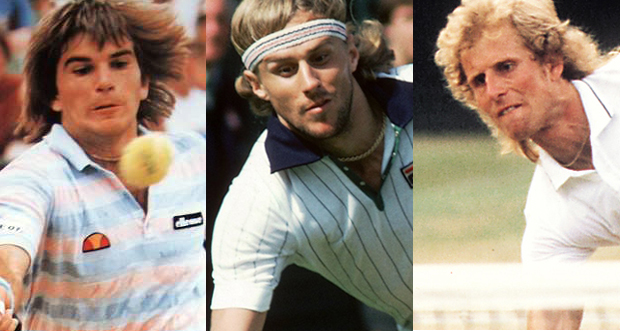
    Johan Kriek Bjorn Borg Vitas Gerulaitis

    The Greatest Swede
    If you take this generation’s best player out of the mix, it would be one of the weakest. In fact, we could say that more than any other generation with a premier talent in it, this generation is the weakest with only five Slams to players other than Bjorn Borg. But of course the generation does include Borg, who is still considered one of the best players in tennis history, and is a candidate for the best young player in the history of the game, with 11 Slams before his 25th birthday. Borg was also the first and greatest of three great Swedish players, followed by Mats Wilander and Stefan Edberg in the golden era of Swedish tennis that was the late 70s into the early 90s.

    Best Players by Birth Year
    1954: Vitas Gerulaitis (USA, 1), Brian Teacher (USA, 1), Mark Edmondson (AUS, 1), John Lloyd (UK)
    1955: Victor Pecci (PAR), Peter McNamara (AUS)
    1956: Bjorn Borg (SWE, 11), Gene Mayer (USA), John Sadri (USA), Steve Denton (USA)
    1957: Chris Lewis (NZ)
    1958: Johan Kriek (SFA, 2), Jose Luis Clerc (ARG), Kevin Curren (SAF)

    Discussion
    As you can see, there are no true standouts after Borg. In some ways this era echoes Ashe’s, although Borg was a much greater player than Ashe, and there is a bit more talent beyond its premier player; but it is a similar one-man show. The only other multi-Slam winner, Johan Kriek, won this two Slams at the Australian Open, a few years before it became as competitive as the other Slams.

    As for Borg, what to say? He was an amazing talent, the premier player in the game during the late 70s, and was the overall best player during that decade, winning almost twice as many Slams (8) than runners-up John Newcombe and Jimmy Connors (5 each). He reached a high level at a very young age in an era when tennis was still dominated by men in their late 20s. Consider that when Borg finished 1974 as the No. 3 player in the world, at the tender age of 18, the only other members of the Top 10 who were younger than 27 were Jimmy Connors and Guillermo Vilas, both 22. With those two Borg took the tennis world by storm in the mid-70s and changed the game.

    Borg was a superstar in the full sense of the word. With his long-haired good looks and cool demeanor he was a welcome counterpoint to the fiery brashness of the other great star during the mid-70s, Jimmy Connors. Though Borg didn’t finish as the No. 1 player until 1979, it is clear that he had surpassed Connors at least a year prior and was deserving of the No. 1 ranking in 1978. But his reign at the very top was short-lived compared to his talent; an even brasher young American by the name of John McEnroe appeared on the tour in the late 70s giving Borg troubles, in what is undoubtedly the most storied and competitive rivalry in tennis history. By 1981 McEnroe had supplanted Borg as the premier player; it was Borg’s last year to play a Slam, after losing the Wimbledon and US Open finals to McEnroe. A contemporary comparison would have been if Rafael Nadal had retired after Novak Djokovic stole the No. 1 ranking from him in 2011; Nadal was the same age as Borg, 25. Borg didn’t play another Slam although didn’t announce his retirement until a year later, in January of 1983. He retired from the game for a variety of reasons, most especially being tired of various squabbles with the tour organizers, and losing the drive required to compete at the highest level. Regardless, he retired too soon for tennis fans and tennis history.

    As an aside, there is an interesting harmonic between this era and more recent years. Just as Connors dominated the mid-70s with the rising young baseliner Borg in his rearview mirror, so too did Roger Federer dominate the mid-00s with a rising young Rafael Nadal behind him. Borg finally overtook Connors in 1979, just as Nadal overtook Federer in 2008. But just as Borg only held the No. 1 ranking for a couple years before being surpassed by McEnroe, Rafa’s reign was marred by injury and then the rise of Novak Djokovic in 2011. (Even the fourth wheel, Ivan Lendl, later became the coach to the fourth of the Big Four, Andy Murray). Borg’s retirement after 1981 would have been echoed in recent years if Rafa had retired after 2011, but as you know Rafa rose again.

    Underachievers and Forgotten Players
    Vitas Gerulaitis was a notorious partier, called the “ultimate tennis playboy.” He was a very talented player, and for about six years—1977-1982—was a Top 10 player, and probably overall the sixth best player in the sport during that span after Borg, Connors, McEnroe, Lendl, and Vilas. His most comparable recent player is probably David Nalbandian, if the latter had won a Slam. Both players could have been more than they were in terms of their raw ability, but didn’t have the focus and mentality required to be true greats.

    If you look at it in a certain way, Borg could also be considered an underachiever. As said before, he won 11 Slams before his 25th birthday – that’s more than Nadal (10), Federer (8), and Sampras (7). One of the biggest “What If?” questions in tennis history is “What if Borg hadn’t retired at such a young age?” The question is unanswerable, especially considering the fact that when he retired he had just been surpassed by John McEnroe as the best player in the game, and was seemingly losing interest in the relentless grind of the tour and tennis politics. But if Borg had somehow managed to rediscover his passion for the game, it seems a certainty that he would have finished his career with 15+ Slams and be mentioned in the same breath as Laver and Federer. But, in the end, his career is what it was.

    Did You Know?
    Bjorn Borg made several failed comeback attempts in 1991, ’92, and ’93. He did not win a match out of twelve played, and only won a set in each of the three matches played in 1993.

    Top Ten Players of the Generation

    1. Bjorn Borg
    2. Vitas Gerulaitis
    3. Johan Kriek
    4. Jose Luis Clerc
    5. Mark Edmondson
    6. Brian Teacher
    7. Kevin Curren
    8. Gene Mayer
    9. Victor Pecci
    10. Peter McNamara

    Honorable Mentions: John Lloyd, John Sadri, Chris Lewis, Steve Denton.

    Yet another generation with a clear No. 1 (this will change shortly). Kriek is an interesting player to rank. On one hand it is hard to argue with two Slams. On the other, those two Slams were the 1981 and 1982 Australian Opens against Steve Denton, who never won a title. Despite winning half as many Slams, Gerulaitis was a far more prolific and successful player. For instance, Kriek never ranked higher than No. 7, and never finished in the year-end Top 10, while Gerulaitis ranked as high as No. 3, and finished six straight years in the Top 10. Gerulaitis was clearly the better player.

    After that it falls sharply. Teacher and Edmondson both won Slams, but we run into the same problem: taking complete careers into account, Cleric was probably better than Edmondson, and Curren better than Teacher. But Nos. 4-8 are very close and somewhat interchangeable.

    Pecci is best known for being by far the best Paraguayan player ever, but also for defeating Guillermo Vilas and Jimmy Connors en route to losing to Bjorn Borg in the 1979 French Open.