Tag: Arthur Ashe

  • Open Era Generations, Part Four: Gen 2 (1939-43) – Arthur Ashe and…Who?

    Open Era Generations, Part Four: Gen 2 (1939-43) – Arthur Ashe and…Who?

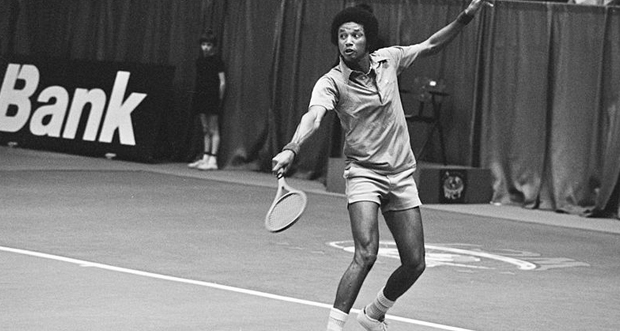
    File:Arthur Ashe.jpg

    After the Glory, the Fall

    After the greatest tennis generation came arguably the worst, with only one true standout player in Arthur Ashe who, while being an excellent player, is more historically important as a pioneering black tennis player, still remaining the only black man to win the Australian Open, Wimbledon, or the US Open. After Ashe the pickings become slim, indeed, as we can see here:

    Best Players by Birth Year
    1939: Wilhelm Bungert (GER), Christian Kuhnke (GER), Nikola Pilic (CRO)
    1940: Butch Buchholz (USA), Martin Mulligan (AUS), Bob Hewitt (AUS), Ken Fletcher (AUS), Mike Sangster (UK)
    1941: Chuck McKinley (USA, 1 Major), Cliff Drysdale (USA), Marty Riessen (USA), Pierre Barthes (FR), Roger Taylor (UK), Ronald Barnes (BRA)
    1942: Frank Froehling (USA), Dennis Ralston (USA)
    1943: Arthur Ashe (USA, 3 Majors), William Bowrey (AUS, 1 Major), Clark Graebner (USA), Owen Davidson (AUS)

    That’s 5 total Majors, or 6.6% of the previous generation’s total (!). Of the eleven Open Era generations with Slam counts, it is the lowest total – just a bit more than half that of the second lowest (1974-78, with nine Slams). Every other generation other than those two has 14 or more.

    [divider]

    Click here to discuss “Open Era Generations, Part Four: Gen 2 (1939-43) – Arthur Ashe and…Who?” in the discussion forum.

    [divider]

    Discussion
    At the risk of belaboring the point, Gen 2 is almost certainly the weakest generation of the Open Era, at least until we get to Gen 12 (1989-93). In truth, this is one generation that is less of a generation and more of a transitional phase from the great 1934-38 generation, which in a way was the last of the pre-Open Era, to the 1944-48 generation which was, in a similar sense, the true first generation of the Open Era. If we were able to nudge Arthur Ashe’s 1943 birth year into that latter generation, we’d have a four year transitional period of 1939-42, which saw no great or even near-greats, and only one Slam winner in Chuck McKinley.

    This is also the only generation – aside from the current youngest two – that never saw a year-end No. 1 player (although Harry Hopman ranked Ashe as the No. 1 player in 1968, but this didn’t include professionals). Laver is generally considered No. 1 overall in 1968-69, and then it skipped a generation to Newcombe, Smith, and Nastase from 1970-73, before Connors took over in 1974.

    As with other poor generations, this one’s lack of combination is not only because of weak talent, it is also because of nearby great talent – namely, the previous generation. Consider that Gen 2 started entering its prime in the early 1960s when Rod Laver was at the peak of his powers, Ken Rosewall was still an elite player, and Roy Emerson was dominating the amateur tour. This didn’t change, with Gen 1 not really showing signs of decline until around 1970, when Gen 2 was turning 27-31. The point being, by the time Gen 1 was declining, Gen 2 was also showing signs of age. We are possibly going to see a similar phenomena with the current Gen 11 (1984-88) and Gen 12 (1989-93).

    As far as Ashe goes, his career spans over two decades from his first appearance at the US Open in 1959 to his retirement in 1979. He drew greater public attention in the late 60s, especially after winning the 1968 US Open, upsetting Tom Okker. He won the Australian Open a couple years later, and then had his perhaps most memorable victory in 1975 at the tender age of 32 when he surprised the tennis world at Wimbledon by beating Bjorn Borg, Tony Roche, and then the world No. 1 Jimmy Connors in the final.

    It is difficult to find comparable players to Ashe in terms of achievements. He belongs among the “lesser greats” like Jim Courier, Guillermo Vilas, and Andy Murray – although unlike the latter two he reached No. 1 in the world, but unlike Courier he did so only in brief moments without Courier’s dominance of a couple years. Regardless, Ashe was an excellent player whose legacy is perhaps most important as both a pioneering black player but also the work he did off-court as an activism for social issues, AIDS, and apartheid.

    Underachievers and Forgotten Players
    We’ll just say the entire generation, except for Ashe. While it is difficult to pinpoint an underachiever, we can call the generation—again, aside from Ashe—as a forgotten one.

    That said, if I were to pick out one player as an underachiever it would be Chuck McKinley, who was one of the best amateurs of the early 1960s, including a 48-2 record from 1960-63. He made the 1961 Wimbledon final as a college sophomore in the strong tennis program at Trinity University. He was soundly defeated in straight sets by a 22-year-old Australian by the name of Rod Laver. A couple years later in 1963 he won Wimbledon, defeating Fred Stolle in the final.

    That was pretty much it for McKinley. After graduating from Trinity in 1963, he opted to become a stockbroker, playing tennis only sparingly. All told, he played only 67 matches on the circuit, with a 52-15 record including one Wimbledon title (1963), several US Open semifinal appearances (1962-64), and two US Men’s Clay Court Championships (1962-1963), as well as three doubles titles at the US Open (1961, 1963, 1964). He died young at age 45 in 1986 from a brain tumor.

    Did You Know?: Arthur Ashe retired from tennis in 1979 after having a heart attack. After undergoing a quadruple bypass surgery that year, he had a second bypass in 1983. Then, in 1988, he had emergency brain surgery after experiencing paralysis in his right arm. A biopsy revealed that he had contracted AIDS from a blood transfusion given to him in the second bypass in 1983. Ashe would die of AIDS five years later in 1993.

    Top Players of the Generation
    1. Arthur Ashe
    2. Chuck McKinley
    3. William Bowrey
    4. Martin Mulligan

    Honorable Mentions: Butch Buchholz, Wilhelm Bungert, Cliff Drysdale, Frank Froehling, Clark Graebner, Bob Hewitt, Nikola Pilic, Dennis Ralston, Marty Riessen, Roger Taylor.

    Aside from Ashe, this is an almost impossible generation to rank. It is the last generation for which there aren’t good records and really once you get to No. 4 or No. 5, they blur together in historical hindsight. Consider that only Ashe, McKinley, and Bowrey won Slams, and only Ashe and McKinley were ranked No. 1 – and the latter only as an amateur. None of the other players won Slams or were ever ranked higher than No. 4. Martin Mulligan had the highest titles with 16, so slips away from the crowd a bit. At least I tried to narrow down the honorable mentions to all players that are possible considerations for being among the ten best of the generation, but how they exactly rank would just be too difficult to determine.

    [divider]

    Cover Photo (Creative Commons License): Nationaal Archief Fotocollectie Anefo
  • American Men’s Tennis and the Cycle of Ages

    American Men’s Tennis and the Cycle of Ages

    5638812812_0691415a18_o

    Photo by Neon Tommy (Creative Commons License)

    Consider the following as an addendum, or second part, to the previous blog in which I looked at the decline of American men’s tennis. In this entry we’ll look at the big historical trajectory of men’s tennis, and from a slightly different perspective: that of mythology.

    Various mythologies throughout the world – such as Greek, Indian, and Mesoamerican – hold that the world passes through great ages of time. While there are differences between these myths, they are also remarkably similar in that all start with some kind of paradisiacal “Golden Age” from which there is a “fall” and further decline into successively lesser ages. The Golden becomes the Silver, then the Bronze, and finally the Iron or Dark Age. Some of these mythologies hold that this process is cyclical, so that the Dark Age will eventually transition into a new cycle, even a new Golden Age.

    It struck me how American men’s tennis has gone through its own cycle of ages over the last four decades (and perhaps before).

    The Golden Age (1974-1984) had its beginnings in the early 70s with the elder statesmen Arthur Ashe and Stan Smith, but did not truly arrive until the peak of Jimmy Connors, the first truly dominant American male player since Pancho Gonzales. American men dominated the rankings from the mid-70s into the mid-80s. Perhaps the most dominant year was 1979 when the #2-5 players were all American (Sweden’s Bjorn Borg was #1), and seven of the top 10 were American. From 1974 to 1984, an American held the #1 ranking for all but two years, in 1979-80 when the great Swede was at the top of the game.

    9097572979_78970c3289_o

    Photo by University of Salford (Creative Commons license)

    There was a slight lull as the ages shifted when the two greatest players of the Golden Age, Jimmy Connors and John McEnroe, were in decline, and before the next generation of American greats arose. 1985-1988 saw no American man win a Grand Slam event, the first time since 1973 that at least one American man hadn’t won a Slam. While Connors and McEnroe were both in the top 5 in 1985, Connors was the highest ranked American in 1986 at #8, and no American male finished the year in the top 2 until Jim Courier in 1991.

    The Silver Age (1989-1999) began when 17-year old Michael Chang won his first and only Grand Slam event in 1989 at the French Open. American men began another streak of years with Grand Slam winners. Chang was joined by Sampras in 1990, Courier in 1991, Courier and Agassi in 1992, and then the reign of Pete Sampras from 1993 and beyond. While American men’s tennis was still strong in the late 80s–at least relative to the current era–it returned to dominance in the early 90s. It was not the Golden Age of the late 70s and early 80s in that while Sampras and Agassi reigned, the field was not as deep. Thus the 90s were truly a Silver Age, with two Americans – Sampras and Agassi – the most dominant players of the decade.

    502317961_f09eb6acf7_o

    Photo by pandemia (Creative Commons license)

    I mark the end of the Silver Age as 1999, when Andre Agassi was #1 and Sampras had dropped to #3. Agassi remained a dominant player for a few more years but Sampras faded quickly.

    The Bronze Age was, in some ways, a transitional era, and thus difficult to demarcate. But I’d offer that it began right after the end of the Silver Age, in 2000, which was the first year since 1991 that an American didn’t hold the #1 ranking. Sampras remained a strong player for a few years but was in obvious decline. Andre Agassi still played at a high level, even reaching #1 at the venerable age of 33 in 2003, the year that young Andy Roddick finished #1 and the last time an American held the #1 ranking. Americans hoped to see Roddick take the mantle from Agassi and Sampras, but it wasn’t to be – partially because his game was simply too one-dimensional to be a truly elite player, but also because of the rise of a Swiss player by the name of Roger Federer, who took the #1 ranking from Roddick in early 2004. Roddick went from being the top player for a short period of time at the end of 2003, to one of a few near-elites vying for the scraps left behind by Federer and, shortly after, Rafael Nadal.

    The Bronze Age was a short period, fading in the mid-Aughties, suitably without a distinct ending. Perhaps it ended when it became clear that no active American male would win a Grand Slam or be #1. This could be 2006 when Roddick dropped out of the top 5, or it could be 2011 when he dropped out of the top 10 – or 2012 when he retired.  No one stepped up to carry the mantle of American spokesman. I’m considering 2005 as the last year of the Bronze Age, for it was the final full season of the last truly great American tennis player, Andre Agassi, who finished the year at #7. Andre played a few tournaments in 2006 but didn’t win any and finished the year #150.

    Legg Mason Tennis Tournament 08/08/09

    Photo by Keith Allison (Creative Commons license)

    We are currently in the Dark Age of American men’s tennis, with no player in the top 10, and no elite player on the horizon. While the present and foreseeable future of American men’s tennis looks bleak, we must remember that the wheel turns and a new Golden Age may come around again. 1961 saw the last Slam win by Pancho Gonzales, the greatest American men’s tennis player of the couple decades before the Open Era, and probably the greatest overall player of the 1950s. In a way we could say that Gonzales was to the pre-Open Era what Sampras was to the Open Era – the leading player of a Silver Age. Early in his career and before him saw other American greats such as Jack Trabert, Pancho Segura, Jack Kramer, and Bobby Riggs, and some years before them you have Ellsworth Vines and Don Budge, and before them the great Bill Tilden.

    The point being, American tennis did not begin with Jimmy Connors, but it was with Connors that it returned to dominance. The late 1950s to early 1970s was dominated by Australian greats Rod Laver, Ken Rosewall, Lew Hoad, Roy Emerson, and John Newcombe. When Arthur Ashe won the 1968 US Open he was the first American to win a Slam, amateur or pro, since Chuck McKinley won Wimbledon in 1963. So the mid-60s were a dark period for the Americans, and only slowly did that Dark Age transition into the new Golden Age. In other words, we could see a transitional, or “Dawn Age” from 1968 through 1973, when Arthur Ashe and Stan Smith were among the best in the game, but not dominant on the level of Gonzales in the 1950s or Connors in the 1970s.

    So Americans can hope that this current Dark Age will transition into a Dawn Age. If history repeats itself, as it often does, then the first signs of transition will be the appearance of lesser luminaries akin to Arthur Ashe and Stan Smith – not truly dominant players, but winners, or at least serious contenders, of Grand Slams. So we will watch and wait for a 21st century Arthur Ashe to usher the way towards that next Golden Age of American men’s tennis. But we might have some time to go. And given the more international nature of the game and world, it seems likely that the next Golden Age of American men’s tennis will not be as dominant, not shine as brightly as even in the early 90s. Some relativity is involved and we must think modestly; the next Golden Age might not see the United States returning to dominance, just re-joining the elite of the game.

    3875104029_0c669ebe14_o

    Photo by freezr (Creative Commons license)

    [divider]

    Click here to discuss “American Men’s Tennis and the Cycle of Ages” in our discussion forum.

    [divider]