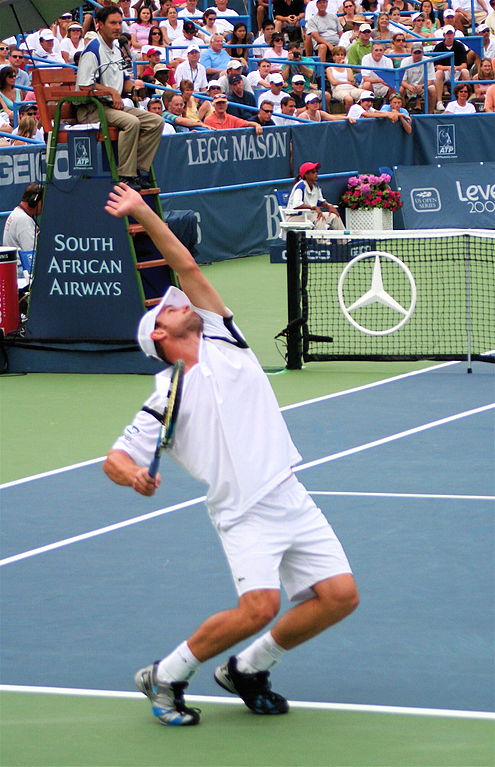
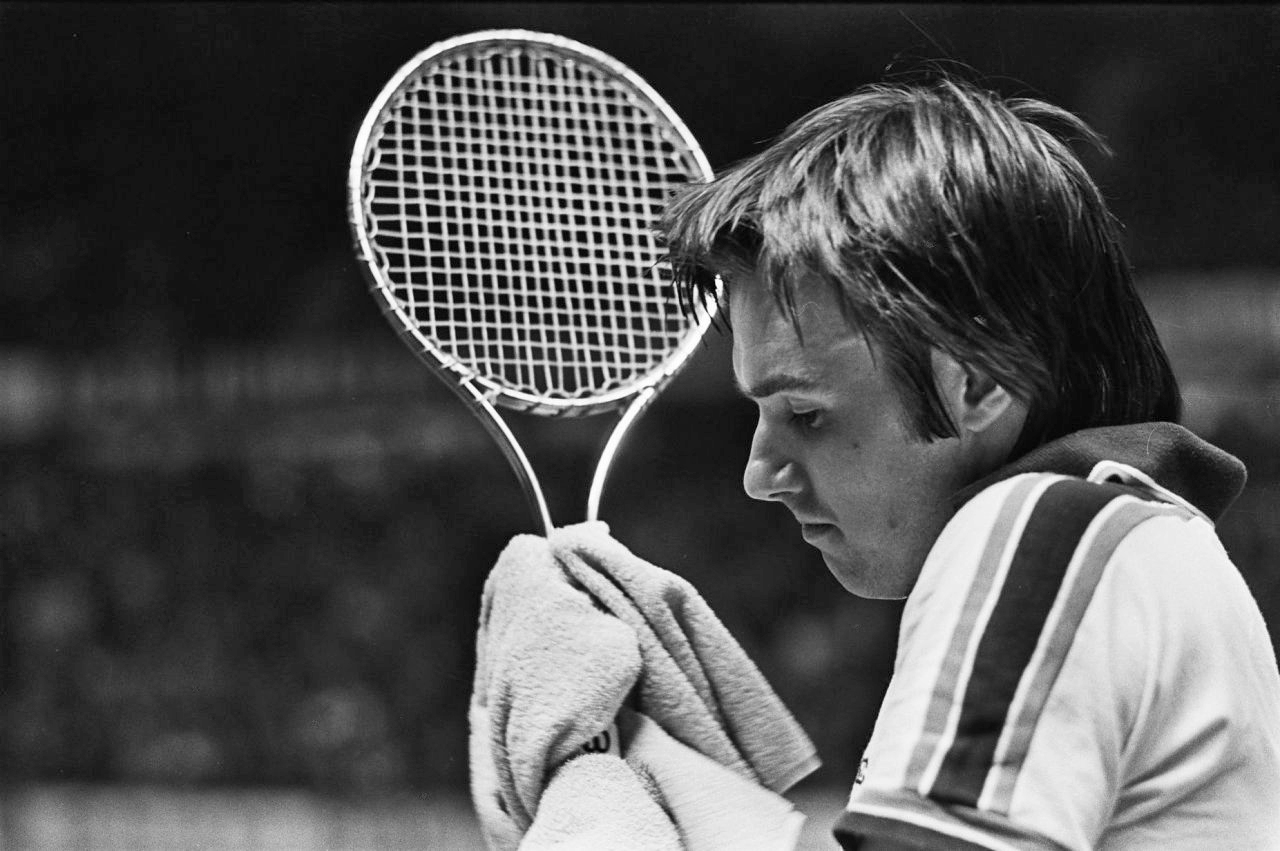
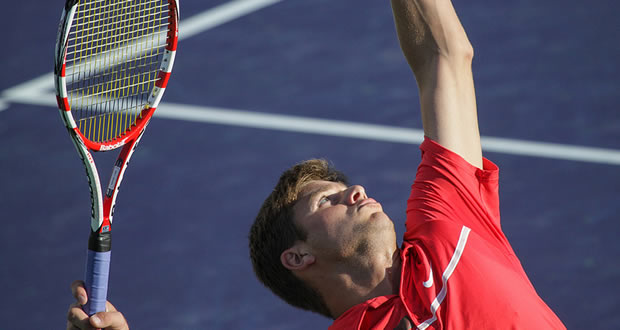
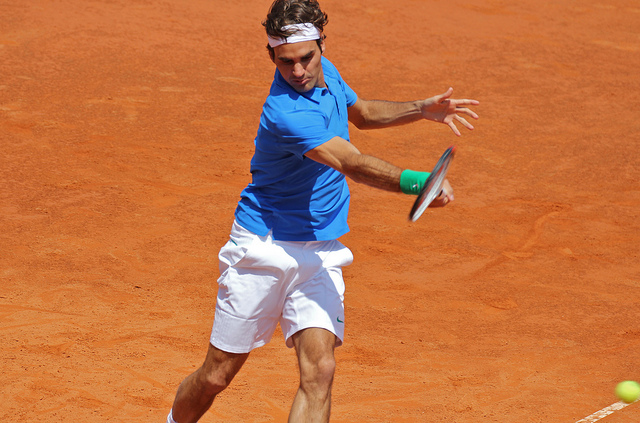
Andy Roddick, newly elected to the Tennis Hall of Fame, had an excellent career. He didn’t make the cut to make it into my Top 20 Players of the Open Era, but he’s just outside it. He’s among the better players to win only a single Slam, and better than some who won two or three. I’ve ranked him as the third best player of his generation (those players born from 1979-83), somewhere in the #21-30 range of the Open Era.
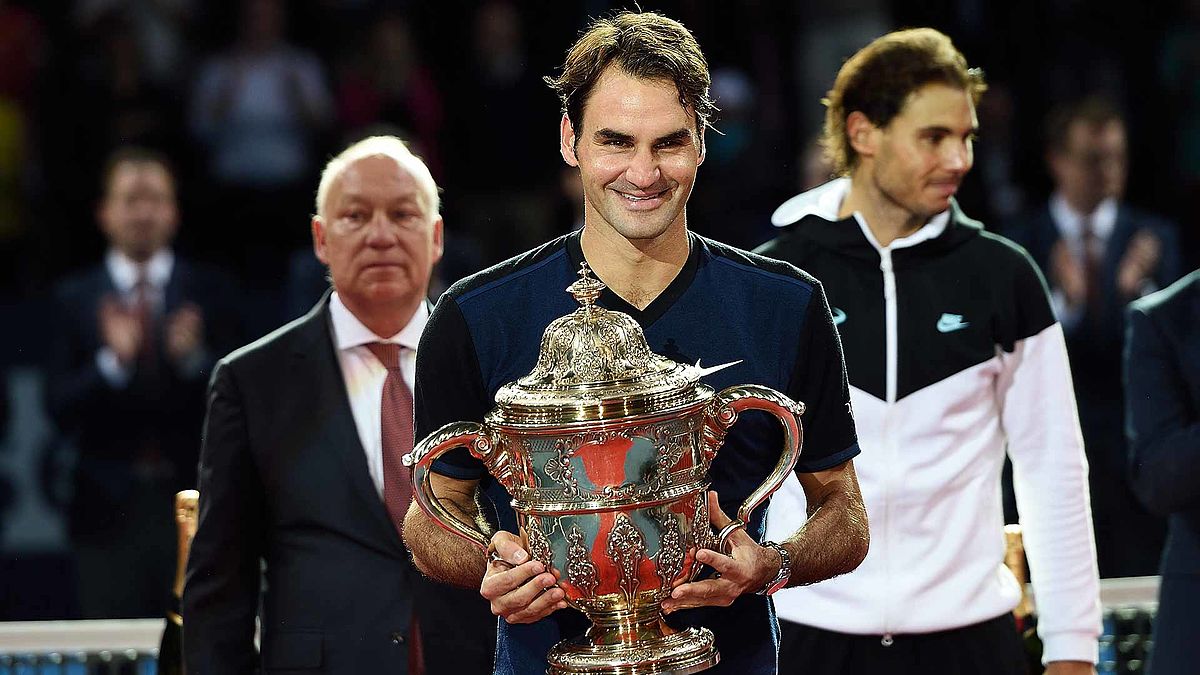
Let’s have a bit of fun. Here’s the scenario: What if Roger Federer had chosen a different career, say became a watch-maker? Let’s imagine that everything else stayed the same on the ATP tour. Almost certainly the player most effect would be Andy Roddick, he of the 3-21 record vs. Federer, including 0-8 at Grand Slams, and 0-4 in Slam finals.
Here’s the caveat: All “what if” scenarios are highly speculative, if only because they tend to overly simplify matters by adjusting one factor without knowing how the other factors would combine without that factor present, but again, we’re just having a bit of fun.
To approach this, we can’t imagine who would have replaced Roger in the previous rounds; the only thing we can do is replace Roger with the player he beat to get to Andy. So in the following, we are going to imagine that Andy faced the opponent that Roger beat, and project an outcome based upon the head-to-head record, both as a whole and on a specific surface type, and then make a judgment. When in doubt, I’ll veer on the side of caution and give Andy’s opponent the win, to keep me honest!
I’m also only going to look at tournaments in which Andy lost to Roger in a semifinal or final. I’m also going to only look at big tournaments—Slams, World Tour Finals, and Masters—at least for now, and then offer a hypothetical career for Andy Roddick, if Roger had followed a different career path.
First of all, here is Andy’s actual career in my new visual tool, “player skyscrapers,” which I explain here.
For the sake of comparison, here are some of the better players of his generation, so we get a sense of how he stacks up:
As you can see, Andy’s career is pretty close to Hewitt’s, and better than any other player of his generation – aside from Federer, of course. Here are a few players to compare Andy to outside of his generation:
That gives us a group of players who Andy is quite similar to. In fact, his career looks almost like the exact inverse of Muster’s.
Now let’s get into the tournaments. As mentioned before, Andy was 3-21 vs. Roger. Of those 21 losses, 6 were in Slam semifinals or finals, 1 at the semifinal of a Tennis Masters Cup (the predecessor to the World Tour Finals), and 2 at Masters tournaments – so 9 big tournaments in all that Andy had a good chance of winning without Roger present, in which he lost to Roger in the SF or F. Let’s take a look at those nine tournaments in chronological order:
2003 Wimbledon SF Roger’s QF opponent: Sjeng Schalken (Roddick 5-1) Roger’s Final opponent: Mark Philippoussis (Roddick 1-0)
While nothing is certain, this looks like a Slam that Andy had a good chance of winning – a dominant H2H over Schalken, and a win in his one match vs. Philippoussis. We’ll give this one to Andy, which would have given him two Slams on the year. +1 Slam title
2003 Tennis Masters Cup SF Runner-up in Roger’s group: David Nalbandian (Roddick 4-2) Roger’s Final opponent: Andre Agassi (Agassi 1-5)
I don’t think we can give this one to Andy. Not only would Nalbandian not have been a sure thing, but Andre Agassi held a commanding H2H lead, so we won’t change Andy’s result. No title
2004 Wimbledon F Roger’s SF opponent: Sebastian Grosjean (Roddick 8-1)
This one is pretty easy – Andy would have won this, probably quite handily. +1 Slam title
2004 Canada Masters F Roger’s SF opponent: Thomas Johansson (Roddick 5-0)
Another easy call – Andy gets an added Masters title. +1 Masters title
2005 Wimbledon F Roger’s SF opponent: Lleyton Hewitt (tied 7-7)
It is fitting that Hewitt and Roddick are tied at 7-7 in the head-to-head, as they are the two most accomplished players of their generation, after Federer (with apologies to Safin). I think this comes down to surface: Hewitt is 1-0 on clay and 6-4 on hard, so I’d give him those surfaces, but Andy won all three grass tournaments they played, including the 2009 Wimbledon QF. So I’m giving this one to Andy. +1 Slam title
2005 Cincinnati Masters F Roger’s SF opponent: Robby Ginepri (Roddick 10-1)
Easy call – another title for Roddick. +1 Masters
2006 US Open F Roger’s SF opponent: Nikolay Davydenko (Roddick 5-1)
We could probably do a similar study for Davydenko, another player greatly impacted by Roger’s presence, with a 2-19 record against the Swiss Maestro. But this is a pretty easy call, so we’ll give this to Andy. +1 Slam title
2009 Australian Open SF Roger’s QF opponent: Juan Martin del Potro (Del Potro 1-4)
We’ll give this one to Del Potro, who got slaughtered by Roger in the QF. Even if Andy had made it past Delpo, he probably would have lost to Rafa in the final. No title
2009 Wimbledon Roger’s SF opponent: Tommy Haas (Haas 6-7)
Andy’s last, and greatest, challenge to Roger. This is a tough call to make as the two never played on grass. While I’d like to think that Andy would have won, I’ll give this one to Haas just to be conservative. No title
OK, so all things tolled, Andy gets four additional Slams and two additional Masters to give him five Slams and seven Masters titles – quite a career. And this isn’t counting the QF losses to Roger, which he may have been able to get more titles out of.
So how does this new, improved Andy Roddick career look, compared to his actual? To get a sense of that, I included the above changes, but also looked at other losses to Federer at Slams and other tournaments, and adjusted accordingly – this ended adding a couple minor titles (2002 Sydney, 2004 Bangkok) and improved Slam results in one case (2007 US Open final) – but I won’t go into details, so as not to lengthen this too much. I also estimated how Andy’s rankings might have changed, as a result. Here we go:
So there’s not only the addition of the four more Slams and two more Masters, as well as two more ATP 250s, but also another year-end #1 in 2004 and an improvement to #2 in 2005 and 2006. Now let’s compare “Hypothetical Andy” to a new group of players:
All of a sudden, “Hypothetical Andy” is amidst a different caliber of players – between multi-Slam winners like Courier, Wawrinka, and Kuerten, yet not quite in the ranks of the near-greats like Vilas, and Murray (I included Wilander, as the least of the true greats….his career doesn’t look much better than Vilas or Murray, but that’s a different story).
Andy, in his actual career, has nothing to be ashamed about. Yes, he was 1-4 in Slam finals, but he still had a strong career – one of the thirty best of the Open Era. But oh, what could have been…
Cover photo by Boss Tweed from Wikimedia Commons, courtesy of Creatives Commons License.
A few years ago I wrote a couple blog articles on the sad state of American tennis, one a bit more straightforward—Houston, We Have a Problem—and one a bit more mythological: American Men’s Tennis and the Cycle of Ages. At the time of those writings, August of 2013, there wasn’t a lot to be excited about. Andy Roddick had retired and the last truly great American men’s player, Andre Agassi, had retired in 2006. The top American players at the time of the former article were (with their ages at the time in parentheses):
14. John Isner (28)
29. Sam Querrey (25)
87. Jack Sock (20)
92. Michael Russell (35)
97. Ryan Harrison (21)
100. James Blake (33)
Sock and Harrison looked vaguely promising, but Harrison (now 24) continued to stagnate and is ranked #90, and Sock (now 23) slowed his development and seems to have peaked as a top 20-30 type.
Here’s an update, the 2016 year-end top 100 Americans:
19. John Isner (31)
23. Jack Sock (24)
31. Sam Querrey (29)
33. Steve Johnson (26)
76. Taylor Fritz (19)
88. Donald Young (27)
90. Ryan Harrison (24)
As you can see, it doesn’t look much better than three years ago. Isner remains the top American and he’s just barely hanging on to a top 20 ranking. There’s a bit more meet in the middle, with four Americans in or close to the top 30, where three years ago there were only two. And there’s Fritz, who is the brightest young American player in years. On the surface it looks like Sock was only a year older but ranked similarly to Fritz, but in actuality he was almost two years older, so Fritz’s ranking is far more impressive.
But the top 100 only tells part of the story. Let’s compare the top ranked Americans age 21 and under in 2016 with those in the year-end in 2013:
2013
100. Ryan Harrison (21)
102. Jack Sock (21)
114. Denis Kudla (21)
306. Bjorn Fratangelo (20)
437. Christian Harrison (19)
476. Mitchell Krueger (19)
573. Marcus Giron (20)
594. Evan King (20)
2016
76. Taylor Fritz (19)
105. Jared Donaldson (20)
108. Frances Tiafoe (18)
116. Stefan Kozlov (18)
141. Ernesto Escebedo (20)
198. Michael Mmoh (18)
200. Noah Rubin (20)
204. Reilly Opelka (19)
I picked eight players for each to give a sense of the depth of 2016’s field. As you can see, there is much more to be excited about now than there was three years ago. Looking solely on my “Pace of Greatness” theory, Fritz and Tiafoe have already accomplished the first benchmark: ranking in the top 100 as 18-year olds. Kozlov is very close, and Mmoh has an outside chance. But the main point is that even if none of these eight players become true greats, there is a lot more talent there than in 2013.
https://www.youtube.com/watch?v=iciaF8VryAU
Let’s go back a bit further. Starting in the late 90s and into the early 00s, there was a talented group of young Americans: James Blake, Andy Roddick, Taylor Dent, Mardy Fish, and Robby Ginepri. Ginepri and Dent had decent but unspectacular careers: Ginepri won an ATP 500 and reached the 2005 US Open semifinal, ranking as high as #15, and Dent won four titles and ranked as high as #21. Fish was better, finishing 2011 #8 in the world and reaching several Slam quarterfinals and Masters finals, but never winning more than an ATP 250 level tournament (he won six); his career was marred and shortened by a heart condition. Roddick was a Slam winner and #1, and perhaps the player who suffered most from Roger Federer’s dominance. James Blake had some good years, peaking in his late 20s, and was probably slightly better than Fish, and thus the distance second behind Roddick among this group.
After the group who came of age in the early 2000s, you get to players like John Isner, Sam Querrey, Brian Baker, and Donald Young. Isner is the best of the bunch, a third tier player who has spent many years in the top 20 but only just barely sniffed the top 10. Querrey is something of a disappointment, looking promising in his early 20s but stagnating; Baker never amounted to much, and the fact that I used Young as the emblematic player of the generation of players born from 1989-93 should speak volumes. I think we can safely say that the current crop of young Americans is the best such group that we’ve seen in at least fifteen years.
Going back before Roddick’s era, the mid-to-late 90s also didn’t see much in the way of American talent, with players like Vince Spadea, Jan-Michael Gambill and Justin Gimelstob being the top ranked young Americans. Gambill and Spadea were solid players who spent some time in the top 20, but never in the top 10 or with major titles.
We have to go all the way back to the early 90s to find a generation of truly great young Americans. Check out the American men age 21 and under in the top 100 in 1990:
1990
4. Andre Agassi (20)
5. Pete Sampras (19)
15. Michael Chang (18)
25. Jim Courier (20)
27. David Wheaton (21)
93. MaliVai Washington (21)
Sampras and Agassi are, along with Jimmy Connors and John McEnroe, two of four truly great American men’s players of the Open Era. Jim Courier won four Slams and remains the youngest player (at age 22 years and 11 months) to have appeared in the finals of all four Slams, and was #1 for 58 weeks; Michael Chang was also a Slam winner and perennial top 10 player, with 34 titles and 7 Masters to his name. Even David Wheaton won the prestigious Grand Slam Cup title and ranked as high as #12, and Washington is known for his run at the 1996 Wimbledon (he lost to Richard Krajicek in the final). Overall we probably haven’t seen a crop of this kind of talent coming up at the same time from any country.
In Conclusion
Let me be clear: I am not predicting that the current crop of young Americans is on par with that group from 1990, but what I am saying is that we have to go back to 1990 to find a more promising group of Americans in terms of youth and rankings. If you go back to that 2016 21-and-under rankings list, there probably isn’t an Andre Agassi or Pete Sampras in that group, but there could be an Andy Roddick, a Michael Chang, even a Jim Courier, or at least several players akin to Todd Martin or Mardy Fish. In other words, American men’s tennis is on the rise and looks more promising now than it has in at least 15 years, and possibly more like 25 years.
There is hope!
Cover photo from Wikimedia Commons courtesy of the Creative Commons License.
Revisiting the Benchmarks: the Pace of Greatness
To recap the last installment, we have clear benchmarks that all true greats (6+ Slam winners) hold in common:
Before their 19th birthday: Ranked in the top 100
Before their 20th birthday: Ranked in the top 50
Before their 21st birthday: Ranked in the top 10; won a title; made it to a Slam QF
Before their 22nd birthday: Ranked in the top 5
Before their 25th birthday: Ranked number 1, won a Slam
We also found that there are about 70 players in the ATP ranking era (1973-present) who met that first benchmark—a top 100 ranking at age 18. Of those 70, 17 are active today, a list we’ll get to in a moment.
“Failed Greats”
Now just because a player meets all of those criteria does not mean they will become a great player. There are players who met all of those criteria and only won a Slam or two. There are also players who met all of the criteria except for one or both of the “fruition” benchmarks met by age 25, the Slam and number one ranking. These two groups combined are players that we could call “failed greats”–they passed all, or almost all, of the benchmarks, but failed to become true greats.
Here are two lists of players, the first being those who accomplished all benchmarks, the second all but the age 25 criteria, the Slam and number one ranking:
All benchmarks: Jim Courier, Michael Chang, Marat Safin, Lleyton Hewitt, Andy Roddick
All except age 25: Goran Ivanisevic, Andrei Medvedev, Juan Martin del Potro
So these are eight players in the Open Era who were on the “pace of greatness,” including five who actually met all of the benchmarks, but eventually fell short of true greatness. It is a surprisingly small number, and tells us that most players who reach the various benchmarks along the way will become great players. If we go back to those players for whom we have all the data, from Borg to Djokovic, we have 11 all-time greats (6+ Slam winners). That means that 11 of 16 players (69%) who met all of the benchmarks became greats, and 11 of 19 (58%) who met all except the age 25 benchmarks.
The main thing these eight players have in common with the true greats is that they all developed very quickly. Consider the fact that one of the criteria is to reach the top 5 before turning 22 years old. That in itself is a difficult benchmark that erases many other players from contention.
Let’s take a look at each of these players, to get a sense of what “went wrong” in their careers. First we have four players born in the first half of the 1970s:
Jim Courier (b. 1970) was one of the top players on tour for a few years, the first of his generation to become #1, four months before Agassi and more than a year before Sampras. But Courier declined quickly, dropping from a top 3 player in 1993 to #13 in ’94, #8 in 95, and out of the top 20 for the remainder of his career. His mid-20s decline is similar to later number one players like Juan Carlos Ferrero and Lleyton Hewitt. There was always the sense with Courier that he was playing over his head and ability, and was less talented than his peers Sampras and Agassi. Courier’s decline coincided with Sampras’s rise to dominance; un-surprisingly, Courier won only 4 of his 20 matches with Sampras. Still, Courier ended his career with 4 Slams, 23 titles overall, a year-end #1 ranking in 1992 and, along with Guillermo Vilas, is one of the two players who I consider the “Gatekeepers” of true greatness.
Goran Ivanisevic (b. 1971) was one of the better players of the 90s who was unable to get past the dominance of Sampras and Agassi, losing two Wimbledon finals to Sampras and one to Agassi. Yet despite fading in the latter part of the decade, he entered the 2001 Wimbledon ranked #125 and miraculously won it, which was the inspiration behind the film Wimbledon. Known for his tremendous serve, Ivanisevic wasn’t very multi-dimensional, although not nearly as one-dimensional as, say, Ivo Karlovic, and was probably a bit better than Milos Raonic is now.
Michael Chang (b. 1972) was the youngest player of the Open Era to win a Grand Slam: the 1989 French Open at the age of 17 years and 4 months, one of only three players—along with Mats Wilander and Boris Becker—to win a Slam before his 18th birthday (Martina Hingis is the youngest woman, winning her first at 16 and 4 months). Yet Chang had a lower ceiling than other early bloomers. While he had a long and prolific career, including 34 titles and 7 Masters, he never ranked higher than #2 or won another Slam. In a way he was the David Ferrer of his generation (although more successful in big tournaments): never in contention for the best on tour, but always right there behind the top players.
Andrei Medvedev (b. 1974) was an early bloomer who looked destined for greatness after ranking #6 in 1993 at the age of 19, and then winning two Masters the following year. Yet Medvedev floundered and was never able to take that next step up. His best years were 1993-95 when he was 19-21 years old.
And then we come to the trio of Marat Safin, Lleyton Hewitt, and Andy Roddick—the best peers of Roger Federer.
Marat Safin (b. 1980) won his first Slam in 2000 at the age of 20 but only won one other and goes down as one of the biggest underachievers in tennis history. He was a very talented player who was capable of an extremely high level and very well could have formed a duo of greats with Federer, but he didn’t have the requisite focus and had the well-earned reputation of being something of a playboy.
Lleyton Hewitt (b. 1981) was the youngest player in the ATP era to reach the number one ranking, which he did in 2001 at the age of 20 years old and 9 months. Hewitt was a very strong player for the first half of the 00s, and was the year-end #1 player in 2001 and 2002, but was more the first among near-equals than truly dominant over the field, and was eclipsed first by Roddick and then Federer in 2003 and never could climb back to the top. He fell out of the top 10 in 2006 and was never to return, playing a long second-half of his career as a non-elite player.
Andy Roddick (b. 1982) is perhaps the player whose career was most damaged by Roger Federer’s greatness. Roddick won the US Open and the year-end #1 ranking in 2003 at 21 years old, and seemed destined for greatness. But Federer became simply better at almost every facet of the game, and Roddick’s relatively one-dimensional game became exploited by others. He was an excellent player and remained a consistent top 10 player throughout the 00s, but never won another Slam, going 1-4 in Slam finals.
Finally we come to Juan Martin del Potro (b. 1988), who through 2009 had met all of the benchmarks of greatness: he was 21, had won a Slam, and was ranked in the top 5. And then injury struck and he hasn’t been the same since. While still a dangerous player when healthy, we’ll never know what a fully healthy del Potro would have looked like. My guess is that he would have vied with Andy Murray for the title of third greatest player of his generation, perhaps even surpassed him. But “Delpo” turns 28 later this year and is unlikely to ever reach his full potential.
In all eight of these we see players who developed early and to a high level, but for various reasons were unable to take that next step, whether due to talent, mentality, or injury. Again, we can return to our “characteristics of greatness,” which all greats have had, and the failed greats have lacked one or more of.
It is also interesting to note that these are all players born 1970 or later; 18 years old in 1973 is the starting point of these criteria because that is the beginning of the computerized rankings. This means that, for whatever reason, for the first 15 years there were no failed greats. Every player that met all of the criteria up to age 25 became greats, including Bjorn Borg, John McEnroe, Ivan Lendl, Mats Wilander, Stefan Edberg, and Boris Becker—a 100% “conversion rate.” Since 1970 we’ve had the eight failed greats along with Agassi, Sampras, Federer, Nadal, and Djokovic—so 5 of 13, or a 38% rate. Why exactly this is, I don’t know, although it could simply be that, as we saw in Part One, there were many more 18-year olds in the top 100 in the late 80s and early 90s than any other period of the Open Era.
I would also add one more possibility. Note that the first four players—Courier, Ivanisevic, Chang, and Medvedev—were all peers of Sampras, while the next three—Safin, Hewitt, and Roddick—were peers of Federer. It could be that part of the reason these players “failed” in becoming true greats was because they were eclipsed by an even greater player in Sampras and and Federer (del Potro was close to Nadal and Djokovic, although his failure to achieve greatness has been blocked by injuries. We simply cannot know what a healthy del Potro would have looked like).
Current Players: Off the Pace of Greatness
So of active players, who was initially on the pace but has since fallen off? We’ll start with the oldest and work our way forward.
Mikhail Youzhny (b. 1982) met the first criteria, and also won his first title at age 20, but slowed in his development. He has had a solid career, been a top 10 player and won 10 titles, but is far from great; I ranked him as the tenth greatest player of his generation (b. 1979-83), behind Tommy Robredo and ahead of Fernando Gonzalez and Guillermo Coria, although the latter two were better players and possibly deserved to rank higher than Youzhny, although Mikhail’s longevity was better.
Tomas Berdych (b. 1985) met the first several benchmarks, ranking in the top 100 at age 18, the top 50 at age 19, winning his first title at 19 and even reaching the top 20 as a 20-year old. But he didn’t reach the top 10 or a Slam QF until a year later, at 21, and only made the top 5 at age 27. Berdych won the Paris Masters in 2005 at 20 years old, but has not won a Masters since. He is what could be called an “aborted great:” he had the early signs, but never blossomed beyond the level of a very good player, which he remains today.
Richard Gasquet (b. 1986) reached the top 100 at 17 years old, the top 50 and his first title at 18, and the top 20 as a 19 year old. But like Berdych, he didn’t reach a Slam QF or the top 10 until he was 21 and approaching 30-years old in June has never ranked in the top 5 or even won a title above an ATP 250. He is often cited as one of the more disappointing players of his generation, although I think in hind-sight it now looks like he simply had a lower ceiling of talent than his teenager career promised.
Gael Monfils (b. 1986) showed immense promise at a young age, winning three Junior Slams in 2004. Monfils ranked in the top 50 at age 18 but took another four years to reach the top 10. He remains an enigmatic player on tour, extremely talented but the classic “head-case.”
Andy Murray (b. 1987) was on the pace until his 21st birthday. He met all of the ranking benchmarks, won his first title, but failed to win a Slam QF until just after his 21st birthday. He also didn’t win his first Slam until 25 and has yet to rank number one. As we all know, Andy is known for his temper and penchant for falling apart in tight matches, as illustrated in his 2-7 record in Slam finals. While he could still win another Slam or two, especially as Federer and Nadal fade away, he turns 29 in a couple months and seems on the wrong side of his peak.
Juan Martin del Potro (b. 1988) is in the “failed great” category and accomplished all of the benchmarks except the number one ranking, so he was even closer than Murray. He is 27, so it hard to imagine him winning 5+ more Slams to become a true great.
Ernests Gulbis (b. 1988) is another of the same type as Gasquet and Monfils: very talented, but considered an underachiever. Gulbis reached the first two ranking benchmarks and also won his first title at age 19, but stalled out in his early 20s, not reaching the top 10 until 25, and then only briefly.
Donald Young (b. 1989), as I have said elsewhere, represents both the failure of his generation and American men’s tennis. He made the top 100 at 18 but has floundered since, still as yet not winning a title, reaching a Slam QF, or ranking higher than #38. According to my research, he has the dubious honor of being one of the half a dozen or so worst players in the ATP era to reach the top 100 as an 18-year old.
Kei Nishikori (b. 1989) won his first title at age 18, but slowed until his early 20s. He has met all of the criteria of 2-4 Slam winners, although at age 26 has yet to win a Slam. Kei has 11 titles so far, including 6 ATP 500s, and is the only player on tour with more than two ATP 500 titles and no Masters or Slams. While he’s a good candidate to eventually win a Masters, if he fails to do so he could end up being one of the greatest players ever not to win a Masters tournament or higher.
Bernard Tomic (b. 1992) reached the top 50 and a Slam QF at age 18, and won his first title at age 20, but then floundered around #50 for a couple years and is now well off the pace of greatness. He is still just 23-years old, although looks more like a top 20 type than a future Slam winner.
Nick Kyrgios (b. 1995) technically already missed one of the benchmarks, as he did not reaching the top 100 until he was 19 years and three months. But I do not think that three months should disqualify him. He did reach the top 50 before turning 20, win his first title and reach his first QF before 21, and he has a shot at reaching the top 20 by age 21, but probably not the top 10 (he turns 21 on April 27). So it could be that Kyrgios turns 21 with three of the first five benchmarks (not including a Slam title), which is pretty good. We’ll need to see a quick rise over 2016 and into the top 10 and, to get back on the pace, he would need to rank in the top 5 by his birthday in 2017. A tall order, but we’ve seen some positive signs of late, a high level of play that, if he can access on a regular basis, could make him a truly great player.
Active Players: On the Pace (So Far)
There are currently only four players who have both reached the first benchmark, the top 100 at age 18, and not yet failed one: Hyeon Chung, Borna Coric, Alexander Zverev, and Taylor Harry Fritz.
Hyeon Chung (b. 5/19/1996) reached the top 100 at 18 but has not yet broken into the 50, which is the benchmark that he must meet before his 20th birthday, on May 19 of this year. That said, he did reach as high as #51, so maybe we can give him some slack. He’s currently ranked #71 so has been stagnating for awhile now; hopefully we see a step forward this year.
Borna Coric (b. 11/14/1996) is 19 years old, turning 20 in November. He is the only player who has reached two benchmarks and is still on the pace: he was in the top 100 at age 18 and top 50 at age 19. Actually, Coric has accomplished one remarkable feat: he has out-paced Novak Djokovic in rankings on their17-19th birthdays; compare:
Djokovic: 515, 128, 63
Coric: 396, 89, 45
Just looking at those numbers point to potential great things for Coric. But beyond that, there are worrying signs. First of all, at 19 years and 4 months, Coric has yet to win a title; at the same age, Djokovic was about to win his second (both ATP 250s) and was about half a year away from his first Masters title and a little over a year from his first Slam.
Where Djokovic went from #63 on his 19th birthday to #6 on his 20th birthday, Coric has been stagnating for about a year now. That said, he doesn’t need to keep pace with Djokovic to be a future great. In order to remain on the pace, he needs to reach the top 10, win a title, and reach a Slam QF all before November of 2017. So he’s got plenty of time to develop his game further. That said, it seems more likely that he becomes closer to Richard Gasquet than Djokovic.
Alexander Zverev (b. 4/20/1997) turns 19 on April 20, and has already reached his first benchmark. In fact, he will turn 19 ranked #50, which is the next benchmark that he needs to reach—but not until April of 2017, so he’s a year ahead of schedule. After that, Zverev would need to reach the next round of benchmarks—top 10, a title, and Slam QF—all before April of 2018, which is two years away. He seems to have a good chance of all of that. So it is quite early for Zverev, which is a good sign. His recent three-set loss to Rafael Nadal at Indian Wells shows us both his potential and that he still needs a lot of work. But signs are encouraging.
Taylor Fritz (b. 10/28/97) is in a similar situation as Zverev. He’ll be 19 later this year, about a year younger than Coric. Fritz is in the top 100 and doesn’t need to reach his next benchmark, the top 50, for a year and a half; he’s currently ranked #68, so is close already. His game is still raw, but he shows a lot of promise and the fact that he’s risen so quickly is a very good sign.
Active Players: On the Cusp
Those are only players who have reached at least one or more benchmark, but there are several others that are “due” for that first benchmark and look to have a solid chance to reach it.
Andrey Rublev (b. 10/20/97) is about a week older than Fritz and currently ranked #154. He needs to squeeze into the top 100 by his birthday to be on pace, which seems very possible. He seems like a player that is ripe to start a quickened pace of development, so bears watching this year.
Frances Tiafoe (b. 1/20/98) just turned 18 a few months ago, so has a lot of time to reach the top 100. He shows a lot of promise, including a three-set loss to David Goffin that showed some of his potential. He is currently the youngest player ranked in the top 200, at #182.
Tommy Paul (5/17/97) and Omar Jasika (5/18/97) turn 19 in May, and are distant possibilities, but need to move very quickly, ranked #192 and #313 respectively.
Duckhee Lee (5/29/98) is quite young and looks to have a good shot. At #206, he is the highest ranked 17-year old on tour, and the only one to be ranked in the top 400.
Stefan Kozlov (2/1/98), ranked #224, and Michael Mmoh (1/10/98) ranked #322, are two young foreign-born Americans that bear watching. Kovlov made a big jump recently, losing in a Challenger final. He is a good candidate to at least come close to the top 100 by year’s end.
Beyond them you have 17-year olds Stefanos Tsitsipas (8/12/98) and Mikael Ymer (9/9/98) and even younger players for him it is just too soon to tell—like Denis Shapovolov (4/15/99) Felix Auger Aliassime (8/8/2000) and Rayane Roumane (9/11/2000), the only ranked players that were born in 2000. Again, it is way too soon for these kids, but theirs are names to remember.
Missing the Cut
There are also quite a few young players who show promise, but did not make that first benchmark. I will mention their names, though, given the possibility that this newer generation simply might be peaking later. Still, I think all of them are far less worthy candidates for the next great player, but could be names we see in the top 50 within the next new several years.
Jared Donaldson, Elias Ymer, Karen Khachanov, Yoshihito Nishioka, Kyle Edmund, Quentin Halys, Thanasi Kokkinakis, Noah Rubin.
Kokkinakis met the first benchmark and ranked as high as #69 last June, but has struggled since and is ranked #143 just after turning 20.
“Stanislas Potential”
There is one final player that I’d like to mention, who is far off the pace of greatness but has drawn attention of late: Dominic Thiem (b. 9/3/93). While I think it very unlikely that he becomes a 6+ Slam winner as he is so far off the pace, Thiem—at 22—has reached the various benchmarks of the near-greats, the 2-4 Slam winners. He reached the top 100 and then top 50 as a 20-year old, then won his first title and the top 20 as a 21-year old, and is currently on the verge of the top 10 and has a good chance to reach it, and play in his first Slam QF, before his 23rd birthday in September.
And then there’s our old friend, Grigor Dimitrov (b. 5/14/91), who at almost 25 is no longer a prospect. We might have to accept Grigor for who he is and will never be. That said, while Grigor did not fulfill any of the criteria for greatness, he has fulfilled almost all of the criteria for near-greatness: reaching the top 100 at 19, the top 50 at 21, the top 20 at 22, and the top 10 at 23. He also made his first Slam QF at 22, although did not win his first title until 22: all multi-Slam winners won their first title at age 21 or younger. So while Grigor will not be a 6+ Slam winner, he is a darkhorse candidate, albeit a fading one, to expand the horizons of near-greats.
Ranking the Candidates
So when all is said and done, where does that leave us? As of right now, I would categorize the candidates the following groups:
Best Candidates for Greatness: Alexander Zverev, Taylor Fritz
Borderline/Outside Chance: Nick Kyrgios, Borna Coric, Hyeon Chung
The Stanislas Darkhorse: Dominic Thiem
Too Soon to Tell, but Promising: Andrey Rublev, Francis Tiafoe, Stefan Kozlov
On the Edge of the Radar: Duckhee Lee, Mikael Ymer, etc
Very Unlikely: Everyone else
Finally, there are the kids—players of the next generation, 1999-2003, for whom it is just far too soon, but we are at least starting to see some names pop up in Futures tournaments.
Which of these players will become true greats? Your guess is as good as mine, but chances are at least one of them will. If in 5 or 10 years we look back and the next 6+ Slam winner wasn’t mentioned in this article, I’ll have to eat my words, but I think there’s a very good chance that won’t be the case.
Cover photo from Wikimedia Commons, By Tomas-ko0 – Own work, CC BY-SA 4.0, https://commons.wikimedia.org/w/index.php?curid=45898208
Why the name?
What else could it be called? Roger Federer dominated his peers unlike any player since at least Bjorn Borg. Consider that he is the only player born in the fourteen-year span of 1972-85 who has more than three Slam titles; he is probably the number one reason why this is the case. Federer won 17 of his generation’s 23 Slam titles, or 74%, more than Borg’s 69% (11 of 16). “Weak Era Theory” aside, Roger simply owned his peers. More on that in a moment.
Best Players by Birth Year 1979: Ivan Ljubicic (CRO), James Blake (USA), Juan Ignacio Chela (ARG), Ivo Karlovic (CRO), Nicolas Massu (CHI), Michael Llodra (FRA), Albert Montanes (ESP) 1980: Marat Safin (RUS, 2), Juan Carlos Ferrero (ESP, 1), Fernando Gonzalez (CHI), Xavier Malisse (BEL) 1981: Roger Federer (SWZ, 17), Lleyton Hewitt (AUS, 2), Nikolay Davydenko (RUS), Feliciano Lopez (ESP), Mardy Fish (USA), Jarkko Nieminen (FIN), Julien Benneteau (FRA) 1982: Andy Roddick (USA, 1), David Ferrer (ESP), David Nalbandian (ARG), Tommy Robredo (ESP), Mikhail Youzhny (RUS), Guillermo Coria (ARG) 1983: Fernando Verdasco (ESP), Phillip Kohlschreiber (GER), Dmitry Tursunov (RUS), Alejandro Falla (COL)
I’ve been a bit more liberal with the names included, as this is a generation still active, or at least fresh in memory. Birth years 1980-82 is the heart of the generation, with 1979 and ’83 being far weaker.
Imagine being Lleyton Hewitt or Andy Roddick: 2003 ends and you’re playing well, both with a Slam and year-end No. 1 or 2 under your belt while still in your early 20s. Then this soft-spoken Swiss guy rises up and utterly dominates tennis, while you toil away, year after year, never able to get past him and win another Slam. This scenario is particularly telling for Andy Roddick, who lost four Slam finals to Federer and won only 3 matches out of 24. Despite that fact, Roddick had an excellent career, finishing every year from 2002-10 in the Top 10, with 32 titles to his name including one Slam and five Masters. Andy retired relatively young by today’s standards, just after turning 30 in 2012, but he saw the writing on the wall–falling from No. 8 in 2010 to No. 14 in 2011 and No. 39 in 2012.
In 2001, at the age of 20, Lleyton Hewitt was the youngest player to reach the No. 1 ranking since the ATP computerized rankings began in 1973. He was No. 1 for 80 weeks — more than Stefan Edberg, Jim Courier, Gustavo Kuerten, Ilie Nastase, Mats Wilander, and Boris Becker. After two year-end No. 1 rankings in 2001 and 2002, Hewitt entered 2003 on top of the world. Yet it soon became clear that a couple of his peers were surpassing him: Andy Roddick and Roger Federer. He remained a top player for a few more years, but by 2006 he had slipped out of the elite, unable to compete with the newer, bigger, more powerful generation that was coming up. As of this writing, Hewitt just played his last Grand Slam, going out in the second round of the Australian Open. Though he hasn’t been in the Top 20 for seven years, he will be missed.
As for the Swiss Maestro himself, it is difficult to say anything that hasn’t already been said. But to return to the topic of his dominance over his generation, consider his head-to-head against peers (born 1979-83) who were Top 10 players: 195-36, or 84.4% – which is better than his overall winning percentage against all players. Of all players in Federer’s generation, the only two who were able to win more than three matches against him were Lleyton Hewitt (9-18) and David Nalbandian (8-11).
Federer’s fans occasionally bemoan the fact that he’s no longer the player he was during his absolute peak, from 2004-07. While this is undoubtedly true, we should not lose sight of the player he is now, still ranked No. 3 halfway between his 34th and 35th birthdays. The vast majority of all-time greats were either long retired or fading out at Roger’s age.
Maybe Roger will buck the trend and remain an elite player into his late 30s, but it seems unlikely. While he is showing no signs of further decline—yet—any setbacks, such as his current knee injury, could damage his momentum. Regardless, we should appreciate the great player while he’s around.
Underachievers and Forgotten Players
David Nalbandian and Marat Safin come most readily to mind. These two challenged Federer in terms of talent, but neither had the mentality and focus to be a perennial champion. Nalbandian is on the short list of most talented player never to win a Slam in the Open Era, and Safin is often mentioned as an almost-great who should have been an all-time great.
Nalbandian was the most competitive peer of Federer’s, winning 8 of 19 matches (42.1%) and their first five matches. After those five, Roger seemed to figure out Nalbandian, with an 11-3 record from the 2003 Tennis Masters Cup onward. The only players with a better percentage against Federer in 10 or more matches are Tim Henman (46.2%), Rafael Nadal (67.6%), Novak Djokovic (51.1%), and Andy Murray (44%), all either significantly older or younger. Regardless of his level of disappointment, Nalbandian had a solid career, the highlight of which was his victory over Roger Federer in the 2005 World Tour Finals, as well as his two Masters in 2007.
Safin was the No. 2 player in the sport at the age of 21 in 2000, a year in which he spent nine weeks as the No. 1 player in the world, defeated Pete Sampras in straight sets to take the US Open title, and won two Masters. It looked like tennis finally had a new, young elite player to join the aging Agassi and Sampras. Yet he was to finish only two other years in the Top 5, 2002 and 2004, and he won only one more Slam and three more Masters. A fine career, but not an all-time great.
Another to consider is Guillermo Coria, who was ranked in the Top 8 from 2003-05, then saw his career collapse in 2006 – for a variety of reasons, including service issues, marital problems, and injury.
Lesser-known Joachim Johansson deserves mention as someone who looked like at least a second-tier player but saw his career destroyed by injury. At the end of 2004, it looked like Sweden would have have an heir to Thomas Enqvist and Thomas Johansson in the “If not quite Borg/Wilander/Edberg, then at least Nystrom/Jarryd” category. Joachim finished the year No. 11, at age 22, including a Slam semifinal appearance and an ATP 500 title, but couldn’t recover from a variety of injuries.
Did You Know?
Roger Federer’s 2006 was widely considered the best season of the Open Era since Rod Laver’s great 1969, only recently surpassed by Novak Djokovic’s 2015. He won three Slams, was the finalist in the fourth, won the World Tour Finals, four Masters, 12 titles overall, and a ridiculous 91-5 record. Four of those five losses were to his nemesis, Rafael Nadal, and the other to Andy Murray. But here is what is interesting: in all but one of those matches, Nadal was still 19-years old, as was Andy Murray, who was ranked No. 21 when he beat Federer at the Cincinnati Masters. When Nadal defeated Federer in the French Open final, he had just turned 20; it was his fourth and last win over the No. 1 player that year (Roger would beat him at Wimbledon and the World Tour Masters).
So think about that for a moment: The best player in the sport, and one of the best all time, lost four times to two teenagers during his best season, and a fifth time to one of them a few days after he turned 20. In his best season. Other than that, Roger was 91-0.
Top Ten Players of the Generation
Roger Federer
Lleyton Hewitt
Andy Roddick
Marat Safin
Juan Carlos Ferrero
David Ferrer
David Nalbandian
Nikolay Davydenko
Tommy Robredo
Mikhail Youzhny
Honorable Mentions: Fernando Gonzalez, Guillermo Coria, Fernando Verdasco, Ivan Ljubicic, James Blake, Feliciano Lopez, Mardy Fish, Jurgen Melzer, Ivo Karlovic, Juan Ignacio Chela, Philipp Kohlschreiber.
Number one is easy, as Federer was (and is) to his generation what Borg was to his. I also feel reasonably confident with my No. 2-4 rankings, although Hewitt, Roddick, and Safin could be arranged in a variety of ways. While Safin was the most talented of the three, and Roddick the most consistent over a long period of time, I give Hewitt the edge because he’s the only one who had a sustained period of time as No. 1, even if it was in the “soft spot” of 2001-02 when men’s tennis was seeing a regime change.
After that, it gets tricky. If you changed Ferrero’s Slam win to a runner up, he would probably rank behind Ferrer, Davydenko, and Nalbandian, all of whom had better overall careers aside from one match. The “Mosquito” wasn’t the worst player to win a Slam, and was an elite player for several years but like many of his peers, he saw his career drop off in his mid-20s. He slipped out of the Top 10 in 2004 and never returned, with a later career similar to Hewitt’s. But he did win a Slam and attain the No. 1 ranking for a short period of time, things that Ferrer, Davydenko, and Nalbandian never did.
David Ferrer has had an unusual career path, peaking in his late 20s and early 30s. Other than Federer, he is the most consistent player of his generation and will go down as one of the greatest players never to win a Slam, along with his contemporary Nikolay Davydenko, who filled a similar role before Ferrer’s peak. Ferrer has the reputation of a player who maximized his modest talents – was not a great player, but a consistently very good one. While he has winning records against similarly ranked players like Tomas Berdych (8-5) and Jo-Wilfried Tsonga (3-1), unlike those two there is a sense that it would have been (and is) impossible for him to win a Slam because Ferrer’s “A game” simply cannot touch the “B games” of Djokovic, Nadal, or Federer.
There’s a steep drop-off after Davydenko, with Robredo and Youzhny earning their way into the Top 10 through longevity. Guillermo Coria, Fernando Gonzalez, Ivan Ljubicic, and James Blake were all better peak players, but none had the overall career accomplishments of Robredo and Youzhny.
Addendum: Twelve Highest Ranked Players of Gen 10 (as of 2/8/16)
3. Roger Federer
6. David Ferrer
25. Feliciano Lopez
26. Ivo Karlovic
32. Philipp Kohlschreiber
34. Guillermo Garcia Lopez
39. Tommy Robredo
40. Gilles Muller
52. Paolo Lorenzi
54. Nicolas Mahut
56. Victor Estrella Burgos
57. Fernando Verdasco
As you can see, this generation still has quite a few players around, although only two in the Top 10. Considering that this generation will turn 33 to 37 in 2016, expect almost all to be gone within another year or two, with maybe a few hold-outs playing into their late 30s.
Imagine if each country had a tennis career. Rather than individual players, you have nationalities; rather than an individual career, you have a national one. As a thought experiment, I decided to compile the top Slam-winning countries in Open Era history, from the 1968 French Open to the 2015 French Open. How would these “national careers” look, as if they had careers spanning 48 years? What would their stories be? I looked at and compiled the best results from players of a given nationality, created a “national career chart” for the Open Era, and in doing so gained a deeper understanding of the history of men’s tennis. I’d like to share that research and understanding with you.
For this exercise I looked at the top five nations by Open Era Slams: The United States (51), Sweden (25), Spain (21), Australia (20), and Switzerland (19). Beyond those five, only Czechoslovakia/Czech Republic has double digits (12); Serbia (8), Germany (7), Argentina (6), Russia (4), and Brazil (3) all have more than two. The countries with two are Croatia, Romania, South Africa, and the United Kingdom; the countries with one are Austria, Ecuador, France, Italy, and the Netherlands.
This will be a six-part series, the first five articles covering the “Big Five” tennis nations, and the sixth part being a summarization, with a look at recent years and some thoughts about the game going forward. Look for further installments every few days to a week through June and July.
In each article I will briefly overview the trajectory of the nation during the Open Era, looking at the top players and compiling a Top 10 list for each nation. For these lists I am using a statistical system that takes into account Slam results, titles, and rankings. For the most part I am faithful to the system, although in one or two cases I add a subjective element – usually as a tiebreaker. Also, for these lists I am including some players who played before the Open Era, but only those players that played a significant portion of their careers in the Open Era. Finally, I will look at the current national players, including a glimpse at any potential up-and-comers.
On to the New World…
PART ONE: THE UNITED STATES
RISE AND FALL OF THE AMERICAN EMPIRE
The United States is the greatest tennis nation of the Open Era–actually, tennis history as a whole–and it isn’t particularly close: With 51 Slam titles during the Open Ea they have more than any other two nations combined, and include greats and multi-Slam winners such as Pete Sampras (14), Andre Agassi (8), Jimmy Connors (8), and John McEnroe (7), as well as lesser greats such as Jim Courier (4), Arthur Ashe (3), Stan Smith (2), and single Slam winners Roscoe Tanner, Vitas Gerulaitis, Brian Teacher, Michael Chang, and Andy Roddick.
Now let’s take a look at the performance timeline:
As you can see, there’s a build-up in the early years of the Open Era with Stan Smith and Arthur Ashe being among the best players in the sport, that blossomed with the first great American phase of Jimmy Connors and John McEnroe, who together won 15 Slams between 1974 and 1984.
After that there was a lull in the mid-to-late 80s as Connors and McEnroe declined, until Michael Chang won his lone Slam in 1989, the harbinger of the second great American era of Courier-Sampras-Agassi that dominated the 90s and into the new century. Finally we have a last gasp in 2003, with Agassi winning the Australian Open and Andy Roddick winning the US Open, and decline since then. Roddick retired in 2012 as the last Slam-winning American. His last Slam final appearance was the epic 2009 Wimbledon, and since then an American has only reached the second week of a Slam three times.
Top 10 Americans of the Open Era
Pete Sampras
Jimmy Connors
John McEnroe
Andre Agassi
Arthur Ashe
Jim Courier
Andy Roddick
Stan Smith
Michael Chang
Vitas Gerulaitis
Honorable Mentions: Roscoe Tanner, Brian Gottfried, Harold Solomon, Todd Martin, Eddie Dibbs, Cliff Richey, Brad Gilbert, Aaron Krickstein, Brian Teacher, Tim Mayotte, Gene Mayer, Bob Lutz, Jimmy Arias, Marty Riessen, Eliot Teltscher, Tom Gorman, James Blake, Steve Denton, MaliVai Washington, Bill Scanlon, Dick Stockton, Tim Gullikson, Mel Purcell, Mardy Fish, John Isner.
Determining the Top 10 greatest American players was relatively easy as there is a drop-off from Gerulaitis to the rest of the pack. That said, the Americans are so strong that there are several players not in the Top 10—namely Tanner, Gottfried, Solomon, and Martin—that would be in the Top 10 of any other nation, with the possible exception of Spain.
Clearly the Top 4 are relatively easy, although some might quibble about the order of Connors, McEnroe, and Agassi. But using my system, Connors is actually closer to Sampras than he is to the rest, while McEnroe just edges Agassi. Further down we become more controversial. Courier had a higher peak than Ashe, but Ashe was good for so long; those two are also very close, but the edge goes to Ashe. Roddick, Smith, and Chang are also very close and most might rank Smith higher than Roddick due to his better peak, but I ranked them according to my system, which acknowledges that despite being dominated by Roger Federer, Roddick was still one of the best players in the sport for a decade. Finally, Gerulaitis is a big step behind the first nine, but even further ahead of No. 11 (Roscoe Tanner).
Pre-Open Era Greats
American greatness in men’s tennis did not start with Jimmy Connors, or even his precursors, Arthur Ashe and Stan Smith. While this series focuses on the Open Era, it would be remiss on my part not to mention some of the best players before the Open Era: Bill Johnston, Bill Tilden, Ellsworth Vines, Don Budge, Jack Kramer, Tony Trabert, Bobby Riggs, Pancho Segura, Vic Seixas, and Pancho Gonzales. Tilden, Gonzales, and Budge are probably all among the dozen or so greatest players in tennis history, with Vines, Kramer, and Riggs not too far behind.
Pancho Gonzales in particular remains one of the most underrated all-time greats, perhaps mainly because he only won two Grand Slams. But he also won 12 Pro Slams and the Tournament of Champions three times, so essentially has 17 Majors to his name – as many as Roger Federer, and more than any player other than Ken Rosewall and Rod Laver. Gonzales was almost certainly the greatest player of the 1950s, just as Rod Laver was of the 1960s (with Ken Rosewall bridging the two decades as second fiddle to both). I place Gonzales, Tilden, and Sampras as the Trinity of greatest American tennis players, with Budge, Connors, McEnroe, and Agassi after them, then Vines, Kramer, Trabert, Riggs, Segura, Seixas, Ashe, and Courier following in some order.
But the key here is to get a sense that American greatness in men’s tennis goes back virtually to the beginning of the sport. Richard Sears won the first seven US Opens, from 1881 to 1887, although it wasn’t until 1908 that an American won a Slam outside of the US–John Alexander at the Australian Open–and not until 1920 when an American first won Wimbledon, the great Bill Tilden. The first American to win the French Open was Don Budge in 1938. The United States remained dominant through the 1950s, until a pair of Aussies led the way for dominance from Down Under…but more on that in a later installment.
Will the Empire Rise Again?
Other than Roddick, American tennis has been slim since the retirement of Andre Agassi. Consider also that in 1990 fully 35 of the Top 100 were Americans; today it is only six, and none in the Top 10. Players such as James Blake, Mardy Fish, and John Isner have been decent but unremarkable. Some players such as Donald Young, Sam Querrey, and Ryan Harrison have displayed varying degrees of promise but have all disappointed in different ways.
What about the future? Is there any hope? First of all, let’s look at the Americans currently in the Top 100, as of June 8:
18. John Isner (30)
31. Jack Sock (22)
39. Sam Querrey (27)
51. Steve Johnson (25)
57. Donald Young (25)
72. Tim Smyczek (27)
Given their ages, the only player who looks to have solid upside is Jack Sock, who is memorable for his solid run at Roland Garros this year, defeating Grigor Dimitrov, Pablo Carreno Busta, and Borna Coric before being defeated by Rafael Nadal in the fourth round. While it seems unlikely that Sock will become an elite player, he at least seems like a probable Top 20 regular, and perhaps could challenge for a spot in the Top 10. But it seems very unlikely that Sock will rise above the level of Fish, Isner, and Blake.
What about younger players? Beyond the Top 100 there are two that are especially worth taking note of: 18-year-old Jared Donaldson, currently ranked No. 152, and 17-year-old Francis Tiafoe, ranked No. 279. Clearly these two are a long ways from making a mark, but Donaldson is just around the corner, and Tiafoe has only just gone pro and is showing promise. Keep your eyes on these two. Also on the radar is 21-year-old Bjorn Fratangelo, ranked No. 144 – but he needs to move fast if he’s going to make his mark.
Summation
American men’s tennis clearly saw its golden age from the early 70s to the early 00s, but has really been in a slump for over a decade now. While it may be that American tennis will never regain its glory, it is worth mentioning that there have been slumps before. After dominance in the 1930s to 50s, from Bill Tilden to Pancho Gonzales, the Australians took the mantle during the late 50s and 60s before Ashe and Smith, and then more fully Jimmy Connors, took it back in the 1970s. Yet unlike that era, when fading great Pancho Gonzales played long enough–into his mid-40s–to see Jimmy Connors emerge, there are no elder statesmen to pass the mantle – Agassi is ten years gone; even lesser great Andy Roddick has been gone for almost three years now (can you believe it?).
So it seems that we’re left with a moderate view: that American tennis will probably not return to its dominant position in the sport any time soon, but that better days are ahead.
Consider the following as an addendum, or second part, to the previous blog in which I looked at the decline of American men’s tennis. In this entry we’ll look at the big historical trajectory of men’s tennis, and from a slightly different perspective: that of mythology.
Various mythologies throughout the world – such as Greek, Indian, and Mesoamerican – hold that the world passes through great ages of time. While there are differences between these myths, they are also remarkably similar in that all start with some kind of paradisiacal “Golden Age” from which there is a “fall” and further decline into successively lesser ages. The Golden becomes the Silver, then the Bronze, and finally the Iron or Dark Age. Some of these mythologies hold that this process is cyclical, so that the Dark Age will eventually transition into a new cycle, even a new Golden Age.
It struck me how American men’s tennis has gone through its own cycle of ages over the last four decades (and perhaps before).
The Golden Age (1974-1984)had its beginnings in the early 70s with the elder statesmen Arthur Ashe and Stan Smith, but did not truly arrive until the peak of Jimmy Connors, the first truly dominant American male player since Pancho Gonzales. American men dominated the rankings from the mid-70s into the mid-80s. Perhaps the most dominant year was 1979 when the #2-5 players were all American (Sweden’s Bjorn Borg was #1), and seven of the top 10 were American. From 1974 to 1984, an American held the #1 ranking for all but two years, in 1979-80 when the great Swede was at the top of the game.
Photo by University of Salford (Creative Commons license)
There was a slight lull as the ages shifted when the two greatest players of the Golden Age, Jimmy Connors and John McEnroe, were in decline, and before the next generation of American greats arose. 1985-1988 saw no American man win a Grand Slam event, the first time since 1973 that at least one American man hadn’t won a Slam. While Connors and McEnroe were both in the top 5 in 1985, Connors was the highest ranked American in 1986 at #8, and no American male finished the year in the top 2 until Jim Courier in 1991.
The Silver Age (1989-1999) began when 17-year old Michael Chang won his first and only Grand Slam event in 1989 at the French Open. American men began another streak of years with Grand Slam winners. Chang was joined by Sampras in 1990, Courier in 1991, Courier and Agassi in 1992, and then the reign of Pete Sampras from 1993 and beyond. While American men’s tennis was still strong in the late 80s–at least relative to the current era–it returned to dominance in the early 90s. It was not the Golden Age of the late 70s and early 80s in that while Sampras and Agassi reigned, the field was not as deep. Thus the 90s were truly a Silver Age, with two Americans – Sampras and Agassi – the most dominant players of the decade.
Photo by pandemia (Creative Commons license)
I mark the end of the Silver Age as 1999, when Andre Agassi was #1 and Sampras had dropped to #3. Agassi remained a dominant player for a few more years but Sampras faded quickly.
The Bronze Age was, in some ways, a transitional era, and thus difficult to demarcate. But I’d offer that it began right after the end of the Silver Age, in 2000, which was the first year since 1991 that an American didn’t hold the #1 ranking. Sampras remained a strong player for a few years but was in obvious decline. Andre Agassi still played at a high level, even reaching #1 at the venerable age of 33 in 2003, the year that young Andy Roddick finished #1 and the last time an American held the #1 ranking. Americans hoped to see Roddick take the mantle from Agassi and Sampras, but it wasn’t to be – partially because his game was simply too one-dimensional to be a truly elite player, but also because of the rise of a Swiss player by the name of Roger Federer, who took the #1 ranking from Roddick in early 2004. Roddick went from being the top player for a short period of time at the end of 2003, to one of a few near-elites vying for the scraps left behind by Federer and, shortly after, Rafael Nadal.
The Bronze Age was a short period, fading in the mid-Aughties, suitably without a distinct ending. Perhaps it ended when it became clear that no active American male would win a Grand Slam or be #1. This could be 2006 when Roddick dropped out of the top 5, or it could be 2011 when he dropped out of the top 10 – or 2012 when he retired. No one stepped up to carry the mantle of American spokesman. I’m considering 2005 as the last year of the Bronze Age, for it was the final full season of the last truly great American tennis player, Andre Agassi, who finished the year at #7. Andre played a few tournaments in 2006 but didn’t win any and finished the year #150.
Photo by Keith Allison (Creative Commons license)
We are currently in the Dark Age of American men’s tennis, with no player in the top 10, and no elite player on the horizon. While the present and foreseeable future of American men’s tennis looks bleak, we must remember that the wheel turns and a new Golden Age may come around again. 1961 saw the last Slam win by Pancho Gonzales, the greatest American men’s tennis player of the couple decades before the Open Era, and probably the greatest overall player of the 1950s. In a way we could say that Gonzales was to the pre-Open Era what Sampras was to the Open Era – the leading player of a Silver Age. Early in his career and before him saw other American greats such as Jack Trabert, Pancho Segura, Jack Kramer, and Bobby Riggs, and some years before them you have Ellsworth Vines and Don Budge, and before them the great Bill Tilden.
The point being, American tennis did not begin with Jimmy Connors, but it was with Connors that it returned to dominance. The late 1950s to early 1970s was dominated by Australian greats Rod Laver, Ken Rosewall, Lew Hoad, Roy Emerson, and John Newcombe. When Arthur Ashe won the 1968 US Open he was the first American to win a Slam, amateur or pro, since Chuck McKinley won Wimbledon in 1963. So the mid-60s were a dark period for the Americans, and only slowly did that Dark Age transition into the new Golden Age. In other words, we could see a transitional, or “Dawn Age” from 1968 through 1973, when Arthur Ashe and Stan Smith were among the best in the game, but not dominant on the level of Gonzales in the 1950s or Connors in the 1970s.
So Americans can hope that this current Dark Age will transition into a Dawn Age. If history repeats itself, as it often does, then the first signs of transition will be the appearance of lesser luminaries akin to Arthur Ashe and Stan Smith – not truly dominant players, but winners, or at least serious contenders, of Grand Slams. So we will watch and wait for a 21st century Arthur Ashe to usher the way towards that next Golden Age of American men’s tennis. But we might have some time to go. And given the more international nature of the game and world, it seems likely that the next Golden Age of American men’s tennis will not be as dominant, not shine as brightly as even in the early 90s. Some relativity is involved and we must think modestly; the next Golden Age might not see the United States returning to dominance, just re-joining the elite of the game.
Mardy Fish retiring from the US Open got me thinking about the state of American men’s tennis. Here is a current list of the American men in the top 100, with their age in parentheses:
#14 John Isner (28)
#29 Sam Querrey (25)
#87 Jack Sock (20)
#92 Michael Russell (35)
#97 Ryan Harrison (21)
#100 James Blake (33)
From looking at that list, the near future of men’s tennis looks bleak. Blake and Russell have seen their best days. Isner is probably as good as he’s going to get. Querrey is an interesting case because five years ago he looked quite promising, finishing 2008 (age 21) at #39, but he was injured and has stagnated since, seemingly establishing himself as a #20-30 type player.
If Jack Sock and Ryan Harrison are the hope of American men’s tennis then, quite frankly, “Houston, we have a problem.” There are a few other players outside of the top 100 that have some promise, but none stand out as the next great American tennis player.
The focus of this blog is on statistics and historical trends, so I won’t speculate too much as to the why of this, but by looking at historical trends we can begin to get a sense of whether the current lack of top American talent is part of a cycle, or whether it’s something new and potentially lasting.
One speculative idea I do want to put forth is the question of how popular tennis is in the United States compared to prior decades, and whether or not this relates to how good the top American players are. Without having any proof other than anecdotal (which obviously doesn’t constitute proof), it is my sense that tennis is less popular today in the United States than it was during the hey-day of American tennis in the early 90s when you had Pete Sampras, Andre Agassi, and Jim Courier dominating the game. But not only is this just a guess, but correlation does not equal causation, and if there is causation it may be two-way – in other words, it could be that the game is less popular in the United States partially because there are no elite American players, and there are no elite American players partially because the game isn’t as popular as it once was.
Let us return to the historical trends. The question I want to answer is this: How dominant have American players been in men’s tennis over the years, and how does 2013 compare to prior years? To do this I looked at the year-end rankings for the entirety of ATP history, from 1973 to 2013, with a focus on American players. What I found was quite astonishing to me. What follows is a chart that depicts the way American rankings have changed over the last four decades, with some explanation and discussion.
The ATP website has a strange lack of rankings from 1980-82; I’m not sure exactly why it is. I can’t find any other source on the internet that has year-end rankings, so while I could find the top 10 rankings, the rest of the rankings will be empty for those years. But it doesn’t make that much of a difference for this study as the years just before and after that span were very similar.
Secondly, due to the lack of a good database for tennis statistics (although Tennis Abstract looks promising), I reserve the right to make errors! Hopefully they’ll be small, but chances are there will be one or two, hopefully small, errors along the way, but it wouldn’t change the overall weight of the statistics.
A briefer note on Ivan Lendl: Lendl became an American citizen on July 7 of 1992. Some records denote American status for earlier years because he lived in the United from 1981 on, for the sake of this study I’m considering him as a Czech for his entire career up to but not including 1992. I feel that it’s both kinder to the Czech Republic (then Czechoslovakia) to do so, but also considering that he was born and raised in the former Czechoslovakia, it’s more accurate to consider him as a Czech for the sake of this study.
American Rankings in ATP History
So let’s look at the rankings. The following chart depicts the number of American men in the year-end ATP top 100, 50, 20 and 10 over 41 years of ATP history (In the case of 1980-82, I just continued from 1979 for 80-81, and made 1982 the same as 1983).
(Please click on it to see a larger, more clear view)
When I put together this chart I was stunned by the results. I was expecting a drop off in recent years, but not to this extent. What I found particularly interesting is that the drop-off didn’t begin recently but actually back in the mid ‘80s and speeding up in the ‘90s.
I was also intrigued to find a rise in the mid-70s. Unfortunately we don’t have rankings before 1973, but if you think of the great names of the 1960s and before, few of them were American. Americans rose to prominence with Arthur Ashe and Stan Smith in the late 1960s and early ‘70s, but it was Jimmy Connors who became the first truly dominant American men’s tennis player, at least in the Open Era, and since the earlier greats of the 1940s and ‘50s: Tony Trabert, Jack Kramer, and Pancho Gonzales, and before them Don Budge, Bobby Riggs, Ellsworth Vines, and Bill Tilden. The Australians dominated men’s tennis in the 1960s, with names such as Ken Rosewall, Lew Hoad, Rod Laver, Roy Emerson, and John Newcombe.
Jimmy Connors changed that, ushering a new era of American tennis (with the help of Smith and Ashe). The baton (or racket, if you will) of men’s tennis was passed from Connors to John McEnroe, and then for a brief time to Jim Courier, then to Pete Sampras and Andre Agassi. And then from Andre and Pete to…Andy Roddick? James Blake? Robby Ginepri?
The decline in the number of American men in the top 100 has been relatively minor since 1995, but what has changed is the presence of a truly great American men’s player. Pete Sampras started declining in 1999 and then retired in 2002, and when Agassi retired a few years later we lost the last truly great American player. Roddick and James Blake carried the baton as best they could, but although Roddick finished 2002 as the #1 player, his reign was short-lived as he was surpassed by superior players Roger Federer and Rafael Nadal, and become one of the “best of the rest” in the field of the Aughties.
Andy Roddick is the last American man to have won a Slam, and also to have been #1. What may even more disturbing is that the only active American man to have been in the top 5 is James Blake, who is 33 years old and ranked #100 in the world. A couple years ago Mardy Fish – of the same generation as Roddick and a couple years younger than Blake – seemed to be a late bloomer, ranking as high as #7 in August of 2011, but a heart condition in the following year limited his play and he seems close to retirement.
With his big serve, John Isner remains a dark-horse candidate at many tournaments and has reached as high as #9 in the rankings in April of 2012. But at age 28 he is unlikely to improve.
Final Thoughts
American men’s tennis is in dire straits and there is no clear end in sight. American men’s tennis rose in the mid-70s, peaked in the late 70s to early 80s, but then began a long decline in the late ‘80s, with a startling drop in the mid-90s and continued slow decline since. We can hope that, like the Once and Future King (which is, ironically enough, of the British cultural mythos), a new great young player will rise up. But who he is, or will be, remains to be seen. The highest ranked American teenager is Christian Harrison, younger brother to Ryan, who is currently #389. The highest ranked American junior is #16, Macedonia-born Stefan Kozlov, who made it to the quarterfinals of the 2013 Boys’ Wimbledon at the tender age of 15.
Certainly, we are amidst a long winter in American men’s tennis.
Credits: Cover Photo: Mike McCune, (Creative Commons License)
As Rafael Nadal and Roger Federer prepared for their thirtieth meeting, a familiar sense of nostalgia grew inside tennis fans. Still very much among the top three best players in the game – rankings notwithstanding – Federer and Nadal were once the undisputed rulers of the tennis world. They’ve given us classics, drama, and dominance, and their rivalry transcended the sport. Despite the lack of animosity, it has been so universally appealing in large part due to the contrast in styles. Beyond how they look, dress, and act, it was the way they play that was so different, and therefore, so captivating.
And yet, despite the multiple nuances in their games, the different attributes, and the very few weaknesses, both Federer and Nadal made a living off one particular weapon – the forehand. Their games couldn’t be more different: Federer was always more complete, more aggressive-minded, had a better serve, took more offensive court positioning, and attacked the net; Nadal was a one-of-a-kind physical specimen, a defensive wall, stood farther behind the baseline, and took control of points through engaging in longer rallies where he would gradually wear out his opponent. None of that changes the fact that, regardless of the adjustments they’ve made throughout the years – Nadal has become more aggressive and well-rounded; Federer had to readjust some aspects of his game to better operate with age – when push came to shove, they cemented their spots in tennis history due to their respective forehands.
Like the rest of their games, their forehands bore very few similarities: Different grips, different spins, and a different follow-through. And yet, whether Federer was running around his backhand to hit an inside out winner, or Nadal was pummeling his opponent’s weaker wing relentlessly, the result was often the same. In what will inevitably go down as the “Fedal era,” one of the most memorable phases in tennis history will be defined by one shot.
Increased racquet technology, homogenization of the surfaces, and the rise of a new breed of phenomenal athletes have altered the game considerably, with serve and volley taking a backseat to a noticeable shift towards baseline tennis. The change has been characterized by a strong emphasis on the forehand. In fact, it is hardly a coincidence that the last couple of world number one’s before the Federer era were Juan Carlos Ferrero and Andy Roddick, two men who, in their heyday, possessed two of the most lethal forehands on tour. And yet, fearsome as those shots were, they paled by comparison to the brilliance that the Swiss Maestro’s racquet would later produce.
Simply put, Roger Federer’s forehand revolutionized the sport. Widely tipped to be the greatest ground stroke in tennis history, Federer re-set the standards of what constitutes a world-class forehand. It wasn’t merely his ability to fire winners off that side that set him apart – after all, James Blake, Fernando Gonzalez, and Andy Roddick hardly struggled to rip out inside-out bullets – but rather, Federer’s combination of power, spin, versatility, taking the ball early, and the ability to hit it on the run that made him a nightmare to deal with.
None of this would be possible had it not been for Federer’s most characteristic trait: his otherworldly movement. Federer’s ability to glide effortlessly on a tennis court was poetry in motion. He always put himself in perfect position to take the ball precisely when he meant to, and the results were devastating. The mixture of movement, precision, and taking the ball on the rise rendered his forehand near unplayable. Lleyton Hewitt had laid the foundations a couple of years earlier by running circles around his opponents, but he lacked the necessary weapons and offensive tools. Federer, on the other hand, didn’t.
In fairness, cat-like quickness wasn’t exclusive to Federer, as the man who previously dominated the world of tennis, Pete Sampras, remains one of the best athletes the sport has ever seen. Meanwhile, the likes of Davydenko, Blake, the above mentioned Hewitt, and others were all great movers in their own right. However, Federer’s footwork was so utterly unique in its fluidity, quickness, smoothness, and efficiency.
Then came Rafael Nadal, arguably the greatest pure athlete in tennis history. He redefined the word “speed,” covered every inch of the court like nobody before him, displayed unprecedented levels of explosiveness, and showed a level of physicality that no one else could match. When he first burst onto the scene, Nadal’s game was, to put it bluntly, fairly limited. His serve was harmless, his backhand was solid but, ultimately, did little offensive damage — beyond the trademark open-stance passing shots — and his return of serve was meant to neutralize points above anything else (which applies even today).
If there is a prime example of how great movement and an elite forehand dominate today’s men’s game, it’s Nadal. Better than anyone in history, he was able to mask his weaknesses with a dominant forehand and unparalleled movement. Even more so than Federer, Nadal based much of his game around running around his backhand wing. However, the Spaniard lacked his rival’s serve and variety, making his forehand an even more integral part of his game.
His entire early success is attributed almost entirely to his forehand and movement. Even as his game developed into something far more polished, Nadal’s bread-and-butter remained intact. Unlike anyone else, Federer included, Nadal is able to find his forehand wing time and time again. The amount of effort required to run around his backhand at every possible opportunity meant the Mallorcan had to work particularly hard in each rally, but Nadal was all too willing to make the effort. Like Federer, his forehand is actually deadlier from his backhand wing, where he can put it pretty much anywhere on the court. Once Nadal is able to find a forehand early in the rally, unless your name was Novak Djokovic, Nikolay Davydenko, and a select others, you weren’t wrestling the point away from him.
The man who ultimately broke the Fedal monopoly was, unsurprisingly, Novak Djokovic. Long tipped to be the future of tennis, the Serb may have differed from his great rivals in that he possessed one of the best backhands the games has ever seen — a shot many deem to be his strongest. However, it wasn’t until Djokovic recaptured the magic on his forehand side that he became the world’s finest player. Following a very strong 2008, Djokovic’s results became increasingly inconsistent. The reasons were numerous, from struggles with fitness, focus, and serve, but above all else, it was his forehand that grew more erratic, and the results underwhelmed accordingly.
Djokovic moves as well as anyone on a tennis court, but the quality of his backhand provides him with far more options, therefore, he doesn’t need to run around that shot as frequently as Federer and Nadal. And yet, you often see him doing just that these days, to great effect. Good as his backhand is, the basic mechanics of the forehand mean he has more options off that wing. Additionally, Djokovic’s backhand being his better shot often clouds the fact that his forehand is easily one of the best on tour, and when playing well, it is the side that does the bigger damage. Yes, it remains the shot that is more likely to break down and fail him when things go south, as opposed to his always rock solid backhand, but offensively, it is slowly becoming his most potent shot.
A quick look at today’s top 10 players shows just how essential it is to possess a great forehand. Beyond the aforementioned players, almost all of the world’s elite players share a world-class forehand: Ferrer, Berdych, Tsonga, Del Potro, etc. Naturally, there are exceptions, but even those, quite ironically, reinforce the rule. Richard Gasquet, for instance, was initially thought to be destined for greatness, only to fail to live up to the hype, in large part due to his unreliable forehand. Even previous one-of-a-kind shot-makers like Nalbandian and Davydenko occasionally suffered due to an inconsistent forehand.
The most notable aberration, of course, is current world number 2, Andy Murray. Far from being a bad shot, Murray’s forehand remains nevertheless below the level of Federer, Nadal, or Djokovic. However, the Brit is able to make amends through fantastic movement, tennis IQ, tactical awareness, counter-punching, and a backhand that is easily among the very best in the men’s game. Nevertheless, it is hard not to attribute some of his shortcomings to his main rivals’ ability to expose his forehand. Djokovic has repeatedly dominated Murray in forehand-to-forehand cross-court exchanges and drew short replies, Nadal’s flattened-out cross-court backhands and inside out forehand have historically troubled Murray on faster surfaces — surprisingly enough — while Federer’s offensive onslaught has robbed Murray of three additional grand slam titles to his resume.
A quick glance at the current crop of up-and-coming players shows no real candidate that fits the description of a modern day champion — a great mover with a world-class forehand. For now, at least, the status quo at the top of the men’s game seems safe.