Tag: Andre Agassi

  • American Hope – Is Men’s Tennis in the US on the Rise?

    American Hope – Is Men’s Tennis in the US on the Rise?

    taylor_fritz_def_benjamin_becker_qf_memphis_12feb2016_13

    A few years ago I wrote a couple blog articles on the sad state of American tennis, one a bit more straightforward—Houston, We Have a Problem—and one a bit more mythological: American Men’s Tennis and the Cycle of Ages. At the time of those writings, August of 2013, there wasn’t a lot to be excited about.  Andy Roddick had retired and the last truly great American men’s player, Andre Agassi, had retired in 2006. The top American players at the time of the former article were (with their ages at the time in parentheses):

    14. John Isner (28)
    29. Sam Querrey (25)
    87. Jack Sock (20)
    92. Michael Russell (35)
    97. Ryan Harrison (21)
    100. James Blake (33)

    Sock and Harrison looked vaguely promising, but Harrison (now 24) continued to stagnate and is ranked #90, and Sock (now 23) slowed his development and seems to have peaked as a top 20-30 type.

    Here’s an update, the 2016 year-end top 100 Americans:
    19. John Isner (31)
    23. Jack Sock (24)
    31. Sam Querrey (29)
    33. Steve Johnson (26)
    76. Taylor Fritz (19)
    88. Donald Young (27)
    90. Ryan Harrison (24)

    As you can see, it doesn’t look much better than three years ago. Isner remains the top American and he’s just barely hanging on to a top 20 ranking. There’s a bit more meet in the middle, with four Americans in or close to the top 30, where three years ago there were only two. And there’s Fritz, who is the brightest young American player in years. On the surface it looks like Sock was only a year older but ranked similarly to Fritz, but in actuality he was almost two years older, so Fritz’s ranking is far more impressive.

    But the top 100 only tells part of the story. Let’s compare the top ranked Americans age 21 and under in 2016 with those in the year-end in 2013:

    2013
    100. Ryan Harrison (21)
    102. Jack Sock (21)
    114. Denis Kudla (21)
    306. Bjorn Fratangelo (20)
    437. Christian Harrison (19)
    476. Mitchell Krueger (19)
    573. Marcus Giron (20)
    594. Evan King (20)

    2016
    76. Taylor Fritz (19)
    105. Jared Donaldson (20)
    108. Frances Tiafoe (18)
    116. Stefan Kozlov (18)
    141. Ernesto Escebedo (20)
    198. Michael Mmoh (18)
    200. Noah Rubin (20)
    204. Reilly Opelka (19)

    I picked eight players for each to give a sense of the depth of 2016’s field. As you can see, there is much more to be excited about now than there was three years ago. Looking solely on my “Pace of Greatness” theory, Fritz and Tiafoe have already accomplished the first benchmark: ranking in the top 100 as 18-year olds. Kozlov is very close, and Mmoh has an outside chance. But the main point is that even if none of these eight players become true greats, there is a lot more talent there than in 2013.

    https://www.youtube.com/watch?v=iciaF8VryAU
    Let’s go back a bit further. Starting in the late 90s and into the early 00s, there was a talented group of young Americans: James Blake, Andy Roddick, Taylor Dent, Mardy Fish, and Robby Ginepri. Ginepri and Dent had decent but unspectacular careers: Ginepri won an ATP 500 and reached the 2005 US Open semifinal, ranking as high as #15, and Dent won four titles and ranked as high as #21. Fish was better, finishing 2011 #8 in the world and reaching several Slam quarterfinals and Masters finals, but never winning more than an ATP 250 level tournament (he won six); his career was marred and shortened by a heart condition. Roddick was a Slam winner and #1, and perhaps the player who suffered most from Roger Federer’s dominance. James Blake had some good years, peaking in his late 20s, and was probably slightly better than Fish, and thus the distance second behind Roddick among this group.

    After the group who came of age in the early 2000s, you get to players like John Isner, Sam Querrey, Brian Baker, and Donald Young. Isner is the best of the bunch, a third tier player who has spent many years in the top 20 but only just barely sniffed the top 10. Querrey is something of a disappointment, looking promising in his early 20s but stagnating; Baker never amounted to much, and the fact that I used Young as the emblematic player of the generation of players born from 1989-93 should speak volumes. I think we can safely say that the current crop of young Americans is the best such group that we’ve seen in at least fifteen years.

    Going back before Roddick’s era, the mid-to-late 90s also didn’t see much in the way of American talent, with players like Vince Spadea, Jan-Michael Gambill and Justin Gimelstob being the top ranked young Americans.  Gambill and Spadea were solid players who spent some time in the top 20, but never in the top 10 or with major titles.

    We have to go all the way back to the early 90s to find a generation of truly great young Americans. Check out the American men age 21 and under in the top 100 in 1990:

    1990
    4. Andre Agassi (20)
    5. Pete Sampras (19)
    15. Michael Chang (18)
    25. Jim Courier (20)
    27. David Wheaton (21)
    93. MaliVai Washington (21)

    Sampras and Agassi are, along with Jimmy Connors and John McEnroe, two of four truly great American men’s players of the Open Era. Jim Courier won four Slams and remains the youngest player (at age 22 years and 11 months) to have appeared in the finals of all four Slams, and was #1 for 58 weeks; Michael Chang was also a Slam winner and perennial top 10 player, with 34 titles and 7 Masters to his name. Even David Wheaton won the prestigious Grand Slam Cup title and ranked as high as #12, and Washington is known for his run at the 1996 Wimbledon (he lost to Richard Krajicek in the final). Overall we probably haven’t seen a crop of this kind of talent coming up at the same time from any country.

    In Conclusion
    Let me be clear: I am not predicting that the current crop of young Americans is on par with that group from 1990, but what I am saying is that we have to go back to 1990 to find a more promising group of Americans in terms of youth and rankings. If you go back to that 2016 21-and-under rankings list, there probably isn’t an Andre Agassi or Pete Sampras in that group, but there could be an Andy Roddick, a Michael Chang, even a Jim Courier, or at least several players akin to Todd Martin or Mardy Fish. In other words, American men’s tennis is on the rise and looks more promising now than it has in at least 15 years, and possibly more like 25 years.

    There is hope!

    Cover photo from Wikimedia Commons courtesy of the Creative Commons License.


  • Open Era Generations, Part Ten: Gen 8 (1969-73) – American Supernova

    Open Era Generations, Part Ten: Gen 8 (1969-73) – American Supernova

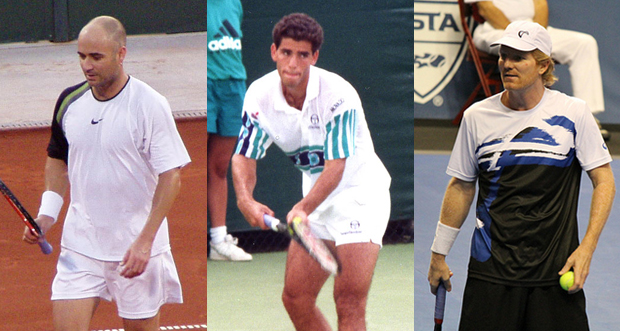
    Andre Agassi Pete Sampras Jim Courier

    Last of the Great Americans
    The United States has always been central to men’s tennis, from early greats like Richard Sears, William Larned, and Bill Tilden to the “golden age” of the 30s to 50s, with stars like Ellsworth Vines, Don Budge, Bobby Riggs, Jack Kramer, and the great Pancho Gonzales. American men’s tennis dipped in the 60s and then resurged with Stan Smith and Arthur Ashe being the harbingers of the first Open Era superstar, Jimmy Connors. Jimmy passed the baton to John McEnroe, who in turn passed it to Andre Agassi and Pete Sampras, the twin stars of Gen 8.

    This was the last great—and probably greatest—generation of American men’s tennis. This generation included two (Sampras and Agassi) of the four greatest Open Era Americans (along with Connors and McEnroe), as well as a strong supporting duo in Jim Courier and Michael Chang.

    [divider]

    Click here to discuss “Open Era Generations, Part Ten” in the discussion forum.

    [divider]

    Players by Birth Year
    1969: Cedric Pioline (FRA), MaliVai Washington (USA), Alberto Mancini (ARG), David Wheaton (USA)
    1970: Andre Agassi (USA, 8), Jim Courier (USA, 4), Todd Martin (USA), Marc Rosset (SWI), Magnus Larsson (SWE)
    1971: Pete Sampras (USA, 14), Goran Ivanisevic (CRO, 1), Sergi Bruguera (ESP, 2), Richard Krajicek (NED, 1), Wayne Ferreira (SAF)
    1972: Michael Chang (USA, 1), Patrick Rafter (AUS, 2), Jonas Bjorkman (SWE)
    1973: Greg Rusedski (CAN/UK), Alberto Berasategui (ESP), Albert Portas (ESP)

    Discussion
    This was a very talented generation, with 33 Slams distributed among eight players, including two who could be considered all-time greats and three other multi-Slam winners.

    It is easy to forget how good Courier was for a few years, as he was historically well overshadowed by Sampras and Agassi. He was a player who wasn’t as naturally gifted as his contemporaries, but played his heart out to the tune of four Slam titles, all within 1991-93. He finished 1992 as the year-end No. 1, then 1993 as year-end No. 3, and then finished in the Top 10 only once more, in 1995, despite playing through the decade.

    Pete Sampras was to the 90s what Roger Federer was to the 00s: the premier player by a good margin. He was never able to win the French Open — not even coming close, really — but he dominated Wimbledon with seven titles and the US Open with five. While some might look at his Slam performance record and think that it doesn’t compare to those of the recent three greats because of Sampras never winning more than two Slams in a year, and with plenty of first week losses even in his prime, it must be understood that the tennis of the 90s was a more diverse game in terms of the courts, before the surface homogenization that has taken place over the last decade or so.

    Sampras was also considered by many to be the best player of the Open Era until Federer, Nadal, and Djokovic came along. He was such a dangerous player; one of his most notable skills was his incredible second serve, known to deliver many an ace. The lone match between Sampras and Federer is must-watch tennis:

    Andre Agassi was no less memorable than Sampras, although more for his storied career than his play – although he was a great player, just not on the level of Sampras. Andre essentially had two careers: the first being a fiery and troubled youth who finished in the Top 100 at age 16 in 1986, although did not win his first Slam until six years later in 1992. Andre’s career unraveled in 1997 when he played only 13 tournaments and dropped to No. 110. He came back slowly at first in 1998, but then had his best year in 1999, winning two Slams and earning the year-end No. 1 ranking. He was the elder statesman of the game in the early 00s, for a few years after Sampras had retired, becoming the oldest player to be ranked No. 1 in 2003 at the geriatric age of 33, remaining in the Top 10 past the page of 35.

    Underachievers and Forgotten Players
    There is no clear player in this generation that I’d call an underachiever, although many players who have glimmerings of it. Agassi was an underachiever in his youth, but made up for it later on. I cannot remember the source, but I believe it was an interview on NPR in which Andre stated that he hated tennis and resented his family for pushing him into it – at least early on. Michael Chang could also be considered an underachiever in that he won his only Slam at the tender age of 17, but his overall skill set was more comparable to the better Slam-less players and overall he had an excellent career.

    Jim Courier is an interesting case in that he could be considered both an under- and overachiever. He is an underachiever if you look at his career through 1993 when he turned 23, which included four Slams and a year-end No. 1 in ’92, and compare it to 1994 onward – when he never won a Slam or even made it to another final. But he could be considered an overachiever in that for those few years in 1991-93 he maximized his modest talent and was one of the best players in the game.

    Two other players that come to mind, who probably fit the term better: Goran Ivanisevic, who had the skill-set to be a dominant grass and fast-court player but only won a single Wimbledon; and Richard Krajicek, an almost great but flawed player who was the only peer of Sampras to have a winning record against the generation’s greatest player, but only a single Slam winner.

    Did You Know?
    One of my favorite stories from this generation is the tale of Goran Ivanisevic – one of the greatest servers in the history of the game, and one of the ten or so best players of the 90s. Imagine Ivanisevic in 2000: he ended the year 29 years old, had seen his ranking fall each year from No. 4 in 1996 to No. 129 in 2000. The big Croat had lost the three Slam finals he had played in, all at Wimbledon – one to Agassi, two to Sampras. 2001 looked to be no different. He went out in the first round of qualifications at the Australian Open, didn’t play in the French Open, and entered Wimbledon ranked No. 125.  He then proceeded to plow his way through the rounds, defeating everyone from Carlos Moya to an 18-year old Andy Roddick, Greg Rusedski, Marat Safin, Tim Henman, and then finally facing–and defeating–third seed Patrick Rafter in the final in five sets, becoming the first wildcard ever to win Wimbledon. I guess it is never too late; Ivanisevic should remain an inspirational story for Slam-less players in the twilights of their careers.

    Top Ten Players of the Generation

    1. Pete Sampras
    2. Andre Agassi
    3. Jim Courier
    4. Michael Chang
    5. Patrick Rafter
    6. Goran Ivanisevic
    7. Sergi Bruguera
    8. Richard Krajicek
    9. Todd Martin
    10. Wayne Ferreira

    Honorable Mentions: Cedric Pioline, Greg Rusedski, Jonas Bjorkman.

    The top three are very easy to rank. After that you could make an argument for different orders of numbers 4-7, although I like Chang’s longevity better than the other three. Chang was, in a way, the 90s version of David Ferrer, but if Ferrer had managed to sneak a Slam in. Rafter won two Slams, but had a relatively short career. Sergi Bruguera was the definition of a clay-court specialist. He won two French Opens, made the final of another and the semifinal of a fourth, yet never made it past the 4th round at any other Slam.

    Richard Krajicek is an interesting player in that he is one of the few to own a winning record against Pete Sampras, including beating him in the quarterfinal of the 1996 Wimbledon en route to his lone Slam title. It was Sampras’ only loss at Wimbledon between 1993 and 2000. After Krajicek, I ranked Martin and Ferreira in the top 10, but the honorable mentions are all close.

    [divider]

    Cover Photo (Creative Commons License): Chris Josefy / James Marvin Phelps / shinyasuzuki

  • Slam Results – Consistency and Era

    Slam Results – Consistency and Era

    Roger Federer Pete Sampras Bjorn Borg

    I have often been struck by how amazingly consistent some of the contemporary great players are, and how it seems they are far more consistent in terms of Slam results than in past eras. I wanted to see if my hunch was correct, so I looked at all players who had won 4+ Slams in the Open Era (except for Ken Rosewall), plus Andy Murray added in the mix (as the player currently active with the best chance at 4+ Slams). I came up with a list of 16 players, who I then checked for a few statistics: total Slams, Quarterfinal appearances, % of Slams that were QF or better, Streaks of QF appearances at Slams, and years in which the player was in the QF of all Slams he appeared in (minimum 2 appearances).

    The results were somewhat surprising. First of all, when I compared the Big Four to the previous generation of greats, namely Sampras and Agassi, but also Courier, I found that the Big Four are far more consistent. Here are those players:

    QF% (longest QF streak, years of all QF)
    Murray: 62% (15, 4)
    Djokovic: 75% (22, 5)
    Nadal: 69% (11, 4)
    Federer: 69% (36, 8)
    Sampras: 56% (11, 2)
    Agassi: 59% (6, 5)
    Courier: 36% (5, 0)

    As you can see, the recent greats–in particular Djokovic and Federer–have been more consistent. Rafa’s QF% is the same as Roger’s, but his penchant for occasionally going out earlier has reduced his overall consistency. What really stands out for me in this list are two things:  Novak’s amazing QF%, and Roger’s ridiculous streak of 36 straight Slams, plus his eight years of making at least the QF in all Slams.

    Let’s dial back to another generation plus:
    Becker: 50% (5, 1)
    Edberg: 48% (5, 1)
    Wilander: 45% (7, 2)
    Lendl: 60% (13, 5)
    McEnroe: 58% (10, 4)

    As always, Becker and Edberg are neck-and-neck. Wilander was great in spurts, but bad in other years. Lendl was remarkably consistent in a very competitive era. Overall it seems the numbers are in line with Agassi and Sampras.

    One more jump:
    Borg: 78% (12, 6)
    Vilas: 39% (8, 3)
    Connors: 72% (27, 12)
    Newcombe: 55% (8, 2)

    Clearly Borg’s numbers are skewed by his shortened career. Connors’s numbers are surprisingly good, but we need to remember that in a lot of years he (and Borg) only played two or three Slams, which is easier to make it far in every appearance.

    So while it seems that the current group of greats are historically more consistent than most eras, there’s a range across the decades, so it doesn’t seem clear that the factors of the game today allow for greater consistency (the so-called court homogeneity), or if it simply could be that the current crop is just so damn good. I imagine its a combination of both.

    What do you think?

    Click here to discuss “Slam Results – Consistency and Era” in the discussion forum.

    [divider]

  • Ongoing Commitments

    Ongoing Commitments

    Federer Kavcic AO 2014 -1

    As intimated earlier in the week, one of the more fascinating battles going on this week has been waged not between players, but between the media and the English language. This has entailed an exhaustive quest for original ways to describe the prevailing atmospheric conditions. Rennae Stubbs found a way, though it didn’t necessarily lead to victory: “Can she survive in this heat, which is extraordinarily hot?” Rhetorically, we might generously call this a polyptoton, although it would exhaust generosity to call it a good one. On the other hand, Serena Williams’s assertion that the Australian Open is “a great start to the beginning of the year” is just a tautology. That’s okay – words are not her business. Her business is winning tennis matches. Thankfully Darren Cahill was on hand to explain in simple terms how she not only continues to do so, but is actually getting better at it, in clear defiance of her age.

    Today Williams faced Daniela Hantuchova, who several days ago achieved the rarest feat in tennis: prompting the commentators to add a new line item to her official fact sheet. In this case the new fact is that she can play the piano, an astonishing feat that was demonstrated to the gobsmacked Australian media several days ago, who summarily dubbed her “a concert pianist”. The fact sheet having been amended, there’s now a legal obligation to bring up her astounding musical prowess whenever she appears on screen. From today: “She’s so good at so many things: tennis, piano . . .” The media love nothing more than celebrities – athletes, actors, US presidents – demonstrating hitherto unrevealed musical talents, no matter how meagre those talents truly are. The fact is, Hantuchova is a concert pianist in the same way that I am a professional tennis player. YouTube suggests her pianistic wizardry has been revealed many times before. (For the record, Williams was out of sorts, but still won. Hantuchova played very well.)

    Of course, supplementary talents don’t have to be musical. Anything not directly related to tennis will do, down to and including functional literacy. More than once I’ve heard Janko Tipsarevic called a “borderline genius” because he has read Dostoevsky. Perhaps Benjamin Becker should try that, since the poor guy’s fact sheet hasn’t been updated in nearly eight years, and still only features two items. Firstly, he isn’t related to Boris (Boris confirmed this personally in the Australian Open’s draw ceremony). Secondly, he was the guy up the other end in Andre Agassi’s last match (Boris also mentioned this, amply fulfilling his ongoing commitment to supply no insight whatsoever).

    Speaking of Agassi, he’s back on Australian television screens this year, fulfilling his ongoing commitment to talk very slowly over thinly-disguised Jacob’s Creek commercials. The overall success of the campaign is apparent in this year’s expanded budget. This time the ads are shot on location, and feature an extended cast including Steffi Graf, Agassi’s brother Phil, his Dad Mike, and Gil Reyes (who was included last year, but this time has more to do). The glacial solemnity of the delivery and the intrusive soundtrack as ever lend Agassi’s inspirational words a slightly creepy edge. It’s no stretch to imagine the weapons-grade sentimentality of the opening film breaking tough prisoners at a secret torture facility. After that, however, something miraculous happens — the rest of the ads are actually pretty good. As far as I can tell they each reprise material already featured in Open, but that’s understandable; any anecdote worthy of a wine commercial shouldn’t be omitted from one’s autobiography. ‘Magic’, the fourth and final film, is a trifle overwrought, with a syrupy orchestral track and a “magic mountain”. This mountain is the one Agassi would famously toil upon in order to prepare for Australia’s cruel conditions, its magic evident in its efficacy. Few players have mastered those conditions more thoroughly. Thirteen years ago I watched Agassi run David Prinosil into the ground on a very hot Melbourne afternoon, until the German keeled over and couldn’t get up. Times were different, and I don’t recall that it was regarded as a moral issue. If Prinosil was still playing, no doubt it’d be on his fact sheet.

    For the longest time, networks kept their fact sheets safely out of sight, but no longer. Channel 7, in line with its “ongoing commitment to the evolution of tennis coverage”, has recently taken to sharing selected titbits before each match. A box pops up on screen, titled “Things You May Not Know”. For example, did you know that Sam Stosur loves to play “Bejeweled Blitz” on her phone? I hope not. Did you know that Hantuchova loves the film Gladiator? Of course you did: she’s a professional tennis player, and they all do. Apparently Benoit Paire is called ‘‘The Stork” because he is tall and thin. Just in case you assumed it was because he is a qualified midwife. Last night he recovered from two sets down, running Nick Kyrgios into the ground on a very hot Melbourne evening. It was tremendous entertainment, initially contoured by the Frenchman’s forehand, which for long periods barely worked at all, and later by the Australian’s legs, which gave out entirely. Given his technical issues, it was a commendably patient performance from Paire, laced with just enough of his characteristic lunacy to keep things interesting. Kyrgios is the image of untrammelled youth on court, but afterwards was as gracious and thoughtful as you could hope for.

    Juan Martin del Potro last night contrived to lose to a laudably determined (and surprisingly inspired) Roberto Bautista-Agut. Del Potro was considered a pre-tournament favourite, or at any rate represented the sole reason to believe Rafael Nadal wouldn’t reach the semifinals unhindered. Nadal wasn’t significantly hindered by Thanasi Kokkinakis, conceding just eight games, although those eight games were accumulated with sufficient panache that Australians now feel some reason to maintain hope for the future, a rare sensation in these Tomic times. Andy Murray was completely untroubled by Vincent Millot, even, it turned out, when he trailed 1-5 in the third set. Roger Federer was imperious against Blaz Kavcic for two sets, then merely good enough for one more. The main interest, apparently, was that Federer was scheduled to play on Hisense Arena, the first time this has occurred since Gladiator appeared on DVD, to the collective ecstasy of both professional tours. Britain’s The Telegraph contended that this reflected Federer’s “current status among the also-rans of the top 10”, although they failed to address what this says about Murray, who as of the third round will have played on Hisense twice. Interviewed after the match, Federer gave every impression that he didn’t much care where he played, though the Hisense crowd couldn’t have been more delirious in their appreciation that he’d played right there in front of them.

    Gilles Simon followed up his complicated five-set victory against Daniel Brands with another against Marin Cilic, all on a broken foot. Details have been slow to emerge, but it seems Cilic served for every set at least fifteen times, and that at one stage play was suspended when an escaped panther wandered onto court. Simon will next face Jo-Wilfried Tsonga. Florian Mayer beat Jerzy Janowicz in straight sets today, a stunning upset that more or less everyone expected. Janowicz’s form convinced no one this week, and after losing he conceded he hadn’t spent sufficient time on Magic Mountain, mostly due to injury. He struggled mightily in the heat, but insisted it was his own fault, an unpopular attitude that will certainly go unreported. Mayer will next face David Ferrer, whose quarter is so short on marketable quality that he has already played twice in Rod Laver Arena. It could be, per The Telegraph, that this merely reflects his exalted position among the elite, but I doubt whether anyone truly believes that. If he’d been drawn in the top half, one doubts whether he’d see the inside of Laver before the quarterfinals. He’d be confined to Hisense, in much the same way that Javier Piles once confined him to an extraordinarily hot ball-closet for shirking his piano practice. Or so the official fact sheet says.

  • Andre Agassi and Stefanie Graf on the Mysteries of Success

    Andre Agassi and Stefanie Graf on the Mysteries of Success

    “It is an illusion to think that setting goals and achieving them makes you happy.”

    By Stefan Wagner.

    Reprinted with permission from The Red Bulletinredbull-com-logo 80

    [divider]

    THE RED BULLETIN: Together you’ve won 30 Grand Slam tournaments, earned fortunes, achieved worldwide popularity and business success.  You raise millions for children’s charities, look after young tennis players, have a strong marriage and are bringing up happy children.  Everything you touch seems to be successful, but what was it like after the end of your tennis careers?  Did you have to relearn what success is? A tennis tournament begins on a Monday, the goal is victory in the finals on Sunday:  that’s relatively straightforward.

    STEFANIE GRAF: And on the Monday you get the new rankings, which tell you where you stand. When I was still playing tennis, a friend once said to me, “You’re so lucky, you can say that you are the best in something.” Today I understand better than ever what he meant. This phrase provides a certain kind of security. A doctor or a therapist never knows exactly how good he really is, there’s always the question of whether or not he could be better.

    Was it easier for you playing sport than it was afterwards?

    SG: No, there were different questions.  For example, whether the success that you have achieved is actually what you wanted to achieve. For a sports player these questions go even deeper with age.

    ANDRE AGASSI: I have my own view of success.

    Which is?

    AA: I believe success is an illusion.

    But you won all four Grand Slams, over $31 million in prize money and were world number one. That is an illusion?

    AA: Success in itself, as an end in itself, is an illusion. Whether it’s in sport or a charitable foundation. Let me put it this way: in the last year, Stefanie has helped 1,000 children with her Children for Tomorrow foundation – and even if it were 2,000, there are still umpteen thousand out there that she can’t help.  Would you describe that as success?

    It would be crazy not to.

    AA: It wouldn’t, because you describe something as success that isn’t actually success. In tennis I learned that the final isn’t the goal, it can’t be. That would have meant, ‘Shit, on Monday it all starts again.’

    Following your logic, Roger Federer isn’t a successful tennis player.

    AA: He is, of course – but not because he’s won the most Grand Slam titles, but because he’s the all-time best, which he is beyond a doubt, and yet he still tries to develop. True excellence is the person who understands that success won’t come sometime in the future, but rather here, now. As soon as I understood that, a few important things became clear: it’s not what I do that’s important, it’s how I do it. I won’t accept not giving my best.  I won’t accept not wanting to be better.  Every day, I have to try to be better, no matter what the scoreboard says or what the world rankings say, or how much I’ve raised in donations.

    But you can’t separate ‘success’ from goals which are objectively set and attained.

    AA: Yes you can. In fact you have to. Try it! Set yourself a goal, work hard to achieve it – will it make you happy? No. It’s an illusion to think that setting goals and achieving them makes you happy.

    How much money have you raised in the last 15-20 years for your charity projects?

    SG: I concentrate on the necessary amount year by year. In total it’s millions, many millions.

    AA: For me, over the years it’s been almost exactly $175 million.

    And do you know how many children you’ve helped?

    SG: In the past year it was 1,000 children, which was our highest number for 15 years.

    AA: Recently we had 1,300 children per year in our academy.

    But you must regard that as success?

    AA: Success isn’t what comes out, but what you put in. Doing things completely or not at all. Caring about what you do. When it comes to charity:  invest yourself in your project. Find out how you can make something exceptional out of it. Does your fame help? Do you have to collect donations yourself? Will you have to spend time away from your children to give interviews? Then you have to do it with all your heart. When it comes to tennis: find out what you’re responsible for, and concentrate on that. Work on your fitness, on your stroke. Don’t lie to yourself and look for shortcuts. Success isn’t a result. Success is a way of living you choose for yourself.

    So success is subjective, not objective?

    SG: Absolutely.

    AA: When you see success as a goal, you’ll never be successful. Because it becomes like an addiction, you can never have enough. Never.

    But how do you measure success?

    SG: By how you feel when you go to bed at night.

    More and more tennis pros come to you in Las Vegas to learn from you.  What can you teach these players, some of whom are world class?

    SG: Actually sometimes it is about technique. Not the basics, sure, but there’s often room for tips.

    You once said that you could teach a young player in 10 minutes what you learnt in 10 years. What would happen in those 10 minutes?

    AA: There are a few things that are important to me, simple things. For example, that there is only one important point you play in life, that is, the next one. And that you should concentrate on the things that you can influence –you can control your attitude, your work ethic, your concentration. If it’s windy or hot or something aches or you’re tired from the match yesterday, then you have to accept it. I also try to teach young players that tennis isn’t a sport where you’ll get perfection. There’s no 100 per cent tennis. There is only the 100 per cent that is within you on the day. It’s all about bringing out your own 100 per cent.

    SG: I can’t put it as succinctly as Andre, I couldn’t fit it all in 10 minutes. Also I see my task a little differently:  I don’t give life lessons. I prefer listening to talking.

    Feature_AgassiGraf_EN-1 125

    In Open [Agassi’s gripping and brutally honest autobiography], there are descriptions of depressive episodes, even after winning Wimbledon and becoming number one in world rankings. Was the pain of losing really stronger than the joy of triumph?

    AA: Yes, and that still applies.

    How do you deal with it?

    AA: I’ve learned to enjoy every moment.  A good day with a major final, that’s a good moment. But you have to learn to value all the moments before that led to it. The moment of victory can’t be better than the moment of preparation. Learning that is pretty much a question of survival for a tennis player.

    SG: Andre’s right. The feeling you have after a victory fades so quickly. What we call success has a terribly short half-life.  You would have been amazed if you’d seen Andre or me after a major victory.  There was some relief, maybe, but no rejoicing or excitement. After a major victory there’s an emptiness, a routine, ‘Let’s go home, we’re done here.’

    That sounds really sad.

    AA: Oh, it is. Learning to see things differently is utterly essential. The day in the weight room, on the training court– that has to count just as much as finals day at Wimbledon. Not understanding that can be dangerous, because you make bad mistakes. So you think, for instance, that money is important, but money is nothing more than an expansion of opportunities for spending your time. Money can’t make you happy. When you’re happy with the opportunities that come with less money, money completely loses its significance. Money is a means to an end, not an end in itself. Exactly the same as what you’ve been describing as success: Success isn’t an end in itself. Success doesn’t mean winning.

    Not many world-famous sportspeople would say that. How does an athlete come to think like that?

    SG: Life is a good teacher, whether you’re a tennis player or not. You just have to ask yourself one question and answer it honestly: is the life I live the life that I want to live?

    Did you already have that attitude during your career?

    AA: At 27 I was number one in the world, I had won Grand Slams, I had taken drugs, I was divorced, I fell to number 141. I was unhappy.  And I had to make a decision: do I keep playing tennis or not? That was the moment when I thought, even if I didn’t choose tennis for myself, because my father did that for me, perhaps tennis will give me the opportunity to get my life together. To do that I needed some meaning in my life. The school I built was that meaning. And so tennis had a purpose, tennis allowed me to create and maintain something which is really important. Suddenly it was all completely simple:  tennis became a tool with which I could do something I really wanted to do.

    You said that fear is a great motivator.  Given your life story, what you suffered as a child through fear and pressure – did you really mean that?

    AA: The fear of losing is an important motivator. Fear of not making the best of a situation.

    It seems as if you raise your children without fear. With your charities you try to make the lives of others easier.

    AA: But the fear of losing stays. That doesn’t go away. Ignoring the fear doesn’t help. I have a fear of failing my children: that fear is good and right, because it keeps me alert.

    Is there such a thing as a life without fear?

    AA: We humans can love and hate, we feel joy and fear, all these emotions are within us. It would be wrong to try and turn one of them off. Quite apart from the fact that it would be impossible.

    Can you raise a child to be successful in the conventional sense of the word?

    SG: No.

    AA: But you can screw it up.

    SG: That’s something we’re really afraid of, that we screw up with our kids.

    AA: You can teach someone to put the scoreboard ahead of everything. But that would be wrong. Children have to learn to push themselves every day.  For themselves, not for anyone else, certainly not for a scoreboard. When you see the result on the scoreboard, that’s a bonus. But what’s on the scoreboard shouldn’t be the meaning of life. Life is bigger than any scoreboard.

    www.childrenfortomorrow.de

    www.agassifoundation.org

    Photography: Longines

  • Nadal the Great, Part 1: Rafa’s Window of Opportunity

    Nadal the Great, Part 1: Rafa’s Window of Opportunity

    6227268072_bcda2ed57b_b

    [This is the first of two thematically-linked articles focusing on Rafael Nadal and his quest for greatness; the second article will be out in a day or two.]

    Rafael Nadal turned 27 years old a few months ago, about a week before winning his 8th French Open and 12th Slam overall, at that point and now, with his 13th Slam victory, standing behind only Pete Sampras (14) and Roger Federer (17) for the most Slams in the Open Era; if we include pre-Open Era Pro Slams–as I think we should–we add a few others so we get the following list:

    Most Slam Wins in Tennis History (Pro, Amateur, and Open Era)

    23 Ken Rosewall
    19 Rod Laver
    17 Pancho Gonzales, Roger Federer
    14 Bill Tilden, Pete Sampras
    13 Rafael Nadal

    With 13 Slam wins and, still only 27 years old, playing some of the best tennis of his life, it’s reasonable to start taking seriously the idea that Nadal could surpass Federer. Now with a player as great as Nadal there are few comparable players – once you get to this level anything is possible and new benchmarks can be made. And of course Nadal, like all of the greats, has his unique style of tennis: a blend of tremendous athleticism, defensive prowess, unrivaled topspin that has been the bane of many a player, and of course his perhaps unparalleled tenacity. (For those watching the US Open Final, you might have heard John McEnroe say that he thought Jimmy Connors tried harder than any player in tennis history until Rafa came along.) But it is still important to ask: What are the precedents? In particular, how many Slams did the above players win after turning 27? And of players with fewer Slams, how many of their total were won after their 27th birthday?

    [divider]

    Click here to discuss “Nadal the Great, Part 1: Rafa’s Window of Opportunity” in our discussion forum.

    [divider]

    Let’s take a look. We’ll start with the above list of “inner circle greats” with the seven highest total Slam victories. We’ll also look at those players in the Open Era that won 6+ Slams, although will exclude those players who did not (or have not yet) played at age 27: Bjorn Borg – who played his last Slam at age 25 – and Novak Djokovic, who is 26. I’m also going to exclude Bill Tilden because he played tennis during a very different era; coupled with the fact that he didn’t win his first Slam until age 27 and won his last at age 42 (!), he skews the numbers in a way that has little relevance to the current game. In truth, we could easily exclude Gonzales, Rosewall, and Laver as well, but I’d like to include them as other “GOAT” candidates (more on this in the second part).

    This gives us a list of 14 players: GOAT candidates Rosewall, Laver, Gonzales, Federer, Sampras, and Nadal, as well as “outer circle” all-time greats John Newcombe, Jimmy Connors, Ivan Lendl, John McEnroe, Mats Wilander, Stefan Edberg, Boris Becker, and Andre Agassi. As of last night, those 14 players have won a total of 160 Slams.

    To start, let’s take a look at the age at which those Slams were won. For the sake of ease, by age I mean the age a player turned in a given year, not the time period between their birthdays. So, for example, any Slam in 2013 is part of Nadal’s “age 27 season” – even the Australian Open, during which he was still 26. Obviously this isn’t exact, and it doesn’t differentiate between players who were born in January versus December, but it’s close enough for the purpose of this study. We’ll be more exact in a moment when we turn our gaze to his closest contemporaries.

    20130910050234

    As you can see, plenty of Slams were won up until the age 31 season but there’s a steep and remarkable drop-off at age 32 and beyond. (As a side note, it is worth mentioning that 2012 was Federer’s age 31 season, and this year is his age 32 season, so he follows this pattern quite well.)

    Of those 14 players, three did not win a Slam at Rafa’s current age – Wilander’s last was at age 24, McEnroe’s at age 25, and Edberg’s at age 26. The rest, however, did win Slams at age 27 and older.

    Rafael Nadal has 13 Slams through his age 27 season. Of the 160 Slams above, 107 were won through age 27, or 67%. If Nadal follows that same ratio, it means he’ll end up with 19 Slams. But note that of those 53 Slams won at age 28 and later, 32 were won by Pancho Gonzales, Ken Rosewall, and Rod Laver – players whose primes were in a very different era. If we take those three out of the mix, we’re left with 101 Slams total and 21 won at age 28 and older – only 21% compared to the 33% total. If Nadal follows that trajectory, it means that he’ll finish with 16, maybe 17.

    Now let’s look more closely at Nadal’s closest contemporaries: Federer, Sampras, and Agassi. Between the three they won 39 Slams. Of those 39 Slams, 12 were won at age 28 or later – or 31%. If Nadal follows a similar pattern, that means his 13 Slams is 69% of his total, and that he’ll win 17 or 18 total.

    Those numbers are somewhat skewed by Andre Agassi’s remarkable longevity. Agassi is the rare player who was better in the second half of his career than he was in the first half, winning five of his eight Slams during his age 29 and later seasons. Sampras and Federer, on the other hand, won seven of their 31 total at age 28 and later – or 23%. So it really depends upon whose career path Nadal is closer to.

    Let’s be a bit more specific with Federer and Sampras. Federer turned 27 on August 8, 2008, shortly before winning his fifth and last US Open. From his 27th birthday on, he’s won five Grand Slam tournaments (so far!), 29.4% of his total. Three of those five were before his 28th birthday, so after turning 28 he has won only two Slams.

    As for Sampras, he turned 27 on August 12, 1998, shortly after winning his 11th of 14 Grand Slams. He won his 12th just before turning 28, his 13th just before turning 29, and his 14th just after turning 31.

    Between Federer and Sampras, they won 23 of their Slams before turning 27 (74%), four at age 27 (13%), and four after turning 28 (13%).

    Nadal has one more Slam before his 28th birthday — the 2014 Australian Open. So far he’s won two Slams at age 27, so has a chance of equaling Federer’s three while 27-years old. Yet here’s where the “window of opportunity” starts to close. Both Sampras and Federer won only two more Slams each after turning 28 (again, so far – we should completely write Roger off…yet). So if Nadal follows their career pattern – and even if he wins the AO to get to 14 – he’ll finish with 16 Slam wins; that’s certainly nothing to be ashamed about but not quite enough to catch Federer.

    But remember also that Andre Agassi won five Slams after turning 28 – and he isn’t the only player to do so; Rosewall, Laver, and Gonzales all won that many or more after turning 28. It could also be said that, in some ways, Nadal plays a style more similar to Agassi than Sampras and Federer. While it should be said that one commonality that just about every all-time great has, especially the inner circle greats, is that they were adept at offense and defense, like Agassi, Nadal plays a more defending than attacking tennis. Whether there is any correlation between this and longevity is questionable.

    Some have explained Agassi’s longevity – which is unmatched in terms of maintaining an elite level of play, at least since Ken Rosewall in the 1970s – to him missing significant periods of time earlier in his career, and thus avoiding the grueling schedule that Sampras and, more so, Federer has undergone. Rafa has missed some time, although not nearly as much as Andre.

    Another thing to bear in mind is that both Sampras and Federer were great servers – Sampras arguably the greatest in tennis history, and Federer certainly among the greatest – while Nadal has been considered a particularly weak server for such a great player (although his serve of late seems to have taken on new guile and spin, last night notwithstanding). Just recently some commentator or analyst—unfortunately I can’t remember whom—said that the reason Federer is struggling so much is that his serve has been off. It makes me wonder if the fact that a larger portion of Sampras’s and Federer’s greatness comes from their serve than, say, Agassi or Nadal, which makes decline after losing an edge on serve more certain.

    Obviously Nadal’s longevity is tied into his health, particularly his knees. It is hard to imagine his knees holding out for another half decade of healthy tennis. But until they go, that is, until Nadal finds himself missing more tournaments than not, and struggling with recovery times, he should remain a top player. I would guess that when he starts to “go”, it will happen fast. I can’t help but imagine that Nadal is currently playing on borrowed time, although as a fan of the game I certainly hope not.

    In conclusion, we started with asking the question: What is Rafa’s window of opportunity for continued greatness and Slam contention? Is it closing? If not, when will it close? There really is no way to definitively answer those questions – but that’s not the point of this article. What I’m trying to do is develop an informed opinion, one that is flexible but has an awareness of context.

    In the end I’m left with this: It all depends upon the health of the knees, which he relies upon for his incredible speed and endurance. But given his incredible will and tenacity, I suspect that Rafa has a few good years left in him. There may be bumps in the road, and the older one becomes the longer recovery from injury takes, but Rafa has given us reason to believe that he will—like other all-time greats—remain effective into his 30s. After age 31, all bets are off, but that still gives us about four years of potential greatness from the Spanish Maestro, and in that time he has a chance to build a case to be considered the greatest player of all time. But more on that next …

    Photo by globalite (Creative Commons license)

    Original chart made using onlinecharttool.com

  • American Men’s Tennis and the Cycle of Ages

    American Men’s Tennis and the Cycle of Ages

    5638812812_0691415a18_o

    Photo by Neon Tommy (Creative Commons License)

    Consider the following as an addendum, or second part, to the previous blog in which I looked at the decline of American men’s tennis. In this entry we’ll look at the big historical trajectory of men’s tennis, and from a slightly different perspective: that of mythology.

    Various mythologies throughout the world – such as Greek, Indian, and Mesoamerican – hold that the world passes through great ages of time. While there are differences between these myths, they are also remarkably similar in that all start with some kind of paradisiacal “Golden Age” from which there is a “fall” and further decline into successively lesser ages. The Golden becomes the Silver, then the Bronze, and finally the Iron or Dark Age. Some of these mythologies hold that this process is cyclical, so that the Dark Age will eventually transition into a new cycle, even a new Golden Age.

    It struck me how American men’s tennis has gone through its own cycle of ages over the last four decades (and perhaps before).

    The Golden Age (1974-1984) had its beginnings in the early 70s with the elder statesmen Arthur Ashe and Stan Smith, but did not truly arrive until the peak of Jimmy Connors, the first truly dominant American male player since Pancho Gonzales. American men dominated the rankings from the mid-70s into the mid-80s. Perhaps the most dominant year was 1979 when the #2-5 players were all American (Sweden’s Bjorn Borg was #1), and seven of the top 10 were American. From 1974 to 1984, an American held the #1 ranking for all but two years, in 1979-80 when the great Swede was at the top of the game.

    9097572979_78970c3289_o

    Photo by University of Salford (Creative Commons license)

    There was a slight lull as the ages shifted when the two greatest players of the Golden Age, Jimmy Connors and John McEnroe, were in decline, and before the next generation of American greats arose. 1985-1988 saw no American man win a Grand Slam event, the first time since 1973 that at least one American man hadn’t won a Slam. While Connors and McEnroe were both in the top 5 in 1985, Connors was the highest ranked American in 1986 at #8, and no American male finished the year in the top 2 until Jim Courier in 1991.

    The Silver Age (1989-1999) began when 17-year old Michael Chang won his first and only Grand Slam event in 1989 at the French Open. American men began another streak of years with Grand Slam winners. Chang was joined by Sampras in 1990, Courier in 1991, Courier and Agassi in 1992, and then the reign of Pete Sampras from 1993 and beyond. While American men’s tennis was still strong in the late 80s–at least relative to the current era–it returned to dominance in the early 90s. It was not the Golden Age of the late 70s and early 80s in that while Sampras and Agassi reigned, the field was not as deep. Thus the 90s were truly a Silver Age, with two Americans – Sampras and Agassi – the most dominant players of the decade.

    502317961_f09eb6acf7_o

    Photo by pandemia (Creative Commons license)

    I mark the end of the Silver Age as 1999, when Andre Agassi was #1 and Sampras had dropped to #3. Agassi remained a dominant player for a few more years but Sampras faded quickly.

    The Bronze Age was, in some ways, a transitional era, and thus difficult to demarcate. But I’d offer that it began right after the end of the Silver Age, in 2000, which was the first year since 1991 that an American didn’t hold the #1 ranking. Sampras remained a strong player for a few years but was in obvious decline. Andre Agassi still played at a high level, even reaching #1 at the venerable age of 33 in 2003, the year that young Andy Roddick finished #1 and the last time an American held the #1 ranking. Americans hoped to see Roddick take the mantle from Agassi and Sampras, but it wasn’t to be – partially because his game was simply too one-dimensional to be a truly elite player, but also because of the rise of a Swiss player by the name of Roger Federer, who took the #1 ranking from Roddick in early 2004. Roddick went from being the top player for a short period of time at the end of 2003, to one of a few near-elites vying for the scraps left behind by Federer and, shortly after, Rafael Nadal.

    The Bronze Age was a short period, fading in the mid-Aughties, suitably without a distinct ending. Perhaps it ended when it became clear that no active American male would win a Grand Slam or be #1. This could be 2006 when Roddick dropped out of the top 5, or it could be 2011 when he dropped out of the top 10 – or 2012 when he retired.  No one stepped up to carry the mantle of American spokesman. I’m considering 2005 as the last year of the Bronze Age, for it was the final full season of the last truly great American tennis player, Andre Agassi, who finished the year at #7. Andre played a few tournaments in 2006 but didn’t win any and finished the year #150.

    Legg Mason Tennis Tournament 08/08/09

    Photo by Keith Allison (Creative Commons license)

    We are currently in the Dark Age of American men’s tennis, with no player in the top 10, and no elite player on the horizon. While the present and foreseeable future of American men’s tennis looks bleak, we must remember that the wheel turns and a new Golden Age may come around again. 1961 saw the last Slam win by Pancho Gonzales, the greatest American men’s tennis player of the couple decades before the Open Era, and probably the greatest overall player of the 1950s. In a way we could say that Gonzales was to the pre-Open Era what Sampras was to the Open Era – the leading player of a Silver Age. Early in his career and before him saw other American greats such as Jack Trabert, Pancho Segura, Jack Kramer, and Bobby Riggs, and some years before them you have Ellsworth Vines and Don Budge, and before them the great Bill Tilden.

    The point being, American tennis did not begin with Jimmy Connors, but it was with Connors that it returned to dominance. The late 1950s to early 1970s was dominated by Australian greats Rod Laver, Ken Rosewall, Lew Hoad, Roy Emerson, and John Newcombe. When Arthur Ashe won the 1968 US Open he was the first American to win a Slam, amateur or pro, since Chuck McKinley won Wimbledon in 1963. So the mid-60s were a dark period for the Americans, and only slowly did that Dark Age transition into the new Golden Age. In other words, we could see a transitional, or “Dawn Age” from 1968 through 1973, when Arthur Ashe and Stan Smith were among the best in the game, but not dominant on the level of Gonzales in the 1950s or Connors in the 1970s.

    So Americans can hope that this current Dark Age will transition into a Dawn Age. If history repeats itself, as it often does, then the first signs of transition will be the appearance of lesser luminaries akin to Arthur Ashe and Stan Smith – not truly dominant players, but winners, or at least serious contenders, of Grand Slams. So we will watch and wait for a 21st century Arthur Ashe to usher the way towards that next Golden Age of American men’s tennis. But we might have some time to go. And given the more international nature of the game and world, it seems likely that the next Golden Age of American men’s tennis will not be as dominant, not shine as brightly as even in the early 90s. Some relativity is involved and we must think modestly; the next Golden Age might not see the United States returning to dominance, just re-joining the elite of the game.

    3875104029_0c669ebe14_o

    Photo by freezr (Creative Commons license)

    [divider]

    Click here to discuss “American Men’s Tennis and the Cycle of Ages” in our discussion forum.

    [divider]

  • Houston, We Have A Problem: The State of American Men’s Tennis

    Houston, We Have A Problem: The State of American Men’s Tennis

    Preamble

    Mardy Fish retiring from the US Open got me thinking about the state of American men’s tennis. Here is a current list of the American men in the top 100, with their age in parentheses:

    #14 John Isner (28)

    #29 Sam Querrey (25)

    #87 Jack Sock (20)

    #92 Michael Russell (35)

    #97 Ryan Harrison (21)

    #100 James Blake (33)

    From looking at that list, the near future of men’s tennis looks bleak. Blake and Russell have seen their best days. Isner is probably as good as he’s going to get. Querrey is an interesting case because five years ago he looked quite promising, finishing 2008 (age 21) at #39, but he was injured and has stagnated since, seemingly establishing himself as a #20-30 type player.

    If Jack Sock and Ryan Harrison are the hope of American men’s tennis then, quite frankly, “Houston, we have a problem.” There are a few other players outside of the top 100 that have some promise, but none stand out as the next great American tennis player.

    The focus of this blog is on statistics and historical trends, so I won’t speculate too much as to the why of this, but by looking at historical trends we can begin to get a sense of whether the current lack of top American talent is part of a cycle, or whether it’s something new and potentially lasting.

    One speculative idea I do want to put forth is the question of how popular tennis is in the United States compared to prior decades, and whether or not this relates to how good the top American players are. Without having any proof other than anecdotal (which obviously doesn’t constitute proof), it is my sense that tennis is less popular today in the United States than it was during the hey-day of American tennis in the early 90s when you had Pete Sampras, Andre Agassi, and Jim Courier dominating the game. But not only is this just a guess, but correlation does not equal causation, and if there is causation it may be two-way – in other words, it could be that the game is less popular in the United States partially because there are no elite American players, and there are no elite American players partially because the game isn’t as popular as it once was.

    Let us return to the historical trends. The question I want to answer is this: How dominant have American players been in men’s tennis over the years, and how does 2013 compare to prior years? To do this I looked at the year-end rankings for the entirety of ATP history, from 1973 to 2013, with a focus on American players. What I found was quite astonishing to me. What follows is a chart that depicts the way American rankings have changed over the last four decades, with some explanation and discussion.

    [divider]

    You can discuss this post and more in our tennis forums

    [divider]

    A Few Notes on Tennis Statistics

    The ATP website has a strange lack of rankings from 1980-82; I’m not sure exactly why it is. I can’t find any other source on the internet that has year-end rankings, so while I could find the top 10 rankings, the rest of the rankings will be empty for those years. But it doesn’t make that much of a difference for this study as the years just before and after that span were very similar.

    Secondly, due to the lack of a good database for tennis statistics (although Tennis Abstract looks promising), I reserve the right to make errors! Hopefully they’ll be small, but chances are there will be one or two, hopefully small, errors along the way, but it wouldn’t change the overall weight of the statistics.

    A briefer note on Ivan Lendl: Lendl became an American citizen on July 7 of 1992. Some records denote American status for earlier years because he lived in the United from 1981 on, for the sake of this study I’m considering him as a Czech for his entire career up to but not including 1992. I feel that it’s both kinder to the Czech Republic (then Czechoslovakia) to do so, but also considering that he was born and raised in the former Czechoslovakia, it’s more accurate to consider him as a Czech for the sake of this study.


    American Rankings in ATP History

    So let’s look at the rankings. The following chart depicts the number of American men in the year-end ATP top 100, 50, 20 and 10 over 41 years of ATP history (In the case of 1980-82, I just continued from 1979 for 80-81, and made 1982 the same as 1983).

    20130821110703

    (Please click on it to see a larger, more clear view)

    When I put together this chart I was stunned by the results. I was expecting a drop off in recent years, but not to this extent. What I found particularly interesting is that the drop-off didn’t begin recently but actually back in the mid ‘80s and speeding up in the ‘90s.

    I was also intrigued to find a rise in the mid-70s. Unfortunately we don’t have rankings before 1973, but if you think of the great names of the 1960s and before, few of them were American. Americans rose to prominence with Arthur Ashe and Stan Smith in the late 1960s and early ‘70s, but it was Jimmy Connors who became the first truly dominant American men’s tennis player, at least in the Open Era, and since the earlier greats of the 1940s and ‘50s: Tony Trabert, Jack Kramer, and Pancho Gonzales, and before them Don Budge, Bobby Riggs, Ellsworth Vines, and Bill Tilden. The Australians dominated men’s tennis in the 1960s, with names such as Ken Rosewall, Lew Hoad, Rod Laver, Roy Emerson, and John Newcombe.

    Jimmy Connors changed that, ushering a new era of American tennis (with the help of Smith and Ashe). The baton (or racket, if you will) of men’s tennis was passed from Connors to John McEnroe, and then for a brief time to Jim Courier, then to Pete Sampras and Andre Agassi. And then from Andre and Pete to…Andy Roddick? James Blake? Robby Ginepri?

    The decline in the number of American men in the top 100 has been relatively minor since 1995, but what has changed is the presence of a truly great American men’s player. Pete Sampras started declining in 1999 and then retired in 2002, and when Agassi retired a few years later we lost the last truly great American player. Roddick and James Blake carried the baton as best they could, but although Roddick finished 2002 as the #1 player, his reign was short-lived as he was surpassed by superior players Roger Federer and Rafael Nadal, and become one of the “best of the rest” in the field of the Aughties.

    Andy Roddick is the last American man to have won a Slam, and also to have been #1. What may even more disturbing is that the only active American man to have been in the top 5 is James Blake, who is 33 years old and ranked #100 in the world. A couple years ago Mardy Fish – of the same generation as Roddick and a couple years younger than Blake – seemed to be a late bloomer, ranking as high as #7 in August of 2011, but a heart condition in the following year limited his play and he seems close to retirement.

    With his big serve, John Isner remains a dark-horse candidate at many tournaments and has reached as high as #9 in the rankings in April of 2012. But at age 28 he is unlikely to improve.


    Final Thoughts

    American men’s tennis is in dire straits and there is no clear end in sight. American men’s tennis rose in the mid-70s, peaked in the late 70s to early 80s, but then began a long decline in the late ‘80s, with a startling drop in the mid-90s and continued slow decline since. We can hope that, like the Once and Future King (which is, ironically enough, of the British cultural mythos), a new great young player will rise up. But who he is, or will be, remains to be seen. The highest ranked American teenager is Christian Harrison, younger brother to Ryan, who is currently #389. The highest ranked American junior is #16, Macedonia-born Stefan Kozlov, who made it to the quarterfinals of the 2013 Boys’ Wimbledon at the tender age of 15.

    Certainly, we are amidst a long winter in American men’s tennis.

    Credits: Cover Photo: Mike McCune, (Creative Commons License)