
ONCE UPON A VIKING…
Of the five great tennis nations covered in this series, three are no longer what they were: the United States, Australia, and Sweden. Whereas American dominance spread out over the majority of the Open Era in two great, interconnected eras, Swedish dominance was comparatively short – but equally dominant, at least for a time. It started with the rise of Bjorn Borg, who won his first major in 1974 and became the game’s top player by 1978, and ended with Stefan Edberg’s last Slam title in 1992. Outside of that range, only one Slam title belongs to a Swede: quintessential one-Slam wonder Thomas Johansson’s Australian Open in 2002.
Let’s take a look at the Swedish career:

As you can see, I split the chart differently than with the United States. The top chart includes the careers of Borg and Wilander, and ends with the last Slam won by Edberg. The bottom half sees the swift decline of Swedish tennis, with that lone major title in 2002.
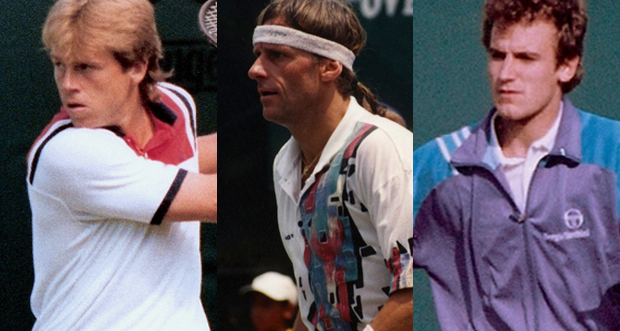
Swedish tennis was almost entirely ruled by three players: Bjorn Borg, Mats Wilander, and Stefan Edberg who, together, account for 24 of the 25 Slams. But they weren’t the only talented players during the 1980s in particular. Henrik Sundstrom, Anders Jarryd, Joakim Nystrom, and Mikael Pernfors all finished in the Top 10 at least once. Once we get to the 1990s we have players like Thomas Johansson, Magnus Gustafsson, Magnus Larsson, Jonas Bjorkman, Magnus Norman, and Thomas Enqvist.
In the early 2000s, several promising young Swedes emerged: Andreas Vinciguerra, Joachim Johansson, and Robin Soderling. Vinciguerra is a name that you might not know, but he came of age around the turn of the millennium with other promising players born in the early 80s. If you look at the 1999 rankings, there were five teenagers who finished the year in the Top 100: Marat Safin (No. 24), Lleyton Hewitt (No. 25), Juan Carlos Ferrero (No. 42), Roger Federer (No. 64), and Vinciguerra (No. 98). Whereas the other four went on to win Slams and be No. 1s, Vinciguerra—still on pace to be a great player in 2001, rising as high as No. 33 at the age of 20—saw his career derailed by a back injury.
[divider]
Click here to discuss “National Tennis Careers – Part Two: Sweden” in the discussion forum.
[divider]
Similarly, Joachim Johansson rose as high as No. 9 and finished 2004 at No. 11 at the age of 22, but struggled with a shoulder injury and eventually retired in 2008. We are all more familiar with Soderling, who is one of only two men to defeat Rafael Nadal at Roland Garros, and unlike Novak Djokovic this year, Rafa was in his prime in 2009. From 2009 into 2011, Soderling was lingering on the edge of the Big Four, but was hit by mononucleosis and hasn’t played since late 2011, although has not officially retired. So in the post-Edberg/Wilander world of Swedish tennis, Thomas Johansson’s Australian Open title in 2002 was a lone bright spot, with lesser glimmers of unfulfilled promise by several Swedes in the last fifteen years.
Ten Greatest Swedish Players of the Open Era
1. Bjorn Borg
2. Stefan Edberg
3. Mats Wilander
4. Thomas Enqvist
5. Thomas Johansson
6. Robin Soderling
7. Jonas Bjorkman
8. Magnus Norman
9. Anders Jarryd
10. (tie) Joakim Nystrom and Magnus Gustafsson
Honorable mentions: Magnus Larsson, Jonas Svensson, Henrik Sundstrom, Mikael Pernfors, Kent Carlsson, and Joachim Johansson.
The top three are not really debatable, although some would quibble with ranking Edberg over Wilander. Wilander had a higher peak, namely the 1988 season, and of course has one more Slam than Edberg. But both made 11 Slam finals, Edberg just lost one more, and this is more than balanced out by Edberg’s five more Semifinals and much greater consistency in the rankings. Wilander had one year-end No. 1 ranking, Edberg two; Wilander had seven to Edberg’s ten Top 10 rankings and eight to Edberg’s thirteen Top 20 rankings.
There’s a big drop after the Tre Stora, and here is where the debate can come in. The system I used likes Enqvist quite a bit better than the rest, but some would prefer Thomas Johansson’s Slam title or Robin Soderling’s higher peak. Certainly if Soderling hadn’t gotten mono he’d probably be fourth on this list. Some might also prefer Jonas Bjorkman at fourth, who like Anders Jarryd was a No. 1 ranked doubles player, but it is hard to argue with Enqvist’s 19 titles versus Bjorkman’s six. Jarryd, Norman, Nystrom, and Gustafsson are almost too close to rank.
The Future?
Consider that since 2008, Robin Soderling has been the only Swede ranked in the year-end Top 100. Yes, that’s right. Since 2012 there have been no Swedes in the Top 100.
But there’s hope, and his name is Elias Ymer. He’s 19 years old and as of this writing, currently ranked No. 130. Interestingly enough, Ymer isn’t your typical blond-locked Scandinavian; he’s of Ethiopian descent. Along with 23-year-old Christian Lindell (No. 188), he’s the only Swede ranked in the Top 400. Elias’ 16-year-old brother, Mikael, is also worth storing in your memory banks, but he’s a long ways off.
Elias Ymer qualified for his first Slam main draw at Roland Garros this year, losing to Lukas Rosol in straights in the first round. Yet here is something promising: at the ATP 500 Barcelona, he beat Thiemo de Bakker and Nick Kyrgios before losing to David Ferrer in the round of 16. Kyrgios, No. 41 at the time, remains the highest ranked player he has defeated.
So Ymer bears watching, although we should temper our expectations – there is no new Swedish golden age of Borg, Wilander, and Edberg on the horizon, but at least there’s someone. According to Magnus Norman, Swedish tennis has reached rock bottom and can only go up. Truly, there’s nowhere else it can go.
[divider]
Cover Photo (Creative Commons License): Carine06 / MadMarlin / Carine06