Blog

  • ATP & WTA Latest Scores, May 22: Nice, Dusseldorf, Brussels, Strasbourg

    ATP & WTA Latest Scores, May 22: Nice, Dusseldorf, Brussels, Strasbourg

    Open de Nice Côte d’Azur, Nice, France [ATP] – Round of 16

    Mathieu d Berlocq 7-5, 3-6, 6-3
    (3) Querrey d Stakhovsky 7-5, 6-3
    Roger-Vasselin d Berankis 2-6, 6-4, 6-2
    Montanes d Hanescu 7-5, 7-6(2)
    Andujar d Lu 6-2, 6-0
    Haase d (4) Isner 6-4, 1-6, 7-5

    [divider]

    Power Horse Cup, Düsseldorf, Germany [ATP] – Round of 16

    (2) Haas d Dodig 3-6, 6-4, 7-5
    Sijsling d (4) Kohlschreiber 3-6, 6-3, 6-4
    (3) Monaco d Ghem 6-4, 6-4
    Pella d (1) Tipsarevic 7-6(1), 6-1
    Kamke d Bedene 6-1, 6-4
    (6) Nieminen d Bautista Agut 6-4, 5-7, 6-3
    Hajek d Brands 6-1, 6-0
    (7) Troicki d Zemlja 6-3, 7-6(3)

    [divider]

    Brussels Open, Brussels, Belgium [WTA] – Second Round

    Stephens d Zhang 6-4, 6-0
    Peng d Govortsova 4-6, 7-6(4), 7-6(4)
    [7] Lepchenko d Baltacha 6-2, 6-0
    Kanepi d Cepelova 6-3, 6-3
    Oprandi d Goerges 6-3, 0-0
    Zheng d [1] Wozniacki 6-2, 6-4

    Brussels Open, Brussels, Belgium [WTA] – First Round

    Zheng d Burdette 6-2, 4-6, 6-3
    [6] Goerges d Vandeweghe 6-1, 7-5
    Oprandi d Oudin 6-2, 6-2
    Putintseva d Van Uytvanck 6-1, 6-0
    [5] Flipkens d Keys 6-4, 1-6, 6-2
    Kanepi d [3] Cibulkova 6-4, 7-6(6)
    [8] Peng d Arvidsson 6-3, 6-0
    Zhang d Rybarikova 6-1, 6-3
    [4] Stephens d Pironkova 6-3, 2-6, 6-3
    Hampton d Wickmayer 1-6, 6-3, 6-4

    [divider]

    Internationaux de Strasbourg, Strasbourg, France [WTA] – Second Round

    [3] Cornet d Linette 6-3, 6-4
    [7] Scheepers d Rogers 2-6, 6-3, 6-4
    Pennetta d Torro-Flor 6-2, 6-3
    Doi d [4] Hsieh 6-4, 4-6, 7-6(3)
    Hradecka d Davis 6-2, 6-2
    Larsson d Razzano 6-3, 6-3
    Tatishvili d [5] Niculescu 4-6, 6-3, 6-2
    Bouchard d Giorgi 6-3, 6-0

    [divider]

    Click here to discuss the Nice tournament, and more with fellow tennis fans on our discussion boards.

    Click here to discuss the Dusseldorf tournament, and more with fellow tennis fans on our discussion boards.

    Click here to discuss the Brussels tournament, and more with fellow tennis fans on our discussion boards.

    Click here to discuss the Strasbourg tournament, and more with fellow tennis fans on our discussion boards.

  • ATP & WTA Latest Scores, May 21: Nice, Dusseldorf, Brussels, Strasbourg

    ATP & WTA Latest Scores, May 21: Nice, Dusseldorf, Brussels, Strasbourg

    Open de Nice Côte d’Azur, Nice, France [ATP] – First Round
    (6) Fognini d Cecchinato 1-6, 6-1, 6-2
    Stakhovsky d Dutra Silva 6-2, 6-3
    Mathieu d Harrison 6-4, 6-4
    Rufin d Lorenzi 6-3, 6-1
    Monfils d Giraldo 4-6, 6-3, 6-3

    [divider]

    Power Horse Cup, Düsseldorf, Germany [ATP] – First Round
    Zemlja d Goffin 5-7, 6-0, 6-2
    Troicki d Russell 3-6, 6-3, 6-4
    Bedene d (8) Davydenko 3-6, 6-4, 6-3
    Sijsling d Korolev 6-2, 6-4

    [divider]

    Brussels Open, Brussels, Belgium [WTA] – First Round
    Cepelova d Tsurenko 5-7, 6-3, 7-5
    Baltacha d Voegele 7-6(9), 7-5
    [7] Lepchenko d Jovanovski 6-2, 6(8)-7, 6-4
    Govortsova d Rus 6-2, 7-5

    [divider]

    Internationaux de Strasbourg, Strasbourg, France [WTA] – First Round
    Giorgi d [1] Bartoli 6-3, 6-2
    Bouchard d Soler-Espinosa 6-3, 6-3
    [5] Niculescu d Erakovic 6(7)-7, 6-3, 7-6(5)
    Tatishvili d Garcia 6(4)-7, 7-5, 6-4
    Razzano d [2] Paszek 6-1, 6-4
    Larsson d Cetkovska 6-2, 2-6, 6-3
    Davis d [6] McHale 7-5, 6-3
    [4] Hsieh d Beck 6(6)-7, 7-5, 6-1
    Doi d Pliskova 7-5, 6-2
    Pennetta d Svitolina 6-4, 6-2
    Torro-Flor d [8] Hantuchova 6-3, 4-6, 7-6(4)
    [7] Scheepers d Feuerstein 7-5, 6-4
    Rogers d Domachowska 6-2, 7-5
    Linette d Puchkova 6-4, 7-6(2)
    [3] Cornet d Johansson 6-3, 6-2
    Hradecka d Muguruza 6-4, 6-3

  • Inside Out: The Era of Forehand and Movement

    Inside Out: The Era of Forehand and Movement

    As Rafael Nadal and Roger Federer prepared for their thirtieth meeting, a familiar sense of nostalgia grew inside tennis fans. Still very much among the top three best players in the game – rankings notwithstanding – Federer and Nadal were once the undisputed rulers of the tennis world. They’ve given us classics, drama, and dominance, and their rivalry transcended the sport. Despite the lack of animosity, it has been so universally appealing in large part due to the contrast in styles. Beyond how they look, dress, and act, it was the way they play that was so different, and therefore, so captivating.

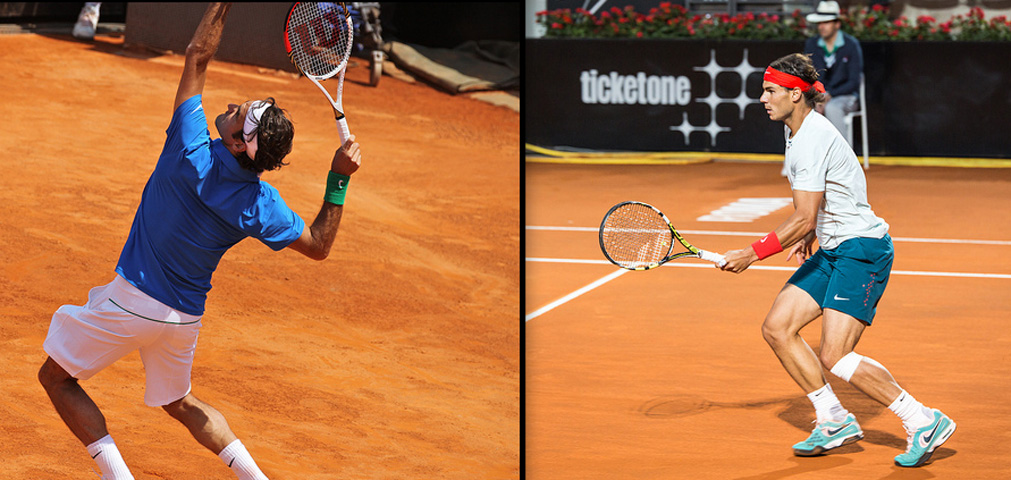
    And yet, despite the multiple nuances in their games, the different attributes, and the very few weaknesses, both Federer and Nadal made a living off one particular weapon – the forehand. Their games couldn’t be more different: Federer was always more complete, more aggressive-minded, had a better serve, took more offensive court positioning, and attacked the net; Nadal was a one-of-a-kind physical specimen, a defensive wall, stood farther behind the baseline, and took control of points through engaging in longer rallies where he would gradually wear out his opponent. None of that changes the fact that, regardless of the adjustments they’ve made throughout the years – Nadal has become more aggressive and well-rounded; Federer had to readjust some aspects of his game to better operate with age – when push came to shove, they cemented their spots in tennis history due to their respective forehands.

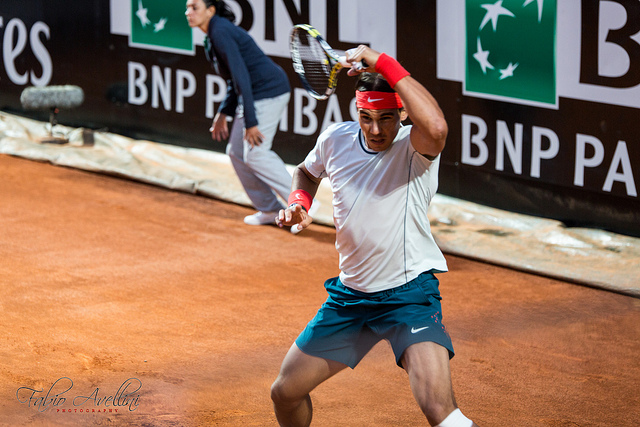
    Like the rest of their games, their forehands bore very few similarities: Different grips, different spins, and a different follow-through. And yet, whether Federer was running around his backhand to hit an inside out winner, or Nadal was pummeling his opponent’s weaker wing relentlessly, the result was often the same. In what will inevitably go down as the “Fedal era,” one of the most memorable phases in tennis history will be defined by one shot.

    Increased racquet technology, homogenization of the surfaces, and the rise of a new breed of phenomenal athletes have altered the game considerably, with serve and volley taking a backseat to a noticeable shift towards baseline tennis. The change has been characterized by a strong emphasis on the forehand. In fact, it is hardly a coincidence that the last couple of world number one’s before the Federer era were Juan Carlos Ferrero and Andy Roddick, two men who, in their heyday, possessed two of the most lethal forehands on tour. And yet, fearsome as those shots were, they paled by comparison to the brilliance that the Swiss Maestro’s racquet would later produce.

    Simply put, Roger Federer’s forehand revolutionized the sport. Widely tipped to be the greatest ground stroke in tennis history, Federer re-set the standards of what constitutes a world-class forehand. It wasn’t merely his ability to fire winners off that side that set him apart – after all, James Blake, Fernando Gonzalez, and Andy Roddick hardly struggled to rip out inside-out bullets – but rather, Federer’s combination of power, spin, versatility, taking the ball early, and the ability to hit it on the run that made him a nightmare to deal with.

    None of this would be possible had it not been for Federer’s most characteristic trait: his otherworldly movement. Federer’s ability to glide effortlessly on a tennis court was poetry in motion. He always put himself in perfect position to take the ball precisely when he meant to, and the results were devastating. The mixture of movement, precision, and taking the ball on the rise rendered his forehand near unplayable. Lleyton Hewitt had laid the foundations a couple of years earlier by running circles around his opponents, but he lacked the necessary weapons and offensive tools. Federer, on the other hand, didn’t.

    In fairness, cat-like quickness wasn’t exclusive to Federer, as the man who previously dominated the world of tennis, Pete Sampras, remains one of the best athletes the sport has ever seen. Meanwhile, the likes of Davydenko, Blake, the above mentioned Hewitt, and others were all great movers in their own right. However, Federer’s footwork was so utterly unique in its fluidity, quickness, smoothness, and efficiency.

    Then came Rafael Nadal, arguably the greatest pure athlete in tennis history. He redefined the word “speed,” covered every inch of the court like nobody before him, displayed unprecedented levels of explosiveness, and showed a level of physicality that no one else could match. When he first burst onto the scene, Nadal’s game was, to put it bluntly, fairly limited. His serve was harmless, his backhand was solid but, ultimately, did little offensive damage — beyond the trademark open-stance passing shots — and his return of serve was meant to neutralize points above anything else (which applies even today).

    If there is a prime example of how great movement and an elite forehand dominate today’s men’s game, it’s Nadal. Better than anyone in history, he was able to mask his weaknesses with a dominant forehand and unparalleled movement. Even more so than Federer, Nadal based much of his game around running around his backhand wing. However, the Spaniard lacked his rival’s serve and variety, making his forehand an even more integral part of his game.

    His entire early success is attributed almost entirely to his forehand and movement. Even as his game developed into something far more polished, Nadal’s bread-and-butter remained intact. Unlike anyone else, Federer included, Nadal is able to find his forehand wing time and time again. The amount of effort required to run around his backhand at every possible opportunity meant the Mallorcan had to work particularly hard in each rally, but Nadal was all too willing to make the effort. Like Federer, his forehand is actually deadlier from his backhand wing, where he can put it pretty much anywhere on the court. Once Nadal is able to find a forehand early in the rally, unless your name was Novak Djokovic, Nikolay Davydenko, and a select others, you weren’t wrestling the point away from him.

    No Title

    No Description

    The man who ultimately broke the Fedal monopoly was, unsurprisingly, Novak Djokovic. Long tipped to be the future of tennis, the Serb may have differed from his great rivals in that he possessed one of the best backhands the games has ever seen — a shot many deem to be his strongest. However, it wasn’t until Djokovic recaptured the magic on his forehand side that he became the world’s finest player. Following a very strong 2008, Djokovic’s results became increasingly inconsistent. The reasons were numerous, from struggles with fitness, focus, and serve, but above all else, it was his forehand that grew more erratic, and the results underwhelmed accordingly.

    Djokovic moves as well as anyone on a tennis court, but the quality of his backhand provides him with far more options, therefore, he doesn’t need to run around that shot as frequently as Federer and Nadal. And yet, you often see him doing just that these days, to great effect. Good as his backhand is, the basic mechanics of the forehand mean he has more options off that wing. Additionally, Djokovic’s backhand being his better shot often clouds the fact that his forehand is easily one of the best on tour, and when playing well, it is the side that does the bigger damage. Yes, it remains the shot that is more likely to break down and fail him when things go south, as opposed to his always rock solid backhand, but offensively, it is slowly becoming his most potent shot.

    A quick look at today’s top 10 players shows just how essential it is to possess a great forehand. Beyond the aforementioned players, almost all of the world’s elite players share a world-class forehand: Ferrer, Berdych, Tsonga, Del Potro, etc. Naturally, there are exceptions, but even those, quite ironically, reinforce the rule. Richard Gasquet, for instance, was initially thought to be destined for greatness, only to fail to live up to the hype, in large part due to his unreliable forehand. Even previous one-of-a-kind shot-makers like Nalbandian and Davydenko occasionally suffered due to an inconsistent forehand.

    The most notable aberration, of course, is current world number 2, Andy Murray. Far from being a bad shot, Murray’s forehand remains nevertheless below the level of Federer, Nadal, or Djokovic. However, the Brit is able to make amends through fantastic movement, tennis IQ, tactical awareness, counter-punching, and a backhand that is easily among the very best in the men’s game. Nevertheless, it is hard not to attribute some of his shortcomings to his main rivals’ ability to expose his forehand. Djokovic has repeatedly dominated Murray in forehand-to-forehand cross-court exchanges and drew short replies, Nadal’s flattened-out cross-court backhands and inside out forehand have historically troubled Murray on faster surfaces — surprisingly enough — while Federer’s offensive onslaught has robbed Murray of three additional grand slam titles to his resume.

    A quick glance at the current crop of up-and-coming players shows no real candidate that fits the description of a modern day champion — a great mover with a world-class forehand. For now, at least, the status quo at the top of the men’s game seems safe.

    Click here to discuss this and more with fellow tennis fans on our discussion boards.
  • Murray, Del Potro And Others Pull Out Of Roland Garros

    Murray, Del Potro And Others Pull Out Of Roland Garros

    Andy Murray has pulled out of Roland Garros. He said in a statement: “It’s a really tough decision and I love playing in Paris, but after seeking medical advice I am not fit to compete,” adding “now my complete focus is on getting back on the court as soon as possible.”

    World #2 Murray has been troubled with a lower-back injury that caused him to retire from his second-round match in Rome. He has also stated that Wimbledon is his main priority.

    Juan Martin Del Potro has also pulled out. The World #6 and a former French Open semi-finalist has been suffering with a bronchial infection since appearing at the Monte Carlo Open. He was forced to sit out scheduled events at the Portuguese Open and Madrid Masters. He returned for the Italian Open in Rome but was below his best in a poor outing against the Frenchman Benoit Paire. Following the Paire loss, Del Potro returned to Argentina.

    Other Roland Garros casualties also include the Americans Mardy Fish and Brian Baker. They will be replaced in Friday’s draw by Joao Sousa of Portugal, and Guido Pella of Argentina.

    Additionally, John Millan, an Australian wild card, has withdrawn due to shoulder injury, and will be replaced by Nick Kyrgios of Australia.

    Click here to discuss this story on our discussion board with fellow tennis fans.

  • “For the 7th Time, Nadal is the King of Rome” (From: Gazzetta dello Sport)

    “For the 7th Time, Nadal is the King of Rome” (From: Gazzetta dello Sport)

    [divider]

    Translated from: “Tennis. Internazionali Bnl. Nadal è per la 7ª volta re di Roma” (Gazzetta.it, May 19, 2013)

    Discuss this and more with fellow tennis fans in our community forums.

    [divider]

    The Spaniard has conquered the Rome Open for the 7th time in his career, winning for the 20th time over Roger Federer. For the Swiss, it was his 111th final, and his 1100th career match.  For Nadal, it was his 2nd win of the season in a MS1000 on the red dirt.

    What more can you want, if you’re biting the cup, than just to have mangled Roger Federer?

    Nadal doesn’t change the script, even as he hefts his 7th trophy of the Internazionale Bnl di Roma (2005-07, 2009-10, 2012-13,) his 6th title of the season, and the 24th MS 1000 title of his career.

    It now appears that the naysayers were right, and the two can’t meet before a hypothetical SF in RG.

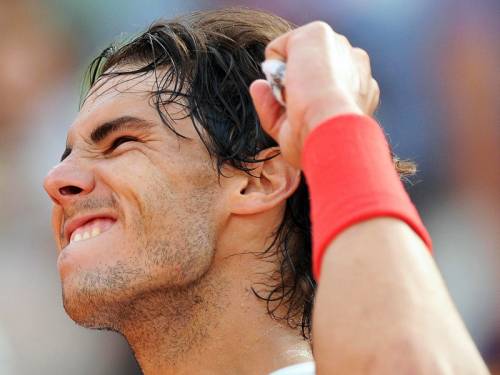
    RAFA IS BACK:  Thanks to this win, secured in barely 1 hr. 9 min., Nadal firmly asserts his assault on the race for the season.  The Mallorcan’s results are 8 finals in 8 tournaments, 6 victories, and, as of Monday, the #4 ranking.  If it’s not the best Rafa of old, very little is lacking.  Most impressive has been the arc of his improvement over the week, from the near upset by the Estonian Gulbis, to the physical and technical dominance in the final.

    IT WASN’T ROGER:  Federer, although he was imposing in successive victories over Janowicz and Paire, he was suddenly faced with the Mallorcan fury, same as in IW, but amplified by the surface friendly to, and beloved of the Spaniard.  Result:  anyone who was hoping for a dream match for their 30th meeting began to rethink it after only a few minutes.  Under the heavy blows and pressure from Nadal, the Swiss player began to make too many mistakes, ending with 32 UFEs (to Nadal’s 8,) and 6 break points conceded.  When he finally broke back, at 1-5 in the 2nd set, it was already too late.

    NOW, TO PARIS:  Rome finishes with a match that pales in comparison to their 2006 final, won by the Spaniard in the 5th set, after having nullified 2 match points by Federer.  “I won’t always win, and for that reason I’m enjoying the moment,” said Nadal.  “It’s a dream for me, what is happening now.”

    “Today I didn’t hit the ball well,” said Federer.  “Beating him at RG would be very difficult, but Djokovic did it in MC.  If you want to win, you have to be perfectly prepared.  Obviously, I have a better chance on cement.”


  • Nadal defeats Federer in Italian Open Final

    Nadal defeats Federer in Italian Open Final

    Rafael Nadal (5) defeated Roger Federer (2) in the final of the Italian Open, 6-1, 6-3.

    It was the pair’s 30th meeting. Nadal now leads the head-to-head 20-10.

    Click here to discuss the Federer/Nadal match, and more with fellow tennis fans on our discussion boards.
  • Fedal It Is!

    Fedal It Is!

    Roger Federer (2) and Rafael Nadal (5) both won their semifinal matches today at the Italian Open, setting the stage for their first encounter in Rome since their legendary 2006 final.

    The King of Clay Rafael Nadal beat the Czech Tomas Berdych (6), 6-2, 6-4.

    Federer, the Swiss Master, beat the young Frenchman Benoit Paire, 7-6(5), 6-4.

    The final will take place on Sunday, May 18, at 4:00 P.M. local time.

    Click here to discuss the Federer/Nadal match, and more with fellow tennis fans on our discussion boards.
  • Serena Williams and Victoria Azarenka Advance To Italian Open Final

    Serena Williams and Victoria Azarenka Advance To Italian Open Final

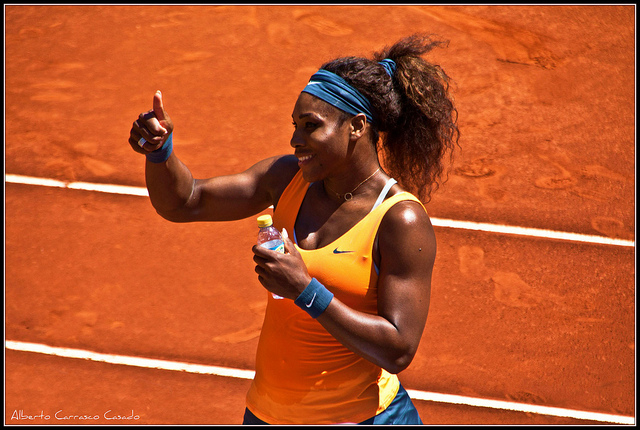
    It took just over an hour for Serena Williams (1) to eliminate the qualifier Simona Halep, 6-3, 6-0, in order to advance to the Italian Open Women’s Final.

    Victoria Azarenka (3) then defeated the Italian Sara Errani (7),  6-0, 7-5 , thus squelching Italy’s last chance to have one of their own make it to the final.

    The final will take place on Sunday, May 18, at 1:30 P.M. local time.

    Click here to discuss the Williams/Azarenka match, and more with fellow tennis fans on our discussion boards.
  • “Sharapova Retires, Errani in the Semi-finals v. Azarenka” (From: Gazzetta dello Sport)

    “Sharapova Retires, Errani in the Semi-finals v. Azarenka” (From: Gazzetta dello Sport)

    [divider]

    Translated from: “Tennis, Internazionali Roma: Sharapova si ritira, Errani in semifinale con Azarenka” (Gazzetta.it, May 17, 2013)

    Discuss this and more with fellow tennis fans in our community forums.

    [divider]

    Masha is out of the Rome Open with physical issues; Sara will face the Bielo-Russian.  

    Serena overwhelming.

    _____

    Maria Sharapova retired out of the Internazionale BNL d’Italia with a physical problem.  The announcement, made around 11:20am (local time) opens the way for Sara Errani to the semi-finals, a first in her career.  This was the first surprising result from the Foro Italico today.  Errani will meet the ex-number one, Vika Azarenka, who beat Samantha Stosur in 3 sets (6-4, 1-6, 6-3).

    Surprise:  In a tournament full of retirements (Andy Murray being the most notable), no one expected that the 2012 Women’s champion would be among them.  The Russian seemed in perfect form in her first 2 matches, winning 6-2, 6-2 against the Spaniard Muguruza, and 6-2, 6-1 against the US player Stephens.  Errani got the news after breakfast, and was understandably surprised, before reorganizing her schedule and pre-match routine.  In the end, she arranged to spend the afternoon with family.

    [The following is a transcription of the Errani interview on the video featured on the link below.  I didn’t translate the first video, or twitters, as they would have been originally in English, anyway.  But do watch the charming Errani in her native Italian.  This is what she said:]

    Errani:

    Yes, I’m lucky, but I have to stay calm.  It would have been great to have played a match against her [Sharapova] today.  I don’t understand exactly why she couldn’t play, but for me the tournament goes on.  I have to stay concentrated, calm, to be ready for tomorrow.  It’s not bad to have a day off to get back to a little bit of form.

    Yes, the ranking matters, the #5 is a big accomplishment for me.  In terms of being “in form,” the “form” changes from one day to the next.  One day you can be in excellent shape, and two days later you might feel not so great, so it’s not like “form” lasts so much time, at a clip.

    I’m happy because this year I’ve been consistent.  So many great matches, so many great results, so many positives for me.

    For sure they’re really strong players [Stosur and Azarenka].  That goes without saying.  Stosur is so strong on clay, and Azarenka is strong everywhere.  So we’ll see who I play against.  I’ll talk with my team when I know who the opponent is.  [Translator’s note:  The opponent will be Azarenka.]

    [Re: memories]  I came here [Rome] as a little girl and I wanted to ask the players for their autographs, but I was too shy.  I remember getting close to some of the players, but I never had the nerve to ask.

    I remember [Vince] Spadea, actually, because he was one of the ones I managed to ask.  (Laughter.)  One of the strongest memories; that one stays with me because I finally had the nerve to ask for an autograph.  I don’t remember any others. I don’t remember.  I had a poster of Mary Pierce (that I dragged around.)

    Maybe one of my biggest memories is when I played Hingis after the qualifiers on Campo Centrale.  I lost 6-1, 6-0, but that was one of my clearest early memories at the Foro Italico.