Blog

  • Roger Federer Wins the Gerry Weber Open, Halle

    Roger Federer Wins the Gerry Weber Open, Halle

    Roger Federer picked up his 78th career title winning the Gerry Weber Open at Halle for the sixth time.

    The 31-year-old Swiss defeated Russia’s Mikhail Youzhny in a tight three-set encounter, 6-7, 6-3, 6-4.  Youzhny had not beaten Federer in 14 previous attempts, but started brightly by winning the first set tiebreak.

    Federer responded by taking the second and third sets to seal his first title of the year.

    Click here to discuss the Halle Tournament and Federer’s title with fellow tennis fans.


  • Why Was Sampras More Prone to Upset Than Current Greats?

    Why Was Sampras More Prone to Upset Than Current Greats?

    It seems to me that the current greats – namely Federer, Nadal, and Djokovic – aren’t being upset in early rounds as often as greats in the past were. Most great players during their very prime seem to make it to at least the QF of every Slam, if not the SF or beyond. But it seems that the current crop are particularly “un-prone” to an early upset.

    For example – if we count a player’s “peak” as being between their first Slam win and their last (which of course is rather artificial and not true, but gives us something to look at), we get the following numbers:

    Federer: First – Wimbledon, 2003; Last – Wimbledon 2012. 37 Slams, 37 played. 35 were QF or beyond; 32 SF or beyond.

    Nadal: First – FO, 2005; Last – FO, 2013. 33 Slams, 29 played. 24 were QF+, 21 SF+.

    Sampras: First – USO, 1990; Last – USO 2002. 49 Slams, 47 played. 34 QF+, 28 SF+.

    Just looking at those three we can see that Sampras was a lot more prone to be upset before the QF. Between his first Slam victory and his last he went out of 13 Slams before the QF. Now with Sampras we should note that he both won a Slam very early – almost three years before his second – and one very late, over two years after his second to last. But if we look only at Sampras’ very highest peak – from Wimbledon of 1993 to 1997, a span of 17 Slams, we still have four upsets before the QF.

    If we look at other greats we see similar patterns, except for perhaps Lendl, who only went out twice between his “bookend Slams”, but that’s a rather narrow span of only 23 Slams, partially because he won his first quite late. And Borg of course, who went out early only three times in the 21 Slams between his first and last wins, but he had a rather narrow span, and of course didn’t play the Australian Open at all during that span. But Becker, Edberg, Wilander, Agassi, Connors, and of course Sampras were all prone to be upset, some quite frequently.

    Now maybe we should just stick to “inner circle greats” – those with 10+ Slams: Borg, Sampras, Federer, Nadal, and we’ll include Djokovic because he looks like he’s heading there. We don’t have enough info to go on, but it’s at least notable how many times Sampras alone went out earlier compared to the more recent players.

    So my question: Why is this? I see a few possible reasons:

    1) Sampras was not as good during his prime as the current greats (or Borg, for that matter), or at least was more erratic
    2) The courts were more diverse in the 90s making utter dominance more difficult
    3) The second tier talent during Sampras’ era was a lot higher than it is today

    Discuss this train of thought with fellow tennis fans on our discussion forums.

  • Defending Champ Cilic Moves Into the semis at Queens

    Defending Champ Cilic Moves Into the semis at Queens

    Latest from Queens… Marin Cilic, the defending champion, defeated the #2 seed Tomas Berdych 7-5, 7-6(4) to reach the semifinals.

    Cilic, who won the title last year when David Nalbandian defaulted by kicking a line judge, faced a break point at 4-4 in the first set. Berdych dumped the return in the net, followed by Cilic failing to convert a brace of set points at 5-4 before Berdych made a forehand error on a third breakpoint at 6-5.

    In the second set, Berdych had break points at 2-2 and another at 4-4. But Cilic once again held off the threat before claiming victory in the tiebreaker.

    Discuss this match and much more in the Tennis Frontier message board forum.

  • “I Win With My Tennis, Not With My Mind” (From: El País)

    “I Win With My Tennis, Not With My Mind” (From: El País)

    [divider]

    Translated from: “Gano con mi tenis, no con la mente” (El Pais, June 10, 2013)

    Click here to discuss this and more with fellow tennis fans on our discussion boards.

    [divider]

    10 June 2013/Paris/Juan José Mateo

    Rafael Nadal (Manacor, Mallorca, 1986) says goodbye to Pau Gasol in the lounge of a hotel they were both staying in.  It’s the first day after the culmination of an odyssey:   the comeback to win Roland Garros for the 8th time, his 12th Grand Slam title, after 7 months out due to an injury to his left knee.  There’s still a trace of celebration in his tired eyes.  His hands move quickly, in accompanying gestures to his answers.

    Q:  How do you feel when an opponent takes you to the limit, like Djokovic in the semi-finals?

    A:  The only thing I feel is that you have to endure a little more.  That’s all I feel.  Put up a little more resistance, because you don’t know how much more resistance the other player can mount.  I’m feeling bad, but it’s likely that the other player is at the limit, too.  I try to push him that little bit more to see if it will get me the win.  This extra effort is always worth it, if you win or lose.  It’s a question of personal satisfaction when you go back to the locker room. It’s priceless.  Those are very difficult feelings to explain.

    Q:  You refuse to lose.

    A:  It’s not refusing to lose, it’s refusing to throw in the towel.  I refuse to throw in the towel.  That is what makes me happy when it’s all over:  knowing that I did everything I could, and if I lost, I lost.

    Q:  Sometimes you talk about suffering as if it were a friend, as does Djokovic.

    A:  I believe that he is a great fighter and a great sufferer.

    Q:  But most people, logically, prefer to suffer less.  Where does that difference come from?

    A:  From the joy in what you’re doing, from the passion for it.  From living it all with this passion.  Because of everything it has taken you to get here, it makes you not want to give in.  It’s a physical suffering and a mental suffering.  That’s the truth…but, in the end, you’re playing on Court Central at Roland Garros, your dream since you were a small child; you’re living a match that you know is special and you know that whatever happens, it will be one of the matches of the year, because of what’s at stake.  Is that suffering?  Yes, but it’s also a gift and a happiness to be able to be there in that moment.

    Q:  In the past, to feel competitive, you felt the need to train a lot.  Winning Roland Garros with only 8 tournaments under your belt, now maybe not.  Does this win vindicate your technical abilities over your mental ones, and physical strength?

    A:  It’s a logical evolution in a career.  As one gets older, a lot of things come more automatically, the game more matter-of-fact, and you don’t need so much preparation.  To be honest, it’s fantastic to be considered to have the mental and physical advantages, and being able to sell that off is a positive.  I believe that mentally and physically I have been a forceful player, that I’ve always tried to play above my level.  Beyond the fight and the dedication, this quality, along with the desire to improve, is a very important mental quality…but you couldn’t have achieved what I have without the rest, without having a great forehand, a great backhand, or great ball control.  Sometimes we forget to stress these things, because they highlight the rest.

    Q:  You can’t win without your racquet, right?

    A:  Mental and physical strength help you in a certain moment of the match, but to win more often, and more overall, you win with your tennis, and not with your head.  You can win mental matches like the one the other day versus Djokovic, but to win them, mentally, you have to get to the absolute limit, and to get to that limit – you have to get there with your tennis.  It’s a combination of everything.  The tennis is what has helped me get to where I am, and the mental toughness is what has allowed me to achieve what I wouldn’t have, without it.

    Q:  Of those who don’t appreciate your technique, is it because you don’t have a one-handed backhand like Federer?

    A:  If you asked my opponents, I think that they would say I have, in terms of tennis, many special things.  Maybe the mental fortitude would come up, because I’ve played a lot of long matches, 5 hours, in which I’ve come back, been equally in the hunt until the end.  These types of matches are memorable, of course, and my style of play, to fight, to overcome, made sense that this type of match would be in sync with my career.  A player like Federer, more given to 3 quick shots, hasn’t played so many of these long matches in his career.  Technically, there’s no doubt that he’s better than me, but, evidently, I’m better than most of the rest. If not, I wouldn’t be here.

    Q:  You have said, “Sport without challenges is stupidity.”

    A:  These are things that I’ve always thought and I live with them.  One has to be realistic:  to play tennis without an objective…fine.  I swing a racquet and hit a ball over a net.  What does that mean?  Very little.  In and of itself, it’s trivial.  Sports in general are stupid, if one doesn’t take them to their highest level.  And the highest level means to play towards a goal, with passion, with joy and desire.  This is what I’ve thought my whole life.  When I play golf, I give it all I have.  People are wrong about me.  They say, “All he wants is to win.”  What I love is competition, the investment of energy, the concentration that it takes to try as hard as possible.  Obviously, I like to win, but what inspires me is to feel that I’ve given all I have.  If not, I don’t see the point.  And if not, I’ll say let’s have a laugh, and find something else to do.

    Q:  How does it make you feel that your co-players see you as an idol?  In Madrid, you spoke to Horacio Zeballos, wishing him well, and he said, “I’ve just been blessed by the Pope!”

    A:  I can’t imagine it’s like that.  I feel close to all the players, especially the Spanish-speaking ones, because the relationship is so easy.  I don’t think they see me like that.  I don’t know.  I see myself as an approachable person and I think they see me that way, too.

    Q:  Now you’re going back to Wimbledon [starting 24 June] where you left injured in 2012.

    A:  Last year I entered Wimbledon without being well, being injured…I was playing compromised.  I wanted to put in the effort, with everything this tournament means to me.  It wasn’t to be.  I forced it.  Everything I wanted to try to do was too limited.  It didn’t affect me negatively in what was to come after.  When I get there this year, the simple fact of being there will be good news.  It’s a beautiful tournament, and I love it.  Even if I won’t arrive so well-prepared, just being there will make me feel satisfied.

    Q:  It clears your head.

    A:  It nourishes me.  I love the feeling of stepping on the grass, of playing on those courts, which is such a different sensation.  For me, whatever the result, it’s worth it.  Am I arriving less prepared than usual?  [He won’t play a grass court tune-up before the tournament.]  Yes, but it comes back to the same thing: I’ll get there healthy, good physically, and mentally I’ll arrive there in a good place.  Then, if I’m lucky enough to get through a few matches, perhaps not having played a tournament before will translate into mental freshness.  [At Wimbledon], all matches are very difficult; it’s the most uncertain tournament of the year.  The confidence of having won here [in Paris] gives me that something extra that you need to play well there.

    Q:  The Nadal of 2008, who only allowed Roger Federer 4 games in the final, is he better than the 2013 version of Nadal?

    A:  In tennis terms?  Could be.  There are moments, and moments.  2008 had things that 2013 doesn’t have, and 2013 has things that 2008 didn’t have.  Speaking strictly of Roland Garros, perhaps that was the best I played in my career.  But you have to look at the whole picture.  In terms of results, I was in the same place in 2008 that I’m in now.  Those things are in the past.  Now, I’m looking forward.

    Q:  What was the best advice you got during your injury lay-off?

    A:  When I had to stop playing, I was lucky to have my family around me, which is very important.  Also my team, which helped me keep working with the enthusiasm and mentality necessary to not lose my form.  I had friends and sponsors who kept their faith in me.  This was a very important source of confidence.

    Q:  You asked that it be made public the exact number of controls [drug tests] that are given to each tennis player.  Did it bother you that, during the injury lay-off, there were those who would say you’d disappeared?

    A:  I don’t like it when a player comes out and says:  “They don’t test me enough.”  It’s easy to come off well by saying that.  Or, to say “I get tested too often.”  [I would probably prefer that it be], “I’m tested this much.”  X-number of times.  Just make it public.  That way, you don’t create doubt, nor the sense that one player looks good because he says they don’t test him enough, or that another looks bad because he complains that they test him too much.  The logical thing is to make everything public knowledge, and then there’s no question. Disappeared?  I didn’t disappear at all;  everyone in the world who wanted to, knew where to find me: at home, and working every day.

  • Rafael “The King of Clay” Nadal Wins Record 8th Roland Garros

    Rafael “The King of Clay” Nadal Wins Record 8th Roland Garros

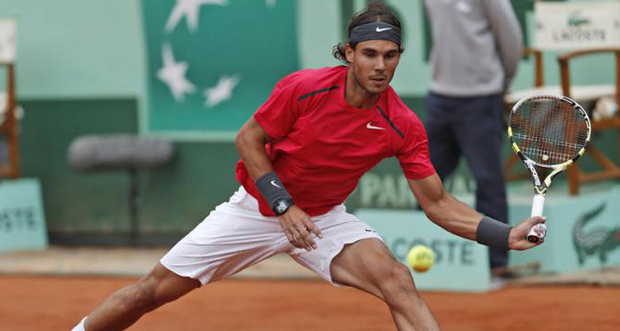
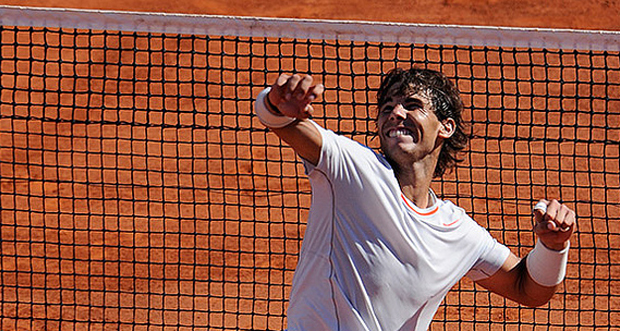
    Rafael Nadal surely is the King of Clay, winning a record 8th French Open today, defeating his compatriot David Ferrer, 6-3, 6-2, 6-3.

    This was Nadal’s 12 Grand Slam title, which moves him into third place for overall wins behind Roger Federer (17) and Pete Sampras (14). By winning Roland Garros eight times, Nadal has now also dominated a Slam more than any other man, passing Sampras and Federer, who have each won Wimbledon 7 times, and besting his own record at the French major.  Additionally, he sets a record by winning at least one Major in nine consecutive years.

    [divider]

    Click here to discuss the Nadal/Ferrer final, and more with fellow tennis fans on our discussion boards.

  • Johan Kriek on the concept of bring “process driven” vs “result driven”

    Johan Kriek on the concept of bring “process driven” vs “result driven”

    “Ok, here is the piece I promised on the terms I used in another post…”process driven” vs “result driven”. This is a philosophy similar to the tortoise and the hare story…

    I was in SA [South Africa] playing most of the top junior tournaments back in the early 70′s while being in a boarding school at a very prestigious high school in Pretoria. I left in my final year before graduating to go live in Austria with my coach Ian Cunningham who had emigrated to Austria two years prior to my arrival. I completely disappeared from SA and International tennis. I heard rumors that I had quit tennis, was burnt out and was going to farm with my dad….blah blah blah, etc. etc. The real truth was that (at the time unbeknownst to others) I was in the “process driven mode” of my tennis development. I did not compete in the Orange bowl, junior Wimbledon, US Open juniors or any major junior event from age 17 to 19. I honed my sliding skills and all that was necessary to become a more sound ball striker on red clay and became a great competitor because if clay and took the train to Switzerland, Vienna, Germany and England to play in smaller “open” events. I cannot tell you how many Swiss Army knives I collected in those two years….

    In 1978 I together with my coach decided it was time to go to America and play for two months in Florida and tackle the then WATCH circuit. The first two weeks I did not even qualify! I finally qualified in Bonita Springs, then won Hialeah ($1500!!!!) and decided to continue playing another circuit for 5 weeks in North and South Carolina. I came in second in points and my ATP ranking was dropping very quickly into the low 200′s after being ranked like 689 or so arriving in the US. I then qualified in North Conway and in Stowe Vermont before heading off to the US Open qualies, won 4 rounds, and went all the way to the quarters beating Brian Teacher, Yannick Noah in 5 sets only to get spanked by Vitas Gerulaitis in the quarters. I have ARRIVED! Suddenly agents are talking and my life changed almost overnite….

    Herein lies the truth. If I had chased points before I had really worked on my basics, my confidence, my everything, I don’t think i would have made it! The system for juniors in many parts of the world is FLAWED and that is why so many top juniors don’t seem to make it in the pros. They just lose heart! They were so “result driven” to be “seen” for sponsors, mom and dad, peers, etc etc. That is IMHO a very narrow and shortsighted approach. People fly around the US and South-America to the weakest ITF events just to get points and kids with way more talent, maybe less money to travel end up with worse rankings and the whole system becomes skewed. I don’t pretend to have the answers to all the ills in the USTA Player Development sector, but this problem is NOT unique to the US either! Talk to any pros that “know” their countries like England, Australia, South Africa…..they all suffer from the same political bs and the kids suffer because of it! The enormous monies plowed into “finding the next great one” very very rarely does!!! Most are from the strangest places! Look at Serbia, Sweden, Spain, Argentina and so may others. For parents to drive all over to have an under ten ranking and burn their kids out LONG before the real test has to take place around 14-16 needs to have their heads examined. Work on technique, point construction, tactics. I see “mental midgets” all over the pace! They all can strike the ball, bang bang from the back but a very small percentage of them are taught how to think, how to behave, how to be humble, how to play fair! It is all about winning, winning, winning aka ” result driven”. And you wonder why the US have so few top prospects and have spent so much money…

    I was ranked 689 when i arrived in the US in 1978. In less than two years (never a wildcard) I was top ten in the world. So what if I didn’t have a junior top ranking. I quietly for nearly three years worked on my “total game” and believed that that was what was going to work best for me, and it did. The cream will rise to the top eventually….”

    Reposted from the Johan Kriek Tennis Academy website

  • A Final Before the Final

    A Final Before the Final

    It was labeled as “the final before the final,” and yet after an anti-climactic third set, it looked to be heading to mere sub-par semi-final territory. However, by the time Novak Djokovic sent a final forehand long to send Rafael Nadal into his eighth French Open final in nine appearances, the match had lived up to its billing, and then some. We’ve grown to expect this type of battles from Nadal and Djokovic — from unique tension and near unrivalled physicality, to the emotions and fist pumps. When these gladiators are done with their superhuman efforts, the viewer can almost share their exhaustion, delight, and heartbreak.

    There is something so captivating about a five-set match of tennis. In many ways, it is akin to a tale of multiple plot twists unfolding before your eyes. The drama, tension, turning points, and missed opportunities are all staples that make these matches all the more memorable. However, from a pure tennis standpoint, the most fascinating parts of these epics are the strategies, tactics, and adjustments that each player makes over the course of the match. The extended nature of the contest makes these factors even more noticeable. Players have time to attempt different things, adjust, tweak their games, and adapt to each other’s adjustments.

    For Djokovic, the approach to playing Nadal has always been fairly straightforward, at least since 2011. His game is better suited to deal with Nadal’s onslaught of forehands than any other player on tour. Djokovic dominates the cross-court exchanges, pins Nadal behind his backhand with spinning cross-court forehands, stretches him on his forehand side with hard, penetrating cross-court backhands, and puts pressure on most of the Spaniard’s service games with otherworldly returning. Moreover, Djokovic’s movement, defense, and counterpunching abilities have historically frustrated Nadal due to his inability to consistently hit through the Serb.

    Since Djokovic began his spell of dominance over his rival a little over two years ago, Nadal has tried altering his game plan, to varying degrees of success. The pre-match tune for Nadal has always been the same: “I have to be aggressive with my forehand.”  And yet, he has generally struggled to consistently take control of the points with that particular shot, something Nadal usually makes a living off.

    This time, however, things were different. The good news for the seven-time Roland Garros champion started with the weather forecast. Firday proved to be the hottest day of the tournament, which ought to have put a smile on Nadal’s face. His forehands would be having that much more bite, and jump that much higher off the court. In a game of inches, such minute factors could eventually make the difference. In many ways, they did.

    It became evident very early that Nadal was in the mood, and his forehand looked like the kind of shot that made him the greatest clay courter this game has ever seen. For once, Djokovic’s backhand looked pedestrian, as he struggled to take Nadal’s cross-court forehand on the rise with the ease he’s usually accustomed to. The ball was exploding off the court, and as a result, Djokovic’s groundstrokes were uncharacteristically lacking in depth in the early going. Nadal adopted a more offensive court positioning, and gained the confidence to go for both his inside out forehand and down the line forehand earlier in the rallies. The latter, in particular, proved to be a game-changer throughout the match. In the seventh game of the first set, Nadal had a break point and went for a routine rally forehand down the line. It caught Djokovic by surprise. He was a touch slower to react, got to the ball a split second late, and pushed his subsequent forehand long. The tone was set.

    These guys had played each other 34 times prior to yesterday’s match, and it’s safe to say they know what to expect from one another. Instinctively, Djokovic leans towards his backhand side when Nadal lines up a rally forehand, as it is where the majority of his lefty forehands go. Likewise, he is generally terrific at anticipating when Nadal will fire his forehand inside out after being in position to line up the shot. However, when the Spaniard directs his forehand at Djokovic’s own forehand early in the rally, it seems to catch the world number one off guard.

    Djokovic’s retrieving abilities are quite superlative, but he defends better off his backhand, as far as getting the ball back with interest goes – he’s more likely to throw a slice or a defensive lob from his forehand side. Part of what Nadal has struggled with against Djokovic has been his inability to stay on top of the rallies. Novak’s counterpunching from his backhand side, in particular, has given his opponent fits, and it often changes the complexion of the rallies. By modifying his usual rally patterns, Nadal was able to reverse his fortunes. Eurosport’s Frew McMillan noted that any time Nadal authoritatively hit his forehand to Djokovic’s forehand, the rally was as good as over. For the first set and a half at least, that seemed to be the case.

    It is never a confidence booster when your main weapon isn’t firing. For about an hour or so, that was the Serb’s main hindrance. His backhand was not adjusting to the dry conditions, he was unable to deal with Nadal’s forehand, and perhaps most surprisingly, his return was tame by his standards. As Djokovic later noted in the press conference, his opponent served better than usual, which partially explains Novak’s unusually iffy returning early in the match.

    What makes the Djokovic match-up so difficult for Nadal is the fact that his normal game-plan plays right into his rival’s hands. He cannot be content to spin serves to Djokovic’s backhand like he does against Federer, and is forced to serve with more variation and power. Nadal did just that, and he was holding more comfortably than perhaps even he would have expected (winning over 50% of his second serve points is pretty telling). Again, the dry conditions could have only helped.

    Meanwhile, Djokovic was also struggling to consistently pin Nadal behind his backhand. One of the main features of his game in this particular match-up is his ability to hit his cross-court forehand with extreme angles and take Nadal out of position to open up the court. To his credit, Nadal’s backhand held up extremely well throughout – he even quite surprisingly produced more winners than Djokovic from that side – and his willingness to hit his double handed backhand hard and flat cross court whenever he was stretched out paid dividends. He may have pushed it wide on a few occasions, but at least he sent a message to Djokovic that he wouldn’t be bullied. Nevertheless, that alone does not explain Novak’s failure to resort to a pattern that has given him so much success against his opponent in the past. Strategically, this was Djokovic’s only major flaw in the match, as even when he upped his level considerably, he still played far too many balls to Nadal’s forehand, and paid the price.

    Luckily for the neutrals, whenever it looked like Nadal would run away with the match, Djokovic raised his game when it mattered most. Over the past two-and-a-half years, he truly has turned into one of the sport’s all-time greatest clutch players. When the chips are down, Djokovic hits his way out of trouble. After getting broken to go down 2-3 in the second set, the Serb did what he does best, and indeed, hit himself out of trouble. Suddenly, there was more spring to his steps – he had looked somewhat flat up until that point – and he wisely opted to run around his backhand more often, recognizing that his usual bread-and-butter was failing him. His inside out forehand clicked, and he began doing the majority of the dictating.

    With the exception of the generally poor third set, Djokovic served extremely well throughout the contest. For most players, serving big and getting cheap points against Nadal is a must. Djokovic, however, recognizes his ability to go toe-to-toe with Nadal from the baseline, and relies on good service placement — as opposed to going for too much — to put himself in position to get the ascension in the rallies. His serving patterns were quite simple actually, as he simply went out wide on both ends of the court. His slider out wide on the deuce court continuously took Nadal out of position, while the Spaniard had equal difficulties dealing with the flatter serve to forehand on the ad court. Nadal’s one noticeable shortcoming in this match – and perhaps even in his career – was his inability, or at least unwillingness, to stand closer to the baseline when returning, even on second serves. He can get away with it against most on clay, but not when playing Djokovic, who is all too willing to give Nadal’s short returns the treatment they deserve.

    After the first break of serve in the fourth set, it again looked like Nadal would emerge victorious with surprising ease, but once again, Djokovic had other plans. He stepped up his return game considerably, and finally went back to exploiting Nadal’s habit of leaning to his backhand side right after he serves. Djokovic exposes that like no other, and it was paying off. That, on top of some well-timed first serve returns right at Nadal’s shoelaces twice earned Djokovic a break back, the second of which with his opponent serving for the match. Momentum was on his side, and he capitalized by playing an extremely solid tiebreak, before taking advantage of Nadal’s lull to break him in the opening game of the deciding set.

    For a while, it seemed like serving first in the fifth was detrimental to Nadal, as he was clearly feeling the disappointment of not closing out the match when he had the chance. A poor service game gave Djokovic the lead, but neither he nor anyone else thought the match would be over. In fact, in the press conference, Djokovic said he had “expected” Nadal’s comeback – a testament, if one was needed, to the level of respect he has for his rival.

    We knew Nadal wouldn’t go away. His mental toughness, heart, and fighting spirit were never in doubt. Just how he would go on about “fighting” however, was the real question. Normally, he does it by tracking every ball down like his life depended on it.  In part, that is what he did. He was definitely moving better than his opponent in the deciding set. More impressively, he moved better than he did all tournament, after initially stating that he wasn’t happy with his movement. Crucially, however, Nadal didn’t rely on that. Taking a page out of Djokovic’s playbook, Nadal hit himself out of trouble. He rediscovered the feel on his down the line forehand, hit his cross-court backhand with more conviction, and played his best tennis of the match – or more accurately, his best tennis of the year. He made twice the amount of winners Djokovic did in that fifth set, and in the end came out a deserving winner.

    From a mental perspective, Nadal always seemed the more relaxed of the two. In fact, his body language, while as determined as ever, looked a touch more subdued. It wasn’t the usual battle of fist pump oneupmanship, which in truth, was quite refreshing. Djokovic, on the other hand, looked inexplicably out of it in the third set after a bad call from the umpire, and was agitated at exactly the wrong moments in the fifth, once after touching the net before his volley bounced twice for a sure winner, and another time after demanding the courts to be watered. After an argument with the court supervisor, he played a costly poor service game and lost the match.

    Nadal’s win was undoubtedly deserved, and he has done extremely well to defend his territory. Twice in as many years, he was able to stand firm against the biggest threat to his clay court dominance. He has now played Federer and Djokovic a combined 10 times at the French Open (five times each), and has amassed a 10-0 record. If winning seven titles, with a possibility of an eighth, wasn’t impressive enough, this statistic should really put things in perspective. The King of Clay, it seems, will sit on his throne for another year.

    [divider]

    Click here to discuss A Final Before the Final, as well as other topics, with fellow tennis fans on our discussion boards.
  • Serena Williams Wins 16th Slam, Defeating Maria Sharapova In Roland Garros Final

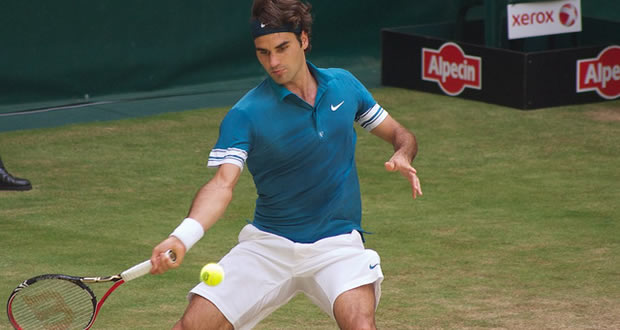
    Serena Williams Wins 16th Slam, Defeating Maria Sharapova In Roland Garros Final

    Serena Williams, the No. 1 seed, defeated Maria Sharapova (No. 2) in the French Open final today, 6-4, 6-4. The victory ups Williams’ Grand Slam total to 16.  This was her 31st win in a row, the longest single-season streak in 13 years. Williams’ W/L record this season is 43-2 with six titles.

    [divider]

    Click here to discuss the Sharapova/Williams final, and more with other tennis fans on our discussion boards.
  • Johan Kriek on How to Counter Dominance

    Johan Kriek on How to Counter Dominance

    “I’ve been thinking about the women’s final at Roland Garros today and how Serena Williams has been so dominating on the WTA tour. I do not know these women personally, in fact have never met either one of them. I do consider myself fairly knowledgeable and a student/ambassador/lover of this wonderful game called tennis!

    The real story to me is how Serena has been dominating Maria Sharapova in majors, and I would like to shed some light on this issue. This is just how I think about “competition”. It is my “everything” vs. their ” everything”. This piece has zero to do with whether I like or dislike any of these players. They have been incredible athletes and regardless of what I think of either one of them, they are winning a lot. Just number one is dominating number two! That is what interests me and here is my thinking… Sharapova can take this free advice from me… won’t cost her…

    Serena Williams is by far the strongest, most vicious competitor in the women’s game — maybe ever — with a serve that rivals some top men players in speed. Period. Her serve is her biggest weapon and when it clicks, it elevates everything else in her game.

    What does one do when this dominance seems so complete? Does one shrug, accept that they are just better, bigger, faster. and move on to the next tournament in hopes of not running into the domineering player? Or do we stop, take stock of what has been happening, look at all the strengths and weaknesses of both of us, and “adjust”? By adjust I mean really change some stuff. If I were Sharapova’s coach I would be doing the following:

    I would stop at NOTHING to figure out how to beat Serena. Get as many matches on video where Serena had beaten her, analyze all of it in depth, and make notes of how she beat her, scores, etc., on what surface, and if there were many variations in the tactics. What was her percentages of serves in each game? Where did she serve on break points against her? Where did she land her second serves under stress points? What was her average first serve speeds in each game, each set, each match? Second most important thing is returns of serves — of both first and second serves. How can she improve on that?Look at pattern play when the chips are not down, vs. when the chips are down, and it is a must win for Serena. We all play a certain way when we are under pressure, and many times we can see patterns emerge. This analysis will take time, but a lot can be learned if one knows what to look for. There is a company in Melbourne, Australia, that has this capability of analyzing top men’s and women’s matches, and everything and has been doing it for many years. Get it! Study every point, every game, every set, and begin to formulate a plan.

    This plan will include some serious stuff. Gym work to increase strength. Sharapova is not a great mover. She reads the ball very well, but she needs to increase her sprint ability. Leave no stone unturned when it comes to physical prowess. Navratilova did it and when she dominated Chris Evert, Chris went to the gym and became much better. It absolutely can be done.

    Here comes the controversial part:

    Sharapova needs to learn to play fearless, aggressive tennis. Not just pounding groundstrokes from the baseline; she needs to get her nose to the net! NOBODY likes to be pushed into a corner and then see the attitude of “I dare you to pass me”.  Serena doesn’t like to be pushed. She likes to be a front runner and it shows. I will have Sharapova serve and volley until she likes it! She can match Serena off the ground, but if Sharapova can learn the “transition game” and be as comfortable with that as she is with her groundstrokes — watch out!

    Sharapova has a pretty good serve with good power! But when she “over-thinks” it, the toss goes sky high, the knees bend even more, and with the combination of a fast dropping ball and slightly out-of-sync legs, she double faults suddenly. It doesn’t take much for that to happen … Saw it again today! I will cure her double faults!

    Here is why I like Nadal: he tinkers, he changes, he tries different things all in the name of making himself “better” and he does it all the time! But what is so astonishing about him, is that he goes into these “changes” with 100% conviction that that is going to work for him! Nobody in tennis does what Nadal does. Look what he has done the last 8 to 10 years! Not Roger, not Djokovic, not Murray — none does what Nadal does. Maria needs to take a page out of Nadal’s book and do the following:

    Work on the stuff I mentioned. That is a must. But over the next few years, if she is doing these changes with a passion and 100% conviction, she will for sure have more success! If not, I cannot see her EVER winning majors against Serena at this point, unless something goes wrong physically or mentally with Serena.

    On Tuesday I wrote a piece about being “process driven” vs. ”result driven”. Here is a classic example and what happened to me. In 1978 and 1979 I reached the quarterfinals at the US Open and in both years I lost to Vitas Gerulaitis. He spanked me in straights in ’78, and in four sets in 1979. He was incredibly quick, served and volleyed, and was a pretty good all -around player but his fitness, his quickness, and his ability to read the play was fantastic. I was beginning to think, maybe I will never be able to beat him; after all he was training with Borg and was number 4 in the world at the time. A year or so later I played Vitas Gerulaitis again in Milan, Italy, on a fast indoor carpet. I liked the surface — and so did he. I agonized the night before of how I was going to play against him. I went through every possible scenario I could think of, and decided on the following which became my “process”:

    1. Serve and volley every single point on my own serve. Regardless of score. Absolutely be fearless, no matter how bad things may turn out for me, but I WILL get to the net before he does, and if he doesn’t come to the net on his serve, I will. Execute, execute, execute — FEARLESSLY!

    2. Never show ANY emotion! I made myself that promise, and I went over these points over and over until the wee hours of the morning.

    3. Every second serve I get would be looked at as an opportunity for me to “pounce”! I would slice and come in. I would rip a backhand and come in. Let him try and pass me. I would drop-shot him sometimes, no matter how fast he was, I would be at the net, too, and see if he could pass or lob me.

    4. I made a pact with myself: No matter how hard it may be, I will not WAIVER in this approach at all.

    I didn’t! And I beat him badly!

    That match meant more to my inner confidence/my self-belief/my strength of thought in my career and I ran into many, many tough guys and tough matches and I won most of them. WHY? I became “PROCESS ” driven. The “result” would come ONLY after I had done the process right.

    I never lost to Gerulaitis after that Milan match ever again…..

    I love this stuff……”

    Reposted from the Johan Kriek Tennis Academy website

  • ‘King of Clay’ Wins Epic 5-Setter to Reach the French Open Men’s Final; Ferrer breaks French hearts

    ‘King of Clay’ Wins Epic 5-Setter to Reach the French Open Men’s Final; Ferrer breaks French hearts

    The seven-time champion, Rafael Nadal, beat Novak Djokovic 6-4, 3-6, 6-1, 6-7(3), 9-7 on Friday, in a match which lastest 4:37, securing his place in Sunday’s championship match at Roland Garros.  It was the much-anticipated rematch to last years’ final, and each player had much at stake.  Nadal is vying for his record 8th title at the French, while Djokovic was playing for the chance to be only the 8th player ever to hold a “career Slam.”

    The Spaniard David Ferrer later defeated Jo-Wilfried Tsonga in straight sets, 6-1, 7-6(3), 6-2, eliminating France’s hope of having one of their own in the Roland Garros men’s final.

    [divider]

    Click here to discuss the Nadal/Ferrer final, and more with fellow tennis fans on our discussion boards.