Blog

  • Australian Open Final Preview: The Tilted Mirror

    Australian Open Final Preview: The Tilted Mirror

    Novak Djokovic Andy Murray

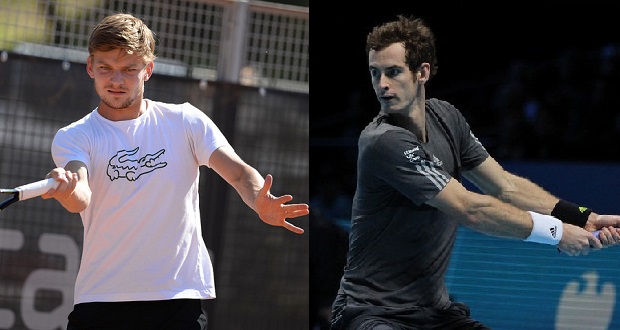
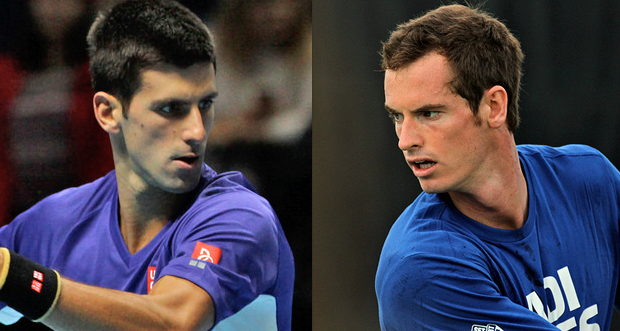
    When Novak Djokovic and Andy Murray contest a tennis match, it brings to mind to me Djokovic staring at a tilted mirror. Both players are in essence counterpunchers. Both rely on superior movement, low error rates, and superior defensive skills to confound most opponent’s efforts. Novak looks across the net and will see much of himself reflected back in Andy. It is a tilted reflection, though, as Murray will often seem further back than Djokovic in their baseline exchanges, Novak’s own strokes sending the ball farther than those that are being sent back. That is the essence of the matchup: The offensive counterpuncher in Djokovic doing pretty much everything the defensive counterpuncher Murray can do, only better.

    [divider]

    Click here to discuss the Djokovic/Murray Australian Open final in the Discussion Forum.

    [divider]

    Djokovic is perhaps playing the best tennis the men’s tour has witnessed in many years. He looks untouchable. Although he lacks the flare of Federer in his prime, the explosiveness of Nadal in his heyday, he looks somehow more complete than either in their own periods of domination, less liable to upsets or struggles on a specific surface. Nadal could always be counted upon to trouble Federer, whilst a Davydenko or Blake could make Rafa look amateur on a hard court at times. Nobody comes to mind that can be a regular thorn in Novak’s side, rather the current status quo of a Wawrinka pummelling him on rare occasions, or Federer seizing the initiative on fast courts in the Middle East or North East America.

    Seizing the initiative sums up rather nicely what Djokovic is doing. Though a counterpuncher, he is continuing to show his natural ability as an offensive baseliner. He is serving big, stepping into the court, and unloading on balls with natural and seemingly increasing power. He is not content to ride out storms against Federer or Nadal; he is actively seeking to deny their like of getting any momentum at all by attacking with controlled aggression.

    Needless to say this presents Murray with an instant uphill climb. He will be able to stay with Djokovic physically better than arguably anyone else on tour. Little separates the two in terms of speed and conditioning, but Murray I believe will suffer on two counts of positioning. Firstly, Murray does not hog the baseline, rather stands well behind it. This allows Novak to dictate from the off, sending his man into the far reaches of the court and opening up space for easy winners, regardless of Murray’s speed. The other is the position of Murray’s shots. Unlike the Lendl days, Murray is content again to revert back to rallying mode. The shots are often pushed into play, particularly with his weaker forehand, sitting up in the centre of the court where the Serb can merrily swat them away for winners or forcing Murray into the defensive.

    Murray’s last win at a Major against Novak was in 2013; he is 0-3 against him in them since, and has won just one of their last eleven matches overall. Furthermore, he is 9-21 in their entire head-to-head series — not a terrible number, but hardly encouraging, especially as Djokovic has grabbed their rivalry by the scruff of the neck since Murray’s 2013 Wimbledon triumph. Murray’s biggest wins against Novak have also occurred on the slicker surfaces of London’s grass or the fast hard courts of Canada, Cincinnati, and New York. He is no slouch on the slower hard courts, reaching four finals in Melbourne, as well as winning two Miami Masters titles. His relative lack of power and defensive style, though, leave him with his work cut out on slower surfaces.

    All is not lost for Murray. I think his first serve at its best is better than the Serb’s, albeit less reliable. I think Murray also has softer hands, and choice attacks at the net could prove bountiful for him. The Australian crowd are definitely the most sporting of the four Majors, and definitely have taken to Djokovic more than their three counterparts. From experience, though, they have always backed Murray more when the two have met here, perhaps out of the Aussie appreciation for the underdog, as well as for a fellow member of the Anglosphere. Crowd support for Murray could spur him on if he were to take an early lead, as well as rile Djokovic, often acutely sensitive to the biases of those in the audience. Murray fans could also take heart from the Djokovic vs. Simon match. The Frenchman, my favourite defensive counterpuncher on tour, has sometimes been labelled derogatorily as a ‘poor man’s Murray’. Both play similar styles, though Murray has more weapons and variety. If Simon can stretch Djokovic to five sets and make him produce 100 errors, it’s more than conceivable Murray could better that.

    All things being equal, such is Novak’s form, dominance of the tour and of Melbourne; it is hard to see him not triumphing tomorrow. I believe Murray will contest and win a couple more Major finals before his career is over, but I feel the only haul he will add to in this year’s Australian Open is his runner-up plates.

    Novak to win in four sets.

    [divider]

    Cover Photo (Creative Commons License): Marianne Bevis
  • Murray Vs. Raonic: Australian Open Semifinal Preview

    Murray Vs. Raonic: Australian Open Semifinal Preview

    Andy Murray Milos Raonic

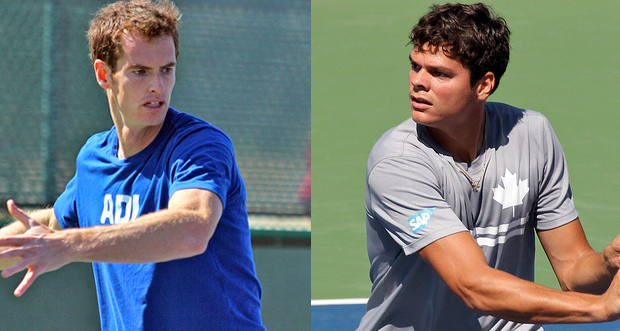
    Raonic vs. Murray has the potential to be a very interesting match. It’ll certainly provide a nice contrast of styles.

    Murray is the game’s consummate defensive counterpuncher — his speed, efficient groundstrokes, and low error rate all combine to make him a shoe-in for the latter rounds of this Major, played on a medium-to-slow variant of his favourite hard surface.

    [divider]

    Click here to discuss the Murray/Raonic semifinal in the Discussion Forum.

    [divider]

    Raonic’s eight titles to date have also been on his favoured surface of hard courts. Although his height and relative lack of mobility aren’t helpful on a slower surface, as in Australia, his serve — up there in the top four in the world, arguably — combined with a renewed commitment to dictate offensively with his forehand, as well as attacking the net, do much to nullify the surface’s pitfalls. He is enjoying quite a streak in Australia, winning in Brisbane this month and progressing through five rounds in Melbourne to contest his second Major semifinal.

    Both players are tied at three wins apiece in their head-to-head series, although Murray has won their sole meeting at Slam level. The Scot certainly starts off as clear favourite in this match, a two-time Major Champion, four times a finalist in Melbourne, and owning four times as many trophies in his cabinet than his Canadian opponent. He will be the last person, though, to underestimate Raonic Mark III that we have been seeing of late.

    Although Murray stands to benefit if this becomes a baseline war of attrition, where he can move his man about and outfox him as he has done so many times before to taller, slower opponents, it would be folly to revert to his passive comfort zone. Raonic is likely to be able to hold the majority of his service games, even against Murray, a player with returning prowess second only to Djokovic. Also, if Raonic sees a lot of Murray’s weak second serves to swat away at leisure, as well as the Scot’s weaker forehands landing in the middle of the court as they often are liable to do, he will be able potentially to dictate the rallies and put Murray on the defensive.

    I like what I have been seeing from Raonic of late, and I hope he continues this rich vein of form into the rest of the season. Such is the calibre and experience of Murray, though, I believe that this will alas be a bridge too far for the amiable Canadian.

    Murray to win in four sets.

    [divider]

    Cover Photo (Creative Commons License): Marianne Bevis

  • Open Era Generations, Part Ten: Gen 8 (1969-73) – American Supernova

    Open Era Generations, Part Ten: Gen 8 (1969-73) – American Supernova

    Andre Agassi Pete Sampras Jim Courier

    Last of the Great Americans
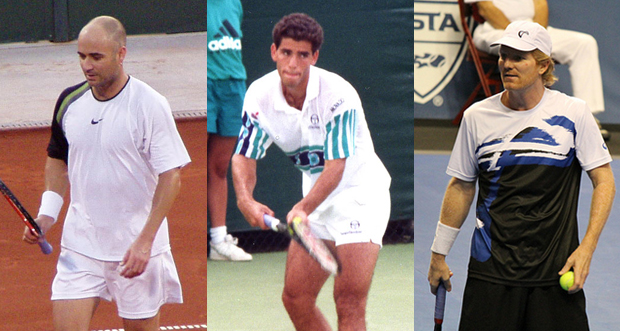
    The United States has always been central to men’s tennis, from early greats like Richard Sears, William Larned, and Bill Tilden to the “golden age” of the 30s to 50s, with stars like Ellsworth Vines, Don Budge, Bobby Riggs, Jack Kramer, and the great Pancho Gonzales. American men’s tennis dipped in the 60s and then resurged with Stan Smith and Arthur Ashe being the harbingers of the first Open Era superstar, Jimmy Connors. Jimmy passed the baton to John McEnroe, who in turn passed it to Andre Agassi and Pete Sampras, the twin stars of Gen 8.

    This was the last great—and probably greatest—generation of American men’s tennis. This generation included two (Sampras and Agassi) of the four greatest Open Era Americans (along with Connors and McEnroe), as well as a strong supporting duo in Jim Courier and Michael Chang.

    [divider]

    Click here to discuss “Open Era Generations, Part Ten” in the discussion forum.

    [divider]

    Players by Birth Year
    1969: Cedric Pioline (FRA), MaliVai Washington (USA), Alberto Mancini (ARG), David Wheaton (USA)
    1970: Andre Agassi (USA, 8), Jim Courier (USA, 4), Todd Martin (USA), Marc Rosset (SWI), Magnus Larsson (SWE)
    1971: Pete Sampras (USA, 14), Goran Ivanisevic (CRO, 1), Sergi Bruguera (ESP, 2), Richard Krajicek (NED, 1), Wayne Ferreira (SAF)
    1972: Michael Chang (USA, 1), Patrick Rafter (AUS, 2), Jonas Bjorkman (SWE)
    1973: Greg Rusedski (CAN/UK), Alberto Berasategui (ESP), Albert Portas (ESP)

    Discussion
    This was a very talented generation, with 33 Slams distributed among eight players, including two who could be considered all-time greats and three other multi-Slam winners.

    It is easy to forget how good Courier was for a few years, as he was historically well overshadowed by Sampras and Agassi. He was a player who wasn’t as naturally gifted as his contemporaries, but played his heart out to the tune of four Slam titles, all within 1991-93. He finished 1992 as the year-end No. 1, then 1993 as year-end No. 3, and then finished in the Top 10 only once more, in 1995, despite playing through the decade.

    Pete Sampras was to the 90s what Roger Federer was to the 00s: the premier player by a good margin. He was never able to win the French Open — not even coming close, really — but he dominated Wimbledon with seven titles and the US Open with five. While some might look at his Slam performance record and think that it doesn’t compare to those of the recent three greats because of Sampras never winning more than two Slams in a year, and with plenty of first week losses even in his prime, it must be understood that the tennis of the 90s was a more diverse game in terms of the courts, before the surface homogenization that has taken place over the last decade or so.

    Sampras was also considered by many to be the best player of the Open Era until Federer, Nadal, and Djokovic came along. He was such a dangerous player; one of his most notable skills was his incredible second serve, known to deliver many an ace. The lone match between Sampras and Federer is must-watch tennis:

    Andre Agassi was no less memorable than Sampras, although more for his storied career than his play – although he was a great player, just not on the level of Sampras. Andre essentially had two careers: the first being a fiery and troubled youth who finished in the Top 100 at age 16 in 1986, although did not win his first Slam until six years later in 1992. Andre’s career unraveled in 1997 when he played only 13 tournaments and dropped to No. 110. He came back slowly at first in 1998, but then had his best year in 1999, winning two Slams and earning the year-end No. 1 ranking. He was the elder statesman of the game in the early 00s, for a few years after Sampras had retired, becoming the oldest player to be ranked No. 1 in 2003 at the geriatric age of 33, remaining in the Top 10 past the page of 35.

    Underachievers and Forgotten Players
    There is no clear player in this generation that I’d call an underachiever, although many players who have glimmerings of it. Agassi was an underachiever in his youth, but made up for it later on. I cannot remember the source, but I believe it was an interview on NPR in which Andre stated that he hated tennis and resented his family for pushing him into it – at least early on. Michael Chang could also be considered an underachiever in that he won his only Slam at the tender age of 17, but his overall skill set was more comparable to the better Slam-less players and overall he had an excellent career.

    Jim Courier is an interesting case in that he could be considered both an under- and overachiever. He is an underachiever if you look at his career through 1993 when he turned 23, which included four Slams and a year-end No. 1 in ’92, and compare it to 1994 onward – when he never won a Slam or even made it to another final. But he could be considered an overachiever in that for those few years in 1991-93 he maximized his modest talent and was one of the best players in the game.

    Two other players that come to mind, who probably fit the term better: Goran Ivanisevic, who had the skill-set to be a dominant grass and fast-court player but only won a single Wimbledon; and Richard Krajicek, an almost great but flawed player who was the only peer of Sampras to have a winning record against the generation’s greatest player, but only a single Slam winner.

    Did You Know?
    One of my favorite stories from this generation is the tale of Goran Ivanisevic – one of the greatest servers in the history of the game, and one of the ten or so best players of the 90s. Imagine Ivanisevic in 2000: he ended the year 29 years old, had seen his ranking fall each year from No. 4 in 1996 to No. 129 in 2000. The big Croat had lost the three Slam finals he had played in, all at Wimbledon – one to Agassi, two to Sampras. 2001 looked to be no different. He went out in the first round of qualifications at the Australian Open, didn’t play in the French Open, and entered Wimbledon ranked No. 125.  He then proceeded to plow his way through the rounds, defeating everyone from Carlos Moya to an 18-year old Andy Roddick, Greg Rusedski, Marat Safin, Tim Henman, and then finally facing–and defeating–third seed Patrick Rafter in the final in five sets, becoming the first wildcard ever to win Wimbledon. I guess it is never too late; Ivanisevic should remain an inspirational story for Slam-less players in the twilights of their careers.

    Top Ten Players of the Generation

    1. Pete Sampras
    2. Andre Agassi
    3. Jim Courier
    4. Michael Chang
    5. Patrick Rafter
    6. Goran Ivanisevic
    7. Sergi Bruguera
    8. Richard Krajicek
    9. Todd Martin
    10. Wayne Ferreira

    Honorable Mentions: Cedric Pioline, Greg Rusedski, Jonas Bjorkman.

    The top three are very easy to rank. After that you could make an argument for different orders of numbers 4-7, although I like Chang’s longevity better than the other three. Chang was, in a way, the 90s version of David Ferrer, but if Ferrer had managed to sneak a Slam in. Rafter won two Slams, but had a relatively short career. Sergi Bruguera was the definition of a clay-court specialist. He won two French Opens, made the final of another and the semifinal of a fourth, yet never made it past the 4th round at any other Slam.

    Richard Krajicek is an interesting player in that he is one of the few to own a winning record against Pete Sampras, including beating him in the quarterfinal of the 1996 Wimbledon en route to his lone Slam title. It was Sampras’ only loss at Wimbledon between 1993 and 2000. After Krajicek, I ranked Martin and Ferreira in the top 10, but the honorable mentions are all close.

    [divider]

    Cover Photo (Creative Commons License): Chris Josefy / James Marvin Phelps / shinyasuzuki

  • Starts As He Means To Go On: Two Mini-Milestones For Novak In Qatar With Potentially Large Consequences

    Starts As He Means To Go On: Two Mini-Milestones For Novak In Qatar With Potentially Large Consequences

    Novak Djokovic

    On the face of it, Novak Djokovic’s 6-1, 6-2 defeat of Rafael Nadal in the relatively minor ATP 250 event of Qatar does not seem either significant or surprising. Novak is world No. 1, the preeminent hard-court player on the men’s tour, and he has owned Nadal in the last year and a half. I believe, though, that two milestones achieved in this encounter by the Serb are of particular note.

    Firstly, in their forty-seven match, nine-year rivalry, Novak Djokovic took the lead in their head-to-head for the first time, edging it 24-23. Throughout the pair’s storied rivalry whenever Novak looked to be in the ascendancy Nadal has managed to find some fresh inspiration and push back in front. I get the sense that Djokovic is now going to pull away from Rafa, extending his newly acquired lead. He has won against him in their last five meetings without dropping a set. Such was Djokovic’s dominance against a by his own admission of late injury free Nadal in Qatar, I can only see future matches between the pair, especially on hard courts, being equally one-sided in favour of Djokovic.

    [divider]

    Click here to discuss Djokovic’s win in Doha in the discussion forum.

    [divider]

    A second milestone Djokovic achieved by winning the title match was winning his sixtieth title, tying fellow counterpunching great Andre Agassi at ninth in the all-time list. I think the two players make for an interesting and fitting comparison. Agassi was also a hard-court specialist, both are considered the greatest returners of their respective eras, and both are famed for their prowess on the backhand wing.

    Djokovic has more of an upside, I believe, than the retired American great, though, after his own sixtieth trophy. Agassi’s sixtieth was at age thirty five, during his last career surge that would include finalist appearances in Canada and New York, but not contesting another final thereafter. Djokovic, at title number sixty, in his prime at twenty eight, and atop the world rankings by some margin, looks only to add to his title haul. Agassi was aged thirty two when he won his eighth and final Grand Slam in 2003; Djokovic is already on ten and looks set to win several more for at least for a few years yet. Agassi, meanwhile, won his last Masters title, an impressive seventeenth, at the advanced age in tennis of thirty four, whilst Djokovic is on twenty six, just one behind record holder Nadal, and on current form seems likely to win thirty of these lucrative titles sooner than later.

    To be on sixty titles whilst enjoying the form of his life, Djokovic has put himself within striking distance of retired greats Vilas (62), Borg and Sampras (64), as well as rival Nadal, currently with sixty seven. If Djokovic dominates like he did last year, and Nadal’s struggles continue, I would not be at all surprised to see him surpass all these legends past and present come the season’s end.

    [divider]

    Cover Photo (Creative Commons License): mirsasha

  • Open Era Generations, Part Nine: Gen 7 (1964-68) – Mats, Stefan, and Boris

    Open Era Generations, Part Nine: Gen 7 (1964-68) – Mats, Stefan, and Boris

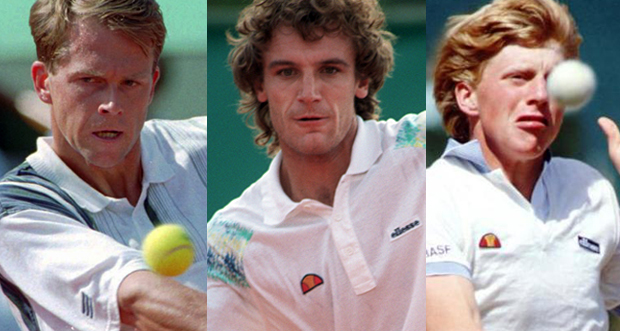
    Stefan Edberg Mats Wilander Boris Becker

    Where the last generation had two all-time greats, this generation had three: Mats Wilander, Stefan Edberg, and Boris Becker, each with very different careers – as we will discuss in a moment. This is the generation that rose in the early 80s and peaked from the mid-80s through the early 90s, although there was only a short gap of years between the reigns of McEnroe/Lendl and Sampras in which they were the dominant generation in the sport.

    [divider]

    Click here to discuss “Open Era Generations, Part Nine: Gen 7 (1964-68) – Mats, Stefan, and Boris” in the discussion forum.

    [divider]

    Best Players by Birth Year
    1964: Mats Wilander (SWE, 7), Jimmy Arias (USA), Miroslav Mecir (CZE/SLO), Henrik Sundstrom (SWE), Jakob Hlasek (SUI)
    1965: Pat Cash (AUS, 1), Guy Forget (FRA), Karel Novacek (CZE), Emilio Sanchez (ESP)
    1966: Stefan Edberg (SWE, 6), Jay Berger (USA), Andrei Chesnokov (USSR/RUS)
    1967: Boris Becker (GER, 6), Thomas Muster (GER, 1), Aaron Krickstein (USA)
    1968: Michael Stich (GER, 1), Petr Korda (CZE, 1), Kent Carlsson (SWE)

    As you can see, seven different players won 23 Slams in all – the most in both categories since the 1934-38 generation.

    Mats Wilander followed in Bjorn Borg’s footsteps, with Sweden winning at least one Slam in every year from 1974 to 1985, and all but two years until 1992 – the end of the Swedish reign and co-dominance with the United States. Wilander was a tender 17-years old at the 1982 French Open and clearly benefited from the absence of Borg. His early rise was quick and fierce; while he only finished No. 1 once, his three-Slam 1988, he was ranked No. 7 or higher from 1982-88, and No. 4 or higher in all but 1982. Wilander’s 1988 was a swan song after which he declined quickly, never even making another Slam final or ranking in the Top 10 until he retired after 1996 – one of the worst declines of any great tennis player.

    Edberg and Becker will likely be forever linked. They are players of very similar career accomplishments, as we will discuss more in a moment when we look at the best players of the era.

    Underachievers and Forgotten Players
    Miroslav Mecir is probably one of the most talented players in Open Era history never to win a Slam. His career was short and bright; if it had been longer, he really could have added a Slam trophy. He played only eight years on tour, from 1983-90, made it to two Slam finals–losing to Ivan Lendl in both–won three Grand Prix (Masters) tournaments and the 1988 Olympics. Perhaps the highlight of his career was winning the WCT Finals in 1987 against John McEnroe.

    Aaron Krickstein was a promising young player who never fulfilled his early success. In 1984 he finished No. 12 at the age of 17. But his career stalled out for several years, until he reached his highest ranking of No. 6 in February of 1990. Krickstein would go on to win six titles but never better than a semifinal result at a Slam. If we look at all players in the Open Era, Krickstein’s career could be the most disappointing relative to his ranking as a 16-17 year old, as we will see in a moment…

    Did You Know?
    Aaron Krickstein was the youngest player to win an ATP title at the age of 16 years and 2 months when he won Tel Aviv in 1983, a record that remains to this day. He is also one of only three players in the ATP Era (1973-present) to finish in the top 100 as 16-year olds, along with Andre Agassi and Michael Chang, and one of only four to finish in the Top 20 as 17-year olds along with Agassi, Chang, and Borg.

    Top Ten Players of the Generation

    1. Boris Becker
    2. Stefan Edberg
    3. Mats Wilander
    4. Thomas Muster
    5. Michael Stich
    6. Petr Korda
    7. Pat Cash
    8. Miroslav Mecir
    9. Guy Forget
    10. Aaron Krickstein

    Honorable Mentions: Emilio Sanchez, Andrei Chesnokov, Karol Novacek, Jakob Hlasek, Jimmy Arias

    Ranking the top three is difficult, with valid arguments for any of them to be at the top. Wilander had the best year in 1988, and won one more Slam than the other two, but declined very young. Becker had the longest range of Slam titles but was less consistent year in and year out than Edberg, and never finished the year as the No. 1 player. Their match-up is “Fedalian” in terms of how lopsided it was (Becker led it 25-10), but Edberg held the edge in Slams (3-1) and ATP finals (1-0) and of course had two year-end No. 1 rankings.

    Really it is 1a, 1b, and 1c, or perhaps 1a, 1b and 3, with Wilander a step behind the others. These three players peaked during one of the most competitive eras in men’s tennis, when Connors, McEnroe, and Lendl were still elite players, and Sampras, Agassi, and Courier were rising to the top. When I started writing this series I gave Edberg the edge, but have since given it to Becker because, if you look below the surface, Becker has the edge in a number of ways. While both won six Slams, Boris had two more years in the Top 10 than Stefan, and also won two more ATP finals and five more Grand Prix/Super 9 (Masters equivalent) tournaments, with a superior overall record in title finals: 49-28 compared to Edberg’s 42-38. Becker was also a much better player against Top 10 opponents, with a career 65.1% vs. Edberg’s 45.7%.

    To put the comparison of the three graphically, I used one of my various statistic systems called “Title Shares,” which imagines that the big tournaments–all four Slams, the tour finals, and the Masters–equal 100 total shares for a given year, or 14 for each Slam, 8 for the ATP year-end championships, and 4 for each Masters. This system then adds 1 point per other title (ATP 250 and 500), and in the case of the WCT year-end championships, 5 extra points; consider these all to be “extra credit.” Now this system makes more sense in recent years, as the ATP structure has been more consistent, but it gives you an idea of the different trajectories of the three players and their relative dominance:

    20151229052337

    As you can see, Wilander was more dominant overall through 1988, which turned out to be a final supernova after which his career sputtered and faded. Edberg was a force from 1985 on, with his best phase in the early 90s. Becker was also relatively strong from 1985 on, but where Edberg faded in 1993, Boris had a resurgence from 1994-96 that strengthened his overall legacy.

    After the Big Three, there’s a steep drop-off to Thomas Muster, but he’s a solid No. 4. Muster is best known for being both a great clay-court player but also an incredible competitor in finals. He has an overall 44-10 record in ATP finals, or 81.5% – far ahead of anyone else. Nikolay Davydenko is number two with a 21-7 (75%) record in ATP finals; Borg has the best among all-time greats, with a 64-24 (72.7%) record.

    Michael Stich was a very good player for, unfortunately, a rather short length of time. He is best known for upsetting Boris Becker in the 1991 Wimbledon final. A comparable recent player would be Juan Martin del Potro. Pat Cash is solidly No. 6, and then Korda and Mecir are harder to rank. Korda has the one Slam but Mecir was probably a better player. He was, in some ways, the Robin Soderling of his generation – very good for a too-short period of time, his career ended prematurely by injury. The last two spots go to Forget and Krickstein, with Emilio Sanchez and Andrei Chesnokov just missing the cut.

  • Open Era Generations, Part Eight: Gen 6 (1959-63) – “You Cannot Be Serious!”

    Open Era Generations, Part Eight: Gen 6 (1959-63) – “You Cannot Be Serious!”

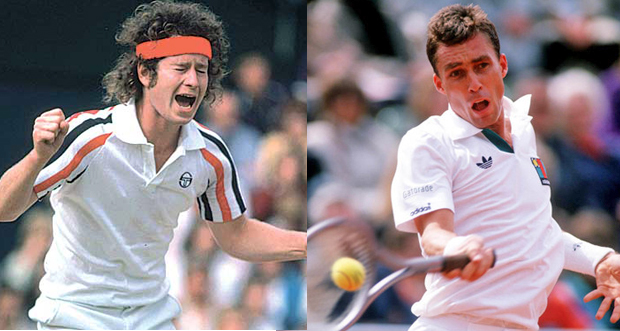
    John McEnroe Ivan Lendl

    Into the 80s

    While the tennis of the 1970s was already quite different than the decade before it, both because of the Open Era but also a shift in the way the game was played, the 1980s saw even further change: namely through the transition to metal racquets as well as the rise of the Australian Open. By 1987 the competition at the AO was, if not quite on par with the other three Slams, very close. A few years later it would be equal.

    While the last three generations each had a singular dominant player, the 1959-63 generation is the first since the 1934-38 generation that saw two players vying for the top spot. In some ways John McEnroe, nicknamed “Superbrat” by the British press, seems more part of Borg’s generation, yet he is much closer in age to Ivan “the Terrible” Lendl. Their respective peaks are a bit different, only overlapping for a year or two; McEnroe was at his best from the late 70s until 1985, Lendl not peaking until well into the 80s and remaining an elite player into the 90s. They are, clearly, the twin crown princes of the generation and the two best players born between Bjorn Borg (1956) and Pete Sampras (1971).

    Best Players by Birth Year
    1959: John McEnroe (USA, 7), Eliot Teltscher (USA)
    1960: Ivan Lendl (CZE, 8), Yannick Noah (FRA, 1), Andres Gomez (ECU, 1), Tim Mayotte (USA)
    1961: Brad Gilbert (USA), Anders Jarryd (SWE)
    1962: Juan Aguilera (ESP)
    1963: Henri Leconte (FRA), Joakim Nystrom (SWE), Mikael Pernfors (SWE)

    Discussion
    Ivan Lendl is the only player of the Open Era with 6+ Slams who has a losing record in finals (8-11), but that speaks more to the strength of the era he played in than any lack of effort on his part. First of all, we should consider that he has played in more Slam finals than anyone in the Open Era other than Sampras, Federer, and Nadal (although Novak will almost certainly surpass him in 2016 – he’s just one behind). Consider also that Lendl’s career overlapped with the peaks of Connors, Borg, McEnroe, Wilander, Edberg, Becker, Courier, Agassi, and Sampras; there is really no other great player of the Open Era who faced such a multi-generational array of all-time greats, with the exception of Jimmy Connors and possibly Andre Agassi. The main tarnish on Lendl’s record, and his unfulfilled White Whale, was his inability to win the grandaddy of all tournaments: Wimbledon.

    Johnny Mac is the most memorable player of the generation, and one of the most infamous players in tennis history, both because of his legendary temper tantrums, one of which made the title of the article famous, but also because of his intuitively brilliant play. He also has the honor of being the only player that could consistently beat Bjorn Borg. While their perhaps unparalleled rivalry yielded a 7-7 record (plus 4-4 in invitational matches), McEnroe held the edge over Borg the last couple years and had a 3-1 record in Grand Slams. The two provide us with an example of an interesting dynamic in discussing tennis greats: While Borg is generally ranked higher on all-time lists, by the time he retired McEnroe was a better player and McEnroe’s overall career accomplishments—aside from Slam titles—are better. This points to the ongoing developmental nature of the game. Regardless, the two are much closer than their Slam title totals (11 and 7) would imply.

    Underachievers and Forgotten Players
    This generation was so dominated by Lendl and McEnroe that it is hard to accuse any player of being an underachiever. I suppose Yannick Noah, who is probably more well-known than his career would entail, could have accomplished more. Noah is well-known not only for being the only French Slam winner of the Open Era, but the second black player to win a Slam, and also for his leadership in the Davis Cup.

    Did You Know?
    Yannick Noah has so many different angles on fame. Aside from his tennis accomplishments, he is also the father of NBA player Joakim Noah, and had a relatively successful music career.

    Top Ten Players of the Generation

    1. Ivan Lendl
    2. John McEnroe
    3. Yannick Noah
    4. Andres Gomez
    5. Henri Leconte
    6. Brad Gilbert
    7. Tim Mayotte
    8. Anders Jarryd
    9. Eliot Teltscher
    10. Joakim Nystrom

    Honorable Mention: Juan Aguilera

    Some might take issue with my ranking Lendl over McEnroe, but Lendl’s record is just better. While McEnroe had a higher peak and was probably a more brilliant tennis player, with a level of dominance and a brilliance of play unmatched by the Czech, Lendl’s peak wasn’t that much lower and he sustained an elite level far longer than McEnroe.

    Noah and Gomez—the only others to win Slams—are pretty easy to rank at No. 3 and No. 4, and then the rest taper off. Gomez is an interesting player in that he won his only Slam in 1990 at the age of 30, against a young Andre Agassi. Gomez—born the same year as Lendl and a year after McEnroe—won his lone Slam just after Lendl’s last and six years after McEnroe’s last, in 1984. He’s a good reminder for players like Jo-Wilfried Tsonga and Tomas Berdych that there’s always hope.

  • Open Era Generations, Part Seven: Gen 5 (1954-58) – Borg and Some Other Guys

    Open Era Generations, Part Seven: Gen 5 (1954-58) – Borg and Some Other Guys

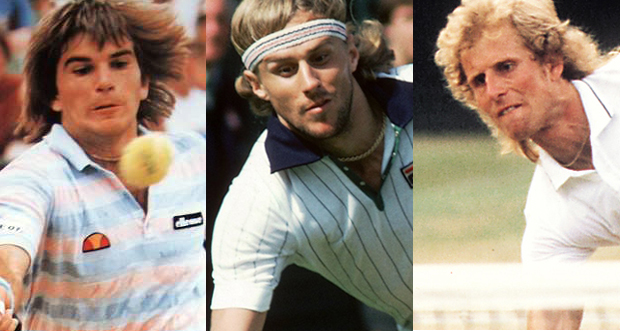
    Johan Kriek Bjorn Borg Vitas Gerulaitis

    The Greatest Swede
    If you take this generation’s best player out of the mix, it would be one of the weakest. In fact, we could say that more than any other generation with a premier talent in it, this generation is the weakest with only five Slams to players other than Bjorn Borg. But of course the generation does include Borg, who is still considered one of the best players in tennis history, and is a candidate for the best young player in the history of the game, with 11 Slams before his 25th birthday. Borg was also the first and greatest of three great Swedish players, followed by Mats Wilander and Stefan Edberg in the golden era of Swedish tennis that was the late 70s into the early 90s.

    Best Players by Birth Year
    1954: Vitas Gerulaitis (USA, 1), Brian Teacher (USA, 1), Mark Edmondson (AUS, 1), John Lloyd (UK)
    1955: Victor Pecci (PAR), Peter McNamara (AUS)
    1956: Bjorn Borg (SWE, 11), Gene Mayer (USA), John Sadri (USA), Steve Denton (USA)
    1957: Chris Lewis (NZ)
    1958: Johan Kriek (SFA, 2), Jose Luis Clerc (ARG), Kevin Curren (SAF)

    Discussion
    As you can see, there are no true standouts after Borg. In some ways this era echoes Ashe’s, although Borg was a much greater player than Ashe, and there is a bit more talent beyond its premier player; but it is a similar one-man show. The only other multi-Slam winner, Johan Kriek, won this two Slams at the Australian Open, a few years before it became as competitive as the other Slams.

    As for Borg, what to say? He was an amazing talent, the premier player in the game during the late 70s, and was the overall best player during that decade, winning almost twice as many Slams (8) than runners-up John Newcombe and Jimmy Connors (5 each). He reached a high level at a very young age in an era when tennis was still dominated by men in their late 20s. Consider that when Borg finished 1974 as the No. 3 player in the world, at the tender age of 18, the only other members of the Top 10 who were younger than 27 were Jimmy Connors and Guillermo Vilas, both 22. With those two Borg took the tennis world by storm in the mid-70s and changed the game.

    Borg was a superstar in the full sense of the word. With his long-haired good looks and cool demeanor he was a welcome counterpoint to the fiery brashness of the other great star during the mid-70s, Jimmy Connors. Though Borg didn’t finish as the No. 1 player until 1979, it is clear that he had surpassed Connors at least a year prior and was deserving of the No. 1 ranking in 1978. But his reign at the very top was short-lived compared to his talent; an even brasher young American by the name of John McEnroe appeared on the tour in the late 70s giving Borg troubles, in what is undoubtedly the most storied and competitive rivalry in tennis history. By 1981 McEnroe had supplanted Borg as the premier player; it was Borg’s last year to play a Slam, after losing the Wimbledon and US Open finals to McEnroe. A contemporary comparison would have been if Rafael Nadal had retired after Novak Djokovic stole the No. 1 ranking from him in 2011; Nadal was the same age as Borg, 25. Borg didn’t play another Slam although didn’t announce his retirement until a year later, in January of 1983. He retired from the game for a variety of reasons, most especially being tired of various squabbles with the tour organizers, and losing the drive required to compete at the highest level. Regardless, he retired too soon for tennis fans and tennis history.

    As an aside, there is an interesting harmonic between this era and more recent years. Just as Connors dominated the mid-70s with the rising young baseliner Borg in his rearview mirror, so too did Roger Federer dominate the mid-00s with a rising young Rafael Nadal behind him. Borg finally overtook Connors in 1979, just as Nadal overtook Federer in 2008. But just as Borg only held the No. 1 ranking for a couple years before being surpassed by McEnroe, Rafa’s reign was marred by injury and then the rise of Novak Djokovic in 2011. (Even the fourth wheel, Ivan Lendl, later became the coach to the fourth of the Big Four, Andy Murray). Borg’s retirement after 1981 would have been echoed in recent years if Rafa had retired after 2011, but as you know Rafa rose again.

    Underachievers and Forgotten Players
    Vitas Gerulaitis was a notorious partier, called the “ultimate tennis playboy.” He was a very talented player, and for about six years—1977-1982—was a Top 10 player, and probably overall the sixth best player in the sport during that span after Borg, Connors, McEnroe, Lendl, and Vilas. His most comparable recent player is probably David Nalbandian, if the latter had won a Slam. Both players could have been more than they were in terms of their raw ability, but didn’t have the focus and mentality required to be true greats.

    If you look at it in a certain way, Borg could also be considered an underachiever. As said before, he won 11 Slams before his 25th birthday – that’s more than Nadal (10), Federer (8), and Sampras (7). One of the biggest “What If?” questions in tennis history is “What if Borg hadn’t retired at such a young age?” The question is unanswerable, especially considering the fact that when he retired he had just been surpassed by John McEnroe as the best player in the game, and was seemingly losing interest in the relentless grind of the tour and tennis politics. But if Borg had somehow managed to rediscover his passion for the game, it seems a certainty that he would have finished his career with 15+ Slams and be mentioned in the same breath as Laver and Federer. But, in the end, his career is what it was.

    Did You Know?
    Bjorn Borg made several failed comeback attempts in 1991, ’92, and ’93. He did not win a match out of twelve played, and only won a set in each of the three matches played in 1993.

    Top Ten Players of the Generation

    1. Bjorn Borg
    2. Vitas Gerulaitis
    3. Johan Kriek
    4. Jose Luis Clerc
    5. Mark Edmondson
    6. Brian Teacher
    7. Kevin Curren
    8. Gene Mayer
    9. Victor Pecci
    10. Peter McNamara

    Honorable Mentions: John Lloyd, John Sadri, Chris Lewis, Steve Denton.

    Yet another generation with a clear No. 1 (this will change shortly). Kriek is an interesting player to rank. On one hand it is hard to argue with two Slams. On the other, those two Slams were the 1981 and 1982 Australian Opens against Steve Denton, who never won a title. Despite winning half as many Slams, Gerulaitis was a far more prolific and successful player. For instance, Kriek never ranked higher than No. 7, and never finished in the year-end Top 10, while Gerulaitis ranked as high as No. 3, and finished six straight years in the Top 10. Gerulaitis was clearly the better player.

    After that it falls sharply. Teacher and Edmondson both won Slams, but we run into the same problem: taking complete careers into account, Cleric was probably better than Edmondson, and Curren better than Teacher. But Nos. 4-8 are very close and somewhat interchangeable.

    Pecci is best known for being by far the best Paraguayan player ever, but also for defeating Guillermo Vilas and Jimmy Connors en route to losing to Bjorn Borg in the 1979 French Open.

  • 2015 Davis Cup Final: Belgium vs. Great Britain Preview

    2015 Davis Cup Final: Belgium vs. Great Britain Preview

    18878832862_91772508ae_z

    This year has been a strange one for the Davis Cup. The usual contestants all disappeared early as France, the Czech Republic, and defending champion Switzerland all lost before the semifinals. As the dust settles, we are left with an unlikely matchup of unseeded teams in the final. Both Great Britain and Belgium upset several higher-ranked teams to get where they are. For Great Britain, it is their first final since 1978; if they win, it will be their first Davis Cup title since 1936. For Belgium, it is their first final since 1904; if they win, it will be their first-ever Davis Cup title.

    [divider]

    Click here to discuss the Davis Cup Final in the discussion forum.

    [divider]

    The Great Britain team starts and ends with Andy Murray. He has won all five singles matches, as well as the two doubles matches he has played this year. James Ward was the hero in the first round when he defeated John Isner 15-13 in the 5th set to give Great Britain a 2-0 lead. In the final, the No. 2 spot will be between Ward and Kyle Edmund. It’s pretty obvious that the Murray brothers will be teaming up for the doubles after their heroics against France and Australia.
    In a similar way, David Goffin is the center of the Belgian team. They need two wins from their star player if they hope to take home one of the best trophies in all of sports. Steve Darcis may be more important in the No. 2 singles slot than their doubles team.

    The Davis Cup Trophy
    The Davis Cup Trophy

    How They Got Here:
    Great Britain defeated the United States 3-2, and then upset top-seed France in the quarterfinals. After tying it up with a win over Jo-Wilfried Tsonga on clay, the Murray brothers fought out a tough four-set doubles win over Tsonga and Nicolas Mahut.  Murray’s amazing determination to get a comeback win over Gilles Simon seemed to be the turning point for the British team. It was suddenly from this point that a Davis Cup championship for Great Britain didn’t seem like such a crazy idea. I still don’t know how Murray won that match, but that was the pivotal point of the season for this team.
    In the semifinals, Great Britain may have been lucky with all the hoopla surrounding Bernard Tomic (on the team, off the team, on the team) and Nicholas Kyrgios (timeout for you!). With Kyrgios excused from the team, Murray took care of Tomic and Kokkinakis, and in the doubles teamed up with Jamie to come from a set down to get the win. That five-set doubles match may have been the match that decided the 2015 Davis Cup champion. Lleyton Hewitt was playing in his final Davis Cup, and alongside Sam Groth, threw everything they had at the Murray Brothers, but the Murrays came from behind to win 4-6, 6-3, 6-4, 6-7(6), 6-4.

    As for Belgium, they were also the underdogs in every round. They were fortunate to draw a Federer/Wawrinka-less No. 2 Swiss team in the first round but still barely won 3-2. In the quarterfinals against the No. 8 team, Canada, they were again fortunate in that Raonic and Pospisil were out with injuries, so they won easily 5-0.
    Against the No. 5 team, the favored Argentina, Goffin won both of his singles matches, but they dropped the doubles and it looked over, but somehow Darcis came through for the Belgians and defeated the higher-ranked Federico Delbonis and sent the Belgians to the final for the first time in 111 years.

    Both teams have been fortunate in getting to the final but here they are. There is no mistaking that this is Murray’s and Goffin’s teams. Each team has needed their unlikely heroes (Ward and Darcis), but whether they win or not depends on the performances of their star players.

    Predictions:
    Singles: Andy Murray (2) vs. David Goffin (16)
    Murray leads the head-to-head 2-0. Goffin has yet to win a set off Murray. We all saw the beat down that Murray put on Goffin at the Paris Masters where he allowed Goffin only one game. Murray is definitely the favorite here. The things Belgium must count on are the clay court, Murray’s fatigue from the World Tour Finals, and the home-court advantage. That probably won’t be enough for Goffin to be able to upset a determined Murray. Great Britain 1-0 Belgium

    Singles: Steve Darcis (84) vs. Kyle Edmund (100) or James Ward (159)
    Darcis has to win here to give Belgium a chance. Neither Edmund nor Ward have played Darcis before, but just from Davis Cup experience and ranking, you would have to give the edge to Darcis. But it’s a small edge. Tied 1-1

    Doubles: Andy and Jaime Murray vs. Rueben Bemelmans and Kimmer Coppejans (or Steve Darcis)
    After their heroics in the last two rounds, you have to expect Great Britain will go with the Murray Brothers. Belgium has gone with a different team each time. Bemelmans (doubles ranking No. 160) had three different partners in the first three rounds, so it’s tough to guess with whom he will team up. Coppejans (doubles ranking No. 501) might be our best bet but the Belgian team might go with Darcis (doubles ranking No. 596). Still, Great Britain has Jamie Murray, one of the best doubles players at the moment, so the British look good here. Great Britain leads 2-1

    Singles: Andy Murray vs. Steve Darcis
    This is their first meeting but it’s difficult to imagine Murray going down to Darcis after the solid, consistent season he had and with so much riding on the line. Great Britain leads 3-1

    Singles: David Goffin vs. Kyle Edmund or James Ward
    Goffin has never met either British player, but he would have to be favored in this one. That is to say, if there is a fifth match. Great Britain leads 3-2

    Past Records:
    Great Britain will be playing in its first final since 1978, and they will be trying to win their first Davis Cup title since 1936 (their 10th overall). Belgium is in its first final since 1904, and it would be their first title if they win. The two countries have met in Davis Cup competition 11 times. Great Britain has won seven of the meetings, but Belgium won their most recent meeting in 2012.

    Fun Fact:
    Team Great Britain has defeated the top three teams with the most Davis Cup championships to get to the final: United States (32), France (9), and Australia (28).

    Prediction:
    Great Britain wins 3-2 on the strength of three Murray wins for its first Davis Cup championship in 79 years.

    Request:
    If Great Britain does win, they better give Judy Murray a Davis Cup trophy of her own!

    Prayer:
    May there be no terrorism and may all the players, fans, and people working at the venues be safe.

    [divider]

    Cover Photo (Creative Commons License): Marianne Bevis (Andy Murray), Tatiana (David Goffin) and elPadawan (Davis Cup trophy).
  • 2015 ATP World Tour Finals: Title Match Preview

    2015 ATP World Tour Finals: Title Match Preview

    16055198803_c453b99b81_z

    As predicted in the tournament preview here this time last week, Novak Djokovic and Roger Federer shall contest today’s final of the season ending finale. It is fitting that the two best players of the year, who have contested six finals this season, should lock horns in the final tour match of the year.

    Unlike last year, with the spectre of the Davis Cup Final lurking in the background, Federer can go into this match knowing that he can go flat out with no playing obligations until January of next year. Neither has he exerted himself physically nor emotionally in his semi-final against Wawrinka as he did last year, the result of which was a precautionary pull out of the final due to a tender back and representing his country in the Davis Cup final the following weekend. Federer has many incentives to win. Posting two wins in a week against Novak would be quite a punctuation mark with which to close the season out with. He would also have some momentum going into next season, being undefeated in five matches against his top eight peers. Furthermore, were he to haul the trophy tonight, he would climb back to number two in the world, crucial with regards to being seeded high at the Australian Open in January and avoiding meeting Djokovic before the final, and the potential of threatening rivals all being clumped together on the opposite side of the draw.

    Djokovic meanwhile has masses to play for in tonight’s match. He can add a career best eleventh title in a season to cap off his best season in which the smallest title he won was a lucrative 500 point event in Beijing. He can also match Sampras’ and Lendl’s haul of five year end championships, putting him within striking distance of record holder Federer’s six. Finally, today is an opportunity to once again tie Federer in their head to head tally, and with the opportunity to face his Swiss nemesis on favourable slow hard courts and clay in the first third of next season, surely there has never been a better opportunity to put himself in a position to inch ahead of Roger for the first time in their nine year rivalry?

    In terms of their form there is little to choose between the pair. Both suffered blips in form in the group stages, Federer losing a set in a scrappy affair against Nishikori, whilst Novak lost his sole match of the tournament against Roger earlier in the week. Both have looked imperious though in all other matches besides, saving some of their best for yesterday’s semi-final clashes. Novak beat Nadal for the fourth time this season in an increasingly one-sided rivalry, Whilst Roger vanquished Wawrinka after initially losing an early break, extending his lead over his countryman to 18-3.

    I expect a thrilling match this evening. Both are excellent indoor players, each has won a title in these conditions in recent weeks. I will give the edge to Djokovic in this encounter. I think that he is a quick learner, he will thus have analysed how Federer hurt him in Tuesday’s clash, and will make a concerted effort to hurt him on the return, hit with depth to pin Federer back, and hit his signature backhand down the line at every available opportunity. The longer he stretches out the match, turns it into a war of attrition, the more errors he will draw from the Swiss. If Federer comes out of the blocks quickly though, serves at a high percentage, dictates from on top of the baseline, and is able to be at his slicing and dicing best, attacking the net intelligently and with purpose, he could frustrate the Serbs rhythm sufficiently to snatch the victory.

    Novak to win in three sets.

    Author’s Blog: danopines22

    [divider]

    Cover Photo (Creative Commons License): Marianne Bevis

  • 2015 World Tour Finals: Semifinals Preview

    2015 World Tour Finals: Semifinals Preview

    11206695823_bd037c35af_z

    First Semi-final: Djokovic vs. Nadal

    Nadal has been the standout player of not only his group, but perhaps the tournament. He dealt with Wawrinka and Murray pretty tamely, dispatching both in straight sets, whilst surviving a tenacious challenge from compatriot Ferrer to come back and win the final two sets on Friday. This is a timely bit of form for Nadal, beating three quality opponents on his least favourite surface in his poorest season in a decade.

    Djokovic has equally surprised. He destroyed Nishikori in straight sets, but wasn’t at his sharpest against an inspired Federer on Tuesday, falling in straight sets. This was not a great surprise, Federer perhaps being the greatest indoor player in history, as well as Novak’s only regular challenger this season. Nevertheless, the manner in which he fell away in the second set against the Swiss is cause for minor concern. He restored order to his world mind on Thursday, taking down Berdych, who offered some resistance, in two sets.

    I think Ferrer is akin to Djokovic, but without the weapons. He was able to push Rafa with defence and speed. Novak possesses these attributes, but in greater abundance. Furthermore, he has a strong serve, the best backhand in the game, and the ability to dictate and finish points quickly. I think therefore, despite his loss to Federer, form and the recent history of their rivalry shall see the Serb prevail. He has Nadal’s number now, likes the rhythm of their rallies and enjoys the edge in physicality. Nadal has been showing glimpses of brilliance this week, but it would take his sustaining of that level in combination with Djokovic turning up sluggish and error prone to cause the upset.

    Second Semi-Final: Federer vs. Wawrinka

    It had to happen again, didn’t it? Last year the Swiss pair met in the semi-finals and delivered a pulsating contest that was far and away the match of the tournament. It was also a heated contest. Tensions were high throughout, Wawrinka exchanging words with Mrs. Federer. Roger saved five match points before staggering over the line. The match, which was a highly physical and emotional affair, left Federer in such poor shape he was unable to contest the final.

    Federer has enjoyed a great tournament so far. He made short work of Berdych in his first round match, before dispatching Novak in straight sets in his second with an awesome display offence and variety. He had his struggles in his last match against Nishikori, producing multiple errors and breaks, and also looked tired out in stretches of the match before attacking decisively to win whilst Kei served to stay in the match. I suppose having already won the group, the last match was as good a one as any to have a sluggish performance and set off the alarm bells for coach Edberg for what needs to be worked on for the weekend.

    Wawrinka has had to work harder than his countryman to reach this stage. Wawrinka was a shadow of himself in his opening match against Nadal, falling meekly in a match I thought would be an epic contest. This was seemingly a blip though, as he turned things around from thereon in to beat Ferrer and Murray in straight sets.

    I think Roger has the edge in this encounter. If physicality is not an issue, I believe variety and a generally good run of recent indoor form will see him through Wawrinka. Federer leads their head-to-head 17-3, and has only ever lost to Stan on clay surfaces. Wawrinka likes the high ball, and Federer has of late used his slice and court craft to offer opponents low bouncing, off pace balls. This could be decisive against Stan, a player who benefits much with time to set up his strokes. Further, Stan is a good rather than great mover, and I think Federer will do everything he can to get his man chasing awkward shots. I expect a tight affair and a shot making exhibition. I think if the Federer which beat Djokovic and Berdych turns up, as opposed to the one who edged Nishikori, we will see him contest tomorrow’s final.

    Author’s Blog: World Tour Finals: Semifinal Preview

    [divider]

    Cover Photos (Creative Commons License): By Marianne Bevis.
    Followed by the name, such as Marianne Bevis