Blog

  • Nadal Tops Monfils at Qatar Open

    Nadal Tops Monfils at Qatar Open

    Doha - Nadal

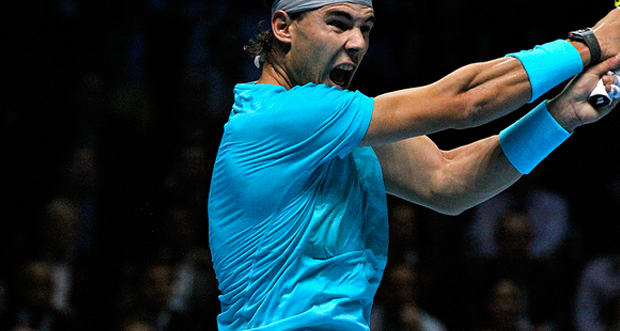
    Rafael Nadal overcame Gael Monfils to capture his first title of 2014 at the Qatar Open in Doha, his maiden trophy here in five attempts, where it was Monfils himself who twice sent the Spaniard packing in previous years, but couldn’t make it a third time today.

    Nadal raced through the first set while Monfils appeared to still be gathering himself, but the Frenchman led the entertaining second by a break for most of it. The Spaniard broke back, but Monfils took it in the tiebreak. Nadal broke early in the third, and didn’t look back, winning the match and the trophy: 6-1, 6-7(5), 6-2.

    This is the world No. 1’s 61st career title, one behind Guillermo Vilas’s total, putting him 7th on the all-time list. The only active player with more titles is Roger Federer, who is looking for his 78th tomorrow in Brisbane versus Lleyton Hewitt. The Frenchman has reached 20 career finals, but has won just four.

    Photo credit: Marianne Bevis (Creative Commons License)

  • Ana Ivanovic Secures WTA Auckland Title

    Ana Ivanovic Secures WTA Auckland Title

    Ana Ivanovic

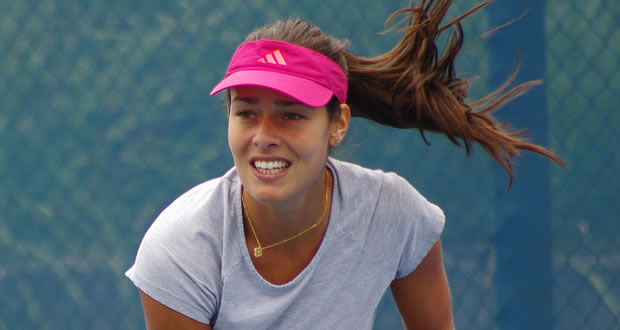
    Former world No. 1 Ana Ivanovic continued with her excellent run of form by defeating Venus Williams 6-2, 5-7, 6-4 in a titanic battle to seize the WTA Auckland crown in 2 hours, 19 minutes.

    Williams, also a former world No. 1, fought back strongly after Ivanovic had raced to an early lead by taking the opening stanza 6-2. The 33-year-old American won the second set to level proceedings having fought back from 3-5 down and facing a championship point.  She held serve and then broke the Serb twice to send the match into a deciding set.

    In the decider, Ivanovic broke Williams early and stayed in control, despite having to survive two break points when serving for the match.

    It was Ivanovic’s 12th title and first since 2011.

    [divider]

    Cover Photo: NAPARAZZI (Creative Commons License)

  • Serena Williams Bags Brisbane

    Serena Williams Bags Brisbane

    Serena Brisbane

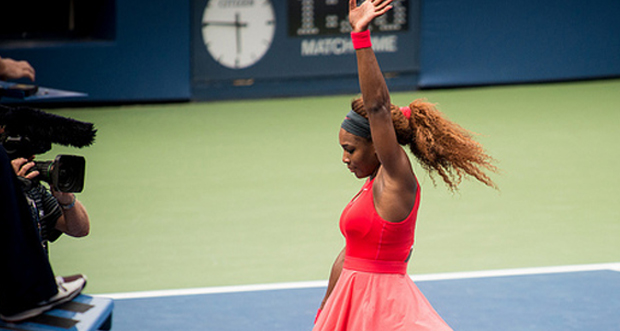
    Serena Williams secured her first title of 2014 defeating Victoria Azarenka in the final of the Brisbane International.

    Williams, the world No. 1, took the match 6-4, 7-5 in 98 minutes to send out a clear warning to her rivals in the build up to the Australian Open.

    She took the first set without facing a single break point and capitalized on an unforced error from Azarenka to break in the seventh game.  The Belarus World No. 2 was offered no opportunity to restore parity and could not get back into the set.

    Azarenka raised the stakes in the second set, twice breaking Williams and was in pole position to level things up after jumping out to a 4-2 lead before Williams broke back.

    At 5-5, the American broke again to edge out in front and then served out the match to take the title.

    The win extended a run of successive victories to 22 and Williams didn’t drop a set during the entire tournament.

    [divider]

    Cover Photo (Creative Commons License): Francisco Carbajal

  • Djokovic Wins Abu Dhabi Invitational

    Djokovic Wins Abu Dhabi Invitational

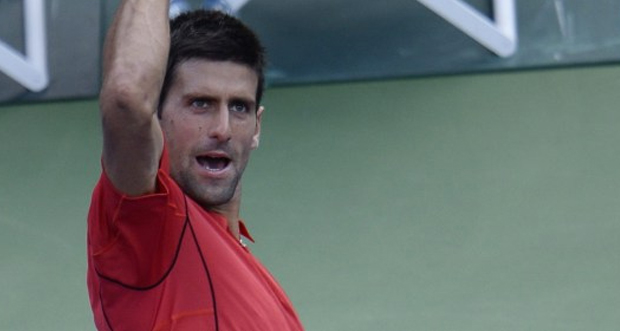
    Novak Djokovic has opened the new season by defeating Spain’s David Ferrer 7-5, 6-2 at the Abu Dhabi Exhibition tournament in 82 minutes.

    Ferrer who came into the final on the back of a victory over World No. 1 Rafael Nadal had led 4-2 in the first set but a succession of unforced errors proved his undoing as Djokovic took control of the match and swept to victory.

    “I’m very satisfied with the way I played and I always enjoy coming back here,” stated the Serb, who added $250,000 to his bank balance in the process.

    New coach Boris Becker was in attendance, and will be encouraged by the Djokovic’s early season form.

    In the third place playoff match, Nadal defeated Jo-Wilfried Tsonga 7-6, 6-3.

  • Federer and Edberg Hook Up (Now Official)

    Federer and Edberg Hook Up (Now Official)

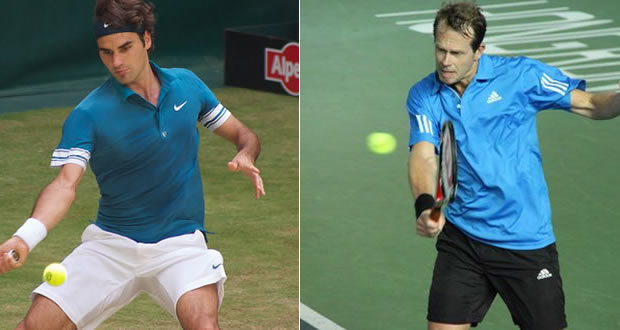
    Stefan Edberg has officially joined the Roger Federer coaching team for the 2014 season. The Swedish legend will travel with the Federer camp for around 10 weeks during the forthcoming year.

    Federer has described Edberg’s role in the context of providing inspiration and bringing a fresh pair of eyes to the camp rather than providing specific coaching.

    “I am sure he can bring a different angle to my game which is interesting,” stated Federer.

    Edberg, 47, is a former world No. 1 who won six singles and three doubles Majors, and has been described as a “childhood idol” by Federer during his formative years.

    The appointment comes on the heels of Novak Djokovic hiring Boris Becker as head coach. A third legend of the period, Ivan Lendl, has already had considerable success coaching within the Andy Murray camp.

    Edberg will join Federer initially in Australia. The appointment coincides with the Swiss maestro’s decision to try a racquet with a bigger frame at his first Brisbane International.

  • Down the T #5: Ben Saunders Interview

    Down the T #5: Ben Saunders Interview

    ben-saunders-andy-murray

    In the latest installment of “Down The T”,  where we talk to people in and around the sport, Tennis Frontier’s Owen Gigg catches up with Ben Saunders, a former coach of Andy Murray during the Wimbledon champion’s formative junior years.

    [divider]

    Ben – you were a member of the team coaching Andy Murray during his early junior days in Scotland – how did you first get involved?

    I was coached by Judy Murray as a junior national player and then she got me involved with some of the younger players, hitting with them to help them improve.

    When I realised I wasn’t going to be the next Tim Henman I started taking my coaching badges and quickly got involved with some good programmes and juniors, working with Scottish National Squads alongside Leon Smith.

    A couple of years after starting to coach I was back working with Judy after she offered me a job at a Next Generation Club in Edinburgh.

    [divider]

    How old were Andy and Jamie at that point, and even at that point, did it occur to you their level of potential and how far they might go?

    They were around ten and twelve years old and they were playing a lot of tennis, as well as other sports. I didn’t think of them as being international sports stars at that stage but I remember Leon asking me if I thought Andy could be top 10 in the world one day.

    We had a long discussion about it but I’m not sure either of us really believed they’d both win Wimbledon titles!

    [divider]

    How strong was the sibling rivalry between the two, and the competition within the camp in general?

    Competition was healthy between the top juniors but there wasn’t really the depth. This is still the case in the UK compared to Spain and places like that.

    Brotherly rivalry was high as is the case with most brothers. I think Jamie as the older brother liked to wind up Andy sometimes but it was Andy who eventually got the upper hand on court!

    [divider]

    Andy went to Spain to continue his junior development – did you think that was an essential part of his development or do you think the UK has everything a player needs to further his development with a view to turning pro?

    Britain has some top juniors coming through now who are training in the UK, so it is possible. However, I think Andy made the right decision for him at the time. As Andy’s success continues so will the growth and opportunities for players in the UK.

    [divider]

    As a junior number one in Scotland yourself, what factors prevented you taking it even further? Tell us a little about your own junior career…

    I played tennis most days of the week and did fitness training when I could, but not to the level that the next generation of juniors did like Andy or Colin Flemming. They had sessions every day taken by our coaching team and dedicated fitness coaches. For me my best opportunities came as a coach, travelling the world with Scottish teams.

    My biggest leap as a player came when I joined Stirling University’s tennis squad for two years. Playing, coupled with fitness training each day. In reality I would have needed to have been doing that since the age of ten to have improved my chances of going further.

    [divider]

    Are you still in contact with Andy, Jamie and Judy?

    I’ve had tweets from Jamie and am in fairly regular contact with Judy as she continues to mentor me in my current role. The last time I spoke with Andy was at Wimbledon a few years ago…he’s a busy guy!

    [divider]

    What’s your take on Andy’s progress with Ivan Lendl as head coach? Was this the final ingredient that took him over the line in winning a major?

    I think Ivan has been a great addition to Team Murray. He’s definitely added to Andy’s progress and probably was the final ingredient in winning majors.

    [divider]

    You must have felt huge satisfaction seeing Jamie win the Wimbledon Mixed Doubles, and then Andy winning the US Open and Wimbledon. Can you describe the feeling personally and what knock-on effect do you think it has for British tennis?

    I was very proud of Jamie and Andy winning their Grand Slams. I’ve followed them for years and always knew they would eventually make the breakthrough.

    However, I knew Andy wouldn’t get the credit he deserved until he won Wimbledon! Now he’s done that, I hope he kicks on to win more and this will undoubtedly have a massive effect on British tennis.

    I also hope the Lawn Tennis Association (LTA) keep pushing to get grassroots tennis more and more accessible for all.

    [divider]

    From a coaching perspective, which players and particular shots would you refer to as textbook tennis for young players?

    Federer is still one of my favorites for teaching kids about technique and footwork.

    The kids still love Rafa, Novak and Andy too though.

    It’s a golden generation of tennis to watch and enjoy!

    [divider]

    I know you are now working in Liverpool (a city synonymous with football in the UK). How have you found it promoting tennis and what programmes are you pushing in this soccer-mad environment?

    It’s been particularly interesting as everywhere else I’ve been hasn’t had the same level of sporting distractions.

    My goal has always to make tennis the strong No. 2 sport choice in this area and promoting tennis and sports in general.  A lot of what my team teaches improves sporty ABCs and will help kids in whatever sports they play in the future.

    As well as continuing to work hard with my social and competitive players on our programme at Campion Tennis Club (North Liverpool), we have recently launched a ‘Tennis for Free‘ initiative in partnership with our own Ben Saunders Tennis Academy, the charity and Sefton Council.

    It was the biggest launch seen by Tennis for Free in ten years of free Park Tennis programmes, and I’m excited about getting even more people playing in 2014!

    [divider]

    Ben, Thank you taking the time out to talk to the Tennis Frontier, it’s been a pleasure, and we wish you all the best for 2014.

    Links:

    Ben Saunders Tennis

  • David, Rafa and Nole’s Excellent Adventure in South America

    David, Rafa and Nole’s Excellent Adventure in South America

    Adventure

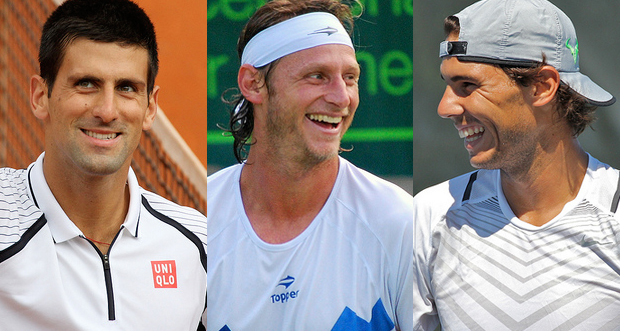
    This part of the off-season is about sending off David Nalbandian, and to a lesser extent, Nicolas Massú. Nadal and Djokovic, the world’s numbers 1 and 2, have joined in for exhibition matches and festivities. Here’s some of the news from the front in the Spanish-language press.

    The red-carpet was rolled out in Chile. The tennis players were received by President Sebastian Piñera. Nicolas Massú, who has also retired this year, was quoted as saying, “To have the honor of sharing this with Rafa, Novak, and David is a pleasure for anyone who cares about tennis.” Massú has now signed on as the Chilean Davis Cup captain. Chilean future hopeful Christian Garin was also in attendance. Also while in Chile, during a presser with Djokovic, Nalbandian, and Massú, Rafael Nadal offered to translate for Novak, and, hilariously, started restating what Nole said…in English. He had to be reminded that he was speaking English. He excused himself in Spanish, then saying, “At this point, I think English is my first language.” Likely it’s his first “press-conference” language, anyway.

    [divider]

    They also played some tennis in Córdoba, Nalbandian’s home town. Massú beat Nalbandian, 6-4, 6-2, and Djokovic got it over Nadal 7-6(3), 6-4. According to the Chilean press: “That never seemed like an exhibition, except for in the second set, where they joked about some fantastic points.” Otherwise the press in Spanish reckoned that they took it very seriously, for a “friendly.” The only break of serve came in the penultimate game of the second set. Interesting. I guess it’s not so easy for them to leave all the competitiveness aside.

    In his home town, Nalbandian also beat Nadal 6-4, 7-6(6).

    This is a particularly great point from the match:

    [divider]

    In between the exhibitions, Nalbandian and Nadal appeared together on the Susana Gutierrez show, a major talk show in Argentina. King David looked tanned and relaxed, and sartorially resplendent in a navy shirt, pink jacket, and red shoes. Nadal, according to the hostess, looked surprising tall. (“They always tell me that,” he said.) The conversation was light and full of humor. When asked about some of the longest matches they’d ever played, Nalbandian mentioned the six-and-a-half hour doubles match he’d played vs. Russia in Davis Cup. “Even I got bored,” said Nalbandian, to much laughter. Nadal said his was in Australia, lasting six hours, vs. Djokovic. “You must have won,” says la Susana. “No, I lost,” admitted Nadal, with a smile.

    When the hostess told David that everyone was heartbroken that he was retiring, he said, “Don’t be sad. Anyway, it was a great excuse to get Rafa to Argentina.” The two do seem to be very genial friends.

    You can see the videos of their appearance on the show here:

    [divider]

    Before everyone got back together in Buenos Aires, Nadal and Djokovic met in Patagonia for a hit-around with the glaciers as background. They took part in an exhibition on Friday, hitting on a barge in front of the Perito Moreno Glacier, near the southern extremity of Argentina. From Nadal: “I’ve just been in one of the most spectacular places that I’ve ever seen before, the Perito Moreno! Really amazing!”

    [divider]

    Novak and Rafa also got to hit goals in the Boca stadium in Buenos Aires. Not sure why River couldn’t get their attention, but:

    In the rematch between Nadal and Djokovic in Buenos Aires, Nadal prevailed, 6-4, 7-5.

    (Listening to Djokovic’s speech in Spanish, it seems clear he was coached by Rafa, because he used the Spanish idioms!)

    Nadal and Djokovic then combined to play doubles against Nalbandian and Monaco. By all accounts, they had a very good laugh. At one point, Djokovic threw himself to the ground so as not to be hit by Rafa’s serve. Nalbandian feigned arguments with the chair, and Monaco tried to hit his opponents at the net.

    Clearly, Nalbandian was well sent-off. The Chilean and Argentinian fans were greatly entertained, and Rafa and Novak seemed to have more-than-a-little fun. An Excellent Adventure, indeed.

  • Small Height Situation

    Small Height Situation

    Small Height

    “We’ve talked about Darcis and his small height situation.”

    There were many issues facing Steve Darcis in the first round of this year’s Wimbledon, though his small height situation was among the least of them. A more looming concern was incarnated by the man across the net, known in the business as the Big Nadal Situation. For those of us watching at home the real issue was the commentary, delivered by men whose intimate knowledge of the sport wasn’t matched by a commensurate command of the English language. As ever the urge to sound clever yielded pompous verbiage. Couldn’t they just say Darcis was short?

    Of course, Darcis, who hails from the region of Western Europe known for its Belgian Situation, ended up winning. His Nadal Situation proved less parlous than had been forecast. The rest of us weren’t so lucky. Whereas a routine Nadal victory would have resulted in merely forgettable commentary, the upset of the year inspired many commentators to go for broke. Their instinct was to match spectacular visuals with coruscating wordplay. It was not necessarily a bad instinct to have, and in some cases worked out to everyone’s benefit — except perhaps Nadal’s. The best commentators rose heroically to the occasion, because they are the best talkers. In too many other cases, however, the sure instinct was undone by bad technique.

    My eagerness to poke fun at poor commentary should not be construed as a comment upon the relative difficulty of the task. This should go without saying, but sadly cannot. The most common defence of commentary is that it is not as easy as the armchair critics fondly believe. This is undoubtedly true, and indeed we are afforded daily proof that it is in fact the hardest job in the world. But this in turn begs the question of why so many patently unqualified people somehow believe they can do it well. Perhaps they were misled. I’m sure Barry Cowan didn’t think it a particularly taxing gig when Sky Sports offered it to him. I suspect he still doesn’t find it very taxing. Perhaps that’s the problem.

    Either commentating is easy and anyone can do it, or it’s hard and few can. I’m not convinced it matters. Whatever the case, there’s no reason to put up with professionals doing it badly, nor does its putative difficulty disqualify anyone from criticising. Proficiency in a given profession is not a prerequisite for noting when it isn’t done well. If a tradesman does a shoddy job repairing my washing machine, he isn’t above reproach simply because I cannot do a better job. No doubt any attempt to fix it myself would instill a heightened respect for the complexity of the task, but it wouldn’t alter the fact that repairing white goods is something that can be done well, and that a more competent repairman would have left me with a working appliance. The existence of good commentary proves that bad commentary isn’t necessary, despite strong evidence to the contrary.

    Commentary is a little like tennis, in that some are more suited to it than others. The key difference is that bad tennis is self-correcting. Players who underperform typically lose matches, and consequently see their ranking decline. Weak commentators get a pay rise. Of course one’s view of what constitutes weak commentary is ultimately a matter of preference. One person’s Robbie Koenig will be another’s Cliff Drysdale (quite aside from the tendency of various fan-bases to organise themselves tribally according to perceptions of bias, measured with instruments so hypersensitive they leave the James Webb telescope looking like a dowsing rod). The venerable adage that there’s no use arguing matters of taste still has currency, notwithstanding the internet’s ongoing mission to prove otherwise. I understand that my preferences aren’t likely to be shared by others, especially since I place no importance on whatever opinions the commentators happen to hold. I don’t care which players they favour, so long as whatever they have to say is said well. Sometimes I’d prefer it if they didn’t talk about tennis at all. Indeed I invariably enjoy listening to Craig Willis on AO Radio more than any “proper” commentator, and he only ever mentions the tennis when the person sharing the booth delivers an elbow to his ribs. But perhaps he isn’t to everyone’s tastes.

    Some fans love Boris Becker. I find him tiresome and obvious. It has been pointed out elsewhere that many viewers initially like John McEnroe, but find him harder and harder to take as they grow more familiar with the sport. Lines that seem insightful at first sound platitudinous after a while, his inclination to self-promote can grow wearying, and his ignorance of players ranked beyond the Top 20 is deplorable. Apparently there are Americans who enjoy Brad Gilbert’s work, but then there are Americans who enjoy spray-on cheese. Conversely some viewers cannot handle Mats Wilander, but I think he’s O.K. I appreciate the way he doesn’t feel a serious point must be ground down beneath excessive solemnity.

    Granting for the moment the near-insurmountable difficulty of the job, surely we can conclude that the skill set required for a good commentator is not the same as the one required to be a great tennis player. Achieving renown as a player doesn’t necessarily preclude a talent for calling matches, but nor does it guarantee one. Why, then, do television networks fall over themselves to hire ex-greats? It probably comes down to trust, and the fact that most people watching coverage of a tennis match (or any sport) probably don’t really know all that much about it. For viewers who regard the basic rules of a sport as inscrutable arcana, there’s doubtless a measure of reassurance in having those rules explained by a well-known champion. Wedded to this is the assumption that the well-known champion boasts a deeper insight into what the players on court are currently thinking and feeling, having been there and done it themselves. All ex-pros believe they possess this special power, though only McEnroe seems convinced he is clairvoyant.

    It is the natural conceit of all disciplines that their inner workings are impenetrable to the mere layperson, a conceit often propagated by a clergy intent on making its presence essential. In the case of theoretical physics this is justified. In other cases, such as tennis … not so much. Networks naturally milk this assumption for all it’s worth, and they aren’t wrong to do so. When Channel 7 brings in Lleyton Hewitt to commentate at the Australian Open – he usually enters the booth one round after he has exited the main draw – there is without fail a promo in which he promises us plebeians that we’ll be vouchsafed a unique glimpse into the workings of each player’s mind. For those of us who’ve both watched and played a great deal of tennis, Hewitt’s insight usually turns out to be less unique than advertised. Mostly he says the same stuff as the other commentators, although I hasten to concede that there’s enough original material to justify his spot.

    It is in the specific details that ex-pros like Hewitt add real value. When, during David Ferrer’s abject loss to Novak Djokovic at this year’s Australian Open, Hewitt revealed precisely how he himself had responded in a near-identical situation the year before, he was providing a level of insight available nowhere else. It was excellent commentary. In his first year with Channel 7 he mentioned that he and Nadal often play golf, and that the Spaniard is just as competitive on the course as he is on the court. Again, it was specific detail, and fascinating. Koenig is another with a tremendous memory for the key facts, often acquired personally. What a treat it was to hear him discuss Radek Stepanek’s early days on tour, and how the Czech had grown so disillusioned he’d almost quit. I’d never heard any of that anywhere else, but even if I had it was worth hearing it again from someone who’d learned it firsthand. He was there.

    But no one can sound like that all the time. There’s only so much to say. Even Darren Cahill, whom I consider to be the best commentator in the world, has to repeat himself from time to time (and he is justified in doing so, since his material isn’t infinite, and he must assume that today’s viewers weren’t necessarily yesterday’s). Most commentary is merely filler, and it is here that the real pros earn their salary. This is the moment when weak commentary becomes helplessly mired in cliché – the essence of which is not falsity but lifelessness – and homilies. The capacity to make a general point in an interesting way is one that I am bound to consider exceptional among ex-champions. The colour guy is there to supply just that, but the backbone of the call must be provided by those with an assured command of language, such as Jason Goodall or Gigi Salmon. One mustn’t necessarily speak flawless Queen’s English, like Frew McMillan; again, Cahill’s conversational style is fine, as is Peter Fleming’s. All share the ability to convey serious points with a light tone, and to let the tennis speak for itself when it can.

    The real problem comes from those ungifted speakers who nevertheless believe themselves to be skilled orators, especially the species that believes “small height situation” is an improvement on “short”. Becker has some notoriety in this area, and Roger Rasheed apparently thinks in neologisms, although for me the exemplar remains the cosmically pretentious John Alexander, now mercifully retired. It is always worse for a commentator to overestimate their stylistic mastery than to be ignorant of style at all. For anyone who works with language, including writers, dim awareness of the power of words is lethal when possessed by those ill-equipped to harness it. At least those innocent of linguistic intricacy will occasionally stumble out of their own way while they make a useful point. The overwrought stylist will never do that, though, since they instinctively know that the key moments should be accompanied by the most incandescent displays of technique. Thus it is that a merely workmanlike commentator such as John Fitzgerald is far preferable to a portentous buffoon like Alexander.

    Alexander, or JA as he was called by those forced to work with him, was without question the worst commentator I have ever heard across any sport. His dark gift was to combine a narrow and dated knowledge of tennis with a delivery so relentlessly grating that you were left to wonder (and regret) how phrases that lacerated your brain could somehow leave your eardrums intact. Temporary deafness would have been a mercy. Apparently unaware that television differs from radio in its ability to transmit images, Alexander’s most reliable trick was to very slowly recount the point everyone had just watched, in granular detail and a reverential murmur, as though he was narrating Napoleon’s coronation.

    The early stages of Jim Courier’s current tenure with Channel 7 was a fraught time for the American, quite aside from the moment he first laid eyes on the anchor Joanna Griggs and inquired on air who “that bimbo” was. He clearly felt nothing but contempt for Alexander, a feeling that was apparently reciprocated. Channel 7, subscribing to the dirt-common belief that mutual animosity might generate memorable frisson, ensured they always shared the commentary booth. Alexander’s knowledge of tennis more or less atrophied in 1986, while Courier as an elite player popularised the tactic of running around the backhand to unload on the off forehand, one of the pillars of the modern game. Thus would Alexander roundly admonish any player who ran around his backhand for leaving the court open, while Courier would wearily point out that this is how tennis is now played. Alexander felt it was too risky. Indeed, he was a passionate advocate of caution, believing that everyone should “play within himself”. This was a common phrase of his, along with “he measured the ball, and hit it for what it was worth.” He would condemn qualifiers who over-hit against Nadal for not playing within themselves. Courier, his patience at an end, would try to point out that their only chance was to go for everything and hope it went in. JA wouldn’t hear of it. Courier told JA he sounded like a broken record, in a tone of voice that suggested he’d be perfectly willing to make JA look like a broken record. He clearly wanted to hit JA for what he was worth.

    We are sometimes cautioned that sports and politics should not mix, in the naïve belief that sport could remain free of politics even if it wanted to. Personally, I’m thankful politics does intervene from time to time. In 2010 Alexander became a member of Australia’s federal parliament, winning the seat of Bennelong as a conservative candidate – his platform was radically progressive compared to his approach to tennis – defeating the immensely capable Maxine McKew. It was a shame McKew had to go, but it was probably worth it to get JA off my television. His politics aren’t mine, but long may he serve.

    If you believe, as I do, that the means by which professional tennis is transmitted to the general public cannot be usefully subtracted from the overall package – i.e., that television is not tangential to the sport’s function as entertainment, but fundamental to it – then it follows that the commentary matters. I have always written about it as if it does. Nevertheless, I’ve no desire to run through a list of all the commentators to whom I’ve ever been subjected. Even if there were space there would be no point. I’m sure I’ve mentioned most of them over the years. Suffice it to say that there are a couple more whose work I enjoy, and many more whose efforts I find ridiculous, yet still enjoy. There are very few from whom I can derive no value at all, and mostly they sin through being dull rather than mistaken. Invariably their dullness reflects a degree of verbal poverty – people who don’t speak well tend to sound the same – which is mostly the result of the mistaken assumption that their business is tennis and not words. The result is not the end of the world, however, merely tedium, or as some would have it: a boring talking situation. But such cases are rare. The truth is that for the most part bad commentary only makes writing about tennis more fun. In the final reckoning I probably wouldn’t be without it.
  • How American Tennis Can Alter Its Course From Mediocrity

    How American Tennis Can Alter Its Course From Mediocrity

    Lewis-Tyson,_2002[1]

    Someone has to take the blame for the mediocre results of American tennis.

    The USTA needs to change its methods. In a major, drastic way. The USTA Developmental System leaders should haul off every American in the Top 200 and force them into a month and a half long tennis boot camp. Not as a form of punishment but a way to build character, team unity, and to toughen them up.

    US Tennis is in a state of emergency. Look at the abysmal rankings of our players. That’s got to change. Now. Before it gets even worse.

    Every American player in the Top 200 or any player in the top thousand who volunteers to attend the boot camp should be accepted. Forty-five days of brutal hard work. Strict diet. No phones, no texts, no contact with family except for emergencies. Just work the players to the bone, Rambo style. 6 A.M. wakeup calls, military officer style blowing whistles and making them run ten miles and doing obstacle courses, boxing training for hand-eye coordination, and even some light boxing sparring would build character and confidence and toughness. Also there will be punishments for disobedience or failure. Work ’em like dogs like in that movie An Officer and a Gentleman. Also let the players have bonding time playing cards, fishing, etc.

    The current system is producing mediocrity. American fans and legends like Sampras, Courier, Agassi, McEnroe, Chang have to be embarrassed by what they see. Drastic changes must happen. Now. Before it’s too late.

    A leader has to emerge to save this sinking ship.

  • An Effect So Poetic

    An Effect So Poetic

    8705873194_103e921be4_z e

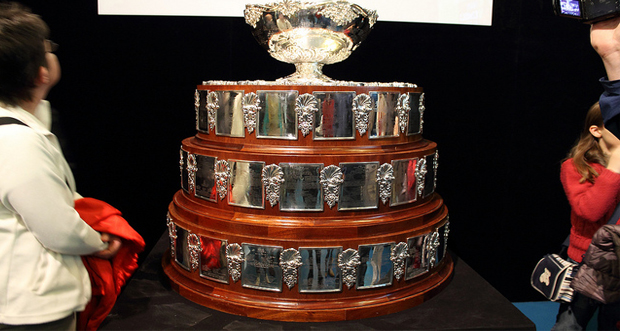
    Davis Cup, Final

    Until last year the tiny proportion of the Czech Republic concentrated in its Davis Cup team had not won the Davis Cup since 1980. They’ve now won it for the second year in a row, by fielding the same two-man squad of Tomas Berdych and Radek Stepanek. Last year they accounted for Spain, the most successful Davis Cup nation of recent years. This year they defeated Serbia, who won the title in 2010, spearheaded by the formidable Novak Djokovic. Yet while the two finals were broadly alike in outline – even the configuration of results was vaguely similar – they could hardly have diverged more in detail. Last year’s final was historically significant, and thrilling from first to last. This year’s was frankly a bore from beginning to end, thus neatly summarising a long season in which a tournament’s last match was seldom its best.

    Last year’s final usefully proved that even Spain is heavily diminished without its best player, while Serbia has now proved you cannot rely only on your best player, especially if he doesn’t play doubles. In neither final did the Czech Republic boast the best player – in both finals Tomas Berdych was soundly beaten by the opposition number one in the reverse singles – but Davis Cup ties typically aren’t decided by who has the best player, but by who has the least worst. Live fifth rubbers are always contested between the number two players, which is why they so often feature as the hero in close ties. Djokovic was impeccable in the 2010 final, walloping any Frenchman placed before him, but it was Victor Troicki’s dismissal of Michael Llodra in the fifth rubber that is destined to be remembered. Or recall Mikhail Youzhny’s defeat of Paul-Henri Mathieu in the 2002 final. More pertinently, remember Radek Stepanek’s dashing defeat of Nicolas Almagro last year. Janko Tipsarevic’s withdrawal several days before this year’s final was thus catastrophic for the Serbian team – Bogdan Obradovic likened his absence to playing tennis on one leg – and removed any tangible doubt about the eventual result. Knowing how things turn out subtracts significantly from the fascination of watching them unfold. There was some chatter as to whether Lukas Rosol should have played instead of Stepanek on the opening day in order to preserve the older man for the hardships to come. The upshot was that really it didn’t matter.

    Anyone who doubts the inherent value of chaos was hopefully reassured by this year’s final. This is what sport looks like in a deterministic world. The weekend unfurled with devastating predictability, like those irritating fight scenes in Guy Ritchie’s Sherlock Holmes films, in which Iron Man and Moriarty hardly bother getting down to fisticuffs because they’ve already mapped out how it’s going to go down. Every match went according to prediction, and none of them went beyond three sets. It was rare for the winning player or team even to cede break points, let alone a break. The closest we came to an upset was Berdych attaining 4-4 in the first set against Djokovic via a series of desperate holds. “Anyone with a hat should be donning it for Berdych!” insisted the Eurosport commentator who wasn’t Frew McMillan. Perhaps he meant “doff”, but his yawns affected his diction.

    What interest there was was confined to the doubles, as is frequently the case. In last year’s final the Czech team encountered a Spanish duo that had just won the World Tour Finals, yet cleaned them up in four sets. This year Berdych and Stepanek’s opposition proved less fearsome in Nenad Zimonjic and Ilija Bozoljac. After the heady thrill of Boise, where Bozoljac performed magnificently to see off the Bryan brothers, and the semifinal in which he and Zimonjic fought gallantly in a marathon loss, the final was a disappointment. One could term it a reality check, but that’s an unkind thing to say about a player like Bozoljac who subsists primarily on the Challenger and Futures tours, where every week is a reality check. He did his best, and it isn’t as though Zimonjic set the stadium alight.

    The pressing issue was whether Djokovic would have done any better. It’s not much of an issue, but given that it is almost the sole point of contention in a searingly uneventful weekend of tennis, it is the issue that is being discussed at length. I’m not convinced it matters. Djokovic doesn’t have much of a doubles record, although he is at present the finest singles player on the planet, especially on an indoor hard court, and that’s historically a recipe for doubles success. Whether it would have been enough to snatch victory is another matter. Word was that after London he was all but spent; winning everything all the time is undoubtedly fabulous, but it does ensure you’re playing all the time. A long doubles match might have hobbled Djokovic for the reverse singles, although admittedly it would have hobbled Berdych as well. The real issue is that Stepanek and Berdych are an excellent doubles combination, and were they to pair up regularly one imagines they would enjoy tremendous success throughout the season. Alas the rigours of the singles tour preclude that possibility. Stepanek of course is a doubles specialist (it ranks highly on his list of endorsed skills on LinkedIn), and has won multiple Majors.

    It turns out he is also a specialist at closing out Davis Cup finals – he now is the third player in history to win two live fifth rubbers at this stage of the competition – whether it is against Nicolas Almagro or Dusan Lajovic. Unlike Almagro, who was left alone and forlorn for far too long by his compatriots after last year’s defeat, no one anywhere holds Lajovic’s loss against him, and his team was lavish with its consolation. It had been a very big ask. No doubt a Davis Cup final is a tremendous opportunity for a young player to make his name, but there are limits. Sink or swim is beside the point when you’re thrown in with crocodiles. Stepanek was as relentless as the tide, attacking without pause, and gave the youngster nothing.

    Afterwards he was overrun by his teammates, while the Czech contingent in the stands went justifiably berserk. Defending a Davis Cup title is considerably rarer than winning one. Stepanek soon extricated himself from the pile of bodies and set to vaulting the net, to the delight of the Czech fans, and no doubt the bemusement of the Serbs. Later he proffered the tactful opinion that not playing Djokovic in the doubles had been akin to “leaving your Ferrari in the garage”, ensuring that for some bemusement was transformed into outrage.

    Berdych later failed to mollify his hosts by asking why Djokovic wasn’t at the post-final dinner, enquiring whether the world number two was still in the “garage”? It gave most of us something to be mildly amused by, and a certain species of plodding moraliser something to get really worked up at, which they duly did. Thus did a forgettable final weekend conclude with a modicum of interest. If only there’d been some tennis to match it. As I said last week, you cannot have everything. If you’re the Czech Republic, however, you can have the Davis Cup — again.