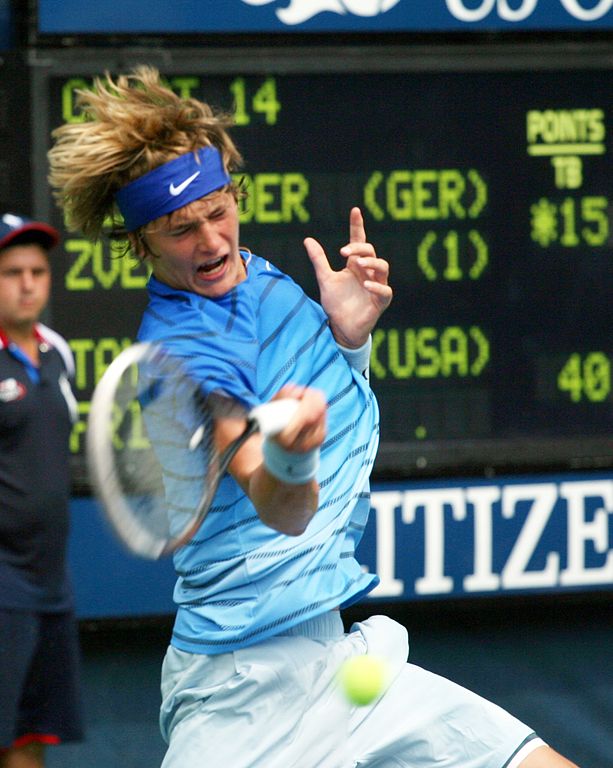
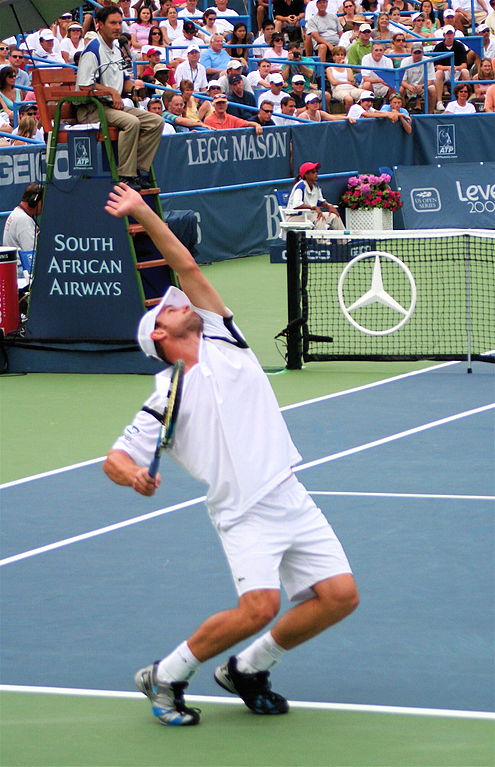
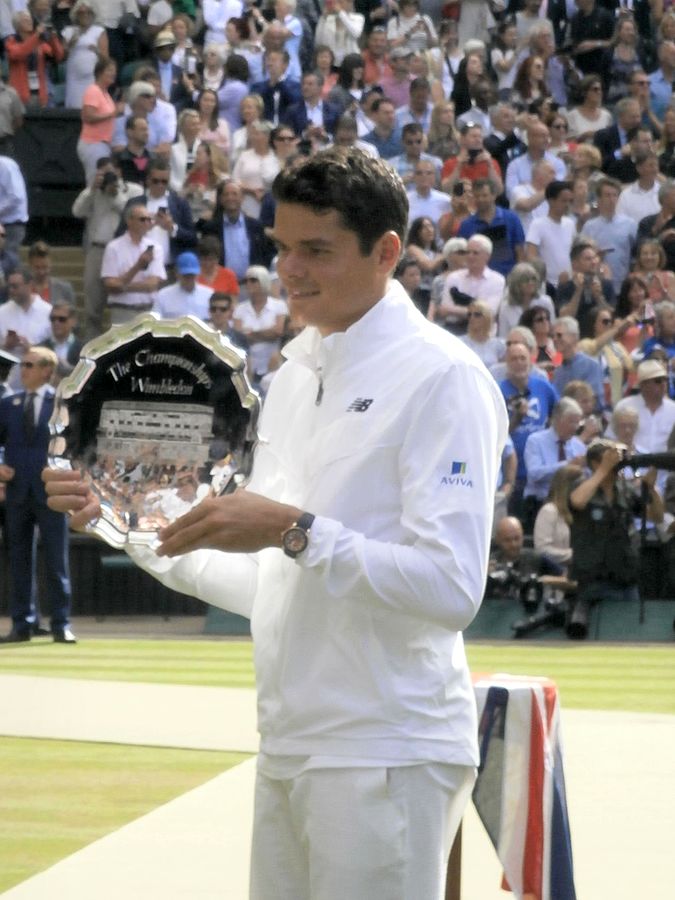
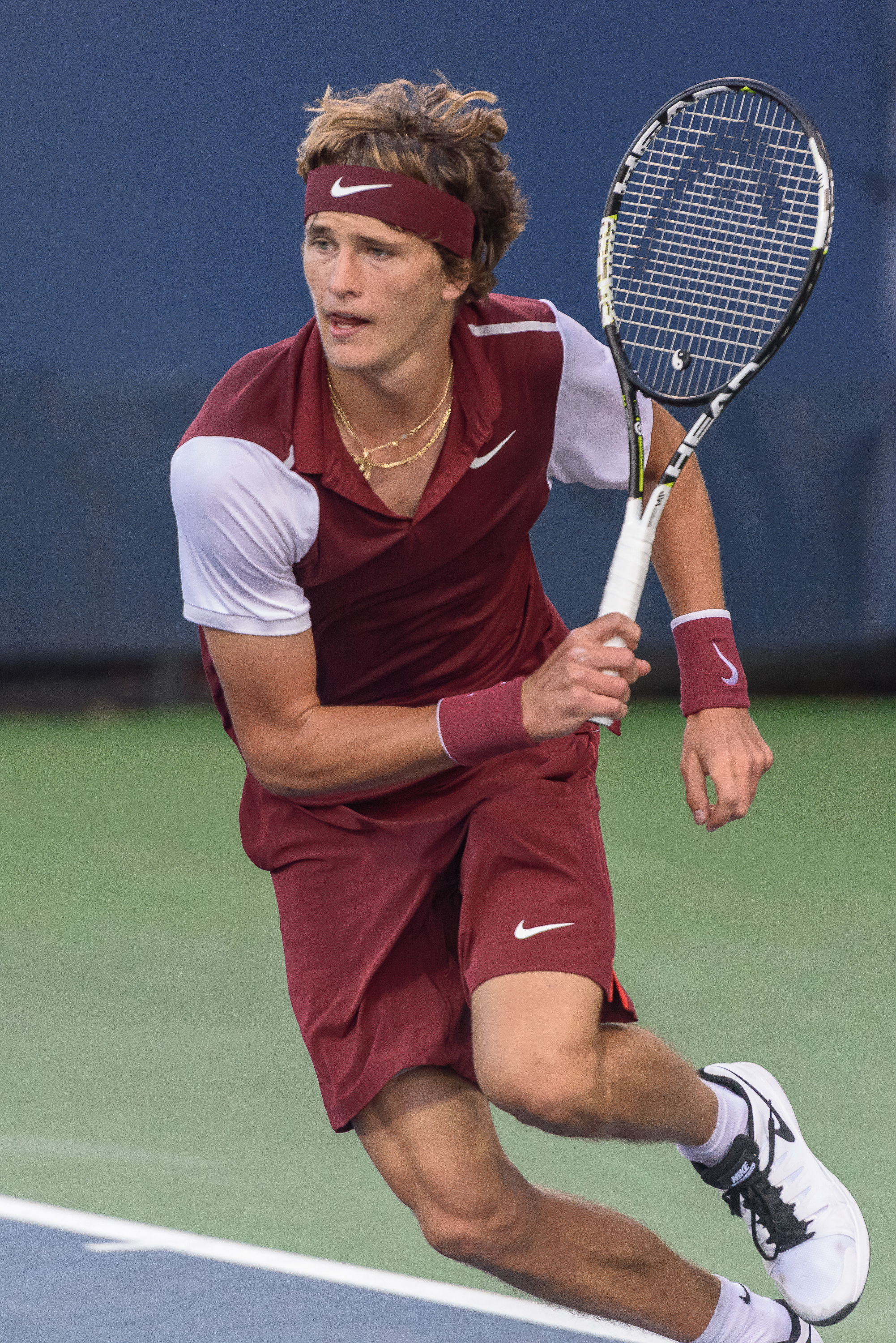
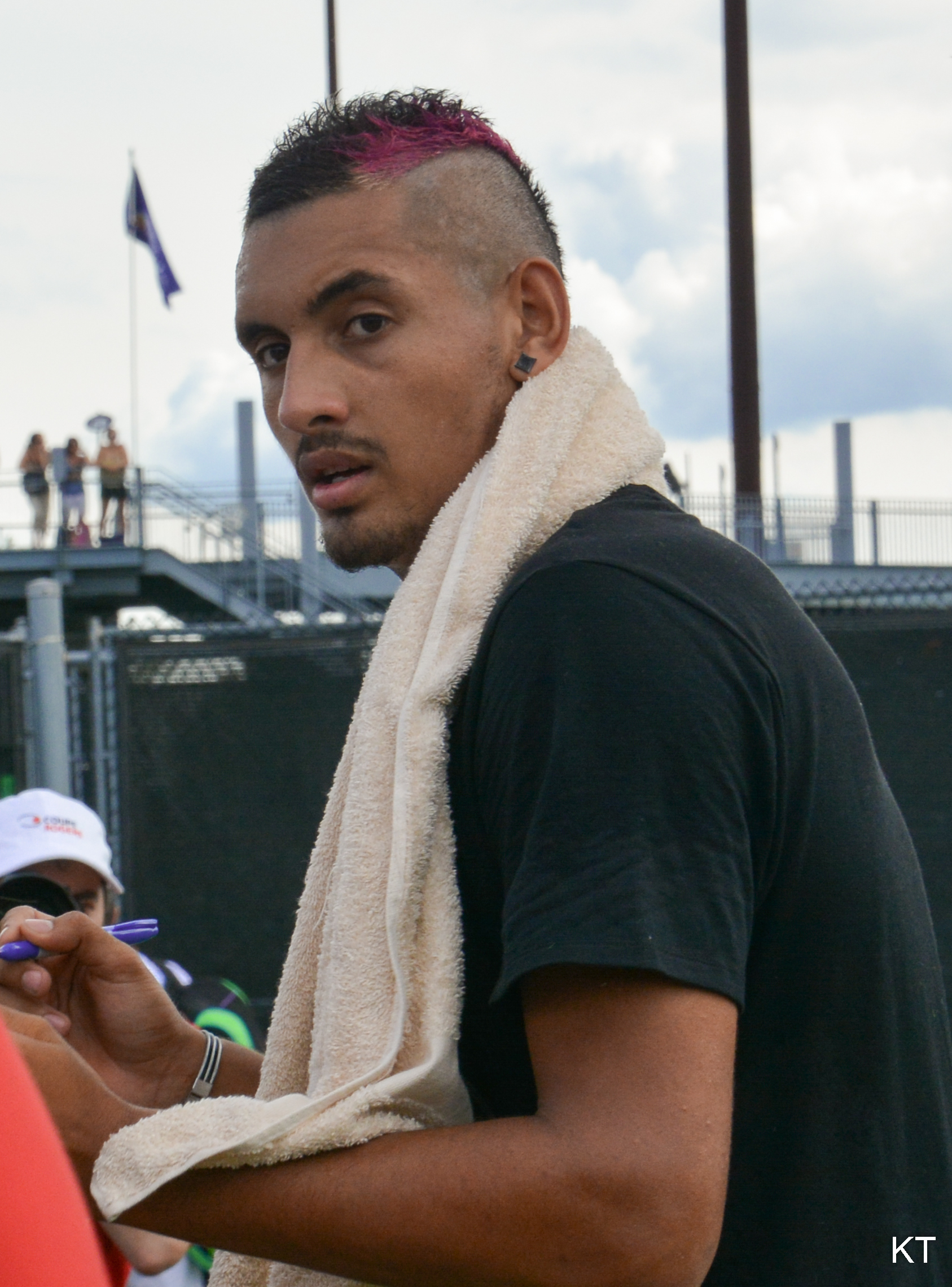
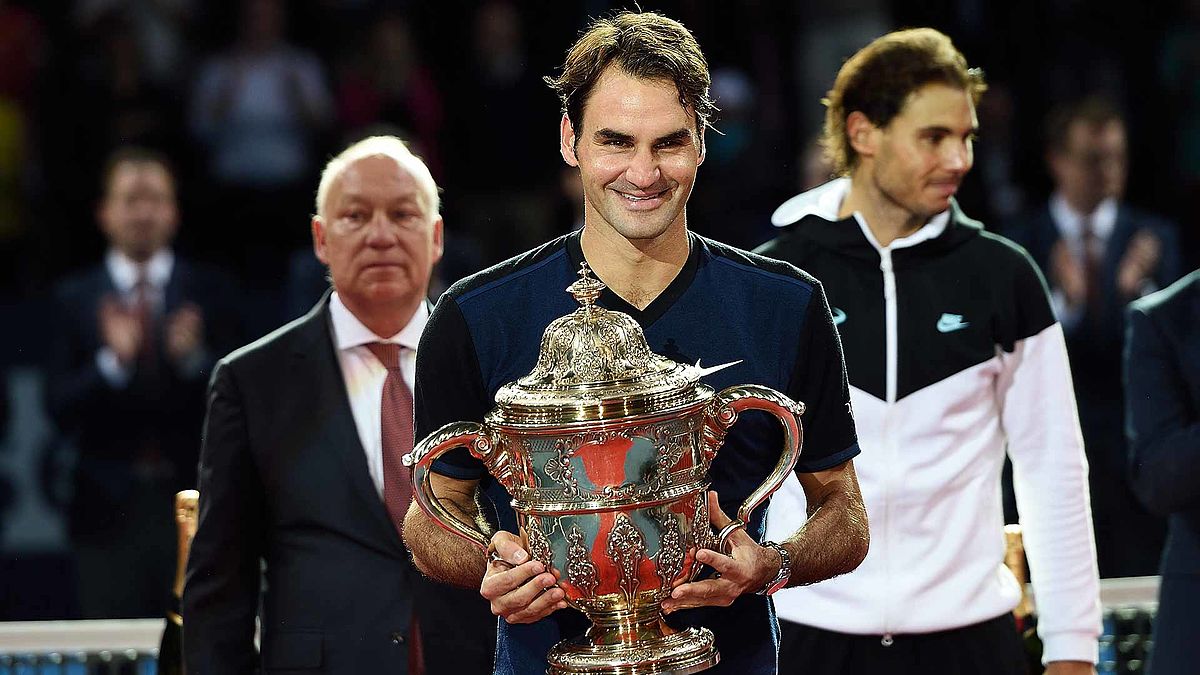
One of the holy grails of tennis speculation is being able to differentiate between those young players who will become stars and those who will not. Right now we’re amidst somewhat of a tide of upcoming young players: from highly touted Alexander Zverev and Nick Kyrgios, to the large number of young players in or approaching the top 100. Yet how can we possibly tell who will become an elite player and who will plateau somewhere on the way to the top?
The Pace of Greatness
There is no easy answer. I have put forth a system of benchmarks that every all-time great (6+ Slam winner) of the Open Era has reached; there is a similar set of benchmarks for multi-Slam winners (2-4 Slams), although these were just greatly expanded by Stan Wawrinka, who reminded us that tennis is always changing and boundaries are meant to be surpassed.
The first of the benchmarks is entering the top 100 before one’s 19th birthday. Of the young players currently on tour, only a few have accomplished this so far: Alexander Zverev, Frances Tiafoe, Taylor Fritz, Hyeon Chung, and Borna Coric. Missing the mark already are Dominic Thiem, Nick Kyrgios, Karen Khachanov, Daniil Medvedev, Andrey Rublev, Michael Mmoh, Stefan Kozlov, and many others. Now this is a benchmark that all 6+ Slam winners of the Open Era—or at least going back to accurate ATP rankings, so from Bjorn Borg on—have reached. But that doesn’t mean that all future 6+ winners must. And it is also a rather rarified company to begin with; to begin with, we shouldn’t expect more than several players from any generation—and perhaps not even that—to win 6+ Slams.
Given that the age in which players are peaking may be rising, or at least expanding, and given Stan’s reminder, these benchmarks should probably be considered “probable guidelines” than strict rules. Surely there must be something else we can look for, to try to ascertain who will rise to the top of the sport? I don’t have a clear method, but I did stumble across something that will at least give us something to look for.
Two Breakthroughs
When I was working on my “career skyscrapers” tool, I noticed that it did a nice job of illustrating how players develop in their early years. The skyscrapers only include titles and quarterfinal or better Slam appearances so are, intentionally, a snapshot of when a player was at or near elite level. But when we talk about breakthroughs, there are many small stages in that process, but two that I find to be of utmost importance: One, winning a title. This is the rite of passage that every good tennis player must go through. The second is winning a big tournament; by “big” I don’t only mean Slams, but Masters (or their equivalent) or a World Tour Finals. This is the point that a player generally reaches elite status and has shown they can play with the big boys.
What I noticed was that in almost every case, the true greats went from winning their first title in one year, to their first big tournament within the same year or next. The only exception in the Open Era is Andre Agassi, who won seven minor tournaments over three years (1987-89) before winning his first big tournaments in 1990. But everyone else—from Jimmy Connors to Novak Djokovic—went from winning their first tournament (whether big or small) to a big tournament within a calendar year.
This gives us another benchmark to look for. Again, it doesn’t mean that it has to happen for a player to become a true great, that it probably will, and the probability is quite high: 12 of 13 6+ Slam winners of the Open Era fit this criteria (interestingly, neither Ken Rosewall or Rod Laver did this; it took them a couple years – but they began their careers in a very different context than the Open Era).
I think the real important insight gleaned from this is that the pattern seems quite different for lesser Slam winners. Of the seven players winning 3-4 Slams in the Open Era, only three–Guillermo Vilas, Jan Kodes, and Gustavo Kuerten–went from a small to big title in sequential calendar years; Arthur Ashe, Jim Courier, Stan Wawrinka, and Andy Murray all took longer.
Of the eight two-Slam winners, only three did it: Ilie Nastase, Sergi Bruguera and Marat Safin who, at the time, was considered a probable future great but ended up having a disappointing career. Bruguera was a clay court specialist who played during a time when courts were quite different from each other and specialists–who were otherwise relatively mediocre on other surfaces–could compete for the biggest prizes on their best courts. Nastase was a borderline great player, whose level isn’t adequately expressed by his mere two Slams.
Of the twenty-four single Slam winners of the Open Era, only six did it: Andres Gimeno, who played much of his career in the very different context before the Open Era, so as with Rosewall and Laver, isn’t that relevant; Mark Edmondson, who is the definition of “one-Slam wonder;” Andres Gomez; Michael Stich; Michael Chang; and Juan Martin del Potro. Stich and Del Potro, like Safin, were considered viable candidates for future greatness, but didn’t reach that mark.
To sum up, consider who went from their first title to a big title (Masters or greater) within the span of a calendar year, among players who played the bulk of their careers, or won most or all of their Slams, in the Open Era:
12 of 13 (92%) 6+ Slam winners
6 of 15 (40%) of 2-4 Slam winners
6 of 23 (26%) of 1 Slam winners
As I said above, these numbers start changing if we look before the Open Era, but that was a very different context of play.
For Whom Is The Clock Ticking?
There is no clear year that the proverbial “NextGen” starts, although we can say it definitely includes all of those players who will be eligile for the Milan NextGen Finals later this year, so those who don’t turn 22 until December (so generally born in 1996 and later); but for this, we will also look at slightly older players, who are still considered young on today’s tour.
So who “has to” win a big title in 2017, to reach this benchmark?
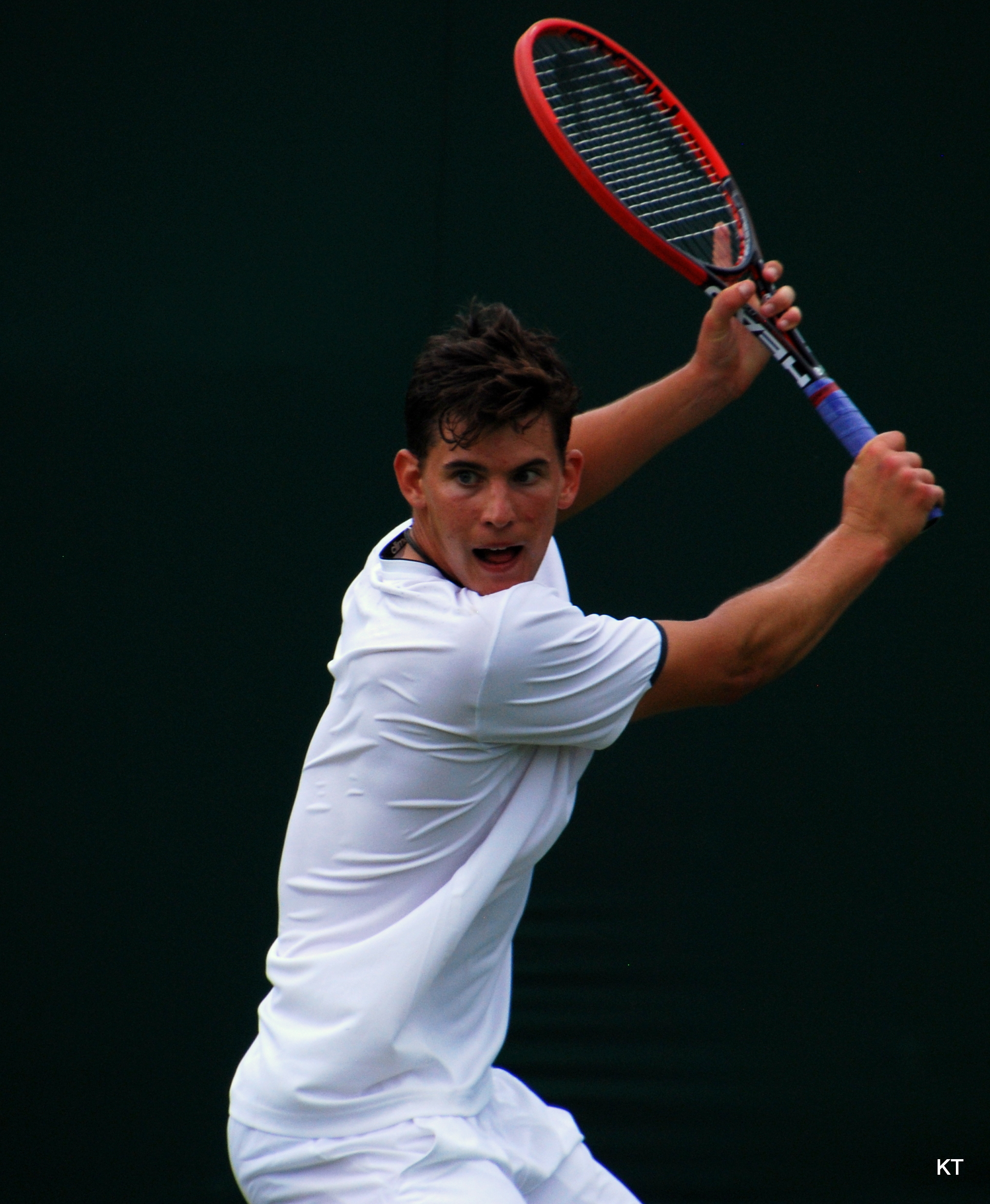
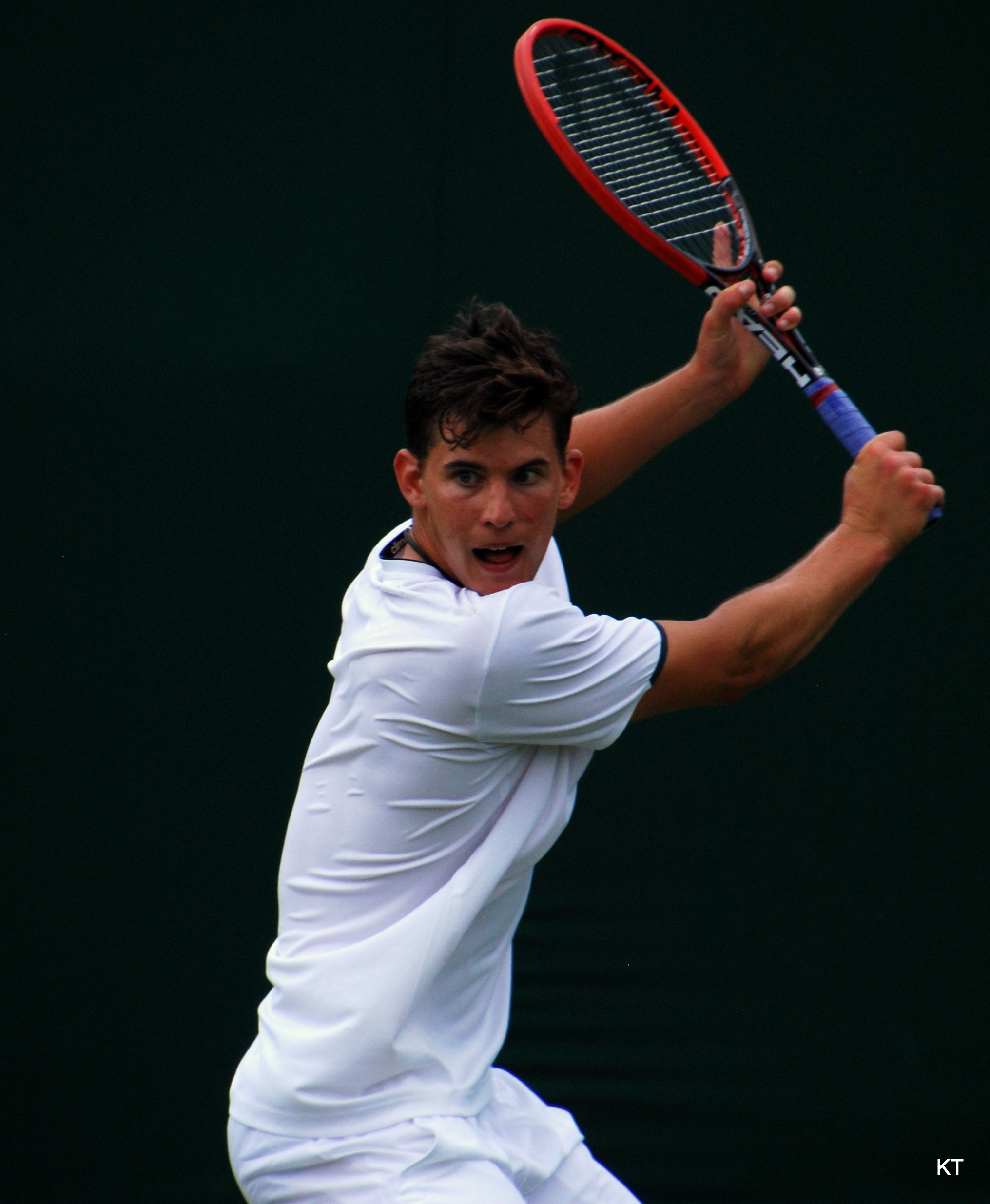
Dominic Thiem won his first title in 2015, but although he improved his performance in 2016, did not win a big title – so he missed this benchmark last year. As I have mentioned elsewhere, his career pattern so far fits that of a second tier player more than a true elite.
Then we have a group of players: Lucas Pouille, Nick Kyrgios, Karen Khachanov, and Alexander Zverev. These are the four young players who all won their first titles in 2016, and thus have started their “clock” and must win a big title in 2017 to reach this benchmark.
We should see several other young players win their first ATP titles in 2017, thus “starting the clock” for 2018.
In Conclusion
I will say it again: records—and benchmarks—are continually broken. Just as Stan Wawrinka set new benchmarks for multi-Slam winners, winning his first at age 28, so too might we eventually see a future 6+ winner take a delayed career path. Ivan Lendl was an elite player in his early 20s, winning tons of tournaments and even reaching #1 before winning a Slam, but did not win his first Slam until he was 24. Andy Murray was 25 and is arguably the greatest Open Era player with less than six Slams, and he only has three (so far).
The shape of what is possible is always changing, yet we also have almost five decades of Open Era history to draw upon for trends and trajectories. This study shows that the vast majority (92%) of all-time greats won their first big title (Masters equivalent or greater) within a calendar year of winning their first ATP pro title. It also shows that of 2-4 Slam winners, only 40% accomplished this, and of single Slam winners only about a quarter. This implies that a major defining feature of the truly great is the pace at which they reach their peak. I’ve noted this before, but this study furthers the point: one of the differentiations between the true elites and the second tier, is the rate at which they rise to the top. A group of talented players might show up in the top 100 at similar ages, yet the future elites tend to continue rising quickly, while the future second (top 10ish) and third tier (top 30ish) players tend to stall at various levels, taking longer to climb the ladder to their peak.
Now poor Alexander Zverev didn’t win his first title until late last year, in September, and Khachanov not until October– so for them the one calendar year gap is especially small – only about an actual year – whereas for Nick Kyrgios, who won his first last April, he has (or has had) a year and a half. So continue watching, and we shall see.
https://www.youtube.com/watch?v=ihcuD-DnAq0
Cover photo by robbiesaurus, courtesy of Creative Commons License
Andy Roddick, newly elected to the Tennis Hall of Fame, had an excellent career. He didn’t make the cut to make it into my Top 20 Players of the Open Era, but he’s just outside it. He’s among the better players to win only a single Slam, and better than some who won two or three. I’ve ranked him as the third best player of his generation (those players born from 1979-83), somewhere in the #21-30 range of the Open Era.
Let’s have a bit of fun. Here’s the scenario: What if Roger Federer had chosen a different career, say became a watch-maker? Let’s imagine that everything else stayed the same on the ATP tour. Almost certainly the player most effect would be Andy Roddick, he of the 3-21 record vs. Federer, including 0-8 at Grand Slams, and 0-4 in Slam finals.
Here’s the caveat: All “what if” scenarios are highly speculative, if only because they tend to overly simplify matters by adjusting one factor without knowing how the other factors would combine without that factor present, but again, we’re just having a bit of fun.
To approach this, we can’t imagine who would have replaced Roger in the previous rounds; the only thing we can do is replace Roger with the player he beat to get to Andy. So in the following, we are going to imagine that Andy faced the opponent that Roger beat, and project an outcome based upon the head-to-head record, both as a whole and on a specific surface type, and then make a judgment. When in doubt, I’ll veer on the side of caution and give Andy’s opponent the win, to keep me honest!
I’m also only going to look at tournaments in which Andy lost to Roger in a semifinal or final. I’m also going to only look at big tournaments—Slams, World Tour Finals, and Masters—at least for now, and then offer a hypothetical career for Andy Roddick, if Roger had followed a different career path.
First of all, here is Andy’s actual career in my new visual tool, “player skyscrapers,” which I explain here.
For the sake of comparison, here are some of the better players of his generation, so we get a sense of how he stacks up:
As you can see, Andy’s career is pretty close to Hewitt’s, and better than any other player of his generation – aside from Federer, of course. Here are a few players to compare Andy to outside of his generation:
That gives us a group of players who Andy is quite similar to. In fact, his career looks almost like the exact inverse of Muster’s.
Now let’s get into the tournaments. As mentioned before, Andy was 3-21 vs. Roger. Of those 21 losses, 6 were in Slam semifinals or finals, 1 at the semifinal of a Tennis Masters Cup (the predecessor to the World Tour Finals), and 2 at Masters tournaments – so 9 big tournaments in all that Andy had a good chance of winning without Roger present, in which he lost to Roger in the SF or F. Let’s take a look at those nine tournaments in chronological order:
2003 Wimbledon SF Roger’s QF opponent: Sjeng Schalken (Roddick 5-1) Roger’s Final opponent: Mark Philippoussis (Roddick 1-0)
While nothing is certain, this looks like a Slam that Andy had a good chance of winning – a dominant H2H over Schalken, and a win in his one match vs. Philippoussis. We’ll give this one to Andy, which would have given him two Slams on the year. +1 Slam title
2003 Tennis Masters Cup SF Runner-up in Roger’s group: David Nalbandian (Roddick 4-2) Roger’s Final opponent: Andre Agassi (Agassi 1-5)
I don’t think we can give this one to Andy. Not only would Nalbandian not have been a sure thing, but Andre Agassi held a commanding H2H lead, so we won’t change Andy’s result. No title
2004 Wimbledon F Roger’s SF opponent: Sebastian Grosjean (Roddick 8-1)
This one is pretty easy – Andy would have won this, probably quite handily. +1 Slam title
2004 Canada Masters F Roger’s SF opponent: Thomas Johansson (Roddick 5-0)
Another easy call – Andy gets an added Masters title. +1 Masters title
2005 Wimbledon F Roger’s SF opponent: Lleyton Hewitt (tied 7-7)
It is fitting that Hewitt and Roddick are tied at 7-7 in the head-to-head, as they are the two most accomplished players of their generation, after Federer (with apologies to Safin). I think this comes down to surface: Hewitt is 1-0 on clay and 6-4 on hard, so I’d give him those surfaces, but Andy won all three grass tournaments they played, including the 2009 Wimbledon QF. So I’m giving this one to Andy. +1 Slam title
2005 Cincinnati Masters F Roger’s SF opponent: Robby Ginepri (Roddick 10-1)
Easy call – another title for Roddick. +1 Masters
2006 US Open F Roger’s SF opponent: Nikolay Davydenko (Roddick 5-1)
We could probably do a similar study for Davydenko, another player greatly impacted by Roger’s presence, with a 2-19 record against the Swiss Maestro. But this is a pretty easy call, so we’ll give this to Andy. +1 Slam title
2009 Australian Open SF Roger’s QF opponent: Juan Martin del Potro (Del Potro 1-4)
We’ll give this one to Del Potro, who got slaughtered by Roger in the QF. Even if Andy had made it past Delpo, he probably would have lost to Rafa in the final. No title
2009 Wimbledon Roger’s SF opponent: Tommy Haas (Haas 6-7)
Andy’s last, and greatest, challenge to Roger. This is a tough call to make as the two never played on grass. While I’d like to think that Andy would have won, I’ll give this one to Haas just to be conservative. No title
OK, so all things tolled, Andy gets four additional Slams and two additional Masters to give him five Slams and seven Masters titles – quite a career. And this isn’t counting the QF losses to Roger, which he may have been able to get more titles out of.
So how does this new, improved Andy Roddick career look, compared to his actual? To get a sense of that, I included the above changes, but also looked at other losses to Federer at Slams and other tournaments, and adjusted accordingly – this ended adding a couple minor titles (2002 Sydney, 2004 Bangkok) and improved Slam results in one case (2007 US Open final) – but I won’t go into details, so as not to lengthen this too much. I also estimated how Andy’s rankings might have changed, as a result. Here we go:
So there’s not only the addition of the four more Slams and two more Masters, as well as two more ATP 250s, but also another year-end #1 in 2004 and an improvement to #2 in 2005 and 2006. Now let’s compare “Hypothetical Andy” to a new group of players:
All of a sudden, “Hypothetical Andy” is amidst a different caliber of players – between multi-Slam winners like Courier, Wawrinka, and Kuerten, yet not quite in the ranks of the near-greats like Vilas, and Murray (I included Wilander, as the least of the true greats….his career doesn’t look much better than Vilas or Murray, but that’s a different story).
Andy, in his actual career, has nothing to be ashamed about. Yes, he was 1-4 in Slam finals, but he still had a strong career – one of the thirty best of the Open Era. But oh, what could have been…
Cover photo by Boss Tweed from Wikimedia Commons, courtesy of Creatives Commons License.
Fact: In the history of Open Era tennis, going back to 1968 through 2016—a span of 49 years and 195 Grand Slam tournaments—there has never been more than two years in a row without a new Slam winner. Of those 49 years, only 15 have been years in which at least one of the Slams wasn’t won by a new winner. To put that another way, in about 70% of the Open Era years, at least one Slam was won by a new Slam champion. The years without a new winner are: 1969, 1973, 1978, 1986, 1993-94, 1999, 2006-07, 2010-11, 2013, and 2015-16.
You’ll notice that a high percentage of those years are recent; six out of the fourteen are all within the last eleven years. You’ll also note that three out of the four two-year gaps are also within the last eleven years. Clearly this points to the homogeneity of Slam winners in recent years. We can also look at the fact that starting with Rafael Nadal’s first Slam, the 2005 French Open, just seven players have won 47 Slams: Nadal (14), Roger Federer (13 of his 17), Novak Djokovic (12), Juan Martin del Potro (1), Andy Murray (3), Stan Wawrinka (3), and Marin Cilic (1).
Which brings me to the topic: Going purely on this pattern, there will be a new Slam winner in 2017. Who will it be? Who knows? But if I were to make wagers, here are the players who are most likely, in rough order:
1. Milos Raonic: The blazing server is coming off his best year in which he finished #3—only the second player after David Ferrer in 2013 to finish in the top three in the last ten years, other than the Big Four. He also reached his first Slam final, losing to Andy Murray at Wimbledon. Raonic doesn’t have the well-balanced game to dominate for an extended period of time, but he does have enough weapons to challenge for a Slam title, being particularly dangerous at Wimbledon.
2. Dominic Thiem: With Rafa questionable and Novak shaky, Andy having not yet truly dominated clay and Stan Wawrinka always erratic, Roland Garros is up for grabs this year. Now it probably won’t be Thiem, but it is his best surface and if anyone other than the usual suspects wins the French Open, it will probably be Thiem, who has a good chance of being the best clay court player over the next half decade or so.
3. Nick Kyrgios: If the temperamental Australian starts showing an ounce of composure and maturity, the rest of the tour needs to look out: he can be a very dangerous player, capable of beating anyone on the right day. But he may be two or three years from that level of maturity, if he ever finds it, but with another year of steady rising—and his first three titles—Kyrgios is a player to watch (and watch out for, if you’re a player) in 2017.
4. Kei Nishikori: I haven’t done the research, but I suspect that Kei may be the best player in Open Era history never to win at least a Master tournament. With just a cursory search, other candidates include Raonic, Richard Gasquet, Fernando Gonzalez, Mikhail Youzhny, Todd Martin, Marc Rosset, Aaron Krickstein, Brad Gilbert, Gene Mayer, Eddie Dibbs, and Alex Metreveli. He’s won 11 tournaments so far, including 6 ATP 500s; he’s reached a Slam final and three Masters finals. It seems inevitable that he’ll win a Masters, although a Slam seems less likely as he hasn’t shown the fortitude that it takes to win seven best-of-five matches in a row. Still, he came very close in 2014 and could conceivably threaten again. If Kei were to reach a final against an exhausted Nadal or Federer, he could pull it off.
5. Alexander Zverev: It isn’t a matter of if, but when. If there is one player on tour that we can be most certain will eventually win at least one Slam, it is Zverev. But 2017 is probably unlikely; he turns 20 years old in April and has yet to even make it to the fourth round of a Slam. If I were to guess, his first Slam will be in 2018 or 2019. Still, he is talented enough that he should be factored into consideration, especially for later in the year.
Less Likely Candidates: I’d love to see Jo-Wilfried Tsonga or Tomas Berdych finally win one, but these guys turn 32 in 2017 and both look to be showing signs of decline. I’d give Tsonga a slightly better chance. I almost can’t bear to type his name, but Gael Monfils is exactly the type of brilliant player who could be a one-Slam wonder. Yeah, right. Monfils might be a more likely candidate if it weren’t for his abyssmal record in ATP title finals: 6-19! Another of his ilk is Grigor Dimitrov, who has the talent but not the mentality; still, you just never know. Lucas Pouille is an unlikely candidate, but at 22 years old and ranked #15 in the world, with two QF Slam appearances in 2016, he’s on the map. I’d like to say that David Goffin has a chance, but he just doesn’t have the upside. Similarly with Jack Sock, who seems to be a similar low-ceiling player as Goffin. One final mention: Karen Khachanov. At 20 years old to start the year and #53 in the world, he’s unlikely in 2017, but he made a big jump up the rankings and is exactly the type of “out-of-nowhere” player that could surprise. But along with every other 21-and-under player not named Zverev and Kyrgios, we have to wait and see before considering him a legit Slam threat.
So there you have it. Statistically speaking, there should be a new Slam winner in 2017. Now this is far from a certainty, and given the composition of the tour in 2016, it is quite conceivable that we will see our first three-year gap of no new Slam winners. But I think those five are the top candidates, with a few others being distantly possible.
If it isn’t 2017, it certainly will be 2018. But I’m guessing we’ll see a new champ in 2017. I certainly hope so!
Addendum: New Slam Winners of the Open Era
I thought some might like to see the whole list, so here goes:
2016:
2015:
2014: Stan Wawrinka, Marin Cilic
2013:
2012: Andy Murray
2011:
2010:
2009: Juan Martin del Potro
2008: Novak Djokovic
2007:
2006:
2005: Rafael Nadal
2004: Gaston Gaudio
2003: Juan Carlos Ferrero, Andy Roddick, Roger Federer
2002: Thomas Johansson, Albert Costa
2001: Goran Ivanisevic, Lleyton Hewitt
2000: Marat Safin
1999:
1998: Petr Korda, Carlos Moya
1997: Gustavo Kuerten, Patrick Rafter
1996: Yevgeny Kafelnikov, Richard Krajicek
1995: Thomas Muster
1994:
1993:
1992: Andre Agassi
1991: Jim Courier, Michael Stich
1990: Andres Gomez, Pete Sampras
1989: Michael Chang
1988:
1987: Pat Cash
1986:
1985: Stefan Edberg, Boris Becker
1984: Ivan Lendl
1983: Yannick Noah
1982: Mats Wilander
1981: Johan Kriek
1980: Brian Teacher
1979: John McEnroe
1978:
1977: Roscoe Tanner, Vitas Gerulaitis
1976: Mark Edmondson, Adriano Panatta
1975: Manuel Orantes
1974: Jimmy Connors, Bjorn Borg
1973:
1972: Andres Gimeno, Ilie Nastase
1971: Stan Smith
1970: Jan Kodes
1969:
1968: Arthur Ashe
Cover image by DanielJCooper from Wikimedia Commons, courtesy of Creative Commons License
A few years ago I wrote a couple blog articles on the sad state of American tennis, one a bit more straightforward—Houston, We Have a Problem—and one a bit more mythological: American Men’s Tennis and the Cycle of Ages. At the time of those writings, August of 2013, there wasn’t a lot to be excited about. Andy Roddick had retired and the last truly great American men’s player, Andre Agassi, had retired in 2006. The top American players at the time of the former article were (with their ages at the time in parentheses):
14. John Isner (28)
29. Sam Querrey (25)
87. Jack Sock (20)
92. Michael Russell (35)
97. Ryan Harrison (21)
100. James Blake (33)
Sock and Harrison looked vaguely promising, but Harrison (now 24) continued to stagnate and is ranked #90, and Sock (now 23) slowed his development and seems to have peaked as a top 20-30 type.
Here’s an update, the 2016 year-end top 100 Americans:
19. John Isner (31)
23. Jack Sock (24)
31. Sam Querrey (29)
33. Steve Johnson (26)
76. Taylor Fritz (19)
88. Donald Young (27)
90. Ryan Harrison (24)
As you can see, it doesn’t look much better than three years ago. Isner remains the top American and he’s just barely hanging on to a top 20 ranking. There’s a bit more meet in the middle, with four Americans in or close to the top 30, where three years ago there were only two. And there’s Fritz, who is the brightest young American player in years. On the surface it looks like Sock was only a year older but ranked similarly to Fritz, but in actuality he was almost two years older, so Fritz’s ranking is far more impressive.
But the top 100 only tells part of the story. Let’s compare the top ranked Americans age 21 and under in 2016 with those in the year-end in 2013:
2013
100. Ryan Harrison (21)
102. Jack Sock (21)
114. Denis Kudla (21)
306. Bjorn Fratangelo (20)
437. Christian Harrison (19)
476. Mitchell Krueger (19)
573. Marcus Giron (20)
594. Evan King (20)
2016
76. Taylor Fritz (19)
105. Jared Donaldson (20)
108. Frances Tiafoe (18)
116. Stefan Kozlov (18)
141. Ernesto Escebedo (20)
198. Michael Mmoh (18)
200. Noah Rubin (20)
204. Reilly Opelka (19)
I picked eight players for each to give a sense of the depth of 2016’s field. As you can see, there is much more to be excited about now than there was three years ago. Looking solely on my “Pace of Greatness” theory, Fritz and Tiafoe have already accomplished the first benchmark: ranking in the top 100 as 18-year olds. Kozlov is very close, and Mmoh has an outside chance. But the main point is that even if none of these eight players become true greats, there is a lot more talent there than in 2013.
https://www.youtube.com/watch?v=iciaF8VryAU
Let’s go back a bit further. Starting in the late 90s and into the early 00s, there was a talented group of young Americans: James Blake, Andy Roddick, Taylor Dent, Mardy Fish, and Robby Ginepri. Ginepri and Dent had decent but unspectacular careers: Ginepri won an ATP 500 and reached the 2005 US Open semifinal, ranking as high as #15, and Dent won four titles and ranked as high as #21. Fish was better, finishing 2011 #8 in the world and reaching several Slam quarterfinals and Masters finals, but never winning more than an ATP 250 level tournament (he won six); his career was marred and shortened by a heart condition. Roddick was a Slam winner and #1, and perhaps the player who suffered most from Roger Federer’s dominance. James Blake had some good years, peaking in his late 20s, and was probably slightly better than Fish, and thus the distance second behind Roddick among this group.
After the group who came of age in the early 2000s, you get to players like John Isner, Sam Querrey, Brian Baker, and Donald Young. Isner is the best of the bunch, a third tier player who has spent many years in the top 20 but only just barely sniffed the top 10. Querrey is something of a disappointment, looking promising in his early 20s but stagnating; Baker never amounted to much, and the fact that I used Young as the emblematic player of the generation of players born from 1989-93 should speak volumes. I think we can safely say that the current crop of young Americans is the best such group that we’ve seen in at least fifteen years.
Going back before Roddick’s era, the mid-to-late 90s also didn’t see much in the way of American talent, with players like Vince Spadea, Jan-Michael Gambill and Justin Gimelstob being the top ranked young Americans. Gambill and Spadea were solid players who spent some time in the top 20, but never in the top 10 or with major titles.
We have to go all the way back to the early 90s to find a generation of truly great young Americans. Check out the American men age 21 and under in the top 100 in 1990:
1990
4. Andre Agassi (20)
5. Pete Sampras (19)
15. Michael Chang (18)
25. Jim Courier (20)
27. David Wheaton (21)
93. MaliVai Washington (21)
Sampras and Agassi are, along with Jimmy Connors and John McEnroe, two of four truly great American men’s players of the Open Era. Jim Courier won four Slams and remains the youngest player (at age 22 years and 11 months) to have appeared in the finals of all four Slams, and was #1 for 58 weeks; Michael Chang was also a Slam winner and perennial top 10 player, with 34 titles and 7 Masters to his name. Even David Wheaton won the prestigious Grand Slam Cup title and ranked as high as #12, and Washington is known for his run at the 1996 Wimbledon (he lost to Richard Krajicek in the final). Overall we probably haven’t seen a crop of this kind of talent coming up at the same time from any country.
In Conclusion
Let me be clear: I am not predicting that the current crop of young Americans is on par with that group from 1990, but what I am saying is that we have to go back to 1990 to find a more promising group of Americans in terms of youth and rankings. If you go back to that 2016 21-and-under rankings list, there probably isn’t an Andre Agassi or Pete Sampras in that group, but there could be an Andy Roddick, a Michael Chang, even a Jim Courier, or at least several players akin to Todd Martin or Mardy Fish. In other words, American men’s tennis is on the rise and looks more promising now than it has in at least 15 years, and possibly more like 25 years.
There is hope!
Cover photo from Wikimedia Commons courtesy of the Creative Commons License.
In Part One we looked at the players born from 1993 to 1996, with a resulting outlook which was pretty grim. There are several players who should be good players, even possible Slam contenders, but in general they continue a trend of weak talent from the 1989-92 group, with no clear future elite players. Let’s take a look at the players born in 1997 to 2000, the teenagers who turned 16 to 19 in 2016.
CLASS OF ’97
24. Alexander Zverev
76. Taylor Fritz
156. Andrey Rublev
204. Reilly Opelka
205. Alexander Bublik
The sun will always rise. Here we see arguably the brightest young player in the game: Alexander Zverev. If I had to put money on any one young player being a future multi-Slam winner, it would be Zverev. He may or may not be a future great, but he should at the least be very, very good. Consider that the last players to finish their age 19 season ranked in the top 25 were Novak Djokovic and Andy Murray in 2006, ranked #16 and #17, respectively. In other words, Zverev is the first teenager to finish in the top 25 in ten years. In fact, the list of teenagers in the Open Era who have finished in the top 25 is a relatively short one:
2016: Alexander Zverev (24)
2006: Novak Djokovic (16), Andy Murray (17)
2005: Rafael Nadal (2), Richard Gasquet (16)
2001: Andy Roddick (14)
2000: Lleyton Hewitt (7), (Roger Federer 29)
1999: Marat Safin (24), Lleyton Hewitt (25)
1995: Marcelo Rios (25)
1993: Andrei Medvedev (6)
1992: Andrei Medvedev (24)
1991: Michael Chang (15)
1990: Pete Sampras (5), Goran Ivanisevic (9), Michael Chang (15)
1989: Michael Chang (5), Andre Agassi (7), Jim Courier (24)
1988: Andre Agassi (3), Guillermo Perez Roldan (18)
1987: Kent Carlsson (12), Guillermo Perez-Roldan (19), Andre Agassi (25)
1986: Boris Becker (2), Kent Carlsson (13)
1985: Stefan Edberg (5), Boris Becker (6)
1984: Pat Cash (10), Aaron Krickstein (12), Stefan Edberg (20)
1983: Mats Wilander (4), Jimmy Arias (6)
1982: Mats Wilander (7), Jimmy Arias (20)
1980-81: Insufficient data
1979: Ivan Lendl (21)
1978: John McEnroe (4)
1977: John McEnroe (21)
1975: Bjorn Borg (3)
1974: Bjorn Borg (3)
1973: Bjorn Borg (18)
That’s 26 individual players in the ATP Era (1973-2016) who have finished a year ranked in the top 25 as a teenager. That may seem like quite a few players, and certainly there are several players on that list who didn’t have exactly stellar careers, but the majority of them were very good, and every applicable 6+ Slam winner—those who were teenagers during the ATP Era—is there, all except one: Roger Federer, who finished 2000—the year he turned 19—ranked #29; so he was close.
Furthermore, consider the aging of the tour: In the last 26 years, a teenager has ranked in the top 25 only 13 times by 11 players; in the previous 28 years (1973-1990) it was done 28 times by 16 players. Zverev is the first player in ten years to accomplish this.
All of this is to point out that Zverev’s accomplishment is quite rare. Secondly, it points to likely future success. Of those 26 players, 20 of the went on to win at least one Slam (77%), 14 won multiple Slams (54%), and 10 won 6+ Slams (38%). The Slamless players are Krickstein, Carlsson, Perez-Roldan, Medvedev, Rios, and Gasquet. Of those six only Krickstein, Perez-Roldan, and Gasquet didn’t win at least a Masters. If we look at only the last 26 years, of the ten players previous to Zverev, only three didn’t win Slams (Medvedev, Rios, Gasquet), five won 1-3 Slams (Chang, Hewitt, Safin, Roddick, Murray) and two became truly great players (Nadal, Djokovic). Going purely on percentages, that’s a 70% probability of at least one Slam title and a 50% probability of at least two. Of course this isn’t enough data to go on, but it gives us a sense of possible outcomes.
All that said, Zverev had a very good year, going from #83 to #24, and winning his first ATP title in his third final of the year, defeating Stanislas Wawrinka in three sets in St. Petersburg, an ATP 250 event. He didn’t make it past the third round of a Slam, but he had consistent results overall and situated himself to be seeded in Slams going forward.
Among the other players, Taylor Fritz is another exciting young player to watch. After starting the year ranked #174, he surged in early 2016, winning an early Challenger title and then gaining larger attention by a strong run at the ATP 250 Memphis Open, defeating second-seeded Steve Johnson en route (#29) to the final, which he lost to Kei Nishikori. He rose as high as #53 in late August, including a memorable three-set loss to Roger Federer at the Mercedes Cup, but then faded a bit later in the year, finishing at #76.
https://www.youtube.com/watch?v=GMzCJ9RkgjQ
The big disappointment for me is Andrey Rublev, who is exactly the same age as Fritz but after winning his first Challenger title in March, stalled out and didn’t progress, going from #185 in 2015 to #156 in 2016. Big server Reilly Opelka shows some promise and could be the next John Isner. He rose from virtually unranked in 2015 (#981) to #204, including his first Challenger title in November.
2017 Outlook: After going from #83 to #24, including his first title, I’d like to say that Zverev—who turns 20 in April—is poised to enter the elite. But I think we’ll be talking that way more likely a year from now. In 2017 I predict stabilization and further modest gains, with an outside chance of sneaking into the top 10 and a World Tour Final berth, but more likely finishing in the 10-15 range. Look for him to be win more low level titles, maybe even compete for a Masters. More importantly, he needs to go deeper into Slams; he still hasn’t made it past the third round, which he made it to at both Roland Garros and Wimbledon. While 2018 might be the year he breaks through into the true elite and Slam contention, he is going to be a dangerous opponent in 2017, and not someone the elite will take for granted. I think that at some point this year, there will be a tournament that we look back on as breakthrough. It may be a second week run at a Slam, or a Masters final – but at some point this year, the big boys will take notice of him.
Fritz is exactly half a year younger than Zverev, and is probably more like a year behind him developmentally; expect to see him do in 2017 what Zverev did in 2016. His gains might be a bit more modest, but he should be in the top 40 by the end of the year, if not higher, and is a good candidate to win his first title. Fritz also will start getting more and more attention as he starts to upset top 20 players, and going deeper in tournaments.
I do expect both Rublev and Opelka to reach the top 100 this year; they just seem a year or so behind their two more successful peers. I do still hope that Rublev figures it out; he seems the type that could do it quickly, but his candidacy as a future elite is now greatly reduced. I see him more as a potential tier two or three player, which is still pretty good.
CLASS OF ’98
108. Francis Tiafoe
116. Stefan Kozlov
143. Duck Hee Lee
198. Michael Mmoh
209. Stefanos Tsitsapis
231. Casper Ruud
This is a subtly strong group, with no players that look like future greats but at least six—those listed above—who could be top 40 types. The jury is still out on Tiafoe; he made good strides this year, and some see him as a future star, but others are worried about his erratic serve and play. I don’t have much to say about Lee except that he continues to progress. Kozlov looks promising and between the first and final draft of this piece, moved up thirty ranks on account of winning his first Challenger title, which was the fifth won by an American teenager in 2016, after Fritz, Tiafoe, Opelka, and Mmoh, who is another promising young American. In those five players, the United States has the most talented group of young players since at least 2003, when Andy Roddick, Mardy Fish, Taylor Dent, and Robby Ginepri were all 22 or younger and ranked 33 or better. But more on that in another article.
Tsitsapis, a #1 ITF Junior, made good progress, as did Ruud. Another player to keep an eye on is Mikael Ymer (#492), who missed most of the year to injury but still holds promise.
2017 Outlook: These players are still quite young so expectations should be modest, but we could see several of them enter the top 100 in 2017, maybe even win a title. Of all of the “classes,” this one has perhaps the deepest talent—at least that we can see so far—so bears watching in 2017. Tiafoe, Kozlov, and Lee should all reach the top 100 sooner than later, and I wouldn’t be surprised to see Mmoh, Tsitsipas, and Ruud all approach the top 100 by year’s end. If Ymer stays healthy, he could rise quickly and be on the cusp of the top 100 as well. So that is at least seven players who bear watching. CLASS OF ’99
250. Denis Shapovalov
354. Alex De Minaur
519. Corentin Moutet
806. Miomir Kecmanovic
926. Yibing Wu
Denis Shapovalov is the big revelation here, with none of the others standing out yet. Shapovalov won his first Junior Slam at Wimbledon, defeating De Minaur, and also won three Futures titles, but it was at the Rogers Cup that he garnered more attention, upsetting Nick Kyrgios in the first round before losing to Grigor Dimitrov in the second.
2017 Outlook: Look for Shapovalov to move steadily up the rankings as he focuses on the Challenger tour. Good progress would be for him to reach the #100-150 range by year’s end, winning a Challenger title or two. It is possible that he breaks into the top 100 as soon as this year, although that is probably unlikely.
CLASS OF ’00
601. Felix Auger Aliassime
789. Nicola Kuhn
925. Yshai Oliel
1063. Rudolf Molleker
1066. Alen Avidzba
It is hard not to be excited about Felix Auger Aliassime, who just turned 16 in August shortly before winning the Junior title at the US Open, as well as winning his first Futures title just a couple weeks ago. And how about this: his birthday is August 8, the same day as a certain Swiss great you might have heard of….although Aliassime is 19 years younger than Federer. To put that in context, when Aliassime was born on August 8, 2000, Roger Federer was ranked #38 in the world and rising.
Aliassime is, by all accounts, an immense talent. There is also some room for concern, as it was revealed earlier this year that he has a heart condition that will almost certainly impact his career, although the question is to what degree (for reference, Mardy Fish had a similar condition). Let us cross our fingers and hope.
As for the others on the list, there isn’t a lot to know right now—but they’re the top players born in 2000. But chances are this list will look very different in year, when we should have a better sense who the true prospects of this year are.
2017 Outlook: Given that these players enter 2017 as 16-year olds, there isn’t much to expect and we just don’t know enough about any of them except for Aliassime, so we’ll have to revisit this group in a year or two. But Aliassime does bear watching, both because of his prodigious talent but also his health concerns. Aliassime will focus on the Junior tour and should be dominant; look for him to win a Slam or two, and start playing in more Futures. A year-end ATP ranking in the 200s is not out of the question.
Cover Photo by Steven Pisano from Wikimedia Commons, Courtesy of Creative Commons License
It wasn’t so long ago that the up-and-coming “Young Guns” on the ATP tour were players like Grigor Dimitrov and Bernard Tomic, born in 1991 and 1992, respectively; now, after half a decade of anemic results and no elite prospects, there have been some promising young players showing up on tour over the last year or two. I discussed this new generation back in April in a two-part series, Looking for the Next Great Player, but with seven months of tennis and the year ending, I thought it was time to take stock and see how the “Younger Guns” did in 2016.
Consider that the youngest players to win Grand Slam titles were born in 1988: Juan Martin del Potro and Marin Cilic. We are amidst the worst dry spell in tennis history, with no Slam title-holders that are age 27 or younger. Kei Nishikori and Milos Raonic have birthdays in December, turning 27 and 26, respectively; no-longer-a-baby Dimitrov is 25, and Tomic is 24. These are no longer young players, but all in the peak range of tennis players. Historically speaking, these are the players that should be dominating now; in fact, Nishikori is the same age that Roger Federer was in late 2008, when he was starting to show signs of slippage. Perhaps even worse than the lack of a Slam title, is the lack of even a Masters title: Marin Cilic, at age 28, remains the youngest Masters titleist and Slam winner.
The point being, barring an unprecedented development, it is now absolutely clear that we won’t be seeing any elite players from this group. At best we might see a stray Slam or two won when no one else is looking, and at the very least it is hard to imagine that one of Raonic or Nishikori won’t win at least a Masters. Or we can look to Stanislas Wawrinka, the only multi-Slam winner in Open Era history who won his first Slam at the geriatric age of 28. There is always hope, and certainly it isn’t too late for a Raonic or Nishikori to win a Slam or two, but the chances of any become an actual great are virtually none.
Regardless of whether or not any of this group wins a Slam or not, or even “does a Stanimal,” we have to chalk the players born from 1989 into the early 90s as a lost generation and our hope for the future lies in the next group, those born in the mid to late 90s. In what follows, I’m going to look at players born in each year from 1993 to 2000, both reviewing their year in 2016 but also looking at 2017 with an eye for what to expect (or hope for).
For each year, or “class,” I will include the top five ranked players, using the year-end 2016 rankings. The rankings are as of November 28, which include all ATP Tour and Challenger tournaments of 2016, but don’t include Futures tournaments to be played in December, so there may be some very minor adjustments for players ranked outside of the top 150-200, but the general rankings should remain similar. These top five aren’t necessarily the best five players of their class, but they give us a starting point.
CLASS OF ’93
8. Dominic Thiem
55. Jiri Vesely
114. Bjorn Fratangelo
127. Taro Daniel
145. Roberto Carballes Baena
In my generation series, 1993 is grouped with the very weak 1989-93 “Lost Generation,” yet I am including it in this discussion because of the emergence of one player: Dominic Thiem. The second best player of this class, Jiri Vesely, is quite a bit behind Thiem, with a career high ranking of #35—and that back in 2015; Vesely’s claim to fame this year was upsetting #1 Novak Djokovic in the second round of the Monte Carlo Masters.
But back to Thiem, he went from #139 in 2013 to #39 in 2014, then to #20 in 2015. His steady rise continued in 2016, as he finished the year #8 in the world after making his first World Tour Finals as an alternate for Rafael Nadal; Thiem repaid Rafa by winning a Round Robin match to sneak ahead of him in the year-end rankings. He was strongest earlier in the season, as he showed himself to be a real threat on the clay courts, including a Semifinal appearance at Roland Garros – his only second week Slam result thus far. He also won his first ATP 500 at Acapulco in February and three ATP 250s. But he fizzled out after mid-year. After winning his fourth title in Stuttgart, he held an 42-11 record for the year, or 79%. From that point on he went 16-13, or 55%. To put that another way, for two-thirds of the year he played like a top five player, then after Stuttgart he looked more like a #20-40 player.
2017 Outlook: After strong gains the last few years, from #139 in 2013 to #8 in 2016, the question is how much higher Thiem can go. He seemed to hit a ceiling this year, his results cooling off in the second half, although whether this was due to exhaustion and a heavy first half schedule, or perhaps his strength on clay vs. the other courts, or maybe he simply reached his ceiling. Thiem just turned 23, which is an age when players should be in their prime, so on one hand we shouldn’t expect much more from him. On the other hand, players may be developing at a slower pace these days, so Thiem could develop a bit further. At this point I think we should enjoy him for what he revealed in 2016: a solid second tier player who is very dangerous on clay. Look to Thiem to stabilize his current level in the lower half of the top 10, and maybe compete for a Master’s title (likely clay) as well as continue to win several low level titles. He’s exactly the type of player who could win a Slam if the context is right, but is unlikely to get past a true elite player like Novak Djokovic or Andy Murray in their primes. In other words, if there’s a Slam title in his future, it probably isn’t in 2017.
As for the others, Vesely could still have a mini-breakthrough and stabilize in the 20-40 range; he may even dive into the top 20 at some point, but I wouldn’t expect much more. It seems that Fratangelo and Daniel have been hovering around #100 for ages, so I wouldn’t expect much.
CLASS OF ’94
15. Lucas Pouille
75. Adam Pavlasek
79. Jordan Thompson
82. Thiago Monteiro
179. Kimmer Coppejans
As you can see, this is another weak class, with only one player in the top 50: Lucas Pouille, whose 2016 echoed Thiem’s 2015. Thiago Monteiro may deserve watching, however. The Brazillian showed some early promise in 2011-12 as a 17-18 year old, winning a couple Futures, and then a strong showing on the Challenger circuit in 2013. But then he struggled with injury for a couple years. In 2016 he began the year ranked #463 and moved all the way into the top 100, including his first Challenger title against veteran Carlos Berlocq. He also gained some attention after beating #9 Jo-Wilfried Tsonga in the first round of Rio, before losing to eventual champion Pablo Cuevas in the 2R.
Pouille is the obvious standout, with a consistent trajectory over the last few years: finishing #204 in 2013, #133 in 2014, #78 in 2015, and #15 in 2016. Some have claimed that he is a limited player and won’t get any better, yet his results speak otherwise: a quick rise in the rankings and two Slam QF appearances, including a five-set upset of Rafael Nadal in the fourth round of the US Open.
https://www.youtube.com/watch?v=HQHgRFqI-aQ
Pavlasek and Thompson both made strong gains, rising from #160 and #154, respectively. Coppejans seems to be stagnating.
2017 Outlook: Look for Pouille to stabilize in the top 20 and creep up to the cusp of the top 10, maybe even sneaking in. He needs to start winning tournaments; his ranking is largely based upon those two QF results and modest consistency in Masters tournaments, and a lone ATP 250 title. He’s a good candidate to win an ATP 500 and/or several ATP 250s, although would be a surprise to win a Masters or Slam, at least in 2017. But he looks to join Thiem as another second tier player of the next era, and should be near or even in the top 10 for years to come.
Pavlasek and Thompson could breach the top 50, but I wouldn’t expect much more than that. They are likely going to be future top 20-50 players. Monteiro bears watching, but we should also be moderate in our expectations.
CLASS OF ’95
13. Nick Kyrgios
45. Kyle Edmund
100. Yoshihito Nishioka
172. Stefano Napolitano
177. Maximillian Marterer
Another weak class overall, but we shouldn’t underrate Kyrgios. It seems many are writing him off as a bust already, even though he is still only 21. Consider also that he went from #30 to #13 in 2016, also winning his first three titles (two ATP 250s and one ATP 500) and 72% of his matches, versus 56% the year before. Yet despite clear and significant forward progress, there’s a veneer of disappointment around Kyrgios. I think it is for two reasons: One, after reaching quarterfinals in both the 2014 Wimbledon and 2015 Australian Open, Kyrgios has not made it past the 4R in the last seven Slams. Two, he is clearly a player of prodigious talent, yet he is also a head-case. Yet we must remember that Kyrgios is still quite young—he doesn’t turn 22 until next April—and he is a very dangerous player. He’s probably the most talented player born in the “lost years” between 1989 and 1996 and the only thing keeping him from being an elite player is himself.
Edmund has given Great Britain a second player to root for, at least in the top 50. He’s young enough to be somewhat excited about, but probably not good enough to be anything more than a top 20 player. Still, he went from #102 at the end of 2015 to #45 now, so should continue to rise.
2017 Outlook: If there is a player who has never ranked in the top 10 that I think has a chance to be a new Slam or Masters titleist in 2017, it is Kyrgios. Now it is hard to imagine him winning a Slam…yet. But I could definitely see him winning a Masters, and perhaps as soon as this coming year. Look for him to break into the top 10 and be a spoiler that no one wants to face. He has the game to challenge for a ranking in the top 5, but it remains to be seen whether he can harness it enough to get there. His upside remains that of a multi-Slam winner, although probably more in the 2-4 range than 5+, and only if all goes right. But what is exciting about Kyrgios is it is so unclear how he’ll turn out. Ten years from now he could be looking back at a Slamless career of continual frustration but occasional moments of brilliance, or we could be looking at a handful of Slam titles and even a #1 ranking. Regardless, he looks to be the next top player that people will love to hate.
On the other hand, as Jeff Sackmann of the Heavy Topspin blog points out, very few players with sub-par return of serve’s like Kyrgios end up winning multiple Slams. He compares him to Mark Philippoussis, who was another relatively one-dimensional but dangerous player who came up empty in Slam titles.
Edmund also bears watching. The optimistic view is that he’ll “do a Pouille” (just as Pouille “did a Thiem”) and vault into the top 20. That said, my sense is that his upside is a bit lower than Thiem and Pouille and I could also see him stagnating in the #20-40 range ala someone like Borna Coric, Bernard Tomic, or Jack Sock. He seems a similar caliber player, but given his relatively youth, still deserves the benefit of the doubt. He almost certainly won’t be an elite, but he could be a second tier type if all goes well, or perhaps more likely in the third tier Nicolas Almagro/Gilles Simon range.
CLASS OF ’96
48. Borna Coric
53. Karen Khachanov
99. Daniil Medvedev
104. Hyeon Chung
105. Jared Donaldson
Yet one more relatively weak year, which makes eight in a row (starting with 1989) that are historically weak. It goes beyond the bounds of this study, but begs the question: What happened? One thought that comes to mind is that these years—born 1989-96—are players who started playing tennis in the early 00s, when Pete Sampras was fading and retired, and Agassi not far behind. American tennis fell flat, and we can see few Americans in these group. In fact, if you look at the best Americans born from 1989 to 1996, you find a lackluster list that includes Donald Young, Ryan Harrison, Jack Sock, Denis Kudla, and Jared Donaldson.
Anyhow, Coric has been around for so long—breaking into the top 100 two years ago—that it is easy to forget that he just turned 20. Yet he completely stagnated this year, even dropping a few rankings. Chung has fallen far—and the third in the group that finished last year in the top 100, Thanasi Kokkinakis—has completely vanished (he’s been injured all year, playing only one professional match). Donaldson—after a brief moment where it seemed he might be progressing—has also stagnated (a word which seems quite descriptive of this group, for the most part).
That said, there is some good news: Karen Khachanov has emerged, rising quickly up the rankings, and Daniil Medvedev has made solid progress. Right now Khachanov seems like the best of the bunch.
2017 Outlook: Expect continued progress from Khachanov. He doesn’t look like a future star, but he could be a legit top 20 player, maybe even top 10; he could be on the Thiem-Pouille track. I’m not sure what to expect from Coric at this point, whose 2016 was quite disappointing. After 2015 it became clear that he was unlikely to be a star, but at least he looked like a top 20 player. Now he may not even be that, but it still seems likely that he has another surge in him…he is just 20 years old, after all. But he reminds me of a similarly weaponless player, Bernard Tomic.
I don’t expect much from Donaldson and Chung, who could be lower-half top 100 players. Medvedev bears watching, but it is too soon to tell. I would also keep an eye out for Kokkinakis. Not a top tier talent, but he should be back in the top 100 if healthy.
Summary
As you can see, the prospects are pretty grim among the players born from 1993 to 1996, a continuation of the “lost generation” of 1989 to 1992. There are a bunch of players who look like perennial second tier players and darkhorse Slam candidates, but none that look like sure-fire elites: Dominic Thiem, Lucas Pouille, Kyle Edmund, Nick Kyrgios, and possibly Karen Khachanov, Borna Coric, and one or two others.
In Part Two we will look at the players born from 1997 to 2000.
Cover Photo by Carine06 from Wikimedia Commons, Courtesy of Creative Commons License
With another year in the books, and encouraged by an email from a reader of Tennis Frontier, I thought I’d offer a highly subjective but statistically informed list of the greatest players of the Open Era. Another factor in deciding to do this is, of course, Andy Murray’s epic and—for most—unexpected rise to #1. I was curious where he might rank, or if he would make it into the top twenty at all.
A few preliminary thoughts and clarifications. First of all, the Open Era spans from the 1968 French Open to the present. Some of the players on this list—most notably Rod Laver and Ken Rosewall, but also John Newcombe and Arthur Ashe—had careers spanning that turning point of modern tennis, even winning Slams before and after. Actually, Laver and Rosewall are the only two players to win Professional, Amateur, and Open Era Slams. In compiling such a list I am left with a judgement call: Do I include these players and, if so, do I include only their Open Era record or their entire career? I have chosen the latter; to include them, but to use their entire career. I feel that we cannot penalize Laver and Rosewall for playing the bulk of their careers—and their best years, for the most part—before the Open Era. Both were great enough in the Open Era that they should be included simply by virtue of their Open Era accomplishments, but I just can’t stomach the idea of ranking them lower on this list, as would be required if we only considered their Open Era careers. I have excluded such greats as Roy Emerson and Pancho Gonzales, both of whom played during the Open Era but whose best years were before.
The other thing I want to talk about is methodology. I rank players by a statistical formula which accumulates points for every Slam result, every title, and year-end rankings. But I don’t stop there; if I did, I’d have Jimmy Connors and Ivan Lendl ranked ahead of Pete Sampras, and that just doesn’t feel right. I also look at a variant that more strongly weighs certain factors (e.g. giving far more weight to Slams and #1 rankings, for example). And then I make a subjective adjustment based upon what I know about the context in which that player played. Any serious historian of tennis knows that the two Grand Slams won by Johan Kriek are far less impressive than any of those won by Novak Djokovic, or that Jan Kodes three Slams are less impressive than Stan Wawrinka’s. But it is difficult (even impossible) to objectively account for that, so I’ve just used my best judgement.
A major aspect of methodology is how to weigh peak vs. longevity. Most analysts tend to emphasize the former, which I generally agree with, but it isn’t an either/or matter. The key is finding the right balance, which unfortunately only really can be done subjectively. For example, I’ve created several variations of my formula and they all rank Connors and Lendl ahead of Borg, which I find problematic. Even TennisBase.com, which uses a far more sophisticated formula than I do, ranks those two ahead of not only Borg, but Sampras as well. While I don’t want to overly focus on Slam titles, I cannot so easily ignore the +6 lead Sampras has over those two. Tennis Base also ranks Andy Murray ahead of Mats Wilander and John Newcombe, because they emphasize depth of records and longevity. Again, I don’t think we can rank Andy ahead of those two seven-Slam winners, at least not yet. But given the rest of their careers, it is reasonable to think that if Andy can win even just a couple more Slams, his overall record would push him ahead of those two. But we’ll cross that bridge when we come to it.
Finally, I’m ranking them in clusters or tiers, because there are gaps in terms of which players are closer in their overall greatness. This will be discussed below.
All that said, the curtain is pulled back and here is the list…
1. Rod Laver 2. Roger Federer 3. Ken Rosewall
These are the big three. For awhile it looked like Rafa was going to be joining them, but it seems that ship has sailed unless, of course, he (re)discovers the Fountain of Youth in 2017. For Rafa to get in, he probably needs at least a couple more Slams. Novak is also a contender for this tier, but the jury is still out. But as of this writing, these three stand above the rest of the pack by a solid margin. If we were doing an all-time list I’d probably put Bill Tilden as the fourth, with Pancho Gonzales also a candidate, but possibly in the next group down.
Why Laver first? No player has had as dominant a decade as Laver, from 1960-1969. During those ten years he was about as dominant as Federer was for his best four, 2004-07. Add to that not one but two calendar year Grand Slams and 200 titles! That’s almost 70 more than the next guy down, Rosewall, and more than double Federer. If we want to find one chink in Laver’s armor, it is that he stopped winning Slams in 1969. But this is largely due to his scheduling and some of the politics of the early 70s; he only played in eight Slams from 1070-77, although remained a top 10 player through 1975.
It is tempting to put Rosewall above Roger due to the massive accumulation of statistics. In fact, if we look at longevity, no one comes even close to what Rosewall accomplished. Rosewall was a freak, winning Slams across over 22 years—double the range of Laver—winning his first Slam in 1951 at age 18 and his last in 1972 at age 37. That would be like Rafael Nadal winning his first Slam in 2005 at age 19 (which he did), but winning his last in 2024 at age 38! Rosewall was the Jimmy Connors of his era; he was very, very good for a very long time, but there was (almost) always someone better than him. First it was Pancho Gonzales, then Lew Hoad, then Laver, then Connors. Still, no one has the breadth of his career, except for perhaps Martina Navratilova and Serena Williams, and no one has the Slam count: 23 including Pro, Amateur, and Open (Laver’s total is 19).
4. Novak Djokovic 5. Pete Sampras 6. Rafael Nadal
Perhaps the most controversial thing here is that I rank Novak higher than both Pete and Rafa, but understand that it is very, very close, and I think there are arguments to be made for any arrangement of the three. Pete still has a slight edge with his 14 Slams to Novak’s 12 and 6 year-end #1s to Novak’s four, but Novak is building a stronger overall resume, with more titles, almost triple the Masters, and better overall Slam results. Part of this is due to the era; Pete played during a time in which courts were more diverse, and had serious trouble on clay. That said, we cannot penalize Novak for playing in the time he has; one of the core qualities of greatness is adapting to the context you play in, and Novak has done that in an almost unparalleled fashion. I think it is also worth mentioning that Novak–unlike Rafa, Pete, and even moreso, Roger–doesn’t have many “gimme” Slam titles. In fact, he only has one: Jo-Wilfried Tsonga. Sampras had quite a few, Rafa several, and Roger even more.
Of course the book isn’t closed on Novak or Rafa. Perhaps Rafa has one more surge in him, another Slam (or even two), and several more Masters. I think just one more Slam that would put him ahead of Sampras, who gets the edge over Rafa because of his greater consistency and year-end #1s; but right now, I give the edge to Pete. If Novak wins just two more Slams, I think my ranking will be more fully justified. If he wins 3+ more and maybe another year-end #1, he enters the top echelon of greats.
7. Bjorn Borg 8. Ivan Lendl 9. John McEnroe 10. Jimmy Connors 11. Andre Agassi
Here also you can play with the rankings a bit, although I’d always leave Agassi last among these five. He just didn’t have as strong a peak as any of them. Borg is one of the great “What if” stories: what if he hadn’t retired at age 25? How many Slams would he have finished with? It is easy to imagine several more and him being in the first tier; on the other hand, he retired when it was clear he was no longer the best player in the sport. I do think he would have won two or three more, but not four or more. But we’ll never know.
Still, I have to rank Borg ahead of the rest. Some also might take issue with my ranking Lendl ahead of McEnroe, but despite the latter having greater virtuoso brilliance and a higher level of dominance, I must respect the workman-like consistency of Lendl, which saw him playing in 19 Slam finals during one of the most competitive eras in tennis history. In fact, Lendl is the only player to have played against three groups of greats playing at or near their peaks; Connors, Borg and McEnroe in the late 70s to early 80s; Wilander, Edberg, and Becker in the 80s; and Sampras and Agassi in the early 90s. That’s a tough context to play in.
12. Boris Becker 13. Stefan Edberg 14. John Newcombe 15. Mats Wilander
This is another group that could be ranked differently, but I do think Becker and Edberg are closely paired, with Newcombe and Wilander a bit behind. I give a slight edge to Boris, but have gone back and forth. Edberg has the edge in the rankings, with two year-end #1s and 72 weeks at #1 to Boris’ mere 12 weeks, but Boris’ non-Slam title count is significantly better, and of course he had a huge edge in the head-to-head.
Newcombe is hard to rank because he played within a very different context and won several of his seven Slams in the weak era of the Australian Open when mainly only Australians played, but he also is one of the few players to win all four Slams and was a consistent great for a decade; he is perhaps the most understated, least known great player of the Open Era, at least today. Plus, there’s the handle-bar mustache.
Photo by Unknown, from Wikimedia Commons courtesy of Creative Commons License.
As for Wilander, he had that terrific 1988, in which he was the only player between Jimmy Connors in 1974 and Roger Federer in 2004 to win three Slams in a year, and was really good for the half decade before that, but he just collapsed at the age of 24 and his overall record is weakened for it.
16. Andy Murray 17. Guillermo Vilas 18. Arthur Ashe 19. Ilie Nastase 20. Jim Courier
This ordering might generate controversy, but I now think that Andy Murray is the “best of the near-greats.” I also rank Nastase ahead of Courier, despite the 2-to-4 Slam deficit. But Nastase is another player—like Newcombe—that is too easily forgotten. He only won two Slams, but he won 58 ATP events and several more in the early Open Era during a time when Slams weren’t quite as prestigious as they are today. Ashe is also difficult to rank, because he only has those three Slams across a long career. But he won a ton of titles before the ATP era, and of course also had a harder context to play in than any player on this list, due to the color of his skin.
Back to Andy for a moment. As of this writing he really has an unusual record. His stats, if you count everything and look at Slam finals rather than wins, is very much closer to that of the next tier up. He played in one more Slam final (11) than Becker and Newcombe (10 each), and as many Slam finals as Stefan Edberg, Mats Wilander and John McEnroe, but has gone 3-8 instead of 6-5, 7-4 and 7-4, respectively. The reason? Well, consider who Andy lost eight times to: three times to Roger Federer and five times to Novak Djokovic. He beat Novak twice and beat Milos Raonic at Wimbledon this year. In other words, of his 11 chances only once did he not face one of the five or so best players of the Open Era. Consider that 10 of Roger’s 17 Slam titles were played against players that are not on this list; he beat Agassi in one Slam final, Rafa in two, Novak in one and Andy in three, and the rest were against lesser players. This isn’t to downplay Roger’s greatness, as his match-ups were more consistent with historical norms, but to point out just how hard Andy’s lot has been.
Rafa and Novak have also had some tough Slam finals, but even Rafa had more (relatively) easy match-ups: Mariano Puerta, Robin Soderling, Tomas Berdych, and David Ferrer. Novak’s only had Tsonga, which accounts for his lower win percentage in Slam finals: 12-9 (57%) vs Rafa’s 14-6 (70%) and Roger’s 17-10 (63%).
My point is not that Andy is as good as the other members of the Big Four—he isn’t—but that he is better than his three Slams account for, even much better, and that if he can win another Slam or two, he’ll move up to the next group and possibly even surpass them.
Honorable Mentions: Stan Smith, Thomas Muster, Michael Chang, Gustavo Kuerten, Yevgeny Kafelnikov, Lleyton Hewitt, Andy Roddick, Stan Wawrinka.
There’s a significant (and convenient) gap between the top twenty and this next group, who would be the next tier down. None of these players really even come close to the top 20. That said, if Stan Wawrinka wins another Slam it will be hard not to seriously consider him. He has such an anomalous record, similar to Jan Kodes in that aside from the three Slam titles there isn’t a huge amount of career accomplishments; Stan’s record aside from those three Slams is more like Tomas Berdych’s than Andy Murray’s and unlike Kodes, all three of his titles are against great opponents (twice Novak, once Rafa); Kodes beat Nastase in one, but Zeljko Franulovic and Alex Metreveli in the other two, players comparable to contemporaries like Nicolas Almagro or Gilles Simon.
Final Word
I’ll take another look at this list a year from now as a few things could alter the rankings. If Stan wins another Slam, he could put pressure on Courier and Nastase. If Andy wins another Slam or two, he could be passing Wilander and Newcombe and be looking at surpassing Becker and Edberg before he’s through (although probably not Agassi). If Rafa wins another Slam, he passes Pete; if Novak wins another Slam or two, his ranking is stabilized and he could be looking at making the Open Era Big Three a Big Four. Finally, if Roger wins another Slam…well, I’m not sure I’m quite ready to rank him above Laver, but it would be tempting. If he is able to win #18 (possible, if unlikely), and re-take #1 if only for a week (very unlikely) and reach 100+ titles, then I think I’d have to slide him past Laver. But that’s a lot to ask for a 35 year old.
Over Photo by mirsasha, courtesy of Creative Commons License.
While the dust settles on the remarkable milestone of Novak Djokovic winning the French Open and thus becoming one of only 5 men in the modern era to win all 4 major titles, and being the first man since Rod Laver to hold all 4 at the same time it would be easy to overlook the relative achievements of his opponent at Roland Garros and his own story and legacy, not least because it is actually likely to be one the key factors in Djokovic’s own story and legacy…
Let me explain!
Ever since Murray had a breakthrough summer in 2008, the most pertinent question from analysts and tennis fans is to ask whether or not there was such a thing as the ‘big 4’ or a ‘big 3 + 1’ in men’s tennis.
Whilst to those outside the inner sanctum of the game, this might seem like a pointless discussion for board posters to debate, to those who live and breathe the sport it is absolutely at the heart of how Murray and his legacy will be remembered long after he retires and crucially how we will order Djokovic, Nadal and Federer and everyone else worthy of inclusion.
For Murray, at face value 2 slam titles an Olympic Gold and a Davis Cup win, suggests a player who on his day was able to produce the goods but in the main was never really a force to be reckoned with. Since the mid to late 70’s and early 80’s right through today, the players we remember with such fond nostalgia are all players with multiple slam titles across various surfaces and define themselves and their era not just with the titles they won, but who they beat to win those titles. The list is a who’s who of men’s tennis and seamlessly demonstrates the evolution of the game across the sporting generations and evokes memories of rivalries and their names are synonymous with greatness. From Connors, Borg, Vilas, McEnroe, Wilander, Lendl, Edberg, Becker, Courier, Sampras, Agassi, Federer, Nadal through to Djokovic, 40 years of Tennis evolutionary history is appropriately defined just by this roll call of names.
So why is Murray important to this discussion? His record of wins certainly does not merit inclusion in the above roll call but when you look beyond just the win column you realise that here lies a unique player who deserves a wide lensed appraisal of his career, not only as stated for helping to decide where Djokovic sits but also to ensure that Murrays own place in history is understood and appreciated appropriately.
So how to go about this? Stats? References? Technical appraisal? Even gut? Perhaps a mixture of all, or perhaps none – I mean as I write this it is clear to me that I have formed my own opinion already but am I doing this for you the reader to agree and to convince you of some unknown truth or am I using this piece to help me justify what I already believe???? It is important at this point to make you aware that I am a big Andy Murray fan and have been since he won the US Open Junior title in 2004. As a Scotsman who was more of a watcher than player, I’d actually heard of the Murray brothers even before this win – there really was not much a precedent of any kind of success in Scottish tennis so naturally among those that were involved we invested early and at every stage through the Junior ranks he continued to deliver and “we” (“we” being the collectively small band of tartan tennis fans – and when I say “fans”, I mean the true fans like you !!!) continued to invest. This very day I sit dejected after watching Murray being well and truly defeated by Djokovic but instead of lamenting his play in sets 2 & 3, or bemoaning his bad luck to be playing in this era I feel compelled to get under the bonnet (or hood if you are not Anglicised) of what I have thought for a long time and that is, the feeling that the world of tennis continues to ‘under-appreciate’ Murray the tennis player, Murray the man and thus the legacy he will leave on the sport in a global sense.
The complexities of sport often boil down to the binary and in 1 vs 1 tennis this truly is the case – there are probably fewer sports where this is more pronounced – even in the top individual athlete sports, there are few that really follow the seeding/ranking like men’s tennis where the best are the best and they have to prove it by beating the best with so little room to hide. So when you boil down the numbers: 2 GS, 1 Olympic Gold, 1 Davis Cup and a career high ranking of 2, it makes the case for Murray being considered for the era defining list much much harder.
So beyond the emotional investment that I made early in this Scottish sportsman, there has to be something else that leads me to believe that he has a place amongst the pantheon of evolutionary defining tennis greats? Or am I gripped with blinkered fandom? Am I seduced by nationalistic pride? Is it that I feel some kind of need to protect the now not so young man from the cruelty of tennis fans who I believe under-appreciate his tennis but also don’t appreciate the virtues of the man himself?
Well clearly it is all these things, but to understand it and admit it is not to say my argument is wrong. Before delving deeper into the tennis, I feel the need to exhort the virtues of the man and to counter his critics. Humility, awareness, preparation and his insatiable work ethic are all on display and known by most. His humour is perhaps less obvious to the casual observer as he is quite introverted when in public, due in part to his nature and also in part to being very unfairly portrayed as anti-English by UK tabloid media when still a teenager – but still to those in the inner sanctum of the game his humour and likability is no secret. The biggest virtue that perhaps gets missed or misunderstood with Murray is his honesty. This honesty can easily be seen through his work ethic, his preparation and that insatiable need to get better and better but it is honesty on the court that actually makes him very appealing to me and very unappealing to many people. He shouts at those in his box, he berates them when things are not going well (even when things in the grand scheme of things are actually going pretty well!). But herein lies the absolutely stripped bare honesty of the man. He is not berating those in his box, he is 100% berating himself – they are merely the face of his own self-loathing and his fear that he is not able or worthy to execute the detailed plans they have collectively agreed on and put in place. There are many who are put off by his ‘antics’ on account of taste and decency; there are many who are put off as it is seen as disrespectful to those on the team. I am not saying anyone is wrong if they feel like this but they perhaps don’t appreciate that this is pure honesty and it is all directed at his own need to try and be the best he can be. The manifestation of this virtue is actually something that many in Scotland and the UK actually understand and ultimately appreciate – it’s the raw and obvious human imperfections that draw us in.
It is actually something that is acutely juxtaposed with Novak Djokovic and is very interesting as he also pursues his legacy. Has a top tennis player ever tried as hard to be liked on the court as much as Novak Djokovic? He works the crowd so beautifully (apart from the now very occasional outburst) when playing and being interviewed (very often in local tongue), he is polite, humble and in the case of the rare defeat is always very gracious in praising the good play of his opponent – You could construe me mentioning this as being the juxtaposition of Murrays honesty and think in some way I am calling what Djokovic does as fraudulent. This is absolutely not the case instead it is actually a reflection of how 2 men playing the same sport born a week apart are at very different points in their career and pursuit of legacy. Murray probably feels like he has under-achieved, not necessarily because he has, but because he pursues perfection and does so not to enjoy winning but because of the hatred of losing. Novak on the other hand has moved on from this and instead of being driven by a fear of losing he fights a different battle. That is because no matter how hard he has worked, what talent he has displayed and what wonderful achievements he has to date, there probably hasn’t been a commensurate amount of love and recognition thrown his way from the casual fan right through to the diehard tennis fan. That he isn’t Federer or Nadal is not his fault, but you can sense it is actually what drives him. Murray will get the love when playing in the UK and that is obviously a boost, but love is not what he seeks – he seeks his own perfection and unless that comes in the next few years it will not be the pursuit of love but the honest management of his own self-loathing that will drive him on.
So that’s Murray the man, and although it is cathartic to write this and to perhaps offer a view of him that makes people think differently it really doesn’t do anything in isolation to make a case for his place in the pantheon of greats… So what about Murray the player? Technical advances in equipment and surfaces make comparisons across the eras difficult (and potentially foolhardy – I have no doubt that the vast majority of people taking the time to read this actually have better appreciation of technique than I have)! Nonetheless I will forego the fear of ridicule and give it a go!
He possess incredible reflexes and anticipation on the return of serve, so often getting the ball in and deep off first serve. His ability to immediately take the upper hand on second serve makes him a physical and mental nightmare for a lot of players. His defensive positioning and anticipation are perhaps only ever bettered by Djokovic himself. His 2 handed crosscourt backhand has depth, bite and metronomic reliance – these skills allied to a very good in-match tennis brain makes him make a top player in this era and I believe would match up very well with any player in that list above. Like any top player of any era he has no major weaknesses in his game though his DTL forehand and recently his DTL backhand (a previous strength) can go missing at big moments – and he also has a huge differential between his A game serving and his B/C game serving (perhaps more so than most at the top level) – but again these are not particularly new or insightful observations and again don’t help me make or break the central case, merely they help in painting the landscape.
So what really underpins the central argument has to come down to the numbers, but instead of boiling them down to the bones, perhaps I can sway the argument with a gentle reduction to bring out the hints of flavour.
There are perhaps more elegant ways to portray the numbers, but to you the sports fan I think I can just as easily and effectively list the salient achievements and key points to articulate his legacy beyond what we know from above:
10 Slam finals reached – In all finals he has either faced Roger Federer (0-3) or Novak Djokovic (2-5) unarguably 2 of the greatest players to have ever played the game. This has him equal 12th in the open era with Boris Becker
Equal 10th all-time on the number of semi-finals at 19 (with McEnroe, Edberg, Emerson and Crawford) – Equal 8th in the Open era
Finalist at all 4 slams – Only 10th man to do so
10th on the Open era list of Masters series titles with 12 when reaching a Masters series final (18 times), he has only been beaten 6 times (5 by Djokovic and once by Nadal – exactly the same winning record against each opponent in reverse – beaten Djokovic 5 times and Nadal once)
The ‘weight of a nation’ factor though difficult to judge, clearly had some kind of effect on him – his conversion rate of Masters finals (though clearly not as important as slams) of 12-6 vs his slam success rate of 2-8 suggests that he has not fulfilled his potential at the crucial points in those biggest of big matches and that some demons exist.
All of this at a time when his main competitors are not just fighting for their legacy to be considered alongside the very best, they have fought and continue to fight to be considered the very best of the best. Perhaps the challenge of this era has spurred Murray onto a performance level that he otherwise would never have reached or perhaps being part of this era has deprived him from the wins that he otherwise would have got? Who knows?
Perhaps this is the appropriate moment to summarise the argument and come full circle back to the question that I think is rightly posed by many about Murray and his position in the ‘Big 4’. It is perhaps that inability to have done it enough times at the biggest of big moments that will ultimately define Murrays place in tennis history. Just 2 or 3 more conversions and there wouldn’t really be the need to debate – instead there is a pantheon of open era greats with 14 tennis gods inside and Murray, as has so often been the case in all of these hypothetical discussions, is leading the charge of those on the porch banging the door to get in. In other words there is not an open era ‘big 15’, there is instead the big 14 + 1, but 1 who perhaps still has some time left to get a few more slams and force through the door to take his place with everyone else or else could always remain that unique outlying enigma as the best of the rest…
So where does that leave Novak? Ok this piece is clearly about Murray, but when Novak’s career does come to an end it is likely that the majority of his achievements will have come at a time when Murray will be his primary challenger. And should he get close to, equal or surpass Roger Federer’s titles it might just be that Murray’s inability to have won more against Djokovic, might ironically actually be the most compelling argument against his own place at the very top of that list. That is to say the success of Andy Murray is arguably the most important factor in where Djokovic sits in terms of overall greatness.
Nick Kyrgios just turned 21 years old on April 27 and, at #20, is currently the highest ranked player age 21 or younger. #15 Dominic Thiem is the highest ranked 22-year old, and the youngest player ranked above Thiem is #11 Milos Raonic at 25-years old; 26-year old Kei Nishikori is the youngest player in the top 10, currently ranked #6, and the only top 10 player under 28. When Novak Djokovic and Andy Murray turn 29 in less than a month, nine out of ten top 10 players will be 29 or older; when Richard Gasquet and Rafael Nadal turn 30 in June, seven out of ten will be 30 or older (assuming the top 10 stays the same, which is by no means a certainty).
For tennis historians these are shocking numbers, or rather shockingly old numbers, although it is generally well known that the ATP tour has aged, or at least the elite has aged. I won’t go into details here as I want to focus on Kyrgios, but the bottom line is that the elite is the oldest it has been since at least the early 70s, after which the game became younger and younger, with the 80s and early 90s being particularly young (consider that three 17-year olds won Slams in the 80s: Mats Wilander, Boris Becker, and Michael Chang). The sport remained relatively young until the last five years or so, as older stars—the Big Four, but also the secondary cast of characters—grew older and maintained their hold on the sport, with no younger players stepping up.
As I have discussed elsewhere, there is room for optimism—or at least hope—as the players born in the mid-90s look far more promising than the “lost generation” of players born from 1989-93. One of those promising players is Nick Kyrgios, who first came to my attention in 2013 when the then 18-year old was the highest ranked teenager, finishing the year at #182. 2013 was the last of a particularly dark stretch for young tennis players, with only three teenagers ranking in the year-end top 100 from 2008-13: Kei Nishikori in 2008 (#63 at age 19), Bernard Tomic (#42 at 19) and Ryan Harrison (#79 at 19) in 2011. Compare that to 2003-07, when the top 100 averaged more than three teenagers per year.
Kyrgios gained wider attention in 2014 when he defeated Rafael Nadal in the fourth round of Wimbledon, displaying a vicious serve and array of weaponry, although lost to Milos Raonic in the quarterfinals. Kyrgios would go on to finish the year ranked #52 and would continue a strong showing in 2015, reaching the Australian Open quarterfinals, although slowing down a bit later in the year, finishing at #30. Kyrgios didn’t quite show the rapid rise that nearly all great players display, so expectations were tempered somewhat.
https://www.youtube.com/watch?v=K6N0ADhUqok
But it seems that Nick has taken another step forward this year, winning his first title in Marseille in February, defeating Marin Cilic, and pushing his ranking to #20.
https://www.youtube.com/watch?v=V-3ngePaErE
So the question is, what can we expect from Nick going forward? As I mentioned in my last article series, he is actually off what I call the “Pace of Greatness”–a series of benchmarks that all true great players–which I define as 6+ Slam winners–have met in the Open Era, or at least when we have the information. The first such benchmark is reaching the top 100 before turning 19-years old. Nick was #171 when he turned 19 on April 27 of 2014, although would rise up to #66 just two and a half months later after his strong Wimbledon performance. So perhaps we can be a bit lenient on this account.
But as of his 21st birthday a couple days ago, Nick was ranked #20 in the world and missed another benchmark that all true greats share: a top 10 ranking before turning 21. Now maybe Nick has a strong showing over the next few months and reaches the top 10 this summer—we shall see. But regardless, this leaves us with Kyrgios reaching three of the five benchmarks of true greats so far: a top 50 ranking and Slam QF before turning 20, and his first title before turning 21. Close but no cigar.
Now as I mentioned in that article series, Stan Wawrinka set new precedents for what I was calling “near-greats,” players who won 2-4 Slams, by not reaching the top 5 or winning his first Slam until age 28. The point being, new precedents can and will be set, and there’s no reason to think that Nick Kyrgios couldn’t be the first (future) true great to have not made it into the top 100 until age 19 and reach the top 10 after turning 21. But we won’t know that for some time, and for now I’d like to focus on what we do know: what Nick has accomplished, what benchmarks he has met, and who his historical comparables are. The Kyrgios Criteria
Nick Kyrgios has met the following three benchmarks, which can call the Kyrgios Criteria:
A Slam QF at age 19
A Top 20 ranking at age 20
A first title at age 20
So here’s the focus of this inquiry: Who has met those benchmarks and what sort of careers did they have? Now first a caveat: there is a wide margin of error here as there is no easy way to look up which players have met those benchmarks. I did find quite a few, as well as a second group of players who met two out of three.
So let’s take a look.
Group A: All-Time Greats
Considering that the Kyrgios Criteria are enfolded within the Pace of Greatness benchmarks, this includes every true great (6+ Slam winners). Not much to say here other than to refresh your memory as to who the names are, in chronological birth order: Jimmy Connors, Bjorn Borg, John McEnroe, Ivan Lendl, Mats Wilander, Stefan Edberg, Boris Becker, Andre Agassi, Pete Sampras, Roger Federer, Rafael Nadal, and Novak Djokovic—undoubtedly the twelve greatest players who played the entirety of their careers in the Open Era, all of whom were #1 and won at least six Slams.
Group B: Non-Greats Who Met All Three Kyrgios Criteria
The next group is comprised of 18 players who met each of the three criteria but aren’t true greats. Of these 18, 11 went on to win at least one Slam, with three winning multiple Slams.
Multi-Slam winners (3): Jim Courier, Marat Safin, Lleyton Hewitt Single Slam winners (8): Pat Cash, Goran Ivanisevic, Michael Chang, Albert Costa, Carlos Moya, Andy Roddick, Marin Cilic, Juan Martin del Potro Non-Slam winners (7): Henrik Sundstrom, Jimmy Arias, Alberto Mancini, Guillermo Perez-Roldan, Andrei Cherkasov, Andrei Medvedev, David Nalbandian
Group C: Non-Greats Who Met Two of Three Kyrgios Criteria
Finally, in the last group, we have thirteen (and probably more) who met two of the three criteria.
Multi-Slam winners (2): Sergi Bruguera, Andy Murray Single Slam winners (2): Yannick Noah, Thomas Muster Non-Slam winners (9): Eliot Teltscher, Aaron Krickstein, Kent Carlsson, Marc Rosset, Mark Philippoussis, Tommy Robredo, Mario Ancic, Tomas Berdych, Richard Gasquet
Greatest player not on any list: Guillermo Vilas, who met none of the three criteria, reaching the top 20 and winning his first title at 21 and his first Slam QF at 22.
So in all three groups we have a total of 43 players who met all or most of the three of the Kyrgios Criteria, with the following career results:
All-time Greats: 12, or 28% Multi-Slam winners: 5, or 12% Single Slam winners: 10, or 23% Slam winners: 27, or 63% Non-Slam winners: 16, or 37%
Some further statistics:
41 of 43 (95%) players went on to rank in the top 10 (everyone but Cherkasov and Perez-Roldan)
31 of 43 (72%) went on to rank in the top 5
19 of 43 (44%) ranked #1 at some point
37 of 43 (86%) won either a Masters or Slam
17 of 43 (40%) won multiple Slams
Now those include the true greats who met benchmarks that Kyrgios did not. If we look at only the 31 players who weren’t true greats, but met all or two of the three Kyrgios Criteria, we get:
29 of 31 (94%) ranked in top 10
19 of 31 (61%) ranked in top 5
7 of 31 (23%) ranked #1
25 of 31 (81%) won either a Masters or Slam
5 of 31 (16%) won multiple Slams
As you can see, the main drop is in #1 and multiple Slams. Almost all went on to rank in the top 10 and win either a Masters or Slam, and most ranked in the top 5.
The Verdict
Well, there really is no verdict, although we can make some predictions based upon historical precedents. We can say that Kyrgios almost certainly will rank in the top 10, and probably the top 5. He also will likely win at least one Masters and, if we look only at his 18 nearest comparable players–those who met the three Kyrgios Criteria, but did not meet the other benchmarks of true greatness–he will probably also win at least one Slam. But he probably won’t rank #1 or win multiple Slams.
Now let me be clear: these are simply historical precedents which are, in a sense, made to be (eventually) broken. I am reminded of a scene from Star Wars:
C3PO: Sir, the possibility of successfully navigating an asteroid field is approximately 3720 to 1! Han Solo: Never tell me the odds!
Han Solo, of course, successfully navigated the asteroid field.
Now of course Star Wars is a story, a myth of high drama. Tennis is reality. But in reality, sometimes—often, even—high drama and myth sprinkle in.
In the case of Nick Kyrgios, we cannot say for certain how good he’ll be, at least not based upon historical precedents. He is already a very good player, is likely to get better and have a successful career, possibly even a nearly-great one, and with a tiny fraction of a chance of being a true great. We can also look at the context in which he will play his best years, which may work for him. He is 21 now, eight years younger than Djokovic and Murray, nine younger than Nadal, and five and a half or more years younger than everyone currently in the top 10. This means that as these players start aging and declining, Kyrgios will be right there to start stealing tournaments from them.
Cover Photo by Carine06 from Wikimedia Commons, courtesy of Creative Commons License
Revisiting the Benchmarks: the Pace of Greatness
To recap the last installment, we have clear benchmarks that all true greats (6+ Slam winners) hold in common:
Before their 19th birthday: Ranked in the top 100
Before their 20th birthday: Ranked in the top 50
Before their 21st birthday: Ranked in the top 10; won a title; made it to a Slam QF
Before their 22nd birthday: Ranked in the top 5
Before their 25th birthday: Ranked number 1, won a Slam
We also found that there are about 70 players in the ATP ranking era (1973-present) who met that first benchmark—a top 100 ranking at age 18. Of those 70, 17 are active today, a list we’ll get to in a moment.
“Failed Greats”
Now just because a player meets all of those criteria does not mean they will become a great player. There are players who met all of those criteria and only won a Slam or two. There are also players who met all of the criteria except for one or both of the “fruition” benchmarks met by age 25, the Slam and number one ranking. These two groups combined are players that we could call “failed greats”–they passed all, or almost all, of the benchmarks, but failed to become true greats.
Here are two lists of players, the first being those who accomplished all benchmarks, the second all but the age 25 criteria, the Slam and number one ranking:
All benchmarks: Jim Courier, Michael Chang, Marat Safin, Lleyton Hewitt, Andy Roddick
All except age 25: Goran Ivanisevic, Andrei Medvedev, Juan Martin del Potro
So these are eight players in the Open Era who were on the “pace of greatness,” including five who actually met all of the benchmarks, but eventually fell short of true greatness. It is a surprisingly small number, and tells us that most players who reach the various benchmarks along the way will become great players. If we go back to those players for whom we have all the data, from Borg to Djokovic, we have 11 all-time greats (6+ Slam winners). That means that 11 of 16 players (69%) who met all of the benchmarks became greats, and 11 of 19 (58%) who met all except the age 25 benchmarks.
The main thing these eight players have in common with the true greats is that they all developed very quickly. Consider the fact that one of the criteria is to reach the top 5 before turning 22 years old. That in itself is a difficult benchmark that erases many other players from contention.
Let’s take a look at each of these players, to get a sense of what “went wrong” in their careers. First we have four players born in the first half of the 1970s:
Jim Courier (b. 1970) was one of the top players on tour for a few years, the first of his generation to become #1, four months before Agassi and more than a year before Sampras. But Courier declined quickly, dropping from a top 3 player in 1993 to #13 in ’94, #8 in 95, and out of the top 20 for the remainder of his career. His mid-20s decline is similar to later number one players like Juan Carlos Ferrero and Lleyton Hewitt. There was always the sense with Courier that he was playing over his head and ability, and was less talented than his peers Sampras and Agassi. Courier’s decline coincided with Sampras’s rise to dominance; un-surprisingly, Courier won only 4 of his 20 matches with Sampras. Still, Courier ended his career with 4 Slams, 23 titles overall, a year-end #1 ranking in 1992 and, along with Guillermo Vilas, is one of the two players who I consider the “Gatekeepers” of true greatness.
Goran Ivanisevic (b. 1971) was one of the better players of the 90s who was unable to get past the dominance of Sampras and Agassi, losing two Wimbledon finals to Sampras and one to Agassi. Yet despite fading in the latter part of the decade, he entered the 2001 Wimbledon ranked #125 and miraculously won it, which was the inspiration behind the film Wimbledon. Known for his tremendous serve, Ivanisevic wasn’t very multi-dimensional, although not nearly as one-dimensional as, say, Ivo Karlovic, and was probably a bit better than Milos Raonic is now.
Michael Chang (b. 1972) was the youngest player of the Open Era to win a Grand Slam: the 1989 French Open at the age of 17 years and 4 months, one of only three players—along with Mats Wilander and Boris Becker—to win a Slam before his 18th birthday (Martina Hingis is the youngest woman, winning her first at 16 and 4 months). Yet Chang had a lower ceiling than other early bloomers. While he had a long and prolific career, including 34 titles and 7 Masters, he never ranked higher than #2 or won another Slam. In a way he was the David Ferrer of his generation (although more successful in big tournaments): never in contention for the best on tour, but always right there behind the top players.
Andrei Medvedev (b. 1974) was an early bloomer who looked destined for greatness after ranking #6 in 1993 at the age of 19, and then winning two Masters the following year. Yet Medvedev floundered and was never able to take that next step up. His best years were 1993-95 when he was 19-21 years old.
And then we come to the trio of Marat Safin, Lleyton Hewitt, and Andy Roddick—the best peers of Roger Federer.
https://www.youtube.com/watch?v=J7KgXQYF7Ss
Marat Safin (b. 1980) won his first Slam in 2000 at the age of 20 but only won one other and goes down as one of the biggest underachievers in tennis history. He was a very talented player who was capable of an extremely high level and very well could have formed a duo of greats with Federer, but he didn’t have the requisite focus and had the well-earned reputation of being something of a playboy.
Lleyton Hewitt (b. 1981) was the youngest player in the ATP era to reach the number one ranking, which he did in 2001 at the age of 20 years old and 9 months. Hewitt was a very strong player for the first half of the 00s, and was the year-end #1 player in 2001 and 2002, but was more the first among near-equals than truly dominant over the field, and was eclipsed first by Roddick and then Federer in 2003 and never could climb back to the top. He fell out of the top 10 in 2006 and was never to return, playing a long second-half of his career as a non-elite player.
Andy Roddick (b. 1982) is perhaps the player whose career was most damaged by Roger Federer’s greatness. Roddick won the US Open and the year-end #1 ranking in 2003 at 21 years old, and seemed destined for greatness. But Federer became simply better at almost every facet of the game, and Roddick’s relatively one-dimensional game became exploited by others. He was an excellent player and remained a consistent top 10 player throughout the 00s, but never won another Slam, going 1-4 in Slam finals.
Finally we come to Juan Martin del Potro (b. 1988), who through 2009 had met all of the benchmarks of greatness: he was 21, had won a Slam, and was ranked in the top 5. And then injury struck and he hasn’t been the same since. While still a dangerous player when healthy, we’ll never know what a fully healthy del Potro would have looked like. My guess is that he would have vied with Andy Murray for the title of third greatest player of his generation, perhaps even surpassed him. But “Delpo” turns 28 later this year and is unlikely to ever reach his full potential.
https://www.youtube.com/watch?v=4fwVz7dTI9E
In all eight of these we see players who developed early and to a high level, but for various reasons were unable to take that next step, whether due to talent, mentality, or injury. Again, we can return to our “characteristics of greatness,” which all greats have had, and the failed greats have lacked one or more of.
It is also interesting to note that these are all players born 1970 or later; 18 years old in 1973 is the starting point of these criteria because that is the beginning of the computerized rankings. This means that, for whatever reason, for the first 15 years there were no failed greats. Every player that met all of the criteria up to age 25 became greats, including Bjorn Borg, John McEnroe, Ivan Lendl, Mats Wilander, Stefan Edberg, and Boris Becker—a 100% “conversion rate.” Since 1970 we’ve had the eight failed greats along with Agassi, Sampras, Federer, Nadal, and Djokovic—so 5 of 13, or a 38% rate. Why exactly this is, I don’t know, although it could simply be that, as we saw in Part One, there were many more 18-year olds in the top 100 in the late 80s and early 90s than any other period of the Open Era.
I would also add one more possibility. Note that the first four players—Courier, Ivanisevic, Chang, and Medvedev—were all peers of Sampras, while the next three—Safin, Hewitt, and Roddick—were peers of Federer. It could be that part of the reason these players “failed” in becoming true greats was because they were eclipsed by an even greater player in Sampras and and Federer (del Potro was close to Nadal and Djokovic, although his failure to achieve greatness has been blocked by injuries. We simply cannot know what a healthy del Potro would have looked like).
Current Players: Off the Pace of Greatness
So of active players, who was initially on the pace but has since fallen off? We’ll start with the oldest and work our way forward.
Mikhail Youzhny (b. 1982) met the first criteria, and also won his first title at age 20, but slowed in his development. He has had a solid career, been a top 10 player and won 10 titles, but is far from great; I ranked him as the tenth greatest player of his generation (b. 1979-83), behind Tommy Robredo and ahead of Fernando Gonzalez and Guillermo Coria, although the latter two were better players and possibly deserved to rank higher than Youzhny, although Mikhail’s longevity was better.
Tomas Berdych (b. 1985) met the first several benchmarks, ranking in the top 100 at age 18, the top 50 at age 19, winning his first title at 19 and even reaching the top 20 as a 20-year old. But he didn’t reach the top 10 or a Slam QF until a year later, at 21, and only made the top 5 at age 27. Berdych won the Paris Masters in 2005 at 20 years old, but has not won a Masters since. He is what could be called an “aborted great:” he had the early signs, but never blossomed beyond the level of a very good player, which he remains today.
Richard Gasquet (b. 1986) reached the top 100 at 17 years old, the top 50 and his first title at 18, and the top 20 as a 19 year old. But like Berdych, he didn’t reach a Slam QF or the top 10 until he was 21 and approaching 30-years old in June has never ranked in the top 5 or even won a title above an ATP 250. He is often cited as one of the more disappointing players of his generation, although I think in hind-sight it now looks like he simply had a lower ceiling of talent than his teenager career promised.
Gael Monfils (b. 1986) showed immense promise at a young age, winning three Junior Slams in 2004. Monfils ranked in the top 50 at age 18 but took another four years to reach the top 10. He remains an enigmatic player on tour, extremely talented but the classic “head-case.”
Andy Murray (b. 1987) was on the pace until his 21st birthday. He met all of the ranking benchmarks, won his first title, but failed to win a Slam QF until just after his 21st birthday. He also didn’t win his first Slam until 25 and has yet to rank number one. As we all know, Andy is known for his temper and penchant for falling apart in tight matches, as illustrated in his 2-7 record in Slam finals. While he could still win another Slam or two, especially as Federer and Nadal fade away, he turns 29 in a couple months and seems on the wrong side of his peak.
Juan Martin del Potro (b. 1988) is in the “failed great” category and accomplished all of the benchmarks except the number one ranking, so he was even closer than Murray. He is 27, so it hard to imagine him winning 5+ more Slams to become a true great.
Ernests Gulbis (b. 1988) is another of the same type as Gasquet and Monfils: very talented, but considered an underachiever. Gulbis reached the first two ranking benchmarks and also won his first title at age 19, but stalled out in his early 20s, not reaching the top 10 until 25, and then only briefly.
Donald Young (b. 1989), as I have said elsewhere, represents both the failure of his generation and American men’s tennis. He made the top 100 at 18 but has floundered since, still as yet not winning a title, reaching a Slam QF, or ranking higher than #38. According to my research, he has the dubious honor of being one of the half a dozen or so worst players in the ATP era to reach the top 100 as an 18-year old.
Kei Nishikori (b. 1989) won his first title at age 18, but slowed until his early 20s. He has met all of the criteria of 2-4 Slam winners, although at age 26 has yet to win a Slam. Kei has 11 titles so far, including 6 ATP 500s, and is the only player on tour with more than two ATP 500 titles and no Masters or Slams. While he’s a good candidate to eventually win a Masters, if he fails to do so he could end up being one of the greatest players ever not to win a Masters tournament or higher.
Bernard Tomic (b. 1992) reached the top 50 and a Slam QF at age 18, and won his first title at age 20, but then floundered around #50 for a couple years and is now well off the pace of greatness. He is still just 23-years old, although looks more like a top 20 type than a future Slam winner.
Nick Kyrgios (b. 1995) technically already missed one of the benchmarks, as he did not reaching the top 100 until he was 19 years and three months. But I do not think that three months should disqualify him. He did reach the top 50 before turning 20, win his first title and reach his first QF before 21, and he has a shot at reaching the top 20 by age 21, but probably not the top 10 (he turns 21 on April 27). So it could be that Kyrgios turns 21 with three of the first five benchmarks (not including a Slam title), which is pretty good. We’ll need to see a quick rise over 2016 and into the top 10 and, to get back on the pace, he would need to rank in the top 5 by his birthday in 2017. A tall order, but we’ve seen some positive signs of late, a high level of play that, if he can access on a regular basis, could make him a truly great player.
https://www.youtube.com/watch?v=y96KGPHIdoI
Active Players: On the Pace (So Far)
There are currently only four players who have both reached the first benchmark, the top 100 at age 18, and not yet failed one: Hyeon Chung, Borna Coric, Alexander Zverev, and Taylor Harry Fritz.
Hyeon Chung (b. 5/19/1996) reached the top 100 at 18 but has not yet broken into the 50, which is the benchmark that he must meet before his 20th birthday, on May 19 of this year. That said, he did reach as high as #51, so maybe we can give him some slack. He’s currently ranked #71 so has been stagnating for awhile now; hopefully we see a step forward this year.
Borna Coric (b. 11/14/1996) is 19 years old, turning 20 in November. He is the only player who has reached two benchmarks and is still on the pace: he was in the top 100 at age 18 and top 50 at age 19. Actually, Coric has accomplished one remarkable feat: he has out-paced Novak Djokovic in rankings on their17-19th birthdays; compare:
Djokovic: 515, 128, 63
Coric: 396, 89, 45
Just looking at those numbers point to potential great things for Coric. But beyond that, there are worrying signs. First of all, at 19 years and 4 months, Coric has yet to win a title; at the same age, Djokovic was about to win his second (both ATP 250s) and was about half a year away from his first Masters title and a little over a year from his first Slam.
Where Djokovic went from #63 on his 19th birthday to #6 on his 20th birthday, Coric has been stagnating for about a year now. That said, he doesn’t need to keep pace with Djokovic to be a future great. In order to remain on the pace, he needs to reach the top 10, win a title, and reach a Slam QF all before November of 2017. So he’s got plenty of time to develop his game further. That said, it seems more likely that he becomes closer to Richard Gasquet than Djokovic.
Alexander Zverev (b. 4/20/1997) turns 19 on April 20, and has already reached his first benchmark. In fact, he will turn 19 ranked #50, which is the next benchmark that he needs to reach—but not until April of 2017, so he’s a year ahead of schedule. After that, Zverev would need to reach the next round of benchmarks—top 10, a title, and Slam QF—all before April of 2018, which is two years away. He seems to have a good chance of all of that. So it is quite early for Zverev, which is a good sign. His recent three-set loss to Rafael Nadal at Indian Wells shows us both his potential and that he still needs a lot of work. But signs are encouraging.
Taylor Fritz (b. 10/28/97) is in a similar situation as Zverev. He’ll be 19 later this year, about a year younger than Coric. Fritz is in the top 100 and doesn’t need to reach his next benchmark, the top 50, for a year and a half; he’s currently ranked #68, so is close already. His game is still raw, but he shows a lot of promise and the fact that he’s risen so quickly is a very good sign.
Active Players: On the Cusp
Those are only players who have reached at least one or more benchmark, but there are several others that are “due” for that first benchmark and look to have a solid chance to reach it.
Andrey Rublev (b. 10/20/97) is about a week older than Fritz and currently ranked #154. He needs to squeeze into the top 100 by his birthday to be on pace, which seems very possible. He seems like a player that is ripe to start a quickened pace of development, so bears watching this year.
Frances Tiafoe (b. 1/20/98) just turned 18 a few months ago, so has a lot of time to reach the top 100. He shows a lot of promise, including a three-set loss to David Goffin that showed some of his potential. He is currently the youngest player ranked in the top 200, at #182.
Tommy Paul (5/17/97) and Omar Jasika (5/18/97) turn 19 in May, and are distant possibilities, but need to move very quickly, ranked #192 and #313 respectively.
Duckhee Lee (5/29/98) is quite young and looks to have a good shot. At #206, he is the highest ranked 17-year old on tour, and the only one to be ranked in the top 400.
Stefan Kozlov (2/1/98), ranked #224, and Michael Mmoh (1/10/98) ranked #322, are two young foreign-born Americans that bear watching. Kovlov made a big jump recently, losing in a Challenger final. He is a good candidate to at least come close to the top 100 by year’s end.
Beyond them you have 17-year olds Stefanos Tsitsipas (8/12/98) and Mikael Ymer (9/9/98) and even younger players for him it is just too soon to tell—like Denis Shapovolov (4/15/99) Felix Auger Aliassime (8/8/2000) and Rayane Roumane (9/11/2000), the only ranked players that were born in 2000. Again, it is way too soon for these kids, but theirs are names to remember.
Missing the Cut
There are also quite a few young players who show promise, but did not make that first benchmark. I will mention their names, though, given the possibility that this newer generation simply might be peaking later. Still, I think all of them are far less worthy candidates for the next great player, but could be names we see in the top 50 within the next new several years.
Jared Donaldson, Elias Ymer, Karen Khachanov, Yoshihito Nishioka, Kyle Edmund, Quentin Halys, Thanasi Kokkinakis, Noah Rubin.
Kokkinakis met the first benchmark and ranked as high as #69 last June, but has struggled since and is ranked #143 just after turning 20.
“Stanislas Potential”
There is one final player that I’d like to mention, who is far off the pace of greatness but has drawn attention of late: Dominic Thiem (b. 9/3/93). While I think it very unlikely that he becomes a 6+ Slam winner as he is so far off the pace, Thiem—at 22—has reached the various benchmarks of the near-greats, the 2-4 Slam winners. He reached the top 100 and then top 50 as a 20-year old, then won his first title and the top 20 as a 21-year old, and is currently on the verge of the top 10 and has a good chance to reach it, and play in his first Slam QF, before his 23rd birthday in September.
https://www.youtube.com/watch?v=3BsIdpfyyrA
And then there’s our old friend, Grigor Dimitrov (b. 5/14/91), who at almost 25 is no longer a prospect. We might have to accept Grigor for who he is and will never be. That said, while Grigor did not fulfill any of the criteria for greatness, he has fulfilled almost all of the criteria for near-greatness: reaching the top 100 at 19, the top 50 at 21, the top 20 at 22, and the top 10 at 23. He also made his first Slam QF at 22, although did not win his first title until 22: all multi-Slam winners won their first title at age 21 or younger. So while Grigor will not be a 6+ Slam winner, he is a darkhorse candidate, albeit a fading one, to expand the horizons of near-greats.
Ranking the Candidates
So when all is said and done, where does that leave us? As of right now, I would categorize the candidates the following groups:
Best Candidates for Greatness: Alexander Zverev, Taylor Fritz
Borderline/Outside Chance: Nick Kyrgios, Borna Coric, Hyeon Chung
The Stanislas Darkhorse: Dominic Thiem
Too Soon to Tell, but Promising: Andrey Rublev, Francis Tiafoe, Stefan Kozlov
On the Edge of the Radar: Duckhee Lee, Mikael Ymer, etc
Very Unlikely: Everyone else
Finally, there are the kids—players of the next generation, 1999-2003, for whom it is just far too soon, but we are at least starting to see some names pop up in Futures tournaments.
Which of these players will become true greats? Your guess is as good as mine, but chances are at least one of them will. If in 5 or 10 years we look back and the next 6+ Slam winner wasn’t mentioned in this article, I’ll have to eat my words, but I think there’s a very good chance that won’t be the case.
Cover photo from Wikimedia Commons, By Tomas-ko0 – Own work, CC BY-SA 4.0, https://commons.wikimedia.org/w/index.php?curid=45898208