Blog

  • Top 20 Greatest Players of All Time (Yet Another Take)

    Top 20 Greatest Players of All Time (Yet Another Take)

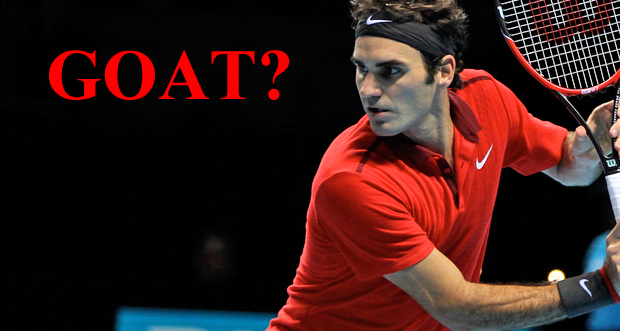
    Roger Federer

    Here’s another take on the Top 20 of all time – they’re always fun to talk about and never fail to get someone’s panties in a wad. The caveat is just that: it is a take and is not meant to be taken as fact or even how I see things. I was just looking at pre-ATP rankings for players and was surprised to see that players like Jack Kramer had finished (alone or tied) No. 1 six times. I decided to create a quick ranking system based upon two things and two things only, to determine true greatness:

    * Year-end No. 1 rankings: three points for solo; two points for shared
    * Majors won: two points for pre-Open Era Grand or Pro Slams; three points for Open Era Slams

    Now obviously, and again, this is a huge over-simplification. It doesn’t take into account a whole host of important data: Non-win results, other titles, non-No. 1 rankings, etc, not to mention it doesn’t differentiate Slams enough (e.g. the Australian Open in the 1970s was less competitive than other Slams). But it is a quick and dirty system and, I think, worked out pretty well.

    So here we go, the Top 20 players of all time according to one system. I’ve also included the points so you can see how close or far players were from each other.

    1. Roger Federer 66
    2. Rod Laver 62
    3. Ken Rosewall 61
    4. Pete Sampras 60
    5. Pancho Gonzales 56
    6. Rafael Nadal 51
    7. Bill Tilden 48
    8. Bjorn Borg 42
    9. Jimmy Connors 39
    10. Ivan Lendl 36
    11t. Don Budge 34
    11t. William Renshaw 34
    13. John McEnroe 33
    14. Fred Perry 31
    15t. Jack Kramer 30
    15t. Novak Djokovic 30
    17. Andre Agassi 27
    18t. Ellsworth Vines 25
    18t. Henri Cochet 25
    18t. John Newcombe 25

    Some interesting things to note.

    1) Whatever you think of the exact order, I think it has the Top 10 players rightly in the Top 10. Novak has a chance of sneaking in there and edging Lendl out in another year or two, but right now it works.

    2) To be honest, the accuracy of the next ten gets decreasingly reliable as I didn’t research absolutely everyone. But I think the next ten is mainly right, although maybe one or two players weren’t accounted for. It is really hard to research 19th century players. Also right off the edge of the list would be players like Stefan Edberg, Mats Wilander, Bobby Riggs, Roy Emerson, etc.

    3) While many (myself included) think Nadal has surpassed Sampras, this system likes Pete quite a bit more because of those year-end number ones. I think it makes a valid point.

    4) This system rightly honors perhaps the most underrated historical great player, Pancho Gonzales, who is underrated because his peak was in the Pro Slam era and he only won two Grand Slams, while winning 15 Pro Slams. Pancho was the best player of the 50s and finished No. 1 a record eight times.

    5) Yes, Roger Federer is No. 1. Sorry Roger Haters, just about any system is going to place him as the greatest of all time, or at least the greatest of the Open Era. Rafa may pass him, although according to this system Roger would have to remain stagnant (a distinct possibility) and Rafa would have to have five more Slam wins and/or year-end No. 1’s to tie him – a tall order, but possible. But for now I think Roger deserves his place.

    [divider]

    Click here to discuss “Top 20 Greatest Players of All Time” in the discussion forum.

    [divider]

    Cover Photo (Creative Commons License): Marianne Bevis
  • Barclays ATP World Tour Finals – Semifinals – Order of Play & Scores

    Barclays ATP World Tour Finals – Semifinals – Order of Play & Scores

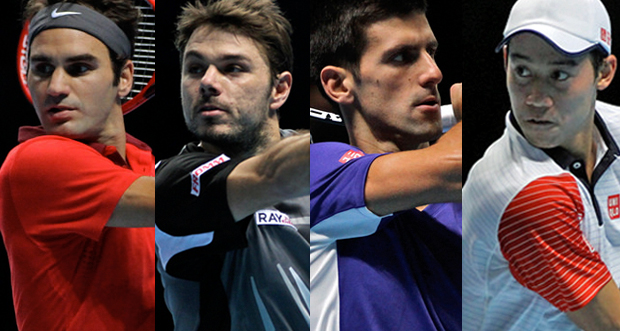
    Roger Federer Stan Wawrinka Novak Djokovic Kei Nishikori

    The semifinals of the Barclays ATP World Tour Finals will take place on Saturday, November 15. The afternoon session pits Novak Djokovic, who just secured the year-end No. 1 ranking, against the US Open finalist Kei Nishikori. The evening session features 17-time Grand Slam titlist Roger Federer, who will face his compatriot Stan Wawrinka, this year’s Australian Open champion.

    [Scores added as known. All times are local.]

    [divider]

    Afternoon Session:

    Doubles — 12:00 P.M.
    Dodig/Melo d Kubot/Lindstedt — 4-6, 6-4, 10-6

    Singles — 2:00 P.M.
    Djokovic d Nishikori — 6-1, 3-6, 6-0

    [divider]

    Evening Session:

    Doubles — 6:00 P.M.
    Bryan/Bryan d Benneteau/Roger-Vasselin — 6-0, 6-3

    Singles — 8:00 P.M.
    Federer d Wawrinka — 4-6, 7-5, 7-6(6)

    [divider]

    Click here to discuss the Barclays ATP World Tour Finals semifinals in the discussion forum.

    [divider]

    Cover Photo (Creative Commons License): Marianne Bevis

  • Barclays ATP World Tour Finals – Day 6 – Order of Play & Scores

    Barclays ATP World Tour Finals – Day 6 – Order of Play & Scores

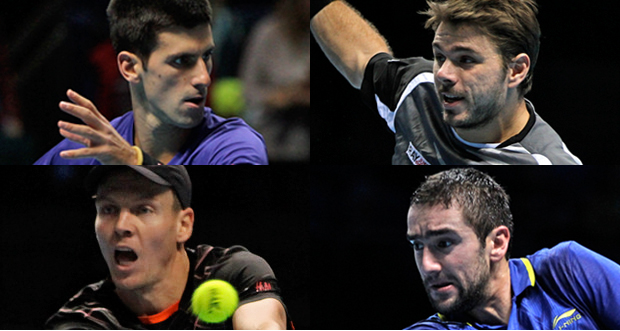
    Novak Djokovic Stan Wawrinka Tomas Berdych Marin Cilic

    Round robin play at the Barclays ATP World Tour Finals concludes on Friday, November 14. The afternoon session features World No. 1 and the defending champion Novak Djokovic, facing off against the Czech Tomas Berdych. The evening session will conclude with Australian Open champion Stan Wawrinka playing the US Open champion Marin Cilic.

    [Scores added as known. All times are local.]

    [divider]

    Afternoon Session:

    Doubles — 12:00 P.M.
    Kubot/Lindstedt d Rojer/Tecau — 6-5, 7-6(4)

    Singles — 2:00 P.M.
    Djokovic d Berdych — 6-2, 6-2

    [divider]

    Evening Session:

    Doubles — 5:45 P.M.
    Bryan/Bryan d Peya/Soares — 7-6(3), 7-6(2)

    Singles — 8:00 P.M.
    Wawrinka d Cilic — 6-3, 4-6, 6-3

    [divider]

    Click here to discuss the Day 6 matches in the discussion forum.

    [divider]

    Cover Photo (Creative Commons License): Marianne Bevis
  • Age-Related Discussion

    Age-Related Discussion

    Feliciano Lopez
    One of my favorite topics is the relationship of age and career performance, questions such as: What are the different phases of a career? When is the most common peak range? Are players peaking later now? Etc.

    For the sake of context and perhaps a taxonomy that would be useful for discussion, as I’ve written quite a few times before, I’ve posited that the historical norm has four general phases:

    Developmental Phase: Age 17-21. Player rises towards peak level.
    Peak Phase: Age 22-26. Player maintains highest level of career.
    Plateau Phase: Age 27-31. Player remains at a very high level, but slightly below peak, with gradual decline.
    Decline Phase: Age 32+. Player declines rapidly and/or retires.

    Again, these are the norms, or the averages if you will. Every player is different – but historically, those are the general ranges that most players fall into, or near to.

    Now what is interesting in recently years is that quite a few players seem to be peaking later, more in what would normally be their plateau phase. David Ferrer is an example, with his best years being 2012-13 when he turned 30 and 31. Despite beating Andy Murray today, Ferrer has showed signs of slowing this year, so he may be entering his decline phase – or he could simply be dropping to a plateau.

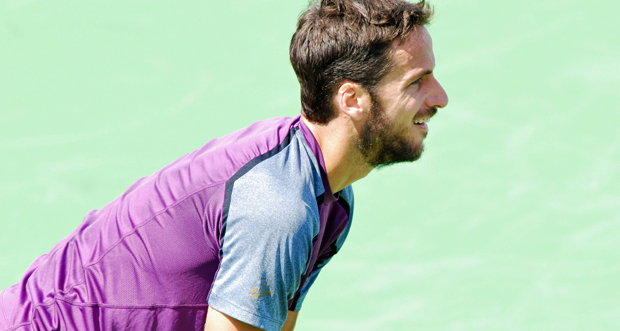
    And then we have the inspiration for this thread, Feliciano Lopez, who is 33 years old and possibly having the best year of his life. While his highest ranking was achieved a couple years ago in 2012 (No. 15), he’s at No. 14 in the live rankings now and has a good chance of having his best year-end ranking (which is currently No. 20 in 2011).

    And then of course there is Stan Wawrinka, who won his first Grand Slam at age 28 and is amidst his best year at age 28-29, and will probably finish the year ranked No. 4, better than last year’s career best of No. 8.

    Marin Cilic is still in what is normally the Peak Phase, but he won his first Slam just before turning age 26 – on the older side.

    And then we have young players like Milos Raonic and Grigor Dimitrov. Grigor is 23 years old, having his best year, but there’s also the sense from many that he’s another year or so away from his peak. Milos is also 23, turning 24 in December, and may or may not be at his peak.

    One thing that strikes me is that these outliers from the career norms are all non-elite players. Roger Federer’s career follows the averages quite closely, as does Nadal’s, Djokovic’s, and Murray’s – although it is still too soon to tell if and when they’ve entered their Plateau. Certainly it seems that Rafa and Andy have; Novak had his best year in 2011 at age 23-24, but I’d have a hard time saying that he’s not still in his Peak phase (that is, best year shouldn’t be equated with Peak phase; the best year usually comes within the peak).

    Those are just some examples. A few questions to consider/discuss:

    • Are players really peaking later?
    • If so, why?
    • Is there a historical precedent for players having their best years in their 30s (e.g. Ferrer and Lopez)?
    • Is it only “second tier” talents that are peaking later? (As it certainly seems like we’ve seen the best of Nadal, Djokovic and Murray)

    And so forth. Any thoughts?

    [divider]

    [divider]

    Cover Photo: Kiu Kaffi, Tennis Frontier Correspondent

  • Best Players Never to Win a Slam

    Best Players Never to Win a Slam

    Nikolay Davydenko David Nalbandian David Ferrer

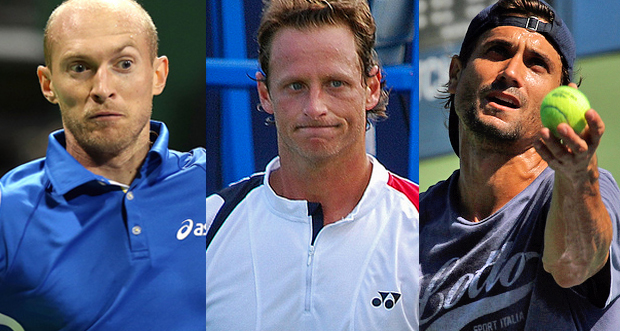
    A couple weeks ago there was some talk about who was the best player ever never to win a Slam – people were using an acronym, which I can’t remember. I don’t quite have the time or patience right now to put it into an article, but I thought I’d at least do some cursory research and share it with this forum.

    I tried to look at all players who had been in Grand Slam finals and/or been in the Top 5 during the Open Era – this gave me a group of just over fifty players.

    I then assigned points for Slam results and wins in other tournaments, using their total titles as a base and then adding points like so:

    Base: total titles
    Slams: 3 Final, 2 Semifinal, 1 Quarterfinal
    Other tournaments: WTF/Cup 3, Olympics 2, Masters 2, ATP 500 1

    This was problematic because data is limited on a lot of older tournaments, but I did the best I could.

    I then sorted the total rankings and gave tie-breakers to the highest career rank (in parentheses). Here’s the list of players with at least 20 points.

    52 David Ferrer (3)
    45 Nikolay Davydenko (3)
    44 Tom Okker (3)
    40 Marcelo Rios (1)
    40 Alex Corretja (2)
    37 Harold Solomon (5)
    35 David Nalbandian (3)
    35 Miroslav Mecir (4)
    35 Raul Ramirez (4)
    34 Brian Gottfried (3)
    33 Tommy Haas (2)
    32 Thomas Enqvist (4)
    32 Jo-Wilfried Tsonga (4)
    30 Andrei Medvedev (4)
    30 Tim Henman (4)
    30 Tomas Berdych (5)
    29 Todd Martin (4)
    27 Greg Rusedski (4)
    25 Henri Leconte (5)
    24 Robin Soderling (4)
    24 Guillermo Coria (5)
    24 Mark Philippoussis (9)
    23 Brad Gilbert (3)
    22 Guillermo Canas (3)
    22 Cedric Pioline (5)
    21 Magnus Norman (2)
    21 Fernando Gonzalez (5)

    That’s about half of the total players. Just missing the cut are players like Jose Luis Clerc, Sebastian Grosjean, Kei Nishikori, and Gene Mayer. There were two players who played in two finals each that I didn’t have enough information to adequately rank – Steve Denton and Kevin Curren – but from what I could tell, both have points in the low 20s at most.

    Now I’m not saying that this definitely states that David Ferrer is the greatest player never to win a Slam. One thing I noted is that more recent second tier players tend to go deeper into more Slams than in past eras; I’m not sure why this might be. But looking at second week Slam results, Tsonga has 10, Ferrer 15, Berdych 11. Compare that to similarly great Thomas Enqvist 3, Alex Corretja 6, Marcelo Rios 5, etc.

    There are also specialist players, like Tim Henman–who is one of the very best Wimbledon players never to win it. Poor time made it to 4 Wimbledon SF, and 4 QF.

    One thing that this list does help us do, I think, is narrow the choices – it gives us a “first round” of candidates, so to speak. While I’m not ready to commit to the “second round,” I’m thinking that it would involve a closer look at weighing total titles won vs. big titles, as well as Slam results, H2Hs against top players, longevity, etc.

    What do you think? Who was the best player never to win a Slam?

    On yeah, what about the worst player to play in a Slam final? By ranking I came up with two names: John Marks, who never won a title in his career but lost in the 1978 Australian Open to Guillermo Vilas. Marks actually lost the first set of his 1R match to 2nd seed Jose Luis Clerc, but Clerc had to retire after the first set. Marks’ highest career ranking was #44.

    The other is Chris Lewis, who lost to John McEnroe in the 1983 Wimbledon final. Lewis’ highest ranking was #46, but he did win three career titles. I’d give the “honor” to Marks.

    Click here to discuss “Best Players Never to Win a Slam” in the discussion forum.

    [divider]

  • Slam Results – Consistency and Era

    Slam Results – Consistency and Era

    Roger Federer Pete Sampras Bjorn Borg

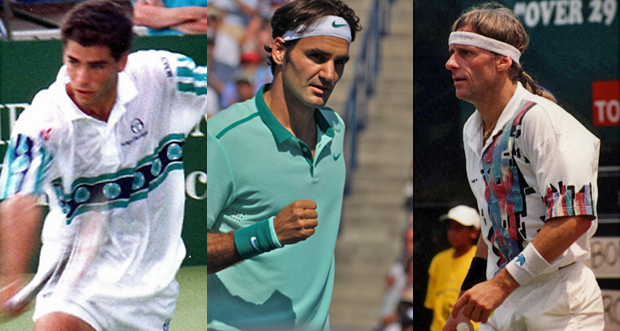
    I have often been struck by how amazingly consistent some of the contemporary great players are, and how it seems they are far more consistent in terms of Slam results than in past eras. I wanted to see if my hunch was correct, so I looked at all players who had won 4+ Slams in the Open Era (except for Ken Rosewall), plus Andy Murray added in the mix (as the player currently active with the best chance at 4+ Slams). I came up with a list of 16 players, who I then checked for a few statistics: total Slams, Quarterfinal appearances, % of Slams that were QF or better, Streaks of QF appearances at Slams, and years in which the player was in the QF of all Slams he appeared in (minimum 2 appearances).

    The results were somewhat surprising. First of all, when I compared the Big Four to the previous generation of greats, namely Sampras and Agassi, but also Courier, I found that the Big Four are far more consistent. Here are those players:

    QF% (longest QF streak, years of all QF)
    Murray: 62% (15, 4)
    Djokovic: 75% (22, 5)
    Nadal: 69% (11, 4)
    Federer: 69% (36, 8)
    Sampras: 56% (11, 2)
    Agassi: 59% (6, 5)
    Courier: 36% (5, 0)

    As you can see, the recent greats–in particular Djokovic and Federer–have been more consistent. Rafa’s QF% is the same as Roger’s, but his penchant for occasionally going out earlier has reduced his overall consistency. What really stands out for me in this list are two things:  Novak’s amazing QF%, and Roger’s ridiculous streak of 36 straight Slams, plus his eight years of making at least the QF in all Slams.

    Let’s dial back to another generation plus:
    Becker: 50% (5, 1)
    Edberg: 48% (5, 1)
    Wilander: 45% (7, 2)
    Lendl: 60% (13, 5)
    McEnroe: 58% (10, 4)

    As always, Becker and Edberg are neck-and-neck. Wilander was great in spurts, but bad in other years. Lendl was remarkably consistent in a very competitive era. Overall it seems the numbers are in line with Agassi and Sampras.

    One more jump:
    Borg: 78% (12, 6)
    Vilas: 39% (8, 3)
    Connors: 72% (27, 12)
    Newcombe: 55% (8, 2)

    Clearly Borg’s numbers are skewed by his shortened career. Connors’s numbers are surprisingly good, but we need to remember that in a lot of years he (and Borg) only played two or three Slams, which is easier to make it far in every appearance.

    So while it seems that the current group of greats are historically more consistent than most eras, there’s a range across the decades, so it doesn’t seem clear that the factors of the game today allow for greater consistency (the so-called court homogeneity), or if it simply could be that the current crop is just so damn good. I imagine its a combination of both.

    What do you think?

    Click here to discuss “Slam Results – Consistency and Era” in the discussion forum.

    [divider]

  • Serena Superb in Singapore

    Serena Superb in Singapore

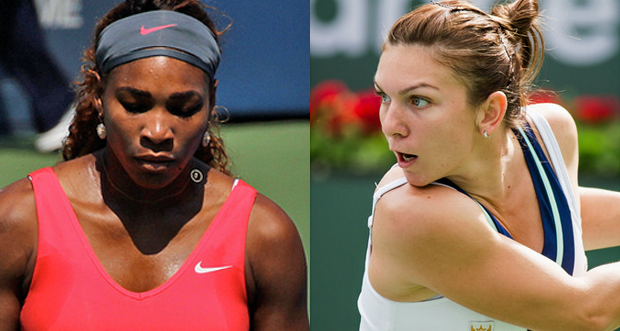
    2014 Singapore WTA Finals Winner – Serena Williams

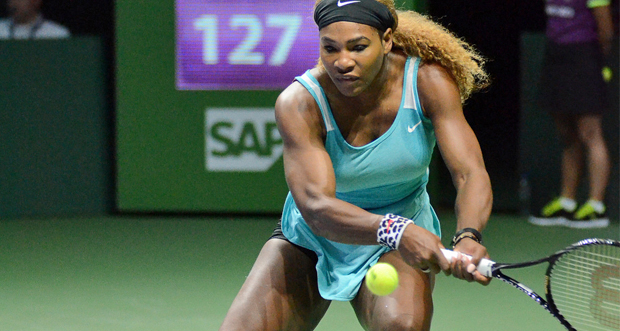
    The WTA Finals, as it’s termed now, featured world No. 1 Serena Williams against the top Romanian, No. 4 seed Simona Halep.  This was the first time Simona Halep made the trip to the year-end championship, whereas Serena was looking for her third WTA Finals title in a row.

    Williams needed just 1 hour and 9 minutes to defeat Halep with a score of 6-3, 6-0.  The match was close early in the first set but at 3-3 Serena took the next nine games to close it in a hurry.

    The inaugural event in Singapore, where the year-end championship dubbed WTA Finals was held this year and shall be for next four years, was more than just the competition between the top eight ladies in tennis; this was a spectacle of show, passion, mishaps, missed opportunities, triumph, and of course defeat.  It was obvious from the beginning this will be a championship like none before since it all started at a packed 21st Century resort’s shopping center.

    In addition to the regular competition, this year the WTA added mini-events titled “Rising Stars” and “Future Stars”, as well as legends matches, stretching the show to 10 days.

    Round Robin competition brought many surprises.  Both top seeds suffered losses and only one made the semifinals.  At the end, No. 4 seed, Simona Halep, and No. 8 seed, Caroline Wozniacki, led their respective groups.

    Although routed in straight sets by Simona Halep in the Round Robin stage in one of the worst defeats of her career, Serena Williams returned the favor by only allowing three games in the final match, and none in the second set.

    Williams will retain her No. 1 ranking for the remainder of the year and beyond.  Halep improved to No. 3.

    [divider]

    Click here to discuss the Serena Williams/Simona Halep final in the discussion forum.

    [divider]

    Cover Photo (Creative Commons License): VOXSPORTSdotNET

  • Singapore BNP Paribas WTA Finals – Day 7: Final – Serena Williams vs. Simona Halep – Order of Play & Scores

    Singapore BNP Paribas WTA Finals – Day 7: Final – Serena Williams vs. Simona Halep – Order of Play & Scores

    2014 Singapore Day 7- Serena Halep

    The BNP Paribas WTA Finals concludes today with the singles and doubles finals. Serena Williams (1) will face Simona Halep (4) in the championship match. In their round-robin encounter, Halep beat Williams 6-0, 6-2.

    [Scores added as known. All times are local.]

    [divider]

    Center Court —  4:00 P.M.

    Cara Black/Sania Mirza (3) d. Su-Wei Hsieh/Shuai Peng (2) — 6-1, 6-0

    Not Before 7:00 P.M.

    Serena Williams (1) (USA) d. Simona Halep (4) (ROU) — 6-3, 6-0

    [divider]

    Click here to discuss the Serena Williams/Simona Halep final in the discussion forum.

    [divider]

  • Singapore BNP Paribas WTA Finals – Day 6: Semifinals – Order of Play & Scores

    Singapore BNP Paribas WTA Finals – Day 6: Semifinals – Order of Play & Scores

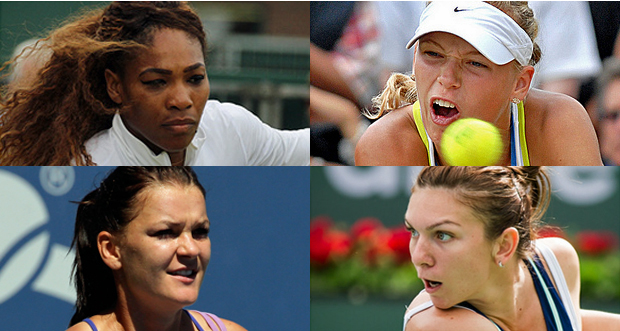
    Serena Williams Caroline Wozniacki Simona Halep Agnieszka Radwanska

    Day 6 of the BNP Paribas WTA Finals features the semifinals. First up are Serena Williams (1) and Caroline Wozniacki (8). They’re followed in the evening session by Simona Halep (4) and Agnieszka Radwanska (6).

    [Scores added as known. All times are local.]

    [divider]

    Center Court — 12:00 P.M.

    Su-Wei Hsieh/Shuai Peng (2) d. Alla Kudryavtseva/Anastasia Rodionova — 6-1, 6-4

    Not Before 2:30 P.M.

    Serena Williams (1) (USA) d. Caroline Wozniacki (8) (DEN) — 2-6, 6-3, 7-6(6)

    Not Before 6:00 P.M.

    Simona Halep (4) (ROU) d. Agnieszka Radwanska (6) (POL) — 6-2, 6-2

    Cara Black/Sania Mirza (3) d. Kveta Peschke/Katarina Srebotnik — 4-6, 7-5, 11-9

    [divider]

    Click here to discuss the Williams/Wozniacki semifinal in the discussion forum.

    Click here to discuss the Halep/Radwanska semifinal in the discussion forum.

    [divider]

  • Singapore BNP Paribas WTA Finals – Day 5 – Order of Play & Scores

    Singapore BNP Paribas WTA Finals – Day 5 – Order of Play & Scores

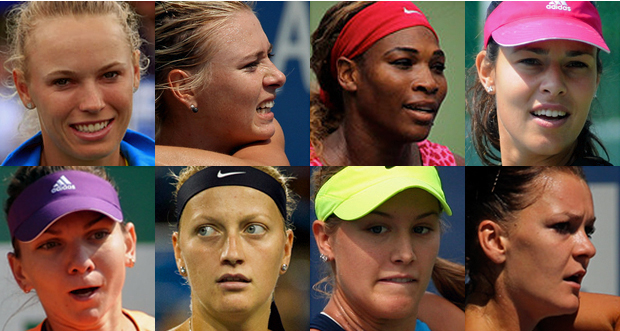
    Serena Williams Maria Sharapova Caroline Wozniacki Ana Ivanovic Simona Halep Petra Kvitova Eugenie Bouchard Agniezska Radwanska

    Round-robin action concludes on Day 5 of the BNP Paribas WTA Finals. Up first are Maria Sharapova (2) and Agnieszka Radwanska (6), followed by Petra Kvitova (3) and Caroline Wozniacki (8). The night session features Simona Halep (4) and Ana Ivanovic (7).

    [Scores added as known. All times are local.]

    [divider]

    Center Court — 1:30 P.M.

    Maria Sharapova (2) (RUS) d. Agnieszka Radwanska (6) (POL) — 7-5, 6-7(4), 6-2
    Caroline Wozniacki (8) (DEN) d. Petra Kvitova (3) (CZE) — 6-2, 6-3

    Not Before 7:30 P.M.

    Ana Ivanovic (7) (SRB) d. Simona Halep (4) (ROU) — 7-6(7), 3-6, 6-3
    Kveta Peschke/Katarina Srebotnik d. Sara Errani/Roberta Vinci (1) — 2-1 (Ret.)

    [divider]

    Click here to discuss the Day 5 matches in the discussion forum.

    [divider]