Blog

  • Has Rafa Improved Since He Was 19? / Jonathan Northrop

    Has Rafa Improved Since He Was 19? / Jonathan Northrop

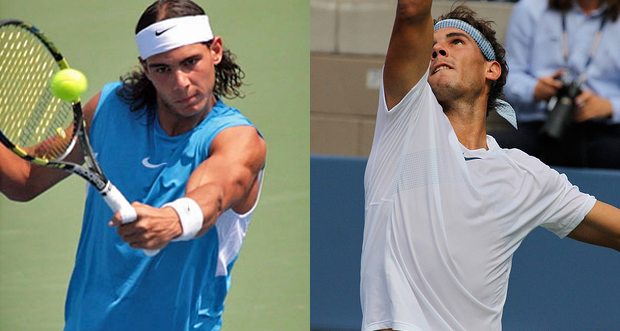
    Rafael Nadal

    The Spanish Meteor
    I realize the question must seem silly and/or rhetorical, but bear with me. As I was reading through some conversations about Rafael Nadal on the Tennis Frontier discussion forums and looking at his career statistics page on Wikipedia, as I often do when discussion of a specific player comes up, I noticed something about Rafa. It is well-known that he had a meteoric rise to the top at a very young age, without the usual long developmental phase that most players go through. He went from around No. 50 in the rankings for a couple years to No. 2 the year he turned 19 years old. Think about that for a moment – that would be like 19-year-old Nick Kyrgios being the No. 2 player in the world right now, or Borna Coric next year — or Grigor Dimitrov four years ago!

    [divider]

    Click here to discuss “Has Rafa Improved Since He Was 19?” in the discussion forum.

    [divider]

    But that wasn’t anything new. The thought, or question, that came to me is whether or not, or to what degree, Rafa has improved since that amazing 2005 season? I had noticed his pattern before, but I hadn’t given much thought to it, so I decided to investigate a bit and see what the data tells us.

    Developmental Patterns
    To start, let’s compare his developmental pattern to those of the other three of the four very greatest players of the last 25 years (I’m deliberately ignoring Andre Agassi because his developmental rise–while early–was extremely unusual and fraught with “off court” issues, and I’m not looking before this era because the further back you go, the less similar the game is).

    Player: Year-end Rank From Age 18-22
    Nadal: 51, 2, 2, 2, 1
    Federer: 64, 29, 13, 6, 2
    Djokovic: 78, 16, 3, 3, 3
    Sampras: 81, 5, 6, 3, 1

    Notice how all four were ranked roughly similarly at age 18, all between No. 51 and No. 81. But starting with age 19 we can pair Rafa and Pete on one hand, and Roger and Novak on the other. The former pair went straight from the latter half of the Top 100 to the Top 5. To put that in a current context, that would be as if Borna Coric–who will finish this year ranked No. 91–rises into the Top 5, or at least Top 10 next year. We can only hope, but it seems extremely unlikely.

    Roger and Novak, on the other hand, had a kind of “beachhead” year – Roger rising to No. 29 at age 19, Novak to No. 16. Actually, Roger had a second beachhead year, finishing his age 20 season at No. 13, and a “semi-beachhead” year at age 21, finishing No. 6. Roger’s rise to greatness was notoriously gradual, at least compared to other all-time greats. He didn’t win a Slam until just before his 22nd birthday; consider that Rafa won his fourth Slam just after turning 22.

    These rankings are, of course, merely a reflection of performance, so if we look at titles Rafa was extremely successful in 2005, winning 11 titles – the most of his career. And this wasn’t a lightweight title season: not only did he win his first of nine French Opens, but he also won four Masters tournaments.

    But those were surely all clay court tournaments, right? Actually, no. Of the four Masters titles, two were on hard courts: the Rogers Cup, in which he beat a 35-year-old Andre Agassi, 16 years older than Nadal; and the Madrid Masters, the indoor hard-court version that was replaced by the Shanghai Masters in 2009. So even in 2005, Rafa was able to perform at an elite level outside of the clay courts. This was further solidified in 2006 at the Slams. After he won his second French Open that year, he was going into Wimbledon with only two second-week Slam appearances, his two Roland Garros titles. But then he made it to the Wimbledon final and the US Open quarterfinal, cementing his all-surface elite status.

    Let us turn our gaze to winning percentage. Take a look at the four players, from age 18 to 27 (I stop at 27 because all four have played through that age, and beyond isn’t really relevant):

    Here we see four subtly, but still distinctly different developmental patterns. All jumped in performance level from age 18-19. But as you can see, Rafa was pretty steady from that point onward (and off the chart is 2014, in which he had an 81% – his worst since 2004, but still roughly within range of the rest of this chart). He fluctuated, of course, but whereas the others all had some variation of rise, peak, and plateau, Rafa’s pattern has been more up and down within an early peak-plateau range. Also, notice how the 2005-14 range has no winning percentages in the 84-87 range; it is either a “down” year of 81-83 or an “up” year of 88-91.

    Roger’s is a classic curve: a steady rise, high peak, and then descent to an up-and-down late-career plateau that continues to this day. Sampras was kind of a hybrid of Nadal and Federer: a quick rise, long peak-plateau, then decline. Novak has an interesting early plateau in his early 20s, and then a rise at age 24, his legendary 2011 season.

    Putting It All Together
    So what does this data tell us? First, what it can’t tell us are all the changes to Rafa’s game, whether we’re talking micro-adjustments or larger ones. We know, for instance, that his serve improved in 2010, probably his best overall year, but then has slipped again over the last few years. But the numbers don’t tell us about his real game, the sweat and focus and will that happens on court. But what it does tell us is that regardless of how his game has changed, his overall performance level has been very similar since breaking through as an elite player in 2005 at the tender age of 19.

    That said, there is another–perhaps more nuanced–narrative that should be brought forth, which is that while he was great from 2005-07, he was still “unfinished” and, in particular, learning to establish himself off clay. His 2005 winning percentage is inflated by the fact that he played 52 matches on clay, or 58.4% of his total matches, compared to 26 in 2006 (36.6%) and 32 in 2007 (37.6%). So while his overall winning percentage dipped, a lot of that was because of fewer clay courts (although interestingly enough, his record on hards was actually better in 2005 than 2006-07).

    To continue the narrative, Rafa was still developing in 2005-07 and then came more fully into his own in 2008 at the age of 21-22, when we saw a more “complete” Rafa. This was Rafa in his prime, finally and fully. 2009 saw two bumps in the road, one being injury and the other being Robin Soderling. Yet he regained his balance in 2010, having his best year of all. And then in 2011 Novak Djokovic had a season for the ages, and while Rafa was probably just as good as he had been the previous year, he couldn’t get around Novak. In 2010 Rafa was 2-0 against the Serb, but in 2011 he was 0-5. Now here’s where it gets very interesting: If we take those matches out of his record for both years, we get the exact same record. Take a look:

    2010 – with Novak: 71-10 (88%), without Novak: 69-10 (87%)
    2011 – with Novak: 69-15 (82%), without Novak: 69-10 (87%)

    In other words, Rafa was virtually the same in 2011 as he had been in 2010; it is just that Novak had his number. Rafa turned the tables in 2012 and they’ve been relatively even since, with Rafa having a slight edge at 7-6 since 2012. Aside from his rivalry with Novak, after his injury in 2012 Rafa rose again in 2013 and then struggled in 2014.

    In summarizing Rafa’s trajectory, we see a quick rise to elite status in 2005 and then a kind of plateau as he worked on aspects of his game, rising to the very top in 2008. From that point on, he was on a higher level of play, but suffered various setbacks that reduced his overall performance level and thus lend credence to the argument that he reached his peak level in 2005 and hasn’t improved since. But I think the answer to the original question is that yes, he has improved since he was 19 in 2005, although perhaps not as much as players like Roger Federer and Novak Djokovic, both of whom have followed more traditional “curved” career patterns.

    In a way, Rafael Nadal was like some kind of Mediterranean demigod, born (nearly) fully formed, (nearly) perfect. Yet like the demigods of myth, he has suffered hardship and challenges, and the end results fluctuated with life’s trials and tribulations.

    Addendum: Rafa’s Alleged “Decline”
    Rafa’s demise has been long-prophesied but never fulfilled. He has always managed to comeback, to rise again as if from the ashes and reclaim his status as one of the very best in the game, certainly the best at times. Yet we cannot ignore the fact that time catches up to us all. Rafa turns 29 years old next year and at some point, the gentle fluctuation of his career pattern won’t rise back up from a fall in performance. I am not saying that this will happen in 2015 – in truth, I don’t think it will – but we should be prepared for it.

    While we don’t know when it will happen, there might be signs beforehand. If you take one more look at the graph above you can notice that in Rafa’s career, there have been four dips, four “downward fluctuations” – in 2006-07, 2009, 2011, and one in 2014 off the chart. But as I pointed out above, the 2006-07 dip was mainly a matter of adjusting to a less clay-heavy schedule, so in truth the only downward turns were in 2009, 2011, and 2014 – his three injury-plagued years. And therein lies the key, and this is no surprise: Can Rafa remain healthy? If he can, I see no reason why he can’t remain on top for several more years. But if not, well, for those of us over three decades of age, we all know how it gets harder and harder to recover. We can hope, though, as fans of Rafa, fans of tennis (if not fans of Roger!) that we’ll see at least one more rise to the top from the great Spanish Meteor.

    Cover Photo (Creative Commons License): James Marvin Phelps / Marianne Bevis
  • Navratilova to Coach Agnieszka Radwanska

    Navratilova to Coach Agnieszka Radwanska

    Agnieszka Radwanska Martina Navratilova

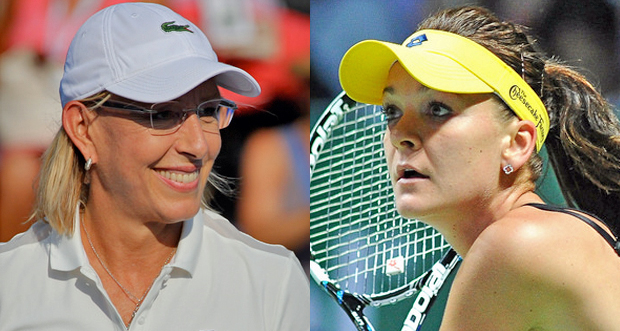
    World No. 6 Agnieszka Radwanska has hired 18-time Major champion Martina Navratilova to be part of her coaching team.

    Radwanska made the official announcement on Twitter: “So happy to announce @Martina as the newest member of my coaching team!”

    Navratilova then Tweeted this follow-up: “Am very excited to be working with @ARadwanska and her team:), should be a fun ride!!!”

    This will be Navratilova’s first endeavor as a coach, but she’s enthusiastic about it: “I did not sleep very well last night, thinking about getting back into match mode and the competitions. I am really excited about this opportunity to join Agnieszka’s team and work with Tomasz and it is going to be a fun challenge. I was delighted when Agnieszka asked me if I would collaborate with Tomasz and I can’t wait to get started.”

    [divider]

    Click here to discuss “Navratilova to Coach Agnieszka Radwanska” in the discussion forum.

    [divider]

    Radwanska echoed her sentiments: “I am absolutely delighted that Martina has agreed to help me and my team next season. She is my idol in tennis and I am honored we will be working together. Her achievements speak for themselves and I hope that I can learn from all her experience. My goal is to win a Grand Slam, so to have someone with Martina’s accomplishments in my corner is going to be hugely advantageous and give me a big boost. We are originally from a similar part of the world so we share an understanding about tennis and life, which I’m sure will translate into a successful relationship.”

    Cover Photo (Creative Commons License): Marianne Bevis / VOXSPORTSdotNET

  • Second Tier Players

    Second Tier Players

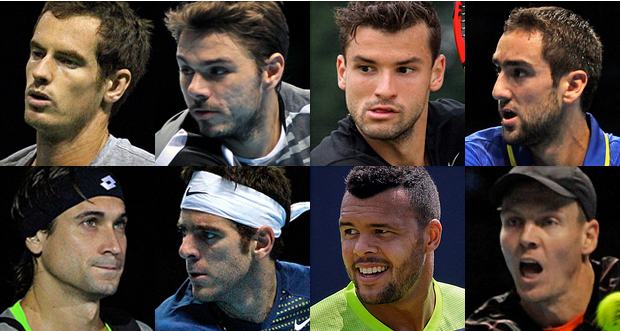
    Andy Murray Stan Wawrinka Grigor Dimitrov Marin Cilic David Ferrer Juan Martin Del Potro Jo-Wilfried Tsonga Tomas Berdych

    Most tennis fans, whether casual or serious, tend to follow the elites – the best players in the game who are perennial contenders for Grand Slams, ranked in the Top 5, and assemble resumes for the history books. Think Roger Federer, Rafael Nadal, Novak Djokovic, and, at times, Andy Murray. Serious fans of the game might extend their radar to the Top 100 and even a bit beyond, especially for long-time veterans and up-and-coming players. Your average serious fan – which I’d define as someone who follows the tour on at least a weekly basis and generally knows what tournaments are occurring, at least the bigger ones – probably could scan the Top 100 and recognize the names of most of them (perhaps another criteria for “serious fan”).

    Federer, Nadal, and Djokovic are household names – they have all been to the top of their sport and are all-time greats. Andy Murray is borderline, but after that it gets dicey. A casual fan of tennis knows the names Juan Martin Del Potro, David Ferrer, Tomas Berdych, Jo-Wilfried Tsonga, and, after 2014, Stan Wawrinka and Marin Cilic, and depending upon where one lies on the casual-to-serious scale, it starts tapering off after the Top 10. But those names – bonafide Top 10 players, but generally not Slam winners – aren’t all that well known among the general public.

    The purpose of this thread is to look at those “second tier” players – players who are not all-time greats, not multi-Slam winners, not No. 1’s, but still very good players. In fact, let’s define a few criteria for what I’m calling a “second tier” player:

    • No more than a single, “stray” Slam
    • No more than five “big” titles (Slams, Masters, World Tour Finals)
    • Never ranked No. 1

    What differentiates a second tier player versus a “third tier” and the rest of the pack? Some general guidelines might be:

    • Must have ranked in the Top 10 at least for a week, and/or
    • Must have won a big tournament
    • Must have at least five career titles
    • Multiple years finishing in the Top 20

    Who fits the bill among active players? Let’s take a look at the players, with a brief overview of their careers.

    [divider]

    Click here to discuss “Second Tier Players” in the discussion forum.

    [divider]

    David Ferrer

    David Ferrer is an interesting case, because on one hand he’s a bit of a tragic figure – he’s made it to the final of nine big tournaments (one Slam, one WTF, and seven Masters) and won only a single one, perhaps the weakest of the lot—the Paris Masters in 2012, and only then arguably because he didn’t have to face any of the erstwhile Big Four (his opponent in the final was Jerzy Janowicz).

    On the other hand, he’s a testament to hard work and thus is perhaps the definition of over-achiever. In other words, Ferrer has made the most of what he has and has come away with an impressive resume. He’s won 21 titles and finished in the Top 10 eight years in a row, the Top 20 ten years in a row, ranking as high as No. 3. He’s had his best two years in 2012-13, at the age of 30-31. In a way he’s as good as you can be without being great. There’s no shame in that.

    [divider]

    Juan Martin del Potro

    Of all the players on this list, del Potro might be the biggest “could have been.” A promising young player he finished 2008, the year he turned 20, at No. 9. Then, in 2009—at a time when the tour was dominated by two players, Federer and Nadal, with everyone else lining up to try to get a piece of the pie—he took the tennis world by storm by defeating Federer in the US Open final. He was not yet 21, and it looked like tennis had a new superstar, or at least someone to complete with Djokovic and Murray for “best of the rest.” After finishing the year No. 5 at the tender age of 21, the sky seemed the limit.

    Then, in an exhibition match in January of 2010, disaster struck: del Potro’s wrist began to hurt, and it kept on hurting. He entered the Australian Open with an ailing wrist, eventually losing in the fourth round to Marin Cilic. He then proceeded to miss nine months and only came back for a couple small tournaments late in the year, his ranking dropping to No. 258. He seemed healthy (or healthy-ish) in 2011, but wasn’t the same player. He did win a couple ATP 250 tournaments but could not make it into the second week at any Slam, although still finished the year No. 11. 2012 and 2013 saw further improvement, years in which he finished No. 7 and No. 5, respectively, but he could not quite match his 2009 glory. In early 2014 disaster struck again, and del Potro was out for most of the year, finishing at No. 138. We can only hope that “Delpo” will come back strong in 2015; he is only 26 years old and still in his prime, but he is clearly a brittle player.

    [divider]

    Tomas Berdych

    Berdych is another player with elements of disappointment to his career (see a pattern here?). The Czech rose quickly in 2005, winning his first, and so far only, big tournament – the revolving door that is the Paris Masters. Not to take that away from him, but it is worth noting that neither of the top two players in the game – Roger Federer and Rafael Nadal – played in the 2005 Paris Masters. Anyhow, Berdych finished that year at No. 24 and seemed poised to challenge for a place among the elite. Yet he stagnated, finishing the next four years in the No. 13-20 range, making the quarterfinal of only one Slam.

    Yet something seemed to click for Tomas in 2010 and, since then, he’s been one of the more consistent players on tour – finishing either No. 6 or No. 7 in each of the past five years, a span of time in which he’s made it to the second week (quarterfinal or later) in half of all Slams, once making the final – losing to Rafael Nadal in the 2010 Wimbledon, although not before defeating Roger Federer and Novak Djokovic.

    Berdych remains an excellent player and a fixture, for the time being, in the Top 10. But he does turn 30 years old in 2015, so the window is closing for him.

    [divider]

    Jo-Wilfried Tsonga

    It is easy to pair Berdych and Tsonga, for not only were they born in the same year (1985), but they’ve haunted similar territory in the lower half of the Top 10 for the last half decade or so, and their career accomplishments are quite similar, although with Tsonga’s win at the Canada Masters this year he’s pulled ahead a bit.

    Tsonga was a successful junior player, winning the 2003 Junior US Open over Marcos Baghdatis. He suffered through a series of injuries before rising quickly on the tour in 2007 and 2008, finishing that year at No. 6. For the last seven years he’s finished No. 13 or higher, five of those years in the Top 10. Tsonga has been deemed an underachiever; he’s got a big game, but doesn’t seem to have the big match mentality. Like Berdych he turns 30 next year, so the hourglass is about to turn.

    [divider]

    Stan Wawrinka

    The “Stanimal” was born the same year as Berdych and Tsonga and, if you look at his career through 2012, could be viewed as an underachiever and disappointment – yet as of this writing, he’s the only one of the Class of ’85 who has come away with a big prize. He rose to No. 54 in 2005, No. 30 in 2006, and then crept up to No. 13 in 2008, but floundered for a few years – looking more like a third tier and perennial Top 20 player, but only just grazing the Top 10 for a few months in 2008. But something seemed to click in 2013 – his results were more consistent as he regularly went deeper into tournaments, including his first Slam semifinal at the US Open and making it to the final of four tournaments, although winning only one, an ATP 250 (the Portugal Open). Stan finished the year at No. 8 after a not-embarrassing performance at the ATP World Tour Finals where he defeated David Ferrer and Tomas Berdych to make it to the semifinals where he lost to eventual champion Novak Djokovic.

    At the beginning of 2014 it seemed that Wawrinka was coming off a career year. He began the year well by winning the Aircel Chennai Open. But it was the Australian Open that proved the shocker: After defeating Novak Djokovic in the quarterfinals, and Tomas Berdych in the semifinals, Stan faced off against No. 1 Rafael Nadal. No one really gave him a chance, but he ended up defeating Rafa in four sets (it is easy to call this a cheap win for Wawrinka as Rafa was injured in the second set, but let us not forget that Stan won the first set and Rafa was well enough to win the third; certainly Rafa’s injury was a major factor, but the focus should be on Stan’s accomplishment). It was easy to consider that a fluke win, but Stan ended up also winning his first Masters, defeating Roger Federer in the Monte Carlo final and improving upon his 2013, finishing No. 4.

    What’s next for Stan? It is hard to imagine a quick drop-off, but it is also hard to imagine him repeating his 2013 performance – especially his Slam. But he’s likely going to remain a Top 10 player for at lest another year or two.

    [divider]

    Marin Cilic

    Talk about a surprising player. After a surge into the Top 10 in early 2010, after making it to the semifinals of the Australian Open at the age of 21, Cilic was erratic for the last few years, settling in as a third tier player. Then he was suspended for nine months (which was reduced), which seemed to serve as a wake-up call, or perhaps merely inspiration, as he rose quickly through the rankings in 2014, winning three minor tournaments before his surprising win at the US Open.

    Cilic is not the worst player ever to win a Slam, but there are better players in terms of overall career level, and thus is a good example of both how a single Slam does not equate with greatness, but also how tenacity can pay off. But he is a Slam winner and finished his second year in the Top 10, so is now a bonafide second tier player. It will be interesting to see whether he can maintain it.

    [divider]

    Just Missing the Cut: Richard Gasquet, Nicolas Almagro, Gilles Simon, Tommy Robredo, John Isner, Feliciano Lopez, Gael Monfils.

    You might quibble with my choices, but in my mind none of them are true second tier players. Some have vied for a spot in the second tier; for instance, Tommy Robredo finished 2006-07 in the Top 10, but for most of his career he’s been more of a third tier No. 20-30-type player. The same could be said for the others. Gasquet is an interesting one because in some sense he’s been the “gatekeeper” between the second and third tier for the last few years, or at least for 2012-13 when he finished No. 10 and No. 9. Gasquet would consistently beat everyone below him and lose to everyone above; previously other players like Janko Tipsarevic, perhaps Almagro, and before both, Fernando Verdasco, filled this role.

    Among this group, or at least those mentioned, the one who stands out as the “could have been more” (and perhaps still can be) is Gael Monfils. He is a player whose reputation and ability far exceeds his usual ranking, mainly due to seemingly being injury prone and perhaps a non-championship mentality. Monfils is a second tier talent with a third tier career–in a sense, the inverse of David Ferrer—and thus is the type of player who could surprise us and win a big tournament. The 2015 Paris Masters?

    [divider]

    On the Cusp: Milos Raonic, Kei Nishikori, Grigor Dimitrov, Ernests Gulbis.

    Kei in particular might deserve to be a second tier player by virtue of his No. 5 finish this year. He’s won six titles but consider that he has not yet won a big tournament (he made the final of both a Slam and Masters this year), nor has he finished in the Top 10 more than once. But if he finished in the Top 10 a second year in a row and/or wins a big tournament, he’s in.

    Similarly with Raonic and Dimitrov. It only seems a matter of time. With Dimitrov there may even be a chance that he becomes a lesser first tier player along the likes of Andy Murray, but the clock is ticking.

    [divider]

    Addendum: The Question of Andy Murray

    It is hard to feel bad for someone with two Grand Slam trophies, 31 titles overall, not to mention an impending marriage to the beautiful Kim Sears. Andy will forever be beloved in the United Kingdom for being the first British player to win a Grand Slam title in the Open Era, and the first since Fred Perry in 1936 to take Wimbledon. But Andy comes off, at least in the press, as disgruntled, surly, and forever unhappy with his standing. Just as Novak Djokovic was the third wheel on the Fedal bicycle for four years in a row, Andy has been the “best of the rest/worst of the best” for just about his entire career. Unlike Novak, Andy didn’t break through the players ahead of him and rise to No. 1. He did win two Grand Slams within one calendar year, being a true member of the Big Four for at least that year, but he couldn’t maintain it.

    That said, Andy Murray is no second tier player. He is a truly great player, the third greatest of a generation that has produced what should turn out, when all is said and done, two of the ten or so greatest players of all time in Nadal and Djokovic. If Andy were born ten years earlier and peaked in the weak era of the late 90s to early 00s, he would undoubtedly have many more Slams than two. But every player has a “what if” story, and in the end, Andy’s career is what it is – and not only is it not over yet, it has been a stellar one so far. My opinion is that Andy is the greatest player of the Open Era with less than four Slams – greater than Kuerten, Hewitt, Safin, even Ashe. (What I mean by “greatness,” in this context, is a combination of peak level and career accomplishment).

    In some ways Andy is the Guillermo Vilas of the current era. Vilas was born in the same year as Jimmy Connors and peaked alongside Connors, Bjorn Borg, John McEnroe, and, to a lesser degree, Ivan Lendl. That’s what I’d call a “raw deal.” Yet Vilas still managed to win four Slams and 62 titles and was ranked in the Top 6 for nine years in a row, but—like Andy so far—he never did rank higher than No. 2, despite arguably being the best player in 1977.

    Career-wise, despite currently stalling out in his Slam count, Andy is closing in on four-Slam winners Vilas and Jim Courier, who are the gatekeepers to the true elites of the Open Era. I’d say he probably needs at least one more Slam to join them, but still has the possibility of surpassing him. Wouldn’t it be appropriate if Andy finished his career with four or five Slams, and became the historical “best of the rest, worst of the best?”

    [Note: At some point I’d like to write a “Part Two – Second Tier Players of the Past,” but there are a few articles on the burner, so stay tuned.]

  • Roger Federer Secures Switzerland’s Historic Davis Cup Win

    Roger Federer Secures Switzerland’s Historic Davis Cup Win

    Roger Federer Stan Wawrinka

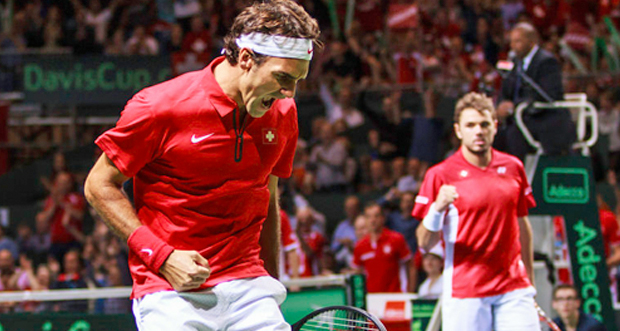
    With his 6-4, 6-2, 6-2 victory over France’s Richard Gasquet, Roger Federer secured Switzerland’s historic first Davis Cup win.

    Switzerland beat France 3-1: on Friday, Stan Wawrinka beat Jo-Wilfried Tsonga (6-1, 3-6, 6-3, 6-2), then Federer lost to Gael Monfils (6-1, 6-4, 6-3); on Saturday, Federer and Wawrinka teamed up to defeat the French team of Julien Benneteau and Richard Gasquet (6-3, 7-5, 6-4); and finally on Sunday, Federer demolished Gasquet (6-4, 6-2, 6-2).

    [divider]

    Click here to discuss the Davis Cup Final in the discussion forum.

    [divider]

    Cover Photo (Creative Commons License): O.Cartu.

  • 2014 Davis Cup Final – Day 3, Sunday, November 23: Order of Play and Scores

    2014 Davis Cup Final – Day 3, Sunday, November 23: Order of Play and Scores

    Roger Federer Richard Gasquet

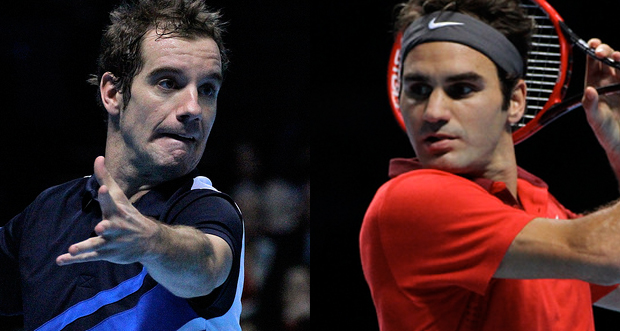
    The 2014 Davis Cup Final concludes on Sunday, November 23. The Swiss are up 2-1 after Roger Federer and Stan Wawrinka teamed up to beat the French doubles team of Julien Benneteau and Richard Gasquet. Now it’s down to the remaining singles matches: Federer will take on Richard Gasquet; if Gasquet wins, then Stan Wawrinka will face Gael Monfils.

    [Scores added as known. All times are local.]

    [divider]

    1:00 P.M.:

    Federer d. Gasquet — 6-4, 6-2, 6-2

    Wawrinka vs. Monfils [Not Played]

    [divider]

    Click here to discuss the Davis Cup Final in the discussion forum.

    [divider]

  • 2014 Davis Cup Final – Day 2, Saturday, November 22: Order of Play and Scores

    2014 Davis Cup Final – Day 2, Saturday, November 22: Order of Play and Scores

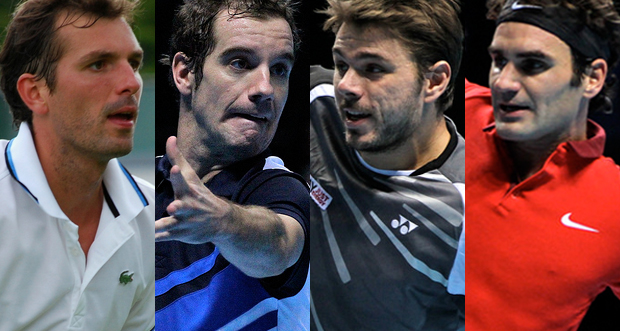
    Roger Federer Stan Wawrinka Julien Benneteau Richard Gasquet

    The doubles match is the focus of Day 2 of the 2014 Davis Cup Final. The French team of Richard Gasquet and Julien Benneteau will face off against the Swiss team of Roger Federer and Stan Wawrinka (who replace Marco Chiudinelli and Michael Lammer).

    [Scores added as known. All times are local.]

    [divider]

    3:30 P.M.:

    Federer/Wawrinka (SUI) d. Benneteau/Gasquet (FRA) — 6-3, 7-5, 6-4

    [divider]

    Click here to discuss the Davis Cup Final in the discussion forum.

    [divider]

  • 2014 Davis Cup Final – Day 1, Friday, November 21: Order of Play and Scores

    2014 Davis Cup Final – Day 1, Friday, November 21: Order of Play and Scores

    Roger Federer Gael Monfils

    Day 1 of the 2014 Davis Cup Final will feature two singles matches. First up will be Jo-Wilfried Tsonga, of France, vs. Stan Wawrinka, of Switzerland. They will be followed by Gael Monfils, of France, vs. Roger Federer, of Switzerland.

    [Scores added as known. All times are local.]

    [divider]

    2:00 P.M.:

    Wawrinka d. Tsonga — 6-1, 3-6, 6-3, 6-2

    Monfils d. Federer — 6-1, 6-4, 6-3

    [divider]

    Click here to discuss the Davis Cup Final in the discussion forum.

    [divider]

  • Federer Withdraws From World Tour Final; Djokovic Wins By Default

    Federer Withdraws From World Tour Final; Djokovic Wins By Default

    Roger Federer

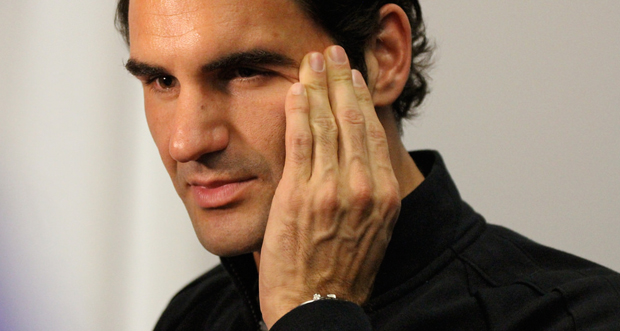
    According to Reuters, six-time World Tour Finals champion Roger Federer has withdrawn before the final, giving Novak Djokovic his third year-end title in a row.

    The tournament’s website has posted: “His opponent, Novak Djokovic, will play a pro set (first to eight) against Andy Murray. Murray will then team with John McEnroe in a doubles exhibition against Tim Henman and Pat Cash.”

    On court, Federer said, “Unfortunately, I’m not match fit to play the match tonight. Clearly I wish it wasn’t so. I tried all year to be ready for the [Barclays] ATP World Tour Finals, and I didn’t want it to end this way. I tried everything I could last night, also today – painkillers, treatment, rest, so forth, warm-up, until the very end – but I just can’t compete at this level with Novak. It would be too risky at my age to do this right now and I hope you understand.

    “I wanted to come out personally and excuse myself. It’s been a great week for me. I played some great tennis and I love coming to The O2 and to London, and there’s been so many great memories for me here. Congrats of course to Novak, who’s played an amazing season, and an amazing tournament here as well. I hope we can play some more great matches, hopefully next year.

    “Thanks to all you guys for making it special to come out and play tennis all around the world. I know you guys travel, as well, and spend a lot of money on tickets and so forth. We really, really appreciate it – me in particular. It keeps me going, it makes me tick, especially at this age. Hopefully, I can come back next year and get another chance to compete for the title here. So thank you very much and I’ll see you soon. I appreciate it.”

    [divider]

    Click here to discuss Federer’s withdrawal from the ATP World Tour Final in the discussion forum.

    [divider]

    Cover Photo (Creative Commons License): Marianne Bevis

  • The Bryan Brothers Reign Again in London

    The Bryan Brothers Reign Again in London

    Bryan Brothers Mike Bryan Bob Bryan

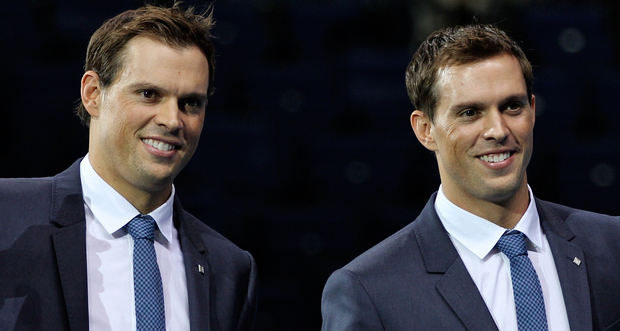
    Bob and Mike Bryan beat Ivan Dodig and Marcelo Melo in the final of the Barclays ATP World Tour finals, 6-7(5), 6-2, 10-7.

    In the first set, both teams were able to hold serve easily, barely losing a point on serve. In the tiebreak, Dodig/Melo managed to pull out a mini-break lead, and clenched the set when Mike Bryan returned a serve wide.

    At 1-2 in the second set, Melo quickly got down 15-40. They managed to save the first break point, but lost the game on a double fault.

    Serving to stay in the set, Melo again went down double break point, and this time Bob Bryan grabbed the set with a backhand volley.

    The super-tiebreak opened with a flurry of mini-breaks. Eventually the Bryans pulled out a 9-7 lead, and on championship point, Melo sent a lob long.

    This was the Bryan brothers’ fourth time winning the prestigious year-end championship. They had previously won in 2003, 2004, and 2009.

    [divider]

    Cover Photo (Creative Commons License): Marianne Bevis

  • Barclays ATP World Tour Finals: Final – Order of Play & Scores

    Barclays ATP World Tour Finals: Final – Order of Play & Scores

    Roger Federer Novak Djokovic

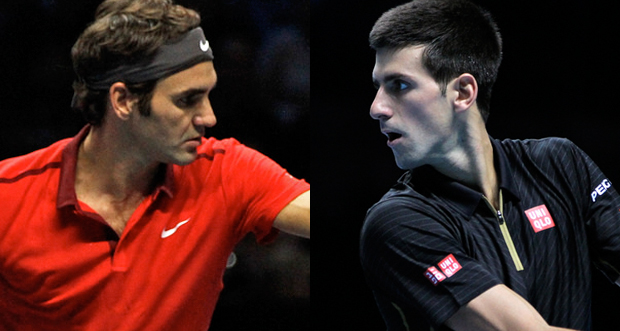
    On Sunday, November 16, in the final of the Barclays ATP World Tour Finals, World No. 1 and defending champion Novak Djokovic will face World No. 2 and six-time year-end championship winner Roger Federer. In the doubles final, the Bryan brothers will play the team of Ivan Dodig and Marcelo Melo for the title.

    [Scores added as known. All times are local.]

    [divider]

    Doubles — 3:30 P.M.
    Bryan/Bryan vs Dodig/Melo

    Singles — 6:00 P.M.
    Djokovic vs Federer

    [divider]

    Click here to discuss the Djokovic/Federer final in the discussion forum.

    [divider]

    Cover Photo (Creative Commons License): Marianne Bevis