Category: Tennis: International Access

Tennis: International Access is a Blog by Susan DePalma bringing together insightful articles, interviews etc. from around the globe.

  • Waiting For Rafa

    Waiting For Rafa

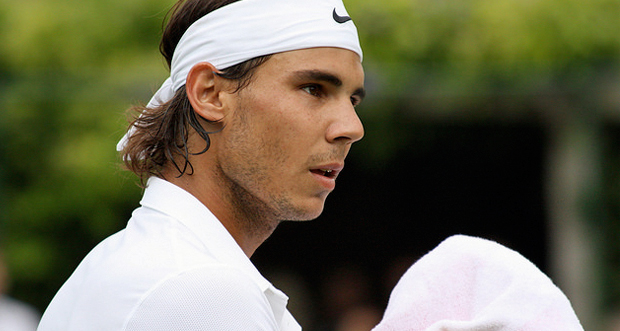
    Rafael Nadal

    Everyone is speculating about when Rafael Nadal will return to competition after being sidelined with a right wrist injury, which caused him to miss all of the North American summer hard-court season, including the US Open. Here are some updates from the Spanish- and Catalan-speaking press.

    Puntodebreak reported yesterday (September 10th, 2014) that he will play an exhibition with Jo-Wilfried Tsonga in Kazakhstan on September 25th, which would seem to indicate that he’s on his way to Beijing for the China Open, which begins September 29th.

    Terra Peru published an article two days ago saying that he’s training for the tournament in Beijing and Nadal says he hopes to play there. However, he also says that the doctors have told him to proceed with caution, because if he has a relapse of the injury, the recovery could be long, indeed.

    There is video from iB3 of him training without a brace, but not hitting using the right hand on the two-hander. This is from his local television station and appeared on September 4th. The commentary and interview are in Catalan. It says that the training goes a bit slowly, but still states that he hopes to play in China.

    [divider]

    Cover Photo (Creative Commons License): Marianne Bevis

  • Muguruza Revealed; Del Potro Practices; Mayer on Nadal

    Muguruza Revealed; Del Potro Practices; Mayer on Nadal

    The latest from Spanish-language press [divider]

    What you didn’t know about Garbiñe Muguruza

    Muguruza is getting a lot of attention after her second-round upset over Serena Williams, so it’s a good time to dig a little deeper. Born in Caracas to a Venezuelan mother and Spanish Basque father, she moved to Spain at age six.  Garbiñe, which means “Inmaculada” in the Basque language, became the Spanish Junior Champion at twelve. “I’ve spent my whole life training on clay, but my best results have been on faster surfaces because of my style of play.  My height [1,82/6’0] helps me be aggressive,” Muguruza said in 2013.  “I’ve studied Serena Williams, who has always been my idol.”

    This was prescient, as it was clear that Garbiñe had a game plan against Williams. She also mentioned that she admires Maria Sharapova’s “attitude, on and off the court.” “Immaculate” she surely was against Williams, and consolidated with a win today over Anna Schmiedlova of Slovakia. She’ll face another surprise winner, the French qualifier, Pauline Parmentier, in the next round. [divider]

    Del Potro Back on the Practice Courts

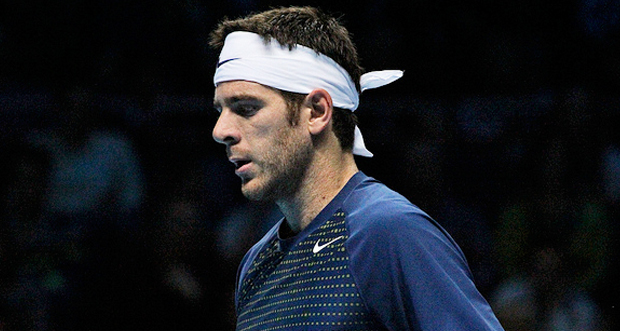
    After surgery on his left wrist last March, Juan Martin Del Potro is back on the practice court. He says he’s mostly practicing drives and volleys, because he’s still wearing a splint on the left wrist. Here’s a video of his practice session:

    [divider]

    Leonardo Mayer Hopes that Nadal is “Human” Tomorrow

    Mayer spoke to the Argentine press about his chances against eight-time Roland Garros champion Rafael Nadal tomorrow in the third round of the French Open. “I have the technique, but I’m not going to say it because [Nadal] might find out,” he said, laughing. (Mayer is 0-2 in their head-t0-head, and has yet to take as set off Nadal.) “I think it’s going to be difficult, but it can be done. And he’s human, at times.” [divider]

    Cover Photo: Cover Photo (Creative Commons License): Marianne Bevis

  • Flavia Pennetta – “Straight to the Heart”

    Flavia Pennetta – “Straight to the Heart”

    Flavia-Pennetta-dalla-racchetta-alla-penna_v_gdv

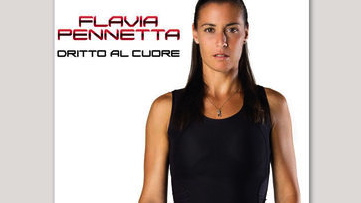
    Recent Indian Wells champion Flavia Pennetta has written about her trials and heartbreaks in the very honest and personal memoir “Dritto al Cuore” (“Straight to the Heart”), published last November by Mondadori.

    Asked why she wrote the book, Pennetta said,  “I was tired of the usual interviews, where I always said the same things: I talked about sport, which doesn’t have anything to do with who I really am. I come off as cold, less spontaneous. People watch me play tennis and they often had no idea how I got here, what was inside of me, how much I counted on my family …. I wrote the book so the people could really know me, in all my fragility and my emotions. So that they could know that we athletes are real people. I might have chosen not to reveal so much, but the book would have been less true.”

    She’s very frank about her relationship with Carlos Moyá, and how much their break-up hurt her. For Flavia, her relationship with Moyá “was one of the most important in my life.”  After three years together, and having discussed becoming a family, Flavia discovered that Carlos was cheating on her with the Spanish actress Carolina Cerezuela (with whom he is now involved and has a child). He admitted it only when it came out in the gossip columns. It was a hard blow for Flavia. She lost 10 kilos (22 pounds) in a short space of time, as well as all strength and motivation to get back on the courts.

    Pennetta describes their relationship as less than equally balanced. “Perhaps the one I lost was not Carlos, but me. He’s a bastard, what more can I say, but if I made a mistake it was in dedicating myself too much to him, at the loss of myself.

    “I had created a reality completely full of Carlos: our friends were Carlos’s, we lived where Carlos wanted to, when we saw family it was Carlos’s. We even spoke Carlos’s language. Carlos has a problem? I’m there. Carlos wants to go out to eat? Even if I’m dead tired, fine, out we go. Carlos is playing Playstation and he doesn’t want to go out with me to see a match, have dinner, or a drink? OK, I’ll stay home.”

    She also says of the relationship: “I thought that the rare times we were able to be together were beautiful, sharing our profession. I closed the door to Flavia and opened it to [being in a couple]. After three years I thought I’d arrived: a complete woman and ready to take on a family.”

    However, that all fell apart when Moyá’s infidelity came to light.

    “You feel pain, and you have to confront it, like everyone,” Flavia told the Italian magazine Grazia“But at a certain point, it’s not a private problem: the whole world knows. And the public face of pain is strained. People tried to pity me, and I couldn’t even defend myself against that. It was as if I’d lost joy in everything. I tried to anesthetize myself from encounters in life, so as not to invite pain.” She said she’d even lost the ability to feel physical pain.

    In difficult times, her therapist told her, “Draw a line in the sand. Move past it, then draw another one. Look inside yourself: you’ll see that the situation is not so bad. It’s you who wants to see it that way.” Pennetta told herself, “I’m twenty-five years old and I have a lot to give. Because of Carlos, I’ve distanced myself from Italy, from my family, from my friends. He was my passion, I gave myself completely, and I lost my balance. I have to get it back. I have to start over from there. I have no boyfriend, no home, no dreams, no future plans. The only certain thing is all the work I’ve done to get to a really good place on the circuit. I’ve played tennis since I was five years old, [been professional] since fifteen, for what? To lie on the couch suffering for some bastard? Never. Finally, the right thing. Finally me, finally my arm, or what was left of it, again free to move. Time to pack my bags. To go back to America to take back my life.

    “I was betrayed, but I betrayed myself [too].” As to the notion of loving again, she says she looked into the mirror and told herself, “Flavia, sooner or later the right person will come along, until then, you’re better off alone than with the wrong one!”

    She adds a note about the current state of her love life. “I’m in a relationship that’s [in the early stages], with a person I’ve known for a long time. But I’m not prepared to make it public. I’ve learned that I want a man who completes me, but without swallowing me up …. I don’t want to make that mistake again. Even if I come off as a bit of an asshole.”

    Flavia also talks tennis, of course:  “I live on airplanes: I’ve had to have my passport reissued in Tokyo because there weren’t enough pages for the stamps. The only advantage is … tournaments are nearly always played in heat. I live in a permanent summer.”

    Part of her resurgence came from her partnership with Gisela Dulko of Argentina. “[She] and I got dumped within a few months of each other, by two handsome tennis players who were all-too media-prominent.” (Dulko had been seeing Fernando Verdasco of Spain.) “We were suffering at the same time, we talked for hours and then figured it was just time to laugh. We decided to play doubles together, even getting to number 1 in the world.” Dulko/Pennetta won the WTA Tour Championships in doubles in 2010, and the Australian Open Women’s Doubles in 2011.

    Pennetta talks also about beating Serena Williams in an exhibition in Milan in 2011, saying that Williams is a player who “never loses concentration, who has no fear,” and calls the win a watershed for her career. However, she says the greatest pleasure was the Fed Cup win for Italy in 2010.

    In her book she writes: “At the introductions, I was white as a ghost, I couldn’t get over my anxiety. Before the match I was weeping with tension …. tight as a drum, I went out onto the court.” Italy was playing the US in the final. Pennetta won her opening match, and sealed the win for Italy in the fourth round.

    “At match point against Oudin I tell myself, ‘Don’t mess up, don’t mess up, don’t mess up ….’ I win and the Cup is ours. My father starts to cry in the stands. It’s only the second time I’ve ever seen him cry. And I, the woman who always exhibits perfect control, had a choice to make: I let go of a few big, fat tears before pulling myself together to flash my tried and true smile.”

    [divider]

    Excerpts from “Dritto al Cuore”

  • David, Rafa and Nole’s Excellent Adventure in South America

    David, Rafa and Nole’s Excellent Adventure in South America

    Adventure

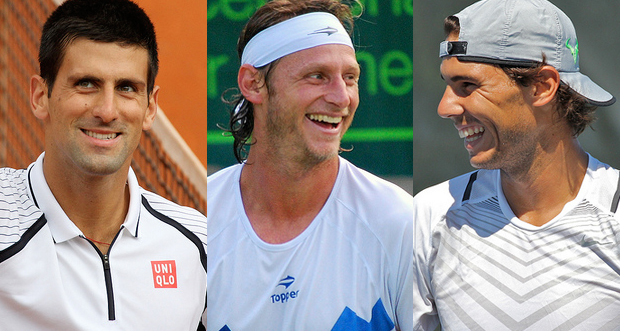
    This part of the off-season is about sending off David Nalbandian, and to a lesser extent, Nicolas Massú. Nadal and Djokovic, the world’s numbers 1 and 2, have joined in for exhibition matches and festivities. Here’s some of the news from the front in the Spanish-language press.

    The red-carpet was rolled out in Chile. The tennis players were received by President Sebastian Piñera. Nicolas Massú, who has also retired this year, was quoted as saying, “To have the honor of sharing this with Rafa, Novak, and David is a pleasure for anyone who cares about tennis.” Massú has now signed on as the Chilean Davis Cup captain. Chilean future hopeful Christian Garin was also in attendance. Also while in Chile, during a presser with Djokovic, Nalbandian, and Massú, Rafael Nadal offered to translate for Novak, and, hilariously, started restating what Nole said…in English. He had to be reminded that he was speaking English. He excused himself in Spanish, then saying, “At this point, I think English is my first language.” Likely it’s his first “press-conference” language, anyway.

    [divider]

    They also played some tennis in Córdoba, Nalbandian’s home town. Massú beat Nalbandian, 6-4, 6-2, and Djokovic got it over Nadal 7-6(3), 6-4. According to the Chilean press: “That never seemed like an exhibition, except for in the second set, where they joked about some fantastic points.” Otherwise the press in Spanish reckoned that they took it very seriously, for a “friendly.” The only break of serve came in the penultimate game of the second set. Interesting. I guess it’s not so easy for them to leave all the competitiveness aside.

    In his home town, Nalbandian also beat Nadal 6-4, 7-6(6).

    This is a particularly great point from the match:

    [divider]

    In between the exhibitions, Nalbandian and Nadal appeared together on the Susana Gutierrez show, a major talk show in Argentina. King David looked tanned and relaxed, and sartorially resplendent in a navy shirt, pink jacket, and red shoes. Nadal, according to the hostess, looked surprising tall. (“They always tell me that,” he said.) The conversation was light and full of humor. When asked about some of the longest matches they’d ever played, Nalbandian mentioned the six-and-a-half hour doubles match he’d played vs. Russia in Davis Cup. “Even I got bored,” said Nalbandian, to much laughter. Nadal said his was in Australia, lasting six hours, vs. Djokovic. “You must have won,” says la Susana. “No, I lost,” admitted Nadal, with a smile.

    When the hostess told David that everyone was heartbroken that he was retiring, he said, “Don’t be sad. Anyway, it was a great excuse to get Rafa to Argentina.” The two do seem to be very genial friends.

    You can see the videos of their appearance on the show here:

    [divider]

    Before everyone got back together in Buenos Aires, Nadal and Djokovic met in Patagonia for a hit-around with the glaciers as background. They took part in an exhibition on Friday, hitting on a barge in front of the Perito Moreno Glacier, near the southern extremity of Argentina. From Nadal: “I’ve just been in one of the most spectacular places that I’ve ever seen before, the Perito Moreno! Really amazing!”

    [divider]

    Novak and Rafa also got to hit goals in the Boca stadium in Buenos Aires. Not sure why River couldn’t get their attention, but:

    In the rematch between Nadal and Djokovic in Buenos Aires, Nadal prevailed, 6-4, 7-5.

    (Listening to Djokovic’s speech in Spanish, it seems clear he was coached by Rafa, because he used the Spanish idioms!)

    Nadal and Djokovic then combined to play doubles against Nalbandian and Monaco. By all accounts, they had a very good laugh. At one point, Djokovic threw himself to the ground so as not to be hit by Rafa’s serve. Nalbandian feigned arguments with the chair, and Monaco tried to hit his opponents at the net.

    Clearly, Nalbandian was well sent-off. The Chilean and Argentinian fans were greatly entertained, and Rafa and Novak seemed to have more-than-a-little fun. An Excellent Adventure, indeed.

  • Andre Agassi and Stefanie Graf on the Mysteries of Success

    Andre Agassi and Stefanie Graf on the Mysteries of Success

    “It is an illusion to think that setting goals and achieving them makes you happy.”

    By Stefan Wagner.

    Reprinted with permission from The Red Bulletinredbull-com-logo 80

    [divider]

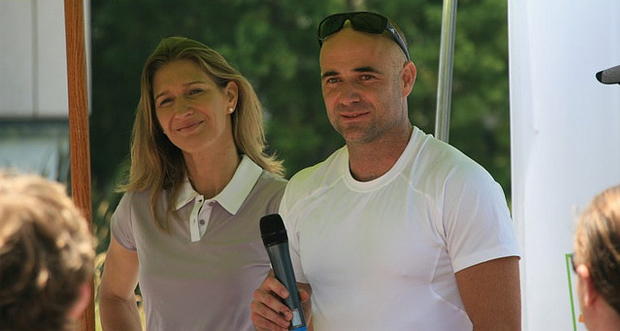
    THE RED BULLETIN: Together you’ve won 30 Grand Slam tournaments, earned fortunes, achieved worldwide popularity and business success.  You raise millions for children’s charities, look after young tennis players, have a strong marriage and are bringing up happy children.  Everything you touch seems to be successful, but what was it like after the end of your tennis careers?  Did you have to relearn what success is? A tennis tournament begins on a Monday, the goal is victory in the finals on Sunday:  that’s relatively straightforward.

    STEFANIE GRAF: And on the Monday you get the new rankings, which tell you where you stand. When I was still playing tennis, a friend once said to me, “You’re so lucky, you can say that you are the best in something.” Today I understand better than ever what he meant. This phrase provides a certain kind of security. A doctor or a therapist never knows exactly how good he really is, there’s always the question of whether or not he could be better.

    Was it easier for you playing sport than it was afterwards?

    SG: No, there were different questions.  For example, whether the success that you have achieved is actually what you wanted to achieve. For a sports player these questions go even deeper with age.

    ANDRE AGASSI: I have my own view of success.

    Which is?

    AA: I believe success is an illusion.

    But you won all four Grand Slams, over $31 million in prize money and were world number one. That is an illusion?

    AA: Success in itself, as an end in itself, is an illusion. Whether it’s in sport or a charitable foundation. Let me put it this way: in the last year, Stefanie has helped 1,000 children with her Children for Tomorrow foundation – and even if it were 2,000, there are still umpteen thousand out there that she can’t help.  Would you describe that as success?

    It would be crazy not to.

    AA: It wouldn’t, because you describe something as success that isn’t actually success. In tennis I learned that the final isn’t the goal, it can’t be. That would have meant, ‘Shit, on Monday it all starts again.’

    Following your logic, Roger Federer isn’t a successful tennis player.

    AA: He is, of course – but not because he’s won the most Grand Slam titles, but because he’s the all-time best, which he is beyond a doubt, and yet he still tries to develop. True excellence is the person who understands that success won’t come sometime in the future, but rather here, now. As soon as I understood that, a few important things became clear: it’s not what I do that’s important, it’s how I do it. I won’t accept not giving my best.  I won’t accept not wanting to be better.  Every day, I have to try to be better, no matter what the scoreboard says or what the world rankings say, or how much I’ve raised in donations.

    But you can’t separate ‘success’ from goals which are objectively set and attained.

    AA: Yes you can. In fact you have to. Try it! Set yourself a goal, work hard to achieve it – will it make you happy? No. It’s an illusion to think that setting goals and achieving them makes you happy.

    How much money have you raised in the last 15-20 years for your charity projects?

    SG: I concentrate on the necessary amount year by year. In total it’s millions, many millions.

    AA: For me, over the years it’s been almost exactly $175 million.

    And do you know how many children you’ve helped?

    SG: In the past year it was 1,000 children, which was our highest number for 15 years.

    AA: Recently we had 1,300 children per year in our academy.

    But you must regard that as success?

    AA: Success isn’t what comes out, but what you put in. Doing things completely or not at all. Caring about what you do. When it comes to charity:  invest yourself in your project. Find out how you can make something exceptional out of it. Does your fame help? Do you have to collect donations yourself? Will you have to spend time away from your children to give interviews? Then you have to do it with all your heart. When it comes to tennis: find out what you’re responsible for, and concentrate on that. Work on your fitness, on your stroke. Don’t lie to yourself and look for shortcuts. Success isn’t a result. Success is a way of living you choose for yourself.

    So success is subjective, not objective?

    SG: Absolutely.

    AA: When you see success as a goal, you’ll never be successful. Because it becomes like an addiction, you can never have enough. Never.

    But how do you measure success?

    SG: By how you feel when you go to bed at night.

    More and more tennis pros come to you in Las Vegas to learn from you.  What can you teach these players, some of whom are world class?

    SG: Actually sometimes it is about technique. Not the basics, sure, but there’s often room for tips.

    You once said that you could teach a young player in 10 minutes what you learnt in 10 years. What would happen in those 10 minutes?

    AA: There are a few things that are important to me, simple things. For example, that there is only one important point you play in life, that is, the next one. And that you should concentrate on the things that you can influence –you can control your attitude, your work ethic, your concentration. If it’s windy or hot or something aches or you’re tired from the match yesterday, then you have to accept it. I also try to teach young players that tennis isn’t a sport where you’ll get perfection. There’s no 100 per cent tennis. There is only the 100 per cent that is within you on the day. It’s all about bringing out your own 100 per cent.

    SG: I can’t put it as succinctly as Andre, I couldn’t fit it all in 10 minutes. Also I see my task a little differently:  I don’t give life lessons. I prefer listening to talking.

    Feature_AgassiGraf_EN-1 125

    In Open [Agassi’s gripping and brutally honest autobiography], there are descriptions of depressive episodes, even after winning Wimbledon and becoming number one in world rankings. Was the pain of losing really stronger than the joy of triumph?

    AA: Yes, and that still applies.

    How do you deal with it?

    AA: I’ve learned to enjoy every moment.  A good day with a major final, that’s a good moment. But you have to learn to value all the moments before that led to it. The moment of victory can’t be better than the moment of preparation. Learning that is pretty much a question of survival for a tennis player.

    SG: Andre’s right. The feeling you have after a victory fades so quickly. What we call success has a terribly short half-life.  You would have been amazed if you’d seen Andre or me after a major victory.  There was some relief, maybe, but no rejoicing or excitement. After a major victory there’s an emptiness, a routine, ‘Let’s go home, we’re done here.’

    That sounds really sad.

    AA: Oh, it is. Learning to see things differently is utterly essential. The day in the weight room, on the training court– that has to count just as much as finals day at Wimbledon. Not understanding that can be dangerous, because you make bad mistakes. So you think, for instance, that money is important, but money is nothing more than an expansion of opportunities for spending your time. Money can’t make you happy. When you’re happy with the opportunities that come with less money, money completely loses its significance. Money is a means to an end, not an end in itself. Exactly the same as what you’ve been describing as success: Success isn’t an end in itself. Success doesn’t mean winning.

    Not many world-famous sportspeople would say that. How does an athlete come to think like that?

    SG: Life is a good teacher, whether you’re a tennis player or not. You just have to ask yourself one question and answer it honestly: is the life I live the life that I want to live?

    Did you already have that attitude during your career?

    AA: At 27 I was number one in the world, I had won Grand Slams, I had taken drugs, I was divorced, I fell to number 141. I was unhappy.  And I had to make a decision: do I keep playing tennis or not? That was the moment when I thought, even if I didn’t choose tennis for myself, because my father did that for me, perhaps tennis will give me the opportunity to get my life together. To do that I needed some meaning in my life. The school I built was that meaning. And so tennis had a purpose, tennis allowed me to create and maintain something which is really important. Suddenly it was all completely simple:  tennis became a tool with which I could do something I really wanted to do.

    You said that fear is a great motivator.  Given your life story, what you suffered as a child through fear and pressure – did you really mean that?

    AA: The fear of losing is an important motivator. Fear of not making the best of a situation.

    It seems as if you raise your children without fear. With your charities you try to make the lives of others easier.

    AA: But the fear of losing stays. That doesn’t go away. Ignoring the fear doesn’t help. I have a fear of failing my children: that fear is good and right, because it keeps me alert.

    Is there such a thing as a life without fear?

    AA: We humans can love and hate, we feel joy and fear, all these emotions are within us. It would be wrong to try and turn one of them off. Quite apart from the fact that it would be impossible.

    Can you raise a child to be successful in the conventional sense of the word?

    SG: No.

    AA: But you can screw it up.

    SG: That’s something we’re really afraid of, that we screw up with our kids.

    AA: You can teach someone to put the scoreboard ahead of everything. But that would be wrong. Children have to learn to push themselves every day.  For themselves, not for anyone else, certainly not for a scoreboard. When you see the result on the scoreboard, that’s a bonus. But what’s on the scoreboard shouldn’t be the meaning of life. Life is bigger than any scoreboard.

    www.childrenfortomorrow.de

    www.agassifoundation.org

    Photography: Longines

  • War and Peace: Victoria Azarenka

    War and Peace: Victoria Azarenka

    By Stefan Wagner

    Photographs by Greg Funnell

    Reprinted with permission from The Red Bulletinredbull-com-logo 80

    [divider]

    VictoriaAzarenka_MG_0675

    The moment that reveals the most about Victoria Azarenka—over $20 million in prize money, the loudest scream in professional sports, girlfriend to the bizarre entertainer Redfoo—is this: Late Sunday morning, two bumpy hours by car outside the capital Minsk, in a holiday home that looks like a UFO damaged on crash-landing in the Belarusian forest, Victoria Azarenka is shuffling across the lobby, leading an older lady by the hand. This is her grandmother. For more than 50 years she worked as a kindergarten teacher, starting work at 5 o’clock in the morning. These days she comes here twice a year for three weeks’ rest.

    She only found out yesterday that her granddaughter was coming to visit, and she hurried to get some grapes and white chocolate. The old lady walks with a stoop. “Slowly, Babushka, slowly,” her granddaughter is saying. “We’ve got all the time in the world.”

    Victoria Azarenka’s racket is indistinguishable from those used on the men’s circuit: Grip size four, wrapped in a sweat-absorbing band, it handles like a birch sapling. Wilson delivers her rackets with a cup per Grand Slam title engraved on the inner rim. Her racket has been adorned with two cups since January, when she defended her Australian Open title and reclaimed the top spot in women’s tennis, ahead of Serena Williams and Maria Sharapova.

    VictoriaAzarenka_MG_4406

    The roles in the three-way bout for No. 1 are evenly distributed.

    There’s Williams, who has 16 Grand Slam titles to her name, and recently turned 31—she’s the grande dame of world tennis. Then there’s Sharapova, who transformed the women’s circuit into a catwalk and has been the best-paid female sports star in the world for the last eight years.

    And Victoria Azarenka? Victoria Azarenka wins. Has won, in fact, 28 out of 31 matches since the beginning of the year; injury forced her to withdraw from Wimbledon in the second round.

    Victoria Azarenka—Victoria as in “victory,” a name her parents consciously chose in 1989. Back then Belarus was still part of the Soviet Union. “There were six of us living in a small apartment, my brother and I, parents, grandparents. My father had two jobs, my grandmother would go to work at 5 o’clock in the morning, my mother worked until late at night—all so I could have the opportunity to play tennis.”

    Azarenka was 9 when her first coach gave her children’s tennis group the challenge of hitting a ball 1,000 times perfectly against the wall. The number was utterly unrealistic; the trainer simply wanted to know how her junior charges handled impossible tasks. Azarenka hit the ball 1,460 times.

    VictoriaAzarenka_MG_0596

    At 13 she won her first tournament in Uzbekistan, on the international under-18s’ circuit; there were no opponents left to conquer in Belarus. A year later, when she was already training in a camp in Marbella, Spain, she broke through to the women’s circuit. Kristin Haider-Maurer, an ex-pro who played against the 14-year-old at a minor tournament in Croatia, recalls a “complete beast who didn’t surrender a single ball, extremely ambitious, tenacious.” The more experienced Haider-Maurer was leading 3-0; Azarenka cried when they swapped sides. Then she emitted a scream of pure rage and ceded just one more game to her opponent, four years her senior: 6-4, 6-0.

    Sam Sumyk, a Frenchman possessed of an imperturbable serenity, has been Azarenka’s trainer for the last three years. When asked what it is that makes Azarenka No. 1 in the world-—her backhand perhaps?—he shakes his head. “It’s her professionalism that makes the difference. It’s fascinating how determined she is to sacrifice everything to success.”

    At the Australian Open they measured the volume of her screams whenever she hit the ball. It was just over 100 decibels. The threshold of pain for the human ear is 110 decibels.

    VictoriaAzarenka_MG_0565

    Some journalists are calling for a change in the regulations to stop female tennis players from screaming; Azarenka and Sharapova come in for particularly harsh criticism.

    “It’s unfair,” says one of Azarenka’s main rivals, Poland’s Agnieszka Radwanska. “It ruins the game,” says tennis legend Martina Navratilova. But for Azarenka: “It’s part of my game.”

    It’s early April and winter still has Minsk in its grip. Azarenka shouldn’t be here at all right now, but rather in Miami, where the world’s fifth-largest tennis tournament is taking place. Or in Arizona, where she moved at age 15 to live with the family of Russian NHL goalie Nikolai Khabibulin, who financed her training in the U.S. Or at least in Monte Carlo, where she has an apartment. But after she sustained an ankle injury in Indian Wells in March, she decided she wanted to recuperate at home, “and home will always be Minsk.” Convalescence combined with a family visit and training camp: Even when you spare an ankle, there are plenty of body parts left to torture.

    As Azarenka relaxes with some yoga in a gym in Belarus’s National Tennis Center, her coach Sumyk, agent Meilen Tu, physical therapist Per Bastholt, and fitness trainer Mike Guevara sip coffee outside the door. The top-flight entourage of a multimillion-dollar international star—two Americans, a Dane, and a Frenchman—presents a striking contrast to the surroundings: greenish neon light, worn floor, shabby ceiling panels, and faded black-and-white photos of Soviet tennis pioneers on the walls.

    VictoriaAzarenka_MG_4248

    Some parts of the National Tennis Center have been refurbished in the last 15 years; the courts have been modernized and windows insulated so you no longer have to scratch frost off from the inside. But the changing rooms, the corridors, the gyms—they still look the same as they did when the 7-year-old Vika encountered them for the first time. Her mother, Alla, had just started a new job, sitting at a glass booth in the reception area from 8 o’clock in the morning to 10 at night.

    On her first day at work Alla handed little Vika a racket. (Azarenka recalls an early Prince aluminum racket, a model that even some adults have difficulty handling. Does she still have it? “No. I was a crazy kid. I’m sure I smashed it up out of anger.”) Vika discovered a kind of gymnasium in the basement, with horizontal stripes on the walls and colorful lines on the floor. And for two years, day after day after day, she would hit tennis balls at that wall until her mother came to pick her up.

    No sooner has the international star finished yoga than Guevara is expecting her for an endurance session on the ergometer. To ensure they remain undisturbed, Guevara has dragged the machine to a dingy room at the end of a dark corridor. Azarenka laughs as she enters the room. She points to the wall: “That was my net.” And indicating a few colored lines on the floor, she says, “That was my center court.”

    VictoriaAzarenka_MG_0111

    The charms of Azarenka’s homeland are slow to reveal themselves. Belarus is located between Poland and Russia, between the Baltic states and Ukraine, and has just under 9.5 million inhabitants. The political power structures are just a little too entrenched to duck the description “dictatorial”: 2014 will mark President Lukashenko’s 20th year in power. The country’s favored foreign partners are Russia, Iran, and Venezuela.

    The soldiers you see around Minsk all wear comically outsized caps, and you almost feel that it is the effort of keeping the enormous things on their heads that gives these officers their slightly swaying, officious gait. It’s a cheerful image that stands in contrast to the kind of relations between authority figures and average citizens that ordinarily prevail here, which are rarely distinguished by humor. You can recognize an experienced Belarusian driver, for instance, by the webcam positioned behind the windshield and pointed in the direction of travel; they’re designed to document excessively arbitrary exercises of power, if not prevent them altogether. At intersections, large-format billboards depict a man lying in bed smoking, the image struck through with a thick red line: Smoking and drunk in bed is a popular cause of death in Minsk. The billboard is rendered in the kind of rudimentary pictograms used to denote Olympic sports, as if drunkenly smoking in bed were a Belarusian Olympic discipline.

    Belarusians generally avoid subjects like politics and social issues—call it post-Soviet fatalism. But they love talking about their land, the people, the traditions, the culture. Belarusian patriotism is proud, peppy, and omnipresent.

    VictoriaAzarenka_MG_4252

    Azarenka, for example, loves talking about fellow Belarusian athletes. Natalia Zvereva, for instance, who represented the Soviet Union at the 1988 French Open and made it to the finals; Max Mirnyi, a world-class doubles player; and world champion biathlete Darya Domracheva (“she’s incredible.”)

    Azarenka is also happy to discuss her role as a national heroine, a job she interprets in a very straightforward manner. When she drives through Minsk in her burgundy Porsche Cayenne, for instance, she isn’t saying: I’m better than you. Rather she’s saying: I am one of you, look at what I’ve achieved—and you can, too. “I would like to help raise the self-confidence of people here,” she says.

    And she’s particularly eager to talk about Ulyana Grib, 13, and Ekaterina Grib, who’s 12. They train in the same tennis center in which Azarenka grew up. “They could be very, very good,” says Azarenka. How good is very, very good? “They have something that is extremely rare. When I asked them what their dream was, they were shy and hesitant at first. And then they said: ‘Please don’t get mad, but we want to be better than you.’ That’s when I knew: I want to help these girls.”

    When she received a bonus for winning Olympic medals in London—bronze in singles, gold in the doubles along with Mirnyi—she sent the money to the young girls to help cover travel costs. She also trains with them, checks in on their progress by text, encourages them, cautions them, shares tips with them.

    VictoriaAzarenka_MG_3423

    “In Belarusian culture there are three basic rules,” says Azarenka. “You can’t understand us until you understand our rules. Number 1: Your family is sacred. Number 2: Do everything for the children. And the most important rule: Respect your elders.”

    In spring 2011, after Azarenka had already slugged her way to a spot on the fringes of the world elite, she lost her passion for tennis. “Training, torturing myself to fight for a tennis ball like I was fighting for my life: I didn’t want it anymore. I wanted to do something different. I asked my grandmother for advice. She listened to me, nodded, smiled, and said, ‘You have to find the thing which makes you happy. And then you have to keep doing that thing even when you’re just not in the mood.” That’s all she said. I went home, gave it some thought, and the next day I started training again.”

    Nine months later, Azarenka won the Australian Open and reached No.1 in the world rankings.

    Sunday afternoon back in the careworn UFO deep in the Belarusian forest. Inside the small holiday apartment, Azarenka sits next to her grandmother on the sofa; on the table in front of them are grapes, white chocolate, and Tolstoy’s War and Peace—grandmother’s holiday reading.

    VictoriaAzarenka_MG_0291

    War and peace: Which one is the real Victoria Azarenka?

    “There’s only one. She has two sides. If you want to win you have to fight. Don’t show weakness, don’t go soft, don’t be sensitive. Otherwise your opponent will use it to her advantage. During a match I’m a warrior.”

    How does one switch between war and peace?

    “It’s natural, like the lioness who goes out and fights. She will kill if she has to, but to her offspring she is the most loving mother imaginable. That’s life.”

    It’s Sunday afternoon and Victoria Azarenka is eating grapes and stroking her grandmother’s hand. As soon as her ankle will support her, she’ll go back out, scream to the threshold of pain with every stroke, and run down the tennis ball as if it were a matter of life and death.

  • On the Cherry Path — [An Up-and-Coming Player and His Unorthodox Coach]

    On the Cherry Path — [An Up-and-Coming Player and His Unorthodox Coach]

    Bild-im-Text_Fleisch27_Resnik_02

    Sepp Resnik turned 60 recently. Now the man with the most colorful reputation in Austria’s sport scene wants to prove that “world class” works differently than everybody thinks it does. He has tennis prodigy Dominic Thiem, recently turned 20, shower in a waterfall, carry tree trunks through the woods, and do sit-ups at midnight until he screams.

    By Stefan Wagner

    Photographs by Max Kropitz

    Originally published in the Austrian magazine Fleisch.

    [divider]

    Dominic Thiem really got to know his fitness coach Sepp Resnik on a March afternoon, by the banks of the Wiener Neustadt canal, an unadorned waterway in the dull outer districts of the town.

    Thiem (barely 20, running and hence out of breath): “Look, Sepp, over there, on the other side, there’s some sun on the meadow. That’d be a good place to work out.”

    Resnik (also running, but not quite as out of breath): “Good idea, let’s do that.”

    Thiem:  “But…”

    Resnik:  “But what?”

    Thiem:  “But… bridge?”

    Resnik:  “Who needs a bridge? That creek isn’t wider than five meters, and it ain’t deeper than two. You won’t drown.”

    Resnik stops, steam clouds forming before his mouth, strips down to his underpants, enters the water as if it’s a hot spring, and motions for Thiem to do the same.

    “What are you waiting for?”

    Doing the same takes a little time, first of all because Thiem felt like hesitating for a moment and second of all because he had a lot of clothes on, including a parka and a woolen hat. Then Thiem enters the water, toes first, with friendly encouragement by Resnik (“What’s taking you so long?”), and swims through the fresh spring water, fidgeting, gasping for air, only to commence doing all sorts of exercise, the kind of which usually gets you in shape for a military pentathlon, on the other side of the canal for an hour. The March sun is only slowly drying the clothes on Thiem. Afterwards, both swim back, get into their clothes, and Resnik says cheerfully, “Look, now we’re even showered.”

    Ferrari Mouse

    One could easily attribute the collaboration of Dominic Thiem and Sepp Resnik to a commentator’s joke. Resnik is a former gymnast, soccer player, judoka, track and field athlete, and military pentathlete (in 1984, he was the first Austrian at Hawaii’s Ironman Triathlon). Afterwards he made a name for himself in various ultra-triathlons, for example 1988 in Grenoble (13km swimming, 540km cycling, 126,6 km running); he got attention in 1994 when he circled the world with his bike. With two decades of management experience in the Vienna Go-Go Bar “Beverly Hills”, a marriage to a women who called herself Ferrari Mouse (and who married a woman after their divorce), projects like a world record in endurance downhill skiing, and participating in a nationally televised matchmaking show, he crossed over from the sports section to general news and the gossip pages.

    The increasing restraint among sports journalists in appreciation of Resnik’s achievements is based in certain doubts about the reliability of his statements. When a sports magazine published a major piece on Resnik’s ultra-triathlon, a letter to the editor urged for more critical research and enumerated how Resnik’s account of his crossing of the Gibraltar Strait meant he would’ve equaled the 100 meter freestyle world record over the whole distance. (“All accounts were correct. You have to take the current into consideration,” Resnik says even today, two decades later.)  The 300 daily kilometers in his 80-days-around-the-world bike tour also raise some skepticism about the credibility of the pipe-smoking Resnik: 300 km is double the distance of an average Tour de France stage, and Resnik was facing non-closed, public roads in countries like Pakistan or Iraq. (“300? It was 350!” says Resnik).

    On the other hand, Thiem is one of the world’s best tennis players in his age group, and along with David Alaba one of the only young Austrians on the radar in tennis, which is viewed as a global sport in ski-centric Austria. When Thiem was 17, he caught Ivan Lendl’s eye. Right on the court, Lendl called Adidas and recommended they get the boy a multi-year contract.

    Bild-im-Text_Fleisch27_Resnik_01

    Flashes of talent weren’t scarce for the young Lower Austrian in the following years, but overall, he seemed a little too delicate for pro tennis. His health was frail, he was often tired, and, on the court, wasn’t convincing as a competitor. He always looked as if he’d want to apologize for his thundering winners. When Dominic Thiem would get over himself and pump his fist after a hard-fought point, as is expected by a tennis player in Austria ever since Thomas Muster, he’d hold his thumb in a way that would have got it broken should he actually have used the fist to punch.

    Our locker is the trunk

    Günter Bresnik, 52, has been Thiem’s coach for eight years and when he’s asked about the most important feature of a successful tennis professional, he says, “Stress tolerance.”  Bresnik has been looking for years for the right fitness trainer for his protégé. There were even talks with Roger Federer’s staff member Pierre Paganini, or Bernd Pasold from the Red Bull training center, but somehow nothing worked out.

    Then, in the fall of 2012, Bresnik met Resnik. They knew each other from years before, got to talking, and Bresnik invited Resnik to visit them in the Südstadt training center, between a soccer stadium and the parking lot of a shopping mall. Resnik came, watched the boy for ten minutes, and said, “Günter, I saw everything. The boy can do anything from the hip upwards and nothing from the hip downwards.”

    About Christmastime of that year, they started working together on a trial basis, in idling mode by Resnik’s standards, which means 15 km runs in the park of the military academy in Wiener Neustadt.

    “We went running at midnight, so we’d be undisturbed. The first time, Dominic asked where the lockers are, and I told him: our locker is the trunk. Then he said that it’s dark. And I told him: what else do you expect at midnight? When I say right, you go right, when I say left, you go left. I’ve run 60.000 km in this park, I know my way around.”

    In the first workout together, Resnik counted 16 walk-breaks in 15 kilometers. “The boy’s pulse hit the roof.“  Two weeks later, it was two walk-breaks.

    Stalingrad et cetera

    Sepp Resnik is one of those people you can’t be formal with. And he’s a rather entertaining narrator, with strengths in the more associative form. When the conversation turns to the topic of sleep, because you ask whether Dominic Thiem would get enough to be on the court the next day after 15km at midnight, he’ll say, “For years, I trained by myself every night. Every evening I biked from Vienna to the Wechsel. [Note: 1.700 m mountain pass about 100km south of Vienna.]  And at 7.30 am in the morning I was here to wish the company a good morning.”

    But when did you sleep?

    “I didn’t.”

    But man can’t live without sleep… ?

    “I didn’t sleep for decades. And do I look bad?  There you have it.  I’m not wasting my time with sleeping anymore.“

    Sepp, with all due respect, but I can’t believe that. Completely without sleep, that’s not possible.

    “Says who?”

    Silence.

    “Now pay attention to what I’m saying. Thirty years ago my coach, Hans Schackl [note: the way Resnik refers to him as “der Schackl Hans” is equally casual and untranslatable] told me: Stop sleeping. From now on, we’re training every evening from seven in the evening to five in the morning, every day, and Saturday, Sunday are the races. I told him, I don’t get it, so he just handed me war literature. Stalingrad, mountaineering, wars, Solzhenitsyn, Gulag Archipelago. I read that, and then I knew, my whole life truly is a vacation.

    But the body’s requirements…

    “I don’t care about requirements. Whatever. You’d be amazed at what you’re capable of when the going gets tough. In the Battle of Stalingrad, people recognized the senselessness of their actions and said, I’m going home now. Then they went home on foot. Those are landmarks for me. You get that?“

    Hm.

    “You know, I’m from an industry where the establishment of boundaries doesn’t exist.“

    Sentences like this one showcase Sepp Resnik’s prominent chin. In the chin discipline, he’s world champion, leagues ahead of Michael Schumacher and Jay Leno.

    Headerbild_Fleisch27_Resnik


    For aerobic capacity

    Immediately after the tournament in Kitzbuhel at the end of July – Thiem beat Juergen Melzer and reached his first quarterfinal at the ATP level – the schedule called for a week of fitness training.  In pro sports, such timeouts from the everyday training and competition cycle are called a “fitness block“, where the core elements of Athleticism 101 are refreshed: strength, speed, coordination, endurance. Fitness blocks are usually held in gyms with mirrored walls, heart-rate monitor straps, lactate tests at the earlobes, ergometers, various colorful training utensils, hip-hop from the sound system, and a laptop to analyze all data on the spot.

    Resnik doesn’t like gyms. He also doesn’t like it when things get too technical: “What sports scientists say is the base, not the purpose.” He doesn’t care much for training schedules. He measures Dominic Thiem’s pulse by putting the finger at his carotid artery. “Right at the start I told Dominic, ‘We’re never going to a fitness center. We’re not lifting weights, we’re lifting tree trunks. Our fitness center is nature, where the best water and the best oxygen are. We’re getting our strength from where most of it is found.’” For the fitness block, Resnik organized a hunter’s cabin near Gutenstein in the southern parts of Lower Austria. “A friend of mine owns half the valley,” says Resnik, “so we got plenty of space.” And then they went back into the woods.

    “One, two hours uphill on a forest trail at first, just walking, not running. Then there’s a tree trunk, 25 kilograms. ‘Dominic’, I say to him, ‘take it on your shoulders’. Then we keep on walking, and I explain to him what this is good for:  shoulder girdle, upper body, aerobic capacity. Every five minutes, we switch, and I take the trunk. And so we keep on walking for another two hours.”

    There isn’t a drill that Resnik doesn’t do along with Thiem.

    “There’s a purpose behind that. Not for me, but for him. Because when he says that he’s hurting, then he looks at me. And he sees a sixty year old doing all the same things he does and whistling all the while.

    “One of the following days, I woke up Dominic before midnight, brought him to the parlor, and told him, ‘We’ll do sit-ups now. Forty-five minutes. And just so things don’t get too easy, we’re each gonna be holding a chair in front of our chest. In the dark, because I didn’t turn on the lights, so he’ll concentrate on the drill. At some point, he started screaming, because it hurt that much, and he said, ‘I can’t do it anymore, I can’t do it anymore!’ I reply, ‘I never want to hear that again, not ever, because what a sixty year old can do, a twenty year old has to be able to do three times.’”

    That morning, they showered under a waterfall.

    Doubt soothes me

    Sepp Resnik’s stories rise above the usual form of conversation in colorful arabesques. For instance, when it comes to the general topic of the extraordinary, it sounds like this:

    “Extraordinary goals require extraordinary measures. I always knew that. If you walk the path that everybody walks, you’ll only reach the goal that everybody reaches. So it’s a great honor to me when someone says, Resnik is a lunatic, a nutjob. Because that means I do something that the other one can’t comprehend. For me, doubt is confirmation. Doubt soothes me.”

    “I used to care about what other people think of me. By now, I don’t give a crap. I’m untouchable, because I don’t care about everyone else. If I want to yell something on court during a tennis match, then I’ll yell. Let people think whatever they want. At the final in Este [a Futures in Italy, which Thiem won in late August], when Dominic went up 1-0 in the first set, I yelled at him, ‘Attack! Attack him now! Break!’ And he went on to break.“

    “Money? It’s not an issue. I have what I need. I have my [Mercedes] 500 Coupé and my Jaguar, in dark blue with beige leather, just like I always wanted. I’m no fool, that’s for sure. I told them, I’d do the first year with Dominic for free. I’ll even pay for my gas, when I have to drive somewhere, and my food. That way, I’m free in what I do and how I do it. I can tell him: If you’re late once, by one minute, I’m gone. Forever. We’ll talk about money when Dominic gets to some cash. And the boy will get there, you bet he will. Did you ever listen when he’s playing? He’s the only one, the only one of them all, who’ll have you hear a bang when he strikes the ball.”

    “When I got back from a tournament with Dominic, the police called and told me that there’d been a burglary at my house. The whole place was messed up. So I get there, take a look around, and the policeman asks me if I need a psychologist, because they have professional assistance for victims of break-ins. So I tell him, ‘Listen. Next time, you’ll need a psychologist. Because I’ll have this whole place fixed, and then I’ll put in some booby traps. Just like I was taught at the army. And next time when someone comes and tries to mess with the door, there’ll be a cadaver lying around by the time you get here.’“

    Solzhenitsyn has to wait

    Last Christmas, Thiem was ranked outside of the Top 300. Eight months later – including two months in spring he lost due to intestinal surgery – he’d cut his ranking number in half. No younger player is ranked ahead of him right now. After making the quarterfinals in Kitzbuhel, he won the Futures tournament in Este and reached his first Challenger level final in Como. He barely missed the cut for the US Open in New York, and will have his Grand Slam debut with the pros in January at the Australian Open in Melbourne.

    When you talk about Resnik with Dominic Thiem , his father Wolfgang, or with Günther Bresnik, they all admit to having reservations initially, but they all praise his creativity, his dedication and enthusiasm. “He’s crazy, in a good way,“ says Bresnik, “and so he’s a rather good fit for our team.”

    Resnik’s approach to tennis is not clogged up with detailed knowledge, but that maybe is the refreshing thing about it. “Tennis is a ghetto,” he says. “As a tennis idiot, Dominic will never be a successful tennis player. In professional sports, everyone talks the same language. And there are cherries that you can pick and transfer from one sport into another. If you master that, to recognize the cherries and transfer them, then jumps in performance are rather easily possible. You just have to accept the experience people in other disciplines have achieved.” Resnik gave Thiem a book about Zen Buddhism, one of those cherries, “so he knows what he can do with his breathing,“ and another book about anatomy, “so he knows what goes where in his body.“

    And the cherry Solzhenitsyn?

    “Solzhenitsyn has to wait for now. But we’ll get there.“

    That out there is not a game , it’s a war

    You can tell rather easily by looking at him that Dominic Thiem doesn’t particularly enjoy grinding sit-ups in a clearing in the woods. And he doesn’t enjoy getting bugs from the tree trunks into his hair when he’s weightlifting. Still, he has come to appreciate the sometimes unorthodox methods of his fitness coach. And besides, Thiem likes Resnik. “He’s just a wicked guy,” he says.

    For his 60th birthday, Thiem even made him a special present. It was the day of his Futures final in Este, Italy. At some point halfway through the first set a spectacular rally brought both players to the net. After a body fake, Thiem wanted to put the ball past his duped opponent in slow motion, but the ball caught the tape, wandered a bit on the edge, before dropping back on Thiem’s side of the court. Thiem looked up to Resnik sitting in the stands, yelled, “Happy Birthday, Sepp!”, and thrashed his racquet. Thiem had never destroyed a racquet in a tournament before.

    “That’s my gift to you,” he yelled and grinned.

    If Resnik had a talent for emotion, his eyes probably would’ve watered. “Yes, that was a beautiful moment,” he says, “Because for my taste, Dominic was too well-behaved on court. I told him, listen, when you get out there, you’re going to be an animal. That out there is not a game , it’s a war. And now… such aggression… a great gift.”

    Ever since, he carries around that racquet like a trophy. “Should I get it? It’s out in the car!”

    Recently, Sepp Resnik got his very first mobile phone. “So I’m available to Dominic at all times.”

    So it goes, day and night.

    At the end of last year, Sepp Resnik quit working at the Beverly Hills, the Go-Go bar in Vienna, where he’d spent almost every night for the last twenty years. On November 30th, he’ll have his last day as a soldier. Then, he’ll be a retiree.

    He’s looking forward to that, the freedom: “From December 1st on, I’m on permanent vacation.”

    And then, almost as if it’s a slip, he adds, “I don’t even know if I’m still up-to-date. In my work with Dominic, I go back 40, 50 years and check whether the standards are still the same. Whether my standards are still up-to-date. This is now an examination on the highest level, how much 40 years of experience are still worth.”

    Can you say that the Dominic project reassures your own youth?

    “No. You can’t. The Dominic project reassures my life. That all parameters of my life are working.”

    Uh, imagine. Failure!

    “There is no failure” — there goes old Sepp Resnik again — “failure would only be proof that I made a mistake and have to change something.”

    And now to the topic of a grand finale:

    “On May 1st, I’ll leave from Rathausplatz, in front of 40.000 people. [Note: Masses actually do congregate on this central spot in Vienna on May 1st. This, however, has nothing to do with Resnik, but with the traditional Labour Day rally.] At the end of my career, one more time: In 80 days around the world. By bike. Get your stuff together, I told my helpers from back then, who’re all now 70, 80 years old, we’ll do it one last time. And if someone has doubts: just come along. Everybody is invited. On May 1st, we’ll ride out of Rathausplatz, turn right, and 80 days later we’ll be coming back, from the left.”

    Which course?

     “Same as always. Our regular course.”

    Right, that would be…

    “Vienna, Hungary, Romania, Bulgaria, from Istanbul through Turkey, through Iran …“

    It’s not very pleasant there at the moment, supposedly.

    “I’ve ridden through war before, that doesn’t matter. Then on through Pakistan, Balochistan, India. We’ll pack up everything at the embassy in New Delhi, then we’re gonna fly to Australia, Cairns, 4.700 kilometers down along the coast to Sydney, then Hawaii, 600 kilometers around the main island for nostalgic reasons, on the plane to Los Angeles, then across Albuquerque, Pasadena, Washington DC, by plane to Lisbon, then down south via Cadiz, Marbella, up towards Barcelona, Genoa, to the left up into Switzerland, Locarno, Feldkirch, and back home to Vienna.”

    “Yes, so it goes,” he says, “day and night.”

    [divider]

    Translation by Tennis Frontier moderator johnsteinbeck.

    Our thanks to Stefan Wagner, Max Kropitz, and Fleichmagazin for allowing us to reproduce their article here.

    [divider]
  • Del Potro: “I Dream More About Football than About Tennis” (From: La Nacion)

    Del Potro: “I Dream More About Football than About Tennis” (From: La Nacion)

    Juan Martin Del Potro in a feature interview from La Nacion Revista.

    [divider]

    He still believes that his destiny was to be a soccer player, not a tennis player.  Although he travels the world, he always comes back to Tandil, to his parents’ home, where his childhood bedroom is exactly the same.  At 24, the Argentinian tennis #1 is still just a big boy.

    [divider]

    Translated from: “Sueño más con el fútbol que con el tenis” (La Nacion, August 11, 2013)

    [divider]

    Click here to discuss Juan Martin del Potro with fellow tennis fans in our discussion forum.

    [divider]

    Juan Martin Del Potro doesn’t lean over to shake your hand, he bends in half.  He’s 24 now, but it’s been that way for some time.  As a kid, when he played football in Tandil, parents of kids from the other team would demand his birth certificate, as of that of another teammate, because they hit the ball so hard, scored goals, and showed up so many other players.

    The Tennis Club Argentina is behind the Planetarium, just past that giant scoop of metallic ice cream.  The winter sun hits the white chairs in the ‘incubator’ of a main hall to blinding effect.  Coming off a court in the far distance, a man appears surrounded by a bunch of boys.  They head toward the ‘incubator.’

    “Hello.  Can you wait while I take a shower?” Juan Martin Del Potro asks from somewhere near the top of his 6’6″ height.

    The “boys” are adults and children, [it turns out.]  Some stood no taller than his elbow.  None higher than his shoulder.

    Certainly, Juan was good at football.  Playing for Independiente de Tandil, at 9, at 11, sometimes at 8 or 5, but always in front, on the attack. [Translator note:  I don’t understand enough about football to know what that means, so it’s a literal translation.]  He played a two-man offense with a  much smaller, but talented and fast teammate.  Like Guillermo-Palermo at their best, he remembered.  Once, arriving at the club early to practice and needing to do something to kill time, he picked up a racquet.  Tennis was, at that time, just a way to pass the time when he couldn’t do what he wanted to do, which was play football.

    When he was 12, there was a South American tennis tournament and a football national to be played at the same time.

    “But in Córdoba.  The tennis one was in Brazil, and I’d never flown in an airplane.  I went on the plane, and went for tennis,” he said.

    * What do you remember about that first trip?

    “I got the last seat.  There were 3 or 4 of us traveling together.  It was my first plane ride.  I really didn’t know what to expect.  For me, to be flying and to be able to see everything from above was the most impressive thing.  The noise of the engines, to look out onto the wing, that was spectacular.”

    He won the tournament.  And he was awarded the prize for best player in South America.  His coaches went crazy and spoke to his parents, because they all believed he had a better chance going with football than shooting for a tennis career.  It was coming time to decide because Juan was going into high school playing both.

    Then it became clear.

    At 16, he shot up in size: his muscles and his arms grew at such a rate it made him awkward.  He says that in football it was a disaster; in tennis [less so.]  He wondered what was happening.  His adolescent body was betraying him.

    In 2008, Del Potro was 19 and he won 4 tournaments in a row.  He played for Argentina in the Davis Cup final [against Spain] – (he had won the 5th tie in the semifinal against Russia, after Nalbandian, surprisingly, lost the 4th.)

    He was a kid reaching for the stars.  Also, a teenager with a fresh mouth:  “We’re going to take Nadal’s underpants out of his ass,” which he later apologized for.  The final came like good movie-popcorn: covered in caramel, but also with unpopped kernels, the kind that break your teeth:  Nalbandian – Del Potro.  Eyes were cut at Juan Martin because he chose to play hurt in Shanghai, a week before the final against Spain.

    And we lost.  In Mar del Plata.  Del Potro lost a tie, and then insisted that he couldn’t play another because of injury.

    A year later, he won the final of the US Open by defeating Roger Federer and found himself in the top 4 of the world rankings.

    * The injury to the wrist; that says it all.  Did it take away your drive to play tennis?

    “The truth is, yes.  I was injured, sad, went through several months without a diagnosis, going from doctor to doctor.  In the end, a lot of things were said that weren’t true. (Ed.: That he had tested positive for doping.)  Everything they said was too much.  After 3 months, I went – I don’t know.

    “I had just won the US Open, just gotten to #4 in the world, everything was in place to push to be #1 and suddenly, a situation I couldn’t have imagined.  But, OK, I hit a big bump in the road, and it has not only helped my tennis, but my life.  I’ve realized who is important to me and who isn’t.  My heart friends, my family, my team – the ones who care about Juan as a person.  In what we do, it’s hard to have your feet on the ground and realize that at the same time.  It’s like you’re on automatic pilot and everything goes by really fast.  Franco [Davin, his coach], Martiniano [Orazi, his physio], and my doctor went almost a year without working.  But they stayed with me…I value that hugely.  Now, we’re more united on a human level than a professional one.

    He was supported by family, friends, trainers, and the doctor who finally operated on him.  He didn’t [go into therapy].  He was sure that guidance came from above and that he would play tennis again.

    “There were days I woke up and thought: ‘What if I never pick up a racquet again?’  In those moments I appreciated my Mamá, who insisted that I finish high school, so that I still had other options.

    “Other options” would have been architecture.  “Mamá” is Patricia, literature professor, and “Papá” is Daniel, a veterinarian.  But not the [precious city-variety]:  Juan was born in Tandil, and the animals don’t get around much on sidewalks.  Following his dad in his work, which he did, meant going into the countryside.

    * When you say you’re guided from above, do you mean your sister?” (Ed. She died in an accident.)

    “Yes, her, and God.  My sister is very important to me.  I give her a gift in every match, the signal.  My family and me, we don’t like to talk about this, but it’s very special.  I know that she looks after me and guides me, and this gives me strength.”

    Aside from his astonishing height, there are other things that are difficult to comprehend.  How can he be 24-years-old and a Springsteen fanatic?  Franco Davin, his coach, is standing 6 feet away, against a fence.  He’s talking to another man the way that men talk imperfections in a car.  One always has a hand on the roof, the other is watching the whole thing with complete concentration.

    Davin made him a Springsteen fan, showing him a DVD of a live concert one night during a tournament.  Dinner, DVD: match won.  Next day, same: match won.  And again.  Juan bought the DVD, and then another.  And then he went to Wembley to see him live.

    “I stood in line and everything.  Fantastic.  I groove on his music.”

    Some of his expressions seem outdated – “I groove on his music” — and others seem out of his reach. He often says he’d like to do the things that a 24-year-old does.  The fact that he has no girlfriend hangs in the air.  He’s not in a hurry to talk about it.  As when asked if libido gets in the way of the most important thing: friends.

    He brings friends up every three questions.  For example, Ramiro…is waiting for the interview to be over so they can drink mate together.  Like Juan he’s waiting to do things that aren’t allowed because he’s a professional athlete.

    “I eat a lot of chocolate.  And cake, and ice cream.  Not so much dark chocolate, but white, and ‘chocolate en rama,’” [an Argentinian specialty] he says, and seems to be eating it in his imagination.  “My favorite dessert is chocolate mousse.  My mother’s is delicious.  My grandmother’s, too.  I can eat it now, but not very often.”

    * How do you explain to others what it means to be Argentinian? How can you explain Del Potro – Davis Cup?

    I understand the people here.  I know it’s hard to make everyone happy with what I decide.  I’ve been playing Davis Cup since I was 17, and I love it.  But, hey, this year was a really complicated decision.  I felt that this was an opportunity to try other things, look towards other goals, knowing that some would not agree with my decision, while others would.  There are a lot of people who would like to see someone try to be the #1, which Argentina has never had, and others who would like to see us win Davis Cup.  It was a difficult choice to make, but it was very considered and I’m confident in it.  It might turn out well, it might not.  As to the public, I can only be grateful.  In the streets, in the club, in Tandil, they’re all fantastic to me.

    * But in the end, isn’t Del Potro and the Davis Cup “a thing?”

    “Anyone can say anything when they aren’t talking to you face-to-face, just via social media.  I’m not against it, but here everyone wants an opinion about everything.  That’s how we are.  I love being Argentinian, I love our way of life, we are very passionate.  When I go to a tournament abroad, I don’t want to say that others exactly envy us, but they do say they wish they had our ‘style.’  Recently, at Wimbledon, I was treated like a local, which seemed crazy, against the world #1. (Ed. speaking of the semifinal, which he lost against Djokovic.)  They give me a hard time, they wonder if it bothers me, this ‘Del Po, Del Pooo’ on the courts.  I love it.  I don’t find it ill-intended, on the contrary, I feel there are increasingly more fans who back me, who cheer me on in really nice ways.  But I know that I will come back (to play Davis Cup.)”

    The sports pages say that he is 7th in the ATP rankings.   In the chat forums, there is no doubt he is one of the ten best in the world.  At the top, Djokovic, Murray, Ferrer, Nadal, Federer, Berdych; on the lower part, Tsonga, Gasquet, Wawrinka.  All Europeans.  Del Potro is Argentine and he lives here, at the end of the world.

    “They travel from one tournament to another in an hour, and I have to fly 14 or 20 hours.”

    * So why don’t you live abroad?

    “Thing is, I like living here.  I get a lot of energy from being with friends and family.  And, these are choices.  That said, when I go to the US, I spend a little more time and avoid other trips.  But still, they [Europeans] have a big advantage in terms of rest and preparation.”

    * You were a great fan of Dragon Ball Z…

    “Absolutely! It was my favorite cartoon. Along with El Charo, it was the one I watched the most.  We’d go straight from school to watch Dragon Ball.  I even kept an album of the characters.”

    * If you were Goku, who is Freezer or Cell?

    “There was one called Kiri? (Ed. Kirilm)…what was it?” He asks Ramiro, who doesn’t know.  “But he was Goku’s best friend.  I don’t remember the enemy.  But tennis players, in terms of actual enemies, we don’t have them.”

    * Well, there are irritations. I can think of one…

    “The one you’re thinking of isn’t.  I don’t know who it is, but he isn’t …” – smiles – “… but if you’re saying that Goku is going to fight against his arch enemy and have a great battle, would it be Nadal?” (Silent pause.)  “Or Djokovic?  Or Murray?”

    He gave Djokovic a Boca jersey, and one to Federer, and it seems to him that Tsonga is also “Boca,” though only because Tsonga said, “Boca is very well known.”  When they have tough matches, or when they are losing, or both, Del Potro is thinking of Boca.  Of playing for Boca.  And he thinks it helps them.  And he dreams of Boca.

    “I dream much more about football than of tennis.  I dream about the players, of making goals, of La Bombonera.  [Boca Juniors’ stadium.]  Whatever.  I can spend all night talking about anything. The other night we did, talking about Disney.  All night talking about it, with friends coming and going.  The next day I dreamt that I was Pluto, totally in costume.  Totally, the whole thing.”  (Laughs.)

    He doesn’t think about retiring.  If one day he won’t play tennis anymore, and gets over his football ambitions, he wants to play the game of life, not Del Potro vs The Field, armed as a tennis warrior – he’ll go back to live in Tandil.

    But that will be a very long time from now.

    For now, when he’s in Buenos Aires, he lives alone in his apartment.  When he goes to Tandil, though, it’s different.

    “My mother is there, and she’ll say, ‘Juan, come eat!’ and I no longer have my moments alone.  I go back to feeling like a kid, when I lived with them.”

    * Do you sleep in your old room?

    “Yes.”

    * Is it still the same?

    “Completely.  My little Boca bear that I’ve had since I was 4 years old is right next to my bed.”

  • Tommy Robredo Gets Back His Highest Ranking in 3 Years (From: Marca)

    Tommy Robredo Gets Back His Highest Ranking in 3 Years (From: Marca)

     * David Ferrer and Rafa Nadal stay at 3rd and 4th, respectively

    Tommy Robredo, who won the Umag (Croatia) tournament this past Sunday, raised his ranking to 23, a position he has not held for 3 years.

    Robredo, who grabbed his 2nd title of the year — the first was the Moroccan tournament in Casablanca — this week raises his rankings 5 points and gets to #23, which he hasn’t held since April of 2010, a month in which he got into the Top 20, by getting to #20.

    At the top of the rankings, Novak Djokovic maintains the #1, with 12,310 points, followed by the Brit Andy Murray, and the Spaniard David Ferrer, 2nd and 3rd respectively, which remains unchanged.

    The Italian Fabio Fognini, who fell in the final at Umag to Robredo, gets to his highest ranking ever, at #16.

    As for Spanish players, Rafa Nadal stays in 4th place with 6,860 points, while Roberto Bautista falls 16 places to #58, and Guillermo Garcia Lopez goes up from #78 to #72.

    [divider]
    ATP World Rankings
    .
    .1. Novak Djokovic (SRB) 12.310 puntos
    .2. Andy Murray (GBR) 9.360
    .3. David Ferrer (ESP) 7.120
    .4. Rafael Nadal (ESP) 6.860

    .5. Roger Federer (SUI) 5.875
    .6. Tomas Berdych (CZE) 4.865
    .7. Juan Martín del Potro (ARG) 4.500
    .8. Jo-Wilfried Tsonga (FRA) 3.480
    .9. Richard Gasquet (FRA) 3.045
    10. Stanislas Wawrinka (SUI) 2.915
    ——————————-
    14. Nicolás Almagro (ESP) 2.135
    23. Tommy Robredo (ESP) 1.570
    30. Feliciano López (ESP) 1.390
    33. Fernando Verdasco (ESP) 1.235
    45. Albert Montañés (ESP) 910
    48. Pablo Andújar (ESP) 890
    53. Marcel Granollers (ESP) 870
    58. Roberto Bautista Agut (ESP) 815
    62. Daniel Gimeno-Traver (ESP) 777
    72. Guillermo García-López (ESP) 686
    73. Albert Ramos (ESP) 685

    [divider]

    Click here to discuss Tommy Robredo’s ranking with other tennis fans in our message forums.

    [divider]

    Translated from: “Tommy Robredo logra su mejor puesto en la ATP en tres años” (Marca, July 29, 2013)

  • Two Spoilers (From: Neue Zurcher Zeitung)

    Two Spoilers (From: Neue Zurcher Zeitung)

    In Gstaad, Roger Federer falls victim to Daniel Brands – and his back. Ten days before the start of the US Hardcourt season. His participation in Montreal is at risk.

    The surprise about the commitment was big, the enthusiasm about his return was bigger. But the real party didn’t last long: After 65 minutes, Roger Federer’s return to the court, on which his professional career started in 1998, was already history. At least for this year. The almost 32-year old from Basel lost his first match against Daniel Brands 3-6, 4-6. In the end, what remained was a disappointed Federer, a bewildered audience, and a lot of question marks.

    Brands dominated

    Brands is, mainly because of his hard serve, an uncomfortable opponent. At Roland Garros, the 25-year-old German took a set from the eventual winner Rafael Nadal. Federer himself also dropped a set in their first meeting last week in Hamburg. But this time, the German was not just uncomfortable (as an opponent), but also the better player. With 11 aces and 78 percent first serves, he made good on his reputation as a great server. All the while, he also regularly scored points from rallies.

    Federer had five break points, but couldn’t break the German’s serve. In his first return to the Berner Oberland in nine years, he played like a normal player. The magic of earlier days, when he used to find a way to win even when his game wasn’t clicking and his opponents were getting the better of him, seems gone.

    Brands, ranked #55, didn’t even have to grow beyond his skills. He appeared surprised himself after the match about how he got to this victory. However, there is a reason for Federer’s pale appearance: The back pain, which had troubled him in March in Indian Wells, is back. Last week in Hamburg it already bothered him. “This week, it got a little better each day. I only made the definitive decision to play today after the warm-up.”

    At least regarding this match, the effort wasn’t worth it. Federer is making an effort not to give too much relevance to the ailment. From the start, his back was his weakness. “Before, the pain used to come, and then disappear rather quickly. Now, it isn’t worse, but it stays around longer.” Certain wear, says Federer, is normal after a career like his. He’s trying to get the problems under control with specific back training. After Indian Wells, he couldn’t train the way he wanted for almost seven weeks. But in Roland Garros and Wimbledon, he says the problems didn’t bother him.

    Hardcourt season in danger

    A week from Monday (Aug. 25th), Federer plans to join the American hardcourt season in Montreal Hartplatz-Saison zu starten. Within a month, the tournaments in Cincinnati and the US Open follow. Federer has 1,720 points to defend there. At the least, his start in Montreal is in danger. “I’ll take three, four days and consult with my team. Then, we will see.”

    It’s also clear that Federer can only find his way back to self-assurance when he’s fully healthy. Every additional loss scratches his self-esteem and boosts his opponents’, who now see a chance against him. Brands is by far not the only one of the lower-ranked players who now enter the court assured that they aren’t without a chance against Federer.

    –Guest translated by johnsteinbeck

    [divider]

    Click here to discuss “Two Spoilers” with fellow tennis fans in our discussion forum.

    [divider]

    Translated from: “Two Spoilers” (Neue Zurcher Zeitung, July 25, 2013)

    [divider]