Category: Jesse Pentecost

My name is Jesse Pentecost.

I play tennis, I like tennis, I write about tennis. I live in Melbourne, Australia, which helps.

  • Direction and Magnitude

    Direction and Magnitude

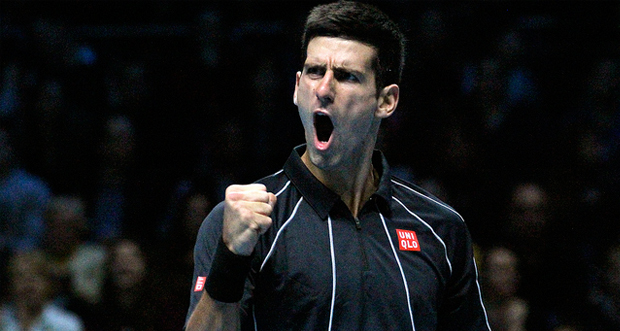
    WTF Winner - Djokovic 1

    World Tour Finals, Final

    (2) Djokovic d. (1) Nadal, 6-3, 6-4

    Novak Djokovic tonight defeated Rafael Nadal in the final of the World Tour Finals, an unlovely sentence to commemorate a forgettable match. It was the third time in the last four years that the top two players have closed out the ATP season, but the first time it has been these two. I suppose it had to happen eventually, since they seem to have played finals everywhere else. Consequently everyone knew what to expect, especially given the glacial surface: an extended defensive slog based around the repetition of readily identifiable patterns. As with minimalism – which people persistently confuse with simplicity – great complexity is achieved by the reiteration of basic blocks, not to mention great length. No one expected it to be simple, and no one expected it to be quick.

    I confess to feeling some relief when everyone was proved wrong, at least when it came to length. When two players face each other thirty-nine times – an Open Era record – it’s inevitable that not all of them with be classics, although one hoped that the last match of a memorable season would turn out to be a bit less forgettable. Alas, Nadal commenced nervously and never entirely settled. Meanwhile, Djokovic was fierce initially – tearing out to a 3-0 lead – then meek for a while, and then forceful all the way until the end. He seemed to hold break points in most of Nadal’s service games, but only reciprocated the favour once to be broken back in the first set. Whatever hope this kindled of a competitive match was lessened by the consideration that the quality wasn’t high enough that you’d necessarily want to see more of it, then doused entirely when Djokovic lifted again. The point with which he re-broke Nadal to claim the eighth game ranks among the finest defensive efforts I have ever seen, a masterpiece of thrust, parry, loft, and touch. Djokovic’s bellow afterwards was long and lusty, and certainly justified. Most of us will never do anything nearly so masterful in that atmosphere for those stakes.

    Djokovic broke early in the second set – more shouting – and threatened to do so repeatedly as the set wore down. Insurance breaks are nice, but aren’t necessary if you never face calamity (like all insurance, really). The Serb was never again threatened on serve, rarely conceded the baseline, and ended up with atypically excellent numbers at the net. Nadal was almost always on the move, and even when he could set his feet on a forehand found it hard to shift his opponent for long. The length on his groundstrokes was a constant problem, except for Djokovic.

    In truth Djokovic was the real problem. Afterwards Nadal conceded that his opponent had simply been too good. On this surface, playing at his best, Djokovic truly is. The homogenisation of the court surfaces has helped ensure that these two end up facing each other at nearly every tournament everywhere, and that when they do they barely have to alter their basic game, but between them the surface still matters. Nadal is better on clay, and Djokovic is superior on hard court, assuming both men play at their best. In both cases the gap is closing, but it is still there.

    Since the beginning of his career, Nadal fading through the late part of the season, has come to feel like a structural requirement of men’s tennis, although it says a lot about his magisterial 2013 season that losing in the final of the year end championships can be construed as a letdown. It is also a testament to his evolving mastery of all surfaces that one’s definition of “late” has had to be pushed further and further back as the years rolled by. Initially that late part of Nadal’s year kicked off very early — once the main clay tournaments were over. Admittedly that was long ago, when he was very young. Soon he learned to commence fading after Wimbledon, with the results petering out by the US Open. In 2008 he became a factor in the later stages in New York, and has never since failed to reach at least the semifinals, assuming he turns up at all.

    Yet the period after the year’s final Major – pollen-choked Australians find it difficult to call this the “fall season” – has remained unaccountably lean. In his entire career he has won just two titles after the US Open, and one of those was in 2005 in Madrid, enabled by an extravagant collapse from Ivan Ljubicic. That remains Nadal’s only indoor title, since the Ariake Coliseum roof remained open through his Tokyo title run in 2010, his other career title in what northern hemisphere fans obdurately refuse to term “the Australian Spring”. But this year one could be forgiven for assuming the usual rules don’t apply, especially on hard courts. Up to and including the US Open, Nadal hadn’t lost a tournament on that surface. After that he contested four events – the same ones as Djokovic – and for all that he seemed more determined than ever to capture the few important titles that have eluded him, and didn’t win any. That’s nothing to be ashamed of, of course. Winning these things is really, really hard.

    Djokovic, of course, won them all, though in the process lost his No. 1 ranking. The extent to which those two events are connected is open for debate. Some felt that losing the top spot firmed his resolve. There’s probably something to this. After a strong start to the year Djokovic’s form grew patchy, even within matches. Transcendent sets would be interleaved with uncharacteristic dreck, as he would unaccountably lose his way. Since Beijing, however, these periods have grown fewer – there was a bizarre one in the Shanghai final – and he has looked more like the Djokovic who swept through the first two thirds of the 2011 season. (Surgically combining the first part of his 2011 season with the last part of his 2013 yields a year of near perfection.) One shouldn’t forget he almost did exactly the same thing last year, but for that strange loss to Sam Querrey in Bercy. Last year he was chasing down Federer for the No. 1 spot, successfully as it turned out. Grand purposes certainly sharpen his focus.

    On the other hand, it’s probably pointless to search for additional reasons for Djokovic to play superbly on hard courts. At his best he is without question the world’s best player on that surface. His current streak of twenty-two matches isn’t the longest by any means, but it is hard to top for quality. It includes twelve victories over the current Top 10 (aside from the injured Murray), including two wins each against Nadal, Federer, and Wawrinka, and eight in less than two weeks. That’s hard to top. The appropriately renamed Brad Drewett Trophy, bedecked with blue streamers and bestowed amidst a blizzard of confetti, was a fitting reward.

    Thus ends the latest edition of the World Tour Finals. It certainly wasn’t the most memorable installment, from any point of view. Perhaps it was the absence of Murray, but the entire week has felt slightly deflated. The Sky Sports commentary was certainly less demented as a direct result. Recall their tedious tut-tutting during last year’s semifinal over the London crowd’s divided loyalties, particularly Sir Ian McKellen’s unforgivable decision to sit in the Federer box. Sir Ian was nowhere to be seen this year. No doubt he’s chasing monsters in New Zealand. One wonders whether the Scot’s absence was a deciding factor in keeping other celebrities away. Last year there was a cameraman tasked with capturing Kevin Spacey’s every facial tic, and apparently no one could get enough of Pippa Middleton. This year there were endless footballers and one of the mannequins from One Direction. Still, you can’t have everything.

    Photo credit:  Marianne Bevis (Creative Commons License)
  • Small Miracles

    Small Miracles

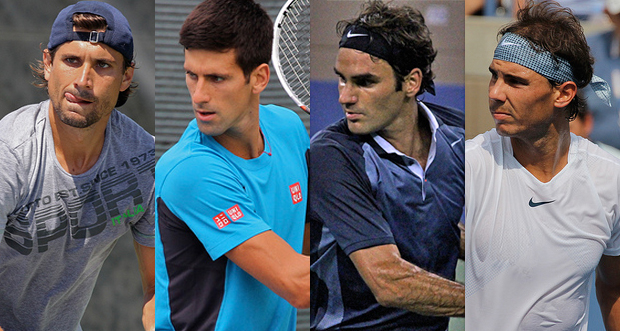
    Paris SF Rafa Roger Novak Ferrer

    Paris Masters, Quarterfinals

    It is rare at any level for the top eight seeds to populate the quarterfinal stage of a tournament, a result that was guaranteed the moment Rafael Nadal defeated Jerzy Janowicz in the last of the Paris Masters fourth round matches. At Masters level this hadn’t occurred in over four years. More intriguing still was the fact that the last eight men remaining at the Palais Omnisports de Paris-Bercy were the same eight who’ll descend upon London’s O2 Arena next week for the World Tour Finals.

    Apparently such a miracle has never happened before, although if it was going to, this was probably the year for it. Coming in to this week, three qualification spots remained open, meaning that a number of men had every reason not only to turn up but to give their best effort, which is precisely the kind of effort that can be lacking at this tournament. Added interest came in the form of Roger Federer, who was prominent among those yet to qualify. By winning his first round match against Kevin Anderson he took care of that, and yet another comfortable victory over Philipp Kohlschreiber saw him attain the quarterfinals. By joining him at that stage both Stanislas Wawrinka and Richard Gasquet ensured their spots in London as well, although whether they’ll do much more than make up the numbers is a nice question. The very best players seem uncharacteristically committed this year.

    Novak Djokovic lost to Sam Querrey in strange circumstances last year, withdrew the year before after proving he cannot lose to Viktor Troicki under any circumstances, and fared badly against Michael Llodra the year before that. Yet this week he has hardly looked like losing or withdrawing. Indeed, through the first set of his quarterfinal against Wawrinka he seemed reluctant to give up points. The Swiss had an early chance to recover an even earlier break, didn’t take it, and was reduced to spectating for the next twenty minutes. The second set was tighter, especially at the start, but Djokovic always had it well in hand.

    Nadal often doesn’t turn up in Paris at all, as a culmination of his disinclination to contest any of the other European indoor events that precede it. One can understand his disinterest, given that conditions don’t suit his game, and he hardly needs the points. He has won precisely one indoor hard-court title in his career (Madrid 2005). But in a season in which he cleaned up the American summer and went undefeated on hard courts until September, who is to say he cannot win the Paris Masters? Gasquet certainly had little say in the matter, thrashed four and one in just over an hour. There was a belief that the last three rounds in Bercy would provide a preview of what to expect in London. It seems that this is the case.

    Many are convinced Nadal will not only win Paris, but the World Tour Finals as well, thereby tripling his collection of indoor titles. One viewer took the trouble to email Sky Sports to that effect, adding, however, that she would be equally happy if Federer never won another match. Marcus Buckland and Barry Cowan professed themselves shocked by this, suggesting neither man spends much time on the internet, which is largely powered by schadenfreude and self-importance, and is thus self-sustaining. Wishing catastrophe on total strangers based on perceived minor transgressions is an even more popular online hobby than charmless grandiosity, though the two are easily combined.

    Cowan confessed he did not understand how anyone could actively dislike watching Federer play, even if for whatever reason you do not care for him off the court. Buckland invited the viewer to email in their reasons, which they naturally did. It turned out to be the usual tedious guff about arrogance and poor losing. Ho-hum. Cowan still didn’t get it. To his credit I’ll hazard that the reason for his confusion is that he fundamentally doesn’t grasp how many ostensible tennis fans are a fan of a particular player more than they’re a fan of the sport. For all Cowan’s manifold shortcomings as a commentator and a player, the fact that he was a professional sportsman means that only a tiny portion of his engagement with tennis concerns any particular player. For the fan who emailed in, and many others just like her, the opposite is true. Their approach to professional tennis is primarily concerned with the deification of their favourite player, and the revilement of whichever players they’ve been taught are diametrically opposed. You’ll observe that fanatics always reserve their unkindest hopes for rivals. No one wastes time wishing Ivo Karlovic never wins another match.

    It was another reminder, as if more were needed, that many sports fans are dullards who cannot function without a depressing little assortment of heroes and villains, and that these roles are by necessity cast within very tight parameters. Thus, say, the soft-spoken and sardonic Robin Soderling is a villain, held by some to be morally on par with Timothy McVeigh. The reality is that most of us encounter considerably worse people than any professional tennis player every time we leave the house, or even when we don’t. You can hear the squalid thoughts of the ethically bankrupt merely by switching on commercial radio, and after listening to many politicians speak you’ll want to take a dip in the septic tank just to feel comparatively clean. Remember the supposed falling out between Federer and Nadal at the beginning of last year over the ATP Player Council? I must have attended half a dozen more acrimonious meetings than that in the last month, and am daily obliged to shake hands with far bigger wankers than any man in the Top 10. As far as I can make out, and for all that it matters, all the top players seem like pretty nice people.

    The fan who’d emailed Sky Sports can’t have been happy with Cowan’s mystified response, and was surely brought to a high simmer by the subsequent coverage, which was unabashedly Federer-centric. “I’m not even looking at del Potro right now,” declared Andrew Castle in commentary as the second quarterfinal commenced, “All my focus is on Federer!” He went on to add that for him Federer was the story of the next twelve to eighteen months in men’s tennis, which seemed rather disrespectful to Philipp Kohlschreiber, who is poised to commence his audacious run to the No. 1 ranking. (Mark my words.) It was also somewhat disrespectful to del Potro, who has been in tremendous form of late, and will be a legitimate title-contender in London next week. He at least deserved a look-in.

    It was clear as the first set proceeded that Federer wasn’t about to give him one. Federer was quite magnificent, hitting seventeen winners to just four errors and comprehensively shutting down the forecourt. It was almost enough to justify the presumption that Federer would was eager for another shot at del Potro so soon after the Basel final. His success against tall, powerful players traditionally entailed exploiting their lack of agility with constant variations of spin, width, and depth. Del Potro admittedly moves superbly for a man his height, but compelling him to lunge, dip, and pivot is still a wiser strategy than trying to trade lusty blows from the baseline. Federer’s first set was a testament to this: 47% of his backhands were slices, the kind of figure he used to post when dispatching the arch-villain Soderling. Unaccountably he went back to hitting over his backhand more in the second, although until 4-5 he remained untroubled on serve. Del Potro so far had had an awful day on return, but at this moment unleashed his biggest forehand, and subsequently broke to take the set. The third set was patchier, with a string of breaks each way. Federer steadied quicker, and eventually served it, to his evident relief and the visceral disgust of at least one fan. Del Potro didn’t appear particularly fazed. If anything he’d looked a trifle fatigued as the match wore on, and I imagine the longer rest will do him a power of good.

    Federer has now posted just his second win over a Top 10 player for the season, offset by five loses. Andrew Castle reminded viewers that by the end of next week he might conclude his season with a more respectable win-loss tally of 9:5, assuming he defeats Djokovic in the semifinals, Nadal (probably) in the final, then everyone in London. This seems rather a generous assumption to make, even by Castle’s standards. We were also reminded that Federer has now beaten at least one Top 5 opponent at least once in each of the last fifteen years. It seemed a strange point to belabour, since he is after all Roger Federer. He is not Philipp Kohlschreiber, although soon Philipp Kohlschreiber won’t be, either. Mark my words.

  • Nature’s Eternal Wonder

    Nature’s Eternal Wonder

    Valencia Youzhny

    Basel, Final

    (1) Del Potro d. (3) Federer, 7-6(3), 2-6, 6-4

    Roger Federer this afternoon enjoyed the unusual sensation of entering Basel’s St. Jakobshalle as the underdog, although perhaps “enjoyed” isn’t the word. In truth he probably enjoyed it about as much as the Swiss crowd, which for the better part of a decade had been sustained on easy brilliance, but must now seek additional nourishment in hope, a notoriously fickle dietary supplement. It has been that kind of season, and in Juan Martin del Potro he was facing a fine player who has transformed himself into a fearsome contender on every surface, roofed or not.

    Last year in Basel Federer performed about as patchily as he has this year, and eventually fell to del Potro in a reasonable three-set final. At that time he was the world No. 1, and all the commentary centred on his doomed bid to retain his ranking until the end of the year. His return to No. 1 had been masterful, and apparently entailed visiting an unusual number of dispiriting losses on del Potro, indeed rather more than seemed necessary. As a consequence, Federer was still the strong favourite for last year’s final. This year he certainly wasn’t. Before the final, he hadn’t defeated another member of the Top 10 since the quarterfinal of the Australian Open, and was now ranked lower than del Potro. After the final, both those facts are still true. The interest this year lies in wondering whether he will qualify for the World Tour Finals, an event he has won six times. Sky Sports’ resident math-whiz Barry Cowan has run the sums, and reassured us that Federer will be there. Even so, it has, to put it mildly, been a horrible season.

    Even that is misleading, though, since the concept of a single season in professional tennis is mostly meaningless. The suggestion that Federer is having a bad season glosses over the reality that he has been playing quite poorly for much longer than that. In fact, though I might be courting a measure of disapproval by saying so, I don’t think he has looked truly impressive since last year’s Olympics. This may seem a contentious point, given that soon after the Games he claimed the Cincinnati Masters without dropping serve, bagelling Novak Djokovic in the final. To the already potent mixture of injury and slumping form, one cannot help but add the question of desire. Overall, his hunger no doubt remains as undiminished as he insists when asked, but at those crucial moments in important matches when every choice must be razor sharp and execution flawless, his instinct lately seems blunted, the old audacity dulled. Perhaps it is merely an issue of confidence, the least tangible casualty of injury and prolonged poor form, and always the last to recover.

    Still, Federer looked amply committed today, and wasn’t all that far from winning, and far from sanguine when he didn’t. It was a decent final, and tangentially diverting for how the shape of the whole match was thoughtfully captured in the first set, the way a tree’s form is reprised in each leaf, or the entire idiocy of pop culture is present in a single Kardashian. Nature’s wonder truly is eternal. Anyway, both players looked good early, before del Potro broke and moved ahead, but was broken back to love as he served for the first set. They reached a tiebreak, and Federer’s level plummeted while the Argentine’s didn’t. Federer stormed back in the second, as del Potro conducted an ill-conceived experiment to ascertain how well he’d do without a first serve. Not very well, it turned out.

    Having satisfied himself of this, he set about proving the corollary in the third set, winning sixteen of the seventeen first serves he put into play. On the slick Basel court, this rendered him all but unbreakable. If only Federer had been. Alas, the key moment came early in the set, as Federer forwent several chances of maintaining his second set momentum, and was laboriously broken. His only opportunity to break back came immediately, but del Potro held steady when it counted. The rest of the match turned out to be a long coda. Del Potro, afterwards, was ecstatic. Look for him in Paris, and London. Look for Federer, too.

    [divider]

    Valencia, Final

    Youzhny d. (1) Ferrer, 6-3, 7-5

    Mikhail Youzhny won’t feature in London, although by claiming the title in Valencia a short while later he has reinserted himself back into the Top 20, displacing a few others, and settling at No. 15. Ferrer, meanwhile, will be in London, since despite losing today he remains comfortable at world No. 3. I cannot help but think this lofty position does not reflect his current form.

    Unlike Federer, the last twelve months have been the finest of Ferrer’s career, including a maiden Masters title, a Roland Garros final, and a career-high ranking. Again I’ll court perversity, this time by arguing that Ferrer has achieved these results in spite of his form and not because of it. If anything this renders his achievement greater still, although I also suspect he has enjoyed a healthy slice of luck, which at the right dosage is hard to gainsay. Consider this: he won the Bercy title last year without playing a match in which he was not the clear favourite, which is a pretty unlikely scenario when you think about it. He reached the Australian Open semifinal only by the grace of Nicolas Almagro’s brain, while the Jo-Wilfried Tsonga whom Ferrer encountered in the Roland Garros semifinal was a mere shade of the majestic Frenchman who’d trounced Federer the round before. A similar case can be made for Ferrer’s run to the Miami final. I’m not one of those who take pleasure in deriding Ferrer. He’s likeable, is rightly commended for the extent to which he maximises his gifts, and all any player can do is take advantage of situations that fall his way. But I do think he was a much better player last year.

    That being said, I also thought he would beat Youzhny in the Valencia final. For all that victories over Almagro shouldn’t be considered a form guide for anything – even allowing for the degree to which match-ups between compatriots can go haywire – it seemed that Ferrer’s inherent advantages over Youzhny would only be rendered overwhelming by the environment. People euphemistically call Basel Federer’s court, but Valencia really is Ferrer’s court. He co-owns the event, which is staged in the Agora, an attractively stylised bone-cathedral that helps it feel like a novelty level from Topspin 4. One presumes Ferrer’s interests are at least partly responsible for the chemical miracle of Valencia’s surface, so far the world’s most successful attempt at rendering molasses into so striking a shade of cobalt. Unlike Stockholm where the court rewards excellent value for shots, a fact Grigor Dimitrov eventually exploited by hitting a few of his in, the Valencia surface is notoriously difficult to penetrate. Like Ferrer, this court is built for retrieval. For an aggressive yet self-destructive player like Youzhny, whose passage through the draw had mostly entailed outlasting even flakier men than himself, it was a tough proposition.

    However, while I maintain that there’s more that can go wrong with an attacking game than a defensive one, Ferrer this year is living proof that inherently defensive tennis still requires more than a pair of legs. He remains as quick as ever, but his retrieving lately has been nowhere near as accomplished as one might expect. Youzhny was superb, bold from the very beginning, from all parts of the court, varied in his approach, and fearless when pressed. Once he finds his groove there are few players more attractive, although his recurrent issue is that he can be de-grooved so readily by a really tenacious opponent. Often the one extra shot is one too many, but today Ferrer only sporadically forced the Russian to come up with it.

    There was a brief period in the second set when it felt like Ferrer would tear the match away. Youzhny could barely win a point, the local crowd found its voice as their man pulled ahead. But Ferrer’s momentum mysteriously flagged, and a poor service game saw him repeatedly out-rallied and broken back. Soon he was broken again, and Youzhny stepped up to serve for the title, after spending a precious minute pre-visualising it under his towel at the changeover. I cannot say whether it went as he’d planned, but it went as well as he could have hoped. His backhand up the line is unorthodox and beautiful, and today it was instrumental. The last point was thus an appropriate summary: Youzhny launched an attack, Ferrer scrambled desperately, and finally managed to get the ball safely up high to the Russian’s single-hander. The Russian, despite many excellent reasons to grow timid, launched a fearless backhand up the line. Ferrer could reach it, but not control it, and that was the match. Youzhny’s smile afterwards as he saluted the Valencia crowd – far more civilised than Madrid’s – was immense, but exceeded easily by that of his coach. Boris Sobkin doesn’t smile often, but it’s always worth the wait.

    Cover Photo (Creative Commons License): Marianne Bevis

  • Living in a Blue World

    Living in a Blue World

    Stockholm, Final

    (7) Dimitrov d. (1) Ferrer, 2-6, 6-3, 6-4

    It is consistent with the ATP’s belated commitment to greater coherence that the European indoor season, which began this week in Moscow, Vienna, and Stockholm, now wastes so little time getting to the point. It was a move long overdue. If the season as a whole still makes little sense, constrained as it is by the timing of the Majors, at least the little mini-seasons that comprise it can achieve some internal logic. Now the European indoors is structured just like the Asian swing, as a three-week escalation from 250 level events, through a pair of 500s, and culminating in a Masters. The clay season and the US Summer are vaguely like that, too, and presumably the grass season would be as well if it only had more time.

    Nevertheless, I confess I miss the more amorphous proportions that the indoor season used to have. Whereas now it is crisply marketed and boasts a discernible shape, it was once baffling and went on seemingly forever, filling the back-end of the season with an indeterminate number of ghoulishly-lit, interchangeable events differentiated only by their trophies, which strove to surpass each other in their nightmarish modernism. It was kind of wonderful. You could tune in at any point and know what you were getting, yet rest assured that none of it mattered very much.

    Along with Basel’s dusted pink – now a confected memory – the hyperborean gloom of Stockholm was the season’s highlight, if that’s the word. It was thus with some disappointment that I tuned in earlier this week, and discovered that the Swedish tournament’s overall look has been sharpened. Since before I can remember it has been so unrelievedly blue that it left viewers in no doubt that the spectacle before them was taking place somewhere very northern and very cold. The way the image seemed to darken and grow fuzzy at the edges helpfully evoked the sensation of freezing to death. Perhaps it was merely an issue with the coverage, not helped by the time difference that ensured I was always watching in the smaller hours of the following morning. Sadly, although the court is still blue, the colour has deepened, and the space around it has been recoloured green, thus helping it look rather like a lot of other tennis courts. Thankfully Stockholm’s other trimmings have remained untrimmed, including the net contraptions used by the ball kids – why are these not used everywhere? – and a trophy that looks like one of Dr No’s discarded doomsday devices.

    This device – I am assured its depleted palladium core has been removed – is now in the possession of Grigor Dimitrov, his reward for becoming the first Bulgarian supervillain ever to win a tour title. His victory also completed a rare day of triumph for one-handed backhands and vindication for the select group of men who’ve rightly or wrongly been dogged by comparisons with Roger Federer. Dimitrov is merely the latest to be burdened by the title “Baby Fed”. The original Baby Fed, you will recall, was Richard Gasquet, who an hour earlier recovered to defeat Mikhail Kukushkin in the Moscow final. Tommy Haas was spared the dubious Baby Fed accolade through being older than Federer. Instead, for large parts of the last decade he was held up as an example of stylish potential untapped, of what Federer might have been had it not all worked out so well. The irony, if we can even call it that, is that Haas this year has won twice as many titles as Federer: two. Maybe it isn’t irony, but it is somewhat miraculous, given Haas’s age. During the trophy presentation Robin Haase remarked that he himself might have been the thirty-five year old, while the German could pass for twenty-five. “If you only knew,” replied Haas.

    Both Gasquet and Haas recovered from a break down in the final set against sporadically inspired opponents, eventually claiming their titles within about ten minutes of each other. Initially it appeared unlikely that Dimitrov would reprise this pattern. He and David Ferrer commenced the Stockholm final in the traditional manner of fast indoor tennis, by breaking each other constantly. Dimitrov quickly wearied of this, though Ferrer didn’t, and soon won the first set. Mostly this was achieved through the universally-applied tactic of directing everything at the Bulgarian’s backhand, though it would be unfair to suggest that it ever truly broke down. Indeed it held up admirably through the tighter second set. Ferrer had by now tired of breaking as well, though he was developing a fondness for unforced errors, and lost his serve late, and then the set. The stage was thus set for Dimitrov to fall down an early break in the deciding set, and then storm heroically back. Sadly, for Ferrer and for those of us pointlessly hoping that all three finals would play out almost identically, Dimitrov was never quite broken, though it was a near-run thing. Instead, again, it was the top seed Ferrer who found the crucial error at the worst moment, and double-faulted to give away the break. Dimitrov served it out, and commenced his celebration routine.

    He began his year by reaching his first tour final in Brisbane, then characteristically lost his way. I was sitting with his old coach and manager as he fell dismally to Julien Benneteau in the first round of the Australian Open – a meticulously rendered example of a backhand crumbling apart – and could hardly have imagined that of the two men Dimitrov would be the first to win a maiden title. One of course should not underestimate Benneteau’s capabilities in this area, especially after Kuala Lumpur. The real risk is that after Stockholm we’ll overestimate Dimitrov. He has always attracted heightened expectations, especially in an era in which the next big things have proven slow to appear.

    Presumably his new coach will help with that. Stockholm was Dimitrov’s first tournament with the ineffable Roger Rasheed, “ineffable” in this case denoting that species of incomprehensibility that contrives to sound meaningful. Rasheed’s gift for impenetrable neologism is of course legendary, and certainly hasn’t gone unexamined in these pages. In the case of Dimitrov, however, I can see its legitimate value: by having to focus so hard on deciphering what Rasheed is saying he ensures that his mind remains empty of whatever it is usually filled with. Rasheed thus stands revealed as a kind of Zen master, with corporate-calibre motivational aphorisms taking the place of Om.

    Beyond his capacity to spout claptrap, though, Rasheed is nothing if not a taskmaster, and notoriously intolerant of any player giving less than his best. His true value will be in addressing those periods, altogether too common, when Dimitrov decides not to bother. Everyone looks good when he’s playing well, and Dimitrov looks better than most. It’s what happens when you’re playing badly that counts. Yesterday in the semifinal he came back from a set down, though admittedly that was against Benoit Paire. But today he recovered from a poor start against Ferrer, and held his nerve admirably through a tight final set. Afterwards Dimitrov insisted that he was happier with his perseverance and resilience than with the actual silverware. I can’t say how true that is – it sounds like the kind of sentiment Rasheed would endorse, although he’d certainly use different words – but I suspect it is at least partially the case. In any case, one can hope.

  • Tracking All Those Streaks

    Tracking All Those Streaks

    Shanghai Masters, Final

    (1) Djokovic d. (6) del Potro, 6-1, 3-6, 7-6(3)

    Novak Djokovic this evening won his second straight Shanghai title, and fifteenth Masters title overall. It was also his twentieth consecutive victory in China. He was of course thrilled, though it’s tough to ascertain which particular achievement meant the most to him. Perhaps, in the moment, it was just winning this one fine match. Either way, it’s hard to quell one’s sense of scepticism when he insists that losing the No. 1 ranking has not steeled his resolve. It’s also hard not to feel sympathetic towards Juan Martin del Potro, who fell agonisingly short of claiming his first Masters title, and didn’t seem consoled by the knowledge that he’s never looked closer. His runner-up streak at this level now stands at three.

    Djokovic this week also extended his winning streak against Frenchman to twenty-eight, despite Gael Monfils’s best efforts to abbreviate it. There was also a two-game period in the first set of the first semifinal when Jo-Wilfried Tsonga looked threatening, and really showed us what he can do. He was out-rallying Djokovic from the backhand, pushing him around with his forehand, and moving beautifully. Then came a much longer stretch of games in which Tsonga demonstrated that he can’t do it often or for long enough. Thus was dispelled any  lingering mystery of why he isn’t ranked No. 1 or 2 in the world, and has yet to claim a Major.

    Djokovic, on the other hand, is ranked No. 1 or 2 in the world, and was hardly fazed by his opponent’s brief resurgence. He hasn’t lost to Tsonga in three and a half years, and learned long ago that these little spots of brilliance soon tarnish. The second set was closer – breaks were traded, lovingly – but even as a tiebreak hove gradually into view it never much felt like Tsonga would win it. As it happened, the tiebreak never arrived. Djokovic broke late, and that was that: his nineteenth straight victory in China, and eighth in a row against Tsonga. More streaks.

    I’ve no doubt various others were augmented, as well. We are living through an era in which records both grand and minor tumble every other week. It turns out there’s such a thing as milestone fatigue. It can be taxing to get too excited for the more trivial of these. Those achieved in a particular country or against citizens of a different country are about my limit. It’s conceivable that I might one day regale grandchildren with tales of where I was when, say, Jerzy Janowicz captured the calendar Grand Slam (I predict I’ll be at home debating whether I should buy some bread or just keep spooning marmalade from the jar). I haven’t yet decided whose grandchildren they will be; boring random kids will be my right as a lonely old loon in a shopping mall. Whoever they are, I doubt they’ll stand still while I explain that Djokovic went unbeaten throughout his career while facing left-handed Canadians in Paraguay.

    It’s also conceivable they won’t really care that for just the second time in 2012, Rafael Nadal failed to reach the final of an event in which he was entered. (The first time was, of course, at Wimbledon, when he fell in straight sets to Steve Darcis. Mentioning that one will surely result in stunned disbelief from all future generations, notwithstanding the carefully preserved documentary evidence.) Nadal, by his own admission, played fine, but was unlucky to run afoul of Juan Martin del Potro in truly fearsome touch. The first set in particular was astonishing from the Argentine. The second was merely very, very good. Nadal’s peculiar post-US Open record continues. Since 2005 he has claimed only one title in this part of the season, which was in Tokyo three years ago. You can bet the grandkids will hear about that.

    Del Potro no doubt extracted a healthy portion of hope from his semifinal performance, not to mention his excellent run to the Tokyo title last week. He was thus well-placed to relearn the lesson that when faced with Djokovic (in China) hope sometimes provides no more nourishment than a mouthful of ashes. Del Potro admittedly didn’t reproduce his level from the day before – faced with a superior returner he was compelled to go after more first serves, and thus missed a lot – but he was still decent. He has won plenty of matches playing worse. The difference was that the bludgeoning groundstrokes that pushed Nadal around left Djokovic unmoved, and were faultlessly redirected up the line. Twice Djokovic gained a point for the first set bagel, but didn’t take either, though he served it out in the next game.

    The change came in the second game of the next set. Djokovic has shown a tendency in those parts of the season staged outside China for his focus to waver. It would be tempting to say something similar happened here, but the issue really seemed more physical than mental. Perhaps it was spiritual. Whatever it was, suddenly Djokovic forgot how to use his feet when hitting forehands, at a very fundamental level. He was lurching all over the place, spraying balls everywhere, as though someone had spiked his magic tennis player water. “Bambi on ice” was Marcus Buckland’s apt description. This enabled del Potro to break. Improved serving helped him eventually hold for the set.

    Last year’s Shanghai final was superb for two sets, then rather faded away in the third as Andy Murray’s legs and will gave way. Today’s final, by contrast, only really got going in the third. As these things go, this is probably the more memorable configuration. Djokovic had by now untangled his feet, while del Potro continued to blast away with that forehand. Finally, the best two players of this year’s Asian swing were playing well at the same time. Break points came and went for both, and in nearly every case were saved with heroic, fearless play. Djokovic gained a couple of match points at 4-5, with del Potro serving, but wasted one with a tight return, and as punishment was obliged to hand back the other as well. The tiebreak never felt inevitable, but it arrived anyway, and once it did it felt fitting. Sadly for Argentine hopes, once it started it was almost entirely Djokovic. There seemed to be hundreds of Argentines present in the Qizhong Forest Sports City Arena, most of whom had ignored the signs at the entrance warning them to abandon all hope. It didn’t help that the signs were written in Serbian. They looked terribly disappointed, but tearfully and rightfully proud of their man, who’d made a mighty effort.

    Djokovic sealed it with a last backhand winner up the line, his 47th winner of the match, whereupon he and his opponent availed themselves of their usual hug at the net. Del Potro wandered to his chair and buried his face in his towel. Djokovic launched himself into more extravagant celebrations. Until 2012 the Shanghai Masters had never produced a great final. Now it’s threatening to become a habit. Its streak of great finals is now two, and counting. I hope you’re all keeping track. This stuff is important.

  • The Blue Shift

    The Blue Shift

    Beijing, Final

    (1) Djokovic d. (2) Nadal, 6-3, 6-4

    Until yesterday, the only hard-court tournaments that Rafael Nadal hadn’t won this year were ones he didn’t enter. It doesn’t take much to mar a perfect record – just one loss to a rampant Novak Djokovic – though falling short of perfection hardly precludes greatness, and Nadal’s 2013 season is nothing if not great. It isn’t done with yet; weeks remain in which it can become greater still.

    Consider this: Nadal has just reclaimed the No. 1 ranking despite accruing zero points at two Majors (Melbourne and Wimbledon), three Masters (Shanghai, Paris, and Miami), and the World Tour Finals. Staggering, indeed, and it suggests that the gap between him and his nearest rivals will widen to a chasm before it begins to close. Djokovic is already making the right noises about regaining the top spot, but he’ll need to win Shanghai, the World Tour Finals, and the Australian Open merely to maintain the points he has. Barring catastrophe or a precipitous waning of interest, Nadal will be No. 1 in the world for a long while yet.

    [divider]

    Click here to discuss The Blue Shift in our discussion forum.

    [divider]

    Last week was Djokovic’s 101st at No. 1, which strands him one week short of Nadal at equal-eighth on the all-time list, though not for long. This week will be Nadal’s 103rd. (Next week will be his 104th. I think you grasp the sophisticated mathematics involved.) I do wonder how many men have lost the No. 1 ranking by winning a tournament, in the final defeating the very man who would supplant them. It cannot be that common. (Still, if it was going to happen, this would be the pair to manage it. They’ve now faced off something like fourteen thousand times. The ATP made a desultory effort to drum up some interest for yesterday’s final with yet another historical retrospective, but given that their previous encounter was a Major final, and that the new survey mostly reprised the last one, it was hard to get too worked up.)

    Nor, however, is it particularly significant. Rankings are based on twelve months’ of results, not two hours’ worth, and Djokovic in Beijing is coming to feel like Djokovic in Melbourne. Just arriving there lofts his form into low orbit. There’s no shame at all in losing to him, no matter what you’re ranked. This week he looked better than he has since January, savaging Richard Gasquet in the semifinals, and comprehensively shutting Nadal out of the final. Much has rightly been made of his serving, which was superb. But his returning was typically accomplished – Nadal won twenty-five percent of points behind second serve in the first set – and his groundstrokes reflected a boldness that is unfortunately atypical in this rivalry. The swift, low bounce didn’t hurt.

    Meanwhile, Nadal wasn’t overly convincing. Generous souls suggested he was experimenting with aspects of his game this week. Perhaps they’re right. He did take time to test just how far behind Fabio Fognini he could fall without looking in real peril of losing. It turned to be quite a long way: a set and 1/4. Conditions also did not favour him, though rather too much was made of this: conditions don’t favour most players most of the time. Whatever the cause, level-headed types had predicted Djokovic would take the final, though few predicted straight sets. The Serb has looked all tournament like he did in the second set of the US Open final, which is to say like the best hard-court player going around.

    But in order to be ranked as the best player one must sustain it for longer than a set, or even a week. Djokovic hadn’t won a tournament since April, and was on borrowed time. Those level heads were correct this week, but they’ve also been predicting losses for Nadal all year, and so far none had gotten it right. Broken clocks have a better rate of success. To be fair Nadal’s losses have been as unpredictable as they’ve been rare, and as curious. Who realistically believed that the third man to defeat Nadal in a clay court final would be Horacio Zeballos, contesting his first tour final, outmuscling the Spaniard in a deciding set? Or that Nadal’s only loss on European clay would come in Monte Carlo in straight sets, the first of which was very nearly a bagel? Or that Steve Darcis would remove him from Wimbledon in the first round? Or that . . . Or that there wouldn’t be any others, and none on a hard court?

    As much as the scarcity of the defeats, the comprehensiveness and plenitude of the victories have been telling. Nadal’s more ardent fans can fan themselves into orgasmic dread whenever he steps on court, and afterwards are eager to peddle the conceit that his victories are testament to an ineffable warrior spirit, but realistically there have been barely a handful of matches this year in which he has looked at all like losing. Mostly he wins because he’s better than everyone else. This is precisely as it should be for the world No. 1.

  • The Drums of War

    The Drums of War

    Davis Cup, World Group Semifinals, and World Group Playoffs

    Which maniac’s idea was it to schedule the Davis Cup semifinals for the week after the US Open? Even in the best years the turnaround is cruelly brief. It is a situation roughly analogous to the situation in Europe after the Great War, when a continent that had narrowly survived the most devastating conflict in world history began tentatively to haul itself from the abyss, only to be dragged back down by an influenza pandemic a year later. I don’t think that’s overstating the case. It’s probably even worse for the players.

    [divider]

    Discuss this article with fellow tennis fans on the tennis forums.

    [divider]

    If anything the situation is more serious with tennis than it was for war-ravished Europe, since ridiculous Monday finals in New York ensure even less opportunity for recovery. (Rafael Nadal was still doing the media rounds in Manhattan while his compatriots assembled in Madrid, rehearsing their favourite motet To Have Any Chance We’ll Have To Play Our Best. Given they were facing Ukraine, it somehow came off as even more ironic than usual.) It’s as though the signing of the Treaty of Versailles had to be pushed back six months, to ensure a spot on CBS’s Spring schedule. Although I cannot say for certain that the current situation will lead irretrievably to another world war, I can vaguely imply it. Rest assured I’ll wax pretty smug if it comes to pass.

    Indeed, there are further intimations that global conflict is not far off. I’ve mentioned it before, but it is surely no coincidence that Australia defeated the United States in the Davis Cup finals of both 1914 and 1939. It is thus with a certain anxiety that one notes Australia’s return to the World Group for the first time in seven years, having ravaged a depleted Poland over the weekend. All eyes will be fixed on the draw for next year’s tournament, to see where Australia and the USA fall. It’s probably a long shot that they’ll meet in the final, though it isn’t an impossibility given the rate and apparent certainty with which Nick Kyrgios, according to his self-devised slogan, is rising. There’s also Bernard Tomic.

    Tomic was Australia’s hero of this weekend, inasmuch as heroism was required. He won both of his singles matches, just as he had against Uzbekistan in the previous round, although this achievement will inevitably be downplayed. The cherished narrative of Tomic as feckless wastrel has by now become so established in its course that there’s no number of Davis Cup victories that will divert it. Think of last year’s World Group qualifying tie against Germany, when Tomic won Australia’s only singles rubber, in contrast with Lleyton Hewitt, who won none. The official line ran that Hewitt was a venerable warrior still giving his all for his country. Meanwhile every Australian tennis luminary with a platform took the opportunity to decry Tomic’s lack of resolve, from Pat Rafter and Tony Roche court side, to John Fitzgerald back in the studio. If anything, Tomic is held in such low regard, even here in Australia, that his exceptional record when representing his nation actually blights the Davis Cup. You can imagine what will happen when he defeats Ryan Harrison in the fifth rubber of next year’s final, annulling the ANZUS treaty at a stroke. Thanks a bunch, Bernie.

    Anyway, Australia wasn’t the only nation to progress to the 2014 World Group. Spain managed it, to no one’s surprise, defeating Ukraine 5-0 in the Caja Magica. Sadly the clay was an uninspired red, but really they could have contested the tie on pink ice cream it wouldn’t have affected the result. The Dutch squad inflicted commensurate misery on Austria, who ran out of players and were forced to wheel out Archduke Franz Ferdinand for the last match, bestowing new meaning on the term “dead rubber”. Apparently Viktor Troicki had rubbed him out back in Monte Carlo, the villain.

    Germany had almost as easy a time seeing off Brazil. There’s a complicated joke lurking somewhere in there. Given what’s coming, I won’t be surprised if they draw the Czech Republic in the first round next year. Great Britain is also through, mainly because of Andy Murray. If history is any guide, then a strong British team will be essential in the years ahead. Japan came from behind to beat Colombia at home, while Israel lost from in front against Belgium away. Amir Weintraub has made his name with desperately fought Davis Cup wins and losses. There’s something about the format that agrees with him. It could be the team environment, though it’s probably more the rare freedom that comes from having other people worry about sundry irritants like food and accommodation, not to mention access to a coach. He battled to an inspiring victory over Ruben Bemelmans on the first day, finishing 10-8 in the fifth. It was a 10-8 in the fifth kind of day. Sadly he lost the deciding rubber to Steve Darcis in a quick and decisive manner. Darcis, it must be said, was superb this weekend.

    Meanwhile, the semifinals proved all over again that although the final score may be the statistic that matters most, beyond the result it can obscure as much as it reveals. Both victorious nations eventually arrived at 3:2 score lines, but they only got there via wildly divergent paths. The Czech Republic, cruising on a futuristic hydrofoil of uncertain origin, had pulled so far ahead of Argentina’s squad that there was no chance they’d be overtaken. Jaroslav Navratil’s mullet streamed out magnificently in his wake, flanked on either side by his chief enforcers: the stern-faced replicant Tomas Berdych, and the wizened homunculus Radek Stepanek. The remainder of the team were confined below-decks, working the bilges, before they were released on the third day and summarily tossed overboard as consolations for the rapacious Argentines trailing astern. This was sold to Jiri Vesely as “experience”. Dead third days are the worst part of Davis Cup. For all that I’m not an advocate of wholesale change to the competition, I pray that any change that does come addresses that problem.

    Serbia entered the home straight trailing Canada, although there was no immediate reason to panic given Novak Djokovic was to kick proceedings off. He wasn’t facing Nadal – he hadn’t faced Nadal in days – and thus could be relied upon to win. He did. It thus all came down to Janko Tipsarevic and Vasek Pospisil. Either man represented a slender thread from which to suspend a nation’s hopes. But for all that Tipsarevic has waned sharply of late, while Pospisil is rising with even greater urgency than Nick Kyrgios, you’d suspect the Serb would see it through, given the not inconsequential advantages of superior experience, a clay surface, and the home crowd. So it proved. Pospisil fought his heart out, although unlike his ankle at least his heart remained more or less intact. He fell heavily on the last point, stabbing at a desperate volley. Tipsarevic ran the ball down, put it away, and joined his opponent on his knees. It was a useful study in contrasts. Pospisil’s teammates rushed over to see if he was okay; Tipsarevic’s teammates rushed over and jumped on him. And why not? They’re through to face the defending champions in what will undoubtedly be the last peacetime Davis Cup final of the modern era.

  • Indefatigable

    Indefatigable

    US Open, Final

    (2) Nadal d. (1) Djokovic, 6-2, 3-6, 6-4, 6-1

    Rafael Nadal yesterday defeated Novak Djokovic to win his second US Open title, continuing a return to the men’s tour that has surpassed the most ardent hopes of all but of his most ambitious fans. It has been a comeback to beggar belief, an opinion I’ll continue to maintain despite the fact that Greg Rusedski agrees with it. If anything, Rusedski went further, and summarily declared it to be the greatest comeback in sporting history. One questions both the length and breadth of his historical perspective, given he’d earlier insisted the match was well on the way to becoming the greatest US Open final ever played. It certainly wasn’t that, though it undeniably had its moments. The longest of these moments was a 54-stroke rally destined to pad out innumerable highlights packages. The best of them came at the very end as Nadal collapsed in ecstasy to the court, victorious in New York once more.

    [divider]

    Click here to discuss “Indefatigable” in our discussion forum.

    [divider]

    First some numbers, which can as ever be relied upon to render the achievement excitingly comprehensible. This US Open is Nadal’s thirteenth Major overall, which moves him to third on the all-time list of winners, one ahead of Roy Emerson, and trailing only Roger Federer and Pete Sampras. Since returning to the tour in February he has contested thirteen events, reaching the final at all but one of them (Wimbledon), and claiming the title ten times. (This incidentally equals the number of titles Jo-Wilfried Tsonga has won in his entire career.) He has won sixty matches, easily the most on tour, and lost just three. Today he became only the third player ever to sweep the main events comprising the US summer, meaning Canada, Cincinnati, and the US Open (the other two men were Andy Roddick in 2003, and Pat Rafter in 1998). Overall Nadal has compiled an astonishing 22-0 record on hard courts this year, and hasn’t technically lost a hard-court match since Indian Wells last year.

    Nadal’s previous US Open title came in 2010, although I’ll court opprobrium and suggest that today’s title is more convincing, insofar as the convincingness of tournament victories is something that can or should be measured. There was a prevailing sense that his first title, for all that it completed his Career Grand Slam, was a testament to opportunism. The fast New York DecoTurf was generally held to be his worst surface. Meanwhile, the two best hard-courters at the time – Federer and Djokovic – had fought each other to a standstill in the late semifinal, after Nadal had already breezed past a wearied Mikhail Youzhny, having faced no one more threatening before that. Realistically his path to this year’s final hasn’t been much more taxing: replace Verdasco with Robredo, and a weary Youzhny with a weary Gasquet. The difference is that this time round Nadal was deservedly one of the pre-tournament favourites, and, given his recent results and form, it is perverse to pretend he is now anything but entirely suited to outdoor hard courts. Favourites always have an easier draw, since by definition they rarely face anyone they are not expected to defeat. He had a favourable US Open draw for the same reason he had favourable draws at Roland Garros: because he earned them.

    Nadal might have been a favourite, but he was by no means unbacked, especially faced with the other favourite. Djokovic is still the world No. 1, even if it is rare for him to recapture the form of his majestic 2011 season, and rarer still to see him sustain it outside of Australia. It’s been the pattern of his year, and it was his pattern in tonight’s final. When Djokovic played at his best, and more importantly, when he thought at his best, he was the better player. But he couldn’t keep it up. Nadal began exceptionally well, once more employing the tactic that had served him well in the French Open semifinal, of pressing hard up the line with his forehand early in the rallies, invariably catching Djokovic out. Djokovic also reprised his strategy from Paris, which was to eschew tactical clarity of any sort, and to avoid the authoritative backhand up the line that once ranked among the sport’s most fearsome shots. The two players combined for a one-sided 6-2 first set.

    The change came in the second set, and it had little to do with Nadal, who continued to strike his forehand ferociously. Suddenly he was having fewer of them to hit, and he was increasingly obliged to hit them from less stable positions. Djokovic hadn’t started to strike the ball better, but he was now directing it far more intelligently, which enabled him to control the rallies. Then, having established himself, he did start to strike the ball better, and abruptly revealed himself to be the fearsome version of himself from two years ago, the one who would patiently pummel Nadal’s backhand until it cracked, and who would only bring the Spaniard’s forehand into play at a moment of his choosing. Djokovic romped through the latter stages of the second set, and moved ahead a break in the third.

    Then, inexplicably, he abandoned this winning game plan, and returned to scattered hitting. Why he didn’t keep it up, one cannot imagine, although I’ll admit that although Nadal’s backhand seems dramatically less fearsome from a remote vantage, it might not feel so gentle when it’s coming at you. It isn’t a poor shot by any standards – even when he isn’t hitting it that well it remains solid, and today he was hitting it well – but it doesn’t measure up to his forehand. More importantly, it doesn’t measure up to Djokovic’s forehand, which is the match up that matters, or would have mattered if Djokovic had only maintained it. It would be useful to see Hawkeye data on Djokovic’s groundstroke placement for that period when he was ascendant, as compared to his placement for the rest of the match. I suspect it would be sufficiently revealing that even he as a player might take notice. Certainly it would tell us more than blunt instrument stats such as unforced errors. Alas, the presiding powers keep their data close, preferring to use them to generate complicated metrics of use to nobody.

    Nadal is probably the best player I have ever seen at sustaining apparently mortal blows yet remaining unbowed, having proved his resilience in countless matches, especially against Federer. He knows in his armature that while anyone can ascend to stratospheric heights for a time, even the very best must come down for oxygen eventually. If they don’t, then well-played to them, but if they do . . . Djokovic had been soaring into orbit, but the moment his throat constricted, Nadal leaped forward, and planted his foot on it. I suspect this made it hard to think clearly. With his mind gone, Djokovic’s body soon followed. Before long he was spraying balls everywhere, and was broken again to drop the set. The fourth set wasn’t close, although considering the 6-1 scoreline it wasn’t especially short, either. But it wasn’t too long before Nadal was accepting Djokovic’s heartfelt congratulations at the net, while 20,000 onlookers screamed affectionately at them. Nadal moves to an impressive 13-5 in Major finals, while Djokovic falls to 6-6.

    CBS had its usual way with the trophy presentation, just as they’d had their way with the schedule. Having learned the lesson of the 2009 final, after which Juan Martin del Potro selfishly attempted to address his supporters in Spanish, the tournament’s broadcaster ensured today’s ceremony was as brief as it was devoid of interest. The whole thing was over in about five minutes. In Melbourne the indefatigable Kia spokesman would have barely begun his vocal warm-ups. Neither Djokovic nor Nadal bothered to dignify Mary Carillo’s inane questions with anything like an answer. Nor did they manage to look more than mildly appreciative as the lavish cash prizes were rapturously announced. Nadal bit into his silverware, and loyal American viewers were whisked away to confront the recurring enigma of Two and a Half Men (now that the smart-arse kid has grown up, the enduring mystery of the show’s popularity has been augmented with confusion over which of them is actually the half-man).

    Those of us lucky enough to be watching on an alternative network weren’t let off so lightly. Sky Sports had assembled its entire team on the court, though they were still one microphone short. Nadal wandered over for a chat, and hit all his marks: gracious, thoughtful, and clearly keen to be elsewhere. Asked if he was going to take a rest now he responded with a chuckle that he had Davis Cup, and then ambled away. After he’d left Rusedski lamented that they hadn’t asked him whether he would overtake Federer’s Major title record. I can’t imagine what Rusedski thinks Nadal’s response might have been.

    Djokovic will still be world No. 1 when the rankings are released next week, regardless of what happens in Davis Cup, and the week after that. The change will likely come in Asia, assuming Nadal bothers to play. Indeed, given he has precisely zero points to defend until February, Nadal boasts the enviable luxury of being able to choose when and where he retakes the top spot. It must be a pleasant thought. Then again, one imagines that having emphatically claimed his thirteenth Major title, Rafael Nadal hardly requires another reason to feel joy.

  • All Manner of Absurdity

    All Manner of Absurdity

    US Open, Quarterfinals Recap

    The US Open, an entity which I contend boasts not only impish sentience but an eye for proportion, thoughtfully balanced a pair of men’s quarterfinals that more or less lived down to expectations with two others that could have hardly conformed less. Two predictable blowouts and two extravagant upsets: what could be more formally elegant? There was a brief period in the last of these encounters, as Mikhail Youzhny stole a set from a momentarily unfocussed Novak Djokovic, when I feared this graceful symmetry might be fractured, or, more worryingly, that I might have to rewrite this opening paragraph. Fortunately the world number one steadied magnificently, and I was able to salvage my broader point, such as it is. For all that I would have enjoyed an audacious comeback from Youzhny almost as much as the tennis-starved punters in Arthur Ashe Stadium, I’d prefer it didn’t cost me whole minutes of work.

    [divider]

    Click here to discuss “All Manner of Absurdity” and more in our discussion forum.

    [divider]

    It’s a nice question whether Richard Gasquet defeating David Ferrer in five sets constitutes a more surprising upset than Stanislas Wawrinka beating Andy Murray in straights, leaving to one side the question of which was the more upsetting surprise. If one were writing a screenplay, which result would cause viewers suddenly to rediscover their disbelief, and simply walk out? Cinema audiences will put up with all manner of absurdity – midi-chlorians, Nicholas Cage – but there are limits. This is the US Open, not Wimbledon. It would probably be more convincing had the scores been swapped: Wawrinka might have prevailed in a tough grind, while an incandescent Gasquet might conceivably have swept the formless Ferrer aside quickly.

    (2) Nadal d. (19) Robredo, 6-0, 6-2, 6-2

    It was always likely that Rafael Nadal would make short work of his quarterfinal, given his exalted hardcourt form and Roger Federer’s exit in the fourth round. But the fact that he was facing a veteran who’d never progressed beyond this stage of a Major in several dozen attempts put it almost beyond doubt. Realisation that this veteran was a compatriot of Nadal’s removed even that modicum of uncertainty. Add in a single-handed backhand and it was hard to see how the encounter would stretch far beyond eighty-minutes. The opponent was Tommy Robredo, who’d done such a sterling job two days earlier in providing a sturdy platform for Federer to ritually disembowel himself on. Robredo brought a similar commitment into his match with Nadal – standing way back, looping groundstrokes, and retrieving like a terrier – with the result that he won five whole points in the opening set. These points sadly weren’t clumped such that they equated to a whole game. Forget eighty minutes — maybe it wouldn’t last the hour.

    The next two sets were marginally more competitive, but such terms are relative, and it was never a contest. Before the match Nadal had somehow maintained a straight face while declaring that in order to have any chance at beating Robredo he’d have to play his best. As it happened Nadal did play somewhere near his best, with the result that Robredo had no chance whatsoever. Nadal has moved through to the semifinals, an outcome he subsequently described as “unbelievable”, which I think translates as “very believable”, considering he has made it at least that far in New York every year since 2007, apart from last year when he didn’t reach the first round.

    For a refreshing contrast he will next face a tour veteran to whom he has never lost, who employs a single-handed backhand, and prefers to operate ten feet behind the baseline. This player is Richard Gasquet, and to say that Nadal has never lost to the Frenchman is slightly misleading. Gasquet actually beat Nadal fourteen years ago, in juniors. This result has no material bearing on their upcoming US Open semifinal except that Gasquet brought it up in his press conference, thereby proving that it’s no longer possible for a professional sportsperson to make a joking aside without having it over-analysed to death. Nadal was naturally quizzed about this during his post-match interview, and astonished everyone by recounting the match in granular detail. Even Brad Gilbert was left momentarily speechless. Jason Goodall reliably wasn’t, joking, “I suppose he’s out for revenge in the semifinal, then.”

    (8) Gasquet d. (4) Ferrer, 6-3, 6-1, 4-6, 2-6, 6-3

    It is hard to imagine he won’t get it, but then it’s pretty hard to believe that Gasquet is there at all. Even to reach the quarterfinals he required five sets, and had to overcome one of the worst fourth round Major records in history (0-11 since Wimbledon 2007). Admittedly that was only against Milos Raonic, who himself had never progressed beyond the round of sixteen. In the quarterfinal Gasquet faced the fourth seeded David Ferrer, thus pitting a man who rarely beats those ranked above him against a guy who seldom loses to those ranked lower, a guy whose constant presence in Major semifinals has ceased to elicit surprise even if it is destined never to gain acceptance. Ferrer will presumably drop out of the top four long before everyone stops wrongly assuming that his quarter of the draw is the one fated to collapse. It was once again to everyone’s chagrin that the only quarterfinal match-up that panned out according to seedings was Ferrer’s, although I do maintain that it was only by the grace of Dmitry Tursunov’s delicate thighs that this was possible.

    Gasquet took the first two sets in fairly convincing fashion, and it seemed likely that a perfunctory upset was underway. This would have been surprising in a sense, though hardly in the league of Federer’s loss to Robredo. Ferrer has been horribly short on form, and sometimes Gasquet is simply unplayable. It happens. But then Ferrer fought back, and levelled the match at two sets each. Gasquet was no longer anything like unplayable, and Ferrer wasn’t playing that badly. The scene – an idyllic French farm setting circa 1917 – was precisely the kind of one into which the Frenchman will typically plummet in a tangle of flaming wreckage. But somehow he remained aloft, mostly due to his serve. Despite his appalling record in fourth rounds, Gasquet has also never lost in the quarterfinals. But nor has he won a semifinal.

    (9) Wawrinka d. (3) Murray, 6-4, 6-3, 6-2

    Murray’s seppuku was only marginally less extravagant than Federer’s, though it was characteristically louder, and given he was facing a superior opponent on a bigger stage, it all worked out looking about the same. By losing to Wawrinka, Murray has failed to reach the final at a Major for the first time since Roland Garros last year (he didn’t play Paris this year). Indeed, aside from last year’s French Open he had reached at least the semifinals at the last nine Majors he had entered, going back to the 2010 US Open, where he lost in the third round to, as fortune would have it, Wawrinka. A mere coincidence, of course, though Murray’s many fans are no doubt right to be dismayed by the connection, since their man is supposed to have moved on from flaccid efforts like this.

    Perhaps they can find some comfort in the suggestion that this new Wawrinka is a categorically superior version to the old one. The addition of Magnus Norman to his team appears to have worked a similar trick for the Swiss that it did for Robin Soderling a few years ago, although it’s worth bearing in mind that Wawrinka was still coach-less when he almost beat Djokovic in Melbourne, so far the season’s finest match. Any changes that Norman has wrought in Wawrinka’s game – the focus appears heavily to be on buttressing his sense of self-belief more than anything technical – are a refinement to the course he’d already set. Wawrinka’s faith in his own capacity to match top ten players was amply displayed against Tomas Berdych in the last round, and reprised today.

    History, in the guise of countless mid-match collapses against Federer, had previously taught all discerning fans that it is rarely a question of whether Wawrinka will collapse in a high-stakes tennis match. It is merely a question of when, which in turn propels one onward to the gasping query of why (for the love of god). So it was today, when Eurosport’s English commentators tirelessly awaited a reversal that never came, even to the end. Wawrinka opened his final service game with a double-fault, then watched unperturbed as Murray smacked a return winner past him. From there it was all Wawrinka, all aggression – including a tremendous bounce-smash winner from the baseline – all the way to the end.

    The defending champion is out.

  • Those Lethal Cocktails

    Those Lethal Cocktails

    US Open, Fourth Round Recap

    A brief survey of the men’s quarterfinalists for this year’s US Open is revealing. For starters all eight men are Europeans, of whom three, naturally, are Spanish. Unsurprisingly, one of them is Swiss. Three of these men are over thirty, while the youngest is twenty-six. Unbelievably, none of these elderly Continental gents is Roger Federer.

    [divider]

    Discuss this article and more in the Tennis Frontier Forum

    [divider]

    (21) Youzhny d. Hewitt, 6-3, 3-6, 6-7(3), 6-4, 7-5

    The match of the day, and probably of the round, was the terrific dust-up between Lleyton Hewitt and Mikhail Youzhny, which stretched to five sinuous sets, the last of which was eventually won by the Russian. Hewitt led by two sets to one, and by 4-1 in the fourth. Hewitt’s mental fortitude was duly praised, or, as it happened, overpraised. Contrary to popular opinion, he was never an accomplished frontrunner, and even during his eighty weeks atop the rankings would often permit leads disastrously to slip. There have been a few players more habituated to producing monuments, but Hewitt is nearly unmatched in his capacity to make routines matches unnecessarily monumental.

    From that perilous position, Youzhny clawed back, and won the next six games, in the process taking the fourth set and moving ahead by a break early in the fifth. From there it was Hewitt’s turn, winning five of the next six, moving to 5-2. Winning a sixth game would have snared him the match, but it wasn’t to be. Youzhny surged again, broke, held, broke, and served out the match, which is an exceedingly rapid way of describing a process that was fraught, frequently brilliant, and occasionally approached genius. A quarterfinal would have been a fitting result for Hewitt, who’d performed so mightily to defeat Juan Martin del Potro a few rounds ago. Alas.

    It is equally as fitting a result for Youzhny, if not to say a surprising one. I confess, watching on as he struggled to overcome Matthew Ebden in five sets in Melbourne in January, I’d believed that Youzhny’s best days were fast receding behind him. Ebden was actually pushing him around. One should have more faith, though that’s an easy thing to misplace when an aggressive player loses confidence. Tentative where once he’d been reckless, he now appeared indecisive and error-prone, and it was easy to assume, too, he’d never regain his speed and certainty. I am pleased to be wrong, but surely not as pleased as he was today, saluting the crowd. It would’ve been nice to hear what he had to say, but instead Eurosport cut away to Barbara Schett, who was bringing her weaponised vivacity to bear on Victoria Azarenka. “You haven’t just been busy on the court, but off the court as well! I hear you’ve been involved in a photo-shoot for a campaign to help ex-smokers! Can you tell us a little bit about that?!” “Well, I’ve never smoked myself so I can’t really relate. But I do find them very inspirational.”

    (1) Djokovic d. Granollers, 6-3, 6-0, 6-0

    Sadly this lethal cocktail of bonhomie couldn’t go on indefinitely. There was live tennis to be had, though live is perhaps a misleading term, if not an ironic one, in the case of the sadly lifeless Marcel Granollers. One presumes he hadn’t held out much hope against Novak Djokovic, though he probably hoped for more than he got, or at any rate hoped that his inevitable beating might be less savage. He won only three games, all of which came in the first set, although this should not lead one to believe he was any closer to winning that set than the others. He failed to win a single point on Djokovic’s first six service games. Then he failed to win a game on his own serve for the rest of the match. Chris Bowers on Eurosport suggested that had it been a boxing match the referee would have stopped the bout. But it was a tennis match, and so Djokovic was permitted to continue pummelling Granollers for our entertainment, until the Spaniard lay unmoving on the side of the court and even his groans had ceased.

    Afterwards, Djokovic granted Brad Gilbert the brief contractually-obligated interview, thus augmenting his total time on court by about a third. The world No. 1 was typically classy, smoothly stepping around his opponent’s body, though if asked he’d no doubt subscribe to Andre Agassi’s view that one should not deny any opponent so rich a learning-experience. When quizzed about his magisterial serving stats, Djokovic took due care to praise John Isner, to scattered applause from the sparse American crowd. Realistically the assembled onlookers might have filled a less extravagant facility, but even sizeable crowds can be lost within Arthur Ashe Stadium. Presumably many of those absent had stepped out to relieve themselves or seek sustenance after the previous match, and couldn’t make it back in time. Tournament officials had by now scraped Granollers’s remains off the court, and Djokovic respectfully followed the procession up the tunnel. “He’s good, isn’t he?” asked one Eurosport commentator. “Djokovic or Brad Gilbert? Djokovic, yes,” responded the other.

    We were returned to Schett. “He was just better in every compartment!” she declared breathlessly. Apparently denied a studio of their own, she and Wilander were once more anchoring the Eurosport coverage from the grounds. Djokovic soon joined them, looking as relaxed as a man who’d just won a tennis match as easily as he had should. He summoned a sensible response when queried about Federer’s loss, and the persistent demands for the great man to retire, although he might have pointed out that the persistent demands largely consist of the media asking questions like that. He didn’t think Federer should retire. He did point out that time catches up to us all, and that younger players are always appearing, making the tour, stronger, and faster than ever. Presumably by younger players he was speaking of his own “generation”, and not the next one.

    (19) Robredo d. (7) Federer, 7-6(3), 6-3, 6-4

    He was mostly right, although it should equally be pointed out that Federer did not lose to a younger player yesterday, but to Tommy Robredo, a veteran to whom he’d never lost. In some ways this was the most telling aspect of yesterday’s upset, not least because it continues a trend that has underscored Federer’s long decline. Defining when such things begin is mostly idle folly, and would serve no special purpose even if consensus were possible. But one cannot help but think back to late 2009, when there was still a large pool of very good players who had either never beaten Federer, or at any rate hadn’t beaten him for a very long time. Prominent among this group were Nikolay Davydenko, Robin Soderling, Andy Roddick, Lleyton Hewitt, Mikhail Youzhny, David Ferrer, and Robredo. Ferrer and Youzhny are still winless, but the rest of them have since defeated Federer at least once, in every case inspiring onlookers to recycle Vitas Gerulaitis‘s venerable quip about no one beating him seventeen times in a row. The significance is that these players are all around Federer’s age. Failure to sustain his domination of them cannot be ascribed to advanced years, to being overrun by the race.

    On the other hand, Federer going undefeated against these guys for so long is probably more amazing than any eventual loss proved to be, a fact we tend to overlook. Winning streaks work the strange trick of making it seem as though constant victory is the natural way of things, or normalising what is in fact exceptional. It is a paradox of sport that although the longest streaks are the most difficult to compile, they work to make any eventual loss seem aberrant. Even sprinting along a tightrope can look easy after a while, such that one forgets it is only growing harder. Sooner or later there will be a misstep.

    These are broadly satisfactory musings, perhaps, but they don’t tell us much about any specific encounter. They don’t quite explain how Federer actually managed to lose to Robredo yesterday. The answer, I suspect, is that everyone has bad days, and sometimes they occur on a big stadium against a guy you’ve never lost to. Federer had a very bad day, bad in almost every direction at once. His movement was sluggish, his decisions were poor, his returning patchy, his serve lacked bite, and his outfit didn’t match. It was altogether a worse performance than the one that saw him lose to an inspired Sergiy Stakhovsky in Wimbledon. He was unfortunate that he had this bad day against a player as solid as Robredo, though the truth is that because the bad days are now coming more often, they’re more likely to come when it matters. Part of it is age, but I maintain that he’s mostly just short on form.

    Robredo was admittedly outstanding, but Federer was still correct in declaring that he had largely beaten himself. Robredo pulled off any number of improbable passing shots, but they wouldn’t have been possible at all if Federer hadn’t so consistently failed to put balls away into the open court, or essay approaches with greater venom. Time and again Robredo simply stood his ground. By the third set even he stopped looking surprised when Federer hit the ball straight back to him. Often these came on crucial points, such as the many break points on Robredo’s serve. Federer grabbed at handfuls of these after the first set, but could hang on to none of them, and that’s really the whole deal with break points. Similarly Robredo was dictating most of the rallies. It tells you everything about Federer’s lethargy that the Spaniard was permitted to maintain pressure from ten feet behind the baseline while maintaining high clearance over the net and rarely going for the lines. On a reasonably quick hardcourt – Federer afterward said Armstrong if anything plays faster than Ashe – this should never happen.

    But it did happen, and it does seem to be happening with gathering regularity. As with Youzhny earlier in the year, Federer looked like a temperamentally aggressive player very low on confidence, plagued with uncertainty. Even comparing them feels odd. I hold Youzhny in the highest esteem, but Federer’s career has instilled in us a belief that even when his form was off, he remained in a separate class. His bad patches were not like others, and even when he played badly he still won. Now when he plays badly, he looks like anyone else playing badly, which is to say he looks lost.