Category: Jesse Pentecost

My name is Jesse Pentecost.

I play tennis, I like tennis, I write about tennis. I live in Melbourne, Australia, which helps.

  • A Deflating Innovation

    A Deflating Innovation

    Miami Masters 1000, Final

    (2) Djokovic d. (1) Nadal, 6/3 6/3

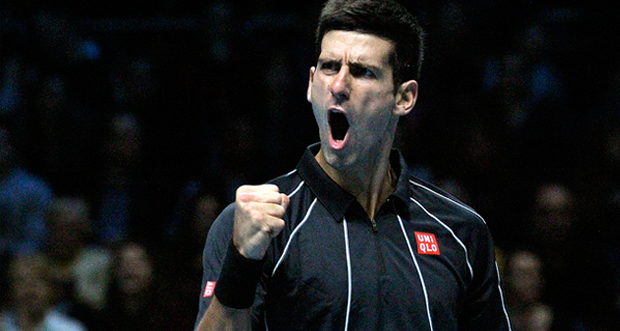
    Novak Djokovic today won the Miami Masters for the fourth time, a mere two weeks after winning Indian Wells, thus re-establishing his pre-eminence on hardcourts just in time for the clay season, and leaving the rest of us with almost nothing new to say. Any point made after Indian Wells remains more or less true after Miami, if not more so. The finalists in California had appeared divinely favoured as all foreseeable impediments were removed from their path. In Florida the gods left even less to chance, excising the draw of likely threats by the quarterfinals, and then striking down both semifinalists before another ball was struck.

    Having both semifinals decided via walkover proved to be a deflating innovation, one that went unappreciated by the local crowd. They booed lustily at the news of Tomas Berdych’s default, although one imagines a large portion of the disapproval can be attributed to the discovery that no tickets refunds were forthcoming. Word is Berdych had a crook gut. Nishikori is notorious for withdrawals and retirements anyway, and his default grew more or less inevitable after he posted a pair of marathon upsets over David Ferrer and Roger Federer. The vexing hypothetical question of what would have happened had Berdych and Nishikori been drawn to face each other and then withdrawn was duly raised. Is there a rule, and if so should it be changed? This matter was addressed by Peter Fleming with devastating practicality. He pointed out that after the first guy withdraws, the second keeps his mouth shut and takes the free passage to the next round. It’s a question of whoever blinks first. Faced with Nadal and Djokovic in rampant form, however, it was probably a pretty easy decision.

    And so it came down to yet another final between this pair, the seven hundred and fourteenth overall, yet, somehow, the first of this year. The hadn’t met since the final of the World Tour Finals, a best of three hardcourt match that Djokovic won quite comfortably. Today’s best-of-three hardcourt match didn’t feel functionally very different. I can only repeat what I said last time they met. Surface homogenisation has eroded the concept of surface specialists, but not entirely. At their best, Nadal is still better on clay and Djokovic is better on a hardcourt. Today Nadal wasn’t really at his peak, but that was mostly thanks to Djokovic, who was.

    The only vaguely fraught moment came early in the first set, when Djokovic fended off a break point, although it was early enough that he would have fancied his chances to break back. As it happened, he didn’t need to, and set about running the Spaniard hither and yon beneath the Miami sun. The air was presumably as thick up Djokovic’s end of the court, but he seemed to be moving more easily through it, and his shots certainly penetrated it more readily. His crosscourt backhand was particularly dangerous. Djokovic’s technical excellence is such that when he is playing this well it’s hard to believe he cannot go on playing like this indefinitely, in stark contrast to the million moving parts of Nadal’s technique, which seems mostly miraculous in that it doesn’t desynchronise more. Today even Djokovic’s rare errors looked purposeful.

    Nadal was broken at the start of the second set, and thereafter the only tension seemed to accrue in his following service games, as he grimly held on to remain only one break behind. Djokovic was typically marvellous on return. Has anyone ever been so good at consistently landing returns within a foot of the baseline? Nadal won only 59% of first serve points for the match. He tried at various points to get the crowd into it, with some success, but it didn’t affect the outcome. A fine final point saw them both finish up at the net, though Djokovic was the one who collapsed in triumph. He sprang up soon enough, and shared a handshake with Nadal that lacked any outward sign of warmth. The world number one looked like he really didn’t want to hang around.

    Fortunately he didn’t have to, since the trophy ceremony was abbreviated for American television. No doubt there was some pressing commitment to broadcast amateur sport played by university students. There were the usual bubbles, confetti and crystal trophies, and that was that. Sky Sports had nowhere else to be, though. Annabel Croft asked Djokovic whether at a certain point today he could feel that he’d broken Nadal’s spirit. ‘Of course,’ responded the champion, and began to riff on the concept of confidence from a position of plenty. He was probably justified in feeling a little cocky.

    The imperious manner in which Djokovic smothers and thereby neutralises those parts of Nadal’s game that have tormented the tour for a decade have been amply catalogued, although there have been few occasions in which the Serb has showcased it better. One such was the first set of last year’s Monte Carlo final, which Sky Sports handily demonstrated by showing highlights of after today’s final. Network programmers have learned to set aside at least four hours for any best-of-three match between Nadal and Djokovic. When today’s final concluded in a mere 83 minutes, there was time to kill, and Greg Rusedski – mercifully – can only go on for so long.

    Djokovic and Nadal between them now hold all nine Masters 1000 events, as well at the World Tour Finals and two of the four Majors. If this isn’t unprecedented, it’s awfully close. (In 2006 Federer and Nadal held all four Majors, the Tennis Masters Cup and six of the nine Masters. I’ll leave it to others to rank these achievements.) Six of the nine Masters 1000 events are played back-to-back, in three groups of two. It has almost grown commonplace for a single player to grab a pair. Last year Nadal won Madrid and Rome in consecutive weeks, and Canada and Cincinnati. In 2011 Djokovic won Indian Wells and Miami consecutively, as well as Madrid-Rome. This doesn’t speak to the modesty of the achievement, but to the high quality of the players achieving it. Winning two of these things in a row – especially Indian Wells and Miami with their absurd 96 draws, abrupt shift from desert to swamp, and over-reliance on Kiss-Cam – is still a mighty accomplishment.

    Overall, it is Djokovic’s eighteenth Masters title, which puts him one clear of Andre Agassi at third on the all-time winner list, trailing only Nadal and Federer. Speaking of Federer, the Swiss has returned to the top four, while David Ferrer by failing to defend his runner-up points has fallen to number six, which should hopefully ensure a few more balanced draws in the coming months. Andy Murray, who was defending champion but lost early, has fallen to number eight. Nadal remains at number one, though his margin has been more than halved in recent weeks. Djokovic, champion in Indian Wells and now Miami, is right on his heels.
  • One Hope Too Many

    One Hope Too Many

    Novak Djokovic

    Indian Wells Masters 1000, Final

    (2) Djokovic d. (7) Federer, 3-6, 6-3, 7-6(3)

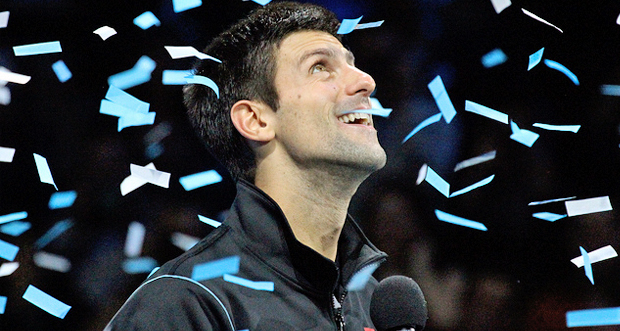
    Novak Djokovic has won the 2014 Indian Wells Masters, embedding himself even more firmly in that group of men who are able to generate endless copy thanks to their records alone. With the great champions, it gets to a point where you can find yourself just going on about the numbers. Arguably the greatest of these was across the net for today’s final, and looked for a time as though he would be the man to triumph once more, thus increasing many of his various records by one. In the end, but only in the end, Djokovic held off the resurgent Roger Federer to claim his third consecutive Masters 1000 title, going back through the Paris Indoors and Shanghai last year. It is also his third Indian Wells title, and seventeenth Masters title overall, and places him equal-third with Andre Agassi on the all-time leader board. As I say, eventually the numbers speak for themselves.

    Aside from the final, the story of the tournament was surely Alexandr Dolgopolov. He startled everyone by beating Rafael Nadal in a third set tiebreak, then delivered an arguably more profound shock by not going down meekly in the following round. I have no statistics at hand, but it has become standard practice to follow up a stunning upset with a dismal loss. Ever the iconoclast, Dolgopolov continued to outpace custom by handily upending Fabio Fognini and Milos Raonic, both in straight sets. Custom finally caught up with him in his first Masters semifinal, when the shreds he was blown to by Federer’s artillery whipped fitfully in the insistent breeze. Nevertheless, the Ukrainian’s ranking has risen from No. 31 to No. 23, with almost nothing to defend for the foreseeable future. Higher seedings beckon, but he’ll always be a dangerous floater. Being Dolgopolov, there’s no sound reason to believe that three strong tournaments in a row and a win over Nadal necessarily mean anything has changed. All in all, enjoy him for what he is worth, for you’ll rarely see his like. Just don’t bank on it lasting.

    Reaching the final guaranteed Federer’s re-ascent to the Top 5, while a victory in the final would have seen him leap over David Ferrer back into the Top 4. Alas, he lost, and languishes about a hundred points adrift. The odds are strong that he will return sooner rather than later, however. Ferrer has finalist points to defend in Miami next week, and one doubts, given his injuries, whether his defence will be sufficiently stout to prevent a tumble from the elite group. Federer didn’t play Miami last year, and thus would likely return to the Top 4 even if he skipped it again this year, an amusing yet not especially significant quirk of the 52-week ranking system.

    Andy Murray, currently ranked at No. 6, will seek to defend the Miami title. After yet another disappointing performance at Indian Wells – he fell to Raonic with all due fuss – it would be easy enough to insist Murray won’t fare any better in Miami than Ferrer. But there’s just no knowing what the Scot will do at the moment, and his perennially execrable level in California no longer necessarily presages similar form in Florida. All that is certain is that his return from surgery has been less smooth than had been anticipated. With the clay season about to commence, now would be a good time to give up expecting too much from Murray for a while. Let any strong results be a pleasant surprise. Come Wimbledon there will be ample opportunity to pile the pressure back on.

    There was a time when John Isner was considered to be his nation’s sturdiest hope on clay, based largely on a few strong Davis Cup performances, and once taking Nadal to five sets at Roland Garros. This probably revealed more about America’s bleak chances on dirt – as an Australian I’m hardly crowing from the high ground – than anything about Isner’s actually prowess. Indian Wells, however, seems to suit him well. Mechanically, it’s no stretch to see why. The thin air and grippy surface combine to render one of the sport’s mightiest weapons if anything more potent: it cuts through the air faster, and explodes off the surface. The desperate home crowd support certainly doesn’t hurt, as opposed to Miami, where North American players come a distant second to those from South America. Nor does the best-of-three format hurt, which ensures Isner cannot indulge his self-defeating passion for endless exertion.

    Still, the stark spectre of impending national irrelevance haunts the US men at every home tournament these days. They (and therefore we) are constantly reminded of the possibility that for the first time no US male might, say, make it to the third round, or be seeded, or ranked in the Top 20. (Again, it’s a wide trail the Australian men blazed years ago.) It usually falls to Isner to save the day, and often he does. Once the smoke has cleared, and Ryan Harrison has provided a meticulous explanation for his latest early round loss, Isner is generally the last one towering, toiling away, interleaving all-American service games with a return style so passive it induces Gilles Simon to yawn. He’s a mystery. Sometimes he perks up and blasts a few big forehand returns, but never for long. Djokovic was less than thrilled when Isner pulled this trick several times as the Serb tried to serve out their semifinal yesterday. Isner then tore through the second set tiebreak, briefly twitterpating the locals. Djokovic only had himself to blame. Once he’d finished admonishing himself he pushed through the third set without hassle. Djokovic hasn’t played well all week, but he has been very good at maintaining his equilibrium. This, more than anything, is probably why he’s the one hoisting the trophy.

    Calmness was fundamental again today in the key moments. There were the usual assortment of bellows, exultant or frustrated as the situation allowed, but when the match coiled tightest he was a picture of equanimity. After a patchy first set, in which Federer played all over him, Djokovic tightened his game up considerably in the second set, doubtless in the hope that if he hung around long enough something fruitful might eventuate. He was rewarded by a poor service game from Federer at 3-4, broke, and then served out the set. He broke early in the third set when Federer’s forehand went momentarily haywire, and rode that almost all the way until the end. As with Isner in the semifinal, however, Djokovic was broken while serving for the match, this time at 5-4. If he erred in this case, though, it was only in attempting greater margin. Federer put together his finest return game of the match, broke lustily to 15, and then held once more to love. From 3-5, he’d won fifteen of sixteen points. Djokovic must have been more than a touch rattled, but maintained his composure beautifully, and, vitally, held comfortably for the tiebreak.

    There was a reasonable hope that what had thus far been a fine and dramatic final might conclude with a fine and dramatic breaker, but this turned out to be one reasonable hope too many. The game whereby Djokovic had held for 6-6 seemingly broke Federer’s momentum, and the Swiss was never to regain it. Djokovic, meanwhile, confined his mood to that narrow band between over-attentiveness and exuberance, and made a virtue out of simply executing the shots he was meant to. The match ended with a weak pair of Federer errors, the first of which put them level on 98 points apiece, the second of which put Djokovic ahead. Statistically it was a terrifically close match – both had even winner/error ratios, served in the mid-sixties, and produced six aces – but it was Djokovic who won two sets to one.

    Both men spoke graciously on the dais. Federer broke new ground by praising the camera operators. Perhaps he was impressed by the new ‘FreeD’ images, although one cannot imagine he was half as impressed as the commentators. I haven’t heard Robbie Koenig sound so enthusiastic since they began measuring the RPMs on Nadal’s forehand. Federer also admitted he was overall pretty pleased with his own form. As exciting as his third set resurgence was today, his resurgence across the first few months of 2014 has mattered more, especially given his poor 2013. Greg Rusedski suggested Federer might be intending to peak for Roland Garros and Wimbledon. It’s the kind of thing Rusedski is, for some reason, paid to say.

    Djokovic for his part conceded that it was “an incredible match – an incredibly difficult match.” For all that it cleaved to the usual format – with Federer leaping out early and Djokovic gradually reeling him back – the subtleties and contrasts inherent to the match-up as ever inspired some great tennis. I find it to be the most consistently interesting of the elite rivalries (others will certainly disagree). Djokovic plays Federer differently to how he plays just about everyone else, which is a testament to his versatility, as is the fact that, despite never consistently playing at his highest level, he is once against the Indian Wells champion.

    [divider]

    Cover Photo (Creative Commons License): Marianne Bevis

  • So Many Yangs

    So Many Yangs

    Ernests Gulbis

    Marseilles, Final

    (3) Gulbis d. (2) Tsonga, 7-6(5), 6-4

    It is a strange quirk that Ernests Gulbis, that least reliable of professional tennis players, somehow boasts a perfect record in tour finals, a record he kept intact today in Marseille. He has now won five ATP titles without losing one, a kind of scruffy yin to so many proven yangs, such as Gael Monfils or Julien Benneteau. Gulbis didn’t get to play either Monfils or Benneteau this week, though that wasn’t his fault, since the former wasn’t here and the latter was defeated early on in another part of the draw. As the truism goes, you don’t get to choose which Frenchmen you face in tennis. You can only defeat the ones who are placed in front of you.

    It was, fittingly, a non-Frenchman Gulbis struggled with. His toughest test came against Roberto Bautista Agut in the second round, although this wasn’t strictly a surprise. (The surprise was that having eluded defeat the Latvian went on winning.) Bautista Agut has distinguished himself this season with several scrapping, aggressive, and defiant efforts, though this week he also distinguished himself by being just about the only Spanish man with a tennis racquet who didn’t show up in Rio. Consider this: there were more Spaniards in Rafael Nadal’s half of the Rio draw than there were Frenchmen in the entire Marseille draw. Once Gulbis had survived that early round struggle, he set about beating any locals he could lay his hands on, starting with Nicolas Mahut, continuing with Richard Gasquet, and concluding today with Jo-Wilfried Tsonga.

    It wasn’t a particularly exciting final as these things are measured, and certainly not compared to last year’s decider between Tsonga and Tomas Berdych. As you’d imagine when two big men face each other on a fast indoor court, the service dominated, though better returning would have helped it dominate less. Gulbis had not been broken since the second round, and Tsonga today could engineer only two opportunities, which he characteristically flubbed. Gulbis, on the other hand, was in plenty of the Frenchman’s service games, although he was no more effective at converting break points, ending the match with a rather  memorable 1/11. The Frenchman generally saved them with muscular play, and managed to do the same with a few match points in the second tiebreak. Gulbis served it out with an ace, before commencing a victory routine from which he’d carefully expunged any trace of exaltation. It made Marat Safin’s celebrations look flamboyant by comparison. You’d think Gulbis wins these things every other week.

    Actually, that’s not far off. He usually wins these things in this week every other year. Last year he won Delray Beach as a qualifier, and his maiden title came at that tournament in 2010. It may seem surprising that he hasn’t returned to Florida this year, but his failure to show up for title defences is another of the few infuriatingly consistent things about him. So far in his career he has never once graced a tournament the year after he has won it. Look for him in Rio next year, or at least anywhere but Marseille.

    Rio de Janeiro, Final

    (1) Nadal d. Dolgopolov, 6-3, 7-6(3)

    Owing to a minor calendar shake-up, Nadal will next week find himself in the rare position of having two titles to defend, in Acapulco and Sao Paulo. Taking a leaf from Gulbis’ playbook, he has chosen to skip both, preferring instead to win this week’s inaugural Rio event. After all, opportunities to be the first name on a new trophy don’t come round every week, presuming there’s a trophy upon which names can be inscribed.

    Nadal almost surprised us all by not winning the tournament, though got there in the end. The direst moment came against Pablo Andujar in the semifinal, a match that saw the world No. 1 recover from a set down, and finally take it in a mighty third set tiebreak, saving a pair of match points along the way. For once the bromidic phrase “he found a way to win,” usually uttered at the first faint whiff of adversity, was actually merited. Usually the way he finds entails being better at tennis than his opponent, but against an inspired Andujar there were stretches of the match in which Nadal was emphatically outplayed. Indeed, Andujar won more points overall. Alas for him, he lacked either the savagery or the cold precision necessary to claim the points that mattered most. He has thus been relegated to a statistical anomaly – this was the first time Nadal has won from match point down since beating Troicki in Tokyo in 2010.

    Alex Dolgopolov’s half of the Rio draw had, for a wonder, boasted only two Spaniards, but they were two of the toughest in David Ferrer and Nicolas Almagro, although the latter has lately learned to be as disappointing on South American clay as he perennially is on the European variety. Throw in Fabio Fognini, and plenty of reasons to be distracted by events back home, and Dolgopolov’s run to the Rio final proved to be a minor masterpiece of tightrope-sprinting. He’d been marvellous, in his dicey weird way. I wouldn’t go so far as to say that there’s no better player to watch when he’s on. Indeed, to say that would be to confess to fetishism. He has a game only a mother could love, but there’s no denying the excitement he delivers, especially for those of us drawn to unpredictable, aggressive tennis.

    Regardless, the betting markets, history, and the general opinion of the person on the street were unanimous in believing that it wouldn’t be enough to get by Nadal in the final. The only exceptions were those subsets of Nadal fandom which insisted that Nadal’s flat performance against Andujar would be sustained into the final: a passionately misguided belief in Nadal’s frangibility has meant some fans fail to absorb the lesson that he very rarely plays badly, and almost never plays badly twice in a row. As ever with Dolgopolov the interest lay in discovering whether the strobes of brilliance could be spaced with sufficient proximity so as to provide consistent luminescence. So far this week they had. His only real chance for the final, however, was to hope they joined up to form a band of light so incandescent it might sear the retinas from Nadal’s head. Dolgopolov lacks anything resembling a bread-and-butter game. Whether through technique or temperament, he appears incapable of sustaining discernible, or at any rate reliable, patterns of play. He is hell to play when he’s playing well. The trick, as far as I can tell, is to force him to have to play well or else, thus ensuring that he probably won’t.

    Nadal, as ever, had the luxury of being able to achieve this by deploying any number of established patterns, knowing that most, if not all, of these would likely guarantee him victory. Today’s patterns involved nothing fancier than the judicious application of just enough pressure to provoke Dolgopolov into over-hitting. This was particularly apparent in the first set, in which Nadal himself hit only one winner, which was the ace he served to seal it. The Spaniard broke early in the second set (as he had in the first), and looked likely to coast it out. Dolgopolov, after all, had not broken Nadal, not merely in this match, but in any of the four other matches they’ve contested.

    It therefore came as something of a surprise when an apparently nervous Nadal lost his way while trying to serve it out at 5-4, the break sealed with yet another scything Dolgopolov crosscourt backhand into the top seed’s forehand corner. I recall how effective this tactic was for Troicki in Tokyo three years ago, thus providing a lesson that Novak Djokovic subsequently learned by rote. You can go crosscourt to Nadal’s forehand, but you have to take the ball very early, and go there flat and with tremendous pace. Dolgopolov went there time and again today with great success, but it’s a dicey way to live, especially on clay, where Nadal is inexorable. He was certainly inexorable in the eventual tiebreak, and Dolgopolov proved all over again that risky tennis only looks good when it comes off. The flashes of light were now spaced too far apart, and soon they went out entirely.

    Nadal won’t be the last Rio champion, but he’ll always be the first. The trophy, worthy of a European indoor event in its determination to reference anything but a trophy, was handed over by the universally beloved Gustavo Kuerten. It’s a kind of lattice-worked wave arrangement, and thus provided plenty of spots for Nadal’s teeth to find purchase. (Marseille, ironically, has a perfectly ordinary trophy, which Gulbis did not bite.) Both men brought up Ukraine’s current situation in their speeches, Nadal graciously and Dolgopolov with all his heart.

    [divider]

    Cover Photo (Creative Commons License): Marianne Bevis

  • Speechless Saying That

    Speechless Saying That

    Australian Open, Final

    (8) Wawrinka d. (1) Nadal, 6/3 6/2 3/6 6/3

    Stanislas Wawrinka has won the 2014 Australian Open, thereby proving wrong those who’d maintained he couldn’t, a group in which he himself was often prominent. At a single broad stroke, which began in his coiled shoulders and uncurled through that mighty backhand, he has become a Major champion, soared into the top three, and stopped Rafael Nadal from becoming the first man in the Open Era to claim a career Grand Slam twice. Due in part to the circumstance and in part to the innate preposterousness of what he had achieved, Wawrinka’s initial reaction was one of muted disbelief, a response that he managed to sustain through the trophy ceremony, and the endless interviews he subsequently granted to all of the world’s main broadcasters. For all I know he is still wearing an expression of bemused incredulity. He wouldn’t be the only one. It was with unabashed wonder that Brad Gilbert on ESPN declared that Wawrinka actually was the Australian Open champion, adding that he was ‘still kinda speechless saying that.’

    To say that Wawrinka was a little lucky is a little redundant. No one wins a Major without some luck, least of all those who aren’t lucky enough to be Roger Federer, Nadal, Novak Djokovic or Andy Murray, collectively known as the big four. Since the 2004 French Open, only three men besides those four have contrived to win a Major – a sequence of thirty-nine tournaments – and in no case was the eventual winner permitted to amble through a wide open draw. At the 2005 Australian Open Marat Safin defeated the first (Federer) and third (Hewitt) seeds. At the 2009 US Open, Juan Martin del Potro also beat the first (Federer) and third (Nadal) seeds. Wawrinka is the first man to see off the first (Nadal) and second (Djokovic) seeds to win a Major since Sergi Bruguera at the 1993 French Open.

    Boris Becker insisted when probed that he would never concede any side of a draw is easier than the other, but then the words that tumble out of Becker’s mouth often bear no trace of a supervising intellect. Perhaps they should have probed him more thoroughly, or with a sharper implement. Wawrinka’s half of the draw was certainly friendlier than the other half, and he was unquestionably helped by a retirement in the first round (Golubev) and a walkover in the third (Pospisil), especially since it limited his exposure to the apocalyptic conditions of the first week. But that merely helped him survive the early rounds, and no draw is benign that brings one up against Djokovic, especially in Melbourne.

    From the quarterfinal until the second set of the final, when events lurched into a strange place, Wawrinka was mostly majestic. As he did with Robin Soderling, Magnus Norman has performed wonders with Wawrinka, and in a relatively short time has ensconced himself among the coaching elite. Unfortunately, even Norman hadn’t anticipated the sharp dip the final would take – a slow turn through the S-bend – and thus couldn’t have known to prepare his charge accordingly. Perhaps he’d figured that the concept of hitting the ball away from an immobile opponent was too obvious to need saying. It turns out nothing is too obvious in a Slam final. It might have been worth a professional code violation to belatedly deliver this complicated message. Marching onto court and smacking Wawrinka upside the head probably would have risked a default, but Norman must have been sorely tempted. I know I was. I suspect even Nadal was by the end.

    Nadal’s back injury inevitably obliges one to wonder what might have transpired had he remained fit, though I confess I don’t find such speculation worthwhile. There was one set in which both players looked fine, and Wawrinka dominated it, but this was his first Major final and there is little reason to think he could have sustained that level indefinitely. One suspects Nadal eventually would have pegged him back. In any case, Nadal’s injuries are a misted, shifting quagmire in which even well-provisioned expeditions are liable to be waylaid and careen over a precipice. Mountains spring from molehills, or at any rate, blisters become volcanoes. Writers who toil hard to maintain a veil of impartiality can fall to anxious weeping the moment Nadal stumbles. There was a moment when he might have twisted his ankle against Kei Nishikori. It soon turned out that he hadn’t, though not soon enough for some alleged professionals to demonstrate that there are in fact fifty-four stages of grief, and that they’re all boring. By the same token, those insisting that Nadal was not injured are certainly wrong, and in many cases have taken their insistence to contemptible lengths. They are also beyond convincing, being possessed by a special kind of mania. As I say, a quagmire, and not worth the trouble.

    Others have insisted they noticed something awry with Nadal early in the first set, if not in the hit-up. Perhaps I’m obtuse, or I was busy staring awestruck at the fearless guy up the other end, but I confess I didn’t see anything wrong. I did remark to my companions that Nadal appeared to have fallen into the trap he used to with David Nalbandian, which was to pay a famous backhand too much respect. Wawrinka’s backhand is, without doubt, a superb shot, one by which I am often reduced to envy. But his forehand remains the more potent shot, and it’s from that wing that most of his groundstroke winners originate. The semifinal was an especially fine showcase for this. Tomas Berdych heard countless forehands hum past. I suppose it hardly mattered, Wawrinka was fearsome from both sides through the first set. It’s worth remembering that this was the first set he ever took from Nadal, though he nearly didn’t. He fell down 0-40 while serving for it, halfway through a sequence of six missed first serves. Nadal then failed to put another second serve return into play, and it’s easy enough to belief his later claim that his back was already bothering him. Something was wrong somewhere.

    The matched changed completely in the second set, which Wawrinka opened in grand fashion by breaking to love. It wasn’t long after this that Nadal evinced clear signs of distress, leaning over and clutching his back, and at 1/2 availed himself of a long off-court medical timeout. Wawrinka, left in the dark on the bright court, took his frustration out on Carlos Ramos, and was only slightly mollified when tournament referee Wayne McKewan emerged with an explanation. There was some concern that the Swiss was thereby squandering valuable energy. Magnus Norman looked on serenely. Nadal re-emerged, encountering lusty boos from the Rod Laver Arena crowd, behaviour that what won’t go down as its finest. (Nadal later said he understood their frustration, though unlike Bernard Tomic he didn’t call a separate press conference to explain himself.) Nadal’s face looked exactly the way it had in the 2011 Australian Open quarterfinal, when an injury early in the first set combined with a ruthless David Ferrer to destroy his at chance at the ‘Rafa Slam’. Wawrinka worked out his vestigial frustration with a brace of aces, while Nadal commenced lobbing serves over at about 140kmh. Before long Wawrinka had won his second set against Nadal. There was speculation that Nadal would default. I didn’t think he would, but believed that the match was essentially over, assuming Wawrinka would do the smart thing and make the Spaniard run.

    This turned out to be a rather large assumption to make. Although physicists have yet to isolate the mechanism by which this process works, injured players will sometimes transform into a kind of localised gravity-well, drawing every ball inexorably towards them. The only reliable way for the opponent to avoid this effect is to launch their shots ten feet out. For the next set and a half Wawrinka tried both these approaches, with limited success. It recalled Albert Montanes’ flailing and dispiriting loss to a crippled Fabio Fognini at Roland Garros three years ago, and Mikhail Kukushkin’s near-implosion against Gael Monfils at the Australian Open. In both cases the latter player could barely move, and was reduced to windmilling his arms at any ball that strayed within reach, generally to devastating effect. In much the same mood, Nadal hardly bothered running for any ball more than a few metres away, but swung lustily at any that landed nearby, which, somehow, was nearly all of them. Thus we discovered yet again that the world number one in a reckless mood is perfectly capable of striking fabulous winners off both sides from neutral balls, leaving some of us to wish that he’d play like this more often. Nadal still missed plenty, however, enabling Wawrinka to achieve multiple breakpoints in every other game, whereupon Wawrinka’s return would explore the bottom of the net or the unscuffed part of the court beyond the Melbourne sign. Nadal’s pace and mobility began gradually to improve, and he won the third set. Wawrinka took to shouting at himself, but not in English. Magnus Norman looked on serenely.

    A match that began electrifyingly for Wawrinka, and continued dismally for Nadal, now spiralled into absurdity for both. Nadal, by his own admission, was mainly continuing for the fans who’d paid a lot of money to be there, but he must have wondered if he wouldn’t be doing them a kindness to end it immediately. Then again, I imagine by this time he was harbouring a few desperate dreams of victory. Aside from his first serve, which Wawrinka could barely return anyway, the Spaniard was starting to play a great deal better. On the other hand, Wawrinka, aside from his serve, had lost all coherence, and his eyes grew clouded with dread. The 2004 French Open final was invoked – always a sure sign that the ropes binding reality together had begun to fray. Jim Courier in commentary pointed out, astutely, that Wawrinka could have lost the final in straight sets and still regarded the tournament as a triumph, but to lose it from this point would be a fiasco. Wawrinka was playing like someone aware of no other fact. He somehow broke, but followed up this accomplishment, monumental in the circumstances, with the worst service game of the modern era, and lost his serve to love. He broke again, more decisively. The crowd went crazy – demented might be a better word – having stared once too often into the abyss. Wawrinka served it out to love, the way exactly no one assumed he would. In deference to his wounded opponent, his celebration was diffident. Magnus Norman leapt to his feet, exultant, and threw his arms around Severin Luthi. Nadal had been granted an unlooked-for hour on court to come to terms with the near-certainty of defeat, but he still looked quite stricken, a look he retained throughout the trophy ceremony.

    Thomas Oh, Kia Motor’s ineffable representative, was so moved by what he’d seen that he kept his speech down to a few minutes, instead of its usual hour. Both players spoke well, though their efforts hardly compared to Li Na’s masterpiece from the night before. Where before they’d booed him, the RLA crowd now hurled their adoration down on Nadal, who fought to quell his tears but lost. Pete Sampras was on hand to dole out the silverware. The official reason for this was because it is the twentieth anniversary of his first Australian Open title. No one failed to grasp the deeper significance, however, which was that, had Nadal won, the world number one would have equalled the American’s Major tally of fourteen. It brought to mind the 2009 final, in which Federer failed to win his expected fourteenth Major. We were in turn reminded that the French Open is only months away. I doubt whether anyone believes Nadal won’t surpass Sampras before long.

    For now, however, the important number isn’t fourteen, but one. Stan Wawrinka, who at some point regressed down the evolutionary chain from being ‘Stan the Man’ to became the ‘Stanimal’, has won his first Major, and has earned his place among the sport’s elite. I, too, feel kind of speechless saying that.

  • An Emotional Feeling

    An Emotional Feeling

    AO Fedal

    Australian Open, Semifinal

    (1) Nadal d. (6) Federer, 7-6(4), 6-3, 6-3

    The Australian Open provides those of us who otherwise avoid commercial television with plenty of excellent reasons not to alter our viewing habits for the rest of the year. Sadly, infrequent exposure means we have built up little tolerance for the unrelenting vibe of ecstatic anticipation, whereby even the most mundane events must be imbued with an unrealistic level of excitement, like a North Korean parade. Thus tonight’s semifinal between Rafael Nadal and Roger Federer was promoted as the most unmissable spectacle since the Normandy landings.

    Worse still are the promos for the shows the networks will inflict upon their loyal viewers in the coming weeks and months. My only exposure to these shows, or even these kinds of shows, comes at this time of year, therefore my grasp of their intricacies may be limited, assuming there are intricacies. Certainly the reality shows seem to feature arcane rule-sets, whilst conforming perfectly to the traditional mission of commercial TV, which is to bring people into your lounge room that you wouldn’t otherwise allow in your house. Indeed, one of the shows – My Kitchen Rules, which sounds like a pun but might not be – bases its format on this very idea. Its conceit is to have a pair of contestants invite the other contestants and judges into their homes and serve them a meal. We are thereby afforded the twin pleasures of watching people prepare food we’ll never eat, which is then consumed by people we’ll never meet. This last is a shame, because some of the table talk is sparkling. One guy does a serviceable impersonation of Jack Nicholson. There are some twins who by their own admission share a single brain, despite being physically separate. Last year’s champion described winning as ‘such an emotional feeling’.

    Some of these contestants and judges periodically turn up in the crowd at the Australian Open, where they’re expertly picked out by cameramen trained for that purpose. Bruce McAvaney and Todd Woodbridge clearly know which side their cross-promotional bread is buttered on, and are diligent in explaining who these nonentities are. Jim Courier does a serviceable job of feigning interest. But his job isn’t to hype Australian television shows; his job is to hype the latest installment of the rivalry between Rafael Nadal and Roger Federer. They have now played thirty-three times, and Federer hasn’t won a match in any format in almost two years, and a match in this format since 2007. Nevertheless, a range of factors led nearly everyone to believe that their latest Grand Slam match might be closer. There was a sentimental desire in some quarters for an all-Swiss final. There was ecstatic concern elsewhere that Nadal’s blister was infinitely more severe than the blisters that the rest of us somehow put up with. There was Federer’s recent form, and Nadal indifferent performances against Kei Nishikori and Grigor Dimitrov.

    As is often the case, the betting markets told the real tale. Nadal was the clear favourite to win, despite early reports that money was flowing for Federer, some of it in response to reports that the Rod Laver Arena roof might be closed. The widespread belief is that Federer, when insulated from the elements, transforms into an ungovernable colossus. Being in Melbourne, I had the advantage of being able to look out my window, and knew that rain was unlikely, and that the roof would therefore be open. News came through that the RLA roof had malfunctioned. It wouldn’t open, or had gained the capacity to love, or something. Leaden quips plummeted dangerously from the sky. Roger Rasheed suggested that Federer had deliberately broken the roof. The latest vapid trend on Twitter is to declare ‘you can’t make this up’ in reference to events that anyone with a modicum of imagination could make up quite easily. It turns out you can’t make up something as wondrous as a stadium roof getting stuck. (There’s conceivably a reference I’m missing, or a substratum of irony. Or it’s just one of those Twitter things, like prefacing a backdoor brag with the phrase ‘that awkward moment’.) Anyway, the roof eventually did open, ensuring Federer stayed at a manageably human scale.

    The breakdown of the Nadal – Federer matchup is by now so well-known that it barely requires reiteration. Nadal hits the ball with enormous topspin to Federer’s backhand, until Federer makes either an error or delivers a shot ball, which Nadal duly puts away. Nadal has proven his capacity to sustain this pattern of play indefinitely without discernible risk. Meanwhile, Federer can only break out of this pattern at enormous risk. This means that their matches are almost always played on Nadal’s terms. What is really remarkable is how rarely this dynamic has actually determined the outcome of their recent matches. What was surprising about tonight’s result was how readily it did. Even last year, a bad year, it was notable how well Federer’s backhand withstood the barrage. This fortnight, finally comfortable with his new racquet, his backhand has been as solid as one could hope for, without hoping for too much. Tonight, however, it was already falling apart when he arrived on court, and Nadal was masterful in denying Federer any opportunity to reassemble it.

    Naturally this isn’t the only dynamic at play. Arguably as important is Nadal ability to ‘reset’ any rally that threatens to spiral away, especially if it threatens to drain away through his forehand corner. Whenever Federer went hard into that corner, almost without exception Nadal would respond with a high looping forehand of his own, moderately paced but very deep, keeping his opponent pinned behind the baseline, and ensuring that Federer could gain no progress within the point. There was also the latent threat of Nadal’s forehand pass. The basic rule when coming to the net is that one should never approach to Nadal’s forehand if he can run at it, stand near it, sight it, or if he is lying handcuffed on a hospital bed in traction to the side of the court. There are no exceptions. All the coaching manuals agree on this. There is nothing wrong with his backhand pass, but at least there’s a chance he’ll miss it. Federer broke this cardinal rule a few times, including in the final game. Whenever he was in trouble, at least through the early going, he approached solely to the backhand, thus delaying defeat for a time.

    One doesn’t thereby wish to imply that Federer approached the net recklessly, or even particularly frequently. He was often given no opportunity to move forward, but even so one searched in vain for the new ideas Stefan Edberg has apparently brought with him. Federer was arguably more aggressive last season when facing Nadal, at least in Rome (suicidally so), Cincinnati (judicious), and the World Tour Finals. Tonight looked more or less like any number of their matches over the last half a decade, only more so, and with due allowance for their respective levels on the night.

    Federer on the night played quite poorly, not quite at the subterranean level of the Brisbane final, but certainly not up to the standard he has maintained through this Australian Open. His serve in particular was less potent than he might have hoped, and all but deserted him in the first set tiebreak, though this more determined its shape than its outcome. Meanwhile, Nadal played well – afterwards he conceded it was his best match of the tournament – which meant that a match that was already his to lose didn’t detain us beyond three sets. There were of course many flashes of brilliance, the brightest of which was a reflexed sliced pass he produced after being wrong-footed by a fine Federer volley, which in turn shocked Federer into a coarse volley error. There were others, such as the backhand return winner in the final game, but what really drove the result wasn’t Nadal’s audacity but the long sequences of bread-and-butter rallying, in which the top seed could build pressure without ever growing incautious.

    After the match Nadal said all the right things, including kind words about how much playing Federer still means to him. ‘When I go on court I have very, very emotional feelings,’ he declared, proving that facing down the mighty Swiss is about as thrilling as winning a reality cooking show. (In Nadal’s defence, English is not his first language, whereas My Kitchen Rules contestants merely speak like it isn’t.) He also neatly admonished Courier for implying that he’d already won the title. He’d watched Wawrinka and Tomas Berdych slug out the other semifinal last night, and was well aware that while both men had erred, it was never on the side of caution. Wawrinka is playing very well, striking the ball with supreme authority, and is now, for the first time, the Swiss No. 1. All the same, the new Swiss No. 1 fares even worse against Nadal than the old one does. Wawrinka has never taken a set from Nadal in twelve attempts. If, as Courier and everyone else anticipates, Nadal does win the final, he’ll become the only man in the Open Era to win all four Majors twice. Imagine how emotional that feeling will be.

  • Lessons Learned

    Lessons Learned

    Australian Open, Quarterfinals

    (8) Wawrinka d. (2) Djokovic, 2-6, 6-4, 6-2, 3-6, 9-7

    It presumably surprised no one when Channel 7’s hype-department went into overdrive at the prospect of another blockbuster match between Novak Djokovic and Stanislas Wawrinka. As with all commercial television networks, Australia’s tennis broadcaster subscribes to the crude conceit that any memorable event must inevitably be repeated if even a few of its defining conditions are present. In this case the defining conditions were the players involved and the best-of-five format. These men played two five-set classics last year, and according to Channel 7 this ensured their next effort was destined to be another. Being steadier and wiser, I wasted no opportunity to inform anyone near me – family members, buskers, stalkers – that there is more to professional tennis than the Majors, and that Djokovic easily dispatched Wawrinka twice at the end of last year, in Paris and London. Only an unredeemed ignoramus, I maintained, would expect another classic. Djokovic would win easily. My son, who has decided that he and Djokovic are going to become friends, was particularly thrilled by this news. As it transpired, the match was a classic. Channel 7 was right, and I was wrong. That may not be the hardest sentence I’ve ever had to write – “Mr Becker, I regret to inform you that your brain condition is inoperable.” – but it’s certainly on the shortlist.

    At least for the first set, it looked as though I’d be proved right. Djokovic was looking exactly like the guy who hadn’t lost a match of any kind since the US Open final in September, who was currently enjoying the second longest Grand Slam semifinal streak in the Open Era. Wawrinka, meanwhile, looked like he couldn’t quite work out where his baseline was, or why it was important that he position himself closer to it. He figured it out in the second set, however, though it still came as a surprise to everyone in the stadium when he finally broke Djokovic, and served it out.

    Crowd sympathy within Rod Laver Arena had slightly favoured Djokovic as the players sauntered on to court, though it could have been that the Serbian fans were more punctual. By the time Wawrinka broke in the third set, twice, there was no doubt which man the crowd preferred. Djokovic was too content to rally with the Swiss, especially crosscourt on the backhand, and rediscovered that this shot doesn’t break down the way other single-handers can. Nonetheless, Djokovic took the fourth comfortably, and broke at the start of the fifth. A reprise of their US Open appeared more likely than their extravagant 12-10 effort from Melbourne last year.

    Then, for reasons ungraspable by rational minds, Djokovic compiled a service game of cosmic awfulness, sturdily mounted on four forehand errors, and was broken back. Both men settled into a long sequence of holds, interrupted briefly by a rain delay. Djokovic went back to holding comfortably. Wawrinka did it harder, but, somehow, legs and mind constricted, he did it. Blithely ignoring the concept of momentum, he finally broke Djokovic with the Serb serving to stay in the match for the fourth time, at 7-8. Djokovic’s brain-wave to serve-volley on match point down has already blossomed into legend. To volley was, to put it mildly, a rash choice, and it was rashly played. He swung at it, pushed it wide, and the three-time defending champion was out. He left the court to a wave of warm regard, which heated to radiant affection once Wawrinka took his chance to speak. He pronounced himself “very, very, very, very happy.” He’d proved me wrong, but in the moment I found it hard to begrudge him his joy. My son was less impressed when I told him the result, but learned a vital first lesson in parental fallibility. It had to happen some time. I won’t complain if he gains something of Djokovic’s perfect grace in defeat, but I do dream he’ll somehow acquire a backhand like Wawrinka’s.

    (1) Nadal d. (22) Dimitrov, 3-6, 7-6(3), 7-6(7), 6-2

    If he falls in with a bad crowd, he may end up with a backhand more like Grigor Dimitrov’s, a doom no parent would wish upon their child. For the first set of today’s match between Dimitrov and Rafael Nadal, the Bulgarian did an excellent job of shielding his backhand wing from the Spaniard’s merciless attention. Mostly he did this by breaking early and serving well.

    This was an unusual match, easily the strangest of the round; not particularly enjoyable to watch, nor, from what I could tell, to play. It boasted little of the drama of Djokovic’s loss to Wawrinka, and none of the quality. Nadal began poorly and never hit full stride. Dimitrov began well, but immediately subsided into woeful inconsistency. He broke early, but thereafter could barely land a return, and saw out the first set on the strength of his first serve alone. Breaks were donated and whimsically re-gifted in the second set. Nadal sought to fire himself up, and succeeded in whipping the crowd into some sort of startled frenzy through the sheer force of his personality, or at any rate the lustiness of his bellows, which for duration and incongruity were a fitting homage to the departed Djokovic. Either man could have taken the second set, but naturally only Nadal did, with a lovely combination of passes.

    The third set was more or less the second set with all the settings dialed up. Breaks each way, flailing inefficiency from both men – Nadal’s serve in particular was heavily affected by a blister on his left hand, which Channel 7 took great delight in showing in dynamic detail, with Spidercam swooping in – an expertly curated selection of beautifully framed forehands, and the inability of both men to sustain pressure. This point from the third set tiebreak encapsulates the overall dynamic quite perfectly: Dimitrov’s tweener lob is the brilliant moment fated to resonate, but observe how once he has re-established himself in the rally he undoes his good work with a sequence of weak, short backhands. Nevertheless, Dimitrov had three set points in total, including one on his own serve. It was a big serve, too – 205kph out wide – leaving him with an attractively pristine acre of court to hit into, or out of, as it transpired. That forehand miss will certainly stay with him for a long time. It was certainly still on his mind in the press conference, as he shed hot tears of frustration. Nadal later admitted to Jim Courier that he’d simply been lucky in that moment, with a relief that had hardly faded in the intervening hour. The fourth set saw Dimitrov fade in the usual manner. He hadn’t played especially well, though he had fought well, and his tournament was over. If he’d been able to land those forehands it might have been a different match, though probably not a different result. If he’d been able to regulate the depth on his backhand better, it certainly would have been.

    (6) Federer d. (4) Murray, 6-3, 6/4, 6/7(7), 6/3

    Nadal will face Roger Federer in the second semifinal, another installment in the most famous rivalry in the sport, an exalted status reflected in its recourse to Roman numerals. This will be their XXXIIIth meeting. Whereas last year’s matches were dominated by Nadal, there is some reason to believe that Friday’s meeting will be more competitive. Federer, with his new racquet and mended back, is back to playing the kind of aggressive tennis he was once famed for, at least for the opening sets of each match. After that his boldness erodes sharply. Two rounds ago he tore through Blaz Kavcic in fearsome fashion, before the third set devolved into an unnecessary dogfight. The same pattern threatened to recur in the fourth round against Jo-Wilfried Tsonga; that it didn’t owed mostly to the Frenchman’s sense of timing, which is not commensurate with his sense of occasion. Tsonga left his run too late, and Federer was permitted to coast over the line. Andy Murray almost committed the same mistake, only coming truly to life as Federer served for the match at 5-4 in the third set.

    Federer commenced in majestic fashion, his forehand and serve both devastating, his backhand impenetrable, and his excursions into the forecourt frequent and decisive. Murray had ambled to the quarterfinals thanks to the most generous draw since, well, his last Australian Open. Federer was thus his first true test, not only of the tournament, but since last year’s US Open. He missed four months of tennis, and last night appeared fatally short of big match practice. I’m not sure anyone besides those ardent Federer fans who exist in a state of perpetual anxiety truly expected Murray to maintain a high level for long enough, in perfect contrast to last year’s semifinal. On paper it was the most appealing of all the men’s quarterfinals, but when it came down to it the stakes somehow didn’t feel very high.

    The Scot finally found his feet in the second set, like Wawrinka the night before forcing himself to venture up onto his baseline. Federer continued to be aggressive, and this was probably the best period in the match, until Murray threw in a poor game to be broken. We can put this lapse down to shortage of match play, but Djokovic had already proved that even the best players don’t really need a reason. Federer served out the set. The third was much the same, with the Swiss entirely untouchable on serve, at least until he stepped up to serve for the match, and thoughtfully reminded us that pressure has internal obligations of its own. Federer tried to coast over the line, but Murray, to his enormous credit, was having no part of it. Invited to step in, he did, heavily augmenting the pace on his groundstrokes, and forcing Federer into error. Federer gained a couple of match points in the tiebreak, and once more reverted into passivity, and was made to pay.

    The fourth set began in much the same manner – Murray’s first service game lasted about a quarter of an hour, and saw Federer gain half a dozen break points, which he mistook for an ideal opportunity to work on his sliced forehand returns. His personal challenge appeared to be to see how many of them he could bunt onto Murray’s service line. It turned out to be a lot. Murray by this point was largely spent, his first serve shorn of pace, and his movement to the forehand corner sluggish. But he was rarely stretched, and made the most of his opportunities to move forward. Federer finally attacked a forehand return on a break point late in the set, and was presumably the only person surprised to learn that this markedly enhanced his chance of winning the subsequent rally. Obliged once more to serve it out, he fell quickly to 0-30, but extricated himself with a bold rally and a brave second serve, before taking the match a few points later.

    Afterwards, forced to explain himself to Courier, he sounded about as relieved as Nadal had, though one was left to wonder if he realises just how weighed-down he lately seems by pressure. At times this tournament he has looked like his old self, not merely the statesman who returned to No. 1 in 2012, but the reckless youth who dominated the world in 2006. At other times, however, he has looked exactly like a man who has learned by heart the lesson that all things must pass, that one’s moments of greatness don’t become less precious the more of them you’ve accumulated, but more precious the fewer of them you have left.

  • Ongoing Commitments

    Ongoing Commitments

    Federer Kavcic AO 2014 -1

    As intimated earlier in the week, one of the more fascinating battles going on this week has been waged not between players, but between the media and the English language. This has entailed an exhaustive quest for original ways to describe the prevailing atmospheric conditions. Rennae Stubbs found a way, though it didn’t necessarily lead to victory: “Can she survive in this heat, which is extraordinarily hot?” Rhetorically, we might generously call this a polyptoton, although it would exhaust generosity to call it a good one. On the other hand, Serena Williams’s assertion that the Australian Open is “a great start to the beginning of the year” is just a tautology. That’s okay – words are not her business. Her business is winning tennis matches. Thankfully Darren Cahill was on hand to explain in simple terms how she not only continues to do so, but is actually getting better at it, in clear defiance of her age.

    Today Williams faced Daniela Hantuchova, who several days ago achieved the rarest feat in tennis: prompting the commentators to add a new line item to her official fact sheet. In this case the new fact is that she can play the piano, an astonishing feat that was demonstrated to the gobsmacked Australian media several days ago, who summarily dubbed her “a concert pianist”. The fact sheet having been amended, there’s now a legal obligation to bring up her astounding musical prowess whenever she appears on screen. From today: “She’s so good at so many things: tennis, piano . . .” The media love nothing more than celebrities – athletes, actors, US presidents – demonstrating hitherto unrevealed musical talents, no matter how meagre those talents truly are. The fact is, Hantuchova is a concert pianist in the same way that I am a professional tennis player. YouTube suggests her pianistic wizardry has been revealed many times before. (For the record, Williams was out of sorts, but still won. Hantuchova played very well.)

    Of course, supplementary talents don’t have to be musical. Anything not directly related to tennis will do, down to and including functional literacy. More than once I’ve heard Janko Tipsarevic called a “borderline genius” because he has read Dostoevsky. Perhaps Benjamin Becker should try that, since the poor guy’s fact sheet hasn’t been updated in nearly eight years, and still only features two items. Firstly, he isn’t related to Boris (Boris confirmed this personally in the Australian Open’s draw ceremony). Secondly, he was the guy up the other end in Andre Agassi’s last match (Boris also mentioned this, amply fulfilling his ongoing commitment to supply no insight whatsoever).

    Speaking of Agassi, he’s back on Australian television screens this year, fulfilling his ongoing commitment to talk very slowly over thinly-disguised Jacob’s Creek commercials. The overall success of the campaign is apparent in this year’s expanded budget. This time the ads are shot on location, and feature an extended cast including Steffi Graf, Agassi’s brother Phil, his Dad Mike, and Gil Reyes (who was included last year, but this time has more to do). The glacial solemnity of the delivery and the intrusive soundtrack as ever lend Agassi’s inspirational words a slightly creepy edge. It’s no stretch to imagine the weapons-grade sentimentality of the opening film breaking tough prisoners at a secret torture facility. After that, however, something miraculous happens — the rest of the ads are actually pretty good. As far as I can tell they each reprise material already featured in Open, but that’s understandable; any anecdote worthy of a wine commercial shouldn’t be omitted from one’s autobiography. ‘Magic’, the fourth and final film, is a trifle overwrought, with a syrupy orchestral track and a “magic mountain”. This mountain is the one Agassi would famously toil upon in order to prepare for Australia’s cruel conditions, its magic evident in its efficacy. Few players have mastered those conditions more thoroughly. Thirteen years ago I watched Agassi run David Prinosil into the ground on a very hot Melbourne afternoon, until the German keeled over and couldn’t get up. Times were different, and I don’t recall that it was regarded as a moral issue. If Prinosil was still playing, no doubt it’d be on his fact sheet.

    For the longest time, networks kept their fact sheets safely out of sight, but no longer. Channel 7, in line with its “ongoing commitment to the evolution of tennis coverage”, has recently taken to sharing selected titbits before each match. A box pops up on screen, titled “Things You May Not Know”. For example, did you know that Sam Stosur loves to play “Bejeweled Blitz” on her phone? I hope not. Did you know that Hantuchova loves the film Gladiator? Of course you did: she’s a professional tennis player, and they all do. Apparently Benoit Paire is called ‘‘The Stork” because he is tall and thin. Just in case you assumed it was because he is a qualified midwife. Last night he recovered from two sets down, running Nick Kyrgios into the ground on a very hot Melbourne evening. It was tremendous entertainment, initially contoured by the Frenchman’s forehand, which for long periods barely worked at all, and later by the Australian’s legs, which gave out entirely. Given his technical issues, it was a commendably patient performance from Paire, laced with just enough of his characteristic lunacy to keep things interesting. Kyrgios is the image of untrammelled youth on court, but afterwards was as gracious and thoughtful as you could hope for.

    Juan Martin del Potro last night contrived to lose to a laudably determined (and surprisingly inspired) Roberto Bautista-Agut. Del Potro was considered a pre-tournament favourite, or at any rate represented the sole reason to believe Rafael Nadal wouldn’t reach the semifinals unhindered. Nadal wasn’t significantly hindered by Thanasi Kokkinakis, conceding just eight games, although those eight games were accumulated with sufficient panache that Australians now feel some reason to maintain hope for the future, a rare sensation in these Tomic times. Andy Murray was completely untroubled by Vincent Millot, even, it turned out, when he trailed 1-5 in the third set. Roger Federer was imperious against Blaz Kavcic for two sets, then merely good enough for one more. The main interest, apparently, was that Federer was scheduled to play on Hisense Arena, the first time this has occurred since Gladiator appeared on DVD, to the collective ecstasy of both professional tours. Britain’s The Telegraph contended that this reflected Federer’s “current status among the also-rans of the top 10”, although they failed to address what this says about Murray, who as of the third round will have played on Hisense twice. Interviewed after the match, Federer gave every impression that he didn’t much care where he played, though the Hisense crowd couldn’t have been more delirious in their appreciation that he’d played right there in front of them.

    Gilles Simon followed up his complicated five-set victory against Daniel Brands with another against Marin Cilic, all on a broken foot. Details have been slow to emerge, but it seems Cilic served for every set at least fifteen times, and that at one stage play was suspended when an escaped panther wandered onto court. Simon will next face Jo-Wilfried Tsonga. Florian Mayer beat Jerzy Janowicz in straight sets today, a stunning upset that more or less everyone expected. Janowicz’s form convinced no one this week, and after losing he conceded he hadn’t spent sufficient time on Magic Mountain, mostly due to injury. He struggled mightily in the heat, but insisted it was his own fault, an unpopular attitude that will certainly go unreported. Mayer will next face David Ferrer, whose quarter is so short on marketable quality that he has already played twice in Rod Laver Arena. It could be, per The Telegraph, that this merely reflects his exalted position among the elite, but I doubt whether anyone truly believes that. If he’d been drawn in the top half, one doubts whether he’d see the inside of Laver before the quarterfinals. He’d be confined to Hisense, in much the same way that Javier Piles once confined him to an extraordinarily hot ball-closet for shirking his piano practice. Or so the official fact sheet says.

  • Magical Moments

    Magical Moments

    Weintraub AO Day1

    Kooyong, Day One

    Australian Open Qualifying, Day One

    ‘Thompson is once again on the precipice of a magical moment in Australian tennis.’

    Australian Jordan Thompson twice came within a point of defeating Richard Gasquet at Kooyong’s AAMI Classic today, a magical result, according to the commentator, that would have equalled Lleyton Hewitt’s defeat of Andre Agassi at the Adelaide International in 1998. He didn’t precisely come out and say that victory for Thompson would have established the youngster on a course leading inevitably to the world No. 1 ranking, but I like to think he implied it. Alas, though it was a fine performance from Thompson – memorable, even, if not magical – he lost. I suppose he’ll have to get to No. 1 the hard way.

    Channel 7 works hard to promulgate the idea that the AAMI Classic is something more than a mere exhibition. Their coverage deliberately makes no distinction between the action occurring in Sydney, an officially endorsed tour event, and Kooyong, a round robin exhibition event conducted in a perennial gale that no one involved seems to take very seriously. A few years ago Bernard Tomic stole an umpire’s shoe during a match; another magical moment in Australian tennis. The year before that I think he beat Novak Djokovic, a result that clearly rocked the Serb to his core.

    A strong performance at Kooyong historically serves as no sort of form guide for the Australian Open, let alone for the tennis fortunes of an entire nation. Recall how Andy Roddick beat Roger Federer in the Kooyong final in 2007, but was then famously drubbed by him two weeks later at Melbourne Park? Hewitt won Kooyong three years ago yet subsequently lost in the first round of the Open. Of course, I disapprove of ‘exhibition’ as a blanket term, since it obscures more than it reveals. The Hopman Cup boasts neither APT nor WTA approval, but it’s still a weightier affair than, say, Federer’s charity match with Jo-Wilfried Tsonga in Rod Laver Arena tonight. For importance, Kooyong is positioned nearer the former than the latter, but that doesn’t mean any of the players necessarily care if they lose. At worst they shrug at the gusting breeze. Usually they just smile with withering wryness.

    Still, the eagerness to unearth future champions is consuming for the local broadcaster, and if potential is what you’re determined to find it’s inevitable you’ll uncover it everywhere. The exception, today, was at the Australian Open qualifying, which for seriousness leaves even the Hopman Cup behind. While Thompson was almost saving Australian men’s tennis across town, only one of ten Australian men had so far progressed past the first round of qualifying. This one, for the record, was Andrew Harris; he played a fine overall match to see off Italian Simone Vagnozzi in straight sets, although he did lose his way in the second set. Later on John-Patrick Smith also moved through, albeit by defeating fellow-Queenslander Ben Mitchell. Marc Polmans was roughly schooled by Paul-Henri Mathieu, which is appropriate since the Australian is still school-aged, though this doesn’t justify the legionnaire’s cap he was rocking. Both Alex Bolt and Luke Saville contrived to lose 11-9 in third sets, to Axel Michon and Paul Capdeville, respectively. Capdeville was one of the few non-Australians to enjoy vociferous support at Melbourne Park today, with a respectable Chilean contingent thoughtfully redoubling their exhortations after he hurled his guts onto court.

    Otherwise, nationalistic fervour rarely attained more than a low simmer. When Yuki Bhambri saved a match point against Potito Starace the resultant applause was far too thin even to be termed a smattering, and it faded to nothing when the Italian actually won. James McGee had a small Irish contingent on hand, and did his best to reward their support by sporting patriotic wristbands, and by putting up a terrific fight against Jimmy Wang. Ruben Bemelmans easily saw off Filip Peliwo, watched over by a surprisingly unconcerned David Goffin – it transpired he’d already withdrawn – and Xavier Malisse, whom retirement seems to be feeding well. I’ve hardly seen Bemelmans hit the ball better, though mostly he just had to keep it deep, secure in the knowledge that Peliwo’s flashes of brilliance, though frequent, were unlikely to coalesce into a real threat. It was never a long wait before the Canadian risked everything. Dan Evans did wonders for British hopes. Oscar Hernandez pulled off the rare feat of making Pere Riba look (comparatively) like a big hitter, but not the rare feat of winning a tennis match. Ricardas Berankis won his first round comfortably, but then he always does. Diminutive stature and too many injuries have conspired to grant his ranking neutral buoyancy, and he is at risk of becoming a qualifying fixture. Flavio Cipolla sliced Filip Krajinovic to shreds, gradually and noisily.

    Amir Weintraub reached the second round of the Australian Open main draw last year, but today lost in the first round of qualifying to Pierre-Hugues Herbert. Sadly, his ranking will consequently drop out of the Top 200. Weintraub was a clear class above Herbert in the first set, his lovely backhand equal parts lethal and secure. He was driven on by a lone fan in the stand, a fan whose voice nonetheless boasted the dulcet resonance of a foghorn. Some in the crowd appeared irritated by these passionate imprecations, but I thought they imparted a little atmosphere to the match that too many other matches were lacking, and set up a lovely call-and-response with the service line judge, a full-chested baritone whom one suspects would make an admirable Lear.

    Alas, the owner of the foghorn voice moved on just as I did, presumably to refurbish his tonsils. I left to watch Mikhail Youzhny practice, a guilty pleasure, under the hawk-like gaze of Boris Sobkin, whose posture is now such that you could serve high tea on his shoulders. (On a related note, I can thoroughly recommend the Grand Slam practice courts for any aficionados of the male hand-clasp; perhaps if you’re compiling a coffee-table book. Every time new players arrive at their designated court, the departing players, their coaches, and any sundry support staff make a point of clasping the arm of every other male present. It looked exhausting, personally, but I understand its value as an internationally understood gesture. The ATP is a confederacy built on the willingness of very fit men to grasp each other’s hands with apparent sincerity, and to go on doing it indefinitely.)

    By the time I returned to Weintraub and Herbert, the latter was up a break in the third, his superior serve dominant. The encouragement flowing from the stands was now all French. Weintraub nonetheless broke back with a mighty effort, and the score reached 6-6, with the Israeli to serve. Herbert won the first point, whereupon he was intrigued to discover there was no tiebreak in the final set of Australian Open qualifying. ‘No tiebreak?! No tiebreak?!’ All the confusion was French. If he was dismayed by this, though, he didn’t let on: he quickly broke to 15, and served it out. The two men clasped hands, one exultant, the other stricken. Unlike Kooyong, where the magical moments mean little, this meant a great deal to both. It means a great deal to all the men here. This is their life, whether that life is based here or far away.

    But it doesn’t mean everything. As he left the court Weintraub was met by his girlfriend, her pretty face resplendent with a consoling grin. She took his hand, he smiled back, and that’s how they walked away.

  • Small Height Situation

    Small Height Situation

    Small Height

    “We’ve talked about Darcis and his small height situation.”

    There were many issues facing Steve Darcis in the first round of this year’s Wimbledon, though his small height situation was among the least of them. A more looming concern was incarnated by the man across the net, known in the business as the Big Nadal Situation. For those of us watching at home the real issue was the commentary, delivered by men whose intimate knowledge of the sport wasn’t matched by a commensurate command of the English language. As ever the urge to sound clever yielded pompous verbiage. Couldn’t they just say Darcis was short?

    Of course, Darcis, who hails from the region of Western Europe known for its Belgian Situation, ended up winning. His Nadal Situation proved less parlous than had been forecast. The rest of us weren’t so lucky. Whereas a routine Nadal victory would have resulted in merely forgettable commentary, the upset of the year inspired many commentators to go for broke. Their instinct was to match spectacular visuals with coruscating wordplay. It was not necessarily a bad instinct to have, and in some cases worked out to everyone’s benefit — except perhaps Nadal’s. The best commentators rose heroically to the occasion, because they are the best talkers. In too many other cases, however, the sure instinct was undone by bad technique.

    My eagerness to poke fun at poor commentary should not be construed as a comment upon the relative difficulty of the task. This should go without saying, but sadly cannot. The most common defence of commentary is that it is not as easy as the armchair critics fondly believe. This is undoubtedly true, and indeed we are afforded daily proof that it is in fact the hardest job in the world. But this in turn begs the question of why so many patently unqualified people somehow believe they can do it well. Perhaps they were misled. I’m sure Barry Cowan didn’t think it a particularly taxing gig when Sky Sports offered it to him. I suspect he still doesn’t find it very taxing. Perhaps that’s the problem.

    Either commentating is easy and anyone can do it, or it’s hard and few can. I’m not convinced it matters. Whatever the case, there’s no reason to put up with professionals doing it badly, nor does its putative difficulty disqualify anyone from criticising. Proficiency in a given profession is not a prerequisite for noting when it isn’t done well. If a tradesman does a shoddy job repairing my washing machine, he isn’t above reproach simply because I cannot do a better job. No doubt any attempt to fix it myself would instill a heightened respect for the complexity of the task, but it wouldn’t alter the fact that repairing white goods is something that can be done well, and that a more competent repairman would have left me with a working appliance. The existence of good commentary proves that bad commentary isn’t necessary, despite strong evidence to the contrary.

    Commentary is a little like tennis, in that some are more suited to it than others. The key difference is that bad tennis is self-correcting. Players who underperform typically lose matches, and consequently see their ranking decline. Weak commentators get a pay rise. Of course one’s view of what constitutes weak commentary is ultimately a matter of preference. One person’s Robbie Koenig will be another’s Cliff Drysdale (quite aside from the tendency of various fan-bases to organise themselves tribally according to perceptions of bias, measured with instruments so hypersensitive they leave the James Webb telescope looking like a dowsing rod). The venerable adage that there’s no use arguing matters of taste still has currency, notwithstanding the internet’s ongoing mission to prove otherwise. I understand that my preferences aren’t likely to be shared by others, especially since I place no importance on whatever opinions the commentators happen to hold. I don’t care which players they favour, so long as whatever they have to say is said well. Sometimes I’d prefer it if they didn’t talk about tennis at all. Indeed I invariably enjoy listening to Craig Willis on AO Radio more than any “proper” commentator, and he only ever mentions the tennis when the person sharing the booth delivers an elbow to his ribs. But perhaps he isn’t to everyone’s tastes.

    Some fans love Boris Becker. I find him tiresome and obvious. It has been pointed out elsewhere that many viewers initially like John McEnroe, but find him harder and harder to take as they grow more familiar with the sport. Lines that seem insightful at first sound platitudinous after a while, his inclination to self-promote can grow wearying, and his ignorance of players ranked beyond the Top 20 is deplorable. Apparently there are Americans who enjoy Brad Gilbert’s work, but then there are Americans who enjoy spray-on cheese. Conversely some viewers cannot handle Mats Wilander, but I think he’s O.K. I appreciate the way he doesn’t feel a serious point must be ground down beneath excessive solemnity.

    Granting for the moment the near-insurmountable difficulty of the job, surely we can conclude that the skill set required for a good commentator is not the same as the one required to be a great tennis player. Achieving renown as a player doesn’t necessarily preclude a talent for calling matches, but nor does it guarantee one. Why, then, do television networks fall over themselves to hire ex-greats? It probably comes down to trust, and the fact that most people watching coverage of a tennis match (or any sport) probably don’t really know all that much about it. For viewers who regard the basic rules of a sport as inscrutable arcana, there’s doubtless a measure of reassurance in having those rules explained by a well-known champion. Wedded to this is the assumption that the well-known champion boasts a deeper insight into what the players on court are currently thinking and feeling, having been there and done it themselves. All ex-pros believe they possess this special power, though only McEnroe seems convinced he is clairvoyant.

    It is the natural conceit of all disciplines that their inner workings are impenetrable to the mere layperson, a conceit often propagated by a clergy intent on making its presence essential. In the case of theoretical physics this is justified. In other cases, such as tennis … not so much. Networks naturally milk this assumption for all it’s worth, and they aren’t wrong to do so. When Channel 7 brings in Lleyton Hewitt to commentate at the Australian Open – he usually enters the booth one round after he has exited the main draw – there is without fail a promo in which he promises us plebeians that we’ll be vouchsafed a unique glimpse into the workings of each player’s mind. For those of us who’ve both watched and played a great deal of tennis, Hewitt’s insight usually turns out to be less unique than advertised. Mostly he says the same stuff as the other commentators, although I hasten to concede that there’s enough original material to justify his spot.

    It is in the specific details that ex-pros like Hewitt add real value. When, during David Ferrer’s abject loss to Novak Djokovic at this year’s Australian Open, Hewitt revealed precisely how he himself had responded in a near-identical situation the year before, he was providing a level of insight available nowhere else. It was excellent commentary. In his first year with Channel 7 he mentioned that he and Nadal often play golf, and that the Spaniard is just as competitive on the course as he is on the court. Again, it was specific detail, and fascinating. Koenig is another with a tremendous memory for the key facts, often acquired personally. What a treat it was to hear him discuss Radek Stepanek’s early days on tour, and how the Czech had grown so disillusioned he’d almost quit. I’d never heard any of that anywhere else, but even if I had it was worth hearing it again from someone who’d learned it firsthand. He was there.

    But no one can sound like that all the time. There’s only so much to say. Even Darren Cahill, whom I consider to be the best commentator in the world, has to repeat himself from time to time (and he is justified in doing so, since his material isn’t infinite, and he must assume that today’s viewers weren’t necessarily yesterday’s). Most commentary is merely filler, and it is here that the real pros earn their salary. This is the moment when weak commentary becomes helplessly mired in cliché – the essence of which is not falsity but lifelessness – and homilies. The capacity to make a general point in an interesting way is one that I am bound to consider exceptional among ex-champions. The colour guy is there to supply just that, but the backbone of the call must be provided by those with an assured command of language, such as Jason Goodall or Gigi Salmon. One mustn’t necessarily speak flawless Queen’s English, like Frew McMillan; again, Cahill’s conversational style is fine, as is Peter Fleming’s. All share the ability to convey serious points with a light tone, and to let the tennis speak for itself when it can.

    The real problem comes from those ungifted speakers who nevertheless believe themselves to be skilled orators, especially the species that believes “small height situation” is an improvement on “short”. Becker has some notoriety in this area, and Roger Rasheed apparently thinks in neologisms, although for me the exemplar remains the cosmically pretentious John Alexander, now mercifully retired. It is always worse for a commentator to overestimate their stylistic mastery than to be ignorant of style at all. For anyone who works with language, including writers, dim awareness of the power of words is lethal when possessed by those ill-equipped to harness it. At least those innocent of linguistic intricacy will occasionally stumble out of their own way while they make a useful point. The overwrought stylist will never do that, though, since they instinctively know that the key moments should be accompanied by the most incandescent displays of technique. Thus it is that a merely workmanlike commentator such as John Fitzgerald is far preferable to a portentous buffoon like Alexander.

    Alexander, or JA as he was called by those forced to work with him, was without question the worst commentator I have ever heard across any sport. His dark gift was to combine a narrow and dated knowledge of tennis with a delivery so relentlessly grating that you were left to wonder (and regret) how phrases that lacerated your brain could somehow leave your eardrums intact. Temporary deafness would have been a mercy. Apparently unaware that television differs from radio in its ability to transmit images, Alexander’s most reliable trick was to very slowly recount the point everyone had just watched, in granular detail and a reverential murmur, as though he was narrating Napoleon’s coronation.

    The early stages of Jim Courier’s current tenure with Channel 7 was a fraught time for the American, quite aside from the moment he first laid eyes on the anchor Joanna Griggs and inquired on air who “that bimbo” was. He clearly felt nothing but contempt for Alexander, a feeling that was apparently reciprocated. Channel 7, subscribing to the dirt-common belief that mutual animosity might generate memorable frisson, ensured they always shared the commentary booth. Alexander’s knowledge of tennis more or less atrophied in 1986, while Courier as an elite player popularised the tactic of running around the backhand to unload on the off forehand, one of the pillars of the modern game. Thus would Alexander roundly admonish any player who ran around his backhand for leaving the court open, while Courier would wearily point out that this is how tennis is now played. Alexander felt it was too risky. Indeed, he was a passionate advocate of caution, believing that everyone should “play within himself”. This was a common phrase of his, along with “he measured the ball, and hit it for what it was worth.” He would condemn qualifiers who over-hit against Nadal for not playing within themselves. Courier, his patience at an end, would try to point out that their only chance was to go for everything and hope it went in. JA wouldn’t hear of it. Courier told JA he sounded like a broken record, in a tone of voice that suggested he’d be perfectly willing to make JA look like a broken record. He clearly wanted to hit JA for what he was worth.

    We are sometimes cautioned that sports and politics should not mix, in the naïve belief that sport could remain free of politics even if it wanted to. Personally, I’m thankful politics does intervene from time to time. In 2010 Alexander became a member of Australia’s federal parliament, winning the seat of Bennelong as a conservative candidate – his platform was radically progressive compared to his approach to tennis – defeating the immensely capable Maxine McKew. It was a shame McKew had to go, but it was probably worth it to get JA off my television. His politics aren’t mine, but long may he serve.

    If you believe, as I do, that the means by which professional tennis is transmitted to the general public cannot be usefully subtracted from the overall package – i.e., that television is not tangential to the sport’s function as entertainment, but fundamental to it – then it follows that the commentary matters. I have always written about it as if it does. Nevertheless, I’ve no desire to run through a list of all the commentators to whom I’ve ever been subjected. Even if there were space there would be no point. I’m sure I’ve mentioned most of them over the years. Suffice it to say that there are a couple more whose work I enjoy, and many more whose efforts I find ridiculous, yet still enjoy. There are very few from whom I can derive no value at all, and mostly they sin through being dull rather than mistaken. Invariably their dullness reflects a degree of verbal poverty – people who don’t speak well tend to sound the same – which is mostly the result of the mistaken assumption that their business is tennis and not words. The result is not the end of the world, however, merely tedium, or as some would have it: a boring talking situation. But such cases are rare. The truth is that for the most part bad commentary only makes writing about tennis more fun. In the final reckoning I probably wouldn’t be without it.

  • An Effect So Poetic

    An Effect So Poetic

    8705873194_103e921be4_z e

    Davis Cup, Final

    Until last year the tiny proportion of the Czech Republic concentrated in its Davis Cup team had not won the Davis Cup since 1980. They’ve now won it for the second year in a row, by fielding the same two-man squad of Tomas Berdych and Radek Stepanek. Last year they accounted for Spain, the most successful Davis Cup nation of recent years. This year they defeated Serbia, who won the title in 2010, spearheaded by the formidable Novak Djokovic. Yet while the two finals were broadly alike in outline – even the configuration of results was vaguely similar – they could hardly have diverged more in detail. Last year’s final was historically significant, and thrilling from first to last. This year’s was frankly a bore from beginning to end, thus neatly summarising a long season in which a tournament’s last match was seldom its best.

    Last year’s final usefully proved that even Spain is heavily diminished without its best player, while Serbia has now proved you cannot rely only on your best player, especially if he doesn’t play doubles. In neither final did the Czech Republic boast the best player – in both finals Tomas Berdych was soundly beaten by the opposition number one in the reverse singles – but Davis Cup ties typically aren’t decided by who has the best player, but by who has the least worst. Live fifth rubbers are always contested between the number two players, which is why they so often feature as the hero in close ties. Djokovic was impeccable in the 2010 final, walloping any Frenchman placed before him, but it was Victor Troicki’s dismissal of Michael Llodra in the fifth rubber that is destined to be remembered. Or recall Mikhail Youzhny’s defeat of Paul-Henri Mathieu in the 2002 final. More pertinently, remember Radek Stepanek’s dashing defeat of Nicolas Almagro last year. Janko Tipsarevic’s withdrawal several days before this year’s final was thus catastrophic for the Serbian team – Bogdan Obradovic likened his absence to playing tennis on one leg – and removed any tangible doubt about the eventual result. Knowing how things turn out subtracts significantly from the fascination of watching them unfold. There was some chatter as to whether Lukas Rosol should have played instead of Stepanek on the opening day in order to preserve the older man for the hardships to come. The upshot was that really it didn’t matter.

    Anyone who doubts the inherent value of chaos was hopefully reassured by this year’s final. This is what sport looks like in a deterministic world. The weekend unfurled with devastating predictability, like those irritating fight scenes in Guy Ritchie’s Sherlock Holmes films, in which Iron Man and Moriarty hardly bother getting down to fisticuffs because they’ve already mapped out how it’s going to go down. Every match went according to prediction, and none of them went beyond three sets. It was rare for the winning player or team even to cede break points, let alone a break. The closest we came to an upset was Berdych attaining 4-4 in the first set against Djokovic via a series of desperate holds. “Anyone with a hat should be donning it for Berdych!” insisted the Eurosport commentator who wasn’t Frew McMillan. Perhaps he meant “doff”, but his yawns affected his diction.

    What interest there was was confined to the doubles, as is frequently the case. In last year’s final the Czech team encountered a Spanish duo that had just won the World Tour Finals, yet cleaned them up in four sets. This year Berdych and Stepanek’s opposition proved less fearsome in Nenad Zimonjic and Ilija Bozoljac. After the heady thrill of Boise, where Bozoljac performed magnificently to see off the Bryan brothers, and the semifinal in which he and Zimonjic fought gallantly in a marathon loss, the final was a disappointment. One could term it a reality check, but that’s an unkind thing to say about a player like Bozoljac who subsists primarily on the Challenger and Futures tours, where every week is a reality check. He did his best, and it isn’t as though Zimonjic set the stadium alight.

    The pressing issue was whether Djokovic would have done any better. It’s not much of an issue, but given that it is almost the sole point of contention in a searingly uneventful weekend of tennis, it is the issue that is being discussed at length. I’m not convinced it matters. Djokovic doesn’t have much of a doubles record, although he is at present the finest singles player on the planet, especially on an indoor hard court, and that’s historically a recipe for doubles success. Whether it would have been enough to snatch victory is another matter. Word was that after London he was all but spent; winning everything all the time is undoubtedly fabulous, but it does ensure you’re playing all the time. A long doubles match might have hobbled Djokovic for the reverse singles, although admittedly it would have hobbled Berdych as well. The real issue is that Stepanek and Berdych are an excellent doubles combination, and were they to pair up regularly one imagines they would enjoy tremendous success throughout the season. Alas the rigours of the singles tour preclude that possibility. Stepanek of course is a doubles specialist (it ranks highly on his list of endorsed skills on LinkedIn), and has won multiple Majors.

    It turns out he is also a specialist at closing out Davis Cup finals – he now is the third player in history to win two live fifth rubbers at this stage of the competition – whether it is against Nicolas Almagro or Dusan Lajovic. Unlike Almagro, who was left alone and forlorn for far too long by his compatriots after last year’s defeat, no one anywhere holds Lajovic’s loss against him, and his team was lavish with its consolation. It had been a very big ask. No doubt a Davis Cup final is a tremendous opportunity for a young player to make his name, but there are limits. Sink or swim is beside the point when you’re thrown in with crocodiles. Stepanek was as relentless as the tide, attacking without pause, and gave the youngster nothing.

    Afterwards he was overrun by his teammates, while the Czech contingent in the stands went justifiably berserk. Defending a Davis Cup title is considerably rarer than winning one. Stepanek soon extricated himself from the pile of bodies and set to vaulting the net, to the delight of the Czech fans, and no doubt the bemusement of the Serbs. Later he proffered the tactful opinion that not playing Djokovic in the doubles had been akin to “leaving your Ferrari in the garage”, ensuring that for some bemusement was transformed into outrage.

    Berdych later failed to mollify his hosts by asking why Djokovic wasn’t at the post-final dinner, enquiring whether the world number two was still in the “garage”? It gave most of us something to be mildly amused by, and a certain species of plodding moraliser something to get really worked up at, which they duly did. Thus did a forgettable final weekend conclude with a modicum of interest. If only there’d been some tennis to match it. As I said last week, you cannot have everything. If you’re the Czech Republic, however, you can have the Davis Cup — again.