Category: El Dude’s Statistical Fetishism

El Dude Statistical Fetishism Tennis Blog at the Tennis Frontier by Jonathan Northrop.

  • Visual Depiction of Big Four (+2) Dominance

    Visual Depiction of Big Four (+2) Dominance

    [divider]

    Click here to discuss this with fellow tennis fans in our discussion forum.

    [divider]

    Note: I received a couple requests to post this to the blog – which I’ve neglected thus far – so I thought I’d take the opportunity to get the gears turning and post some entries. Expect more of the same – statistical analysis and historical surveys. 

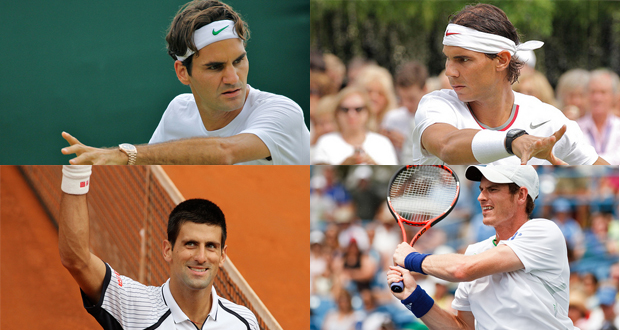
    I thought it would be interesting to create a chart that depicts the levels of dominance of the “Big Four” over the last decade. With apologies to Tomas Berdych and Jo-Wilfried Tsonga, I’ve included David Ferrer and Juan Martin Del Potro to flesh it out a bit with a couple from the next tier of players.

    The graph might be a bit confusing at first but I think the key is to focus on each player’s line to see how it changes, then go to the next player, etc, and then put it all together.

    What do the numbers mean? They are the average of how many matches a player won per Slam played in a particular year. This does NOT include Slams a player didn’t enter, nor does it include qualification victories or take note of walkovers. The key is simple: 2R = 1, 3R = 2, 4R = 3, QF = 4, SF = 5, F = 6, W = 7. So, for example, Andy Murray was in the Final at the Australian Open (6), missed the French Open, and won Wimbledon (7). I am not penalizing him for missing Roland Garros as that would inaccurately reflect his actual performance, so the total of 13 is divided by 2, for an average of 6.5.
    It should go without saying that not all Slam rounds are equal, which this method implies. But this system is not an attempt to measure overall greatness via Slam results – I’ve done that in past forum posts and may resuscitate my methodology here in the future – but to look at the players relative to each other.

    So here’s the chart (click on it to make it large enough to decipher):

    20130709051732

    A few things pop out to me:

    • Notice that Andy Murray (green) is the only player to equal or improve his results from each year – his line just keeps getting better and better.
    • We can see that Roger Federer’s phase of dominance is quite clear: 2004-2009, with Rafael Nadal equaling him in 2008.
    • The downward trend for Roger and Rafa is alarming. Obviously it is skewed by their early exits in Wimbledon, but I don’t think we can discount that as an anomaly. This strongly indicates that both players are in decline – yes, Rafa as well as Roger.
    • Contrary to a view I hear occasionally, Novak in 2012-13 is not the same player he was before 2011; he isn’t quite as good as in 2011, but he’s definitely a notch above 2010 and before – at least according to his Slam results, which I think is the single most important indicator of a player’s level.
    • It is interesting to note Ferrer’s dip in 2009-2010, and then his resurgence in 2011 until the present – his best tennis so far. A rare career trajectory.
    • As for Del Potro, we can see that in 2009 he surpassed Andy and Novak and then dealt with injuries. Hopefully he can get back there, although it may be too much to expect a truly elite season (which we could define as >5, or averaging more than a SF in each Slam).

    What does this chart tell us in general? It supports what we all likely already know, that the “Fedal Era” is over and has been over for a couple years now – at least in terms of their shared dominance. It also suggests that Andy Murray – at least in 2013 thus far – is right there with Novak Djokovic. If we consider the “Fedal Era” to be 2005-2010, given the age of “Djokurray” (both 26), it seems unlikely it will last as long, but we can say it is 2011-13 so far, with possibly another year or two ahead.
  • Why Was Sampras More Prone to Upset Than Current Greats?

    Why Was Sampras More Prone to Upset Than Current Greats?

    It seems to me that the current greats – namely Federer, Nadal, and Djokovic – aren’t being upset in early rounds as often as greats in the past were. Most great players during their very prime seem to make it to at least the QF of every Slam, if not the SF or beyond. But it seems that the current crop are particularly “un-prone” to an early upset.

    For example – if we count a player’s “peak” as being between their first Slam win and their last (which of course is rather artificial and not true, but gives us something to look at), we get the following numbers:

    Federer: First – Wimbledon, 2003; Last – Wimbledon 2012. 37 Slams, 37 played. 35 were QF or beyond; 32 SF or beyond.

    Nadal: First – FO, 2005; Last – FO, 2013. 33 Slams, 29 played. 24 were QF+, 21 SF+.

    Sampras: First – USO, 1990; Last – USO 2002. 49 Slams, 47 played. 34 QF+, 28 SF+.

    Just looking at those three we can see that Sampras was a lot more prone to be upset before the QF. Between his first Slam victory and his last he went out of 13 Slams before the QF. Now with Sampras we should note that he both won a Slam very early – almost three years before his second – and one very late, over two years after his second to last. But if we look only at Sampras’ very highest peak – from Wimbledon of 1993 to 1997, a span of 17 Slams, we still have four upsets before the QF.

    If we look at other greats we see similar patterns, except for perhaps Lendl, who only went out twice between his “bookend Slams”, but that’s a rather narrow span of only 23 Slams, partially because he won his first quite late. And Borg of course, who went out early only three times in the 21 Slams between his first and last wins, but he had a rather narrow span, and of course didn’t play the Australian Open at all during that span. But Becker, Edberg, Wilander, Agassi, Connors, and of course Sampras were all prone to be upset, some quite frequently.

    Now maybe we should just stick to “inner circle greats” – those with 10+ Slams: Borg, Sampras, Federer, Nadal, and we’ll include Djokovic because he looks like he’s heading there. We don’t have enough info to go on, but it’s at least notable how many times Sampras alone went out earlier compared to the more recent players.

    So my question: Why is this? I see a few possible reasons:

    1) Sampras was not as good during his prime as the current greats (or Borg, for that matter), or at least was more erratic
    2) The courts were more diverse in the 90s making utter dominance more difficult
    3) The second tier talent during Sampras’ era was a lot higher than it is today

    Discuss this train of thought with fellow tennis fans on our discussion forums.

  • Djokovic: 2011-13…signs of concern?

    Djokovic: 2011-13…signs of concern?

    OK, I’m exaggerating but it got your attention! That said, while I don’t think anyone expected Novak to ever have a year like 2011 again (few players have), it seems that he’s even a step behind 2012, at least to date.

    First of all, it should be noted that Nadal is now #1 in the Race to London rankings – despite missing the Australian Open. But let’s take a look at Novak’s performances in the last three years through Rome:

    2011:
    Slams: W
    ATP 1000: W, W, A, W, W

    2012:
    Slams: W
    ATP 1000: SF, W, F, QF, F

    2013:
    Slams: W
    ATP 1000: SF, 4R, W, 2R, QF

    So as you can see, his ATP 1000 record is quite diminished; as in 2012, he had a W, SF, and QF, but in 2012 he had two Final losses to a 4R and 2R loss in 2013. That’s the difference.

    A cause for concern? I don’t think so. But A) I do think that Rafa needs to be taken seriously for the #1 ranking this year, and B) The gap between Novak and everyone else might not be as large as previously thought. In 2011 he was the clear #1, last year he and Federer were about even, and this year it seems that he and Rafa are going to duke it out for best in the game.

    If Rafa wins Roland Garros it should be a very interesting dog-fight to the finish. Rafa would really need to win Wimbledon as well, which he has a better chance at than the US Open. If Novak wins one of the French Open or Wimbledon I think he’s got it.

    Click here to discuss this and more on our Tennis Forums

  • Peak Performance Analysis

    Peak Performance Analysis

    The project started as a way to try to figure out what ages do players have their best year(s) in. I fiddled with a rating system that would be relatively comprehensive but also simple enough not to take an enormous amount of time figuring out. I came up with the following point follows:

    GRAND SLAM: W 10, F 5, SF 3, QF 1
    WT FINALS (& Similar): W 5
    ATP 1000 (or “Super High”): W 4
    ATP 500 (or “High”): W 2
    ATP 250 (or “Low”): W 1

    Tiebreakers are handled by looking at Grand Slam results and Year-End Rankings and ascertaining which, together, points to a stronger season.

    So let’s look at the numbers. I looked at every 4+ Slam winner of the Open Era that played the bulk of their career in the Open Era. I didn’t include players like Rod Laver, Ken Rosewall, and John Newcombe because of inadequate data and/or a good portion of their careers being before the Open Era. I might try to revisit them at some point and do some more research, but it isn’t necessary for the sake of this study.

    So that leaves us with a total of 14 players – probably the 14 greatest players of the Open Era, not including Laver, Rosewall, and Newcombe – with Andy Murray “pending.”

    Just a technical note: A player’s age does NOT necessarily refer to their age at the time of a given tournament, but at the end of the year. Unfortunately this means that a player whose birthday is January 1 and December 31 are considered the same age for that year, but thankfully there wasn’t anything that bad!

    So here we go. Some various stats to begin:

    – The best season overall was Roger Federer in 2006 (61 pts), his age 25 season. Novak Djokovic’s 2011 (age 24) and John McEnroe’s 1984 (age 25) are tied for second (56 pts).
    – The player with the three best seasons, in order, are: Federer (54.7 avg), Lendl (48.0), and Borg (43.7).
    – It is interesting to note that Borg and McEnroe have the exact same five-year average (37.0), with Borg’s three-year average (43.7) being just slightly higher than McEnroe’s (43.0). McEnroe has the best season of the two – 1984 (56.0). Borg’s next three seasons are better than any other seasons of McEnroe’s.
    – Jim Courier’s three best years – 1993 (age 23, 32 pts), 1992 (age 22, 30 pts), and 1991 (age 21, 24 pts) are right along the lines of Edberg, Becker, Wilander, and Agassi, but his fourth and fifth best seasons (9 and 6 pts) are by far worse than any of the five best seasons of any other player. In other words, this system verified what we already knew – that for three years Jim Courier was looking like an all-time great, but then he declined and is stuck in the a lower category, as a “semi-great” along with Vilas.

    So here’s where it gets interesting, and I’ll highlight this in bold because it “answers” my original query: Of the 14 players, every single one had their best year in the age 22-25 range.

    I find that remarkable. Here is how it breaks down:

    Age 22 – Connors, Becker
    Age 23 – Borg, Courier, Sampras
    Age 24 – Wilander, Edberg, Nadal, Djokovic
    Age 25 – Vilas, McEnroe, Lendl, Agassi, Federer

    This means that none of the players had a better year after age 25 as they did age 25 or younger. Some were close, but all had their very best years age 25 or younger.

    Looking at second best years, the range is much wider – from Wilander at age 19 to Agassi at age 29. Other than those two, however, the range is age 21-26, still quite narrow.

    Third-best years vary more widely – from age 19 to 31.

    The point being, tennis players almost without fail play their very best tennis at age 25 or younger, although still play some great tennis afterwards – but no truly great player has yet surpassed their earlier peak year (with the possible exception of Rod Laver in 1969 at age 31, but it probably wasn’t better than his 1962 season when he was 24).

    Of the 11 players who have played into their 30s (so not including Borg, Nadal, and Djokovic), only Connors, Vilas, and Agassi had age 30+ seasons in their top five – and Agassi actually had two, his age 31 season (2001, 24 pts), and his age 33 season (2003, 20 pts) – although the latter is tied with a couple others from his 20s. Federer’s 2012 (age 31, 35 pts) was his 6th best season.

    Speaking of Federer, according to this system he has six seasons better than any produced by Edberg, Becker, Courier, or Agassi. Unreal.

    So looking at players like Nadal, who is in his age 27 season, and Djokovic and Murray, both in their age 26 seasons – and thus all past that magical 22-25 window – what can we conclude? A couple things:

    1) It is very unlikely that any will have better seasons in 2013 and beyond than their best season thus far. If any of the three do, they will be the first of the 4+ Slam winners to do so (I think Andy Murray is the only one with a good chance – Djokovic’s 2011 will be nearly impossible to surpass – but he has only won a single Slam, so we can’t assume anything).

    2) All three should still have great seasons left. While all 11 other players never surpassed their age 22-25 best year, all of them had years of a greater age in their top 5 with the exception of Mats Wilander, all of whose #2-5 seasons were at younger ages than his #1 season. Courier is similar in that there is a huge drop-off between his top three and other seasons, and his top three are age 23, 22, and 21 and the other two are older.

    So in other words, don’t expect Djokovic to ever have a season like 2011. He could surpass 2012 (age 25, 42 pts), but that too will be difficult. But he almost certainly will surpass his third best so far, 2008 (age 21, 29 pts).

    I may post some raw numbers later but I’m beat.

  • Young Guns, Players to watch in 2013

    Young Guns, Players to watch in 2013

    Below are ten players age 24 or younger that could be risers in the rankings and bear watching. They are ordered by current official ATP ranking (as of March 4th), and thus before Indian Wells. I’m also including their birth month and year in parentheses.

    #16 – Kei Nishikori (12/89) – Kei made a big leap in 2011, going from #98 to #25, but his rise was slower in 2012, finishing the year just six ranks higher at #19. But remember that he missed the French Open, as well as Madrid and Rome, so any points in those three tournaments should help his ranking. Like Milos Raonic, Kei is a good candidate to challenge Janko Tipsarevic and Richard Gasquet for a spot in the top 10 this year and should at least become a player regularly ranking the #10-15 range.

    #17 – Milos Raonic (12/90) – Milos cruised up the rankings last year, from #31 to #13. He’s been holding steady in the mid-teens so far this season and hasn’t quite had that breakthrough performance, making it the 4R at the last two Slams and never going past the QF at an ATP 1000. Milos has played seven finals, winning all four ATP 250s and losing all three ATP 500s. Raonic is as good a candidate as any to play spoiler at a Slam or even contend for an ATP 1000, but he doesn’t seem to be able to get over the hump…yet. When he does he could be a similar player to Juan Martin Del Potro at his best.

    #22 – Alexandr Dolgopolov (11/88) – Talk about an enigma. Alexandr looked like he was going to rise quickly when he made it to the QF of the 2011 Australian Open, but has been erratic since. Sometimes he looks like a top 10 player, sometimes he goes out in the first round of a tournament. He finished 2011 at #15 and 2012 at #18; he’s now #22, so the trajectory is not a good one. He needs to straighten things out – he’s going to turn 25 at the end of the year, so he should be playing at his best by now. That said, I see him more in the Gasquet/Cilic mold – very talented, but probably not a regular in the top 10.

    #24 – Jerzy Janowicz (11/90) – Jerzy bust on the scene last year by making it to the final of the Paris Masters, plowing through Andy Murray and a few other top 20 players before David Ferrer taught the youngster a lesson. He followed up with a solid Australian Open, losing in the 3R to Nicolas Almagro. Jerzy is somewhat similar to Milos Raonic: A big man with a big serve, although his serve isn’t as good as Milos’s. That said, his overall game might be as good or better. Like Raonic, he could be a spoiler this year. I think he’ll have his ups and down but will finish the year in the top 20, maybe higher, and have a chance for big things in 2014.

    #29 – Martin Klizan (7/89) – Martin Klizan, you ask? Well, he had a strong performance at the US Open last year – making it to the 4R – and then following it up with an ATP 250 win in St Petersburg, defeating Fabio Fognini. Klizan won’t be an elite player but he could be a perennial top 20 player.

    #31 – Grigor Dimitrov (5/91) – Ah, Grigor, what a tease. He still hasn’t gone past the 2R at a Slam, but has risen about 30 spots in each of the last two years, finishing 106, 76, and 48 in 2010-12, and already has risen half that in this early season. Baby Fed is talented, although probably not talented enough to live up to his nickname. But I can’t help but like him – he DOES have some of Roger’s smoothness, and he’ll occasionally offer a backhand and/or dropshot reminiscent of the Great One. But let’s look at Dimitrov for what he is: A rising talent, but probably not an all-time great. At almost 22, it may be a bit too late for that. But I do have high hopes for Grigor. I think he could be one of a few players–along with Raonic, Janowicz, and Tomic, maybe one or two others–that will start taking tournaments from the Big Four in the next two or three years as they begin to age. In other words, a 21-year old Dimitrov might not be a challenge for a 25-year old Djokovic, but a 24-year old Dimitrov might challenge a 28-year old Djokovic.

    Expect Grigor to firmly place himself in the top 20 by the end of this year, and perhaps vie for the top 10 next year. He may not be a future #1, but in another two or three years he could be one of the 5-10 best players in the game.

    #40 – Benoit Paire (5/89) – For some reason I pair Paire (pun intended) with Klizan. Both will turn 24 in a few months, both seem to have similar upside – top 15-20 at best. Paire hasn’t won a tournament yet, although has made it to two ATP 250 finals, most recently losing to Richard Gasquet in Montpellier. Paire has yet to make it past the 3R at a Grand Slam and most recently went out in the 1R in Australia, so he needs to up his game a bit at the Slams.

    #45 – Bernard Tomic (10/92) – The second great tease of this list. Bernard is one of the few players on this list that actually took a slight step back in the rankings, finishing 2011 at #42 and 2012 at #52. But that’s largely due to the fact that he made it to the QF of 2011 Wimbledon, although had an overall slightly better year in 2012 – and certainly played a fuller schedule. i think Tomic is ready to rise up the rankings and, like Dimitrov, could end the year in the top 20. He could suprise, though, and make it to another Slam QF this year.

    #54 – David Goffin (12/90) – I can’t help but like David Goffin. He started on the tour late, but made his mark last year by making it to the 4R at the French Open and the 3R at Wimbledon. But he only played in three ATP 1000 tournaments, and only made it past the qualifications once, so this year could see a lot of points added. I don’t see an elite player but, like Klizan and Paire, he could find himself a regular place in the top 20.

    #83 – Evgeny Donskoy (5/90) – He’ll be 23 soon, but he bears watching. Why? Well, in his first Slam that he made it past the Qualifications, he made it to the 3R, defeating Adrian Ungur and then Mikhail Youzhny before losing to Kei Nishikori. Yesterday he defeated Tatsumo Ito and will face Andy Murray in the 2R at Indian Wells, so his journey likely ends there. But again, he bears watching. He could rise quickly and enter the top 40-50 in short time.

    Bonus player…

    #330 – Nick Kyrgios (4/95) – Nick Kyrgios? Well, he’s 17 years old and is the highest ranked teenager in the ATP Race Ranking right now, which isn’t saying much but says something. He won the boys event at the AO and is now on the men’s tour. I know nothing about his skills but it is hard not to take notice of a 17-year old on the tour…let’s hope he does well!

    Honorable Mentions – Ryan Harrison, Jack Sock, Rhyne Williams, Matthew Barton.

  • When Can We Expect A New Elite Player?

    When Can We Expect A New Elite Player?

    Let me define “elite player” as someone who is both a contender to win Grand Slam events and perennially in the top 5 – so right now there are only the Big Four (Djokovic, Murray, Federer, Nadal). There are a few “semi-elite” players (del Potro, Ferrer, Berdych, Tsonga) who are dark horse candidates and possible spoilers, but they aren’t really taken all that seriously as contenders to win any Slam.

    As I see it, none of the young players on tour – age 22 and younger – show true elite potential. At best, Raonic and Janowicz look like semi-elite players (and even that’s not guaranteed); Dimitrov just doesn’t seem to have the head for the elite, and no other young player in the top 100 has the talent, in my opinion.

    So in lieu of various conversations about peak years and young guns, a question emerged: What is the soonest that we could reasonably expect a new true elite player? If no one that we know about – or at least that your average, serious tennis fan knows about – is a potential elite player, then any potential elite players are playing in obscurity right now – either just starting on the pro tour and deep in the rankings, or still on the junior circuit.

    So here’s the refined question: How quickly do players rise from obscurity (say, ranked below #100) to elite (say, top 5)? And what sort of steps occur in-between? To figure this out is relatively straightforward: Look at the rankings of historical elite players and see how many years it took them to rise from obscurity to being in the top 5. For this study I’ll use the following criteria:

    1) Players that developed during the ATP Era (1973 and later) – that is, players who were not yet in their prime when the ATP rankings begain. One exception is Jimmy Connors who was already the #3 ranked player at the end of 1973, but we can get a good enough sense of his development from 1970 onward. This cuts out some early greats like John Newcombe, and of course Ken Rosewall and Rod Laver. It also excludes players like Stan Smith, Ilie Nastase, Jan Kodes, and Arthur Ashe. We just don’t have good rankings to go on before the ATP era.

    2) I used a “Slam Greatness” statistic to differentiate elite from near-elite. This system assigns 12 pts for a Slam win, 5 pts for a Final, 2 pts for a Semifinal, and 1 pt for a Quarterfinal. I then somewhat arbitrarily cut the list off at 35 or higher; this include Vitus Gerulaitis, but excluded Juan Carlos Ferrero and Sergi Bruguera (both with 31 pts). If anything, I would have liked to cut it off at a higher point level but I wanted to include Gerulaitis as an example of a player who was consistently the “best of the rest” amidst one of the greatest fields in tennis history.

    So here are the players, listed by their “Slam Greatness Quotient” (or SGQ):
    263 Federer
    204 Sampras
    175 Lendl
    173 Connors
    167 Nadal
    163 Borg
    163 Agassi
    127 McEnroe
    120 Edberg
    113 Becker
    113 Djokovic
    83 Vilas
    75 Courier
    52 Murray
    51 Roddick
    46 Hewitt
    42 Kafelnikov
    42 Safin
    41 Kuerten
    40 Chang
    40 Ivanisevic
    40 Rafter
    35 Gerulaitis

    (In case you’re wondering, the current “near-elite” players have the following SGQ: Del Potro 21, Tsonga 16, Ferrer 15, Berdych 13; these are comparable to players like Nalbandian with 18, Henman with 16, and Davydenko and Soderling both with 14).

    That gives an a range of the all-time greats to players that were great for a short period of time (e.g. Courier, Kuerten) or truly excellent for a significant period of time (e.g. Chang, Ivanisevic). You might notice that the only multi-Slam winner–other than pre-ATP era players–not on there is Sergi Bruguera; he’s actually one of the reasons I cut the points off where I did. Bruguera is an example of a player who wasn’t a true great, and lesser than many players that won one or even no Slams, in my opinion – he was a clay court specialist who won the French Open twice, but didn’t make it past the 4R in any other Slam. Gerulaitis, on the other hand, while only winning one Slam – and the AO at that – was a consistent top 5 performer for seven years and competitive at all Slams. I suppose you could say that, statistically at least, Vitas was a bit like Nalbandian if David had won a Slam, or like a slightly lesser version of Andy Murray if Andy didn’t continue at a high level for the next few years.

    On a side note, and not particularly relevant to this discussion, we can also see that using the SGQ, there are clear tiers of players – with big gaps between Agassi and McEnroe, and then again between Djokovic and Vilas, and Courier and Murray. I think it is safe to say that A) Djokovic will (probably/at least) join the non-GOAT inner circle elite of Lendl/Connors/Borg/Nadal/Agassi, and B) Murray will (probably/at least) join Courier and Vilas as the “gatekeepers” between the true greats and the lesser greats.

    So that lays the groundwork for the next stage, which will be to look at each of those 23 players and their rankings – how long it took them to rise from obscurity (outside the top 100) to elite (top 5), and thus get a sense of the earliest we could hope to see a new elite player.