Category: Arienna Lee

Arienna Lee is a psychologist and storyteller in the Northern California. She writes about tennis and the psychology of tennis. She likes long walks on the beach, fist-pumps, and one-handed backhands.

  • Alive Verse

    Alive Verse

    Roger Federer

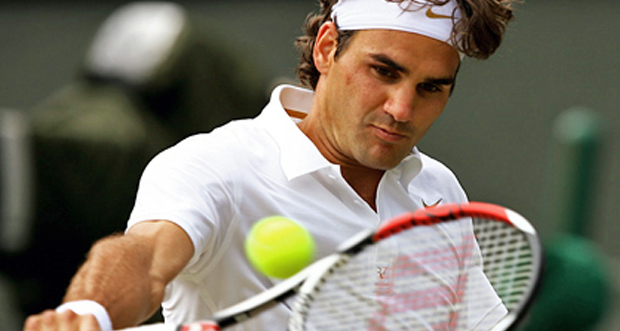
    The Championships at Wimbledon, 2014 Men’s Final

    [1] Novak Djokovic def. [4] Roger Federer 6-7(7), 6-4, 7-6(4), 5-7, 6-4

    A little less than a fortnight ago, on a drizzly afternoon in London—which also happened to be a gray, foggy early morning in Northern California—I read an essay by Clive James on Camille Paglia’s book Break, Blow, Burn: Camille Paglia reads forty-three of the world’s best poems (Knopf Doubleday2005)The dry, sometimes sour Australian commends Paglia’s skill in the face of a difficult task. Explaining the meaning of poetry—writing on writing that describes the indescribable—without snuffing out its essential mystery requires sure-footed assertion and lacewing intricacy. In the essay’s final paragraphs James moves on from his book review to scold, first, Americans in general, and then Paglia specifically, for failing, in certain important ways, to grow all the way up. It was all very interesting, and totally unrelated to tennis.

    However, for the purposes of writing about the 2014 Wimbledon Championships, there’s one passage—maybe it was partly on account of the dreary weather— that stayed with me. It was James’ description of Emily Dickinson as “a poet who could enamel the inside of a raindrop.” It’s an impeccable observation. One that almost rivals Jane Austen’s two inches on ivory (on which she painted with so fine a brush), and it made me immediately envious. I wished I’d thought of it first. I stared at my TV screen, at the wet, beaten-down tarps pulled over the All England Club’s outer courts, and sighed glumly. I despaired of ever crafting such a perfect point of praise. And then, being the bright-side type of tennis blogger, I spent the next two weeks waiting for Roger Federer to reach the Wimbledon final so I could happily pillage and have my way with James’ phrase.

    The cloisonné interior of a raindrop would do admirably, it occurred to me, as metaphor for the Swiss athlete’s style of tennis. There is no tennis player, ever, who has been heaped with as much taffeta praise as Roger Federer, especially on the grass. From the grandiloquent to the superlative variety, every kind of lily has been plucked and gilded in the name of the Federeresque Roger Federer. David Foster Wallace raised the bar by ranging into the realm of the numinous. Suffice it to say, it gets to be a challenge to find words and phrases that don’t feel either overwrought or overdone.

    Granted, pulling a connective thread between a reclusive poet who kept her manuscripts hidden away in her sock drawer, and an extroverted millionaire who once strode onto Centre Court, waving to an adoring throng of thousands while wearing a gold-lamé-trimmed blazer (gilding the lily!) might seem like the very definition of overwrought and overdone. But Federer gets compared to poetry in motion at least a dozen times a tournament. (Unless he loses early, in which case he’s promptly consigned to annals of past geniuses, with the likes of Mozart, or Nijinsky, or the guy who invented car phones.) But from the romantic’s point of view—and today my glasses are thoroughly rose-colored, with gilt wire frames— Dickinson and Federer are, in words and gestures respectively, engaged in very similar conversations: Life, death, immortality, obscurity, risk, vulnerability, love, grace, and that indomitable thing with feathers—it’s all right in front of us, ready to teach us about the beautiful life. So, I assume I was not alone in my desire to write about an eighteenth slam title.

    Indeed the media buzz going into the final was much more about Federer’s chances than it was about his opponent’s, despite the fact that the Serb would regain the World No. 1 ranking with a win. Partly this was because Federer is a father of four in his mid-thirties, and who knows how many more major finals we’ll get to watch him play. Partly because this is Wimbledon, and Federer’s game—not to mention his brand— has, over the course of nine finals and seven titles, merged with the public’s perception of lawn tennis at its refined best. (Federer and Wimbledon: the storied tradition of ivy-covered, Evian-drenched, Rolex-bound, Nike-clad greatness.) And also, partly, because Novak Djokovic doesn’t play tennis like he’s making art on the inside of a water droplet.

    Oh, sure, he plays great tennis. But it’s his tennis, as opposed to Federeresque tennis, that is, as opposed to lawn tennis. Instead of small balletic steps, Djokovic takes big striding slides, and he falls. Often. He messes up easy volleys (but tends to nail the tough ones). He stays back. He defends. The go-to guy in his box has a face like Boris Becker instead of like the fine-featured Stefan Edberg. His return-winner count is higher than his ace tally. He chest thumps; his shoulders heave as he fights for air (Federer’s, by contrast, are as still as a glass lake); he makes a lot of strange sniffing sounds between points. And he did all of the above in the Wimbledon final, too—not to mention Boris was looking especially Borisy in the afternoon sunshine—but he also played a match that was as exquisite as it was mighty. If it wasn’t quite cloisonné tennis, it was at least champlevé. And it was quite good-enough.

    There was no sign of the pouring rain that plagued two-thirds of the tournament over Centre Court on Sunday. And one thing I noticed, early on in the first set, was how thoroughly the rest of the Championships faded into the mizzle of the past. This was not a final that was going to be outshone by a semi, or the quarters, or even the upset of two-time champion Rafael Nadal by a brazen, energetic, first-pumping teen-ager. [I did see that match and though Nadal played passably, all the while his body language seemed to be asking, ‘so, what does this prove?’ Head down, gaze wary but remote, he seemed just beyond the reach of tennis. Meanwhile, for Kyrgios, who had everything to prove, and wanted to prove it every way possible, every shot was a thrill.] As Federer and Djokovic moved toward a tiebreak, Andy Murray and Grigor Dimitrov seemed a long way away. Even the British fans seemed to think so, as they alternated between an intense hush and exuberant ‘ahhs.’ This match was the rare breed of major final that declares its substance immediately. Its magnetic core pulls the audience in so completely the outside world—even the part of the world with Lionel Messi in it—ceases, for a few hours, to be. Instead, we’re given direct passage to the shining, variegated center of the purely metaphorical raindrop.

    Another thing I noticed, again early on, is that both Federer and Djokovic were doing what they do well, so well, that the well-roundedness of each man’s game was obscured. In other words, Federer’s successful serving and chip-charging masked the fact that he was also playing very effective defense, hitting some fearsome shots on the run, and generally scramble-floating hither and thither without anyone being the wiser. For Djokovic’s part, his wicked return game, which improved incrementally as the match wore on, drew attention away from his clever serving—especially his aggressive second serves— and his precision passing shots were much more noticeable than his improved backhand slice.

    Other than that, the match went by for me in a pleasurable blur of spectating, despite the fact that I took five pages of notes. I dutifully wrote down the dozens of potentially pivotal shots, concomitant scores, and every time Federer shouted ‘Allez!’ I noted that Djokovic did not start grunting loudly in rallies until the fourth set. There was a 23-shot rally, won by Djokovic, which took approximately as long as an entire Federer service game at 4-all in the third set (56 seconds). There was a lull in action midway through the second set, during which I did not take notes, but instead had a brief nap. Lines, passes, aces, and winners were struck from all points of the compass and with happy regularity. Tension and momentum were traded back and forth, also with regularity, if less happily. Royals clapped enthusiastically, and Bradley Cooper texted a lot.

    Serving at 4-5 in the fourth set Federer fought off a championship point with an ace down the T that was initially called out. He then served another ace, earning a game point, which he sealed with a forehand winner. He moved swiftly to break, helped along by a sudden tightness from Djokovic, and held again to force a fifth set. Had Federer won the fifth, this string of points would have marked the official turning point of the match (OTP). But, he didn’t win. (And there really wasn’t a discernible OTP.) He did, however, give himself, and the match, an extension. This final deserved its fifth set.

    Still, in the end, it ended quickly. At 4-5 in the fifth the Swiss went down two quick points to 0-30. He blinked. Federer won the next point, but then sent a ball long, and one more into the tape. Had the match gone on for another eight or ten points, it’s not hard to imagine Federer winning it. But, of course, that’s not how it works. Nonetheless, there was something about this particular finish that reminded me of a friendly game of musical chairs. The music simply stopped too soon for Federer, and at exactly the right time for Novak Djokovic.

    No sooner was the match over than did the American ESPN team elevate the match to the lofty ground of the Federer/Nadal contest in 2008. Yes, the excellence of this final was nothing if not co-authored, yet there is an irony in the fact that Roger Federer might be best remembered at Wimbledon for the finals that he lost. Today’s was the kind of match that makes a person (specifically, me) want to decry the false dichotomy of sports that locates all the loss in one player and all the triumph in the other. Although, obviously, the trophy ceremonies would be much less emotional without all the winning and losing, and the trophy itself wouldn’t look half as impressive actually chopped in half.

    Djokovic was especially emotional during this particular trophy presentation. No wonder, the 27-year-old just returned to the top of the rankings, broke a streak of three slam finals losses, and defeated the man whose name is synonymous with grass court greatness in a high-quality final. But the tears somehow seemed more personal than all this. Djokovic dedicated his victory to the people who mean the world to him: his parents and his childhood coach, and especially his wife and soon-to-be-born child. If Federer’s defeat was not one that made the Swiss player look old or tired, there was something about the manner of Djokovic’s victory that made him look more mature. This is a strange thing to say about a man who has already spent over 100 weeks at No. 1 and is the owner of seven slam titles, but, Sunday, posing with his second Wimbledon trophy, he really looked all grown up.
    As for Federer, during the trophy ceremony he let fall a single, poignant teardrop—no doubt one enameled on the inside—but, though he lost, and though it’s far from granted that he’ll have another shot at a Wimbledon crown, it’s clear, as Ms. Dickinson might write, that Roger Federer’s Verse is alive—
    [divider]
    Cover Photo (Creative Commons License): rainycat
  • Unforgettable Forever

    Unforgettable Forever

    2014 RG Winner - Nadal III

    2014 Roland Garros Mens Final

    [1] Rafael Nadal def. [2] Novak Djokovic 3-6, 7-5, 6-2, 6-4

    Once, years ago, I heard a horse racing enthusiast quip that races aren’t really decided by the horses, or even the trainers or the jockeys, and certainly not by the owners, but by the finish line. Give that line a little nudge one way or the other, and you’ve crowned a new winner. Saturday, at Belmont Park, this moveable finish line was too far away for California Chrome, the horse trying to become the first to claim American horse racing’s illustrious Triple Crown since Affirmed won it back in 1978. It’s been a decade since a horse has even come close. In 2004 Smarty Jones won the Kentucky Derby and the Preakness, only to finish a heartbreaking second-place at the third and final race, the Belmont Stakes.

    Racing is hard on horses, even when they’re bred for it. Three months after his Belmont loss, at the ripe old age of three-years-old, Smarty Jones retired due to chronic bruising on his ankle bones, and has been happily siring expensive children ever since. The same spring that Smarty Jones first stood stud at Three Chimneys Farm in Midway, Kentucky—reportedly occupying the stall that once housed legendary Triple Crown winner Seattle Slew—Rafael Nadal won his first French Open. It’s uncanny to consider how long a single player has been winning at one of the world’s most elite tennis tournaments. As of today, the King of Clay’s record on the Roland Garros dirt stands at a whopping 66-1. Even if it turned out that all of the bones in his body are bruised and Nadal had to retire tomorrow, his record cannot be broken in less than a decade. It’s not difficult to imagine it standing forever. The finish line keeps moving, and—somehow— the Spaniard keeps crossing it.

    Unlike the five-set 2013 French Open semifinal contest between the then World No. 3 Rafael Nadal and World No. 1 Novak Djokovic, today’s match was not an unforgettable thriller. (It was, however, a good sight more engaging than last year’s final, even without the glow of the roadside flares.) Lasting four sets and three-and-a-half-hours, Nadal’s defeat of Novak Djokovic revealed no new secret plan of attack from either player. Apart from a fistful of break points near the end of the first set, the match wasn’t especially well-stocked with dramatic tension either. Each set was won by the man who played the better set, and that man was not difficult to identify. The match did feature its fair share of those time-warping ‘amazing gets’ and brilliantly angled forehands (Nadal) and backhands (Djokovic) that we’ve come to expect from the Rafole mash-up, but it also offered plenty of nervous errors and gloomy low patches. (In a combined effort, the world’s top two tennis players racked up 82 winners, 92 unforced errors, and 24,830 ATP rankings points.)

    For those entertained by impossible hypotheticals, today’s Roland Garros final made for good evidence that the best slam finals are often played in earlier rounds of the tournament, such as in last year’s semifinals, or this year in the first round, when the Frenchman Julien Benneteau lost to Facundo Bagnis 16-18 in the fifth. (By the by, if you’ve ever felt sympathy for Julien Benneteau—a 32-year-old player who has contested nine ATP finals and lost all of them—you’d do well to watch his reaction to winning Saturday’s doubles title with countryman Edouard Roger-Vasselin.) As commentator Mary Carillo put it, both Nadal and Djokovic were “feeling the burden of the pressure,” which is akin to feeling the pressure of the burden, or even the pressure of the pressure. (The burden of the burden?) However you describe it, the feeling is a heavy one, and can drag a tennis match down with it.

    Rafael Nadal, as we all know, was trying to defend his eighth Roland Garros title by winning his ninth, while Novak Djokovic was trying to earn his seventh slam title and complete the illusive Career Grand Slam. Aside from feeling the pressure, both men were, at one time or another during the match, feeling plain bad. Djokovic was in ill-humor, by which I mean his tummy appeared to be filled with nothing but bile, as was demonstrated to television viewers in an (unnecessarily) extreme slow-motion close-up shot at the beginning of the fourth set. [So etched in my mind was the image of the Serb vomiting bubbles onto the terre bateau, that I was startled to learn from John McEnroe’s interview of Nadal afterward that Rafa hadn’t even noticed Djokovic’s upset tummy. Such is the high-level of his internal-bloodless-warrior focus.] Furthermore, Djokovic is still tending to a wrist injury he earned some weeks ago, while Nadal has had kinesio tape running the length of his lower back for months. I wouldn’t be surprised to learn both men also suffer from chronic bruising on their ankle bones.

    Nadal’s back didn’t appear to hamper his play at all through the first three-and-a-half sets. In fact, Rafa appeared to be moving and hitting more freely as the match wore on. There were patches in the second and third sets where two-thirds of the Spaniard’s forehands looked to be kicking off the dirt within two or three inches from whichever line was farthest from his opponent (according to my sophisticated measurements). And his body serves were actually hitting Djokovic in the body (which could not have been good for the tummy). But then, midway through the fourth set, Nadal’s back did seem to seize up—either that, or he was, as he seemed to say later, seized by a sudden bout of nervous body-cramping exhaustion. Whatever it was, it caused him to serve poorly, double-fault, and stuff up an overhead on his way to returning his early break advantage to Djokovic.

    Then, two games later, after holding serve for 5-4, Rafa nearly caused himself grievous bodily harm with a vigorous, twisty fist-pump. His fans began to fear, and vigorously tweet, the likelihood of a fifth-set breakdown. But, despite almost upending himself on his way to his chair, Nadal’s body proved sound enough to win four of the next six points, enough to claim his ninth Coupe des Mousquetaires, his fourteenth major title. The Spaniard has now pulled even with Pete Sampras on the slam-title leader board, second only to Roger Federer.

    Twenty-four hours earlier, back in Elmont, New York, California Chrome finished the Belmont Stakes in a dead heat for fourth place. Horse racing is a brutal sport for many reasons, one of which is that only one horse is celebrated in the winner’s circle. Finishing second means nothing. Fourth means even less. The leaden hush that fell over the thousands of fans who’d gathered excitedly to watch history make itself in under two-and-a-half minutes was eventually broken by the bitter sound one of California Chrome’s distraught owners, Steve Coburn. When asked to say a few words after the race, Coburn succumbed to an all-too-human impulse to rail against the unfairness of life. His horse had worked so hard to win back-to-back races, and had been upset in the end by fresher, better-rested beasts who hadnt even run the earlier races. Non-contenders. Cowards. The rules, he said, at unfortunate length, ought to be changed.

    But, a part of the essence of sports is to provide a way for us humans to process the joy and heartbreaks of reality—which rarely proffers anything approaching a level playing field. Nadal and Djokovic are defensive-minded players who excel, as Carillo noted, at hitting “big shots from bad positions.” Tennis is hard on the body as it is. The way Nadal and Djokovic play makes it even harder, which is why it’s so impressive to see them reaching big tournament finals over, and over again. I’m not sure if it’s a testament to skill, or heart, or will, or talent, or what—but it’s, well, a big deal. And, unlike Coburn, as much of their essence as they put into crossing the finish line first, neither man is less than gracious in defeat.

    Today was no exception. Novak Djokovic must have been devastated to lose this final, especially since he has bested Nadal in the past four, one of which was on Rafa’s favorite surface. He must also have felt disappointed by the way it ended, with a double-fault. It’s a deflating point on which to finish a slam, even if it wasn’t an unfitting way to end that particular set of tennis. When Djokovic’s final serve was called long, the disappointment from the crowd in Philippe Chatrier was palpable. It was nothing like the grim silence that fell across Belmont Park when the well-rested Tonalist crossed the wire three horses ahead of the Triple-Crown-hopeful—Nadal does have some fans in Paris—but the crowd had thrown their full-throated support behind the Serb, and their man had fallen short. The match had come up short.

    But—and this was one of those moments in sports that I love, sentimental as it might be—the crowd moved beyond the match and into the moment. When Djokovic was awarded his runner-up plate he was given a massive ovation. It seemed to go on forever, and it brought the Serb to tears. Today wasn’t his day, but, he’s given tennis almost all his days, and there have been so many good ones. It was nice to see this greater effort recognized, and made me think of how few words there are in the English language express the bittersweet nature of reality; living and losing are so closely intertwined. Maybe there are more of these words in French, and maybe Djokovic used some of them when he delivered his poised speech to an appreciative crowd in that same language.

    The French crowd also gave Nadal—nine years their conqueror— a warm applause when he was awarded his trophy, complete with conveniently bite-able wings. After Novak Djokovic double-faulted on championship point, Rafael Nadal did as Maria Sharapova and Julien Benneteau had before him—he fell to his knees and he cried. It was an attitude of release as much as ebullience. Later, on the podium, before making his thank-yous in his signature admixture of English, French, and Catalan, Nadal listened to his national anthem and sobbed his heart out. This one clearly meant much. In words that gestured to the pressured burden, and burdensome pressure, of becoming a major champion fourteen times over, Rafael Nadal called the experience of winning his ninth Roland Garros title “unforgettable forever.”  It’s a redundant phrase, but l like it. (Sounds like a perfect name for the next Triple Crown winner.) And for Rafa’s sake, I hope it’s true. 

    Cover Photo (Creative Commons License): Marianne Bevis

  • His Heart’s His Mouth

    His Heart’s His Mouth

    Rome Masters, Men’s Final

    [2] Novak Djokovic def. [1] Rafael Nadal 4-6, 6-3, 6-3

    “He would not flatter Neptune for his trident,
    Or Jove for’s power to thunder. His heart’s his mouth:
    What his breast forges, that his tongue must vent;
    And, being angry, does forget that ever
    He heard the name of death.”

    Not for a moment did today’s final in Rome fail to command my attention. It felt, until almost the very finish, as if the match could have gone either way. It was—not unexpectedly, but nonetheless interestingly— less a game of inches or strategy, than it was one of fear and resolve. But, as raptly as the spectacle fixed my attention in the present, my thoughts couldn’t resist ranging back over the week of tennis in the Foro Italico to marvel at the processes by which both Rafael Nadal and Novak Djokovic made their way through their respective sides of the draw. The World Nos. 1 and 2 seemed to progress toward the final as if through a painstaking annealing process. From Simon to Youzhny, to Murray (what a match!) for Nadal; from Kohlschreiber to Ferrer, to Raonic for Djokovic—each match three-sets long— the tennis and passions of both men were heated and cooled, and eventually pounded into supreme toughness, seemingly in preparation for Sunday’s final battle.

    This mid-match association of mine—to the effortful forging of the tools of tennis warfare—downed the mental drawbridge to an onslaught of martial metaphors. My mind was quickly conquered by hawkish language, as was my field of vision. (War metaphors are almost as dangerous to a sports-writer as getting lost on a sea of superlatives, or reveries about ballet.) Every winner off Novak Djokovic’s racquet suddenly looked like a bullet ricocheting off the dusty pitch of battle. Each time Rafa charged the net, head down, shoulders pulling forward, he became a human siege-engine. The Spaniard’s yellow Babolat racquet was no longer decorated with red-clay-colored stripes in a gimmicky marketing ploy to move merchandise. No, it dripped with the blood of his vanquished foes. The annoyed glance Djokovic shot a toddler (who had himself thrown an ill-timed tantrum behind the Serb’s baseline) became as awesome and terrible as Saturn’s devouring glare. I even imagined I could hear the stirring melody of “Chariots of Fire” rising with the sun over the Northern California hills. Clearly, I needed to clear my head.

    Breakfast, I was sure, would do the trick.

    So, armed with a butter knife—with eyes still fixed on the action on TV— I commenced slaughtering a bagel. Just as I was about to deliver the killing blow to my gluten-rich prey, and while Rafa returned serves from the way, way back, I was visited by a vision of Tom Hiddleston. He was clad as a battle-weary but triumphant Roman general. Now, it’s possible the British actor came to mind simply because any warm-blooded woman who enjoys an eloquent tough guy—regardless of whether he wields words or racquets—is likely to think of Tom Hiddleston at some point during the day, such as while attacking her breakfast. [In case you’ve not heard, Hiddleston has been conquering leading actor roles the way Nadal and Djokovic have been claiming ATP rankings points; that is to say, rapaciously.] But, frankly, it’s probably more to do with the martial metaphors that were on the march through the caffeinated neuronal tangles of my mind. Because last time I saw Tom Hiddleston he was putting on a masterful performance of the Roman general Coriolanus in Shakespeare’s tragedy of the same name—and now here he was again, dressed in his bloodied toga, watching me watch Roman tennis and chew on a sesame bagel from the Boogie-Woogie Bagel Boy. The synchronous significance of all but the Boogie-Woogie bagel could not be ignored (though the BWBB does make a quality bagel if you’re ever in the neighborhood).

    It’d be an exaggeration to say that my vision of Coriolanus-slash-Tom-Hiddleston spoke to me. He didn’t. He just stood there in the cheerful morning sunshine, looking martial. But the visitation did remind me that I occasionally enjoy thieving lines from Shakespeare and reapplying them to tennis. Moreover, there is a passage from Coriolanus—and about Coriolanus—that makes a fitting description of the way both Nadal and Djokovic play tennis. Not only that, but it makes a suitably heroic post title: “His heart’s his mouth.” His body is his soul. His game is unfiltered. For better and for worse, nothing is held back.

    Thus did my Hiddlestonian Vision make for a relaxing moment in an otherwise tense morning of tennis-watching. Partly because Tom Hiddleston has a soothing gaze, but mostly because I was aware my quotation-inspired post heading would do equally well for whomever won the tournament. I had my title even if I did not yet know who had Rome’s.

    At the start of this post I wrote that the outcome of Nadal and Djokovic’s 41st meeting turned more on fear and resolution than it did on strategy and execution, which isn’t to say that strategy and execution are unimportant. On the contrary, the strategy is everything— and nothing without execution. It’s just that both players know the strategy, and are fully capable of executing. Not a lot had changed since last time, or the time before last.* Therefore, today wasn’t as much about whose strategy broke his opponent’s game, but who flinched, and when—

    Even in the first set—while Djokovic was still either tense or enervated (it’s sometimes hard to tell the difference with him) and Rafa’s game-plan was working fairly well, his deep shots drawing relatively easy errors from the Serb’s forehand—even then, there were signs of anxiety from Nadal. The kind of anxiety we’ve been seeing less and less of as we moved through the last two weeks, but that is still visible, especially in his small hesitations. For instance, when Nadal was serving up 4-1, but down a break point, he hit a good body serve and earned a weak reply. Instead of driving the ball at Djokovic’s forehand, which was at that point still wobbly, he hesitated and then settled on a rally ball to the Serb’s backhand. Djokovic promptly broke serve with an angled backhand winner. Rafa was still ahead in the match, but he still looked uncertain of himself, while Djokovic looked like he was just beginning to take heart.

    In the second set, in the 2-3 game, Nadal handed Djokovic the break with a nervous double-fault. I know it was an especially nervous double-fault because it’s been text-validated. (As in, before he hit the second serve a fellow Rafa-fan and I crossed texts that formally announced our guy was about to “DF :(” We could feel it coming. This is the kind of highly scientific research I conduct on Sunday mornings after receiving visitations from celebrities dressed in togas.) Djokovic, who was by now playing pretty, and pretty fearless, tennis, took the break and ran with it, closing out the second set three games later with an ace.

    But like I said, the Serb didn’t run away with the championship. Rafa was in the second and third sets until the end. By now you’ve probably read various technical accounts of the match, and know all about the importance of Nadal’s poor second serve stats and Djokovic’s improved forehand (which has been improved for quite some time as far as I can tell). However, the two moments I found most significant in the third set were—surprise, surprise—largely psychological. The first of the two arrived on Rafa’s serve at 1-3, 30-15, when he and Djokovic found themselves in cozy quarters near net after a let-cord, which had set up a relatively easy put-away for the Serb. This time it was Djokovic who hesitated. For a split-second his humanity—or maybe it was simply good manners— broke through the warrior casing. It looked almost as if the Serb felt he didn’t deserve to hit the winner. If it hadn’t been for the let-cord, Djokovic knew he wouldn’t have been in the position to win the point. So, instead of going at Nadal with the shot, he tried to lob. Rafa wasted no time in putting the ball away.

    Indeed, the Spaniard used this hard-fought service hold to haul himself back into the final set. After winning game point, Nadal let out a tremendous fist-pumping bellow. At that moment his heart was in his mouth, and on his sleeve. (And Tom Hiddleston and I were up out of our seats clapping. Yes, Tom was still with me. I’d given him half my bagel.) Rafa followed the hold with an immediate break of serve. But—and I believe this was crucial—in the process of breaking, Rafa again found himself opposite Novak at the net. This time he had the easy ball to put away. Nadal could have passed Djokovic, but instead he went at him. The unspoken message—ordinarily one I’d favor—was that he would give no quarter. It was the move of a consummate warrior.

    Unfortunately for Nadal, the lasting impact of his aggressive play was to make Djokovic just a little bit angry, and to remind the Serb that he was also a ruthless warrior, also meant to show no mercy—or, for that matter, fear. And from that point on, he didn’t. “And, being angry, does forget that ever He heard the name of death…” For the final three games of the match, Novak Djokovic was suitably heroic. He broke back immediately, and his two championship points were brought up with a service return that polished the baseline. He couldn’t have struck the ball more aggressively had he hit it with a battle axe. Then, after shaking the hand of his rival, the newly named Champion of Rome used his racquet to draw a massive heart in the clay. (No doubt Tom Hiddleston had visited him on a changeover.)

    Rafael Nadal claims to be encouraged by his performance in the final, and I don’t have difficulty believing him. He usually means what he says. Sure, he won Madrid, but he played better in Rome. And if the past is any indication of the future, the types of niggling fears and hesitations that undermined Nadal in Rome are exactly the type of fears he most enjoys pummeling into oblivion. Should he and Djokovic meet again in the final at Roland Garros I wouldn’t call Nadal the favorite (that would be upsetting for him), but neither would I call him not the favorite.

    As far as Djokovic is concerned, there was much to admire this week. His is a harder character to decipher than Nadal’s. Sometimes Djokovic seems like exactly the kind of guy who would flatter Neptune for his trident, or sweet talk Jove out of his thunder. But on court his ambition is easy to read. When he goes for his shots like he did today, when his game shows so much complexity in terms of pace and spin, it’s exciting to see. And there’s no questioning how hard he tries, even after the match is done.

    The Rome trophy presentation was an oddly pieced together ceremony. The strangest aspect was probably that the winner was asked to give his speech before the runner-up spoke, but there was also an extended period of time before the talking bits when both men were left standing on stage with their trophies while a recording of “Chariots of Fire” really did play—maybe a few times over— in the background. It made for a long Kodak-moment that was more awkward than inspiring. Glancing almost cautiously around the stadium, and sensitive to the crowd vibe, Djokovic did a quick hip-shaking jig in time with the music. This is one of the best tennis players on earth, and he puts almost all his heart into his game—except for that little bit he reserves for our comic relief.

    * For his part, Nadal needs to target Djokovic’s forehand, drive his own down the line, serve well and with variety, and stand somewhere in the approximate vicinity of the baseline. Novak Djokovic must pin Rafa to his forehand side, redirect his own backhand, return well, and take time from Nadal by flattening out his groundstrokes and going for winners early. It’s this element that gives Djokovic the strategic advantage. Nadal depends on taking his time (which might be why he gets so anxious serving in the face of Djokovic’s blistering returns). If the Serb is able to flatten out that acutely-angled crosscourt backhand as well as his signature shot down the line, Nadal has nowhere to hide, and, more importantly, no time to get there. Yet, despite this strategic advantage, Djokovic can still lose if Rafa plays close to his best (especially on the rare occasion when Rafa flattens out his own shots for winners, as he did at last year’s US Open).

  • Sterner Stuff

    Sterner Stuff

    Kei Nishikori

    Madrid Open, Men’s Final

    [1] Rafael Nadal def. [10] Kei Nishikori 2-6, 6-4, 3-0

    There are many reasons I enjoy watching tennis, not least among them is that tennis is a form of theater. The drama is frequently compelling, the staging appealingly straightforward, and tennis has, of course, its varied cast of players. As such, yesterday’s production of the Men’s Madrid Final had the makings of a thoroughly engaging show: It was performed on traditional red clay, featured one of the world’s most renowned clay-courters, co-starred one of the sport’s rising stars, had a supporting cast of beautiful, belted extras (all with the word “Pull” emblazoned over the right breast and “Bear” over the left as if declaring some bold, yet alluringly vague, nymphet creed), and it took place inside a box-shaped theater of Magic.

    And it did turn out to be an interesting production, but not an altogether satisfying one. Both players experimented—with more and less success—by moving outside their typical range. Kei Nishikori executed the Djokovic Method with tremendous flair, going hard and fast at Nadal’s forehand and taking his own backhand audaciously early, changing the direction of the ball with seeming ease. Rafael Nadal, on the other hand—who was recently dubbed “Sir Rafa, Bloodless Warrior Prince” by the friendly-faced Queen of Spain—forwent dictating with his forehand out of his backhand corner in favor of scrambling, committing errors (some tentative and forced, others entirely out of his control), and reciting brief, but intensely self-critical soliloquies between points. (In my opinion, for such a fine performer, the groundstroke errors were a mistake—many mistakes, actually—but the monologues were excellent. Nadal projected his troubled emotional state exceptionally well. I didn’t even need to understand the words to comprehend the force of his meaning: the warrior prince was distinctly displeased.)

    ESPN coverage of the final ended traditionally enough, with Rafa chomping yet another trophy. This Madrid victory is Nadal’s 27th Masters Title, one for every year he’s been alive, and five more than anyone else has got. The trophy itself looks like it might have once done a stint as Iago’s favorite cudgel. [I can’t help but think that the runner-up plate should actually be a set of brass knuckles adorned with diamond-studded tennis balls.] Nonetheless, seeing the sadistic-looking scepter held aloft in the bandaged hands of the defending champion, reigning World No. 1, knighted bloodless warrior, and anointed King of Clay made everything feel back to normal, if not quite all right.

    One obvious source of emotional dissonance was the fact that the curtain dropped on this particular Madrid production midway through the third act. This left me with a feeling of –surprise, surprise—incompleteness. The other wrong note sounded from the fact that I wasn’t really surprised by the way things played out, or failed to play out, as the case might be. I expected Nadal to win, I expected him not to be at his best, and I expected Nishikori to be somehow injured. What I had not expected was Nishikori to play so incredibly well before succumbing so suddenly to injury. It was disappointing to watch, and it must have been nightmarish to experience firsthand. 

    Kei Nishikori has a very entertaining game, solid all-around, and starring a forehand that’s big and flashy without being the least reckless. The Japanese No. 1today the first Japanese man ever to enter the Top 10—also has a nuanced grasp of strategy that seems only to be improving. For instance, yes, Nishikori required ten match points to see off David Ferrer in the semifinals (the match of the tournament), but it’s worth noting that Ferrer outplayed Nishikori for most of the first and a good portion of the second set. Ferrer returned exceptionally well in Madrid, most notably while launching himself into the air after John Isner’s exploding kick-serves (the tall American only won 30 out of 50 points behind his massive first serve in his third round loss to the Spaniard). But Nishikori found his way around Ferrer’s uncanny return, choosing his spots carefully and hitting them well (especially his serve down the T on the ad side, which broke away from a lunging Ferrer over and over again). 

    It wasn’t his strategy but his courage that wavered at the close, as Nishikori started to miss his first serves and send smothered forehands into the net cord (that, and Ferrer played his guts out). But, although Nishikori’s heart missed a few beats, it didn’t fail him. After three sets, ten match points—the first coming nearly an hour before the next nine—and almost three hours of tennis, Nishikori had earned his first role as a Masters-level finalist. This new battle-hardened Nishikori pleased me (he won the Barcelona title in April, his first on clay), as I assume he pleased many other tennis fans wondering who besides Wawrinka might come into his own on the ATP tour this year. Kei Nishikori is 24-years-old, his tennis is textured and exciting, and he seems like a nice fellow. We could do much worse.

    The question is whether Nishikori can stay healthy. Unfortunately, he has a pattern following up a big win or a promising run with an injury retreat (hence my expectation that he’d pull up lame in yesterday’s final). There might be nothing at all that can be done for what ails Nishikori’s body. The repetitive nature of tennis doesn’t allow much space for the healing of certain wounds, and carrying an injury makes a player more susceptible to injury. Still, there was something about the storyline of yesterday’s match, in the way the balance of power shifted from Nishikori to Nadal that felt, for lack of a better word, familiar. And where there is familiarity, it’s a good bet there’s also psychology. 

    Nishikori won the first set in stunningly dominant fashion, making the Warrior Price look unsettlingly ordinary. Then, to the dismay of the Spanish crowd, Nishikori kept it up in the second set, breaking immediately for 1-0. That’s when the structure began to crumble for Nishikori, at the very moment he found himself up a set and a break on the greatest clay-courter of our time. Was it simply his injury beginning to bother him? Or was this the moment when he started to think about the possibility of actually winning? Did he somehow prompt the other shoe to drop? And did that shoe, perhaps, land directly on his wounded back? Did Nishikori start to worry his body wouldn’t hold out for long enough to secure the win? Or did he worry that hed backed one of the games most deadly competitors into a corner and that this competitor was now going to box him about the ears with his forehand cudgel? 

    Or maybe—most likely—it was a mix of all of the above and more. Because Nishikori immediately went down 0-40 on his serve, and although he managed to fend off the break, he didn’t look even close to as settled as he had in the first nine games. Then, while still leading 3-1 in the second set, Nishikori asked the umpire to quiet the partisan crowd, thereby insuring stoney silence in La Caja Mágica whenever he won a point, and, more crucially, letting Nadal know he was a bundle of anxiety underneath all that tremendous ball-striking.

    At the 4-3 changeover Nishikori received a massage from the trainer. Another note of encouragement to his opponent, who is—we all know—not the type of player to shy away from attacking an injured foe. Sure enough, Rafa broke the very next game, looking, for the first time in the match, like the bloodless Warrior Prince version of his self. The word “roar” is overused as it applies to Rafael Nadal, but it’s the still the best one to describe his reaction when Nishikori’s let-cord sailed long, leveling the set at 4-4. Rafa roared. The commentators took the opportunity to observe that not only is Nadal “a mental fortress,” he was also aiming to get in Nishikori’s grill and “rattle his cage.” Nishikori, for his part, took the opportunity to call for the trainer. His grill was rattled. 

    Nadal has been without his full-on game for months now. The walls of his mental fortress are in need of a good spackling. But he is still Rafael Nadal, and therefore nobody knows just when and where he’ll get his game back. He waits only for the tournament, or the match, or even the lone point, on which to turn his fate, and rekindle his desire to devour every available tennis trophy. This potential energy, ever on the verge of becoming searingly kinetic, frightens people standing opposite him. Indeed, it was Nadal’s big cudgel forehand that earned him the crucial break point in the second set, but it was also the point that seemed to break Nishikori’s body and spirit—he turned an ankle trying to cope with Nadal’s attack, and nothing turned out well for him after that.

    By the time the first game of the third set had elapsed, it was obvious Nadal would win the match. Nishikori’s capitulation was complete, which meant, interestingly, that Nadal’s victory was not, or at least not quite yet. As faithful as both players were to their assigned roles—the underdog put up a good fight, but went out meekly in the end, and the leading man got the trophy (and all the girls)—the script failed to convince. Both Nishikori and Nadal have more to offer, and—one hopes— more to prove. Fortunately, in the tennis version of theater, the script is rewritten each week anew, and the play has already begun at the Foro Italico. In Rome, as a famous playwright once noted, ambition should be made of sterner stuff.

  • The Eighth Wonder of the Learned Alchemists

    The Eighth Wonder of the Learned Alchemists

    Wawrinka

    Monte Carlo Masters 2014: A round-about wrap-up & some psychology.

    Near the middle of the day, near the middle of last week, I opened my internet browser to the news that Gabriel Garcia Márquez had died at the age of 87.

    Aww, no,” I exclaimed to no one in particular.

    A colleague—a fellow psychologist who happened to be within earshot—responded to my expression of disappointment with concern. “What’s wrong?”

    “Gabriel Garcia Márquez is dead.”

    Aww, no,” her expression was resonant with compassion. Therapists learn, almost without intention, to pack our monosyllabic murmurings with rich, affirming emotion. I felt immediately understood, and my colleague and I shared a moment of heavy silence as I pondered the impermanence of all things, including authors (and also my lunch, which I’d forgotten on my kitchen counter before work that morning). But, as the sad seconds ticked by and my colleague continued to honor my feelings with quiet empathy, I decided I ought to say something to lighten the mood. After all, it’s not like the Nobel-Prize-winning author was a friend of mine. 

    “Truth be told,” said I, “until this moment I wasn’t aware he was still alive.” 

    “Well,” said my colleague, “truth be told, until this moment, I’d never been aware of him at all. Who is he?”

    It’d been one of those days at work. In fact, it’d been one of those weeks— one of those months. We were both tired and worn-down. The sudden, mutual realization that my colleague and I were sharing grief over the death of a man neither of us had known was alive…well, it was just too much. We burst into fits of irrational laughter. Then—once I regained control of my capacity to inhale—I told her I thought she’d enjoy Márquez’s novel, One Hundred Years of Solitude, she replied that maybe she’d give it a try, and we got back to work, both of us feeling much lighter at heart than before we were saddened by the death of one the literary world’s greats.

    Rafael Nadal’s straight-sets defeat at the hands of David Ferrer in the Monte Carlo quarterfinals took place in the middle of the California night, and I slept straight through it. When I woke up to news of the loss, I was both surprised and not. My reaction was more Hrmm than Aww. Whether it’s mental (as Nadal says it is), or physical (as he might prefer not to discuss with the media), or both (as the two are often intertwined), whatever is going on for Rafa is familiar. We’ve been here before. Nobody rises from the ashes quite like Rafael Nadal, but once he’s risen—once his muscular wings are fully spread, with Nike microfiber plumage shining in the sunlight as he perches at the summit of a mountain made entirely of ranking points and the broken racquets of his shattered opponents—he gets a tad bit uncomfortable. From where I sit, on the summit of my sofa pillows, it seems that something (a significant something) inside Nadal’s psyche prefers to fight the powers that be rather than be one— or at least, prefers not to be World No. 1.

    Unfortunately for (what I am assuming is) Nadal’s conflicted relationship with his own greatness, Novak Djokovic, the current World No. 2, has a wrist injury that looks to keep him sidelined for no small amount of time. The Serb’s injury is a real shame, considering the stunning performance Djokovic delivered in the Miami final. He looked, then, as if nothing would suit him better than an extended, dusty turf war for the No. 1 ranking.

    For now, unless Djokovic’s wrist manages a miraculous Easter recovery, Rafael Nadal is stranded at the top. Unless the King of Clay is suffering physically, or unless he has an abiding desire to abandon tennis for the gambling table, I expect Rafa to be able to convince himself—if not the tennis world at large—that he’s not the favorite to win every title contested on the dirt, thereby freeing himself to do just that. He might even get things sorted this week in the relative shade of Barcelona’s 500-level tournament. Or, the process might take months and he won’t run the metaphorical clay tables again until 2015. Either way, I’ll leave him to it for the moment and turn my attention to the No. 3 and 4 players in the world, who also happen to be the Swiss No. 1 and No. 2.

    [3] Stanislas Wawrinka def. [4] Roger Federer 4-6, 7-6(5), 6-2

    During the 2014 Monte Carlo final—which began very early in the California morning, and spanned three sets containing many brilliant points and scintillating shots but never quite constellated into a beautiful match—and as I watched Roger Federer fend off a break point in the third set with a threaded backhand down-the-line followed by a fearsome overhead smash, I was suddenly moved to pull my copy of One Hundred Years of Solitude down from its resting place on the bookshelf in my living room. It’s probably been fifteen years since I last read the novel, but a passage in the opening paragraph brought much of the story flooding back: “The world was so recent that many things lacked names, and in order to indicate them it was necessary to point.” It’s a passage that lets the reader know the story will begin at the very beginning—in an Eden of wonder—and move in circles from there. What is old is also new. It’s also a sentence that made me think of enraptured tennis fans at a Federer match.

    What Roger Federer does, he’s been doing for well over a decade, but when he does it well, it still feels impossible to replicate. It’s still so new—so recent—that it’s necessary to point. And to gasp. And maybe even to exclaim in an elongated monosyllable resonant with deep emotion. Toward the end of the first set of Federer’s semifinal win over Novak Djokovic, while Federer was struggling to hold his nerves together and Djokovic’s arm was beginning to fall apart, the commentators opened the familiar chapter of the unresolvable GOAT debate. Can Roger Federer truly be called the greatest of all time, or even of his time, since he doesn’t hold a winning record over Nadal or Murray? 

    A half-hour later the Swiss could boast an 18-16 record over the Serb, but he’s still 10-11 against Murray, and 10-23 against Nadal. There was a silence in the booth as those numbers sank in, and then somebody—it might have been Nick Lester—said, somewhat sheepishly, “Aww, I still think he’s the best.” And everyone else agreed with him. Because he’s Federer; and because they know how it feels to watch and to be reduced to wordless gestures, when what you’re paid to do is talk. Márquez’s fascinating gypsies from Solitude might put the Swiss right up there with the invention of magnets, which, they tell us, were originally known as “the eighth wonder of the learned alchemists.” He is a little bit magic.

    Still, as supernatural as Federer’s tennis can be, and as healed as his back appears to be, he’s still struggling with the reality of closing out big points, and big matches. If you spend any time at tournaments with avid Federer fans—something I’ve done on multiple occasions already this year—they will be able to tell you the very instant the typically aggressive Swiss player goes passive. But they will not be able to tell you why. Instead, they will probably ask you, or, if they’ve got a powerful set of lungs, him: “Why didn’t he follow that ball in?”, “Why did he chip that return?”, “Why does he approach to Nadal’s forehand? He’s going to get killed doing that!”, “Why?!?” I don’t know. Maybe he truly believes it’s a good idea to approach Rafa’s forehand, or to remain passively in the backcourt. Or maybe he’s busy thinking about how quickly his daughters are growing up; or whether his capped shirt-sleeves mightn’t be a bit preppy, even for him; or the fact that he’s about to be father three times over; or about the tragic impermanence of the lunch-hour. It could be a thousand things. All we can do is guess. So here’s mine: 

    At the trophy ceremony after the final, Federer told the crowd that he hoped to be back in Monte Carlo for “many, many years.” Thirty-two is by no means old, but there’s no denying that Federer is nearer the end of his career than the beginning, probably much nearer. One day, hopefully many, many, many years from now, when Federer is well past 87, someone will read the news and say, “Aww, Roger Federer died today.” And someone else will respond, “Aww … Who is he?”

    Recognition—the experience human beings crave most— is an impermanent experience. It shifts and alters, as we do, even if you are the most wonderful attraction of the tennis world has ever seen. And when we struggle against accepting inevitable endings and limitations, we start to get confused about what we can control in life and what we can’t. We panic. We try to stem impossible tides instead of focusing on making good decisions about where to place an approach shot, or when not to get too cute with the drop shots. We try to tell ourselves we have all the time in the world, while we secretly freak out that our time might have already come and gone. From my vantage point—again the sofa cushions—Federer looks to me like a man trying to win titles without falling into a mind-twisting pothole of panic. He does just fine, as long as he doesn’t catch a glimpse of the abyss. But, I think it’s possible that if Federer can let go of the need for “one more great run” he’ll have one. Or several. At the very least he’ll stop fading away in deciding sets. Federer might not have “many, many years” left on tour, but he’s got time. And he still inspires plenty of wordless, gestural wonders.

    If trying to prevent the inevitable is a task doomed to failure, then attempting to recover from it is another story altogether—which is why Stanislas Wawrinka’s week at Monte Carlo had the psychologist in me thrilled to her fingertips. There’s little that is more fundamental to life (and therefore tennis) than loss. We all lose in the end. For those of us interested in infant attachment theory (or biblical studies, for that matter) we lose in the beginning, too. But when were able to survive these losses—whether it’s a five-hour, five-set loss to the World No. 1 on center court at a slam; or a seven-hour Davis Cup defeat; or 13 losses to the Eighth Wonder of the World; or a brief loss of dignity along the way to your first slam victory—that’s when change becomes possible, if only we’re helped to keep at it. (Please, somebody tell Jo-Wilfried Tsonga to consider a cozy stay at Magnus Norman’s academy in Sweden.)

    For the most part, substantive change happens gradually, intermittently, with great effort, and only eventually, with easy grace—which pretty much sums up the trajectory of the Monte Carlo final for Stanislas Wawrinka. He started off tense, making easy errors, and losing the first set to the combined force of Federer and his nerves. But, gradually, intermittently, and with a few effortful bellows, Wawrinka began to recover. Watching him clear a channel for his talent to flow was an almost palpable experience. Essentially, this is the kind of stuff I spend my days helping people do. I help people learn how to learn. Yet, whenever I watch somebody integrate intention with action, or insight with experience, becoming more himself along the way, it’s like I’m seeing it happen for the first time. I’m enthralled. 

    By the time the newly made Swiss No. 1 arrived at the third set he was standing well within the baseline, powering through the court with one audacious forehand after another. His serving was equally imperious (if my count is accurate, he dropped only four points on serve in the third set), and his backhand potent. In breaking Federer in the first and third games of the final set, Wawrinka played very much as he had when he nearly bagelled David Ferrer in the semifinals, or when he did bagel Marin Cilic in the second round — which is to say, wonderfully well. 

    Fittingly, Wawrinka closed the match, earning his first-ever Masters title, on a forehand winner. It was this shot that Stan used most aggressively all week. Also fittingly, Roger Federer gave his younger countryman a warm hug and congratulations at the net. A moment of recognition from one learned alchemist to another.

    Cover Photo (Creative Commons License): Marianne Bevis

  • Tears and Laughter

    Tears and Laughter

    Stanislas+Wawrinka+Australian+Open+2014+Men+eaKRCvehVMHl e

    The 2014 Australian Open Finals

    Li Na [4] def. Dominika Cibulkova [20] 7-6(3), 6-0

    Stanislas Wawrinka [8] def. Rafael Nadal [1] 6-2, 6-3, 3-6, 6-3

    At some point in the twelve months between the day Swiss player Stanislas Wawrinka lost a five-set, five-hour tennis match to defending champion Novak Djokovic at the Australian Open, and the night when he won a five-set Australian Open match against the again-defending champion Djokovic, Wawrinka got a tattoo on his forearm. A motivational tattoo courtesy of Samuel Beckett’s Worstward Ho: “Ever tried. Ever failed. No matter. Try again. Fail again. Fail better.”

    Tennis players see a lot of their forearms. If Wawrinka ever forgot to try, or forgot how important it is to fail in life, all he had to do was glance downward and Mr. Beckett could remind him of the game plan. Keep going! I remember deploying the same passage on my site, Extreme Western Grip in early 2012, after Rafael Nadal lost a grueling six-hour Australian Open final, also to Novak Djokovic. After falling to Djokovic in umpteen straight finals, Nadal had, I believed, finally failed better—a lot better. And, indeed, next time Djokovic and Nadal met in a tournament final, Rafa won. But that’s Rafa; getting badly burned and then rising majestically, muscularly from the ashes—fist-pumping and vamos-ing in six directions at once—is what he does. He almost did it this past Sunday, despite carrying a back injury so severe he required a medical timeout and repeated visits from the trainer.

    I ought to have realized, from the evidence of the permanent marker he’d injected into his very being, that Stanislas Wawrinka was very also serious about rising like a scruffy phoenix from the ashes. Instead, I was surprised when he pulled himself together, after a very shaky first set against Djokovic in last week’s quarterfinal match, to win in five. I was impressed to see the Swiss force himself, time and time again, to cling to the baseline when it was clear as the stripes on Berdych’s T-shirt that his instinct was to retreat to the comparative emotional safety of the backcourt. I was relieved when he didn’t let down in the next round, defeating Tomas Berdych and earning his first chance to play for a slam title. But he’d never taken a set off Rafael Nadal, not in 26 tries, so all I expected—hoped—for him was that he keep trying again, and again. I hoped he’d get a set, or maybe even two. I hoped the loss wouldn’t hurt too much. 

    In fact, I suspected that the match might unfold in much the way the women’s final did, with the underdog putting up an admirable fight but succumbing in the end to the better, more experienced player. Despite being billed on Channel 7 as a Bond-girl-esque battle between “Lethal Li and Dominika the Dominator,” the attention during coverage of the women’s match remained, and fittingly so, on the tennis. (So far as I can recall, Eugenie Bouchard’s impending marriage to Justin Bieber was not mentioned even once.) It was good tennis, with a happy ending. During the trophy speeches, Li Na’s comic timing was, as usual, impeccable—much like her backhand in the second set— and the smile on her face was unguarded and wonderful to see. But Cibulkova, despite the tears coursing down her face, also seemed honestly happy to be there. It’s not that she was “just” happy to be there, Cibulkova obviously wanted to win. (And if she can keep playing the kind of tennis she played throughout the Open, win she will.) Yet her 6-7(3), 0-6 loss—that second set was closer than it sounds—hadn’t obliterated her awareness of how much she’d accomplished before it.

    Dominika+Cibulkova+2014+Australian+Open+Day+pMzpaSOaaYKl

    Watching the two pose for trophy photos, I was hard-pressed to remember another time when the person left holding the runner-up plate looked so, well, radiant. It’s a shame it doesn’t happen more often. Being No. 2 out of 128 is an achievement to be proud of, but tennis doesn’t work that way. It’s a psychologically harsh sport. Take a tune-up tournament for example. Thirty-two players enter the Sydney draw, but only one gets to go on to the Australian Open with a victory fresh on her mind. Others might win a match or two, or possibly even three, but the last experience will be of loss. No wonder it’s the nihilistic Samuel Beckett and not, say, Ram Dass, to whom tennis players turn to for their inspirational tattoos. 

    After watching Wawrinka defeat Djokovic, I expected that Wawrinka, like Cibulkova, would put up a good fight in the final. I didn’t think he would win. But more important, I didn’t think he’d win playing the way he did: first, so spectacularly, and then so very anxiously. The first set and a half from Wawrinka—regardless of whether Nadal was already injured or not—was magnificent on all fronts. After the match he called it the best tennis he’s ever played. He served well, returned well, and drove his backhand down the line in a way that made Roger Federer look almost frail. Wawrinka’s forehand might be the stroke most vulnerable to a dip in form (he occasionally forgets he has knees to bend), but the winners he strikes off that side are likely to cause sharp, admiring intakes of breath from onlookers. (Or, at least from me.) If only he’d kept it up after he knew Nadal was hurt, like Rafa would have done himself.

    For all that Nadal is kind to children, afraid of puppies, and modest on the podium, he’s ruthless when it comes time to drive the dagger home. Stanislas Wawrinka, on the other hand, is more like the rest of us. As he said after the match, it was hard for him to know that his friend and rival was hurting, hard to stay focused on what he needed to do. Well, it was also hard for me to watch. I was at Indian Wells in 2013 when Wawrinka managed to lose to an injured Roger Federer in much the same way that Wawrinka played the third set of the Australian Open final. He obligingly hit half-paced balls directly to his opponent’s racquet so that the poor guy with the bad back didn’t have to run. It was painful to watch. The next round, which pitted the wounded Federer against Rafael Nadal wasn’t a barrel of fun either, but it was a relief to see Rafa move swiftly to put his ailing opponent out of his misery.

    There is another passage from Beckett, this time from Molloy, which could describe the spiral of psychological struggle that became the men’s final: “I did my best to go in a circle, hoping in this way to go in a straight line.” It was difficult to watch Wawrinka wrestle with himself to keep his aggressive game turned outward against his opponent, and not against himself. It was difficult to watch Nadal struggle to keep himself in the match, knowing that he would (or should) lose, and painful to see his tears when it was done. It would have been Rafael Nadal’s 14th slam title, equaling Pete Sampras’ tally, and the American was on hand to present the trophy. If there was ever doubt about the psychological law of diminishing returns, all that needs to be done is to compare the crestfallen face of Rafael Nadal to the brimming smile of Dominika Cibulkova. Success is nothing if not relative.

    But if the 2014 Men’s Final was messy, Wawrinka’s joy at winning it was sublime. With this title he becomes the new Swiss No. 1 and World No. 3, and he, like many of us, couldn’t quite believe it, saying he’d find out the next morning whether or not he was dreaming. For me, the disappointment of the final two sets gave way to a vicarious experience of Wawrinka’s happiness in a matter of hours. By the early hours of Monday morning, as I waited in line at the airport to board my flight to New Zealand, it was not only the pleasure of the smiles of two new Australian Open champions, and two wonderful weeks spent in Melbourne that was on my mind, but also the loss of an ending. I didn’t want it to be over. Samuel Beckett once wrote, “tears and laughter, they are so much Gaelic to me.” It’s a sad sentence, not suitable for inspirational body art. Tears and laughter are without clear meaning, and of the past. But I mention it now because tears and laughter are also of a piece. In tennis, there’s no winner without a runner-up plate. And there’s no beginning to a holiday down under without its ending. 

    I’ll see you all back in California.

  • Wabi-Sabi and Spider Bites

    Wabi-Sabi and Spider Bites

    Roger+Federer+2014+Australian+Open+Day+12+Wn7S9KclWuCl

    The Australian Open 2014 Men’s Semifinals

    Stanislas Wawrinka [8] def. Tomas Berdych [7] 6-3, 6-7(1), 7-6(3), 7-6(4)
    Rafael Nadal [1] def. Roger Federer [6] 7-6(4), 6-3, 6-3
     

    The redback spider, Latrodectus hasselti, is a species of venomous spider indigenous to Australia. By way of dinner preparation, the redback uses her fangs to inject a neurotoxin into the vulnerable flesh of her prey, liquefying its insides before binding it thoroughly in silk and sautéing it lightly under the hot Australian sun. Lucky for me, I was able to see a redback—at delightfully close range— on my very first evening in Australia, right about dinnertime, in fact. There she was: sleek and elegant, with a bright red stripe running down her back, and lethal as hell. My Australian hosts took no small pleasure in explaining that recent research indicates the people who’ve been killed by a redback bite actually died from the pain, not the venom. But not to worry, they cheerfully reassured me, should I be bitten by a redback, I’d simply be rushed to hospital, injected with an anti-venom serum, and then pumped full of morphine for a few days to prevent pain-induced organ failure. Easy.

    Now, I won’t go so far as to compare World No. 1 Rafael Nadal to the Latrodectus hasselti, but I will go so far as to say that beating him at tennis isn’t easy, and losing to him looks like it hurts. Both these points were amply demonstrated by Grigor Dimitrov in his 6-3, 6-7(3), 6-7(7), 2-6 quarterfinal loss to the Spaniard. The Bulgarian shed tears after the match. But, at 22 years-of-age, Dimitrov is still very much a player in-process. The 32-year-old Roger Federer, on the other hand, has been declared dead, buried, and resurrected at least a dozen times by now. He already is who he will be, at least on the tennis court. (But after he retires, Federer might want to consider a second career in necromancy.) Maybe this is why it can be so painful to watch the Swiss superstar lose, yet again, to Nadal. There is a sense that instead of getting closer to deciphering the trick to making Rafa’s forehand disappear, Federer’s chances are getting ever more remote.

    This is not to say that Federer will never beat Nadal again. He probably will, possibly soon. But he will never discover the magic serum that allows him to avoid the pain of fending off a fusillade of Rafa forehands—all exploding into his backhand corner like hollow-point bullets—with only one hand on his tennis racquet. (And he will especially not discover the special serum if he persists on approaching into Nadal’s lethal side.) Roger Federer will never gain anything like ownership over their head-to-head, which Nadal now leads 23-10.

    There is not much new to say about this latest encounter, which was a comprehensive and familiar-feeling victory for the Spaniard, though it was Nadal’s first win in straight sets at a major since the French Open in 2008. As anticipated, Nadal arrived with almost none of the unsettled confusion he showed against Dimitrov two days earlier. From his serve, to his forehand, to his clenched jaw, Rafa looked muscular in his determination. Yes, he was blistered, but he was also callous. [Sorry, couldn’t help it.] There are those of us who imagine it causes Rafael Nadal some degree of internal pain to pummel the great Roger Federer. But that doesn’t stop him from doing it. And, really, those forehands are so much fun to see. 

    Watching Federer, I wasn’t quite sure what I felt. Wabi-sabi comes to mind, The Japanese aesthetic wherein impermanence, incompleteness, and imperfection are prized. The flaw highlights the beauty, and objects become more treasured as they become more worn. Besides, he’ll always have those 17 Major titles, 300-odd weeks at No. 1, and et cetera, et cetera on which to rest his weary, single-handed laurels.

    Watching the other Swiss semifinalist, the new Swiss No. 1, I knew exactly how I felt: “really happy,” just as Stanislas Wawrinka described himself. Considering this was the first Australian Open semifinal for either Wawrinka or the Czech seventh-seed Tomas Berdych, and that three of their four sets were decided by tiebreakers, the match was oddly flat. This might have had something to do with the fact that while Berdych and Wawrinka own no major titles, the players in the other semifinal have thirty between them. It might also have something to do with the fact that Wawrinka and Berdych took turns tightening up abysmally in the breakers. Stan went first, losing all but one point of the second set tiebreak. Then it was Berdych’s turn, and he double-faulted left and right in the second set breaker, which could be seen as ironic, since his tremendous serve was the whole reason the set had reached a tiebreak in the first place.

    But the real problems started for Berdych when he failed to remember, at the very end of the fourth set—which turned out to be the end of the match— that it was meant to be Wawrinka’s turn to screw up the tiebreak. So, after selfishly mishitting the same volley twice, Berdych went on to miss some more serves, make a few errors off the ground, and before we knew it—but not before three-and-a-half hours had elapsed—the match was over. Stanislas Wawrinka had done what no ATP player has done since Tomas Berdych did it at Wimbledon in 2010. He’d earned himself a spot in a slam final while seeded outside the top four. In fact, Wawrinka became the first No. 8 seed to reach the Australian Open final since Brian Teacher did it 34 years ago, which was so long ago, even Roger Federer wasn’t born.

    I don’t want to give the impression that this semifinal, which almost felt like an undercard show compared with the hype surrounding Fedal XXXIII, wasn’t a quality match. It was, and one aggressively played; it just wasn’t a great one. The contest had its moments: Wawrinka hit approximately twelve dozen exciting forehand winners, and exactly two even-more-exciting backhand winners down the line (or possibly three, stats is not my strong suit). Berdych did serve exceptionally, except for when it counted most. And, beginning in the second set, Wawrinka also developed an interesting, slightly frustrating habit of ceding the first 15 points of his service games to his opponent. So, his games were infused with a little extra tension, thus giving the crowd more reason cry out Stanimal! in loving, pleading tones.

    But the real outpouring of emotion came directly after match point was won. The stadium went all warm and loudly fuzzy with joy. Wawrinka earned the affection of the Australian crowd last year, with his valiant five-set loss to the 2013 champion, Novak Djokovic. He doubled that affection by beating Djokovic in five in the quarterfinals this week. The Swiss also happens to be modest, open-hearted, and articulate in his interviews. In the on-court interview after Thursday’s match, Jim Courier asked Wawrinka if Stan’s young daughter understands what her father does for a living. Wawrinka replied she only understands that if he loses, she gets to see him sooner. Then he apologized to her, on camera, that he wouldn’t be home for another couple days yet. He was brimming over with emotion, and I admit, when he said the bit about his daughter, I got a little teary, too.

    Rafael Nadal defeated a series of one-handed backhands—Philipp Kohlschreiber, Tommy Robredo, and Richard Gasquet—to reach the most recent major final, the 2013 US Open. Now, in 2014, he’s already defeated Dimitrov and Federer, and will get a shot at a third one-handed backhand and a second Australian Open title on Sunday. It’s likely he’ll win it. But, I hope, not too easily.

  • An Elemental Truth

    An Elemental Truth

    The 2014 Australian Open Men’s Quarterfinals, and Other Observations

    Tomas Berdych [7] def. David Ferrer [3] 6-1, 6-4, 2-6, 6-4

    Stanislas Wawrinka [8] def. Novak Djokovic [2] 2-6, 6-4, 6-2, 3-6, 9-7

    Rafael Nadal [1] def. Grigor Dimitrov [22] 6-3, 7-6(3), 7-6(7), 6-2

    Roger Federer [6] def. Andy Murray [4] 6-3, 6-4, 6-7(7), 6-3

    Speaking from the expertise of over week’s worth of days in south Australia, I can say there are a lot of great things about Australians, not least of which is a penchant for friendly abbreviations. Here, on this vaster than vast continent, language lovers can discover more diminutives than Merriam and Webster ever imagined possible. Chocolate becomes ‘choco’ or even ‘choc,’ special becomes ‘spesh,’ documentaries are ‘docos,’ a renovation is a ‘reno,’ mosquitos are ‘mozzies,’ Stanislas Wawrinka is, well, ‘Stanimal,’ and the 2014 Australian Open becomes, simply, ‘The Tennis.’

    Television announcers tell you “the Channel 7 News will be aired following the tennis.” The gate staff at Melbourne Park will tell you to “have a great day at the tennis!” And if you clap your hands very, very loudly when Mikhail Youzhny wins a point in men’s doubles, the elderly lady next to you will whisper to her husband in an tolerant, amused tone, “She really enjoys the tennis, doesn’t she?” ‘The tennis’ is endowed with such easy intimacy, and it’s wonderfully, unabashedly tennisy. “Are you going to the tennis today?” is a question I’ve been asked by everyone from friends, to fellow tram passengers, to complete strangers. Even the Uniqlo brand-representative standing outside the Uniqlo pop-up store hopes I’ve been enjoying my time at the tennis.

    Uniqlo is newly arrived in Melbourne, and the line outside this particular location—on bustling Swanston Street, not far from Federation Square—zigged and zagged across the wide sidewalk so many times I was all but sure I’d find Novak Djokovic perched at its end, signing autographs, or maybe doing his best Boris Becker impersonation. When I asked the Uniqlo representative where they’d put Novak, he explained that the long line had less to do with the tennis than it had to do with free underwear. In honor of the brand’s entrance to the Melbourne market, Uniqlo was giving away underclothes to all comers. And not just any underclothes, “AIRism” undershirts. Equally as philosophical as it is sartorial, the entire AIRism line is hand-woven from molecules of pure, organic oxygen. “No matter what you wear it under, the AIRism will keep you cool,” the Uniqlo representative told me with a friendly smile. (The AIRism is also worn by Novak Djokovic, on the rare occasion when his opponents require him to sweat.) 

    If I’d waited in line I could’ve tested that theory, because the temperature rose into well into the 40s (approximately 2,012 F) before lunchtime on that day. But I didn’t wait in line, because it’s nonsense to wait in a 40-minute line in the 40-degree heat for what is essentially a white tank top. Besides, I was on my way to the tennis. Since arriving in Australia I’ve done all sorts of southern-hemisphere type activities. I’ve gone swimming in the South Sea, kangaroo spotting on a suburban golf course, to the Queen Victoria Market to ogle barrels of ground spices and buy myself one of those hats with the corks hanging off the brim to keep the mozzies away. But most of all, I’ve gone to the tennis.

    clouds

    And not unlike the hours spent frolicking in the ocean waves, the tennis has been an immersive experience. To keep on with the elemental metaphors, my Australian Open experience reminds me of going to the Musée de l’Orangerie—which I did for the first time years ago, on an August day in Paris hot enough to melt my unfashionable American tennis shoes— and standing very, very close to Monet’s water lilies to admire the rainbow of color on the surface of all that blue water. Looking at a Monet up that close is a textural and evocative experience, the brush strokes brim with feeling, but it’s damn near impossible to distinguish anything like structure or form, let alone plants, in all that scribbled mess.

    That’s what the first week at the Australian Open was like for me. I was submerged in the experience of colorfully garbed athletes—Adidas blues, Lacoste sea foam green, Asics pink, Nike teal, and shades of Uniqlo sand—skittering across a sea of blue concrete. But, unlike trying to discern les nymphéas at close range, if you stay at a tennis tournament long enough, allowing your gaze to soften and the pace of your thoughts to slow until it matches the rhythmic chanting of Bulgarian tennis enthusiasts, you will begin to discover the lilies. And one of those lilies will have a gilded backhand, and his Aussie name will be Stanimal.

    Stanislas Wawrinka’s surprising upset of the Australian Open defending champion, and the champion of defending, Uniqlo’s Novak Djokovic, was far and away the best match of the tournament, and will likely feature as one of the best of 2014. And I was there. And I did not take a single bathroom break. Granted, it was a relatively quick five-setter, for all that the score was 9-7 in the final set. The first set went by all too quickly for those of us hoping Wawrinka would put up the kind of fight that gave us their tremendous five-set, five-hour encounter in the 2013 Australian Open fourth round. I confess to being one of those tennis fans who thought this year’s sequel would fail to live up to the hype. (I felt the same about the second edition of Sloane Stephens vs. Victoria Azarenka, especially because that matchup wasn’t even particularly close last year, just controversial.) Imagine how elated I was to be wrong.

    Throughout the first set, and for a good portion of the second, I mostly marveled at what seemed like the sheer impossibility of hitting a tennis ball to a place on the court not occupied by the World No. 2. Djokovic’s defense is uncanny, for its impenetrability, but also for its strategy. He has a habit of accelerating into his forehand when least expected, and the placement on his return is downright cruel. If Wawrinka landed a competent first serve, the Swiss was likely to find the ball bouncing off his shoelaces a second later, or buried into the farthest corner of the court. Wawrinka’s response to the confidence-killing Djokovic return seemed to be to avoid serving the ball anywhere near the service box. Likewise, the Swiss response to the Serb’s forward-moving, attacking defense was to retreat well beyond the baseline and try (and fail) to fire winners from behind the Melbourne sign.

    But, as the second set wore on, Wawrinka kept forcing himself back up to the baseline, willing himself to try again, to fail better. Being there, I could imagine that I, too, felt the depth of his effort. I suspect many others in the crowd would agree with me, because the stadium was enthusiastically, warm-heartedly behind the scruffy, barrel-chested No. 8 seed. Objectively speaking, the second set featured some of the best tennis of the match, as the upward arc of Wawrinka’s tennis intersected with the vaguely downward trajectory of Djokovic’s game. But it was the fifth set that was most thrilling.

    After Wawrinka somehow won the second and then the third sets, my spectating companion—a fellow tennis-writer whose humor plays equally as well live as it does on the page—remarked that now we were at least guaranteed five sets. And Djokovic did win the fourth, though he didn’t run away with it as I’d thought he might. There was also a moment in the fourth, somewhere nearer the end of the set than the beginning—one of the things about getting caught up in the creative flow of live tennis is that, for me, time loses some of its linearity—when Wawrinka left a ball he should have hit, thinking it would float wide. It was a decision clouded by hope, and the Swiss looked utterly deflated afterward. It was one of those moments that could have marked a turning point in the match. Indeed, I noted it with an eye toward mentioning it here, as evidence of the difference between the unwavering concentration of tennis’s demi-gods and the emotional force that rules the lives of mere mortals.

    But as the fifth set opened, Djokovic’s nerves were every bit as jangled as Wawrinka’s, and the set was a wild ride. As they had been in the second set, the rallies in the fifth were sometimes stunning, and stunningly long, with booming backhands from both men, and those wonderful, dramatically angled flat forehands from Stan. But there were also plenty of cautious, tentative rallies, with both players trying to wait out the other. Wawrinka’s serve came in and out of focus, as did Djokovic’s forehand wing, which often flapped fitfully at his side, all out of sync with the rest of his body. The Serb’s primal scream, however, remained as richly articulated as ever. I wish I could tell you exactly how the final two games unfolded, but the details are lost in the massive emotional wave that crashed through Rod Laver Arena after Djokovic’s attempt to serve and volley away match point went quietly, strangely awry. Even the AIRism underclothes weren’t enough to keep Novak’s head cool in the moment, and he pushed a relatively routine forehand volley wide. 

    can tell you that by the time we got to 5-5 in the fifth I was feeling intensely for both men, who were so clearly giving the match their all. The stakes felt sky high. There was a moment—again, I’m not sure when it was, maybe in the 7-7 game—wherein Wawrinka landed an excellent first serve, and saw it come back to him made even more dangerous by the Serb’s return. For few points before this one, Wawrinka had been playing tight, tentative tennis. But as the defending champion’s service return came flying back at his feet it seemed as if something clicked inside the Swiss. He went after the ball, really went after it, as if he finally realized he could only win if he put his whole heart into it. And he won the point, and then, miraculously, the match. Afterward, he said he felt really, really, really happy. It showed.

    None of the other quarterfinals were near the quality of this one, though they were all exciting in their way. I somehow found myself watching most of Berdych’s upset of Ferrer on a muted television screen under Rod Laver Arena in the players’ cafe, surrounded by tennis people who all seemed to agree that Ferrer was out of form. They also agreed that while Berdych’s serve might often rise to the level of unplayable, his T-shirt is downright unwearable. 

    Federer’s four set win over Andy Murray, which I did not see live, should have been over in three. As Federer told Courier afterward, he knows he’s better at earning break points than converting them. And as high as the stakes felt for Djokovic and Wawrinka, the Federer-Murray encounter was relatively tensionless (unless you count the tension Murray managed to work into his grimaces, which was, as per usual, tremendous). It is good to have the Scot back on tour after his back surgery, but it was also evident that he’s not yet fully returned to form. As a spectator, and a Jo sympathizer, I preferred Federer’s fourth round win over Tsonga. It was a sumptuous match, and so easy to admire for the beauty of the brushstrokes. Sure, there was never much sense that the Frenchman might win a set, let alone the match, but there were so many points to be enjoyed as stand-alone creations, like the public art that decorates the urban landscape here in Melbourne.

    As a Rafael Nadal fan, and one who would also be pleased to see the Bulgarian Grigor Dimitrov take up residence somewhere nearer the Top 10, I’d hoped to enjoy their quarterfinal match more than I actually did. Maybe it was the fact that my seat was positioned in the midst of twenty or so spectators who’d disembarked from a cruise ship that morning and felt compelled to compare notes on the wall décor in their various cabins (very similar, it turns out). Or maybe it was that Dimitrov’s serves were either astonishing or terrible. Or that Nadal’s forehand was like Dimitrov’s serve, and that the Bulgarian’s return of serve was nearly non-existent. Maybe it was because I was aware Mikhail Youzhny and Max Mirnyi were losing their doubles match out on Court 2. Or—and, this is just a guess—it might be that I’d already watched 20 hours of tennis in the past two days.

    As close as Nadal came to not winning the two tiebreak sets, I didn’t worry much that he’d fail to win the entire match. His champions’ fire was too well lit. And, as Rafa said when it was all over, he also got very, very lucky. Taken together, the No. 1 and 2 seed’s quarterfinal matches reinforced both sides of an essential, conflicting reality: Most of the time, the better player wins the match, especially when the better player is one of the Big Four. But, it’s tennis, which also means anything can happen, anything can be. Call it an elemental truth, call it a TRUEism if you like—or just call it another great day at the tennis.

  • Curious About Pleasure

    Curious About Pleasure

    Roger+Federer+2014+Australian+Open+Day+4+5TYQ1KH1Qakl

    Australian Open 2014, Second Round, Days 3 and 4

    Florian Mayer def. [14] Mikhail Youzhny 6-4, 3-6, 6-3, 3-6, 6-3

    Sam Querrey def. Ernests Gulbis 6-2, 6-3, 6-4

    [3] Maria Sharapova def. Karin Knapp 6-4, 3-6, 10-8

    [6] Roger Federer def. Blaz Kavcic 6-2, 6-1, 7-6

    Back when I was gearing up for my visit to Melbourne, when I bought my copy of Australia: The Continent so Hot it Melts Concrete, I also purchased a pretentious hardcover book about coffee: The Blue Bottle Craft of Coffee, by James Freeman. Because reading about the comparative merits of pour-over versus siphon extraction is perfect preparation for international travel. (The flight attendants on New Zealand Air were thrilled when I demanded to know whether their on-board brew was made with wet- or dry-process beans.) Also, it was an impulse buy. The photo of the cup of coffee on the book cover happened to look exactly like the cup of coffee I wanted to be drinking at the time. Amazon knows these things about us.

    Anyway, the book turned out to be absorbing. Its subject-matter—growing, roasting, and drinking a caffeinated beverage—is held in highest regard, and discussed with utmost gravity. Freeman describes the lonesome, creative suffering of a career as a coffee roaster with the same level of seriousness usually reserved for heart surgery or saving babies. Or sports-writing. But, if you like excellent coffee, or hoity-toity cafes, or luxury gadgetry, it’s a goldmine of fascinating details. And it reminded me of tennis.

    Freeman, who is the founder of Blue Bottle, one of Northern California’s most respected—borderline fetishized— coffee-roasting companies, might inflate the importance of coffee in the grand scheme of life, but he isn’t wrong about the strange satisfaction to be found in the repetitive loneliness of trying to do something unnecessary, unnecessarily well. Roasting the perfect blend of coffee beans is not unlike the Sisyphean suffering involved in playing tennis devotedly, and even in watching tennis devotedly—or, at any rate, in wilting in the concrete-busting afternoon heat while one of your favorite players loses a fifth set of tennis.

    On my first day at Melbourne Park, I watched Mikhail Youzhny and Florian Mayer play a midday five-set match on Court 8. The match eventually went the way of the German, who was stepping gingerly on his tender, booted ankle, and sculling away at his double-handed backhand slice, but who also played mostly well and almost always aggressively. Youzhny, by contrast, played well occasionally, mostly when his back was against the wall in the fourth set, or down break points in the fifth. Otherwise, the Russian spent the hottest part of a searingly hot afternoon slapping an endless series of groundstrokes and serves into the tape, excoriating himself emphatically in his mother tongue, and clenching his square jaw in rage until his tanned complexion turned the color of cooked lobster. At no point during the match did Mikhail Youzhny look like he found the competitive process fun.

    Later, in Margaret Court Arena, Ernests Gulbis quickly got down to the business of making tennis look like a truly wretched way to spend time. The Latvian lost in straight sets to American Sam Querrey, who executed his special brand of morose excellence with a level-headedness that neatly juxtaposed his opponent’s decompensating ego. The crowd looked for any and every excuse to get behind Gulbis, cheering enthusiastically for each wing-flapping forehand winner, and cooing sympathetically after every drop shot that dropped, mortally wounded, onto the wrong side of the net. But the most exciting moment of the match turned out to be when Gulbis launched his racquet vaguely in the direction of a ball-child and exactly toward the ground. The racquet head snapped in half on court, where Gulbis left it for dead. After shucking his sweaty wristband into the stands, Gulbis slowly unwrapped a new racquet, gestured imperiously for a child to fetch his designer vibration dampener off his broken stick, and sauntered back to the baseline to continue spraying forehand errors.

    My first day at the Happy Slam seemed intent on reminding me that playing tennis for a living is less about playing than it is about hard, virtually liquefying, work. Even Alexandr Dolgopolov, usually content to at least grin in the face of defeat, looked thoroughly miserable to be losing to a determined Jeremy Chardy in the humid early evening breeze. (I’ll spare Matt Ebden the ignominy of describing the purgatory that was his loss to an injured Vasek Pospisil during the night session on Rod Laver Arena.) And on Day 4, the tennis suffering seemed to be, if anything, worse. The heat—extreme western heat, if you will— continued on being relentlessly hot, but there was less cloud cover than on the day before, and sunlight poured over the blue courts like so much molten gold. 

    Despite her stylish changeover ice-vest, Maria Sharapova looked heat-stricken and muddle-headed on Rod Laver Arena as she dragged herself—and her straining vocal cords—to a victory over Karin Knapp, 10-8 in the third. Carla Suarez Navarro also needed three sets and over three hours under the cruel sun to defeat her opponent, Galina Voskoboeva. And then the tournament itself was forced to deploy the “extreme heat rule,” which decrees that all coffee served on the grounds must be thoroughly iced—and also that people stop playing tennis outdoors. 

    Speaking of coffee, I thought about Freeman’s book on crafting the perfect cup on Wednesday, as I watched Youzhny try to coax forth something like his best tennis on a seriously off day while I, my spectating self, struggled to avoid slipping into a full-on heat-stupor.* In The Craft of Coffee Freeman described, at length, the necessity of vigilant attention to detail, not to mention the overall tedium involved in learning to make coffee-making look effortless. But he also wrote lovingly of the finished product, saying, among other things, that coffee makes us curious about pleasure. This was a declaration that stuck with me, and I think it applies to almost anything in life—person, place, or thing—into which we project our emotional experience of potential. If it doesn’t make us curious about the good things in life, it should. 

    It was this curiosity that came to mind as I realized Youzhny was not going to bounce back against Mayer in the fifth set as he had bounced back in the fourth. The match was not a pleasure for me to watch, and I imagine it was not a pleasure for the Russian to play – or for the German either, for that matter. But although watching all those sets of tennis, only to see my guy lose in the end was dreary, and cost me most of the salt reserves in my body, it wasn’t a disappointing disappointment. (If that makes sense.) Instead, it felt a part of the larger experience—a low note to emphasize the high ones to come, to use Freeman’s language. It was still tennis, and it made me curious about pleasure.

    As fortune would have it, a high note wasn’t far away. Within 24 hours of Youzhny’s loss I found myself with an excellent seat on Hisense, underneath a closed roof in an air-conditioned stadium, cradling a dish of affogato, and watching Roger Federer unfurl two sets of sleek tennis on his way to a 6-2, 6-1, 7-6(4) victory over a game, clean-hitting, and occasionally bold Blaz Kavcic. It was all very posh—like a siphon-brewed cup of Ethiopia Yirgacheffe on a leisurely (and temperate) Sunday morning. That is, if a leisurely Sunday morning included the cracking sound of swiftly struck forehand winners and the cheers of a few thousand sports fans.

    Roger Federer, the sixth seed, was having a pretty good night. He displayed an unerring attraction to the open court, as well as an affinity for break point conversions and the happy ability to please a crowd that loved nothing more than to Ooh and Ah at his shot-making prowess. People tend to say that Federer makes it—tennis, perfection— look easy. I’m not so sure about that. A better way to put it might be that Federer, when he’s playing well, makes it look unattainable. There was a fantastic, and fantastically long point on Federer’s serve at 3-0 in the second set wherein the Swiss managed to get to several balls he had no business arriving at, and then doing things with those shots that he had no business doing. He eventually won the point, while Kavcic was left shaking his head in disbelief. Only Federer.

    But as many times as Kavcic was left with nothing but a wry grin of frustration, he didn’t give up. Just after that long, magic point from Federer, the Slovenian broke the Swiss for 1-3. Federer responded by hitting four winners and breaking right back. For two solid sets of tennis, it was that kind of night for the Rolex Brand Ambassador. Still, it wasn’t a perfect performance. In the third set Kavcic lifted his game, primarily via gutsy serving, and Federer’s level dropped to somewhere between fair-to-middling and just-plain-passive. There were several interesting shanks. But the Swiss regained some rhythm as the third set aged, earning match point in the tiebreaker, which he won after forcing Kavcic to dive for not one, but two, volleys in a row. Carlos Bernardes called “game, set, match” while the Slovenian was still coming out of his second roll on the concrete. It was an absolute pleasure. And it made me very curious about how Rafa was doing over on Laver. 


    *At some point during the fourth set I worried I might be succumbing to heat-induced auditory hallucinations because I imagined I heard live accordion music. Further investigation—in the form of directing my gaze to the stands of Court 13—proved that it was only Damir Dzumhur’s loyal fans, who’d come thoroughly equipped to help the Bosnian defeat Ivan Dodig. Besides a few dozen Bosnian flags and a catalog of traditional Bosnian tennis folk-chants, they’d also brought a piano-accordion to play during changeovers.

  • A Few Words of Advice

    A Few Words of Advice

    Novak+Djokovic+Australian+Open+Official+Draw+RLd19DRqHaVl

    The 2014 Australian Open Men’s Draw, and Vacation Planning.

    As those close to me already know, despite feigning indifference to the world of tennis for some months now—mostly in the form of not writing about it, and by canceling the Tennis Channel in a fit of futile protest against the nefarious skimming price-structure of the Comcast Corporation— I have actually been busy scheming to get myself to the 2014 Australian Open. All that’s left now is to put a final coat of paint on my Balsa wood raft, print out a PDF of the Google Maps version of the Pacific Ocean, and pack some snacks. Oh, and copies of the tournament draws will be useful, too. In case I need a focus for my travel anxiety—there’s no telling if that Elmer’s wood glue is going to hold against tons of sloshing salt-water— I can always fret about the Men’s top half of the draw. (There are few other anxious pleasures as delicious as worrying over the fate of your favorite during the lead-in to a tournament.)  

    Of course, I am not serious about the raft. But I am serious about going to the Australian Open, and also about that top half of the draw, which is as over-loaded with fine tennis players as my Balsa boat is with Cheez-Its and bottles of sunscreen. In actual fact, my meticulous preparations for my journey to the land down under began just after Christmas, with a concentrated and drawn-out bout with flu (to get me in a competitive mood), followed by more sleep than I had in all the nights of twenty-thirteen put together, followed by the online purchase of a purple skort (with reflective zipper pockets), and a stack of guidebooks on Australia and New Zealand. (Did I mention I’m also stopping over in the land of teenaged Lordes and flying Concords?) I’m as ready as I’ll ever be.

    Sure, it might have helped to have actually read my guidebooks. But why bother? Not when I’ve been getting plenty of advice from friends, colleagues, and complete strangers ever since I purchased my 20-hour plane ticket. Even in this modern age of jaded, Twittified, digital global interdependence, a vacation in Australia is still viewed as something of an adventure. Generally speaking, after a person learns about my travel plans and has finished telling me Australia is located far, far away indeed, he or she sorts themselves into one of two camps: Those who have been to Australia, and therefore to Melbourne, and who think the city is the most wonderful place on earth and enjoy telling me exactly why this is so; and those who have never been to Australia and spend long sentences warning me about snakes, spiders, venomous birds, pterodactyls, and Australian men. Also, they tell me to always wear sunscreen because Australia is hot.

    (A notable exception to this intimate knowledge of Australian weather came in a recent conversation with my hair stylist, who simply refused to believe it’s currently summertime in Melbourne. How can this possibly be, when it’s winter and (almost) chilly in Northern California? To illustrate to her how this seasonal anomaly is made possible, I created a makeshift diagram of our solar system out of hair product containers. Earth was a pink bottle of Kevin Murphy POWDER PUFF — aka poudre volumisante— which happened to be vaguely spherical. I explained that if we, in the NorCal temperate zone, are the “F” in the vertically printed POWDER PUFF, then Melbourne is the powdery “P” all the way down near the bottom of the bottle. Thus, the sun —which turns out to be a vial of peppermint-scented “Naturaltech” Energizing Lotion— is way closer to the P than it is to the F at the moment because of the magic of gravity, which was invented in olden times before anybody had good hair days. Ta-da, summer!

    I’m not sure my makeshift solar system was able to demystify the southern hemisphere for my hairdresser, but at least it didn’t cramp her style. My bangs are now neatly trimmed for travel, and I am the proud owner of a pink bottle of corn starch to puff onto my head in the mornings. Incidentally, Kevin Murphy products are “Australian designed and formulated,” and everybody knows that products designed and formulated closer to the ‘natural tech’ of the sun work better.)

    But, instead of taking all the generously given travel advice from friends and strangers along with me to Melbourne—there is only so much room in a suitcase—I’ve decided to make note of it here, manipulating it until I manage a connection, however spurious, to the 2014 Australian Open draw. Because that’s the purpose of a tennis blog —and, one could argue, even of tennis itself— to offer metaphorical linkage to the larger game of life. Also, as Oscar Wilde once noted, good advice is best passed on, as it is never of any use to one’s self.

    So here goes, a list of advice for those on sojourn in Australia, those intending to sojourn in Australia (or even those who have ever considered a sojourn in Australia), in no particular order, and in no way at all derivative of any hit radio single concocted by Baz Luhrmann*—

    Always wear sunscreen;

    Do not bother with makeup — it will only make your face look like it’s melting;

    Try not to melt;

    Avoid being bitten by spiders, snakes, venomous birds, or Australian men;

    Carry a bottle of antibiotic wherever you go (to treat the bites);

     Get smitten;

     Put corn starch on your hair in the morning;

     Watch out for any animals carrying extra vowels;

     Visit the bush country, but leave before it makes you too hot; nothing – not even sleeping with ice packs under your pillow— will make you too cold;

     Explore;

     Remember that you are still young(ish), and therefore better looking than you think you are;

     Try not to blame David Ferrer;

     Drink lots of coffee (it’s good there);

     Stay up too late; siesta; misbehave; don’t eat meat pies;

     Do not check your work email;

     Watch tennis, cricket, and people in general;

     Remember to look the other way when you cross the street;

     Write; listen to forehands (and Tommy Haas’s backhand); then write some more;

     Blame David Ferrer;

     Do not fall asleep on the plane, because if you do, your mouth will fall open and that’s how the germs get in;

     And don’t forget the sunscreen.  

    As tempted as I am to tell you that the advice about the germs on airplanes came to me in a tweet from Boris Becker, it didn’t. It is real advice. It might even be my favorite advice. But the advice that relates most to the Australian Open Draw is —you guessed it— the bit about blaming David Ferrer. As many of you know, I am fond of David Ferrer, and not just because of his tremendous calf musculature and his subtle use of poudre volumisante. I enjoy watching him play tennis. I admire his speed, his split-step, and his finely calibrated forehand; and I enjoy being impressed by the intensity of his effort. But I also spent a pretty penny on a semifinal ticket for the bottom half of the draw. If the seeds should hold, I’ll have paid well over a hundred dollars to watch Novak Djokovic demolish Ferrer in less time than it takes a motivated flotilla of germs to seek out a snoring airplane passenger. Which is to say, hardly any time at all.

     Of course, it isn’t Ferrer’s fault that Murray and Federer have bad backs. Nor is it his issue that Tsonga has, well, issues. Or that Wawrinka doesn’t win the big titles, that Berdych is Berdych, and Juan Martin del Potro is forced to keep returning from injuries. (Though I wouldn’t be at all surprised if 2014 turns out to be the year the Argentine bushwhacks his way to a more permanent residence near the pinnacle of the game. I cannot think I’m alone in this expectation. After all, he did dethrone the fearsome Bernard Tomic in Sydney last weekend.) David Ferrer made a fitting and able World No. 5, the steadfast guardian of the gate to the impenetrable fortress of the Big Four. Over the past few years Ferrer has been part of some of the most exciting mid-round contests in Majors. But, as a Top Four seed he has also been a part of a few of the most lopsided and painful-to-watch matches at the tail end of the Slams and Masters. Several of them against Novak Djokovic. Also, Ferrer does not seem happy as the fourth seed (let alone the third)! A player with calves like that deserves to be happy.

    But it is not only Ferrer who is throwing off the balance of the draw. Some of the other 127 tennis players present must also share in the burden, especially the ones with the little numbers next to their names. Consider the breakdown of seeds in the four quarters:

    Top Half

    Nadal’s quarter: Monfils, Seppi, Nishikori, Raonic, Dimitrov, Paire, and del “dethroner” Potro

    Murray’s quarter (alternatively known by the old-school appellation “Federer’s quarter”): Lopez, Kohlschreiber, Isner, Tsonga, Simon, Verdasco, and Edberg

    Bottom Half

    Djokovic’s quarter: Tursunov, Gulbis, Fognini, Gasquet, Robredo, Pospisil, and Wawrinka

    Ferrer’s quarter: Chardy, Janowicz, Youzhny, Haas, Anderson, Dodig, and Berdych

    I don’t like to name names (I prefer to list them), but some of these names are not quite like the others. Murray and Federer probably have it worst, since they have to fight the likes of Isner and Tsonga, each other, and their own bodies. Nadal is likely to be OK (don’t tell anyone I said that) until he bumps into del Potro, who should present a formidable challenge. If Rafa gets past del Potro, he’ll have to face Murray or Federer, or possibly Tsonga, or possibly an army of venomous Australian pterodactyls. And all before meeting either Novak Djokovic or Serena Williams in the final. A tough draw.

    If I had to guesswhich I realize only I am obliging myself to do—despite his relatively gentle draw, Ferrer will go out before the semifinals this time. Parting ways with Javier Piles, his coach and a father-figure since childhood, is a massive change, and one that requires a period of transition. Meaning, of course, that Novak Djokovic will get to beat somebody else very quickly in the semis. Maybe Haas? Or is it possible – and now I’m dreaming big—a Haas/Wawrinka semi? Or Youzhny and Gulbis? Fognini and Berdych? Gasquet and Chardy, a fickle French affair? Tursunov and Janowicz could be entertaining if the tournament officials interviewed both guys every changeover. . .

    Who am I kidding? I simply cannot imagine Djokovic losing before the very last moment (and even that is difficult to picture). So, whomever finds himself in the semis with Novak Djokovic, as the Serb seeks to clinch his fifth Australian Open title —whether it’s Ferrer, or Haas, or Jordan Thompson— I hope he’s been sleeping with his mouth closed. Because the guy who takes on Djokovic is going to need all the vigor he can muster.

    David+Ferrer+Heineken+Open+Day+5+_6ynvLq9tvul

    But, there’s a lot of tennis to be played before the final weekend. And I couldn’t be more pleased to be headed out to watch it live. My Balsa raft and I should be washing up on Australian shores sometime during the second half of the first round. So, until then, farewell! I’m off! Next time I write, it’ll be summer.


    *Although Baz Luhrmann released the song “Everybody’s Free (to Wear Sunscreen)” with voice-over by fellow Australian Lee Perry, the original words were written by Chicago Tribune columnist Mary Schmich, who also wrote the sexy (sort of) Brenda Starr comic strip for nearly 30 years. Or so Wikipedia tells me.