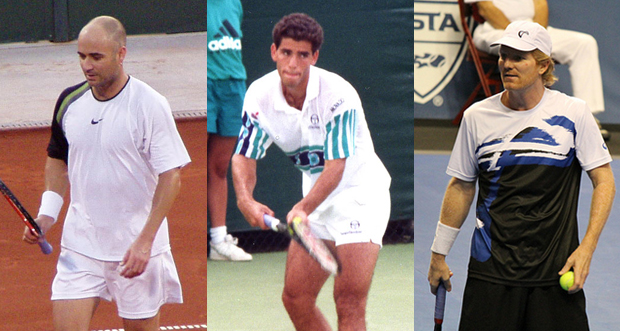

Last of the Great Americans
The United States has always been central to men’s tennis, from early greats like Richard Sears, William Larned, and Bill Tilden to the “golden age” of the 30s to 50s, with stars like Ellsworth Vines, Don Budge, Bobby Riggs, Jack Kramer, and the great Pancho Gonzales. American men’s tennis dipped in the 60s and then resurged with Stan Smith and Arthur Ashe being the harbingers of the first Open Era superstar, Jimmy Connors. Jimmy passed the baton to John McEnroe, who in turn passed it to Andre Agassi and Pete Sampras, the twin stars of Gen 8.
This was the last great—and probably greatest—generation of American men’s tennis. This generation included two (Sampras and Agassi) of the four greatest Open Era Americans (along with Connors and McEnroe), as well as a strong supporting duo in Jim Courier and Michael Chang.
[divider]
Click here to discuss “Open Era Generations, Part Ten” in the discussion forum.
[divider]
Players by Birth Year
1969: Cedric Pioline (FRA), MaliVai Washington (USA), Alberto Mancini (ARG), David Wheaton (USA)
1970: Andre Agassi (USA, 8), Jim Courier (USA, 4), Todd Martin (USA), Marc Rosset (SWI), Magnus Larsson (SWE)
1971: Pete Sampras (USA, 14), Goran Ivanisevic (CRO, 1), Sergi Bruguera (ESP, 2), Richard Krajicek (NED, 1), Wayne Ferreira (SAF)
1972: Michael Chang (USA, 1), Patrick Rafter (AUS, 2), Jonas Bjorkman (SWE)
1973: Greg Rusedski (CAN/UK), Alberto Berasategui (ESP), Albert Portas (ESP)
Discussion
This was a very talented generation, with 33 Slams distributed among eight players, including two who could be considered all-time greats and three other multi-Slam winners.
It is easy to forget how good Courier was for a few years, as he was historically well overshadowed by Sampras and Agassi. He was a player who wasn’t as naturally gifted as his contemporaries, but played his heart out to the tune of four Slam titles, all within 1991-93. He finished 1992 as the year-end No. 1, then 1993 as year-end No. 3, and then finished in the Top 10 only once more, in 1995, despite playing through the decade.
Pete Sampras was to the 90s what Roger Federer was to the 00s: the premier player by a good margin. He was never able to win the French Open — not even coming close, really — but he dominated Wimbledon with seven titles and the US Open with five. While some might look at his Slam performance record and think that it doesn’t compare to those of the recent three greats because of Sampras never winning more than two Slams in a year, and with plenty of first week losses even in his prime, it must be understood that the tennis of the 90s was a more diverse game in terms of the courts, before the surface homogenization that has taken place over the last decade or so.
Sampras was also considered by many to be the best player of the Open Era until Federer, Nadal, and Djokovic came along. He was such a dangerous player; one of his most notable skills was his incredible second serve, known to deliver many an ace. The lone match between Sampras and Federer is must-watch tennis:
Andre Agassi was no less memorable than Sampras, although more for his storied career than his play – although he was a great player, just not on the level of Sampras. Andre essentially had two careers: the first being a fiery and troubled youth who finished in the Top 100 at age 16 in 1986, although did not win his first Slam until six years later in 1992. Andre’s career unraveled in 1997 when he played only 13 tournaments and dropped to No. 110. He came back slowly at first in 1998, but then had his best year in 1999, winning two Slams and earning the year-end No. 1 ranking. He was the elder statesman of the game in the early 00s, for a few years after Sampras had retired, becoming the oldest player to be ranked No. 1 in 2003 at the geriatric age of 33, remaining in the Top 10 past the page of 35.
Underachievers and Forgotten Players
There is no clear player in this generation that I’d call an underachiever, although many players who have glimmerings of it. Agassi was an underachiever in his youth, but made up for it later on. I cannot remember the source, but I believe it was an interview on NPR in which Andre stated that he hated tennis and resented his family for pushing him into it – at least early on. Michael Chang could also be considered an underachiever in that he won his only Slam at the tender age of 17, but his overall skill set was more comparable to the better Slam-less players and overall he had an excellent career.
Jim Courier is an interesting case in that he could be considered both an under- and overachiever. He is an underachiever if you look at his career through 1993 when he turned 23, which included four Slams and a year-end No. 1 in ’92, and compare it to 1994 onward – when he never won a Slam or even made it to another final. But he could be considered an overachiever in that for those few years in 1991-93 he maximized his modest talent and was one of the best players in the game.
Two other players that come to mind, who probably fit the term better: Goran Ivanisevic, who had the skill-set to be a dominant grass and fast-court player but only won a single Wimbledon; and Richard Krajicek, an almost great but flawed player who was the only peer of Sampras to have a winning record against the generation’s greatest player, but only a single Slam winner.
Did You Know?
One of my favorite stories from this generation is the tale of Goran Ivanisevic – one of the greatest servers in the history of the game, and one of the ten or so best players of the 90s. Imagine Ivanisevic in 2000: he ended the year 29 years old, had seen his ranking fall each year from No. 4 in 1996 to No. 129 in 2000. The big Croat had lost the three Slam finals he had played in, all at Wimbledon – one to Agassi, two to Sampras. 2001 looked to be no different. He went out in the first round of qualifications at the Australian Open, didn’t play in the French Open, and entered Wimbledon ranked No. 125. He then proceeded to plow his way through the rounds, defeating everyone from Carlos Moya to an 18-year old Andy Roddick, Greg Rusedski, Marat Safin, Tim Henman, and then finally facing–and defeating–third seed Patrick Rafter in the final in five sets, becoming the first wildcard ever to win Wimbledon. I guess it is never too late; Ivanisevic should remain an inspirational story for Slam-less players in the twilights of their careers.
Top Ten Players of the Generation
- Pete Sampras
- Andre Agassi
- Jim Courier
- Michael Chang
- Patrick Rafter
- Goran Ivanisevic
- Sergi Bruguera
- Richard Krajicek
- Todd Martin
- Wayne Ferreira
Honorable Mentions: Cedric Pioline, Greg Rusedski, Jonas Bjorkman.
The top three are very easy to rank. After that you could make an argument for different orders of numbers 4-7, although I like Chang’s longevity better than the other three. Chang was, in a way, the 90s version of David Ferrer, but if Ferrer had managed to sneak a Slam in. Rafter won two Slams, but had a relatively short career. Sergi Bruguera was the definition of a clay-court specialist. He won two French Opens, made the final of another and the semifinal of a fourth, yet never made it past the 4th round at any other Slam.
Richard Krajicek is an interesting player in that he is one of the few to own a winning record against Pete Sampras, including beating him in the quarterfinal of the 1996 Wimbledon en route to his lone Slam title. It was Sampras’ only loss at Wimbledon between 1993 and 2000. After Krajicek, I ranked Martin and Ferreira in the top 10, but the honorable mentions are all close.
[divider]
Cover Photo (Creative Commons License): Chris Josefy / James Marvin Phelps / shinyasuzuki