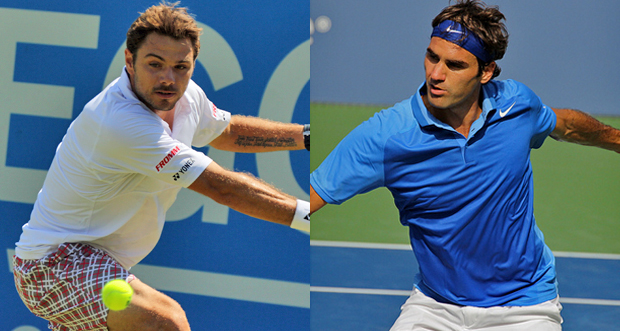

The Maestro, Stan, and Some Other Guys
When I began this series I was curious about Swiss tennis before Roger Federer took the tennis world by storm; I wondered whether there was some hidden jewel in the past who went under the radar due to lack of Slam wins but perhaps still had a strong career, perhaps the Swiss version of an Alex Corretja or Thomas Enqvist? Well, the simple answer is this: No, there wasn’t. There are a couple players who had decent careers, but really Swiss tennis began with Roger. And then Stan. And then…well, that’s about it.
Let’s take a look at the Swiss tennis career:

That’s a pretty extreme picture. Consider that no Swiss player reached the 4th round of a Slam in the first ten years of the Open Era — not until Colin Dowdeswell made the 4th round of the US Open in 1978, defeated by a teenage John McEnroe. But even Dowdeswell was English-born, playing for Switzerland from 1977-81.
Fast forward to 1985 and we have the first appearance by a Swiss player in a Slam quarterfinal in the Open Era, one Heinz Günthardt, who also appeared in the US Open quarterfinal that year, but never another Slam quarterfinal. Günthardt won five career titles and had a career high ranking of No. 22; he was a better doubles player, with 30 titles to his name and a career high ranking of No. 3.
1991 saw Jakob Hlasek reach the French Open quarterfinal where he was defeated by a 21-year-old Andre Agassi, and then five years later Marc Rosset reached the semifinal of the French Open where he was defeated by Michael Stich. Rosset also reached the quarterfinal of the 1999 Australian Open.
So before Roger Federer, in the Open Era Swiss players only reached one semifinal and four quarterfinals.
For those of us looking back, it is easy to forget the impact that Roger Federer had on the tennis world. He was a strong junior player, winning the 1998 US Open Junior final and ending the year with the No. 1 junior world ranking. His first professional tournament was also in 1998: Gstaad, where he lost in the first round to No. 88 Lucas Arnold Ker. To put that in historical context, Roger’s first pro tournament was when Bill Clinton was in the White House, Boris Becker was still playing tennis (he lost in that Gstaad final to Alex Corretja); it was also Pete Sampras’s last year as No. 1. Saving Private Ryan, There’s Something About Mary, and The Big Lebowski were in the movie theaters. In other words, it was a long time ago!
A lot has been written about Federer elsewhere so I won’t go into too much detail, but over the next five years he gradually worked his way up, entering the Top 100 in 1999, then perhaps really gaining attention when he defeated a declining No. 6-ranked Pete Sampras in the 4th round of the 2001 Wimbledon. We didn’t know it at the time, but it was the passing of the baton from the only two seven-time Wimbledon champions (well, along with William Renshaw in the 19th Century). 2002 saw Federer enter the Top 10 and win his first Master’s, but it wasn’t until 2003 when he was almost 22-years-old that Federer won his first of seventeen Slams and the first of seven Wimbledon titles. He then proceeded to win 12 of the next 18 Slams, including all but five in the four years from 2004-07. It was a level of dominance not really seen in the Open Era.
Roger’s reign was tarnished only by a young Spaniard named Rafael Nadal, who repeatedly kept him from winning the French Open and had the match-up edge overall. The baton was finally passed in 2008, a year that saw Roger suffer from mononucleosis. Roger regained the No. 1 ranking in 2009, but lost it again in 2010 and only gained it back for a short period in 2012. We can see now that Roger’s peak lasted from late 2003/early 2004 to early 2010, and he has been one of the two or three best players in the sport from 2003 to the present day – thirteen years of incredible consistency and elite performance perhaps unequaled in Open Era history.
Five Greatest Swiss Players of the Open Era
1. Roger Federer
2. Stan Wawrinka
3. Marc Rosset
4. Jakob Hlasek
5. Heinz Günthardt
No. 1 and No. 2 are easy. Even before Stan’s rise to the top over the last few years, he’d probably rank as No. 2 – or at least similar to Rosset and Hlasek. But Wawrinka has been somewhat of a meteor recently, winning the two Slam finals he’s been in — over Nadal and Djokovic no less. He is 30 years old but shows no sign of declining. After that Rosset and Hlasek are close, but Rosset has eight titles to Hlasek’s two, although Hlasek’s Slam results and ranking history are slightly better, but just slightly. The two are very close. Gunthardt is a solid No. 5, and then there’s a huge drop-off.
After those five, there really are no significant Swiss players in the Open Era. George Bastl was not a great player by any means, with a career high ranking of No. 71. But he is known for one thing: defeating Pete Sampras in the first round of the 2002 Wimbledon, one of the greatest upsets in Slam history. There are a few others: Claudio Mezzadri, Roland Stadler, Marco Chiudinelli, and others – but few even broke into the Top 50, and other than the five listed above, as far as I can tell only Mezzadri won a tournament.
The Future
As with Spain, there really are no Swiss prospects on the horizon. After Federer and Wawrinka, the next highest ranked Swiss is 23-year-old Henri Laaksonen who is ranked No. 289. There are no Swiss teenagers in the Top 1,000 players, with 20-year-old Enzo Sommer being the youngest in the Top 1000 (No. 929). The point being, there is no one on the horizon to replace Federer and Wawrinka once they’re gone.
And when will they be gone? Roger turns 34 in a few weeks, and Wawrinka turned 30 earlier this year. Wawrinka should be around at least for another couple years, if not longer. Roger, despite no longer being the player he was five or six years ago, is still ranked No. 2 in the world. He will seemingly play as long as he wants to, as long as he takes joy in playing. He is already approaching Andre Agassi longevity; Agassi remained an elite player through 2005, the year he turned 35, and retired in 2006; the equivalent to Federer of Agassi’s 2005 would be next year, 2016. Jimmy Connors is another comparable player in terms of possible longevity; Federer’s current year is, age-wise, equivalent to Connors’s 1986; Jimmy would have two more years in the Top 10, 1987-88, and of course had that semifinal run at the 1991 US Open just a bit shy of his 39th birthday.
Yet while Roger seems immortal, at some point he’s probably going to slip enough that he won’t want to play anymore. I suspect that we have at least through next year of Roger playing at a high level, and maybe a year or two beyond that. But who knows? What we do know is that Roger is still here, and we should enjoy him while we can.