Author: Susan DePalma

  • Equal Pay in Tennis:  ESPN to Air “Venus Vs.” Tonight at 8pm EDT

    Equal Pay in Tennis: ESPN to Air “Venus Vs.” Tonight at 8pm EDT

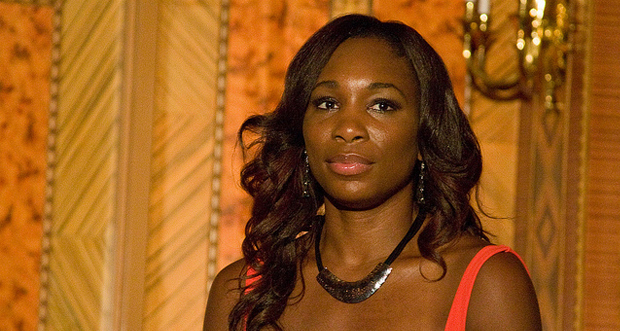
    A different look at Venus Williams’ legacy in the sport.  Not only is she a multi-Slam champion, but also a catalyst in the fight for equal pay and women’s rights in tennis.  Still a controversial topic, ESPN delves into the issue.

    [divider]

    Click here to discuss the Venus Williams documentary with fellow tennis fans.

  • Wimbledon Women’s QFs:  Kirsten Flipkens upsets Petra Kvitova; Sloane Stephens, last US player, is out.

    Wimbledon Women’s QFs: Kirsten Flipkens upsets Petra Kvitova; Sloane Stephens, last US player, is out.

    [divider]

    Click here to discuss the Radwanska/Li Na match with fellow tennis fans.

    Click here to discuss the Kvitova/Flipkens match with fellow tennis fans.

    Click here to discuss the Lisicki/Kanepi match with fellow tennis fans.

    Click here to discuss the Bartoli/Stephens match with fellow tennis fans.

    [divider]

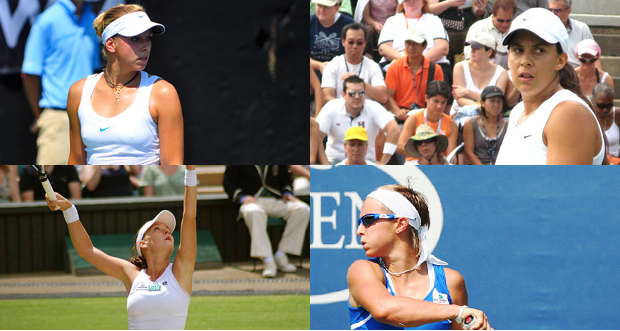
    Kirsten Flipkens of Belgium pulled off the latest upset at Wimbledon.  And, at this point, why not?  A year ago, Flipkens was ranked 262, due to injury lay-offs.  She’s back at #20, but she withstood the #8 ranked, (7-inches taller and favored) Petra Kvitova of the Czech Republic, 4-6, 6-3, 6-4.

    Sloane Stephens, the 20-year-old US hopeful, lost to Marion Bartoli of France, 6-4, 7-5.  Stephens made a match of it, but Bartoli is seasoned and crafty.  A controversial moment came when the Frenchwomen insisted on stopping play at 4-5, deuce, on the American’s serve, citing the rain and condition of the court.  When play resumed, she won the next two points, and the set.  Ultimately, Bartoli prevailed in the second, keeping her on track for her second Wimbledon final. (She lost to Venus Williams in 2007.)

    Sabine Lisicki, who yesterday bumped Serena Williams from The Championships, got through her match v. Kaia Kanepi in impressive fashion, 6-3, 6-3.

    In another tightly contested match, Li Na was down a set and a break to Agnieszka Radwanska in the second, but fought back to take the second, though it was all Radwanska in the third:  7-6 (5), 4-6, 6-2.

  • Lisicki Ousts Serena From Wimbledon

    Lisicki Ousts Serena From Wimbledon

    [divider]

    Click here to discuss the Serena Williams/Sabine Lisicki match with fellow tennis fans.

    Click here to discuss the Day 7 men’s action with fellow tennis fans.

    [divider]

    The women’s top seed, world #1, and overwhelmingly heavy favorite to win the title, Serena Williams, was upset by the tournament’s latest giant killer, Sabine Lisicki of Germany, the number 23 seed.  Williams dropped the first set, but regained her dominant form, even going up a break in the third to lead 3-1.  Usually, that’s enough for Serena to cruise to the finish line.  But the German, who has a strong grass game and perhaps the best serve in the women’s game after Williams, refused to yield.  She fought back hard, eventually taking the third, and the match:  6-2, 1-6, 6-4.

    Lisicki is no stranger to knocking out champions at SW19.  She has now beaten the reigning French Open winner at Wimbledon for the fourth year in a row:  Svetlana Kuznetzova (2009,) Li Na (2011,) Maria Sharapova (2012,) and now Serena, who won her second Roland Garros trophy just three weeks ago.   With today’s win, Lisicki also snapped Williams’ 34-match winning streak, the longest of her career.  The highest seed now left in the draw is Agnieszka Radwanska (4) of Poland.

    On the men’s side, the top seeds Novak Djokovic (1) and Andy Murray (2) got through their matches in straight sets, stanching the flow of upsets in a tournament already rife with them — at least for today.

  • Federer Out Of Wimbledon – 2nd Round Shocker

    Federer Out Of Wimbledon – 2nd Round Shocker

    [divider]

    Click here to discuss the Federer upset with fellow tennis fans.

    Click here to discuss today’s losses on the women’s side with fellow tennis fans.

    [divider]

    A day of upsets and surprises was capped at the end by the biggest stunner, not just of the day, but amongst any in the history of Grand Slam Tennis.  Roger Federer lost to Sergei Stakhovsky, an unsung, 116th-ranked Ukrainian.  The loss hands the 7 time- and defending-champion his earliest loss at Wimbledon since a 1st-round loss in 2002; his earliest loss in any Major since losing in the 1st round at Roland Garros in 2003; and snaps his unprecedented streak of reaching the quarterfinals or better in 36 consecutive Grand Slam events.  It was Stakhovsky’s first win over a Top 10 player, making the feat all the more remarkable.

    When Rafael Nadal went out in the first round on Monday, the tennis world was shaken.  Today, it is reeling.

    Earlier in the day, Maria Sharapova was ousted by Michelle Larcher De Brito of Portugal, currently ranked #131. Sharapova is a former champion here, holder of the career Slam, and former world #1, while the Portuguese woman is so unknown that even Chris Evert admitted to having to look her up.

    Other upsets included Ana Ivanovic, who lost to Eugenie Bouchard (#66) of Canada in straight sets; Caroline Wozniacki, who rolled her ankle on the slippery grass and went down to Petra Cetkovska (#196); Jelena Jankovic, who lost to countrywoman Vesna Dolonc, #98; and, arguably, Lleyton Hewitt, a former champion who was mounting a mini-comeback after injury, to German Dustin Brown, ranked #189.

    Additionally, the tournament saw 7 withdrawals today, some directly due to injuries suffered here:

    Withdrawals:

    Victoria Azarenka, due to a knee injury suffered in her match on Monday.

    Marin Cilic, also citing knees.

    Steve Darcis, giant-killer of Nadal on Monday, citing a shoulder injury sustained in that match.

    Yaraslava Shvedova, with no reason given.

    Retirements:

    Jo-Wilfred Tsonga, who suffered a knee injury during his match today against Ernests Gulbis.

    John Isner, after two games, due to knee injury.

    Radek Stepanek, due to an on-going thigh injury.

    [divider]

    When the day began, 7 former world #1 players would take the court:  Federer, Hewitt, Sharapova, Azarenka, Wozniacki, Ivanovic, and Jankovic.  When it ended, they were all finished for the tournament.

    When the day began, 6 holders of Major titles walked onto the court:  Federer, Hewitt, Murray, Sharapova, Azarenka, and Ivanovic.  When it ended, Andy Murray was the only one still standing.

  • The Other Upset – Lleyton Hewitt and The New Toe

    The Other Upset – Lleyton Hewitt and The New Toe

    Click here to discuss this and more with fellow tennis fans.

    [divider]

    While the tennis world reeled over Steve Darcis taking out Rafael Nadal in the first round of Wimbledon, Lleyton Hewitt scored arguably the “other” upset of the day.  Hewitt is 32, ranked 70 in the world, and he took out Stan Wawrinka, the 11th seed, 10th ranked player in the world, and one who’s been having a very fine year.  And he did it in straight sets:  6-4, 7-5, 6-3.

    Hewitt is a former Wimbledon champion (2002, as well as winner of the USO, 2001), and former world #1, but he has been hampered by injuries over more than a few years.  Grass, however, can sometimes keep him in the game.  He beat Roger Federer in the final at Halle as recently as 2010.  For that reason, tennis fans looked at this to be a barn-burner of a first round match.  The shock wasn’t completely that Hewitt pulled it off, but that it didn’t go to 4 or 5 sets.

    The reason may be Hewitt’s most recent, and most radical surgery.  He revealed last month that he’s had his left toe reconstructed and irreversibly surgically fused.  He is now pain-free in his push-off foot, but he had the surgery knowing that it was possible that he’d never play tennis again.  According to his team, this allows him to return full-time to the tour, which he still has ambitions about.  And Lleyton Hewitt is an ambitious man.  Moreover, he has reason to fancy his chances on grass.  He’s unlikely to go very deep in this Wimbledon, but a few players in his direct path over the next couple of rounds would be right to be nervous.

    [divider]

    In Tues. results, both #1’s got through in straights:  Serena cruised, while Novak was tested by a game Florian Mayer.  British hope Laura Robson upset #10 seed Maria Kirilenko, while another Brit, Heather Watson, lost to the US’s Madison Keys.  And another US hopeful, Brittany Mattek-Sands, fell to the #7, Angelique Kerber.

  • “Tennis, Federer, The Record Numbers: For 13 Years He’s Won At Least One Tournament” (From: Gazzetta dello Sport)

    “Tennis, Federer, The Record Numbers: For 13 Years He’s Won At Least One Tournament” (From: Gazzetta dello Sport)

    Roger is one step from Lendl’s top mark (14.)  The Swiss man passes everyone on grass in winning percentage (87.7%) and tournaments won on the surface (13.)

    One week from the start of Wimbledon, Roger Federer comes back strong, gets his first title of the season, and breaks another impressive series of records.  By winning his 6th championship at Halle, (one of his favorite strongholds), Roger Federer consolidates his dominance on grass in the Open Era.  The Swiss bettered his winning percentage by .4 points, going from 87.3% to 87.7%.  From 1999 to 2002, Federer lost 11 matches on grass; then he remained unbeatable for 65 matches in 5 years, until the final of Wimbledon against Nadal in 2008, and then, until the Olympic final against Murray, he lost only 6 more matches.  In the Open Era, only Jimmy Connors (170), John Newcombe (132), and Ken Rosewall (126) have won more matches than Federer (121) on grass, though it bears remembering that, back then, all of the Majors were played on grass, apart from the one in Paris.

    87.7 – Percentage of matches won by Roger Federer on grass.  John McEnroe is 2nd with 85.6%, Rod Laver 3rd with 84%.  After that, Borg (83.6%), Pete Sampras (83.5%), Jimmy Connors (83.3%), and Boris Becker (82.3%.)

    13 – Tournaments won by Roger Federer on grass.  (7 Wimbledon, 6 Halle.)  In the Open Era, Federer leads Sampras, who has 10 (7 Wimbledon, 2 Queens, 1 Manchester), and John McEnroe and Jimmy Connors who have 8 apiece.

    65 – Match winning streak by Roger Federer on grass:  the run started at Halle 2003 (after the loss to Ancic in the first round at Wimbledon in 2002) and ended on 6 July 2008 at Wimbledon, in the historic final which he lost 7-9 in the 5th set to Nadal.

    13 – Years in a row that Roger has won at least one tournament.  2001 (1) 2002 (3) 2003 (7) 2004 (11) 2005 (11) 2006 (12) 2007 (8) 2009 (4) 2010 (5) 2011 (4) 2012 (6) 2013 (1.)  Only Ivan Lendl is still better than Roger (14, from 1980-1993.)

    77 – Career tournaments won by Roger Federer.  The Swiss ties John McEnroe for 3rd on the list of all-time most titles.  Ahead of him is only Jimmy Connors with 109 titles, and Ivan Lendl with 94.

    27 – Different tournaments won by Federer.  [He] has won once at:  Estoril, Gstaad, Tokyo, Marseille, Milan, Monaco [translator’s note:  I think this is wrong], Bercy, Roland Garros, Stockholm, and Sydney; twice at: Bankok, Canadian Open, Miami, Rotterdam, and Vienna; three times at:  Doha and Madrid; four times at: Australian Open, Hamburg, and Indian Wells; five times at: Basel, Cincinnati, Dubai, and US Open; six times at: Halle and the YEC, and seven times at Wimbledon.

    _________________________________________________

    3 – Tournaments won this year by Andy Murray, who yesterday won Queen’s, besting Marin Cilic in the final, 5-7, 7-5, 6-3.  Murray won Brisbane in January, and Miami in March.

    27 – Career tournaments won by Andy Murray, the first being in 2006 in San José, CA.

    4 – Tournaments won by Andy Murray on grass.  Queen’s in 2009, 2011, and 2013, and the Olympics in London in 2012.

    [divider]

    [Translator’s note:  I’m not translating the rest because it’s all speculation on Eastbourne and s’Hertogenbosch, which were already contested.]

    [divider]

    Translated from: “Tennis, Federer, Numeri Record: da 13 Anni Vince Almeno un Torneo” (Gazzetta dello Sport, June 17, 2013)

    Click here to discuss this and other topics with fellow tennis fans on our discussion boards.


  • “I Win With My Tennis, Not With My Mind” (From: El País)

    “I Win With My Tennis, Not With My Mind” (From: El País)

    [divider]

    Translated from: “Gano con mi tenis, no con la mente” (El Pais, June 10, 2013)

    Click here to discuss this and more with fellow tennis fans on our discussion boards.

    [divider]

    10 June 2013/Paris/Juan José Mateo

    Rafael Nadal (Manacor, Mallorca, 1986) says goodbye to Pau Gasol in the lounge of a hotel they were both staying in.  It’s the first day after the culmination of an odyssey:   the comeback to win Roland Garros for the 8th time, his 12th Grand Slam title, after 7 months out due to an injury to his left knee.  There’s still a trace of celebration in his tired eyes.  His hands move quickly, in accompanying gestures to his answers.

    Q:  How do you feel when an opponent takes you to the limit, like Djokovic in the semi-finals?

    A:  The only thing I feel is that you have to endure a little more.  That’s all I feel.  Put up a little more resistance, because you don’t know how much more resistance the other player can mount.  I’m feeling bad, but it’s likely that the other player is at the limit, too.  I try to push him that little bit more to see if it will get me the win.  This extra effort is always worth it, if you win or lose.  It’s a question of personal satisfaction when you go back to the locker room. It’s priceless.  Those are very difficult feelings to explain.

    Q:  You refuse to lose.

    A:  It’s not refusing to lose, it’s refusing to throw in the towel.  I refuse to throw in the towel.  That is what makes me happy when it’s all over:  knowing that I did everything I could, and if I lost, I lost.

    Q:  Sometimes you talk about suffering as if it were a friend, as does Djokovic.

    A:  I believe that he is a great fighter and a great sufferer.

    Q:  But most people, logically, prefer to suffer less.  Where does that difference come from?

    A:  From the joy in what you’re doing, from the passion for it.  From living it all with this passion.  Because of everything it has taken you to get here, it makes you not want to give in.  It’s a physical suffering and a mental suffering.  That’s the truth…but, in the end, you’re playing on Court Central at Roland Garros, your dream since you were a small child; you’re living a match that you know is special and you know that whatever happens, it will be one of the matches of the year, because of what’s at stake.  Is that suffering?  Yes, but it’s also a gift and a happiness to be able to be there in that moment.

    Q:  In the past, to feel competitive, you felt the need to train a lot.  Winning Roland Garros with only 8 tournaments under your belt, now maybe not.  Does this win vindicate your technical abilities over your mental ones, and physical strength?

    A:  It’s a logical evolution in a career.  As one gets older, a lot of things come more automatically, the game more matter-of-fact, and you don’t need so much preparation.  To be honest, it’s fantastic to be considered to have the mental and physical advantages, and being able to sell that off is a positive.  I believe that mentally and physically I have been a forceful player, that I’ve always tried to play above my level.  Beyond the fight and the dedication, this quality, along with the desire to improve, is a very important mental quality…but you couldn’t have achieved what I have without the rest, without having a great forehand, a great backhand, or great ball control.  Sometimes we forget to stress these things, because they highlight the rest.

    Q:  You can’t win without your racquet, right?

    A:  Mental and physical strength help you in a certain moment of the match, but to win more often, and more overall, you win with your tennis, and not with your head.  You can win mental matches like the one the other day versus Djokovic, but to win them, mentally, you have to get to the absolute limit, and to get to that limit – you have to get there with your tennis.  It’s a combination of everything.  The tennis is what has helped me get to where I am, and the mental toughness is what has allowed me to achieve what I wouldn’t have, without it.

    Q:  Of those who don’t appreciate your technique, is it because you don’t have a one-handed backhand like Federer?

    A:  If you asked my opponents, I think that they would say I have, in terms of tennis, many special things.  Maybe the mental fortitude would come up, because I’ve played a lot of long matches, 5 hours, in which I’ve come back, been equally in the hunt until the end.  These types of matches are memorable, of course, and my style of play, to fight, to overcome, made sense that this type of match would be in sync with my career.  A player like Federer, more given to 3 quick shots, hasn’t played so many of these long matches in his career.  Technically, there’s no doubt that he’s better than me, but, evidently, I’m better than most of the rest. If not, I wouldn’t be here.

    Q:  You have said, “Sport without challenges is stupidity.”

    A:  These are things that I’ve always thought and I live with them.  One has to be realistic:  to play tennis without an objective…fine.  I swing a racquet and hit a ball over a net.  What does that mean?  Very little.  In and of itself, it’s trivial.  Sports in general are stupid, if one doesn’t take them to their highest level.  And the highest level means to play towards a goal, with passion, with joy and desire.  This is what I’ve thought my whole life.  When I play golf, I give it all I have.  People are wrong about me.  They say, “All he wants is to win.”  What I love is competition, the investment of energy, the concentration that it takes to try as hard as possible.  Obviously, I like to win, but what inspires me is to feel that I’ve given all I have.  If not, I don’t see the point.  And if not, I’ll say let’s have a laugh, and find something else to do.

    Q:  How does it make you feel that your co-players see you as an idol?  In Madrid, you spoke to Horacio Zeballos, wishing him well, and he said, “I’ve just been blessed by the Pope!”

    A:  I can’t imagine it’s like that.  I feel close to all the players, especially the Spanish-speaking ones, because the relationship is so easy.  I don’t think they see me like that.  I don’t know.  I see myself as an approachable person and I think they see me that way, too.

    Q:  Now you’re going back to Wimbledon [starting 24 June] where you left injured in 2012.

    A:  Last year I entered Wimbledon without being well, being injured…I was playing compromised.  I wanted to put in the effort, with everything this tournament means to me.  It wasn’t to be.  I forced it.  Everything I wanted to try to do was too limited.  It didn’t affect me negatively in what was to come after.  When I get there this year, the simple fact of being there will be good news.  It’s a beautiful tournament, and I love it.  Even if I won’t arrive so well-prepared, just being there will make me feel satisfied.

    Q:  It clears your head.

    A:  It nourishes me.  I love the feeling of stepping on the grass, of playing on those courts, which is such a different sensation.  For me, whatever the result, it’s worth it.  Am I arriving less prepared than usual?  [He won’t play a grass court tune-up before the tournament.]  Yes, but it comes back to the same thing: I’ll get there healthy, good physically, and mentally I’ll arrive there in a good place.  Then, if I’m lucky enough to get through a few matches, perhaps not having played a tournament before will translate into mental freshness.  [At Wimbledon], all matches are very difficult; it’s the most uncertain tournament of the year.  The confidence of having won here [in Paris] gives me that something extra that you need to play well there.

    Q:  The Nadal of 2008, who only allowed Roger Federer 4 games in the final, is he better than the 2013 version of Nadal?

    A:  In tennis terms?  Could be.  There are moments, and moments.  2008 had things that 2013 doesn’t have, and 2013 has things that 2008 didn’t have.  Speaking strictly of Roland Garros, perhaps that was the best I played in my career.  But you have to look at the whole picture.  In terms of results, I was in the same place in 2008 that I’m in now.  Those things are in the past.  Now, I’m looking forward.

    Q:  What was the best advice you got during your injury lay-off?

    A:  When I had to stop playing, I was lucky to have my family around me, which is very important.  Also my team, which helped me keep working with the enthusiasm and mentality necessary to not lose my form.  I had friends and sponsors who kept their faith in me.  This was a very important source of confidence.

    Q:  You asked that it be made public the exact number of controls [drug tests] that are given to each tennis player.  Did it bother you that, during the injury lay-off, there were those who would say you’d disappeared?

    A:  I don’t like it when a player comes out and says:  “They don’t test me enough.”  It’s easy to come off well by saying that.  Or, to say “I get tested too often.”  [I would probably prefer that it be], “I’m tested this much.”  X-number of times.  Just make it public.  That way, you don’t create doubt, nor the sense that one player looks good because he says they don’t test him enough, or that another looks bad because he complains that they test him too much.  The logical thing is to make everything public knowledge, and then there’s no question. Disappeared?  I didn’t disappear at all;  everyone in the world who wanted to, knew where to find me: at home, and working every day.
  • Roland Garros Men’s Semifinals: Friday’s Order of Play

    Roland Garros Men’s Semifinals: Friday’s Order of Play

    [divider]

    Court Philippe Chatrier – 1:00 PM

    Rafael Nadal (ESP) (3) def. Novak Djokovic (SRB) (1) 6-4 3-6 6-1 6-7(3) 9-7

    David Ferrer (ESP) (4) def. Jo-Wilfried Tsonga (FRA) (6) 6-1 7-6(3) 6-2

    [divider]

    Court Suzanne Lenglen – Not Before: 1:00 PM

    Ekaterina Makarova (RUS) (4) / Elena Vesnina (RUS) (4) def. Andrea Hlavackova (CZE) (2) / Lucie Hradecka (CZE) (2) 6-4 7-5

    Not Before: 3:00 PM

    Sara Errani (ITA) (1) / Roberta Vinci (ITA) (1) def. Nadia Petrova (RUS) (3) / Katarina Srebotnik (SLO) (3) 6-3 5-7 6-3

    [divider]

    Click here to discuss the Nadal/Djokovic semifinal, and more with fellow tennis fans on our discussion boards.

    Click here to discuss the Tsonga/Ferrer semifinal, and more with fellow tennis fans on our discussion boards.

  • “Physical Impediments A Nightmare For Juan Martin del Potro” (From: Canchallena)

    “Physical Impediments A Nightmare For Juan Martin del Potro” (From: Canchallena)

    [divider]

    Translated from: “Los obstáculos físicos, una gran pesadilla para Juan Martín Del Potro” (Canchallena.lanacion.com.ar, May 23, 2013)

    Click here to discuss this and more with fellow tennis fans in our community forums.

    [divider]

    In keeping with a year that has had more heartache than happiness, the world #7 won’t be playing at the French Open this year; due to a viral infection, physical problems are still complicating his career.

    Del Potro keeps running into problems, one after the other — inopportune, harmful.  Every week since the beginning of the year, the current top Argentine player has been losing ground from where he was projected to be, which was #5 in the world, after a recharged 2012 that included an Olympic Bronze Medal.  The injuries and health issues have squelched  the path of JMDP in the last months of ATP action.  And now, the biggest blow of the season:  he won’t play at Roland Garros.

    The physical issues aren’t new:  they’ve plagued him since he turned pro, and when he had a real chance to realize his dream, to be #1 [after the USO in 2009,] injuries got in the way.  At this point, the decision of whether or not to skip the second Grand Slam of the year, where he is defending 360 QF points, came down to him, his team, and sports cardiologist, Roberto Piedró.

    In the start-up to the European clay court season, he contracted an upper-respiritory infection, and a lower digestive tract virus, which required him to stop training.  A recurrence of the bronchial spasms caused the withdrawal from Oeiras (formerly Estoril, where he had won in 2011-12,) and also from Madrid, a MS1000.

    It was in Rome, also a MS1000, where, lacking rhythm, he lost, not unexpectedly, and returned to [Argentina] to recover.  He regained his general strength, but he wasn’t in top competitive shape, and, since he wouldn’t be going into RG at his maximum level, he and his team decided that the best course was to keep up with the rehab, and to begin looking forward to the  grass swing, which, depending on how it goes, will include Queen’s (10 June), an exhibition at Boodle’s (18 June), and Wimbledon (starting 24 June).

    Unlike last year, in the current calendar year del Potro has lost several matches – at least 4 – to lesser rivals, and certainly he wasn’t willing to expose himself to another fall in Paris.  Up to this point in the year, the Argentine has accumulated only 1605 ranking points, whereas, up to this point last year, through RG, he had gained 2475.

    “I’m sad not to participate at RG, and to have been able to play [the European clay court swing] the way I would have liked to.  RG is one of the most important tournaments of the year, and I don’t like having to miss it.  I’m not in the best physical shape to fight for a tournament of this level.  I’m going to keep working as hard as possible, because I want, more than anyone, to come back at my best,” del Potro declared, on his Facebook page.  At the same time, interviewed for The Nation, Piedró explained, “Juan Martin is better than he was a while back, but still is not 100% to compete in a tournament of best of 5 sets.  He wanted to play, that was his intention, but we analyzed it all together, and the important thing was not to have a set-back.”

    Piedró … was not surprised about the virus that took down del Potro.  “This is the season when we see a lot of these cases, especially in the beginning of the Spring.  The recovery time depends on each person, but, with Juan Martin,  this one hit him particularly hard, and it created respiratory problems.  I’m actually surprised by how quickly he’s gone back to training.  He has to train physically and aerobically, and get back to full capacity,” says del Potro’s personal physician.

    After an interesting 2012, [del Potro] looked forward to this year with dreams of success, and solid strides in the big tournaments.  But, once again, as has happened so many times in his career, injuries or health issues have stalled him.


  • “Federer and Wawrinka, Friends No More – Rivalry in the Garden of Eden” (From: Neue Zurcher Zeitung)

    “Federer and Wawrinka, Friends No More – Rivalry in the Garden of Eden” (From: Neue Zurcher Zeitung)

    [divider]

    Translated from: “Federer und Wawrinka keine Freunde mehr – Konkurrenz im Garten Eden” (Neue Zürcher Zeitung, May 28, 2013)

    Discuss this and more with fellow tennis fans in our community forums.

    [divider]

    In Federer and Wawrinka, for the first time since the summer of 2008 Switzerland has two men in the ATP ranking’s top ten. At the tournament in Rome, Wawrinka had to withdraw in Round 2.

    By Jürg Vogel

    Change is a constant in tennis. The super power USA has, for the first time in twenty years, no player in the ATP top ten, while Switzerland has two in the leading group – a representation that, however, only partly reflects the true distribution of power in men’s tennis.

    Consequences of Effort

    The result seems all the more positive for Swiss tennis’s efforts to build a new platform for the time after Roger Federer. Regarding the considerable stagnation in the field of candidates for a professional career, Wawrinka is buying time for the federation. The Romand [French Swiss] is, at age 28, in his tennis prime. And on the big tour, the presence of thirty-somethings at the top is increasing.

    Wednesday [May 15th] however wasn’t a lucky day for Wawrinka. Because of thigh problems, the right-hander had to give up in the second round of Rome. The forfeit was made for precautionary reasons, with the perspective of the French Open (starting May 26th) in mind. Wawrinka had seemed battered in the first round already. He later remarked that he was “playing tennis on one leg” after the effort of Madrid, where he had gone all the way to the final.

    Income of four million Swiss franks

    Wawrinka is starting this season from a high plateau, a place in the top 20. The Waadtländer, who moved with his family into a new home near Geneva, seems more focused, grown up. The investment of hiring a new coach, the Swede Magnus Norman, a decision taken with his English manager Lawrence Frankopan, is a sign of courage.

    Barring injury, Wawrinka will be able to hold a top ten position until the end of the year, which will earn him about one million additional Swiss francs, thanks to bonus payments and appearance fees. His income will rise to the area of about 4 million francs. The player’s gratitude goes to his personal sponsor Reinhard Fromm, who’s been loyally supporting him since 2006, with over one million francs.

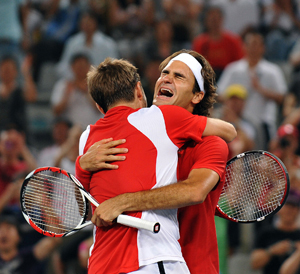
    Politically, Wawrinka is improving his position in comparison to front runner Federer, in whose shadow he had been standing for years. The two Olympic doubles champions of Beijing 2008 are colleagues, but not friends anymore. One reason is the internal competition, where Federer’s ego is bigger than many outsiders would assume. Always on-call for Davis Cup, Wawrinka is also gaining a lot of goodwill with the Swiss tennis federation, while Federer’s late withdrawal from February’s tie in Geneva, after lengthy dawdling, still has many riled up. The team surrounding Wawrinka at the moment seems more relaxed than that of the superstar, whose image isn’t exactly improved by the aggressive methods of his US-American agent Tony Godsick.

    Crowd draw in Gstaad

    Federer will be Federer. The technician* happens to be looking for his form on clay at the very moment in which Wawrinka has reduced the gap, sports-wise, between the players. A certain rivalry like Germany once had in Boris Becker and Michael Stich certainly won’t hurt. Wawrinka will stimulate the Helvetic scene. Gstaad is getting an attractive crowd-puller in him. It’s unfortunate that the organizers of the Berner Oberland [region in which Gstaad is located] made a political mistake in giving up the date right after Wimbledon. At its new date in late July, the stars are already fine-tuning for the US hard courts. More than before, this is now true for Wawrinka as well.

    [*”Techniker” means a player whose main quality is perfect technique, as opposed to someone who wins with strength/force. I’m not perfectly sure whether “technician” is used in the same way, but I didn’t want to substitute it for something like “stylist”, since it’s a totally different meaning.]

    –Guest-translated by johnsteinbeck