Author: Jonathan Northrop

  • Slam Results – Consistency and Era

    Slam Results – Consistency and Era

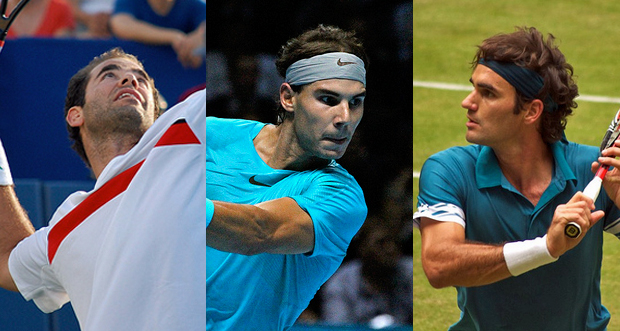
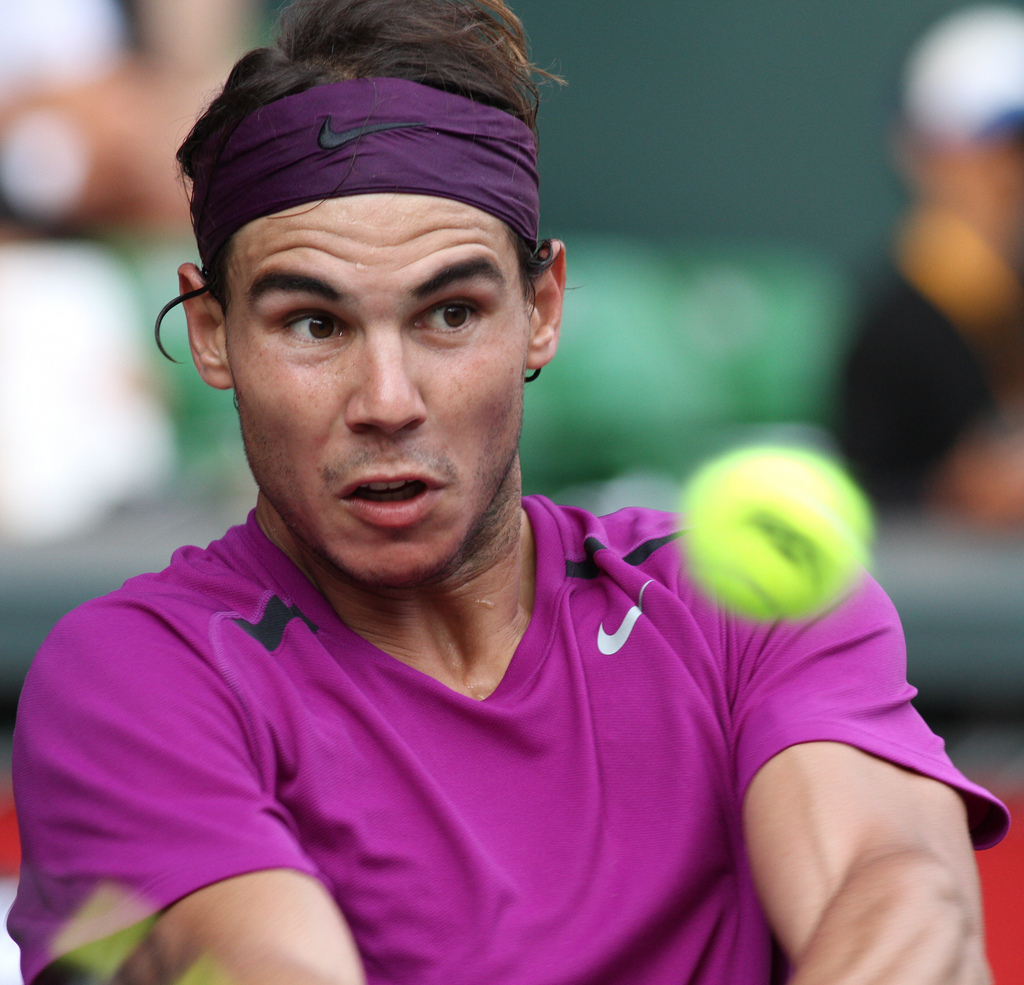
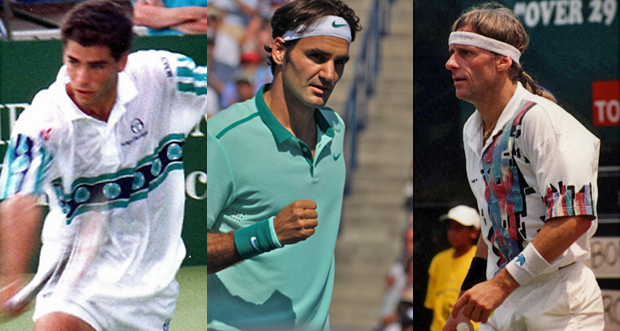
    Roger Federer Pete Sampras Bjorn Borg

    I have often been struck by how amazingly consistent some of the contemporary great players are, and how it seems they are far more consistent in terms of Slam results than in past eras. I wanted to see if my hunch was correct, so I looked at all players who had won 4+ Slams in the Open Era (except for Ken Rosewall), plus Andy Murray added in the mix (as the player currently active with the best chance at 4+ Slams). I came up with a list of 16 players, who I then checked for a few statistics: total Slams, Quarterfinal appearances, % of Slams that were QF or better, Streaks of QF appearances at Slams, and years in which the player was in the QF of all Slams he appeared in (minimum 2 appearances).

    The results were somewhat surprising. First of all, when I compared the Big Four to the previous generation of greats, namely Sampras and Agassi, but also Courier, I found that the Big Four are far more consistent. Here are those players:

    QF% (longest QF streak, years of all QF)
    Murray: 62% (15, 4)
    Djokovic: 75% (22, 5)
    Nadal: 69% (11, 4)
    Federer: 69% (36, 8)
    Sampras: 56% (11, 2)
    Agassi: 59% (6, 5)
    Courier: 36% (5, 0)

    As you can see, the recent greats–in particular Djokovic and Federer–have been more consistent. Rafa’s QF% is the same as Roger’s, but his penchant for occasionally going out earlier has reduced his overall consistency. What really stands out for me in this list are two things:  Novak’s amazing QF%, and Roger’s ridiculous streak of 36 straight Slams, plus his eight years of making at least the QF in all Slams.

    Let’s dial back to another generation plus:
    Becker: 50% (5, 1)
    Edberg: 48% (5, 1)
    Wilander: 45% (7, 2)
    Lendl: 60% (13, 5)
    McEnroe: 58% (10, 4)

    As always, Becker and Edberg are neck-and-neck. Wilander was great in spurts, but bad in other years. Lendl was remarkably consistent in a very competitive era. Overall it seems the numbers are in line with Agassi and Sampras.

    One more jump:
    Borg: 78% (12, 6)
    Vilas: 39% (8, 3)
    Connors: 72% (27, 12)
    Newcombe: 55% (8, 2)

    Clearly Borg’s numbers are skewed by his shortened career. Connors’s numbers are surprisingly good, but we need to remember that in a lot of years he (and Borg) only played two or three Slams, which is easier to make it far in every appearance.

    So while it seems that the current group of greats are historically more consistent than most eras, there’s a range across the decades, so it doesn’t seem clear that the factors of the game today allow for greater consistency (the so-called court homogeneity), or if it simply could be that the current crop is just so damn good. I imagine its a combination of both.

    What do you think?

    Click here to discuss “Slam Results – Consistency and Era” in the discussion forum.

    [divider]

  • Rafael Nadal – From Peak to Plateau

    Rafael Nadal – From Peak to Plateau

    Sampras Nadal Federer

    All good things come to an end. It is the inevitable tragedy of life, although of course it also allows for greater appreciation of the moments we do have. And so it is with tennis greats, whether the current twilight years of Roger Federer or, as is the focus of this piece, the inevitable decline of Rafael Nadal from an unstoppable force of nature to merely a great, but beatable, player.

    Before you protest that all players have their ups and downs, let us consider the simple fact that Rafael Nadal is in an age window when most great players drop a notch; even if he’s not dropping yet, it is inevitable that at some point soon he will. But a notch from his peak level still makes him one of the best players in the game – just as in Roger’s “twilight years” he is still probably the third greatest player on tour.

    [divider]

    Click here to discuss this in the Tennis Frontier discussion forum.

    [divider]

    Perhaps by understanding the career trajectories of other great players we can better understand where Nadal might be in his own career, and what might be ahead. For a player of Nadal’s stature there are few peers – we have to look at players who were for a significant portion of their careers considered the best in the game. Going back through Open Era history, we have Roger Federer, Pete Sampras, Ivan Lendl, John McEnroe, Bjorn Borg, and Rod Laver. With apologies to other dominant players such as Novak Djokovic, Andre Agassi, Boris Becker, Stefan Edberg, Mats Wilander, and Jimmy Connors, I’m looking at players who were the best for an extended period of time (Djokovic is close, but he’s younger than Nadal so doesn’t really qualify). Borg also has to be taken out of the equation as he retired at 25.

    That leaves us with Federer, Sampras, Lendl, McEnroe, and Laver. Considering that Nadal turns 28 this year, let’s keep in mind the year those five turned 28 for a reference point:

    • Federer: 2009
    • Sampras: 1999
    • Lendl: 1988
    • McEnroe: 1987
    • Laver: 1966

    As I’ve suggested elsewhere, most players follow a career pattern in four major phases (with general age averages): development (17-21), peak (22-26), plateau (27-31), and decline (32-). Obviously players veer out of those ranges, but those are typical. I would maintain that one way to define the peak phase is that it is the period of a player’s career in which their results, especially winning percentage, are solidly over their career average, while the plateau phase is more around the career average or a bit below. Now the question at hand in this context is whether or not Rafael Nadal is transitioning from his peak to plateau phase, which is a step below peak but still very high.

    Let’s take a look at the five players and see at what point they transitioned from peak to plateau. To get a sense of that, we’ll be focusing on their Grand Slam results and match winning percentage.

    Roger Federer

    The Swiss Maestro was clearly in his peak from 2004 to 2007. When he actually dropped a notch into his plateau phase is a bit unclear, however. Many consider the great 2008 Wimbledon match as when Roger passed the baton to Rafa for greatest player in the game. But not only was that match a complete toss-up, but Roger went out and won the next Slam and four out of the next six. Rather, I would maintain that what the 2008 Wimbledon marked was Nadal joining Federer as the best in the game, a partnership which was maintained–some some passing of the baton back and forth–until 2010 when two things happened: Rafa had probably his best year and Roger dropped a notch, leaving Rafa as the sole king of the tour.

    Regardless of when Federer’s skills began to erode, greatness is always defined relative to others, thus the results offer a reliable barometer for his drop in performance. Looking at the statistical record, Roger’s career definitely dropped a solid step after the 2010 Australian Open, his penultimate Slam victory (so far, at least). Whereas Roger won a remarkable 16 of 27 Grand Slams from Wimbledon 2003 to the 2010 Australian Open, playing in a perhaps even more remarkable 22 of 27 Finals, from 2010 Roland Garros to the present, Roger has won only 1 and played in 2 Finals of 16 Slams. He is still a very, very good player, but clearly a step down from his previous peak.

    Looking at Roger’s winning percentage confuses the matter a bit, as he dropped quite a bit from 88% in 2007 to 81% in 2008, and then equalized in the 83-86% range from 2009 to 2012, and then plummeting to 73% in 2013 before rising to 87% (so far) in 2014. But winning percentage is only part of the equation, the other being Slam results, and Roger remained pretty dominant through the Australian Open in 2010 so I would argue that he entered his plateau phase around Roland Garros in 2010 – when he was 28 years old, turning 29 a few months later.

    Pete Sampras

    Pistol Pete was the No. 1 ranked player in the game for an unparalleled six years in a row, from 1993-1998, the year he turned 27. While Pete was No. 1 as late as November 2000 when he was 29 years old, his reign of dominance had clearly ended, or at least diminished.

    In 1998, Pete’s last year at No. 1, his winning percentage had dropped for the second straight year and, at 78.2%, was about at his career average (77.4%). But then in 1999 it shot up again to 83.3%, the highest it had been since 1996 and the fourth highest of his career. Yet it dropped again in 1999 to 76.4% and continued to drop over his last couple years.

    So in one sense we could say that Pete was as good as ever in 1999, the year he turned 28, yet on the other it was in far fewer matches than usual – he only played 48, the fewest he had played since 1989, and far fewer than his average of 81 per year from 1990-98.

    Regardless, it seems clear that Pete entered his plateau phase sometime between 1998 and 1999. He lost the No. 1 ranking in late March of 1998 after holding it for 102 weeks straight. He did regain it again before the end of the year so that he still finished No. 1, but I think at that point the writing was on the wall. So I’d maintain that he transitioned into his plateau phase around age 27.

    Ivan Lendl

    Some might take issue with Lendl’s inclusion, as his early career was overshadowed by Borg, McEnroe, and Connors, and later on he vied with Wilander, Becker, Edberg, and then Sampras and Agassi. (Actually, as an aside, Lendl may be one of the most underrated players in tennis history because of all great players—at least during the Open Era—no one else played alongside other greats playing at or near their peaks, and Lendl held his own, and then some.) Let us remember that Lendl finished three years in a row, 1985-87, at No. 1, and a fourth year in 1989. He also finished in the Top 3 for nine straight years and the Top 8 for thirteen straight years, both of which only Roger Federer has equalled since (Fed finished in the Top 3 for ten straight years and assuming he finished 2014 in the Top 8, will equal Lendl’s thirteen straight years in the Top 8).

    Lendl’s fall to his plateau is relatively easy to determine. In 1989, his last year finishing No. 1, he had a winning percentage of 92% which fell to his career average of 82% in 1990, which was also the last year he won a Slam, and then 75% in 1991. So the fall came between 1989 and 1990 – perhaps after his last Slam at the Australian Open in 1990, so when he was 29, almost 30 years old.

    John McEnroe

    Johnny Mac is a bit of an outlier to this group because his later career was marred by personal issues. But he was still a similarly dominant player as the others on this list during the first half of his 20s, ranked No. 1 for four years in a row, and the only player to be considered the great Bjorn Borg’s equal, even surpassing the great Swede towards the end of their rivalry.

    Anyhow, McEnroe’s drop is quite clear. His very greatest year was 1984 when he had an amazing 96% winning percentage (82-3). Yet 1985—despite not winning any Slams—was also great, with an 89% winning percentage and far above his career average of 81.5%. But then he missed a lot of time in 1986-87 and never came back even close to peak form, so we could say that there’s a clear separation between peak and plateau/decline between the years 1985 and 1986. Johnny Mac turned 27 in early 1986, so the drop was at age 26-27.

    Rod Laver

    I include Laver with some hesitancy considering that he played in the mists of ancient tennis history. Yet he was a similarly dominant player to Nadal and Federer, and had his last great year in the Open Era.

    It is more difficult to example the statistical records from before the ATP era (1973), but from what the statistical record shows us, Laver maintained a peak level of performance throughout his 20s and through his great year in 1969 when he won all four Grand Slams. He turned 31 that year.

    Laver remained a good player for a few more years, but was never the same. So his peak ended quite late – at age 31.

    Summary

    So when we look at our five comparable greats to Nadal, we see the age that they transitioned from peak to plateau form as follows:

    • Federer: ~28
    • Sampras: ~27
    • Lendl: ~29
    • McEnroe: ~26
    • Laver: ~31

    Looking back over the last year or so, Rafa was playing at a very high level through the summer of 2013. After dominating the North American section of the tour by winning the US Open and both the Canadian and Cincinnati Masters, Nadal slowed down a bit, not winning a tournament for the rest of the year. He started 2014 by winning the Qatar Open, although then lost in the Australian Open final, partially due to injury. He also won his second tournament of the year in Rio, but both his wins so far are relatively minor (an ATP 250 and 500, respectively), and he hasn’t won any of the three Masters and just lost in Barcelona in the quarterfinal. His 91% winning percentage in 2013 was the best of his career, while his 82% so far this year is actually a bit below his career average of 83.6%, so there is cause for concern.

    Nadal will turn 28 years old in a little over a month, so he is certainly within range of the norm for transitioning from peak to plateau. Right now he is the same age that Roger Federer was when he won the 2009 Wimbledon and when Sampras won the 1998 Wimbledon. At Rafa’s current age, both Roger and Pete won three more Slams; Lendl won only two more, but had fewer total.

    So if we want to guess what is before Rafa, we can look at Federer and Sampras in particular. If Rafa truly is transitioning from his peak to his plateau—and it seems likely, in my opinion—he still has many good years ahead of him. And if I were to guess how many more Slams he will win, like Federer and Sampras at the same age, three is as good a guess as any. Both Roger and Pete won two more at their best Slam (Wimbledon) and one more at another. Perhaps, then, an educated guess would be that Rafa will win two more French Opens and one more on another court, which would bring him to a total of 16 for his career – one shy of Roger Federer’s current total, but more than anyone else.

    But of course there are always exceptions to the rule, and Rafa is as good a candidate to be one as any other. Every player has a different career trajectory; but if he follows the typical trajectory of a great player, while he would truly be transitioning into his plateau phase now, he also likely has a few good years—and a few Slam titles—left in him.

  • The Big Four by Winning Percentage

    The Big Four by Winning Percentage

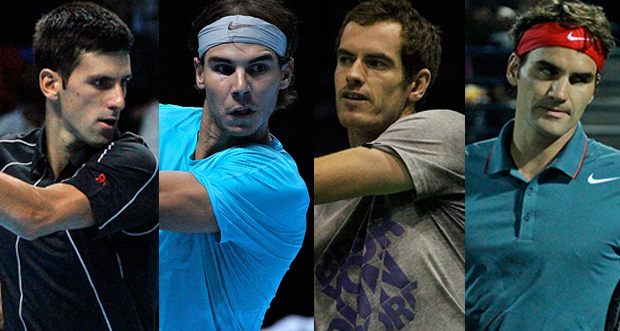
    Novak Djokovic Rafael Nadal Andy Murray Roger Federer

    I was looking at Wikipedia pages for a variety of players and was surprised to notice that Roger’s win percentage this year is the same as 2012, which supports the notion that he’s really resurged well. Certainly he’s only played 23 matches this year, but that’s already more than a third of his total from last year (62) so gives us a large enough sample size to get a sense of his performance level so far. For comparison, through Indian Wells last year he was 13-4 (76%).

    Anyhow, this isn’t meant to be about Roger but the Big Four, and to look at their careers through the lens of win percentage.  Without further ado, here’s a chart:

    20140322063149
    A few notes on each player:

    Roger Federer – this chart really displays a clear peak in 2004-06, with the downturn beginning in 2007, although this could also be because by 2007 both Djokovic and Murray were on the map, with year-end rankings of No. 3 and No. 11, respectively, although Roger had winning records against both Nadal (3-2) and Djokovic (3-1), with no matches against Murray in 2007, so his overall win percentage without those two only goes down a few percentage points.

    Anyhow, the big thing to notice about Roger now is that he’s playing at a similar clip this year as he did in 2012. Hopefully this means we’re back to “post-peak plateau Roger,” as he’s been relatively consistent in terms of winning percentage since 2008, ranging between 81% and 86%, except for 2013’s 73%.

    Rafael Nadal – The thing that really stands out for me is just how consistent Rafa has been in his win percentage since 2005, never dipping below 82% or rising above 91%. In other words, no matter his ups and downs and injuries, he’s been consistent and steady in his performance level. His dip in 2009 is well chronicles because of Robin Soderling and injury, and then in 2011 it was entirely due to Novak’s 6-0 record against him that year. Remove those six matches and he’s at 88% for the year.

    Novak Djokovic – The most interesting part of this chart for Novak is what happened between 2009 and 2011. In 2009 he had finished his third straight year as the clear third best player in the game, and then in 2010 – while he retained his No. 3 ranking – he slipped a bit, winning only two titles and appearing in only four finals. And then 2011 happened. Was it going gluten free or something else? Regardless, it is easily the best year other than Roger’s three great seasons, and in many ways rivals those – certainly one of the ten best seasons in Open Era history. His fans may be disappointed that he’s dropped a notch since, but this chart shows that his level has remained very high – and that he’s been a better player after his career year than he was before.

    Andy Murray – the red-headed stepchild in the family of contemporary greats, both the least loved and least hated of the Big Four – perhaps because he’s the clear No. 4. This chart brought out a couple of minor, but interesting, points. First of all, he had the best debut year by win percentage of the four. It isn’t by much, and it isn’t all that significant, but it’s worth mentioning. Secondly, I was surprised to notice that in 2009 he had the highest win percentage of the Big Four. While 2012 or 2013 are certainly considered his best years because of his Slam wins, in 2009 he won six titles (a career high) and lost only 11 matches, winning 66 (again, a career high).

    Anyhow, it will be interesting to see what this chart looks like by year’s end.

    [divider]

    Image courtesy of rainycat via Creative Commons license

  • The Curious Case of Grigor Dimitrov: Is “Baby Federer” (Finally) Growing Up?

    The Curious Case of Grigor Dimitrov: Is “Baby Federer” (Finally) Growing Up?

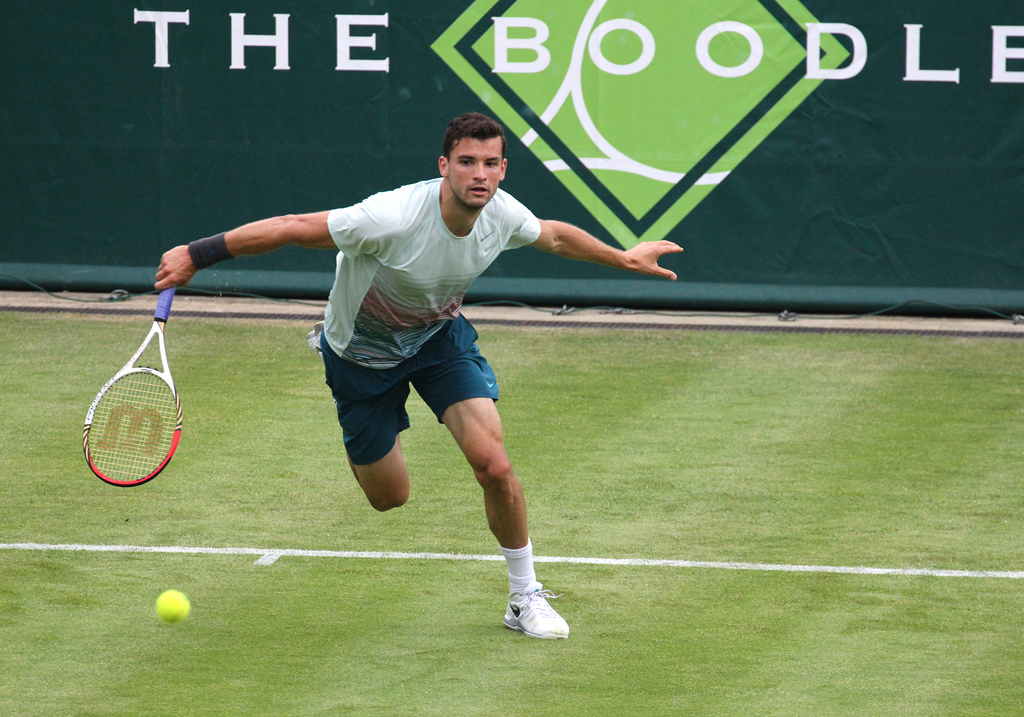
    9077226103_3e45fbc8aa_b

    I can’t help but cheer for Grigor Dimitrov. Maybe it is his fluid grace that is reminiscent of a certain great Swiss player (in style, although not potency). Maybe it is his blasé demeanor which is often interpreted as not caring, but also could be indicative of a happy-go-lucky attitude which, while admirable as far as his seeming amiability is concerned, may prove detrimental to the resolve needed for a championship attitude. Regardless, I like young Mr. Dimitrov and want to see him succeed.

    Over the last year Grigor has established himself as one of the premier talents of his generation, rising from No. 46 at the end of 2012 to No. 23 as 2013 comes to a close.  Just a couple weeks ago, Dimitrov finally won his first ATP title at Stockholm, an ATP 250 event. That win, coupled with his overall improvement in 2013, has led to a response that seems to be cautiously optimistic, that this could be the breakthrough that the talented but seemingly listless young player needs to start actualizing the potential and smooth play on the court that has earned him the appellation “Baby Federer.”

    But not so fast. Let us not forget that Grigor is already 22 and part of a generation that has been either slow to develop, or lacks elite talent.

     A Lost Generation?

    It is well known that there aren’t many highly ranked young players on tour at the moment; in fact, above Grigor’s rank of No. 23 there are only two players—Milos Raonic at No. 11 and Jerzy Janowicz at No. 21—that were born in the 1990s (Kei Nishikori, at No. 17, misses the cut by a few days), and both Janowicz and Raonic turn 23 years old later this year. After Dimitrov, the players born in the ‘90s are few and far between; here is a complete list of those players in the Top 100:

    11. Milos Raonic (22)

    21. Jerzy Janowicz (22)

    23. Grigor Dimitrov (22)

    32. Vasek Pospisil (23)

    52. Bernard Tomic (21)

    56. Federico Delbonis (23)

    65. Pablo Carreno Busta (22)

    79. Evgeny Donskoy (23)

    82. Jiri Vesely (20)

    91. Jack Sock (21)

    Perennial disappointment Ryan Harrison (21), Denis Kudla (21), and David Goffin (22) have all slipped just outside of the Top 100, with quite a few others in the No. 101-200 range.

    Jiri Vesely is the youngest player in the Top 100 at age 20. To get to the first teenager, you’ve got to go all the way to promising 18-year-old Nick Kyrgios ranked No. 181.

    It is clear that the rankings—especially the Top 50—are light with young players. The question is why – and there are two general theories. One is that players are simply maturing later, perhaps due to the more physical nature of the game. If this is true we won’t know for another year or two, as the players listed above enter their mid-20s. So we’ll leave that one aside for the time being.

    The second is that we’re in a bit of a generational lull; meaning, the young players on tour—which we can loosely define as anyone born in the 1990s—are not a very talented generation, perhaps harkening back to the generation of players born in the late 70s, of whom Gustavo Kuerten was probably the best.

    As an aside, I’m defining a “tennis generation” as a span of five years. I am dividing generations by half-decades; this is obviously arbitrary but I’m not sure if there’s any way around that.

    Anyhow, Kuerten’s generation – those players born from 1975-79 – won only a total of seven Grand Slams. Compare that to other generations of the Open Era:

    1985-89:  22 (Nadal 13, Djokovic 6, Murray 2, Del Potro 1)

    1980-84: 23 (Federer 17, Hewitt 2, Safin 2, Roddick 1, Ferrero 1)

    1975-79: 7 (Kuerten 3, Moya 1, Gaudio 1, Johansson 1, Costa 1)

    1970-74: 34 (Sampras 14,  Agassi 8, Courier 4, Bruguera 2, Kafelnikov 2, Rafter 1, Chang 1, Krajicek 1)

    1965-69: 15 (Becker 6, Edberg 6, Muster 1, Korda 1, Stich 1)

    1960-64: 18 (Lendl 8, Wilander 7, Cash 1, Gomez 1, Noah 1)

    1955-59: 20 (Borg 11, McEnroe 7, Kriek 2)

    1950-54: 16 (Connors 7, Vilas 4, Edmondson 1, Gerulaitis 1, Panatta 1, Tanner 1, Teacher 1)

    Going back further, you’ve got Stan Smith, Jan Kodes, Tony Roche, and Ilie Nastase born in the late 40s; John Newcombe and Arthur Ashe born in the early 40s; Rod Laver and Roy Emerson born in the late 30s; Ken Rosewall in the early 30s, etc.

    The generation born in the late 70s is easily the worst of the Open Era, and probably going back much further. This new generation born in the 1990s could very well vie for that honor.

    Either way, they’re both theories. What we do know is that this younger generation is not—yet, at least—as strong as past generations.

    Back to Grigor. In the same way that we won’t be able to answer the questions above, at least not for another couple years when the top players in the early 90s generations start reaching age 24 and 25, so too can we not know if Grigor’s win at Stockholm is the beginning of an elite player coming into his own. Grigor has been lauded as one of the few of his generation with the talent to win Grand Slams, yet it is also true that most No. 1 players and Grand Slam winners are already playing at a very high level by the time they are Dimitrov’s age.

    What Does History Tell Us?

    What we can do is look at historical precedent. If Dimitrov’s generation is peaking later, then this information is less useful – but it still gives us a starting place.

    I’ve created a few criteria to look at:

    • Active players who have won at least 2 ATP title events of any level
    • Active Players who have won an ATP 500 or higher in their careers
    • All players who have won an ATP 1000, WTF, or Grand Slam in the 21st century (2000-present)

    This gave me a list of 67 players, ranging from the greats of the 1990s like Pete Sampras and Andre Agassi, to young players like Raonic and Janowicz.

    I then looked at the first tournament each player won, and the age they were when they won it.  Finally, I accounted for each title they won, giving “points” for them as follows:

    • 8 Grand Slam
    • 5 WTF/Masters Cup, Olympics Gold
    • 4 ATP 1000
    • 2 ATP 500
    • 1 ATP 250

    You will note that a point is equal to 250 ATP points, except for the case of the WTF, Masters Cup, and Olympic Gold, all of which I somewhat arbitrary gave 5 points for – because I feel like they are all of similar difficulty to win and thus roughly equal in value, for the sake of this study at least. Anyhow, the point is not to quibble with the particularities of the system; it is only a means to an end, which is to look for similar players to Dimitrov and see how they did.

    Of the 67 players, 27 of them won their first title at age 22 or later. Using my point system, of those 27 players the highest point totals were Thomas Johansson, Gaston Gaudio, Ivan Ljubicic, Tim Henman, and Jo-Wilfried Tsonga. To put it another way, if Grigor Dimitrov follows historical precedents for recent players, he will not have a career greater than any of those five players.

    Johansson and Gaudio are the only players of the 67 who won a Slam and didn’t win their first titles until age 22 or later. The ten multi-Slam winners of the 67 all won their first ATP title before turning 22 years old; actually, all 10 won their first title before turning 21, and only one – Gustavo Kuerten – didn’t win their first title before turning 20. Lleyton Hewitt was 16 when he won his first title, Agassi 17; Nadal, Sampras, Murray, Roddick, Ivanisevic, Enqvist, Berdych, Gasquet, and Nishikori were all 18; and Federer, Djokovic, Kafelnikov, and Safin were all 19.

    Now, of the 27 players who won their first title at age 22 or later, the highest ranking any attained was Ivan Ljubicic at No. 3; Tim Henman and Sebastian Grosjean were No. 4; Gaudio, Tsonga, and Cedric Pioline were No. 5.

    Furthermore, none of the 27 players won more than a single ATP 1000 level event – and only 9 of the 27 (33%) did so. None won more than 2 ATP 500s, and only 4 of them won two (15%). That said, only 4 of the 27 only won ATP 250 events – Nicolas Mahut, John Isner, Albert Montanes, and Janko Tipsarevic (although, remember that these 67 are all multi-titlists and/or players who won an ATP 500 or higher; so Grigor has to win at least one more title before he’s officially in the demographic).

    Final Thoughts

    Putting all of that together, we see a rather clear picture. If Dimitrov holds to historical norms – that is, if he doesn’t break new territory and have a more successful career of any player to have won their first title at age 22 – then his upside is that of a Top 10 player, perhaps a Top 5 player, and just maybe someone who wins a single Slam (although this is very unlikely, in terms of historical precedents) and/or an ATP 1000 event.

    But again, history is being re-written all of the time. And it could be that the first theory discussed above – that the younger generation is taking longer to mature – will support new horizons being reached. Couple that with the complexity of Grigor’s game, and the possibility that it might have just taken this long for everything to start to click together. But let us be cautious in our optimism; right now Grigor’s upside looks like that of a second tier player, someone like Berdych or Tsonga – and there is certainly no shame in that. Further, unlike Berdych and Tsonga, Dimitrov has no elite-talent peers; as Nadal (27), Djokovic and Murray (both 26) start to show signs of age, opportunities may arise for Dimitrov–and Janowicz, Raonic, and perhaps one or two others–to surprise and sneak out a Grand Slam title. Yet it also may be that he turns into someone more like Gasquet or Cilic, neither of whom have (yet) won a tournament above an ATP 250.

    2014 Prediction: I think Grigor will continue his upward trend and is a good bet for an ATP 500 title, and a dark horse candidate for an ATP 1000. Where in 2012 he established himself as a Top 50 player and in 2013 he ended on the cusp of the Top 20, in 2014 he’ll establish himself as a perennial Top 20 player – and on the upper half of that range, even with a chance to challenge for the “soft bottom” of the Top 10, the spots that players like Tipsarevic, Gasquet, and Wawrinka vie for – and which he, Janowicz, Raonic, and Nishikori will fight for in 2014. He won’t yet challenge the near elites for a spot in the Top 8 – that will come in 2015.

    In the long-term, I like Grigor’s chances of winning a Slam some day. I don’t see it in 2014, and probably not 2015, but come 2016 – the year Nadal turns 30 and Djokovic and Murray 29, while Dimitrov will be in his prime at 24-25 – anything is possible.

    Photo by Marianne Bevis (Creative Commons license)
  • Don’t Mess With The Milos

    Don’t Mess With The Milos

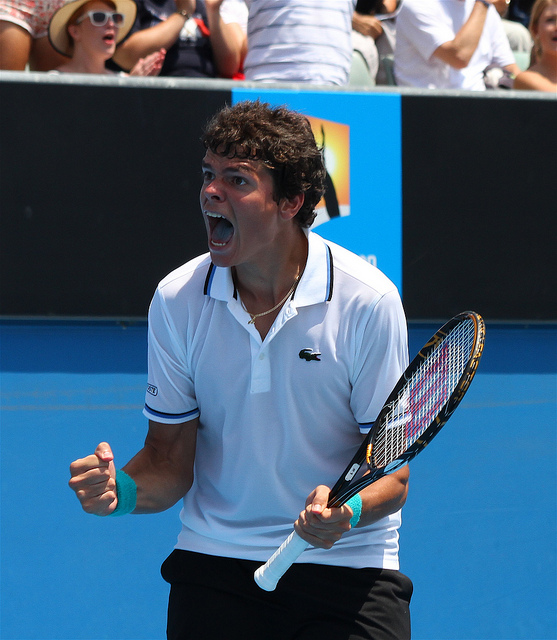
    5378499514_231d905c18_z

    Milos Raonic’s defeat of Tomas Berdych in the Thailand Open got me thinking about the young Canadian and the way perceptions of him have changed over the course of 2013. Milos was (almost) the darling of the tennis world last year, the brightest young player on tour, at least until Jerzy Janowicz’s run at the Paris Masters. Milos finished 2012 ranked No. 13, a huge jump from No. 31 in 2011. This year his ranking has held steady, even creeping up a bit to his current No. 11 (it was at No. 10 briefly), although overall his 2013 season has seemed mildly disappointing for two reasons:

    1) He still hasn’t gotten past the fourth round of a Grand Slam tournament
    2) His Canada Masters results, which saw him cheat his way into the final (although he may have beaten Del Potro despite his dishonesty), and once he got to the final he was utterly demolished by Rafael Nadal, affirming the view that, unlike the similarly aged Jerzy Janowicz, Raonic may neither have the head nor the overall game to win a major tournament, at least against a true elite player.

    [divider]

    Click here to discuss “Don’t Mess With The Milos” in the discussion forum.

    [divider]

    Combining both we see a young player who hasn’t been able to take his game up a significant notch from the previous year and may end this year just outside the Top 10 for the second year in a row.

    But let’s take a step back for a moment. Milos is only disappointing if we’re expecting him to be an elite player. What he has established is that he’s a legit Top 20 player and has a good chance of soon becoming a fixture in the Top 10. Let’s see how Milos matches up against the current Top 10 players in the game:

    1. Novak Djokovic: 0-1
    2. Rafael Nadal: 0-4
    3. Andy Murray: 2-1
    4. David Ferrer: 0-4
    5. Tomas Berdych: 1-0
    6. Roger Federer: 0-4
    7. Juan Martin Del Potro: 1-0
    8. Jo-Wilfried Tsonga: 0-2
    9. Richard Gasquet: 1-1
    10. Stanislas Wawrinka: 0-1

    Total: 5-18

    That record is nothing to be proud of, but note that if we are selective and look at only Murray, Berdych, Del Potro, and Gasquet, Raonic is 5-2, whereas against Federer, Nadal, Djokovic, Ferrer, Tsonga, and Wawrinka he’s 0-16 — some of the matches which were played in 2011, before he really came into his own.

    If we look beyond the wins and losses, we see a player that has been a tough opponent for a couple of years now. His two losses to Tsonga, for instance, have been very close – two three setters in best-of-three matches, one at Indian Wells this year and one at the Olympics last year in which he lost a tiebreak 25-23. Against David Ferrer, Milos is 0-4 but three of those matches were in 2011. He did lose to Ferrer in Barcelona last year, but it was two 7-6 sets.

    If we look at 2013 alone, Raonic is 37-17. He just defeated No. 5 Berdych in Bangkok for the title, the fifth of his career, all five of which have been ATP 250 events. At the US Open he lost a grueling five-setter to No. 9 Richard Gasquet, a match that included three tiebreaks. In Cincinnati he lost to a very hot John Isner in the third round; in Canada he lost to Nadal in the final, but not until he made it through a grueling gauntlet: Jeremy Chardy, Mikhail Youzhny, Juan Martin Del Potro, Ernests Gulbis, and Vasek Pospisil.

    In Halle he lost to a resurgent Gael Monfils; he also lost to another comeback player, Fernando Verdasco, in Madrid. In Roland Garros to an ever-dangerous Kevin Anderson, in Rome to a similarly dangerous Phillip Kohlschreiber. In Barcelona he lost to the greatest clay-courter of all time, Rafael Nadal.

    Milos had a few rather surprising losses as well:  against No. 83 Marinko Matosevic in Washington, No. 64 Igor Sijsling in Wimbledon, No. 54 Ivan Dodig in Eastbourne, and No. 168 Jack Sock in Memphis early in the year. He also lost to No. 49 Jarkko Nieminen in Monte Carlo, and No. 48 Grigor Dimitrov in Brisbane at the beginning of the year (Dimitrov being perhaps an even more talented and disappointing youngster).

    To put it another way, there’s little rhyme or reason to Milos’s record this year. He’s 0-4 against Big Four opponents but has held his own against everyone else — a 37-13 record, or 74%.

    So what’s ahead for the big Canadian? Critics doubt his ability to be a true elite player or to win a Slam due to his relatively poor movement and the lack of diversity in his game. Yet there are other, similar players at or near the top of the game – his recently defeated foe, Tomas Berdych, comes to mind.

    It does seem unlikely that Milos Raonic will become an elite player on the level of the current Big Four. But he’s already playing a high level of tennis and is still not yet quite 23 years old. He’s part of a generation of players — including Dimitrov and Janowicz, but also Bernard Tomic, Ryan Harrison, Jack Sock, David Goffin, and Pablo Carreno Busta — that has no clear elite players, but could be squabbling for titles as the current elite — especially Nadal, Djokovic, and Murray — begin to show signs of age in another year or three. So if we expected Milos Raonic to be that elite talent that is so lacking in his generation of players born in the early 90s we will likely be disappointed, but let’s not forget that he is, and will remain, a formidable player and will be in or near the Top 10 for the foreseeable future.

    Photo Courtesy of globalite (Creative Commons license)

  • Nadal the Great, Part 1: Rafa’s Window of Opportunity

    Nadal the Great, Part 1: Rafa’s Window of Opportunity

    6227268072_bcda2ed57b_b

    [This is the first of two thematically-linked articles focusing on Rafael Nadal and his quest for greatness; the second article will be out in a day or two.]

    Rafael Nadal turned 27 years old a few months ago, about a week before winning his 8th French Open and 12th Slam overall, at that point and now, with his 13th Slam victory, standing behind only Pete Sampras (14) and Roger Federer (17) for the most Slams in the Open Era; if we include pre-Open Era Pro Slams–as I think we should–we add a few others so we get the following list:

    Most Slam Wins in Tennis History (Pro, Amateur, and Open Era)

    23 Ken Rosewall
    19 Rod Laver
    17 Pancho Gonzales, Roger Federer
    14 Bill Tilden, Pete Sampras
    13 Rafael Nadal

    With 13 Slam wins and, still only 27 years old, playing some of the best tennis of his life, it’s reasonable to start taking seriously the idea that Nadal could surpass Federer. Now with a player as great as Nadal there are few comparable players – once you get to this level anything is possible and new benchmarks can be made. And of course Nadal, like all of the greats, has his unique style of tennis: a blend of tremendous athleticism, defensive prowess, unrivaled topspin that has been the bane of many a player, and of course his perhaps unparalleled tenacity. (For those watching the US Open Final, you might have heard John McEnroe say that he thought Jimmy Connors tried harder than any player in tennis history until Rafa came along.) But it is still important to ask: What are the precedents? In particular, how many Slams did the above players win after turning 27? And of players with fewer Slams, how many of their total were won after their 27th birthday?

    [divider]

    Click here to discuss “Nadal the Great, Part 1: Rafa’s Window of Opportunity” in our discussion forum.

    [divider]

    Let’s take a look. We’ll start with the above list of “inner circle greats” with the seven highest total Slam victories. We’ll also look at those players in the Open Era that won 6+ Slams, although will exclude those players who did not (or have not yet) played at age 27: Bjorn Borg – who played his last Slam at age 25 – and Novak Djokovic, who is 26. I’m also going to exclude Bill Tilden because he played tennis during a very different era; coupled with the fact that he didn’t win his first Slam until age 27 and won his last at age 42 (!), he skews the numbers in a way that has little relevance to the current game. In truth, we could easily exclude Gonzales, Rosewall, and Laver as well, but I’d like to include them as other “GOAT” candidates (more on this in the second part).

    This gives us a list of 14 players: GOAT candidates Rosewall, Laver, Gonzales, Federer, Sampras, and Nadal, as well as “outer circle” all-time greats John Newcombe, Jimmy Connors, Ivan Lendl, John McEnroe, Mats Wilander, Stefan Edberg, Boris Becker, and Andre Agassi. As of last night, those 14 players have won a total of 160 Slams.

    To start, let’s take a look at the age at which those Slams were won. For the sake of ease, by age I mean the age a player turned in a given year, not the time period between their birthdays. So, for example, any Slam in 2013 is part of Nadal’s “age 27 season” – even the Australian Open, during which he was still 26. Obviously this isn’t exact, and it doesn’t differentiate between players who were born in January versus December, but it’s close enough for the purpose of this study. We’ll be more exact in a moment when we turn our gaze to his closest contemporaries.

    20130910050234

    As you can see, plenty of Slams were won up until the age 31 season but there’s a steep and remarkable drop-off at age 32 and beyond. (As a side note, it is worth mentioning that 2012 was Federer’s age 31 season, and this year is his age 32 season, so he follows this pattern quite well.)

    Of those 14 players, three did not win a Slam at Rafa’s current age – Wilander’s last was at age 24, McEnroe’s at age 25, and Edberg’s at age 26. The rest, however, did win Slams at age 27 and older.

    Rafael Nadal has 13 Slams through his age 27 season. Of the 160 Slams above, 107 were won through age 27, or 67%. If Nadal follows that same ratio, it means he’ll end up with 19 Slams. But note that of those 53 Slams won at age 28 and later, 32 were won by Pancho Gonzales, Ken Rosewall, and Rod Laver – players whose primes were in a very different era. If we take those three out of the mix, we’re left with 101 Slams total and 21 won at age 28 and older – only 21% compared to the 33% total. If Nadal follows that trajectory, it means that he’ll finish with 16, maybe 17.

    Now let’s look more closely at Nadal’s closest contemporaries: Federer, Sampras, and Agassi. Between the three they won 39 Slams. Of those 39 Slams, 12 were won at age 28 or later – or 31%. If Nadal follows a similar pattern, that means his 13 Slams is 69% of his total, and that he’ll win 17 or 18 total.

    Those numbers are somewhat skewed by Andre Agassi’s remarkable longevity. Agassi is the rare player who was better in the second half of his career than he was in the first half, winning five of his eight Slams during his age 29 and later seasons. Sampras and Federer, on the other hand, won seven of their 31 total at age 28 and later – or 23%. So it really depends upon whose career path Nadal is closer to.

    Let’s be a bit more specific with Federer and Sampras. Federer turned 27 on August 8, 2008, shortly before winning his fifth and last US Open. From his 27th birthday on, he’s won five Grand Slam tournaments (so far!), 29.4% of his total. Three of those five were before his 28th birthday, so after turning 28 he has won only two Slams.

    As for Sampras, he turned 27 on August 12, 1998, shortly after winning his 11th of 14 Grand Slams. He won his 12th just before turning 28, his 13th just before turning 29, and his 14th just after turning 31.

    Between Federer and Sampras, they won 23 of their Slams before turning 27 (74%), four at age 27 (13%), and four after turning 28 (13%).

    Nadal has one more Slam before his 28th birthday — the 2014 Australian Open. So far he’s won two Slams at age 27, so has a chance of equaling Federer’s three while 27-years old. Yet here’s where the “window of opportunity” starts to close. Both Sampras and Federer won only two more Slams each after turning 28 (again, so far – we should completely write Roger off…yet). So if Nadal follows their career pattern – and even if he wins the AO to get to 14 – he’ll finish with 16 Slam wins; that’s certainly nothing to be ashamed about but not quite enough to catch Federer.

    But remember also that Andre Agassi won five Slams after turning 28 – and he isn’t the only player to do so; Rosewall, Laver, and Gonzales all won that many or more after turning 28. It could also be said that, in some ways, Nadal plays a style more similar to Agassi than Sampras and Federer. While it should be said that one commonality that just about every all-time great has, especially the inner circle greats, is that they were adept at offense and defense, like Agassi, Nadal plays a more defending than attacking tennis. Whether there is any correlation between this and longevity is questionable.

    Some have explained Agassi’s longevity – which is unmatched in terms of maintaining an elite level of play, at least since Ken Rosewall in the 1970s – to him missing significant periods of time earlier in his career, and thus avoiding the grueling schedule that Sampras and, more so, Federer has undergone. Rafa has missed some time, although not nearly as much as Andre.

    Another thing to bear in mind is that both Sampras and Federer were great servers – Sampras arguably the greatest in tennis history, and Federer certainly among the greatest – while Nadal has been considered a particularly weak server for such a great player (although his serve of late seems to have taken on new guile and spin, last night notwithstanding). Just recently some commentator or analyst—unfortunately I can’t remember whom—said that the reason Federer is struggling so much is that his serve has been off. It makes me wonder if the fact that a larger portion of Sampras’s and Federer’s greatness comes from their serve than, say, Agassi or Nadal, which makes decline after losing an edge on serve more certain.

    Obviously Nadal’s longevity is tied into his health, particularly his knees. It is hard to imagine his knees holding out for another half decade of healthy tennis. But until they go, that is, until Nadal finds himself missing more tournaments than not, and struggling with recovery times, he should remain a top player. I would guess that when he starts to “go”, it will happen fast. I can’t help but imagine that Nadal is currently playing on borrowed time, although as a fan of the game I certainly hope not.

    In conclusion, we started with asking the question: What is Rafa’s window of opportunity for continued greatness and Slam contention? Is it closing? If not, when will it close? There really is no way to definitively answer those questions – but that’s not the point of this article. What I’m trying to do is develop an informed opinion, one that is flexible but has an awareness of context.

    In the end I’m left with this: It all depends upon the health of the knees, which he relies upon for his incredible speed and endurance. But given his incredible will and tenacity, I suspect that Rafa has a few good years left in him. There may be bumps in the road, and the older one becomes the longer recovery from injury takes, but Rafa has given us reason to believe that he will—like other all-time greats—remain effective into his 30s. After age 31, all bets are off, but that still gives us about four years of potential greatness from the Spanish Maestro, and in that time he has a chance to build a case to be considered the greatest player of all time. But more on that next …

    Photo by globalite (Creative Commons license)
    Original chart made using onlinecharttool.com

  • The Ebb and Flow of Talent in the ATP Era

    The Ebb and Flow of Talent in the ATP Era

    2645577395_fed7784140_o

    Photo provided by rainycat (Creative Commons license)

    When looking at the different periods of tennis history, the late 1970s to early 1980s is often considered the “Golden Era,” highlighted by what must be the greatest rivalry in tennis history: Bjorn Borg versus John McEnroe. We could say that this era began in 1978 when the young American upstart McEnroe surprised the tennis world by beating Bjorn Borg at the Stockholm Open, the first of 14 matches they played against each other, each winning seven. The natural end of this era, then, would be their last match: the 1981 US Open, when McEnroe solidified his usurpation as the top player in the world by beating Borg in the final, and also Borg’s last Grand Slam contest.

    [divider]

    Click here to discuss “The Ebb and Flow of Talent in the ATP Era” in our discussion forum.

    [divider]

    So from the very end of 1978 to late into the 1981 season was a great era of men’s tennis, dominated by Borg and McEnroe, with older but still excellent Jimmy Connors and Guillermo Vilas rounding out the elite and, in the last half of that span, young Ivan Lendl coming onto the scene. Yet the question that arises is this: Was it the most talent-rich period of tennis history or merely the most celebrated? This set me to doing some research; for the sake of ease I stuck to the Open Era and, in particular, the period of ATP rankings, 1973 to the present. So we can fine-tune the question a bit and ask: How has “talent-richness” changed over the last 40 years of men’s tennis?

    I decided to look at only those players who could be considered “all-time greats.” My criteria were flexible, but included all players who had won three or more Slams in the Open Era, or were likely to win three or more, and at more than one venue. This means that I excluded Gustavo Kuerten, who won three Slams at Roland Garros, but included Andy Murray, who has won two Slams at different venues, and seems likely to win at least one more.

    I came up with a list of nineteen players; here is a chart that shows their year-end rankings (click on chart for better viewing):

    Greats ATP Ranking

    Just looking at that chart gives us a sense of the ebbs and flows of upper echelon talent in men’s tennis, although of course it is important to point out that I’m only looking at the very greatest players and not the “near-elites” or players that might have been great for a short period of time (e.g. Lleyton Hewitt, Michael Stich, etc.). The purpose here is to focus on truly great talent and in what density it has shown up over the last four decades.

    I then separated those nineteen players into three groups or tiers by their total Slam count, to differentiate levels of greatness:

    Tier One (10+ Slams): Rosewall, Laver, Borg, Sampras, Federer, Nadal

    Tier Two (6-9 Slams): Newcombe, Connors, McEnroe, Lendl, Wilander, Edberg, Becker, Agassi, Djokovic

    Tier Three (5 or fewer Slams): Ashe, Vilas, Courier, Murray

    I think we can safely say, without too much quibbling, that the above list represents the 19 greatest players of the Open Era, roughly arranged in levels of greatness. Strike that; I’m sure there will be quibbling, and I can imagine the protests of, say, Andy Murray’s inclusion but not Gustavo Kuerten’s or Marat Safin’s or Patrick Rafter’s or Ilie Nastase’s. But I think we can at least agree on most of that list; in other words, if we want to quibble about Murray or Ashe or Vilas or Courier, fine, but the other fifteen are clearly all-time greats, and of the four “Tier Three” players we can, at the least, say that they’re deserving of consideration and at least as deserving as anyone else.

    That aside, I won’t go into exact numbers for the sake of avoiding complexity and confusion, but I then assigned different points for different rankings, with Tier One getting roughly twice the points of Tier Three, and Tier Two halfway in between. Players would get points for different levels of ranking – #1, #2-5, #6-10, #11-20, etc. Finally, I counted up the points from each year for the above 19 players, from 1973 to 2012, arriving at a number which is meant to indicate “talent-richness” of any given year.

    Let me be clear and re-emphasize what I just wrote: This number indicates (or describes); it does not seek to definitively finalize or give us any more than a sense of talent-richness. To get a more accurate, comprehensive picture we’d have to look much deeper than the above nineteen players. What this does show us in a relatively accurate manner is how dense or rich the level of truly great talent has been in any given year. In other words, it tells us for any given year what level of all-time great talent was playing at a high level; it doesn’t tell us the total depth and breadth of talent.

    The next chart shows us that number over time:

    20130907054418


    There are a few things that stand out for me:

    One, there’s an interesting two-year window in 1974-75 which, according to this calculation, were the two most talent-rich years in the last 40 years. The reason for this is that a few of the top players of the 1960s—Laver, Rosewall, and Ashe—were still playing at a high level; at the same time, you had Newcombe in his prime, a young Connors and Vilas, and a teenage Borg establishing himself as an elite player. The number dropped as the older players faded away; in 1976, for instance, Laver finished the year at No. 76 compared to No. 10 the year before.

    Secondly, we can see that the 1978-81 period—while talent-rich—is not as much so as the late 1980s when you had three generations all playing at or near their peaks. This is not to say that the ’78-81 period wasn’t talent rich; but this certainly supports the idea that its appellation as the “golden era” of men’s tennis has more to do with the great Borg-McEnroe rivalry than it does with a clear supremacy of talent over other periods.

    Moving on, there is an obvious and massive decline in the mid-90s. Wilander and Connors were done as elite players by 1990, McEnroe retired in ’92, Lendl a couple years later, and then Edberg and Becker faded just after that, and Jim Courier—like Wilander—peaked and faded at a young age, so during the mid-to-late 90s there were only two clear elite players, Agassi and Sampras, and Sampras started fading in the late 90s.

    The absolute nadir of Open Era talent seems to be 2000. The talent-level began to rise with the arrival of Roger Federer, and then jumped when Rafael Nadal stormed through Roland Garros in 2005. From 2008 through 2012 it has “flat-lined,” with four players dominating the field in a way previously unseen.

    Before ending, allow me to indulge in some speculation. It seems clear that Roger Federer has slipped out of the elite; perhaps the best we can hope for is him hanging around the Top 10 for another couple years. Nadal, Djokovic, and Murray should be around for some time, but the big concern is that there are no obvious candidates to join the above list, to turn that list of 19 into 20 or more. Of course we will see more elite players, but it’s hard to imagine Milos Raonic or Jerzy Janowicz or Grigor Dimitrov winning three or more Slams and earning a spot on this list. Who knows? I could be wrong–I certainly hope I am!–but my sense is that for that next great player, we’re going to have to wait two to three years or more before we even know who he (or they) will be.

    With Federer unlikely to finish in the Top 5, that number is going to drop for 2013. Not by much, but probably by five points. I could see it holding steady in the upper 40s for another year or two, but after that it all depends upon whether we start seeing signs of that next great player and/or how quickly the current Big Three will decline. The decline of all players is inevitable, and we’re likely going to start seeing signs of the decline of the Big Three within the next two or three years, as they enter their late 20s and are more frequently beaten by the hungry near-elite players below them.

    In conclusion, talent ebbs and flows and no era is quite like any other. Neither of the above charts shows a clear pattern or cycle; it would seem that each new era is different and that all we can be certain of is change itself. One of the great joys of tennis, at least for myself, is waiting and watching for the next generation of talent to arise, to try to understand who the next great player will be, and what match – like Stockholm in 1978 – will signal the changing of an era. So I will continue to watch and wait. Meanwhile, we can sit back and enjoy the great tennis play of today.

  • American Men’s Tennis and the Cycle of Ages

    American Men’s Tennis and the Cycle of Ages

    5638812812_0691415a18_o

    Photo by Neon Tommy (Creative Commons License)

    Consider the following as an addendum, or second part, to the previous blog in which I looked at the decline of American men’s tennis. In this entry we’ll look at the big historical trajectory of men’s tennis, and from a slightly different perspective: that of mythology.

    Various mythologies throughout the world – such as Greek, Indian, and Mesoamerican – hold that the world passes through great ages of time. While there are differences between these myths, they are also remarkably similar in that all start with some kind of paradisiacal “Golden Age” from which there is a “fall” and further decline into successively lesser ages. The Golden becomes the Silver, then the Bronze, and finally the Iron or Dark Age. Some of these mythologies hold that this process is cyclical, so that the Dark Age will eventually transition into a new cycle, even a new Golden Age.

    It struck me how American men’s tennis has gone through its own cycle of ages over the last four decades (and perhaps before).

    The Golden Age (1974-1984) had its beginnings in the early 70s with the elder statesmen Arthur Ashe and Stan Smith, but did not truly arrive until the peak of Jimmy Connors, the first truly dominant American male player since Pancho Gonzales. American men dominated the rankings from the mid-70s into the mid-80s. Perhaps the most dominant year was 1979 when the #2-5 players were all American (Sweden’s Bjorn Borg was #1), and seven of the top 10 were American. From 1974 to 1984, an American held the #1 ranking for all but two years, in 1979-80 when the great Swede was at the top of the game.

    9097572979_78970c3289_o

    Photo by University of Salford (Creative Commons license)

    There was a slight lull as the ages shifted when the two greatest players of the Golden Age, Jimmy Connors and John McEnroe, were in decline, and before the next generation of American greats arose. 1985-1988 saw no American man win a Grand Slam event, the first time since 1973 that at least one American man hadn’t won a Slam. While Connors and McEnroe were both in the top 5 in 1985, Connors was the highest ranked American in 1986 at #8, and no American male finished the year in the top 2 until Jim Courier in 1991.

    The Silver Age (1989-1999) began when 17-year old Michael Chang won his first and only Grand Slam event in 1989 at the French Open. American men began another streak of years with Grand Slam winners. Chang was joined by Sampras in 1990, Courier in 1991, Courier and Agassi in 1992, and then the reign of Pete Sampras from 1993 and beyond. While American men’s tennis was still strong in the late 80s–at least relative to the current era–it returned to dominance in the early 90s. It was not the Golden Age of the late 70s and early 80s in that while Sampras and Agassi reigned, the field was not as deep. Thus the 90s were truly a Silver Age, with two Americans – Sampras and Agassi – the most dominant players of the decade.

    502317961_f09eb6acf7_o

    Photo by pandemia (Creative Commons license)

    I mark the end of the Silver Age as 1999, when Andre Agassi was #1 and Sampras had dropped to #3. Agassi remained a dominant player for a few more years but Sampras faded quickly.

    The Bronze Age was, in some ways, a transitional era, and thus difficult to demarcate. But I’d offer that it began right after the end of the Silver Age, in 2000, which was the first year since 1991 that an American didn’t hold the #1 ranking. Sampras remained a strong player for a few years but was in obvious decline. Andre Agassi still played at a high level, even reaching #1 at the venerable age of 33 in 2003, the year that young Andy Roddick finished #1 and the last time an American held the #1 ranking. Americans hoped to see Roddick take the mantle from Agassi and Sampras, but it wasn’t to be – partially because his game was simply too one-dimensional to be a truly elite player, but also because of the rise of a Swiss player by the name of Roger Federer, who took the #1 ranking from Roddick in early 2004. Roddick went from being the top player for a short period of time at the end of 2003, to one of a few near-elites vying for the scraps left behind by Federer and, shortly after, Rafael Nadal.

    The Bronze Age was a short period, fading in the mid-Aughties, suitably without a distinct ending. Perhaps it ended when it became clear that no active American male would win a Grand Slam or be #1. This could be 2006 when Roddick dropped out of the top 5, or it could be 2011 when he dropped out of the top 10 – or 2012 when he retired.  No one stepped up to carry the mantle of American spokesman. I’m considering 2005 as the last year of the Bronze Age, for it was the final full season of the last truly great American tennis player, Andre Agassi, who finished the year at #7. Andre played a few tournaments in 2006 but didn’t win any and finished the year #150.

    Legg Mason Tennis Tournament 08/08/09

    Photo by Keith Allison (Creative Commons license)
    We are currently in the Dark Age of American men’s tennis, with no player in the top 10, and no elite player on the horizon. While the present and foreseeable future of American men’s tennis looks bleak, we must remember that the wheel turns and a new Golden Age may come around again. 1961 saw the last Slam win by Pancho Gonzales, the greatest American men’s tennis player of the couple decades before the Open Era, and probably the greatest overall player of the 1950s. In a way we could say that Gonzales was to the pre-Open Era what Sampras was to the Open Era – the leading player of a Silver Age. Early in his career and before him saw other American greats such as Jack Trabert, Pancho Segura, Jack Kramer, and Bobby Riggs, and some years before them you have Ellsworth Vines and Don Budge, and before them the great Bill Tilden.

    The point being, American tennis did not begin with Jimmy Connors, but it was with Connors that it returned to dominance. The late 1950s to early 1970s was dominated by Australian greats Rod Laver, Ken Rosewall, Lew Hoad, Roy Emerson, and John Newcombe. When Arthur Ashe won the 1968 US Open he was the first American to win a Slam, amateur or pro, since Chuck McKinley won Wimbledon in 1963. So the mid-60s were a dark period for the Americans, and only slowly did that Dark Age transition into the new Golden Age. In other words, we could see a transitional, or “Dawn Age” from 1968 through 1973, when Arthur Ashe and Stan Smith were among the best in the game, but not dominant on the level of Gonzales in the 1950s or Connors in the 1970s.

    So Americans can hope that this current Dark Age will transition into a Dawn Age. If history repeats itself, as it often does, then the first signs of transition will be the appearance of lesser luminaries akin to Arthur Ashe and Stan Smith – not truly dominant players, but winners, or at least serious contenders, of Grand Slams. So we will watch and wait for a 21st century Arthur Ashe to usher the way towards that next Golden Age of American men’s tennis. But we might have some time to go. And given the more international nature of the game and world, it seems likely that the next Golden Age of American men’s tennis will not be as dominant, not shine as brightly as even in the early 90s. Some relativity is involved and we must think modestly; the next Golden Age might not see the United States returning to dominance, just re-joining the elite of the game.

    3875104029_0c669ebe14_o

    Photo by freezr (Creative Commons license)

    [divider]

    Click here to discuss “American Men’s Tennis and the Cycle of Ages” in our discussion forum.

    [divider]

  • Houston, We Have A Problem: The State of American Men’s Tennis

    Houston, We Have A Problem: The State of American Men’s Tennis

    Preamble

    Mardy Fish retiring from the US Open got me thinking about the state of American men’s tennis. Here is a current list of the American men in the top 100, with their age in parentheses:

    #14 John Isner (28)

    #29 Sam Querrey (25)

    #87 Jack Sock (20)

    #92 Michael Russell (35)

    #97 Ryan Harrison (21)

    #100 James Blake (33)

    From looking at that list, the near future of men’s tennis looks bleak. Blake and Russell have seen their best days. Isner is probably as good as he’s going to get. Querrey is an interesting case because five years ago he looked quite promising, finishing 2008 (age 21) at #39, but he was injured and has stagnated since, seemingly establishing himself as a #20-30 type player.

    If Jack Sock and Ryan Harrison are the hope of American men’s tennis then, quite frankly, “Houston, we have a problem.” There are a few other players outside of the top 100 that have some promise, but none stand out as the next great American tennis player.

    The focus of this blog is on statistics and historical trends, so I won’t speculate too much as to the why of this, but by looking at historical trends we can begin to get a sense of whether the current lack of top American talent is part of a cycle, or whether it’s something new and potentially lasting.

    One speculative idea I do want to put forth is the question of how popular tennis is in the United States compared to prior decades, and whether or not this relates to how good the top American players are. Without having any proof other than anecdotal (which obviously doesn’t constitute proof), it is my sense that tennis is less popular today in the United States than it was during the hey-day of American tennis in the early 90s when you had Pete Sampras, Andre Agassi, and Jim Courier dominating the game. But not only is this just a guess, but correlation does not equal causation, and if there is causation it may be two-way – in other words, it could be that the game is less popular in the United States partially because there are no elite American players, and there are no elite American players partially because the game isn’t as popular as it once was.

    Let us return to the historical trends. The question I want to answer is this: How dominant have American players been in men’s tennis over the years, and how does 2013 compare to prior years? To do this I looked at the year-end rankings for the entirety of ATP history, from 1973 to 2013, with a focus on American players. What I found was quite astonishing to me. What follows is a chart that depicts the way American rankings have changed over the last four decades, with some explanation and discussion.

    [divider]

    You can discuss this post and more in our tennis forums

    [divider]

    A Few Notes on Tennis Statistics

    The ATP website has a strange lack of rankings from 1980-82; I’m not sure exactly why it is. I can’t find any other source on the internet that has year-end rankings, so while I could find the top 10 rankings, the rest of the rankings will be empty for those years. But it doesn’t make that much of a difference for this study as the years just before and after that span were very similar.

    Secondly, due to the lack of a good database for tennis statistics (although Tennis Abstract looks promising), I reserve the right to make errors! Hopefully they’ll be small, but chances are there will be one or two, hopefully small, errors along the way, but it wouldn’t change the overall weight of the statistics.

    A briefer note on Ivan Lendl: Lendl became an American citizen on July 7 of 1992. Some records denote American status for earlier years because he lived in the United from 1981 on, for the sake of this study I’m considering him as a Czech for his entire career up to but not including 1992. I feel that it’s both kinder to the Czech Republic (then Czechoslovakia) to do so, but also considering that he was born and raised in the former Czechoslovakia, it’s more accurate to consider him as a Czech for the sake of this study.


    American Rankings in ATP History

    So let’s look at the rankings. The following chart depicts the number of American men in the year-end ATP top 100, 50, 20 and 10 over 41 years of ATP history (In the case of 1980-82, I just continued from 1979 for 80-81, and made 1982 the same as 1983).

    20130821110703

    (Please click on it to see a larger, more clear view)

    When I put together this chart I was stunned by the results. I was expecting a drop off in recent years, but not to this extent. What I found particularly interesting is that the drop-off didn’t begin recently but actually back in the mid ‘80s and speeding up in the ‘90s.

    I was also intrigued to find a rise in the mid-70s. Unfortunately we don’t have rankings before 1973, but if you think of the great names of the 1960s and before, few of them were American. Americans rose to prominence with Arthur Ashe and Stan Smith in the late 1960s and early ‘70s, but it was Jimmy Connors who became the first truly dominant American men’s tennis player, at least in the Open Era, and since the earlier greats of the 1940s and ‘50s: Tony Trabert, Jack Kramer, and Pancho Gonzales, and before them Don Budge, Bobby Riggs, Ellsworth Vines, and Bill Tilden. The Australians dominated men’s tennis in the 1960s, with names such as Ken Rosewall, Lew Hoad, Rod Laver, Roy Emerson, and John Newcombe.

    Jimmy Connors changed that, ushering a new era of American tennis (with the help of Smith and Ashe). The baton (or racket, if you will) of men’s tennis was passed from Connors to John McEnroe, and then for a brief time to Jim Courier, then to Pete Sampras and Andre Agassi. And then from Andre and Pete to…Andy Roddick? James Blake? Robby Ginepri?

    The decline in the number of American men in the top 100 has been relatively minor since 1995, but what has changed is the presence of a truly great American men’s player. Pete Sampras started declining in 1999 and then retired in 2002, and when Agassi retired a few years later we lost the last truly great American player. Roddick and James Blake carried the baton as best they could, but although Roddick finished 2002 as the #1 player, his reign was short-lived as he was surpassed by superior players Roger Federer and Rafael Nadal, and become one of the “best of the rest” in the field of the Aughties.

    Andy Roddick is the last American man to have won a Slam, and also to have been #1. What may even more disturbing is that the only active American man to have been in the top 5 is James Blake, who is 33 years old and ranked #100 in the world. A couple years ago Mardy Fish – of the same generation as Roddick and a couple years younger than Blake – seemed to be a late bloomer, ranking as high as #7 in August of 2011, but a heart condition in the following year limited his play and he seems close to retirement.

    With his big serve, John Isner remains a dark-horse candidate at many tournaments and has reached as high as #9 in the rankings in April of 2012. But at age 28 he is unlikely to improve.


    Final Thoughts

    American men’s tennis is in dire straits and there is no clear end in sight. American men’s tennis rose in the mid-70s, peaked in the late 70s to early 80s, but then began a long decline in the late ‘80s, with a startling drop in the mid-90s and continued slow decline since. We can hope that, like the Once and Future King (which is, ironically enough, of the British cultural mythos), a new great young player will rise up. But who he is, or will be, remains to be seen. The highest ranked American teenager is Christian Harrison, younger brother to Ryan, who is currently #389. The highest ranked American junior is #16, Macedonia-born Stefan Kozlov, who made it to the quarterfinals of the 2013 Boys’ Wimbledon at the tender age of 15.

    Certainly, we are amidst a long winter in American men’s tennis.

    Credits: Cover Photo: Mike McCune, (Creative Commons License)

  • Career Snapshot: Tommy Robredo

    Career Snapshot: Tommy Robredo

    This will be the first in a series of glimpses of the careers of various players, anyone from the complete obscure to the greatest players of all time. There will likely be no rhyme or reason to the players I choose to feature, except my own curiosity, the results of which I will share with you! Enjoy.

    [divider]

    “Disco Tommy”: The Other Other Spaniard

    We all talk about Tommy Haas’s remarkable play at the age of 35 and David Ferrer peaking in his early 30s, but a third older player who is having a bit of a career resurgence is Tommy Robredo, who at 31 years old is currently #29 – the highest he’s been ranked since 2010. In fact, he’s probably having his best season since 2009, when he finished #16.

    Tommy Robredo, named after the rock opera by the The Who, is a member of “Generation Federer.” I consider a tennis generation to be roughly five years, and if we look at players within two and half years or so of Federer’s age, that would be players born from 1979-1983, or those players turning 30-34 this year. After Juan Carlos Ferrero and David Ferrer, Robredo is–along with Fernando Verdasco and Feliciano Lopez–one of the five or so best Spanish players of Generation Federer (Carlos Moya, born in 1976, is of the prior generation, and Nicolas Almagro, born in 1985, and Rafael Nadal, born in 1986, are of the later generation.)

    Robredo became a ranked player in 1999, with his first ATP tour event, and finished that year at #249, but didn’t truly get under way until 2001, when he made it to the 4R at both Roland Garros and the US Open, finishing the season #30 at the tender age of 19. Yet Robredo didn’t catapult up the rankings; he finished the following year at #30 as well, 2003 at #21, 2004 at #13, and then 2005 at #19.  Robredo had his best span in 2006-07, finishing #7 and #10 respectively, including an ATP 1000 win at Hamburg in 2006, and two QF Slams appearances in 2007. On August 28 of 2006 he reached his highest career ranking of #5.

    Since 2007, Robredo’s decline has been steady: he finished 2008 at #21, 2009 at #16, and then plummeted in 2010 (#50) and 2011 (#51). His worst span was between mid-2011, when he missed the French Open, through about half of 2012, in which he played only one Slam, losing in the 2R at the US Open.  In 2013 he went out in the 1R of the Australian Open but then won his first ATP tournament since 2011 in April in Morocco (ATP 250), defeating Kevin Anderson. At Roland Garros, he had his best Slam result since 2009, including a five-set win over Nicolas Almagro in the 4R, but then lost in straights to David Ferrer in the QF. He had a decent Wimbledon, going out in the 3R. As of this writing he is competing in the ATP 500 tournament in Hamburg, and is ranked #29 with a chance to rise further depending upon how he does.

    Robredo’s one of those players that has had a nice, understated career – what I’d call a “third tier” player – not an elite player (first tier), not a near-elite challenger (second tier), but among those players who tend to play deep into the first week of Slams, occasionally peaking into the second week, and might win one or two upper level and a handful of lower level ATP tournaments. He’s never made it past the QF at a Slam, but he’s made it that far six times – five at the French Open – and the 4R 13 times. He’s been part of a winning Spanish team at the Davis Cup three times.

    At the other ATP tournaments, he’s won one ATP 1000 tournament – Hamburg in 2006, defeating Radek Stepanek (when Hamburg was still in the 1000 series), made it to four SF at ATP 1000s, and quite a few QF. He’s lost in the finals of three ATP 500s, and gone 8-5 in the finals of ATP 250 tournaments.

    He’s beaten 18 top 10 opponents but has never beaten one of the Big Four during their prime, overall going 0-10 vs. Roger Federer, 0-6 vs. Rafael Nadal, 1-5 vs. Novak Djokovic, and 2-3 vs. Andy Murray — those three wins against Djokovic and Murray coming before they were in the top 10.

    Robredo’s results were mixed against other #1 players, going 0-11 vs. Andy Roddick, 2-3 vs. Juan Carlos Ferrero, 1-1 vs. Lleyton Hewitt, 6-4 vs. Marat Safin, 4-1 vs. Gustavo Kuerten, and 0-2 vs. Andre Agassi.

    Let’s hope that “Disco Tommy” (a nickname for his formerly long hair) can continue to play well.

    Data culled from Wikipedia.org, ATPworldtour.com, and live-tennis.eu

    [divider]

    Click here to discuss Career Snapshot: Tommy Robredo with fellow tennis fans in our discussion forum.

    [divider]