Author: Jonathan Northrop

  • National Tennis Careers – Part Three: Spain

    National Tennis Careers – Part Three: Spain

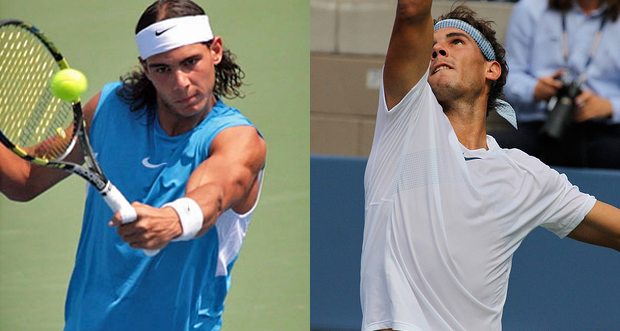
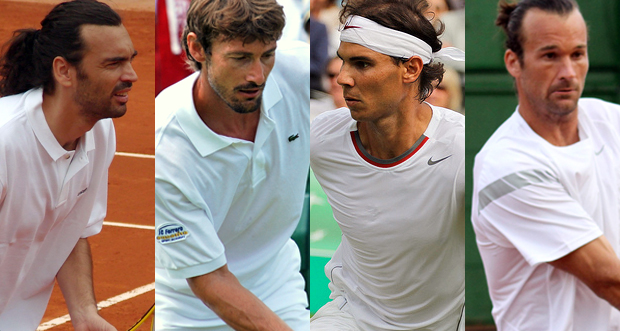
    Sergi Bruguera Juan Carlos Ferrero Rafael Nadal Carlos Moya

    Rafa & The Conquistadores

    Among the five greatest tennis nations in this series, Spain and Switzerland share something in common: they are completely dominated by a single player, one who is head and shoulders above the rest of the field. These two players will be forever linked, not only as two of the greatest ever to play the game, but because of their evocative (albeit lopsided) rivalry.

    [divider]

    Click here to discuss “National Tennis Careers – Part Three: Spain” in the discussion forum.

    [divider]

    Before getting to Rafa, let’s look at Spanish tennis before the King of Clay. Before the Open Era, only three Spanish players appeared in Slam finals, Pro or Amateur: Manuel Santana, Andres Gimeno, and Juan Gisbert Sr. The first two are well known as top players of the 1960s, but Gisbert Sr is not so well known – he lost to William Bowrey in the 1968 Australian Open final, the last Slam before the Open Era began. Santana won four Amateur Slams in the 1960s and was ranked No. 1 among Amateurs in 1966 when he won Wimbledon, but never entered the professional circuit, so didn’t play the top players in the game.

    Andres Gimeno was one of the best players from the 60s that wasn’t Australian. He had a long career, beginning as an amateur in 1956, turning pro in 1961, and playing until 1973. While he never won a Pro Slam, he played in four finals – losing to Rod Laver three times, Ken Rosewall once. He is perhaps best known for winning the 1972 French Open at the ripe age of 34.

    Spanish tennis became stronger during the Open Era, but didn’t see its first truly great player until Rafael Nadal emerged from the clay of Manacor, fully formed like some Mediterranean deity. Let’s take a look at the Open Era Slam record:

    Spain Career

    As you can see, before Nadal seven Slams were won by Spanish players: one each by Gimeno, Manuel Orantes, Albert Costa, Carlos Moya, and Juan Carlos Ferrero, and two by Sergi Bruguera. The weakest era for Spain was the 1980s, after Manuel Orantes retired, but then picked up in the 90s with Bruguera, then later Moya and Ferrero, among others. It is also worth noting that of the seven Spanish Slam winners of the Open Era, only Orantes and Nadal won Slams on a surface other than clay.

    Ten Greatest Spanish Players of the Open Era
    1. Rafael Nadal
    2. Manuel Orantes
    3. Juan Carlos Ferrero
    4. Carlos Moya
    5. Sergi Bruguera
    6. David Ferrer
    7. Andres Gimeno
    8. Alex Corretja
    9. Albert Costa
    10. Tommy Robredo

    Honorable Mentions: Jose Higueras, Emilio Sanchez, Felix Mantilla, Carlos Costa, Albert Berasategui, Francisco Clavet, Feliciano Lopez, Fernando Verdasco, Nicolas Almagro, Albert Portas, Juan Aguilera.

    Number one is easy, but after that it gets really dicey. Orantes, Ferrero, Ferrer, Moya, Bruguera, and Gimeno could be ranked in any number of ways. Gimeno would probably be second if we counted his whole career, but his Open Era career wasn’t as impressive as the others. Albert Costa is, along with Thomas Johansson and Gaston Gaudio, a one-Slam wonder who benefited from playing in the weak early years of the 21st century. Alex Corretja is among the better players never to win a Slam – along with later countryman David Ferrer.

    Spanish tennis has been strong over the last ten years, although with one player dominating. But David Ferrer, Feliciano Lopez, Tommy Robredo, Fernando Verdasco, and Nicolas Almagro have all had very good careers.

    A bit on Rafael Nadal. There is little doubt that he is the most dominant clay court player in the history of the game, and there has been no harder task than beating Rafa at Roland Garros where he holds a 70-2 record. Rafa was the clear World No. 2 for 2005-07 but then stole not only Wimbledon but the No. 1 ranking from Roger Federer in 2008. He has struggled with injury through much of his career, so there’s an element of “what if” to Rafa’s career. Some say that if he had been healthy he’d have surpassed Federer’s Slam count by now, while others say that we cannot separate Rafa’s penchant for injury from his greatness due to his style of play. Either way, his record is what it is: Regardless of what his future accomplishments might be, right now he is one of the greatest players in tennis history.

    The Future
    Troubled times may be ahead for Spain. Consider the Spanish players current (as of July 6) in the Top 100 with their ages:

    7. David Ferrer (33)
    10. Rafael Nadal (29)
    16. Feliciano Lopez (33)
    19. Tommy Robredo (33)
    22. Roberto Bautista Agut (27)
    32. Guillermo Garcia-Lopez (32)
    37. Pablo Andujar (29)
    43. Fernando Verdasco (31)
    63. Daniel Gimeno-Traver (29)
    65. Albert Ramos (27)
    67. Pablo Carreno Busta (23)
    72. Marcel Granollers (29)

    Notice something? Nine of the twelve players are 29 or older. We could chalk this up to the way of things these days, but there’s a disturbing lack of young players on that list. In other words, of those twelve players only Carreno Busta and possibly Bautista Agut and Ramos have room to improve, however none of them are likely to be future elite players.

    There is also the question of Rafa’s decline. Clearly he is not the player he was in 2008-13, his peak range. Rafa has a tendency to play well, get injured, then surge back to the top again – a cycle that has repeated itself a few times. But this latest round hasn’t seen a surge (yet), and we’re now almost eight months from his appendicitis surgery. Does Rafa have another surge him? Who knows? Many, including myself, have long speculated that when the end comes for Rafa it will come quickly. But I, for one, am not ready to relegate him to the history books. Not yet. I doubt we’ll see another 2013, but we could see a lesser version.

    But other than the players listed above, is there a future for Spanish men’s tennis? Let’s take a look at the youth.

    Highest Ranked Player By Age
    23: Pablo Carreno Busta (No. 67)
    22: Roberto Carballes Baena (No. 169)
    21: David Perez Sanz (No. 305)
    20: Albert Alcaraz Ivorra (No. 481)
    18/19: Jaume Munar (No. 690)
    17: Carlos Taberner (No. 970)

    So consider that – the highest ranked Spanish teenager is No. 481 in the world. Even the United States has three teenagers ranked higher. History has shown us that great players are usually pretty good while still in their teens – meaning in or near the Top 100 – and there’s no player even close to that. Even if we say that players are starting their peaks more in the 23-25 range rather than 20-22, as in the past, there’s no young Spanish player who looks to be on the trajectory for greatness. Surprise weather patterns happen, but the forecast as of right now is not positive for Spanish men’s tennis – at least not over the next few years. What we are likely going to see is a gradual and then quick diminishing of Spanish tennis as Nadal, Ferrer, Lopez, Verdasco, Robredo, and Almagro all fade away and then retire, with perhaps only Bautista Agut and Carreno Busta carrying the torch as Spanish players in the Top 20-30 range in a few years time. Whether they can carry that torch long enough to pass to the next great Spaniard remains to be seen.

    [divider]

    Cover Photo (Creative Commons License): bourgol / Carine06 / Marianne Bevis / conson

  • National Tennis Careers – Part Two: Sweden

    National Tennis Careers – Part Two: Sweden

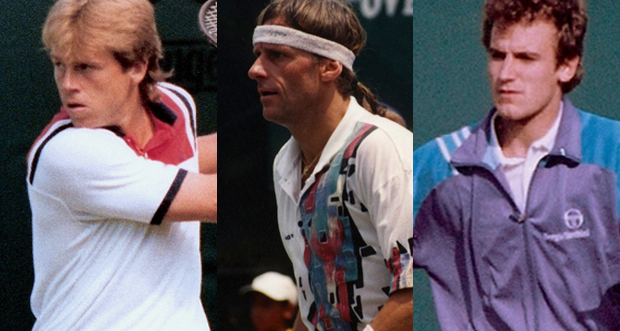
    Stefan Edberg Bjorn Borg Mats Wilander

    ONCE UPON A VIKING…

    Of the five great tennis nations covered in this series, three are no longer what they were: the United States, Australia, and Sweden. Whereas American dominance spread out over the majority of the Open Era in two great, interconnected eras, Swedish dominance was comparatively short – but equally dominant, at least for a time. It started with the rise of Bjorn Borg, who won his first major in 1974 and became the game’s top player by 1978, and ended with Stefan Edberg’s last Slam title in 1992. Outside of that range, only one Slam title belongs to a Swede: quintessential one-Slam wonder Thomas Johansson’s Australian Open in 2002.

    Let’s take a look at the Swedish career:

    Sweden Career

    As you can see, I split the chart differently than with the United States. The top chart includes the careers of Borg and Wilander, and ends with the last Slam won by Edberg. The bottom half sees the swift decline of Swedish tennis, with that lone major title in 2002.

    Swedish tennis was almost entirely ruled by three players: Bjorn Borg, Mats Wilander, and Stefan Edberg who, together, account for 24 of the 25 Slams. But they weren’t the only talented players during the 1980s in particular. Henrik Sundstrom, Anders Jarryd, Joakim Nystrom, and Mikael Pernfors all finished in the Top 10 at least once. Once we get to the 1990s we have players like Thomas Johansson, Magnus Gustafsson, Magnus Larsson, Jonas Bjorkman, Magnus Norman, and Thomas Enqvist.

    In the early 2000s, several promising young Swedes emerged: Andreas Vinciguerra, Joachim Johansson, and Robin Soderling. Vinciguerra is a name that you might not know, but he came of age around the turn of the millennium with other promising players born in the early 80s. If you look at the 1999 rankings, there were five teenagers who finished the year in the Top 100: Marat Safin (No. 24), Lleyton Hewitt (No. 25), Juan Carlos Ferrero (No. 42), Roger Federer (No. 64), and Vinciguerra (No. 98). Whereas the other four went on to win Slams and be No. 1s, Vinciguerra—still on pace to be a great player in 2001, rising as high as No. 33 at the age of 20—saw his career derailed by a back injury.

    [divider]

    Click here to discuss “National Tennis Careers – Part Two: Sweden” in the discussion forum.

    [divider]

    Similarly, Joachim Johansson rose as high as No. 9 and finished 2004 at No. 11 at the age of 22, but struggled with a shoulder injury and eventually retired in 2008. We are all more familiar with Soderling, who is one of only two men to defeat Rafael Nadal at Roland Garros, and unlike Novak Djokovic this year, Rafa was in his prime in 2009. From 2009 into 2011, Soderling was lingering on the edge of the Big Four, but was hit by mononucleosis and hasn’t played since late 2011, although has not officially retired. So in the post-Edberg/Wilander world of Swedish tennis, Thomas Johansson’s Australian Open title in 2002 was a lone bright spot, with lesser glimmers of unfulfilled promise by several Swedes in the last fifteen years.

    Ten Greatest Swedish Players of the Open Era
    1. Bjorn Borg
    2. Stefan Edberg
    3. Mats Wilander
    4. Thomas Enqvist
    5. Thomas Johansson
    6. Robin Soderling
    7. Jonas Bjorkman
    8. Magnus Norman
    9. Anders Jarryd
    10. (tie) Joakim Nystrom and Magnus Gustafsson

    Honorable mentions: Magnus Larsson, Jonas Svensson, Henrik Sundstrom, Mikael Pernfors, Kent Carlsson, and Joachim Johansson.

    The top three are not really debatable, although some would quibble with ranking Edberg over Wilander. Wilander had a higher peak, namely the 1988 season, and of course has one more Slam than Edberg. But both made 11 Slam finals, Edberg just lost one more, and this is more than balanced out by Edberg’s five more Semifinals and much greater consistency in the rankings. Wilander had one year-end No. 1 ranking, Edberg two; Wilander had seven to Edberg’s ten Top 10 rankings and eight to Edberg’s thirteen Top 20 rankings.

    There’s a big drop after the Tre Stora, and here is where the debate can come in. The system I used likes Enqvist quite a bit better than the rest, but some would prefer Thomas Johansson’s Slam title or Robin Soderling’s higher peak. Certainly if Soderling hadn’t gotten mono he’d probably be fourth on this list. Some might also prefer Jonas Bjorkman at fourth, who like Anders Jarryd was a No. 1 ranked doubles player, but it is hard to argue with Enqvist’s 19 titles versus Bjorkman’s six. Jarryd, Norman, Nystrom, and Gustafsson are almost too close to rank.

    The Future?
    Consider that since 2008, Robin Soderling has been the only Swede ranked in the year-end Top 100. Yes, that’s right. Since 2012 there have been no Swedes in the Top 100.

    But there’s hope, and his name is Elias Ymer. He’s 19 years old and as of this writing, currently ranked No. 130. Interestingly enough, Ymer isn’t your typical blond-locked Scandinavian; he’s of Ethiopian descent. Along with 23-year-old Christian Lindell (No. 188), he’s the only Swede ranked in the Top 400. Elias’ 16-year-old brother, Mikael, is also worth storing in your memory banks, but he’s a long ways off.

    Elias Ymer qualified for his first Slam main draw at Roland Garros this year, losing to Lukas Rosol in straights in the first round. Yet here is something promising: at the ATP 500 Barcelona, he beat Thiemo de Bakker and Nick Kyrgios before losing to David Ferrer in the round of 16. Kyrgios, No. 41 at the time, remains the highest ranked player he has defeated.

    So Ymer bears watching, although we should temper our expectations – there is no new Swedish golden age of Borg, Wilander, and Edberg on the horizon, but at least there’s someone. According to Magnus Norman, Swedish tennis has reached rock bottom and can only go up. Truly, there’s nowhere else it can go.

    [divider]

    Cover Photo (Creative Commons License): Carine06 / MadMarlin / Carine06

  • National Tennis Careers – Part One: United States

    National Tennis Careers – Part One: United States

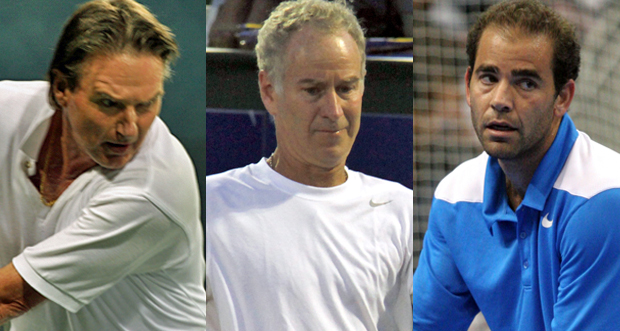
    Jimmy Connors John McEnroe Pete Sampras

    Introduction to the Series

    Imagine if each country had a tennis career. Rather than individual players, you have nationalities; rather than an individual career, you have a national one. As a thought experiment, I decided to compile the top Slam-winning countries in Open Era history, from the 1968 French Open to the 2015 French Open. How would these “national careers” look, as if they had careers spanning 48 years? What would their stories be? I looked at and compiled the best results from players of a given nationality, created a “national career chart” for the Open Era, and in doing so gained a deeper understanding of the history of men’s tennis. I’d like to share that research and understanding with you.

    For this exercise I looked at the top five nations by Open Era Slams: The United States (51), Sweden (25), Spain (21), Australia (20), and Switzerland (19). Beyond those five, only Czechoslovakia/Czech Republic has double digits (12); Serbia (8), Germany (7), Argentina (6), Russia (4), and Brazil (3) all have more than two. The countries with two are Croatia, Romania, South Africa, and the United Kingdom; the countries with one are Austria, Ecuador, France, Italy, and the Netherlands.

    This will be a six-part series, the first five articles covering the “Big Five” tennis nations, and the sixth part being a summarization, with a look at recent years and some thoughts about the game going forward. Look for further installments every few days to a week through June and July.

    In each article I will briefly overview the trajectory of the nation during the Open Era, looking at the top players and compiling a Top 10 list for each nation. For these lists I am using a statistical system that takes into account Slam results, titles, and rankings. For the most part I am faithful to the system, although in one or two cases I add a subjective element – usually as a tiebreaker. Also, for these lists I am including some players who played before the Open Era, but only those players that played a significant portion of their careers in the Open Era. Finally, I will look at the current national players, including a glimpse at any potential up-and-comers.

    On to the New World…

    PART ONE: THE UNITED STATES

    RISE AND FALL OF THE AMERICAN EMPIRE

    The United States is the greatest tennis nation of the Open Era–actually, tennis history as a whole–and it isn’t particularly close: With 51 Slam titles during the Open Ea they have more than any other two nations combined, and include greats and multi-Slam winners such as Pete Sampras (14), Andre Agassi (8), Jimmy Connors (8), and John McEnroe (7), as well as lesser greats such as Jim Courier (4), Arthur Ashe (3), Stan Smith (2), and single Slam winners Roscoe Tanner, Vitas Gerulaitis, Brian Teacher, Michael Chang, and Andy Roddick.

    Now let’s take a look at the performance timeline:

    Screenshot from 2015-06-10 13:42:35

    As you can see, there’s a build-up in the early years of the Open Era with Stan Smith and Arthur Ashe being among the best players in the sport, that blossomed with the first great American phase of Jimmy Connors and John McEnroe, who together won 15 Slams between 1974 and 1984.

    After that there was a lull in the mid-to-late 80s as Connors and McEnroe declined, until Michael Chang won his lone Slam in 1989, the harbinger of the second great American era of Courier-Sampras-Agassi that dominated the 90s and into the new century. Finally we have a last gasp in 2003, with Agassi winning the Australian Open and Andy Roddick winning the US Open, and decline since then. Roddick retired in 2012 as the last Slam-winning American. His last Slam final appearance was the epic 2009 Wimbledon, and since then an American has only reached the second week of a Slam three times.

    Top 10 Americans of the Open Era

    1. Pete Sampras
    2. Jimmy Connors
    3. John McEnroe
    4. Andre Agassi
    5. Arthur Ashe
    6. Jim Courier
    7. Andy Roddick
    8. Stan Smith
    9. Michael Chang
    10. Vitas Gerulaitis

    Honorable Mentions: Roscoe Tanner, Brian Gottfried, Harold Solomon, Todd Martin, Eddie Dibbs, Cliff Richey, Brad Gilbert, Aaron Krickstein, Brian Teacher, Tim Mayotte, Gene Mayer, Bob Lutz, Jimmy Arias, Marty Riessen, Eliot Teltscher, Tom Gorman, James Blake, Steve Denton, MaliVai Washington, Bill Scanlon, Dick Stockton, Tim Gullikson, Mel Purcell, Mardy Fish, John Isner.

    Determining the Top 10 greatest American players was relatively easy as there is a drop-off from Gerulaitis to the rest of the pack. That said, the Americans are so strong that there are several players not in the Top 10—namely Tanner, Gottfried, Solomon, and Martin—that would be in the Top 10 of any other nation, with the possible exception of Spain.

    Clearly the Top 4 are relatively easy, although some might quibble about the order of Connors, McEnroe, and Agassi. But using my system, Connors is actually closer to Sampras than he is to the rest, while McEnroe just edges Agassi. Further down we become more controversial. Courier had a higher peak than Ashe, but Ashe was good for so long; those two are also very close, but the edge goes to Ashe. Roddick, Smith, and Chang are also very close and most might rank Smith higher than Roddick due to his better peak, but I ranked them according to my system, which acknowledges that despite being dominated by Roger Federer, Roddick was still one of the best players in the sport for a decade. Finally, Gerulaitis is a big step behind the first nine, but even further ahead of No. 11 (Roscoe Tanner).

    Pre-Open Era Greats
    American greatness in men’s tennis did not start with Jimmy Connors, or even his precursors, Arthur Ashe and Stan Smith. While this series focuses on the Open Era, it would be remiss on my part not to mention some of the best players before the Open Era: Bill Johnston, Bill Tilden, Ellsworth Vines, Don Budge, Jack Kramer, Tony Trabert, Bobby Riggs, Pancho Segura, Vic Seixas, and Pancho Gonzales. Tilden, Gonzales, and Budge are probably all among the dozen or so greatest players in tennis history, with Vines, Kramer, and Riggs not too far behind.

    Pancho Gonzales in particular remains one of the most underrated all-time greats, perhaps mainly because he only won two Grand Slams. But he also won 12 Pro Slams and the Tournament of Champions three times, so essentially has 17 Majors to his name – as many as Roger Federer, and more than any player other than Ken Rosewall and Rod Laver. Gonzales was almost certainly the greatest player of the 1950s, just as Rod Laver was of the 1960s (with Ken Rosewall bridging the two decades as second fiddle to both). I place Gonzales, Tilden, and Sampras as the Trinity of greatest American tennis players, with Budge, Connors, McEnroe, and Agassi after them, then Vines, Kramer, Trabert, Riggs, Segura, Seixas, Ashe, and Courier following in some order.

    But the key here is to get a sense that American greatness in men’s tennis goes back virtually to the beginning of the sport. Richard Sears won the first seven US Opens, from 1881 to 1887, although it wasn’t until 1908 that an American won a Slam outside of the US–John Alexander at the Australian Open–and not until 1920 when an American first won Wimbledon, the great Bill Tilden. The first American to win the French Open was Don Budge in 1938. The United States remained dominant through the 1950s, until a pair of Aussies led the way for dominance from Down Under…but more on that in a later installment.

    Will the Empire Rise Again?
    Other than Roddick, American tennis has been slim since the retirement of Andre Agassi. Consider also that in 1990 fully 35 of the Top 100 were Americans; today it is only six, and none in the Top 10. Players such as James Blake, Mardy Fish, and John Isner have been decent but unremarkable. Some players such as Donald Young, Sam Querrey, and Ryan Harrison have displayed varying degrees of promise but have all disappointed in different ways.

    What about the future? Is there any hope? First of all, let’s look at the Americans currently in the Top 100, as of June 8:

    18. John Isner (30)
    31. Jack Sock (22)
    39. Sam Querrey (27)
    51. Steve Johnson (25)
    57. Donald Young (25)
    72. Tim Smyczek (27)

    Given their ages, the only player who looks to have solid upside is Jack Sock, who is memorable for his solid run at Roland Garros this year, defeating Grigor Dimitrov, Pablo Carreno Busta, and Borna Coric before being defeated by Rafael Nadal in the fourth round. While it seems unlikely that Sock will become an elite player, he at least seems like a probable Top 20 regular, and perhaps could challenge for a spot in the Top 10. But it seems very unlikely that Sock will rise above the level of Fish, Isner, and Blake.

    What about younger players? Beyond the Top 100 there are two that are especially worth taking note of: 18-year-old Jared Donaldson, currently ranked No. 152, and 17-year-old Francis Tiafoe, ranked No. 279. Clearly these two are a long ways from making a mark, but Donaldson is just around the corner, and Tiafoe has only just gone pro and is showing promise. Keep your eyes on these two. Also on the radar is 21-year-old Bjorn Fratangelo, ranked No. 144 – but he needs to move fast if he’s going to make his mark.

    Summation
    American men’s tennis clearly saw its golden age from the early 70s to the early 00s, but has really been in a slump for over a decade now. While it may be that American tennis will never regain its glory, it is worth mentioning that there have been slumps before. After dominance in the 1930s to 50s, from Bill Tilden to Pancho Gonzales, the Australians took the mantle during the late 50s and 60s before Ashe and Smith, and then more fully Jimmy Connors, took it back in the 1970s. Yet unlike that era, when fading great Pancho Gonzales played long enough–into his mid-40s–to see Jimmy Connors emerge, there are no elder statesmen to pass the mantle – Agassi is ten years gone; even lesser great Andy Roddick has been gone for almost three years now (can you believe it?).

    So it seems that we’re left with a moderate view: that American tennis will probably not return to its dominant position in the sport any time soon, but that better days are ahead.

    [divider]

    Cover Photo (Creative Commons License): robbiesaurus / bootbearwdc / craigoneal

  • Where Were They (When They Were as Old as Roger Federer)?

    Where Were They (When They Were as Old as Roger Federer)?

    16822167545_de9f9fc346_b ea

    I didn’t get a chance to watch the Indian Wells final, but intermittently checking the ATP World Tour’s live scores I was somewhat distracted from making and eating dinner. When the match was over, I felt the usual disappointment for my long-time favorite Roger Federer’s loss, but the feeling was quickly replaced by a feeling of appreciation for the great Swiss Maestro as I remembered: The guy is almost 34 years old! He’s No. 2 in the world and giving the best player in the game a run for the money.

    The question came to me, where were other great players at Roger’s age? So I did some research. Federer, as of March 23, is 33 years old, 7 months, and 15 days. To many reading this (myself included), that sounds like a young man, but in the tennis world he’s virtually an old man. Consider that most of Roger’s peers have retired. Of players born from 1980 to 1982, within a year of Federer’s birth year, the following have retired, some many years ago: Marat Safin, Juan Carlos Ferrero, Fernando Gonzalez, Nikolay Davydenko, Andy Roddick, Guillermo Coria, David Nalbandian – most of the best of Federer’s generation. Of those remaining, only Federer, David Ferrer, Feliciano Lopez, Tommy Robredo, and Mikhail Youzhny are anywhere near their peak level, with Lleyton Hewitt still around but a far cry from what he used to be.

    But what about other great players? Where where they at over 33 and a half? Below is a chart of all players who won four or more Slams during the Open Era:

    Screenshot from 2015-03-22 20:58:46

    As you can see, six of the thirteen players were retired by the time they were Federer’s age – and five of the last six in terms of chronological age. You can see a clear pattern of earlier players lasting longer, while players born in the 60s and 70s were largely out of the game by the time they were Federer’s current age. Among those more recent six, only the remarkable Andre Agassi was still around – and thriving, no less, ranked No. 4 and with a few more years and two more titles in him.

    Going back further, Lendl was on his way out, having won his last title just a few days before he was Federer’s current age. McEnroe was in his final year. Connors was many years from retirement and still a good player, but no longer a true elite. Vilas was in a long and slow fade, and Newcombe in his last year. The immortal Rosewall and Laver still had many years and were still excellent players, although no longer at their very best (although Rosewall would still win three more Slams and 41 more titles). Clearly it was a different game.

    So what lies ahead for the great Swiss player? Who knows. He isn’t the same player he was six or seven years ago, but he is still very, very good; aside from Novak Djokovic and Rafael Nadal, he is almost certainly the best player in the game, and it is hard to imagine a quick and immediate drop-off any time soon. As he himself said recently, he wants to play for as long as possible. What that means remains to be seen, but I think the bottom line is that Roger will play for as long as he wants to; certainly as long as he is competing in title matches. At his age every year matters, but hopefully he’ll be good enough to stick around for at least a few more, because when he’s gone, we’re all going to miss him.

    [divider]

    Cover Photo (Creative Commons License): Marianne Bevis

  • 15 Up-and-Coming Players to Watch in 2015 / Jonathan Northrop

    15 Up-and-Coming Players to Watch in 2015 / Jonathan Northrop

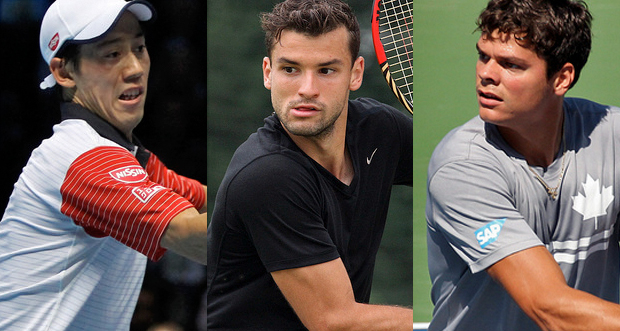
    Kei Nishikori Grigor Dimitrov Milos Raonic

    As the first tournaments of 2015 wrap up, it is almost shocking to think that the Australian Open is just around the corner on January 19. As always, we’ll all be watching the top players with the usual questions: How healthy will Rafael Nadal be and will it be enough to supplant Novak Djokovic at the top of the rankings? Can Novak maintain his focus? Will Father Time catch up with Roger Federer, who turns 34 later this year? Can Andy Murray find his 2012-13 form again? Will Juan Martin del Potro be healthy enough to rise again? And so on.

    But what about the rest of the pack? We focus so much on the “Big Four” and a few dark-horse candidates, while there are a lot of interesting stories and players beyond the big name elite. Let’s take a look at these other players, in particular those who bear watching in 2015 for whatever reason – but mainly as players poised to rise in the rankings. Some may be knocking at the door of the elite, while others may simply be establishing themselves as players to know, while others yet might be potential future stars.

    There are, of course, many other players worth watching – but I wanted to highlight these fifteen as particularly interesting, for a variety of reasons. Let’s take a look.

    [divider]

    Click here to discuss “15 Up-and-Coming Players to Watch in 2015” in the discussion forum.

    [divider]

    THE ALMOST BIG THREE
    Grigor Dimitrov

    Let’s start with Grigor Dimitrov, who may have been so overrated in the past in terms of expectations that he’s now being underrated (although his recent Brisbane demolishing at the hands of Federer is not exactly encouraging). Let us not forget that Grigor has improved in each year he’s been on tour; consider his year-end rankings since 2008: 493, 288, 106, 76, 48, 23, 11. Notice the trend? If Grigor keeps it up in 2015 he will possibly make it as high as the edge of the Top 5. But of course at some point he’s going to even out, and it is hard to imagine him supplanting Novak, Rafa, or even Roger. But it seems that he can beat anyone else, or at least remain competitive among the rest of the near-elites of the game. The problem with Grigor seems to be that, while he’s very good at almost every facet of the game, he doesn’t have any truly killer weapons – and seemingly lacks a killer instinct altogether.

    Prediction: The book is still open for Grigor. He needs something else — a killer shot and perhaps more of a killer instinct — to fully actualize his potential, otherwise he’ll remain more of a pretty player to watch, but not a true elite. In 2015 I think we’ll see continued incremental gains as Grigor creeps into the Top 10. He’ll continue to go deeper in Slams, being relevant at Masters tournaments, with a chance of winning one late in the year (Paris?), eventually earning his way to the World Tour Finals next November.

    Kei Nishikori
    On one hand, we may have seen the best of Kei in 2014. On the other, he seems to keep getting better and better, and of the rest of the field seems like he has what it takes to upset one of the Big Three. Kei is now a legit candidate to win a Masters and a dark horse at the Slams. Whether he has the stamina to make it through remains to be seen; despite his strong year, it should be remembered that he still only made it to the second week once.

    Prediction: Kei settles in within the second half of the Top 10. For some reason Nikolay Davydenko comes to mind – a player that never really challenged at Slams, but won a couple Masters and was always around. Perhaps Kei will have a similar peak.

    Milos Raonic
    At first I excluded Mighty Milos from this list but then I decided that it would be unfair. The big Yugo-Canadian is, quite frankly, a bit underrated at this point. Like Dimitrov it is hard to imagine him beating any of the Top 3 when it really counts, but he did just that versus Roger Federer at the Paris Masters. Milos continues to make small gains, as evidenced by his year-end rankings: 373, 156, 31, 13, 11, 8. If the pattern holds he’ll finish 2015 in the No. 5-6 range. At the least, though, I think Milos is a fixture to hand out in the latter half of the Top 10 for years to come, playing a similar role in the next half decade as Tsonga and Berdych have for the last half decade.

    Prediction: Something good for Milos in 2015. Will it be a Masters? A Slam even? Hard to imagine, but he’s knocking at the door. I think he wins several titles in 2015, maybe even a Masters. He feels close.

    DON’T FORGET ABOUT THE OTHER TWO
    Jiri Vesely & Dominic Thiem

    For some reason I pair these two players. Well, the reasons are pretty clear: they’re of a similar age, on the younger side of “Generation Raoshitrov”; Vesely’s advancement was steady but perhaps a bit disappointing, going from No. 85 to No. 66, while Thiem jumped 100 ranks from No. 139 to No. 39.

    Prediction: I expect continued steady progress from both. Both, I think, will fully establish themselves in the Top 40, and Thiem might even challenge for the Top 20. I think we’re still a couple years away from their peaks, but both should eventually be fixtures in the Top 20 and may even challenge for the Top 10 as players like Ferrer, Berdych, Wawrinka, and Tsonga age themselves out of it. But that’s probably a couple years away.

    THE BOYS ARE GROWING UP
    Nick Kyrgios

    The first of two up-and-comers to beat Rafael Nadal in 2014. Nick Kyrgios is a big kid (6’4”) with a big game and a big serve (14.8 ace %, good for No. 6 among the Top 50); I can’t help but think of Juan Martin del Potro when I see him out there. Ironically enough, the last time a teenager upset the world No. 1 at a Grand Slam was Rafa over Roger Federer at the 2005 French Open. Anyhow, great things are ahead for the Australian – he finished the year at No. 52 up from No. 182 in 2013, so he made quite a jump. He turns 20 years old in April, so still has some room to grow.

    Prediction: Nick makes steady progress but doesn’t quite jump into the elite. That said, he fights for, and at least comes close to, a year-end Top 20 ranking. While he may play the spoiler in 2015 again, he probably won’t be in the mix for big titles until 2016.

    Borna Coric
    No young player has me quite as excited as Borna Coric. I just see him having the highest upside of any player currently on the radar (that is, in the Top 300 or so). We all know him for taking out Rafael Nadal at Basel, but let’s not forget that he also beat Ernests Gulbis in that tournament and lost to red-hot David Goffin in three sets. Coric is for real and his advancement should be steady from here on, although at this point we should remain patient – he did just turn 18 a couple months ago, after all.

    That said, it is important to note that most truly elite players were ranked somewhere in the second half of the Top 100 or so at Coric’s age, and most jumped into the Top 20 the year after. Compare the year-end rankings for recent all-time greats at age 18 and 19:

    Djokovic: 78, 16
    Nadal: 51, 2
    Federer: 64, 29
    Sampras: 81, 5
    Agassi: 3, 7

    (Prior greats – starting with Agassi, but including Becker, Edberg, Wilander, etc., tended to have their break-out a year earlier, with age 17 being the first in the Top 100 and age 18 the big jump; one could speculate that perhaps we’re going ahead another year, with Nick Kyrgios’ trajectory being closer to the norm for elite players – first year in the Top 100 at age 19, big jump at age 20).

    Now compare the next tier down:
    Del Potro: 92, 44
    Murray: 65, 17
    Roddick: 156, 14
    Hewitt: 25, 7
    Kuerten: NA, 188
    Kafelnikov: 275, 102
    Courier: 43, 24

    As you can see, the next tier tends to rise a bit later, or at least more slowly.

    The point here is that if Coric is going to be great—as in an all-time great—then he needs to rise fast. Given the fact that players seem to be taking longer to develop these days with later peaks, I think we can go a bit easier on him and not expect a Rafa-like or Pete-like rise, but for me the benchmark would be a Top 40 or 50 ranking by year’s end. If he makes it into the upper half of the Top 100, then I think it is a sign that he has a chance to be special, even a truly great player. If he sticks around No. 100 or slips out of the Top 100, then we might need to temper our expectations a bit.

    Prediction: Borna will continue to rise, with some bumps in the road, but his overall trajectory will be clear. He finishes somewhere in the No. 40-50 range, although I would be surprised if he wins anything more than maybe an ATP 250.

    Alexander Zverev
    The second youngest player on this list, 17-year-old Zverev finished the year ranked No. 136. That might not sound all that impressive, but consider that of the active players who have ranked in the Top 10, only Tomas Berdych (No. 103), Lleyton Hewitt (No. 100), and Rafael Nadal (No. 49) ranked higher at the end of the year they turned 17. Novak was No. 186, Roger No. 301, and many players weren’t even on tour yet. While we should be moderate in our expectations at this point, it is hard not to get excited about this kid. If Nick Kyrgios and Borna Coric are the top two candidates to be the next elite players, then Zverev is No. 3 and not far behind.

    Prediction: Baby steps. Zverev doesn’t turn 18 until April, so has a lot of room to grow – both as a human body and as a player. I think he has a good shot at the Top 100 this year, but I wouldn’t expect much more than a year-end No. 80-100 ranking.

    OTHERS TO KEEP AN EYE ON
    Ernests Gulbis:
    Long viewed as an underachiever, Ernests (named after Hemingway) had his best year, challenging at one point for the Top 10. But questions remain: After an erratic career, can he maintain his current level? Can he take it a step higher? Or is he in the vein of up-and-down perennial underachievers like Alexandr Dolgopolov and Richard Gasquet? Who knows with Ernests. I suspect he’ll have more upsets like the fourth round French Open victory over Roger Federer, but not be consistent enough to break into the elite. That said, I think he’ll flirt with the Top 10 and maybe dip into it briefly, but then fall back and finish somewhere in the latter half of the Top 20. I’d prefer not to be so specific in my predictions, but for some reason No. 15-18 sounds about right.

    Jack Sock: While it is hard to become too excited about a 22-year old ranked No. 42 and with no titles to his name, consider that Sock is now the fourth highest ranked American and only one of five in the Top 100. Not only that, he’s the youngest American ranked in the Top 200, just a month younger than No. 121 Denis Kudla, and a few months younger than No. 190 Ryan Harrison. But here is where there is some hope: Sock’s rise has been strong and steady – consider his year-end rankings from 2010 to the present: 878, 381, 150, 102, 42. We probably can’t expect Sock to be the next Andy Roddick, but he could be the next John Isner or Mardy Fish.

    Stefan Kozlov: Stefan who? Well, a year or two from now he could be front and center in our minds. Who is Stefan Kozlov, you ask? He’s the youngest player to finish in the Top 500 this year at No. 468. No. 468?! Who cares? Well, I care – because Stefan Kozlov was born in 1998. Yes, 1998. Kozlov is 16-years old, turns 17 in February. He hasn’t done much yet, but he did play in the qualification rounds of the US Open, defeating his first round opponent, Mitchell Frank, before losing in three sets to “old man” Borna Coric. Kozlov is a long way away, but I wanted to introduce him as he’s a player worth keeping an eye on. Oh yeah, and best of all, while he’s Macedonia-born, he’s technically American (I know, it feels like cheating – but tell that to the Canadians re: Milos).

    Yoshihito Nishioka: In the shadow of similarly named (at least to a Westerner) top-ranked and fellow Japanese player, Kei Nishikori, Nishioka is 19 years old and ranked No. 156, and could be a real sleeper to break into the Top 100 next year and a player to watch.

    Thanasi Kokkinakis: Another member of the “Class of ’96,” which is turning out to have some talent. Kokkinakis is the third highest ranking teenager at No. 150, behind only Coric and Zverev. Another Australian to watch.

    Jared Donaldson: Ranked all the way down at No. 261, 18-year-old Jared Donaldson is worth mentioning not as much because he’s the sixth highest ranking teenager, but mainly because he’s the highest ranking American teenager; actually, he’s the highest ranking American age 21 or younger, which makes him arguably America’s Great Hope to return to relevance. But let’s check in next year to see where he is.

    Hyeon Chung: Korean-born, the fourth member of the Class of ’96 on this list (along with Coric, Kokkinakis, and Donaldson). I don’t know what his upside is but at No. 173 he’s the highest ranked Korean by a good margin, and well-situated on the career trajectory towards a strong career.

    ADDENDUM: Another 15 to the Mix
    I’d like to add a few more names to keep an eye on. Again, remember that the above list is not meant to be comprehensive, but a the same time I’d be remiss not to give at least an honorable mention to a few others.

    Roberto Bautista Agut: A surprising rise from No. 58 to No. 15 in 2014, can he maintain a top 20 ranking for a few years?
    David Goffin: After a disappointing 2013, Goffin had a tremendous rise in 2014, going from No. 110 to No. 22.
    Jerzy Janowicz: Let’s not forget about Jerzy, but’s he fast becoming a cautionary tale, a least for those of us that got excited a year or two ago. He’s still young enough to turn it around.
    Pablo Carreno Busta: It seemed that he was a cult favorite to be excited about a year ago, but after only a moderate rise in 2014–to a solid No. 49–I think expectations have cooled. Still, he’s a name to get used to as he could be a regular in the top 40 for years to come.
    Dusan Lajovic: Best known for making it the 4R at Roland Garros where he lost to Rafa, but not before beating Delbonis and Sock to get there. I think he’s a sleeper to be a solid player.
    Bernard Tomic: Oh Bernie, it is hard to root for you. You’re like a playboy superstar that isn’t a star. Time to grow up if you want a decent career.
    Victor Estrella Burgos: In contrast to Tomic, how can we not cheer for this guy? Starting on the ATP tour at age 33-34, and he made it as high as No. 65! Who knows what’s ahead but I’m cheering him on.
    Lucas Pouille: Another sleeper – seems talented.
    Luke Saville: Ditto. These guys aren’t future elites, but they are probably future top 50 players.
    Diego Schwartzman: At 5’7″ you’ve got our attention. Seems like another sleeper.
    Elias Ymer, Christian Garin, Roman Safiullin, Andrey Rublev, Gianluigi Quinzi: More young ‘uns to keep an eye on, all born in 1996-97.

    OK, that’s it. The problem with trying to be semi-comprehensive with this second list is that there is no way to draw the line. No Vasek Pospisil? Federico Delbonis? Well, I had to draw the line somewhere and it is “15 + another 15.”
  • Has Rafa Improved Since He Was 19? / Jonathan Northrop

    Has Rafa Improved Since He Was 19? / Jonathan Northrop

    Rafael Nadal

    The Spanish Meteor
    I realize the question must seem silly and/or rhetorical, but bear with me. As I was reading through some conversations about Rafael Nadal on the Tennis Frontier discussion forums and looking at his career statistics page on Wikipedia, as I often do when discussion of a specific player comes up, I noticed something about Rafa. It is well-known that he had a meteoric rise to the top at a very young age, without the usual long developmental phase that most players go through. He went from around No. 50 in the rankings for a couple years to No. 2 the year he turned 19 years old. Think about that for a moment – that would be like 19-year-old Nick Kyrgios being the No. 2 player in the world right now, or Borna Coric next year — or Grigor Dimitrov four years ago!

    [divider]

    Click here to discuss “Has Rafa Improved Since He Was 19?” in the discussion forum.

    [divider]

    But that wasn’t anything new. The thought, or question, that came to me is whether or not, or to what degree, Rafa has improved since that amazing 2005 season? I had noticed his pattern before, but I hadn’t given much thought to it, so I decided to investigate a bit and see what the data tells us.

    Developmental Patterns
    To start, let’s compare his developmental pattern to those of the other three of the four very greatest players of the last 25 years (I’m deliberately ignoring Andre Agassi because his developmental rise–while early–was extremely unusual and fraught with “off court” issues, and I’m not looking before this era because the further back you go, the less similar the game is).

    Player: Year-end Rank From Age 18-22
    Nadal: 51, 2, 2, 2, 1
    Federer: 64, 29, 13, 6, 2
    Djokovic: 78, 16, 3, 3, 3
    Sampras: 81, 5, 6, 3, 1

    Notice how all four were ranked roughly similarly at age 18, all between No. 51 and No. 81. But starting with age 19 we can pair Rafa and Pete on one hand, and Roger and Novak on the other. The former pair went straight from the latter half of the Top 100 to the Top 5. To put that in a current context, that would be as if Borna Coric–who will finish this year ranked No. 91–rises into the Top 5, or at least Top 10 next year. We can only hope, but it seems extremely unlikely.

    Roger and Novak, on the other hand, had a kind of “beachhead” year – Roger rising to No. 29 at age 19, Novak to No. 16. Actually, Roger had a second beachhead year, finishing his age 20 season at No. 13, and a “semi-beachhead” year at age 21, finishing No. 6. Roger’s rise to greatness was notoriously gradual, at least compared to other all-time greats. He didn’t win a Slam until just before his 22nd birthday; consider that Rafa won his fourth Slam just after turning 22.

    These rankings are, of course, merely a reflection of performance, so if we look at titles Rafa was extremely successful in 2005, winning 11 titles – the most of his career. And this wasn’t a lightweight title season: not only did he win his first of nine French Opens, but he also won four Masters tournaments.

    But those were surely all clay court tournaments, right? Actually, no. Of the four Masters titles, two were on hard courts: the Rogers Cup, in which he beat a 35-year-old Andre Agassi, 16 years older than Nadal; and the Madrid Masters, the indoor hard-court version that was replaced by the Shanghai Masters in 2009. So even in 2005, Rafa was able to perform at an elite level outside of the clay courts. This was further solidified in 2006 at the Slams. After he won his second French Open that year, he was going into Wimbledon with only two second-week Slam appearances, his two Roland Garros titles. But then he made it to the Wimbledon final and the US Open quarterfinal, cementing his all-surface elite status.

    Let us turn our gaze to winning percentage. Take a look at the four players, from age 18 to 27 (I stop at 27 because all four have played through that age, and beyond isn’t really relevant):

    Here we see four subtly, but still distinctly different developmental patterns. All jumped in performance level from age 18-19. But as you can see, Rafa was pretty steady from that point onward (and off the chart is 2014, in which he had an 81% – his worst since 2004, but still roughly within range of the rest of this chart). He fluctuated, of course, but whereas the others all had some variation of rise, peak, and plateau, Rafa’s pattern has been more up and down within an early peak-plateau range. Also, notice how the 2005-14 range has no winning percentages in the 84-87 range; it is either a “down” year of 81-83 or an “up” year of 88-91.

    Roger’s is a classic curve: a steady rise, high peak, and then descent to an up-and-down late-career plateau that continues to this day. Sampras was kind of a hybrid of Nadal and Federer: a quick rise, long peak-plateau, then decline. Novak has an interesting early plateau in his early 20s, and then a rise at age 24, his legendary 2011 season.

    Putting It All Together
    So what does this data tell us? First, what it can’t tell us are all the changes to Rafa’s game, whether we’re talking micro-adjustments or larger ones. We know, for instance, that his serve improved in 2010, probably his best overall year, but then has slipped again over the last few years. But the numbers don’t tell us about his real game, the sweat and focus and will that happens on court. But what it does tell us is that regardless of how his game has changed, his overall performance level has been very similar since breaking through as an elite player in 2005 at the tender age of 19.

    That said, there is another–perhaps more nuanced–narrative that should be brought forth, which is that while he was great from 2005-07, he was still “unfinished” and, in particular, learning to establish himself off clay. His 2005 winning percentage is inflated by the fact that he played 52 matches on clay, or 58.4% of his total matches, compared to 26 in 2006 (36.6%) and 32 in 2007 (37.6%). So while his overall winning percentage dipped, a lot of that was because of fewer clay courts (although interestingly enough, his record on hards was actually better in 2005 than 2006-07).

    To continue the narrative, Rafa was still developing in 2005-07 and then came more fully into his own in 2008 at the age of 21-22, when we saw a more “complete” Rafa. This was Rafa in his prime, finally and fully. 2009 saw two bumps in the road, one being injury and the other being Robin Soderling. Yet he regained his balance in 2010, having his best year of all. And then in 2011 Novak Djokovic had a season for the ages, and while Rafa was probably just as good as he had been the previous year, he couldn’t get around Novak. In 2010 Rafa was 2-0 against the Serb, but in 2011 he was 0-5. Now here’s where it gets very interesting: If we take those matches out of his record for both years, we get the exact same record. Take a look:

    2010 – with Novak: 71-10 (88%), without Novak: 69-10 (87%)
    2011 – with Novak: 69-15 (82%), without Novak: 69-10 (87%)

    In other words, Rafa was virtually the same in 2011 as he had been in 2010; it is just that Novak had his number. Rafa turned the tables in 2012 and they’ve been relatively even since, with Rafa having a slight edge at 7-6 since 2012. Aside from his rivalry with Novak, after his injury in 2012 Rafa rose again in 2013 and then struggled in 2014.

    In summarizing Rafa’s trajectory, we see a quick rise to elite status in 2005 and then a kind of plateau as he worked on aspects of his game, rising to the very top in 2008. From that point on, he was on a higher level of play, but suffered various setbacks that reduced his overall performance level and thus lend credence to the argument that he reached his peak level in 2005 and hasn’t improved since. But I think the answer to the original question is that yes, he has improved since he was 19 in 2005, although perhaps not as much as players like Roger Federer and Novak Djokovic, both of whom have followed more traditional “curved” career patterns.

    In a way, Rafael Nadal was like some kind of Mediterranean demigod, born (nearly) fully formed, (nearly) perfect. Yet like the demigods of myth, he has suffered hardship and challenges, and the end results fluctuated with life’s trials and tribulations.

    Addendum: Rafa’s Alleged “Decline”
    Rafa’s demise has been long-prophesied but never fulfilled. He has always managed to comeback, to rise again as if from the ashes and reclaim his status as one of the very best in the game, certainly the best at times. Yet we cannot ignore the fact that time catches up to us all. Rafa turns 29 years old next year and at some point, the gentle fluctuation of his career pattern won’t rise back up from a fall in performance. I am not saying that this will happen in 2015 – in truth, I don’t think it will – but we should be prepared for it.

    While we don’t know when it will happen, there might be signs beforehand. If you take one more look at the graph above you can notice that in Rafa’s career, there have been four dips, four “downward fluctuations” – in 2006-07, 2009, 2011, and one in 2014 off the chart. But as I pointed out above, the 2006-07 dip was mainly a matter of adjusting to a less clay-heavy schedule, so in truth the only downward turns were in 2009, 2011, and 2014 – his three injury-plagued years. And therein lies the key, and this is no surprise: Can Rafa remain healthy? If he can, I see no reason why he can’t remain on top for several more years. But if not, well, for those of us over three decades of age, we all know how it gets harder and harder to recover. We can hope, though, as fans of Rafa, fans of tennis (if not fans of Roger!) that we’ll see at least one more rise to the top from the great Spanish Meteor.

    Cover Photo (Creative Commons License): James Marvin Phelps / Marianne Bevis

  • Second Tier Players

    Second Tier Players

    Andy Murray Stan Wawrinka Grigor Dimitrov Marin Cilic David Ferrer Juan Martin Del Potro Jo-Wilfried Tsonga Tomas Berdych

    Most tennis fans, whether casual or serious, tend to follow the elites – the best players in the game who are perennial contenders for Grand Slams, ranked in the Top 5, and assemble resumes for the history books. Think Roger Federer, Rafael Nadal, Novak Djokovic, and, at times, Andy Murray. Serious fans of the game might extend their radar to the Top 100 and even a bit beyond, especially for long-time veterans and up-and-coming players. Your average serious fan – which I’d define as someone who follows the tour on at least a weekly basis and generally knows what tournaments are occurring, at least the bigger ones – probably could scan the Top 100 and recognize the names of most of them (perhaps another criteria for “serious fan”).

    Federer, Nadal, and Djokovic are household names – they have all been to the top of their sport and are all-time greats. Andy Murray is borderline, but after that it gets dicey. A casual fan of tennis knows the names Juan Martin Del Potro, David Ferrer, Tomas Berdych, Jo-Wilfried Tsonga, and, after 2014, Stan Wawrinka and Marin Cilic, and depending upon where one lies on the casual-to-serious scale, it starts tapering off after the Top 10. But those names – bonafide Top 10 players, but generally not Slam winners – aren’t all that well known among the general public.

    The purpose of this thread is to look at those “second tier” players – players who are not all-time greats, not multi-Slam winners, not No. 1’s, but still very good players. In fact, let’s define a few criteria for what I’m calling a “second tier” player:

    • No more than a single, “stray” Slam
    • No more than five “big” titles (Slams, Masters, World Tour Finals)
    • Never ranked No. 1

    What differentiates a second tier player versus a “third tier” and the rest of the pack? Some general guidelines might be:

    • Must have ranked in the Top 10 at least for a week, and/or
    • Must have won a big tournament
    • Must have at least five career titles
    • Multiple years finishing in the Top 20

    Who fits the bill among active players? Let’s take a look at the players, with a brief overview of their careers.

    [divider]

    Click here to discuss “Second Tier Players” in the discussion forum.

    [divider]

    David Ferrer

    David Ferrer is an interesting case, because on one hand he’s a bit of a tragic figure – he’s made it to the final of nine big tournaments (one Slam, one WTF, and seven Masters) and won only a single one, perhaps the weakest of the lot—the Paris Masters in 2012, and only then arguably because he didn’t have to face any of the erstwhile Big Four (his opponent in the final was Jerzy Janowicz).

    On the other hand, he’s a testament to hard work and thus is perhaps the definition of over-achiever. In other words, Ferrer has made the most of what he has and has come away with an impressive resume. He’s won 21 titles and finished in the Top 10 eight years in a row, the Top 20 ten years in a row, ranking as high as No. 3. He’s had his best two years in 2012-13, at the age of 30-31. In a way he’s as good as you can be without being great. There’s no shame in that.

    [divider]

    Juan Martin del Potro

    Of all the players on this list, del Potro might be the biggest “could have been.” A promising young player he finished 2008, the year he turned 20, at No. 9. Then, in 2009—at a time when the tour was dominated by two players, Federer and Nadal, with everyone else lining up to try to get a piece of the pie—he took the tennis world by storm by defeating Federer in the US Open final. He was not yet 21, and it looked like tennis had a new superstar, or at least someone to complete with Djokovic and Murray for “best of the rest.” After finishing the year No. 5 at the tender age of 21, the sky seemed the limit.

    Then, in an exhibition match in January of 2010, disaster struck: del Potro’s wrist began to hurt, and it kept on hurting. He entered the Australian Open with an ailing wrist, eventually losing in the fourth round to Marin Cilic. He then proceeded to miss nine months and only came back for a couple small tournaments late in the year, his ranking dropping to No. 258. He seemed healthy (or healthy-ish) in 2011, but wasn’t the same player. He did win a couple ATP 250 tournaments but could not make it into the second week at any Slam, although still finished the year No. 11. 2012 and 2013 saw further improvement, years in which he finished No. 7 and No. 5, respectively, but he could not quite match his 2009 glory. In early 2014 disaster struck again, and del Potro was out for most of the year, finishing at No. 138. We can only hope that “Delpo” will come back strong in 2015; he is only 26 years old and still in his prime, but he is clearly a brittle player.

    [divider]

    Tomas Berdych

    Berdych is another player with elements of disappointment to his career (see a pattern here?). The Czech rose quickly in 2005, winning his first, and so far only, big tournament – the revolving door that is the Paris Masters. Not to take that away from him, but it is worth noting that neither of the top two players in the game – Roger Federer and Rafael Nadal – played in the 2005 Paris Masters. Anyhow, Berdych finished that year at No. 24 and seemed poised to challenge for a place among the elite. Yet he stagnated, finishing the next four years in the No. 13-20 range, making the quarterfinal of only one Slam.

    Yet something seemed to click for Tomas in 2010 and, since then, he’s been one of the more consistent players on tour – finishing either No. 6 or No. 7 in each of the past five years, a span of time in which he’s made it to the second week (quarterfinal or later) in half of all Slams, once making the final – losing to Rafael Nadal in the 2010 Wimbledon, although not before defeating Roger Federer and Novak Djokovic.

    Berdych remains an excellent player and a fixture, for the time being, in the Top 10. But he does turn 30 years old in 2015, so the window is closing for him.

    [divider]

    Jo-Wilfried Tsonga

    It is easy to pair Berdych and Tsonga, for not only were they born in the same year (1985), but they’ve haunted similar territory in the lower half of the Top 10 for the last half decade or so, and their career accomplishments are quite similar, although with Tsonga’s win at the Canada Masters this year he’s pulled ahead a bit.

    Tsonga was a successful junior player, winning the 2003 Junior US Open over Marcos Baghdatis. He suffered through a series of injuries before rising quickly on the tour in 2007 and 2008, finishing that year at No. 6. For the last seven years he’s finished No. 13 or higher, five of those years in the Top 10. Tsonga has been deemed an underachiever; he’s got a big game, but doesn’t seem to have the big match mentality. Like Berdych he turns 30 next year, so the hourglass is about to turn.

    [divider]

    Stan Wawrinka

    The “Stanimal” was born the same year as Berdych and Tsonga and, if you look at his career through 2012, could be viewed as an underachiever and disappointment – yet as of this writing, he’s the only one of the Class of ’85 who has come away with a big prize. He rose to No. 54 in 2005, No. 30 in 2006, and then crept up to No. 13 in 2008, but floundered for a few years – looking more like a third tier and perennial Top 20 player, but only just grazing the Top 10 for a few months in 2008. But something seemed to click in 2013 – his results were more consistent as he regularly went deeper into tournaments, including his first Slam semifinal at the US Open and making it to the final of four tournaments, although winning only one, an ATP 250 (the Portugal Open). Stan finished the year at No. 8 after a not-embarrassing performance at the ATP World Tour Finals where he defeated David Ferrer and Tomas Berdych to make it to the semifinals where he lost to eventual champion Novak Djokovic.

    At the beginning of 2014 it seemed that Wawrinka was coming off a career year. He began the year well by winning the Aircel Chennai Open. But it was the Australian Open that proved the shocker: After defeating Novak Djokovic in the quarterfinals, and Tomas Berdych in the semifinals, Stan faced off against No. 1 Rafael Nadal. No one really gave him a chance, but he ended up defeating Rafa in four sets (it is easy to call this a cheap win for Wawrinka as Rafa was injured in the second set, but let us not forget that Stan won the first set and Rafa was well enough to win the third; certainly Rafa’s injury was a major factor, but the focus should be on Stan’s accomplishment). It was easy to consider that a fluke win, but Stan ended up also winning his first Masters, defeating Roger Federer in the Monte Carlo final and improving upon his 2013, finishing No. 4.

    What’s next for Stan? It is hard to imagine a quick drop-off, but it is also hard to imagine him repeating his 2013 performance – especially his Slam. But he’s likely going to remain a Top 10 player for at lest another year or two.

    [divider]

    Marin Cilic

    Talk about a surprising player. After a surge into the Top 10 in early 2010, after making it to the semifinals of the Australian Open at the age of 21, Cilic was erratic for the last few years, settling in as a third tier player. Then he was suspended for nine months (which was reduced), which seemed to serve as a wake-up call, or perhaps merely inspiration, as he rose quickly through the rankings in 2014, winning three minor tournaments before his surprising win at the US Open.

    Cilic is not the worst player ever to win a Slam, but there are better players in terms of overall career level, and thus is a good example of both how a single Slam does not equate with greatness, but also how tenacity can pay off. But he is a Slam winner and finished his second year in the Top 10, so is now a bonafide second tier player. It will be interesting to see whether he can maintain it.

    [divider]

    Just Missing the Cut: Richard Gasquet, Nicolas Almagro, Gilles Simon, Tommy Robredo, John Isner, Feliciano Lopez, Gael Monfils.

    You might quibble with my choices, but in my mind none of them are true second tier players. Some have vied for a spot in the second tier; for instance, Tommy Robredo finished 2006-07 in the Top 10, but for most of his career he’s been more of a third tier No. 20-30-type player. The same could be said for the others. Gasquet is an interesting one because in some sense he’s been the “gatekeeper” between the second and third tier for the last few years, or at least for 2012-13 when he finished No. 10 and No. 9. Gasquet would consistently beat everyone below him and lose to everyone above; previously other players like Janko Tipsarevic, perhaps Almagro, and before both, Fernando Verdasco, filled this role.

    Among this group, or at least those mentioned, the one who stands out as the “could have been more” (and perhaps still can be) is Gael Monfils. He is a player whose reputation and ability far exceeds his usual ranking, mainly due to seemingly being injury prone and perhaps a non-championship mentality. Monfils is a second tier talent with a third tier career–in a sense, the inverse of David Ferrer—and thus is the type of player who could surprise us and win a big tournament. The 2015 Paris Masters?

    [divider]

    On the Cusp: Milos Raonic, Kei Nishikori, Grigor Dimitrov, Ernests Gulbis.

    Kei in particular might deserve to be a second tier player by virtue of his No. 5 finish this year. He’s won six titles but consider that he has not yet won a big tournament (he made the final of both a Slam and Masters this year), nor has he finished in the Top 10 more than once. But if he finished in the Top 10 a second year in a row and/or wins a big tournament, he’s in.

    Similarly with Raonic and Dimitrov. It only seems a matter of time. With Dimitrov there may even be a chance that he becomes a lesser first tier player along the likes of Andy Murray, but the clock is ticking.

    [divider]

    Addendum: The Question of Andy Murray

    It is hard to feel bad for someone with two Grand Slam trophies, 31 titles overall, not to mention an impending marriage to the beautiful Kim Sears. Andy will forever be beloved in the United Kingdom for being the first British player to win a Grand Slam title in the Open Era, and the first since Fred Perry in 1936 to take Wimbledon. But Andy comes off, at least in the press, as disgruntled, surly, and forever unhappy with his standing. Just as Novak Djokovic was the third wheel on the Fedal bicycle for four years in a row, Andy has been the “best of the rest/worst of the best” for just about his entire career. Unlike Novak, Andy didn’t break through the players ahead of him and rise to No. 1. He did win two Grand Slams within one calendar year, being a true member of the Big Four for at least that year, but he couldn’t maintain it.

    That said, Andy Murray is no second tier player. He is a truly great player, the third greatest of a generation that has produced what should turn out, when all is said and done, two of the ten or so greatest players of all time in Nadal and Djokovic. If Andy were born ten years earlier and peaked in the weak era of the late 90s to early 00s, he would undoubtedly have many more Slams than two. But every player has a “what if” story, and in the end, Andy’s career is what it is – and not only is it not over yet, it has been a stellar one so far. My opinion is that Andy is the greatest player of the Open Era with less than four Slams – greater than Kuerten, Hewitt, Safin, even Ashe. (What I mean by “greatness,” in this context, is a combination of peak level and career accomplishment).

    In some ways Andy is the Guillermo Vilas of the current era. Vilas was born in the same year as Jimmy Connors and peaked alongside Connors, Bjorn Borg, John McEnroe, and, to a lesser degree, Ivan Lendl. That’s what I’d call a “raw deal.” Yet Vilas still managed to win four Slams and 62 titles and was ranked in the Top 6 for nine years in a row, but—like Andy so far—he never did rank higher than No. 2, despite arguably being the best player in 1977.

    Career-wise, despite currently stalling out in his Slam count, Andy is closing in on four-Slam winners Vilas and Jim Courier, who are the gatekeepers to the true elites of the Open Era. I’d say he probably needs at least one more Slam to join them, but still has the possibility of surpassing him. Wouldn’t it be appropriate if Andy finished his career with four or five Slams, and became the historical “best of the rest, worst of the best?”

    [Note: At some point I’d like to write a “Part Two – Second Tier Players of the Past,” but there are a few articles on the burner, so stay tuned.]

  • Top 20 Greatest Players of All Time (Yet Another Take)

    Top 20 Greatest Players of All Time (Yet Another Take)

    Roger Federer

    Here’s another take on the Top 20 of all time – they’re always fun to talk about and never fail to get someone’s panties in a wad. The caveat is just that: it is a take and is not meant to be taken as fact or even how I see things. I was just looking at pre-ATP rankings for players and was surprised to see that players like Jack Kramer had finished (alone or tied) No. 1 six times. I decided to create a quick ranking system based upon two things and two things only, to determine true greatness:

    * Year-end No. 1 rankings: three points for solo; two points for shared
    * Majors won: two points for pre-Open Era Grand or Pro Slams; three points for Open Era Slams

    Now obviously, and again, this is a huge over-simplification. It doesn’t take into account a whole host of important data: Non-win results, other titles, non-No. 1 rankings, etc, not to mention it doesn’t differentiate Slams enough (e.g. the Australian Open in the 1970s was less competitive than other Slams). But it is a quick and dirty system and, I think, worked out pretty well.

    So here we go, the Top 20 players of all time according to one system. I’ve also included the points so you can see how close or far players were from each other.

    1. Roger Federer 66
    2. Rod Laver 62
    3. Ken Rosewall 61
    4. Pete Sampras 60
    5. Pancho Gonzales 56
    6. Rafael Nadal 51
    7. Bill Tilden 48
    8. Bjorn Borg 42
    9. Jimmy Connors 39
    10. Ivan Lendl 36
    11t. Don Budge 34
    11t. William Renshaw 34
    13. John McEnroe 33
    14. Fred Perry 31
    15t. Jack Kramer 30
    15t. Novak Djokovic 30
    17. Andre Agassi 27
    18t. Ellsworth Vines 25
    18t. Henri Cochet 25
    18t. John Newcombe 25

    Some interesting things to note.

    1) Whatever you think of the exact order, I think it has the Top 10 players rightly in the Top 10. Novak has a chance of sneaking in there and edging Lendl out in another year or two, but right now it works.

    2) To be honest, the accuracy of the next ten gets decreasingly reliable as I didn’t research absolutely everyone. But I think the next ten is mainly right, although maybe one or two players weren’t accounted for. It is really hard to research 19th century players. Also right off the edge of the list would be players like Stefan Edberg, Mats Wilander, Bobby Riggs, Roy Emerson, etc.

    3) While many (myself included) think Nadal has surpassed Sampras, this system likes Pete quite a bit more because of those year-end number ones. I think it makes a valid point.

    4) This system rightly honors perhaps the most underrated historical great player, Pancho Gonzales, who is underrated because his peak was in the Pro Slam era and he only won two Grand Slams, while winning 15 Pro Slams. Pancho was the best player of the 50s and finished No. 1 a record eight times.

    5) Yes, Roger Federer is No. 1. Sorry Roger Haters, just about any system is going to place him as the greatest of all time, or at least the greatest of the Open Era. Rafa may pass him, although according to this system Roger would have to remain stagnant (a distinct possibility) and Rafa would have to have five more Slam wins and/or year-end No. 1’s to tie him – a tall order, but possible. But for now I think Roger deserves his place.

    [divider]

    Click here to discuss “Top 20 Greatest Players of All Time” in the discussion forum.

    [divider]

    Cover Photo (Creative Commons License): Marianne Bevis

  • Age-Related Discussion

    Age-Related Discussion

    Feliciano Lopez
    One of my favorite topics is the relationship of age and career performance, questions such as: What are the different phases of a career? When is the most common peak range? Are players peaking later now? Etc.

    For the sake of context and perhaps a taxonomy that would be useful for discussion, as I’ve written quite a few times before, I’ve posited that the historical norm has four general phases:

    Developmental Phase: Age 17-21. Player rises towards peak level.
    Peak Phase: Age 22-26. Player maintains highest level of career.
    Plateau Phase: Age 27-31. Player remains at a very high level, but slightly below peak, with gradual decline.
    Decline Phase: Age 32+. Player declines rapidly and/or retires.

    Again, these are the norms, or the averages if you will. Every player is different – but historically, those are the general ranges that most players fall into, or near to.

    Now what is interesting in recently years is that quite a few players seem to be peaking later, more in what would normally be their plateau phase. David Ferrer is an example, with his best years being 2012-13 when he turned 30 and 31. Despite beating Andy Murray today, Ferrer has showed signs of slowing this year, so he may be entering his decline phase – or he could simply be dropping to a plateau.

    And then we have the inspiration for this thread, Feliciano Lopez, who is 33 years old and possibly having the best year of his life. While his highest ranking was achieved a couple years ago in 2012 (No. 15), he’s at No. 14 in the live rankings now and has a good chance of having his best year-end ranking (which is currently No. 20 in 2011).

    And then of course there is Stan Wawrinka, who won his first Grand Slam at age 28 and is amidst his best year at age 28-29, and will probably finish the year ranked No. 4, better than last year’s career best of No. 8.

    Marin Cilic is still in what is normally the Peak Phase, but he won his first Slam just before turning age 26 – on the older side.

    And then we have young players like Milos Raonic and Grigor Dimitrov. Grigor is 23 years old, having his best year, but there’s also the sense from many that he’s another year or so away from his peak. Milos is also 23, turning 24 in December, and may or may not be at his peak.

    One thing that strikes me is that these outliers from the career norms are all non-elite players. Roger Federer’s career follows the averages quite closely, as does Nadal’s, Djokovic’s, and Murray’s – although it is still too soon to tell if and when they’ve entered their Plateau. Certainly it seems that Rafa and Andy have; Novak had his best year in 2011 at age 23-24, but I’d have a hard time saying that he’s not still in his Peak phase (that is, best year shouldn’t be equated with Peak phase; the best year usually comes within the peak).

    Those are just some examples. A few questions to consider/discuss:

    • Are players really peaking later?
    • If so, why?
    • Is there a historical precedent for players having their best years in their 30s (e.g. Ferrer and Lopez)?
    • Is it only “second tier” talents that are peaking later? (As it certainly seems like we’ve seen the best of Nadal, Djokovic and Murray)

    And so forth. Any thoughts?

    [divider]

    [divider]

    Cover Photo: Kiu Kaffi, Tennis Frontier Correspondent

  • Best Players Never to Win a Slam

    Best Players Never to Win a Slam

    Nikolay Davydenko David Nalbandian David Ferrer

    A couple weeks ago there was some talk about who was the best player ever never to win a Slam – people were using an acronym, which I can’t remember. I don’t quite have the time or patience right now to put it into an article, but I thought I’d at least do some cursory research and share it with this forum.

    I tried to look at all players who had been in Grand Slam finals and/or been in the Top 5 during the Open Era – this gave me a group of just over fifty players.

    I then assigned points for Slam results and wins in other tournaments, using their total titles as a base and then adding points like so:

    Base: total titles
    Slams: 3 Final, 2 Semifinal, 1 Quarterfinal
    Other tournaments: WTF/Cup 3, Olympics 2, Masters 2, ATP 500 1

    This was problematic because data is limited on a lot of older tournaments, but I did the best I could.

    I then sorted the total rankings and gave tie-breakers to the highest career rank (in parentheses). Here’s the list of players with at least 20 points.

    52 David Ferrer (3)
    45 Nikolay Davydenko (3)
    44 Tom Okker (3)
    40 Marcelo Rios (1)
    40 Alex Corretja (2)
    37 Harold Solomon (5)
    35 David Nalbandian (3)
    35 Miroslav Mecir (4)
    35 Raul Ramirez (4)
    34 Brian Gottfried (3)
    33 Tommy Haas (2)
    32 Thomas Enqvist (4)
    32 Jo-Wilfried Tsonga (4)
    30 Andrei Medvedev (4)
    30 Tim Henman (4)
    30 Tomas Berdych (5)
    29 Todd Martin (4)
    27 Greg Rusedski (4)
    25 Henri Leconte (5)
    24 Robin Soderling (4)
    24 Guillermo Coria (5)
    24 Mark Philippoussis (9)
    23 Brad Gilbert (3)
    22 Guillermo Canas (3)
    22 Cedric Pioline (5)
    21 Magnus Norman (2)
    21 Fernando Gonzalez (5)

    That’s about half of the total players. Just missing the cut are players like Jose Luis Clerc, Sebastian Grosjean, Kei Nishikori, and Gene Mayer. There were two players who played in two finals each that I didn’t have enough information to adequately rank – Steve Denton and Kevin Curren – but from what I could tell, both have points in the low 20s at most.

    Now I’m not saying that this definitely states that David Ferrer is the greatest player never to win a Slam. One thing I noted is that more recent second tier players tend to go deeper into more Slams than in past eras; I’m not sure why this might be. But looking at second week Slam results, Tsonga has 10, Ferrer 15, Berdych 11. Compare that to similarly great Thomas Enqvist 3, Alex Corretja 6, Marcelo Rios 5, etc.

    There are also specialist players, like Tim Henman–who is one of the very best Wimbledon players never to win it. Poor time made it to 4 Wimbledon SF, and 4 QF.

    One thing that this list does help us do, I think, is narrow the choices – it gives us a “first round” of candidates, so to speak. While I’m not ready to commit to the “second round,” I’m thinking that it would involve a closer look at weighing total titles won vs. big titles, as well as Slam results, H2Hs against top players, longevity, etc.

    What do you think? Who was the best player never to win a Slam?

    On yeah, what about the worst player to play in a Slam final? By ranking I came up with two names: John Marks, who never won a title in his career but lost in the 1978 Australian Open to Guillermo Vilas. Marks actually lost the first set of his 1R match to 2nd seed Jose Luis Clerc, but Clerc had to retire after the first set. Marks’ highest career ranking was #44.

    The other is Chris Lewis, who lost to John McEnroe in the 1983 Wimbledon final. Lewis’ highest ranking was #46, but he did win three career titles. I’d give the “honor” to Marks.

    Click here to discuss “Best Players Never to Win a Slam” in the discussion forum.

    [divider]