Author: Samer Kadi

  • You Know You Made It When…

    You Know You Made It When…

    Hours before Andy Murray opens his 2013 US Open title defense campaign, there seems to be an unusual — but welcome — air of tranquility surrounding him, or more accurately, surrounding his critics, supporters, and tennis pundits in general. Sure, there is no escaping the clichéd narrative of “defending champion pressure,” as it seemed to become the de facto question mark once the media ran out of reasons to doubt the Brit, but that almost seems like a compliment when compared to years of harsh assessments, inaccurate labels, and false predictions of a gloomy future following every loss. In the span of twelve months, Murray went from everyone’s obligatory choice on a “best player never to win a Slam” shortlist, to the heaven-sent savior of British tennis and a multiple Grand Slam champion.

    [divider]

    Click here to discuss “You Know You Made It When …” in our discussion forum.

    [divider]

    For years, Murray was impatiently crucified for every high profile loss, every shocking defeat, and yes, even every Masters 1000 event tournament win because “if only he can do that in Majors.” At times, he was given a few deserved passes due to competing in an era where three of the greatest ever to play the game happen to dominate, but he was ultimately a victim of his own success: He had proven he could beat them on more than one occasion, but had yet to do so when it mattered most. Of course, in an ever fickle tennis world, failing to string together two consecutive wins over Nadal and Federer in your first ever Major semifinal (and final) appearance, losing to Novak Djokovic on his beloved Australian Open turf, and succumbing to the Swiss master on the Centre Court of Wimbledon dubiously brings your mental toughness into question.

    If the general consensus was to be believed, every Slam was Murray’s last chance to win a Major, and every Grand Slam final loss somehow meant his chances of finally snatching one were decreasing, despite the fact that he was continuously putting himself in a position to do so. Murray’s years of unfair media treatment were largely a result of him not winning a Slam as early as most predicted. Typically, he was quick to be put on a pedestal only to be shot down once he didn’t immediately meet the needlessly inflated expectations.

    In hindsight, Murray’s career has been far from unusual. In fact, its evolution makes sense, once one looks at the tennis aspect of his game, what he lacked, what he excelled at, and what he has managed to improve. If experts simply distanced themselves from the fanfare and unreasonable demands of immediate glory, the reasons behind Murray’s “failings” were fairly evident, especially once contrasted with his subsequent success in winning Grand Slams.

    Murray was long chastised for his inability to play aggressively in key matches or moments, but this was hardly a mental block that he was somehow unable to overcome, or an elusive strategy he had yet to comprehend. From a pure tennis perspective, Murray’s forehand was letting him down against the game’s elite. That is not to suggest that he had never approached a match the wrong way, implemented an ill-advised strategy, or remained too content to stay within his comfort zone. In fact, those factors definitely contributed to many of his defeats. Likewise, while he was never nearly as shaky between the ears as many would have you believe, the Scot didn’t always have the most exemplary attitude facing adversity (a semifinal match with Nadal at the 2011 US Open particularly stands out), and he was obviously nervous in his first ever Grand Slam final appearance against Federer.

    However, for the bulk of his career, Murray’s forehand was what was stopping him from employing the aggression many urged him to, while the improvement he later made to that very shot (helped immensely by the partnership with Ivan Lendl) turned him into the champion many predicted he would become. Heartbreaking as it must have been, Murray’s 2012 Australian Open semifinal loss to Novak Djokovic was the definite sign of things to come. Up until that point, Murray had been routinely dominated in forehand-to-forehand crosscourt exchanges by Djokovic, Federer, and even by Nadal’s crosscourt backhand. That Djokovic semi marked the first time since his brilliant 2010 Australian Open performance against Nadal that Murray used his forehand with authority against one of the game’s “Big 3” in a Major. The Lendl partnership was immediately paying off.

    Looking back at the pre-2012 US Open phase of Murray’s career, you can pinpoint four crucial matches that perfectly capture his development. Often, a player turns in an eye-opening performance (even in defeat) that earns him premature predictions of guaranteed greatness by trigger-happy fans and pundits, only to spectacularly fail to live up to the hype. Murray, on the other hand, is a rare case of a player whose defining matches were corroborated by his career trajectory.

    Murray had shown flashes of his future brilliance in a five-set loss to David Nalbandian at Wimbledon in 2005, and a straight-set upset of Roger Federer at the 2006 Cincinnati Masters. However, his real “take notice” moment, at least as far as I’m concerned, was his five-set loss to Rafael Nadal at the 2007 Australian Open. A more fit version of Murray would have more than likely emerged victorious, but the Brit looked noticeably winded in the deciding set. Nevertheless, Murray’s talent was on full display, as he handled Nadal’s spin with crosscourt backhands all day, toyed with his opponent with silky-smooth drop shots, and showed incredible hands at the net. While injury would soon derail his momentum that year, it remains the match which gave us the first glimpse of Murray against a future rival, and one of the sport’s giants on the Grand Slam level.

    Eighteen months later, Murray got his shot at redemption, this time producing what was the most sensational tennis of his career to topple Nadal in 4 sets at the 2008 US Open semifinal. Murray had just broken into the Top 10, and cemented his status as a legitimate threat at Majors by eliminating the Spaniard in the midst of the hottest run of his career. The match remains among Murray’s finest hours, as his serve, aggression, and forehand looked near unplayable. Despite a disappointing outing against Federer in the final, Murray would build off that monumental win over Nadal with an impressive fall indoor season, winning his second Masters 1000 event in Madrid (his first was at Cincinnati earlier that summer), thus officially becoming part of the sport’s “Big 4” (when the term was first coined).

    If the two Nadal matches were turning points as far as Murray cementing his status among the sport’s very best is concerned, his aforementioned semifinal with Djokovic at the 2012 Australian Open was the turning point with regards to his eventual Grand Slam triumph. The Lendl partnership was still in its early stages, but the intent was clear. Despite the loss, there was an overwhelming amount of positives for Murray to take. The match saw him combine his variety, defense, and aggression to deliver an absolute classic that would have been even more fondly remembered had it not been for a rough opening set and the subsequent Djokovic/Nadal final.

    Murray built off that match to take himself all the way to his first Wimbledon final, where he was once again toppled by his Grand Slam final tormentor, Roger Federer. However, a few weeks later, Murray would gain revenge in one of the greatest moments of his career, and his ultimate pre-Grand Slam win turning point, when he beat Federer in the final of the 2012 Olympics in London. From a tennis perspective, the performance itself may not have been as telling as Murray’s aggressive outing against Djokovic in Melbourne, but it finally gave Murray a satisfaction that rivals winning a Major, and the emotional boost he needed on his way to realizing his dream. It took him mere weeks to do so, as Murray once again used  that career exemplifying match against Federer to win the US Open crown by beating Novak Djokovic in five windy sets.

    Almost a full year later, Murray revisits the ground that provided him his first taste of Grand Slam glory, and walks in as the Wimbledon champion to boot. There are no talks of last chances,  mental obstacles, “first British man since…”, or the need to adopt a more aggressive approach. In fact, there have been no overreactions to his now-customary post-Slam final lulls when he surprisingly loses early in Masters 1000 events. There is only “Andy Murray: US Open and Wimbledon champion.”

    You know you’ve made it when the media manage to keep a level head after you lose, and still pencil you in as one of the favorites for a Major, instead of using said defeat as a sure-fire sign of a tennis apocalypse. Only a few players are offered this luxury. Andy Murray, you have officially made it.

    Credits: Cover Photo: anonlinegreenworld (Creative Commons License)
  • A Final Before the Final

    A Final Before the Final

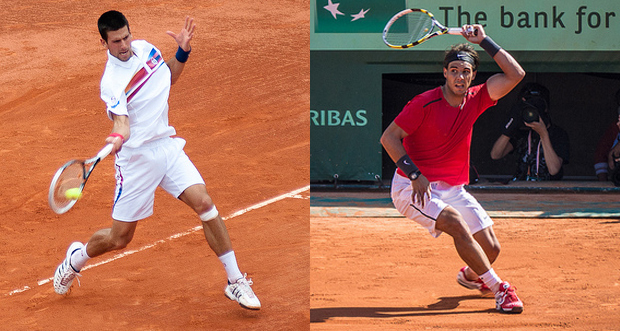
    It was labeled as “the final before the final,” and yet after an anti-climactic third set, it looked to be heading to mere sub-par semi-final territory. However, by the time Novak Djokovic sent a final forehand long to send Rafael Nadal into his eighth French Open final in nine appearances, the match had lived up to its billing, and then some. We’ve grown to expect this type of battles from Nadal and Djokovic — from unique tension and near unrivalled physicality, to the emotions and fist pumps. When these gladiators are done with their superhuman efforts, the viewer can almost share their exhaustion, delight, and heartbreak.

    There is something so captivating about a five-set match of tennis. In many ways, it is akin to a tale of multiple plot twists unfolding before your eyes. The drama, tension, turning points, and missed opportunities are all staples that make these matches all the more memorable. However, from a pure tennis standpoint, the most fascinating parts of these epics are the strategies, tactics, and adjustments that each player makes over the course of the match. The extended nature of the contest makes these factors even more noticeable. Players have time to attempt different things, adjust, tweak their games, and adapt to each other’s adjustments.

    For Djokovic, the approach to playing Nadal has always been fairly straightforward, at least since 2011. His game is better suited to deal with Nadal’s onslaught of forehands than any other player on tour. Djokovic dominates the cross-court exchanges, pins Nadal behind his backhand with spinning cross-court forehands, stretches him on his forehand side with hard, penetrating cross-court backhands, and puts pressure on most of the Spaniard’s service games with otherworldly returning. Moreover, Djokovic’s movement, defense, and counterpunching abilities have historically frustrated Nadal due to his inability to consistently hit through the Serb.

    Since Djokovic began his spell of dominance over his rival a little over two years ago, Nadal has tried altering his game plan, to varying degrees of success. The pre-match tune for Nadal has always been the same: “I have to be aggressive with my forehand.”  And yet, he has generally struggled to consistently take control of the points with that particular shot, something Nadal usually makes a living off.

    This time, however, things were different. The good news for the seven-time Roland Garros champion started with the weather forecast. Firday proved to be the hottest day of the tournament, which ought to have put a smile on Nadal’s face. His forehands would be having that much more bite, and jump that much higher off the court. In a game of inches, such minute factors could eventually make the difference. In many ways, they did.

    It became evident very early that Nadal was in the mood, and his forehand looked like the kind of shot that made him the greatest clay courter this game has ever seen. For once, Djokovic’s backhand looked pedestrian, as he struggled to take Nadal’s cross-court forehand on the rise with the ease he’s usually accustomed to. The ball was exploding off the court, and as a result, Djokovic’s groundstrokes were uncharacteristically lacking in depth in the early going. Nadal adopted a more offensive court positioning, and gained the confidence to go for both his inside out forehand and down the line forehand earlier in the rallies. The latter, in particular, proved to be a game-changer throughout the match. In the seventh game of the first set, Nadal had a break point and went for a routine rally forehand down the line. It caught Djokovic by surprise. He was a touch slower to react, got to the ball a split second late, and pushed his subsequent forehand long. The tone was set.

    These guys had played each other 34 times prior to yesterday’s match, and it’s safe to say they know what to expect from one another. Instinctively, Djokovic leans towards his backhand side when Nadal lines up a rally forehand, as it is where the majority of his lefty forehands go. Likewise, he is generally terrific at anticipating when Nadal will fire his forehand inside out after being in position to line up the shot. However, when the Spaniard directs his forehand at Djokovic’s own forehand early in the rally, it seems to catch the world number one off guard.

    Djokovic’s retrieving abilities are quite superlative, but he defends better off his backhand, as far as getting the ball back with interest goes – he’s more likely to throw a slice or a defensive lob from his forehand side. Part of what Nadal has struggled with against Djokovic has been his inability to stay on top of the rallies. Novak’s counterpunching from his backhand side, in particular, has given his opponent fits, and it often changes the complexion of the rallies. By modifying his usual rally patterns, Nadal was able to reverse his fortunes. Eurosport’s Frew McMillan noted that any time Nadal authoritatively hit his forehand to Djokovic’s forehand, the rally was as good as over. For the first set and a half at least, that seemed to be the case.

    It is never a confidence booster when your main weapon isn’t firing. For about an hour or so, that was the Serb’s main hindrance. His backhand was not adjusting to the dry conditions, he was unable to deal with Nadal’s forehand, and perhaps most surprisingly, his return was tame by his standards. As Djokovic later noted in the press conference, his opponent served better than usual, which partially explains Novak’s unusually iffy returning early in the match.

    What makes the Djokovic match-up so difficult for Nadal is the fact that his normal game-plan plays right into his rival’s hands. He cannot be content to spin serves to Djokovic’s backhand like he does against Federer, and is forced to serve with more variation and power. Nadal did just that, and he was holding more comfortably than perhaps even he would have expected (winning over 50% of his second serve points is pretty telling). Again, the dry conditions could have only helped.

    Meanwhile, Djokovic was also struggling to consistently pin Nadal behind his backhand. One of the main features of his game in this particular match-up is his ability to hit his cross-court forehand with extreme angles and take Nadal out of position to open up the court. To his credit, Nadal’s backhand held up extremely well throughout – he even quite surprisingly produced more winners than Djokovic from that side – and his willingness to hit his double handed backhand hard and flat cross court whenever he was stretched out paid dividends. He may have pushed it wide on a few occasions, but at least he sent a message to Djokovic that he wouldn’t be bullied. Nevertheless, that alone does not explain Novak’s failure to resort to a pattern that has given him so much success against his opponent in the past. Strategically, this was Djokovic’s only major flaw in the match, as even when he upped his level considerably, he still played far too many balls to Nadal’s forehand, and paid the price.

    Luckily for the neutrals, whenever it looked like Nadal would run away with the match, Djokovic raised his game when it mattered most. Over the past two-and-a-half years, he truly has turned into one of the sport’s all-time greatest clutch players. When the chips are down, Djokovic hits his way out of trouble. After getting broken to go down 2-3 in the second set, the Serb did what he does best, and indeed, hit himself out of trouble. Suddenly, there was more spring to his steps – he had looked somewhat flat up until that point – and he wisely opted to run around his backhand more often, recognizing that his usual bread-and-butter was failing him. His inside out forehand clicked, and he began doing the majority of the dictating.

    With the exception of the generally poor third set, Djokovic served extremely well throughout the contest. For most players, serving big and getting cheap points against Nadal is a must. Djokovic, however, recognizes his ability to go toe-to-toe with Nadal from the baseline, and relies on good service placement — as opposed to going for too much — to put himself in position to get the ascension in the rallies. His serving patterns were quite simple actually, as he simply went out wide on both ends of the court. His slider out wide on the deuce court continuously took Nadal out of position, while the Spaniard had equal difficulties dealing with the flatter serve to forehand on the ad court. Nadal’s one noticeable shortcoming in this match – and perhaps even in his career – was his inability, or at least unwillingness, to stand closer to the baseline when returning, even on second serves. He can get away with it against most on clay, but not when playing Djokovic, who is all too willing to give Nadal’s short returns the treatment they deserve.

    After the first break of serve in the fourth set, it again looked like Nadal would emerge victorious with surprising ease, but once again, Djokovic had other plans. He stepped up his return game considerably, and finally went back to exploiting Nadal’s habit of leaning to his backhand side right after he serves. Djokovic exposes that like no other, and it was paying off. That, on top of some well-timed first serve returns right at Nadal’s shoelaces twice earned Djokovic a break back, the second of which with his opponent serving for the match. Momentum was on his side, and he capitalized by playing an extremely solid tiebreak, before taking advantage of Nadal’s lull to break him in the opening game of the deciding set.

    For a while, it seemed like serving first in the fifth was detrimental to Nadal, as he was clearly feeling the disappointment of not closing out the match when he had the chance. A poor service game gave Djokovic the lead, but neither he nor anyone else thought the match would be over. In fact, in the press conference, Djokovic said he had “expected” Nadal’s comeback – a testament, if one was needed, to the level of respect he has for his rival.

    We knew Nadal wouldn’t go away. His mental toughness, heart, and fighting spirit were never in doubt. Just how he would go on about “fighting” however, was the real question. Normally, he does it by tracking every ball down like his life depended on it.  In part, that is what he did. He was definitely moving better than his opponent in the deciding set. More impressively, he moved better than he did all tournament, after initially stating that he wasn’t happy with his movement. Crucially, however, Nadal didn’t rely on that. Taking a page out of Djokovic’s playbook, Nadal hit himself out of trouble. He rediscovered the feel on his down the line forehand, hit his cross-court backhand with more conviction, and played his best tennis of the match – or more accurately, his best tennis of the year. He made twice the amount of winners Djokovic did in that fifth set, and in the end came out a deserving winner.

    From a mental perspective, Nadal always seemed the more relaxed of the two. In fact, his body language, while as determined as ever, looked a touch more subdued. It wasn’t the usual battle of fist pump oneupmanship, which in truth, was quite refreshing. Djokovic, on the other hand, looked inexplicably out of it in the third set after a bad call from the umpire, and was agitated at exactly the wrong moments in the fifth, once after touching the net before his volley bounced twice for a sure winner, and another time after demanding the courts to be watered. After an argument with the court supervisor, he played a costly poor service game and lost the match.

    Nadal’s win was undoubtedly deserved, and he has done extremely well to defend his territory. Twice in as many years, he was able to stand firm against the biggest threat to his clay court dominance. He has now played Federer and Djokovic a combined 10 times at the French Open (five times each), and has amassed a 10-0 record. If winning seven titles, with a possibility of an eighth, wasn’t impressive enough, this statistic should really put things in perspective. The King of Clay, it seems, will sit on his throne for another year.

    [divider]

    Click here to discuss A Final Before the Final, as well as other topics, with fellow tennis fans on our discussion boards.

  • Inside Out: The Era of Forehand and Movement

    Inside Out: The Era of Forehand and Movement

    As Rafael Nadal and Roger Federer prepared for their thirtieth meeting, a familiar sense of nostalgia grew inside tennis fans. Still very much among the top three best players in the game – rankings notwithstanding – Federer and Nadal were once the undisputed rulers of the tennis world. They’ve given us classics, drama, and dominance, and their rivalry transcended the sport. Despite the lack of animosity, it has been so universally appealing in large part due to the contrast in styles. Beyond how they look, dress, and act, it was the way they play that was so different, and therefore, so captivating.

    And yet, despite the multiple nuances in their games, the different attributes, and the very few weaknesses, both Federer and Nadal made a living off one particular weapon – the forehand. Their games couldn’t be more different: Federer was always more complete, more aggressive-minded, had a better serve, took more offensive court positioning, and attacked the net; Nadal was a one-of-a-kind physical specimen, a defensive wall, stood farther behind the baseline, and took control of points through engaging in longer rallies where he would gradually wear out his opponent. None of that changes the fact that, regardless of the adjustments they’ve made throughout the years – Nadal has become more aggressive and well-rounded; Federer had to readjust some aspects of his game to better operate with age – when push came to shove, they cemented their spots in tennis history due to their respective forehands.

    Like the rest of their games, their forehands bore very few similarities: Different grips, different spins, and a different follow-through. And yet, whether Federer was running around his backhand to hit an inside out winner, or Nadal was pummeling his opponent’s weaker wing relentlessly, the result was often the same. In what will inevitably go down as the “Fedal era,” one of the most memorable phases in tennis history will be defined by one shot.

    Increased racquet technology, homogenization of the surfaces, and the rise of a new breed of phenomenal athletes have altered the game considerably, with serve and volley taking a backseat to a noticeable shift towards baseline tennis. The change has been characterized by a strong emphasis on the forehand. In fact, it is hardly a coincidence that the last couple of world number one’s before the Federer era were Juan Carlos Ferrero and Andy Roddick, two men who, in their heyday, possessed two of the most lethal forehands on tour. And yet, fearsome as those shots were, they paled by comparison to the brilliance that the Swiss Maestro’s racquet would later produce.

    Simply put, Roger Federer’s forehand revolutionized the sport. Widely tipped to be the greatest ground stroke in tennis history, Federer re-set the standards of what constitutes a world-class forehand. It wasn’t merely his ability to fire winners off that side that set him apart – after all, James Blake, Fernando Gonzalez, and Andy Roddick hardly struggled to rip out inside-out bullets – but rather, Federer’s combination of power, spin, versatility, taking the ball early, and the ability to hit it on the run that made him a nightmare to deal with.

    None of this would be possible had it not been for Federer’s most characteristic trait: his otherworldly movement. Federer’s ability to glide effortlessly on a tennis court was poetry in motion. He always put himself in perfect position to take the ball precisely when he meant to, and the results were devastating. The mixture of movement, precision, and taking the ball on the rise rendered his forehand near unplayable. Lleyton Hewitt had laid the foundations a couple of years earlier by running circles around his opponents, but he lacked the necessary weapons and offensive tools. Federer, on the other hand, didn’t.

    In fairness, cat-like quickness wasn’t exclusive to Federer, as the man who previously dominated the world of tennis, Pete Sampras, remains one of the best athletes the sport has ever seen. Meanwhile, the likes of Davydenko, Blake, the above mentioned Hewitt, and others were all great movers in their own right. However, Federer’s footwork was so utterly unique in its fluidity, quickness, smoothness, and efficiency.

    Then came Rafael Nadal, arguably the greatest pure athlete in tennis history. He redefined the word “speed,” covered every inch of the court like nobody before him, displayed unprecedented levels of explosiveness, and showed a level of physicality that no one else could match. When he first burst onto the scene, Nadal’s game was, to put it bluntly, fairly limited. His serve was harmless, his backhand was solid but, ultimately, did little offensive damage — beyond the trademark open-stance passing shots — and his return of serve was meant to neutralize points above anything else (which applies even today).

    If there is a prime example of how great movement and an elite forehand dominate today’s men’s game, it’s Nadal. Better than anyone in history, he was able to mask his weaknesses with a dominant forehand and unparalleled movement. Even more so than Federer, Nadal based much of his game around running around his backhand wing. However, the Spaniard lacked his rival’s serve and variety, making his forehand an even more integral part of his game.

    His entire early success is attributed almost entirely to his forehand and movement. Even as his game developed into something far more polished, Nadal’s bread-and-butter remained intact. Unlike anyone else, Federer included, Nadal is able to find his forehand wing time and time again. The amount of effort required to run around his backhand at every possible opportunity meant the Mallorcan had to work particularly hard in each rally, but Nadal was all too willing to make the effort. Like Federer, his forehand is actually deadlier from his backhand wing, where he can put it pretty much anywhere on the court. Once Nadal is able to find a forehand early in the rally, unless your name was Novak Djokovic, Nikolay Davydenko, and a select others, you weren’t wrestling the point away from him.

    No Title

    No Description

    The man who ultimately broke the Fedal monopoly was, unsurprisingly, Novak Djokovic. Long tipped to be the future of tennis, the Serb may have differed from his great rivals in that he possessed one of the best backhands the games has ever seen — a shot many deem to be his strongest. However, it wasn’t until Djokovic recaptured the magic on his forehand side that he became the world’s finest player. Following a very strong 2008, Djokovic’s results became increasingly inconsistent. The reasons were numerous, from struggles with fitness, focus, and serve, but above all else, it was his forehand that grew more erratic, and the results underwhelmed accordingly.

    Djokovic moves as well as anyone on a tennis court, but the quality of his backhand provides him with far more options, therefore, he doesn’t need to run around that shot as frequently as Federer and Nadal. And yet, you often see him doing just that these days, to great effect. Good as his backhand is, the basic mechanics of the forehand mean he has more options off that wing. Additionally, Djokovic’s backhand being his better shot often clouds the fact that his forehand is easily one of the best on tour, and when playing well, it is the side that does the bigger damage. Yes, it remains the shot that is more likely to break down and fail him when things go south, as opposed to his always rock solid backhand, but offensively, it is slowly becoming his most potent shot.

    A quick look at today’s top 10 players shows just how essential it is to possess a great forehand. Beyond the aforementioned players, almost all of the world’s elite players share a world-class forehand: Ferrer, Berdych, Tsonga, Del Potro, etc. Naturally, there are exceptions, but even those, quite ironically, reinforce the rule. Richard Gasquet, for instance, was initially thought to be destined for greatness, only to fail to live up to the hype, in large part due to his unreliable forehand. Even previous one-of-a-kind shot-makers like Nalbandian and Davydenko occasionally suffered due to an inconsistent forehand.

    The most notable aberration, of course, is current world number 2, Andy Murray. Far from being a bad shot, Murray’s forehand remains nevertheless below the level of Federer, Nadal, or Djokovic. However, the Brit is able to make amends through fantastic movement, tennis IQ, tactical awareness, counter-punching, and a backhand that is easily among the very best in the men’s game. Nevertheless, it is hard not to attribute some of his shortcomings to his main rivals’ ability to expose his forehand. Djokovic has repeatedly dominated Murray in forehand-to-forehand cross-court exchanges and drew short replies, Nadal’s flattened-out cross-court backhands and inside out forehand have historically troubled Murray on faster surfaces — surprisingly enough — while Federer’s offensive onslaught has robbed Murray of three additional grand slam titles to his resume.

    A quick glance at the current crop of up-and-coming players shows no real candidate that fits the description of a modern day champion — a great mover with a world-class forehand. For now, at least, the status quo at the top of the men’s game seems safe.

    Click here to discuss this and more with fellow tennis fans on our discussion boards.

  • The (King Of) Clay Season

    The (King Of) Clay Season

    It’s that time of the year again. The sun is shining over Europe – at least in theory – and the tennis season heats up accordingly. To many, it’s the most fascinating part of the tennis calendar. More exciting yet is the fact that in many ways, the energy of the European clay court season doesn’t necessarily culminate at the French Open. Instead, it extends itself to the grass courts of Wimbledon, which, due to the unfortunate lack of proper “grass court season,” seems to have become the climax of the European spring/summer, and a natural expansion of the clay season — as if the sport’s most prestigious tournament needed added cachet.

    Beyond the changes in continents, seasons, and scenery, the clay season has, for the longest time, marked a momentary shift in dynamics at the top of men’s tennis. Serves were suddenly returned with more frequency, rallies extended, players sliding all over the baseline, umpires abandoning the comfort of their chairs to examine ball marks, and the term “specialist” coined with near tiresome regularity. Most noticeably, the dominant forces were no longer quite as supreme once their feet hit the dirt. That’s when you knew that for about three months or so, the tennis world would be different. At some point in the 90’s, clay court tennis nearly became its own entity.

    The homogenization of the courts at the turn of the millennium made the change a little less extreme, and baseline tennis gradually became an all-surface norm. That, however, did not spell an end to the clay-induced hierarchical restructures at the top of the game. Like Pete Sampras before him, Roger Federer, the new tennis golden boy, struggled to make his mark on the red stuff early on. And while the number of true “specialists” around him was slowly decreasing, he was soon left with a far greater challenge to surmount. As Federer finally began to adapt his game to the courts he reportedly grew up on, a new specialist emerged – one so good that he exceeded the term itself; one whose game (and results) was too good to be that of a mere specialist. A king of clay had emerged, and the clay court season became the time of the year when Rafael Nadal sits, runs, grunts, and slides his way across his clay-covered throne.

    It didn’t matter whether Federer was enjoying near unthinkable runs of dominance, Novak Djokovic was breaking out in spectacular fashion to win his first Grand Slam, or Nadal himself was riding eleven months title droughts, come the Monte Carlo Masters, the Spanish bull was the man to beat. In fact, at some point, he became the man to avoid, as other top players made it a habit to skip the tournament altogether. In fairness, their decisions were certainly motivated by other, more important factors, but the inevitability of the outcome couldn’t have helped. Eventually, Rafael Nadal winning the tournament year after year ceased being special, despite the outrageous nature of the accomplishment. It simply became the tournament where Nadal reminded the world who the winner of the next major was going to be, just in case they’d forgotten.

    Nadal’s near absolute dominance on the surface was not without the occasional blemish, but his very few clay court losses were considered to be anomalies. Any intrigue created by his loss to Federer at Hamburg in 2007 was quickly killed off three weeks later when he vanquished his rival in Paris once more, while his shocking 2nd round exit in Rome the following year was largely blamed on blisters, with next to no mention of the man who beat him (it was Juan Carlos Ferrero, just in case you’re wondering). And why wouldn’t people so easily dismiss his losses when Nadal made sure to quickly restore order at the following tournament? His 2009 loss to Federer in Madrid received similar treatment, with Federer himself quickly playing down the significance of his win. After all, we had seen Federer and Nadal square off in enough French Open finals to know how their eventual meeting was going to unfold.

    Then, that loss happened. On a surreal Sunday afternoon in Paris, Robin Soderling produced what could well be the biggest upset in tennis history and handed Nadal his first loss at Roland Garros. The world was in shock, and it took Roger Federer finally completing his career slam to provide the tennis universe with a different subject to touch on, before the attention shifted back to Nadal once again when the words “knee injury” were uttered. The clay court season, as if there was any doubt, had become the Nadal season, in triumph or disaster. He was the one constant variable; the man whose wins are praised, and losses overshadow other players’ victories.

    In fact, 2009 was the year that proved just how reluctant we are to accept change. We might openly yearn for it or secretly wish it, but we only want it on our terms. There is a reason the post-Sampras/pre-Federer days are not remembered fondly. For as much as many complain about a status quo, they prefer it to chaos. People might enjoy upsets when they happen, but they want official “passing of the torch” moments, as opposed to “flukes.” People so willingly accepted Nadal as the best player in the world following his 2008 Wimbledon final triumph over Federer because they knew he was here to stay, and had already seen the signs a year before. We desire big picture narratives – moments which we look back on and pinpoint as an official changing of the guard, as opposed to wondering, “How the hell did he lose to that guy?”

    The neutrals wouldn’t want Nadal to dominate on clay forever, how could they? But as exciting as huge upsets are, they generally mean little in the long run. Those who wish for Nadal’s clay court dominance to cease would likely prefer to see the King of Clay removed from his throne, as opposed to momentarily pushed aside. When Nadal bounced back the following year to storm through the clay court season undefeated, the tennis world almost collectively embraced the familiarity of it all. Nadal stomped Soderling in the French Open final, the previous year’s debacle was put to rest, and all was right in the world.

    Enter Novak Djokovic…

    The man tipped to be Fedal’s (that’s Federer and Nadal, for the two of you who are unfamiliar with the term) successor for three years had finally gotten back on track, and this time, he wasn’t going anywhere. An unprecedented start to the season saw Djokovic clinch every tournament he participated in, and racked up a combined five victories over Federer and Nadal in the process, but the big question remained whether his dominance would translate to clay. Djokovic chose to skip Monte Carlo, and Nadal was handed his usual winner’s trophy and shook Prince Albert’s hand for the umpteenth time. However, two clay court victories over Nadal later, Djokovic had shown he meant business. He was far and away the best player in the world, and entered the French Open with a gigantic wave of momentum. For the first time in six years, Rafael Nadal was not the overwhelming favorite to win Roland Garros.

    And yet, as always, when it comes to attention and headlines, the clay court season remained all about Nadal. As Djokovic was silently making quick work of his early round opponents, Nadal was conducting melodramatic press conferences in which he was asked to make sense of his losses to Djokovic as well as going five sets (for the first time ever at Roland Garros) with big serving American John Isner. Nadal bizarrely sounded like a man burned out with tennis, and it looked increasingly likely that Djokovic would strike a lethal blow. Unfortunately for the Serb, a cruel twist of irony would dictate otherwise, as Roger Federer rolled back the years with a breathtaking display to bring Djokovic’s winning streak to a halt, essentially handing Nadal another “Coupe de Mousquetaires” in the process. Sure enough, Nadal was taking a trademark bite off of his favorite trophy two days later. The following year, Nadal enjoyed a far more peaceful European spring, steamrolling through the competition in typical fashion, while recording three victories over Djokovic to boot. The King of Clay was not to be dethroned yet.

    While injury soon put Nadal on shelf for seven months, a strong return indicated that the Spaniard would be picking up right where he left off. After a great display at Indian Wells and a wise scheduling choice to skip Miami, Nadal entered the Monte Carlo Masters as a strong favorite. Uncertainty surrounding Novak Djokovic’s participation due to an ankle injury further intensified Nadal’s status, but a sensational display in the final reminiscent of their 2011 matches saw Djokovic become the first man in nine years to hand Nadal a defeat in Monte Carlo. To state the obvious: the win was monumental.

    For the next month, this will be Nadal’s season. His wins will be cherished, his losses will be over-analyzed, and his comments will be beaten to death. However, more so than any other time, his status as the undisputed King of Clay is in jeopardy. If Djokovic is able to replicate his 2011 wins over Nadal at the upcoming Masters 1000 events, it could officially spell the end of an era. People might be reluctant to accept change, but for the past two years, Novak Djokovic has given them little choice but to. If the world number one finally puts an end to Nadal’s French Open monopoly, the changing of the guard that first started on other surfaces in 2011 would be completed at last. One could think of easier tasks, though…

    Click here to discuss this and more with fellow tennis fans on our discussion boards.

  • Where are the “mid-carders”?

    Where are the “mid-carders”?

    For those who aren’t familiar with the term, “mid-carders” is used in Boxing and MMA to describe fighters who aren’t super high profile and don’t main event, but fill up the rest of the card.

    A lot of them fighters made a living being exciting mid-carders, putting on good fights, and became fan favorites.

    I feel that right now, tennis is lacking in that regard. The “main eventers” are all there (with the exception of Nadal who is injured), and the top 5-7 is still exciting filled with great players (many argue the top 4 is the best ever, and it has a solid case), but beyond that, I feel the list is growing thin.

    The biggest indicator is the somewhat dull nature of the AO (even on paper) in the first week, where not a lot of intriguing match-ups are taking place, something that is actually quite unusual. Of course, the second week is where things get really interesting, but we’ve always had good encounters in the first 3 rounds, something that has been missing recently (again, this is strictly on paper, as sometimes matches can surprise us.. like Nadal-Rosol).

    To highlight my point, allow me to look at the list of players ranked between 11 and 20:

    11 Almagro, Nicolas
    12 Monaco, Juan
    13 Isner, John
    14 Cilic, Marin
    15 Raonic, Milos
    16 Simon, Gilles
    17 Wawrinka, Stanislas
    18 Nishikori, Kei
    19 Kohlschreiber, Philipp
    20 Dolgopolov, Alexandr

    I don’t know about you, but that’s a truly underwhelming list of players to me. For people ranked so high, none of these players have done anything of note as of late.

    It gets even worse the further you go down the list. Here are those ranked between 21 and 30:

    21 Haas, Tommy (GER)
    22 Querrey, Sam (USA)
    23 Seppi, Andreas (ITA)
    24 Verdasco, Fernando (ESP)
    25 Youzhny, Mikhail (RUS)
    26 Janowicz, Jerzy (POL)
    27 Fish, Mardy (USA)
    28 Mayer, Florian (GER)
    29 Melzer, Jurgen (AUT)
    30 Klizan, Martin (SVK)

    Again, no disrespect to any player, but with the exception of Fish (who’s injured, and maybe an in form Haas or Youzhny, would you get excited to see any of them in action?

    While it’s been quite a great time for tennis at the top (the slams being split among the top 4 last year was great), with Federer pushing father time, Nadal’s knees pushing hospital doors, and no exciting young talent showing any real promise, the tour might suffer greatly in two years, with only Novak and Murray to carry it (I’m sure that won’t be 100% accurate as someone will emerge, but you get the point).

    The difference between the tour now and say, 2-3 years ago, is that back then, in addition to the top 4 and the perennial top 10’ers like Del Potro, Tsonga, Berdych (and Soderling, who was still playing), you had the older generation who still had some tennis in them to make things interesting. Davydenko was still a force (at least by his standards), Roddick still had good tennis in him, Hewitt was less washed up than he is now, Nalbandian and Gonzalez still knew how to swing a racquet, etc…

    This might not feel like a big deal now, but these players actually added depth to the tour, so when you get a 4th round match-up between say, Federer and Hewitt (2010 AO), it meant something, regardless of whether or not the outcome was in doubt (even at last year’s AO, Djokovic vs. Hewitt had a big-time feel to it).

    With the older generation hanging up their racquets completely (Safin, Roddick, Gonzalez), or not having much left in them, the lack of up-and coming players to occupy their spots in the top 20/top 30 became quite evident, and as a result, we’re all just killing time waiting for the second week of a GS for things to become interesting. Think of it this way, how many matches/potential matches not involving Novak, Fed or Murray are you looking forward to this week?