Author: Arienna Lee

  • What’s Next?

    What’s Next?

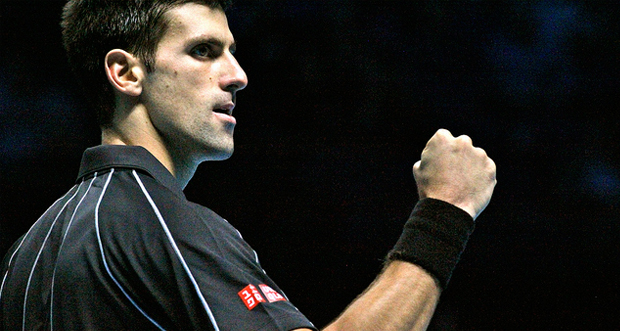
    WTF Winner - Djokovic 3

    The Barclay’s ATP World Tour Finals, Final

    [2] Novak Djokovic def [1] Rafael Nadal 6-3, 6-4

    [6] Verdasco/Marrero def [1] Bryan/Bryan 7-5, 6-7 (3), 10-7


    Hello.

    I know. It’s been awhile. And I’m sorry about that. But I did bring excuses. Some of them are even good ones. Others are distinctly less good-– such as, for instance, would you believe that a few days after the US Open final a convocation of eagles flew in through my office window and made off with my laptop? Or that in October a lamentation of swans invaded my living room and ate the TV? A bevy of larks broke in last week and took off with all my pens? Or, wait, here’s one: How about that I kept trying to watch Asian Swing tennis after work but the Tennis Channel was only showing matches from 2012? (Bingo!) See, a whole flock of excuses. But suffice it for now to say: I’m back, and just in time to say goodbye to another tennis season, to close the book on a heroic tale so many tennis fans fervently hope is only half-finished. That’s right — I’m talking about Fernando Verdasco’s doubles career.

    The Spaniard and his compatriot, David Marrero, defeated the No. 1 ranked Bryan brothers 10-7 in the super tiebreak to claim the WTF beribboned doubles cup. The celebration and victory speech from the Spanish pair could hardly have been more emotional and touching, even by Verdasco’s extraverted, emoticoned standards. I only got home to my TV (a special swan-proof model) in time to see Verdasco win the final point of the match (a serve), and even without knowing anything about the dramatic arc of the match, I was immediately caught up in the exuberance of the moment. First, Verdasco fell joyfully to the ground. Then he got back up, leapt into his partner’s arms and hugged him with all four limbs before running to the sidelines to hug an entire century’s worth of Spaniards. Verdasco then wrote twelve stanzas of free verse poetry on the TV camera lens, and joined forces with Marrero—who became emotionally overcome while dedicating the victory to his late grandfather—to give the season’s most heartwarming acceptance speech. It was a lovely moment, and made me wish I’d seen the tennis that inspired it. (After the trophy presentation both men were stripped from the waist up, interviewed, and made to declare their intention to, first put clothes on, and then go eat Spanish food in South Kensington. Huzzah.)

    I did, however, see all the points of the thirty-ninth chapter in the Nadal v. Djokovic rivalry. So far as tennis rivalries go, it’s hard to fathom how anybody could still argue against this one being among the very best. The pair has met fifteen times since 2011, and all but two of those encounters were tournament finals. (Both other meetings were semifinals:  Roland Garros and Beijing in 2013. The match on the Paris clay was made of such high-quality drama that I wouldn’t be surprised if, going forward, it’s frequently misremembered as the tournament final.) Sure, the six-hour-long Australian Open final in 2012 could be accused of being a too-drawn-out slug-fest, but the rivalry has matured considerably over the past two years, with both players (and their ever-present support squads) devising new and more intricate ways to torture each other on the tennis court.

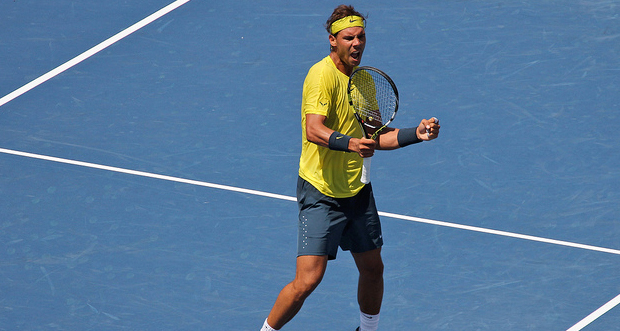
    Unfortunately, no matter how good the rivalry, an individual tennis match tends not to soar to the outer-reaches of greatness when one half of the participants forgets to bring his forehand to the court. Novak Djokovic, ever the generous competitor, tried to make up for Rafael Nadal’s absentmindedness by playing super incredibly well from pretty much everywhere on the court, but no matter how hard he tried, he couldn’t quite compensate for Rafa’s missing forehand. (Even Djokovic isn’t quick enough to return his own serves.)

    The world No. 2 held easily to open the match, then broke fairly easily, then held again. By the time we reached 3-0 in the opening set Novak had won 12 points to Nadal’s four, and Rafa’s game was looking as if his second serve might have run off with his forehand (probably to South Kensington to eat gambas al ajillo with Fernando). When Djokovic nearly broke the Spaniard again in the fourth game, the Serb decided he had to change tactics if there was any hope of elevating this edition of The Rivalry off the plywood floor. So, Djokovic started to make strange errors on his own forehand wing, and the backhand one, too. And it worked like a charm. Rafa held, and then broke back, and then held again.

    By now—we’re at 3-3 in the first, in case you’ve lost count—Djokovic realized that if he went on smothering his forehand and forcing his backhand wide, he might actually not win the match, especially considering that Nadal had begun to play somewhat more assertively and that wary, feral gleam was now visible in the Spaniard’s eyes. Since losing the final of the Barclay’s ATP World Tour Finals would have been no good at all for Djokovic’s twenty-something match win streak (tennis players tend to prefer their streaks to their rivalries), he resumed playing incredibly well and quickly went back to winning the match.

    The highlight of the day came on break point at 3-4 on Nadal’s serve. The point, which you must watch if you haven’t seen it, featured stunning movement and hands from both men. But it was Djokovic who hit the eye-popping lob and Djokovic who won the point, and therefore it was the Serb who was entitled to claim the bonus loot, aka “the manna of destiny.” In the next game, Nadal won a point almost as good to go up 30-15 on Djokovic’s serve—Rafa slammed a muscular forehand down-the-line and followed it up by a no-look jumping backhand volley winner—but Djokovic got a lucky net cord the very next point and therefore collected double manna, which he promptly cashed in for an ace on set point.

    From there the Serb looked like he was made of starswhile Rafael Nadal kept on fending off break points like a man who refused to be forced to earth. (Nadal defended 8 of 11 break points, compared with Novak’s 2 of 3.) But despite Nadal’s best psychological efforts, and perhaps because of several forehand errors, Djokovic still managed to break early in the second set. It should be said that Rafa brought his full measure of grit to the contest—fighting off two championship points before sending one of his trademark forehands just wide on the third— but he simply did not have the game today, while Djokovic had more than plenty. The final score was a surprisingly straightforward 6-3, 6-4.

    After the match, as I waited patiently for the ATP Steering Committee to take their places near the trophy table, and for a nice lady named Rebecca to walk the trophy out onto the court, I took a moment to reflect on the state of men’s tennis today. Yesterday’s WTF semifinals featured Federer, Nadal, Djokovic, and Stanislas Wawrinka. Federer has career 77 titles, Nadal has 60, Djokovic now has 41. The 27-year-old Wawrinka has collected four. Nadal eased by Federer in the first semifinal, despite being outplayed in throughout most of the first set. Wawrinka was psychologically overmatched from the start and didn’t offer Djokovic anything like the fight he showed in Australia or New York. And while I agree with Darren Cahill that Roger Federer is likely to have a better 2014 than his 2013, he is 32 years old. Who’s next?

    Even if Nadal didn’t play anything like his best tennis today, both men belonged in the final ATP match of the year. They’ve been several cuts above the competition for the majority of the season. Nadal will finish the “most emotional season” he’s had as the No. 1 ranked player in the world. Djokovic will be right behind him, at No. 2, with a Major title to defend in two months’ time. As exciting as it’s going to be to watch and see where 2014 takes this rivalry, it’s hard to imagine who is going to be able to hang in there with these two. Healthy versions of Murray, Federer, and del Potro? Pierre-Hugues Herbert? Martin Alund? Whomever he is, he’s going to need to be very good at tennis, and even better at summoning destiny.

    When Novak Djokovic accepted his WTF trophy, he thanked the London crowd for coming out all week to watch tennis. “Thank you for appreciating what we do,” he said. “It means a lot to us.” This isn’t the first time Djokovic has thanked a crowd for hanging in there through a tournament or a match. He has a way of sounding not only grateful, but also surprised that people turn up to watch him—one of the greatest tennis players in the game—play great tennis. Nadal and Djokovic will both take home more than a million dollars for their London efforts, but it’s still the human recognition that counts. That’s heartwarming. Not quite a Fernando-Verdasco-hug level heartwarming, but nice nonetheless.

    It’s also why I would like somebody to tell Djokovic—and Rafa and the rest—that I have plans to fly all the way across the Pacific Ocean to turn up to watch them play tennis at the Australian Open. I’m sure it will mean a lot to them. It also means that I will be able to write to you all about it. And that means a lot to me.

    Cover Photo (Creative Commons License): Marianne Bevis
  • All The Way Up

    All The Way Up

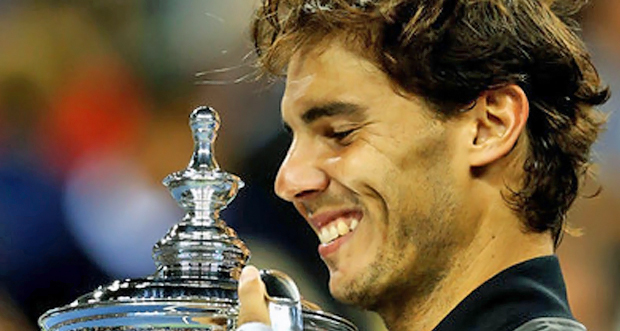
    The 2013 US Open Men’s Final

    [2] Rafael Nadal def. [1] Novak Djokovic 6-2, 3-6, 6-4, 6-1 

    From the perspective of a psychologist-Rafa-fan-tennis-blogger, there was not a lot wrong with the 2013 US Open men’s final. The trophy ceremony is another story, but the final itself was tremendous—Brobdingnagian, even. From Novak Djokovic’s perspective, the immense beauty of the match was likely diminished by the bevy of unforced errors that contributed to his losing. (The Serb made upwards of four-dozen.) But from where I sat—on a blue yoga ball in my living room —it was not only an exciting final, but also an instructive one. Over the course of nearly four hours, Nadal and Djokovic took turns revealing the frescoed ceiling of what is possible when preternatural talent meets application and deep-seated drive.

    [divider]

    Comment on Arienna’s blog and more in our tennis forums.

    [divider]

    No, the trouble with this final, from my perspective, had nothing to do with the tennis. It was the desire the tennis instilled in me to quote novelists, in particularly, the urge to quote Ernest Hemingway— or as the Gulbis Clan would spell it, Ernests. The problem with quoting the Latvian No. 1’s approximate namesake is twofold. First, when the opportunity arises to connect tennis matches to the American Jazz Age—such opportunities are shockingly few and far between—I prefer to quote F. Scott (or even Zelda) Fitzgerald because they are, well, way jazzier than Ernie. Those two really knew how to make their adjectives sing. Second, and perhaps more important, I’ve already quoted this particular passage of Hemingway here once before.

    Much like Novak Djokovic feeding balls to Nadal’s forehand, re-quoting famous authors is not a pattern I’m looking to fall into. Last week it was Borges, this week Hemingway. Who’s next, Carrie Bradshaw? (Yes, I am 99.9% percent sure I somehow linked Sex & the City to Nadal’s footwork. Or maybe it was David Ferrer’s calves.*) But the fact remains that when Rafael Nadal stole the third set out from under Djokovic’s racquet, and then executed a deep knee-bend accompanied by a lawnmower-style fist-pump, my first thought was a worry that he’d pulled a hamstring. (It was a fist-pump as awkward-looking as it was enthusiastic.) The second thing that popped into my head was Jake’s answer to Robert Cohn in Hemingway’s The Sun Also Rises: “Nobody lives their life all the way up except bull-fighters.” Whether or not the statement is accurate, the sentiment underneath it is true.

    So, to continue in the storied tradition of assembling terminology from other sports into descriptive metaphors about tennis—e.g., boxing, horse racing, ballet, baseball, orienteering, hopscotch, glee club, etc.—this tennis match was a bull-fight. To keep the outcome in question as long as possible, Djokovic and Nadal took turns playing the roles of matador and bull. They traded-off between sets, or on the occasional change of ends. Once in awhile they even switched between individual points, one assumes so they’d have something to do while they waited for that annoying guy in the stands to stop lowing like a wounded herbivore. The 2013 final was a showy spectacle; as brutal as it was beautiful.

    If you saw this tennis fight—maybe from the comfort of your own yoga ball, or even better, from a seat in the stands—you won’t soon forget it. And if you did not watch it, you should. But if you did see it and want to relive it, or if you couldn’t watch, maybe because you forgot what TV channel CBS occupies (I had some trouble with this myself last weekend) here’s how I saw it:

    Nadal was extraordinarily dominant in the first set—100% torero. He served thoughtfully and forcefully, winning 80% of his first serves and nearly 60% of the second. The Mallorcan maintained his aggressive 2013 court positioning; sliced and passed with his backhand; and did all the standard damage, plus a little extra, with his forehand. When Rafa held for 4-2 John McEnroe said, “This first set is highly important, to put it mildly.” I agreed, mildly. Including yesterday’s match, Rafael Nadal is 152-3 when winning the first set at a major.

    Of course, one of those three losses came to Novak Djokovic, on a hard court in Australia, in a match that lasted forty days and forty nights (or at least all the way through a California night). During yesterday’s surprisingly lopsided first set, it looked as if Djokovic was struggling mightily with the wind on Arthur Ashe Stadium, which is known intergalactically as the universe’s largest-ever sporting centrifuge. When Djokovic stretches for a backhand return out wide, or a forehand on the run, he looks like he travels through space and time. It’s uncanny eye-bending stuff. The Serb moves with marvelous quickness and his balance is fantastic, but his footwork can’t quite keep up with the rest of him. Nadal’s form is better there. So is Ferrer’s, for that matter. (Probably because of his calves.**)

    Anyway, as Rafa closed out the first set 6-2, I start to wonder if the combined forces of Nadal’s aggression and Mother Nature’s breath were going to make quicker-than-expected work of this match. It was about that time that Djokovic began to find his footing and take the ritual steps that would transform him into a full-fledged tennis deity. It’s tempting to say the change hinged on the 54-shot rally on break point in the second set. It was a rally that included several pummeled forehands from Rafa, ended with Nadal netting a ball, and was immediately followed by Djokovic lifting his arms in triumph while the stadium erupted in applause. In reality, the change started early in the second set, and would require a few more games to solidify.

    In fact, Nadal broke back immediately to put the set back on serve at 3-4. But then Djokovic broke back again, and Nadal found himself pushed well behind the baseline. The Serb won the second set convincingly, but it wasn’t actually until the beginning of the third set that Djokovic played his best tennis. It’s almost not enough to say he was unplayable, his shots—particularly his return of serve and his forehand crosscourt—were downright untouchable. On the other side of the net, Rafael Nadal hung his head, downtrodden. It was 2011 all over again.

    At 1-1, 4-4, 0-40 on Nadal’s serve, Rafa-fans were experiencing some measure of distress (to put it mildly). Djokovic had won the first point of the game with a brilliant lob, and most all of the Serb’s returns were skimming the baseline. In the process of losing the second point of the game, after hitting a quality forehand that Nadal seemed to have expected to be a winner, Rafael Nadal stumbled on the baseline and went down—swinging. (He was truly trying to hit the tennis ball even as his rear-end hit the concrete.) The Spaniard looked wounded, but in soul more than body. I wondered if he would recover from the indignity of having to stand by helplessly as Djokovic turned the match on its head. I should have known better.

    It’s both tempting and accurate to say that it was at the very moment when Rafa was down triple break point that he turned it all the way up. Nadal saved the first break point with a forehand winner, a better version of the shot that saw him to the seated position just minutes earlier. At 15-40 he slowed the rally to a snail’s pace by slicing his backhand until he drew the error from Djokovic. The third break point he saved with his first ace and fastest serve of the match, at 125 mph. Nadal eventually held with an overhead smashed so hard it bounced into the stands and flattened Edward Norton’s hairdo. Nadal went on to wrest the third set away from Djokovic’s deserving hands, then run away with the fourth, while Novak went back to making unhappy unforced errors.

    The most pronounced moment of tension in the fourth set actually came from the stands, when the crowd was unable to shush itself before championship point. I didn’t have my stopwatch handy, but that had to be the most protracted collective “shhhhhhhh” in the record books. It was, I suspect, longer than the combined time CBS gave Nadal and Djokovic to thank their coaches and families. The match ended, fittingly, with an error from Djokovic.

    Continuing on with his habit of flinging his body against every hard court he conquers, Rafael Nadal immediately stopped, dropped, and rolled—and cried. Nadal and Djokovic shared a warm hug at the net, and then Rafa went back to joyfully rolling around on the court. (Who can blame him? He really has been on fire this season. Rafa now owns 10,860 ranking points as compared with Novak Djokovic’s 10,980.) The trophy ceremony was awkward and rushed. Both Nadal and Djokovic did well to answer the question they should have been asked, rather than the one they were asked. There were also way too many American flags. It’s better not to dwell on it. Instead, I’ve prepared a poignant summation, replete with fitting quotations:

    Last time I mentioned the Hemingway passage from The Sun Also Rises was in a post I wrote before the 2012 US Open. My intention had been to comfort dismayed Nadal fans. Hey, the sun also rises. Buck up, and whatnot. And see, I was right. A lot can change in twelve months’ time. With some trepidation—given my loyalties—I offer the same sentiment to Djokovic fans today. Novak Djokovic will probably be disappointed with this performance, particularly with his play in the first and fourth sets. But in watching both the men’s and women’s finals this year I was mostly struck by the shared capacity of this small group of extraordinary athletes. They fight.

    The other SwissStanislas Wawrinka, authored the most heartwarming storyline at this year’s US Open and I was disappointed not to have a chance to write more about him. I did watch, and cheer for him, and even found myself doing an air-punch fog-horn blast thing whenever he hit a booming backhand winner. (Which none of you saw, right?) So, I think it’s fitting if I let Stan have the last word. When it comes to Djokovic and Nadal—and Serena and Vika—they’re supremely good at tennis, that’s true. But when it comes to effort, will, and intent, they’re seriously “fucking strong.”


    *In case you are wondering, I try to mention David Ferrer’s calves at least once per major tournament. His calf muscles happen to generate dozens upon dozens of Google searches (more even than the number of unforced errors Djokovic hit in the final) and I have decided they’re good for business.

    ~For those of you who do not live in the United States and were deprived of team-ESPN’s commentary, you might be interested to know that Brad Gilbert and Patrick McEnroe tirelessly interviewed each and every American football player who showed up in the stands to gain the best possible understanding of exactly which position Nadal should have played had he ever shown the slightest interest in playing American football. From what I can tell the verdict was split between “running back” and “he’s too f***ing small to play football.”

    **See first footnote.

  • A Precarious Position

    A Precarious Position

    US Open 2013, Men’s Fourth Round

    [19] Tommy Robredo def [7] Roger Federer 7-6(3), 6-3, 6-4
    [2] Rafael Nadal def [22] Philipp Kohlschreiber 6-7(4), 6-4, 6-3, 6-1

    This morning, as the sun broke open over Northern California, I woke with Federer and Nadal on my mind (a little bit of Kohlschreiber, Robredo, Gasquet, and Ferrer, too, but mostly Roger and Rafa). And there they stayed. As the September sunshine warmed my shoulders, I made my way to my favorite cooperative bakery for a croissant (typical behavior for a Northern Californian on a Tuesday morning) and wondered if you, my readers, would forgive me for recycling a sentence I stole, stripped, and re-purposed for tennis once already.

    A year and a week ago I quoted Jorge Luis Borges in a post about the 2012 US Open draw. In his essay The Superstitious Ethics of the Reader, Borges wrote, “the perfect page, the page in which no word can be altered without harm, is the most precarious of all.” As I took my place in the bakery line—eying the cheese Danish with affection—I couldn’t help but think Borges’s well-crafted sentence was the perfect way to describe my experience of watching Roger Federer lose in straight sets to Tommy Robredo in Louis Armstrong Stadium last night.

    As it happened, the young woman ahead of me in line wasn’t in the market for baked goods so much as she was wanting employment baking goods. And she was mucking it up royally. All she needed to do was turn in her application and cover letter and walk out of the shop, but she could not stop talking. She asked what her chances were; she explained how willing she’d be to work early in the morning; and to stay in the position at least a year; and how fond she was of bread; and cookies, too; and when, she wondered, might she find out if she would be called for an interview? She spoke quickly and bounced on her heels as she talked, and reminded me of nothing so much as the cringe-inducing answering machine scene from Swingers.

    No sooner did she—finally—turn to leave the counter than did she turn back, “I hope my cover letter is OK!” She bounced. I stared, openly eavesdropping at this point. Ohmygod, please stop, I thought. Just go! Quit while you’re ahead, or at least before you make it worse!

    She continued, “I worked a long time on it, but I’m still not sure if it’s good. But there’s a lot in it! I hope it’s OK. It’s like a list.”

    The Amish-bearded baker behind the counter paused before answering. He spoke in a soothing voice, “Remember what Borges said: ‘Every list abounds with meaning.’”

    The young woman was quiet for at least a second, maybe even two. “What? Who?”

    “Borges, he was a writer. From Argentina. He said: ‘Every list abounds with meaning.’” The baker paused again, touching his fingertips to his beard, “So, it’s important you wrote the letter. It’s meaningful.”

    “Oh.” She bounced again. “That’s great! And it’s so true, too, isn’t it? Wait, what was it again??”

    “Every list abounds with meaning.”

    “Right! That’s great. Who said it?”

    “Borges.”

    “Oh, right. Well, thank you! When will I find out about the interview again?”

    When it came to be my turn at the counter I refrained from sharing my tennis thoughts with the bearded baker-sage. He’d listened enough for one morning. But I did tell him that I’d been thinking about a line from Borges on my way over, and we marveled together at the coincidence of so much Jorge Luis on a Tuesday morning. He recommended that I listen to Borges’s Harvard lectures, “This Craft of Verse,” which the author delivered from memory in the 1960’s when he was nearly blind. I said I would, and then I bought breakfast.

    On my way home, happily chewing on my croissant, I also chewed over thoughts about lists and meanings. It seemed to me that the baker was trying to reassure the young woman that her act of writing the cover letter—the declaration of personal intent—could never be time wasted, whether or not the finished product was anything like perfection. This led me back to thoughts about Roger Federer …

    Thousands of fans on Armstrong, who’d all waited out a rain delay to see Federer play for a spot opposite Rafael Nadal in the quarterfinals, must have felt their time had been wasted, or worse. If it hurt to watch on television, it had to have been more difficult in person, where the lack of sting off the Swiss’ miniature racquet would have been even more apparent.

    From where I sat, Tommy Robredo looked to be Roger’s pink elephant. Federer could not seem to help hitting directly to him. Volleys, approach shots, passing shorts, rally balls — all went toward Robredo’s racquet, and often to his forehand. And when Federer’s shots didn’t find the nineteenth seed, neither did they find the tennis court. And the break points —only 2 of 16 for Federer— those were the most painful points of all. I imagine many spectators were having thoughts like mine in the bakery this morning: Ohmygod, please stop. Just go! Quit while you’re ahead, or at least before you make it worse!

    Robredo’s tennis was more than competent— and he was psychologically rock-solid— but his performance wasn’t half as special as it should have needed to be to beat the five-time US Open champion. Many tennis fans, including a few with the last name of Nadal, think that Roger Federer’s best level is as close to perfection as mere mortals can get. In fact, there are many who believe The Mighty Fed’s mortal guise is merely that:  a way to dress down his divinity. (Another way is to wear royal blue shorts that don’t quite match one’s polo shirt.) But dressed-down is one thing; diminished is another. Divine beings are not supposed to perish, especially not in straight sets in the fourth round after a near-immaculate performance in the third. In his essay, Borges goes on to say that perfection “consists of those delicate fringes that are so easily worn away.” Last night Federer was without his fringes, a king without his miniver collar.

    ESPN aired Roger Federer’s press conference side-by-side with Rafael Nadal’s highly entertaining four-set win over Philipp Kohlschreiber. There was an especially poignant moment when Federer confessed he’d been looking forward to the intimacy of playing on Armstrong, and to the experience of the crowd being enthusiastically with him. As he spoke on the right-hand side of my TV screen, Rafael Nadal was in the process of gaining a stranglehold on the entire Arthur Ashe Stadium on the left. Roger looked ready to cry; Rafa looked ready to shred concrete with his teeth.

    Like Federer, Nadal lost the first set of his fourth-round match in a tiebreaker. As did his longtime rival, Nadal also struggled to convert break points (5 of 21 overall). But there the resemblance ended. Kohlschreiber played beautifully from first point to the third-to-last —excepting that disastrous overhead in the fourth set— but all his intricacy and angles weren’t nearly enough to overcome Nadal, whose brutality was especially evident on his drop shots and backhand-passing winners. The Spaniard has only faced six break points in the tournament, and has yet to lose a single one.

    If you’re like me, a Rafa-fan with a healthy appreciation for Kohlschreiber’s shot-making, you will have found it a delightful match. Nadal got better all the way through, while the German hardly got worse. In my opinion, Sloane Stephens and Kohlschreiber are now tied for the most entertaining breadstick-set losses of the tournament.

    If you’re a Federer fan, watching the commanding victory of his rival might not have done much to ease the ache of the evening. Maybe there was comfort to be had in Ferrer’s grinding triumph over Tipsarevic, or, more likely, in the eventual victory of Gasquet’s one-handed backhand over his own history at Majors. There’s no doubt Federer finds himself in a precarious position. How meaningful was this latest loss? There’s also no telling, with any degree of certainty, what the future will bring for the player whose game is so often called poetry-in-motion.

    In another essay, this one titled “History of Angels,” Jorge Luis Borges wrote:

    …No poetry, however modern, is unhappy to be a nest of angels and to shine brightly with them. I always imagine them at nightfall, in the dusk of a slum or a vacant lot, in that long, quiet moment when things are gradually left alone, with their backs to the sunset, and when colors are like memories or premonitions of other colors. We must not be too prodigal with our angels; they are the last divinities we harbor, and they might fly away.

    In other words, it’s a bummer Fed lost. Let’s hope he’s not ready to fly away.

    [divider]

    Click here to discuss “A Precarious Position” in our discussion forum.

  • Life on the Big Stage

    Life on the Big Stage

    Day One at the US Open 2013

    You know you’re a tennis fan when, on a crisp August evening, under a plumb colored sky, you’re sitting at the Greek Theatre in Berkeley, California, where cello virtuoso Yo-Yo Ma introduces his quartet, The Goat Rodeo Sessions, by saying, “I bet you’ve never seen four goats on a stage before,” and your immediate reaction is to look around for Roger Federer—or Rafael Nadal; or Serena; or even Djokovic.

    [divider]

    You can discuss this and more on our tennis message boards.

    [divider]

    Yep, that’s how you know you’re a tennis fan: you have forgotten that goats exist in the real world, where they have four legs and horns, and don’t know a forehand from a fingerboard. As it was explained to the audience, a “goat rodeo” is a metaphor for a risky and chaotic situation, not unlike the creative process, or an arena filled with angry goats and cowboys, or Super Saturday at the US Open. In fact, I’m pretty sure the musicians named their collaboration in honor of an especially blustery Super Saturday. You know what it’s like, when courts boil and roil from the inside, hurricanes blow from the outside, and the world’s best players don’t get to play much tennis. That’s essentially the definition of a goat rodeo.

    Along with Edgar Meyer on bass, Stuart Duncan on fiddle, and Chris Thile—the only mandolin player I’ve ever seen perform while wearing a meticulously tailored hipster suit—Mr. Ma played two hours of music that was almost as exciting as the running slice-slash-stab passing shot Rafael Nadal hit off Ryan Harrison’s overhead smash to earn the first of many, many break points on the American’s serve. But though Nadal did hit several thrilling shots, I have to admit that overall, the single set of music performed by The Goat Rodeo Sessions on Saturday was more engaging than all three sets of the Nadal-Harrison match. I should point out, before I upset a significant number of my readers, this was not Rafa’s fault.

    Perched— and chirping away—in the ESPN booth, John McEnroe made the accurate observation that there is simply not a single thing that Harrison does anywhere near as well as Nadal does everything. Ryan Harrison is now 0-20 against Top 10 opponents, a stat he might appreciate more if those losses had occurred at a slightly more advanced stage of important tennis tournaments. When asked, Harrison is always quick to point out that he relishes playing the best “on the big stage,” but I bet he’d trade the biggest and the best for a shot at the second round, or more importantly, a better split-step after his serve.

    Shortly after Nadal broke Harrison’s serve and then held his own with ease, McEnroe went on to note— with a delightful disregard for sense—that Ryan Harrison has never won a five set match, and therefore “the longer this goes, the worse it gets for Harrison.” Fortunately for the 21-year-old, it didn’t go on very long. Nadal won 6-4, 6-2, 6-2 in just over two hours. Harrison actually lost the final point from the seated position, having toppled over just in time to watch Nadal bury a short ball in the opposite corner of the court.

    To go on citing opinions of broadcast commentators, one of the online ESPN announcers (possibly Taylor Dent) said that while Nadal is playing for the title, Harrison is playing for respect. This struck me as a poor choice of motivators for the 21-year-old. After all, it presumes an essential lack in the self that has nothing to do with tennis technique. If he’s not playing to win—which would make a kind of sense in this case—Harrison should be playing to better understand himself, not to try to get other people to understand him better.

    In any case, the one-sided nature of the contest made it difficult to judge the Spaniard’s form, but two hours and five minutes was plenty of time for me to form a decided opinion on Rafa’s new pointillist headband: I like it. Like a well-tailored hipster suit on a mandolin player, it works.

    What hasn’t worked, on account of the rain delay, was my plan to steal everything Yo-Yo Ma said during his between-song chats at the Greek Theatre — Ma is hands down the jolliest and most insightful world-famous cello player I have ever heard talk about goats— and apply it to the GOATs who were to perform on the Arthur Ashe stage during Day 1 of the Open. Mr. Ma spoke eloquently about his continued love of playing his instrument, and of the undying human need for invention and risk. He said our passions deserve practice, and referred to himself as an old goat who never wanted to stop learning new tricks. (He put both hands to his head as he said this last bit, index fingers pointed skyward, to show us his goat horns. See, a jolly cellist.)

    I had intended to lift all these lovely Yo-Yo sentiments and stick them directly to the goatiest of all the current GOATs: Roger Federer. Had all gone according to plan, it would have been very inspirational, like a Blue Mountain card, but with horns. However, as you know, it rained. And like the Greek Theatre in Berkeley, Arthur Ashe stadium is—for now— wide open to the night sky. (Except, I’d like to point out, it does not rain in Berkeley in August.) So, no Federer primetime match, and no making little horns with my fingers while I type. (Probably easier that way.)

    Oh, what the heck. I’ll write it anyhow. How often does a tennis blogger get to use a Presidential-Medal-of-Freedom-winning classical musician discussing domesticated ruminants as her muse?

    OK, there. You probably can’t see, but I’ve just done the horns. (To do it properly you’ve got to get the index fingers aligned precisely with the edges of your eyebrows.) Now for the typing:

    Leading into the Open, there has been much talk concerning the exact moment when the 32-year-old Roger Federer ought to retire.* Yesterday, today, tomorrow, and ten years from now have all been suggested to Roger via helpful tweets. Already the Swiss has fallen to No. 7 in the rankings, which makes it statistically difficult for him to qualify for membership in the Big 4. Moreover, nobody wants to see the sheen rubbed off his GOAT coat if he tumbles any lower.

    But the problem with quitting while you’re ahead, or even quitting when there is any possibility at all of getting ahead, is that you’ll never know where you could have gone. In place of the secure knowledge that every avenue was exhausted, there will be uncertainty. And uncertainty is the GOAT of difficult states of being—most of us go to great lengths to avoid it most of the time.

    After my initial confusion about goats on the stage at the Greek Theatre, I didn’t think about tennis during The Goat Rodeo Sessions’ performance. Mostly I enjoyed the pleasure of listening to and watching four accomplished musicians work and play at something they so clearly love. But at the end of the evening, just before the encore, I did think about tennis again. The quartet finished their set with a rousing tune called Attaboy. Then, they thanked the audience for being there, and Yo-Yo Ma instructed us, with something very like joy in his voice, all to go home and always practice our passions. He sounded sincere.

    The essence of sports depends on laying down a firm line between the experiences of victory and defeat, but for a split-second I wished it didn’t. What if Federer and the Williams, and the struggling Harrison, and James Blake—who did announce his retirement, effective immediately after his final round at the Open— could all pick up their stringed instruments and collaborate—practicing, performing, and enjoying? Wouldn’t it be nice if the goal was for each person to become the best they could become on that very day, instead of “better than everyone else for all eternity”—an enterprise doomed to failure?

    Well, it would be nice. But it would also be a lot less like tennis.

    So instead, we’ll wait and watch, and be uncertain. And if Roger Federer —or Venus Williams, or James Blake, or Tommy Haas, or any other people too old to know how to twerk like Hannah Montana — do manage to win the US Open, I am going to put on my best hipster jacket, break out my mandolin, and totally pretend I know how to play it. Attaboy!

    *They say the champions –from Venus Williams to Roger Federer to Francesca Schiavone—always think they can get it back. Federer is 32. Venus and Fran are 33. But come September, Serena Williams, who allowed Schiavone only six points in six games, will also be 32-years-old. And Tommy Haas, as we all know, is 142. Age is not the only deciding factor.

  • One More Time, With Feeling

    One More Time, With Feeling

    The Western & Southern Open ATP Final, 2013

    Rafael Nadal [3] def. John Isner 7-6 (8), 7-6(3)

    Three tournaments, three crowns: With his 7-6, 7-6 win over John Isner in the final of the Western & Southern Open in Cincinnati, Rafael Nadal remains unbeaten on North American hard tennis courts in 2013. The Spaniard also reclaims the No. 2 world-ranking; earns his 26th career Masters title, the second in as many weeks; and gets to take home a floral-themed vessel adorned with an earthier-than-ever-before glaze palette of burgundy and green. (I am not making that last bit up.) Indeed, there is talk of crowning him King of Concrete, or, at the very least, considering him as a favorite to win the US Open.

    Last week, in the Montreal final, Nadal demolished his 6’ 5” Canadian opponent, Milos Raonic, 6-2, 6-2. Raonic’s performance was decidedly muted, and Nadal calibrated his victory celebration accordingly. (It involved little more than warm, heartfelt smiles and a a few thankyouverymucheverybodys.) Today, at the Lindner Family Tennis Center in Mason, Ohio, Rafael Nadal again faced a native son. But unlike Raonic in Canada, the 6’ 10” American played a fantastic final.

    Although, from my perspective, today’s two tiebreak-sets still weren’t as thrilling as the first two sets of Nadal’s quarterfinal victory over Roger Federer on Friday evening. (Read about it here.) Gargantuan serves like Isner’s are more fun for me to see in person than on TV. (In fact, they are almost impossible to see on TV, because although they are beastly in size, they are also avoidant creatures, and tend to scurry off the television frame before you can get a good look at them.) Nadal earned exactly zero break points in twelve Isner service games. John managed to get three break points of his own, but converted none. Isner’s forehand was tremendous, which was both enjoyable and visible, but his return let him down at crucial moments, most notably at 3-5 in the second set tiebreaker.

    It’s possible Nadal was every bit as good in the Cincinnati final as he was against Federer in the quarters, but with Isner on the other side of the net, the conversation wasn’t half as eloquent. Which isn’t to say it wasn’t deep and meaningful—Isner’s presence in the final means Americans who have heard of tennis can tell foreigners that we once again have a top twenty player in the ATP computer rankings. It will be good for our collective sense of numerical self-worth. It should also be good for John Isner’s sense of his tennis self as he prepares to enter the US Open with the weight of American expectations on his broad shoulders.

    Speaking of American pride, the U.S. crowd was with Isner from first point to last. Yet Nadal had a fair measure of support from the stands, and no small amount of their admiration. After all, he has put together a highly entertaining two weeks of tennis. And, like any great big-stage performer, when it came time—on his first of three available match points— for Rafa to bury his final forehand winner of the tournament down the line, he sensed the moment had arrived to let loose his inner celebratory animal.

    After collapsing flat onto his back (with impressive alacrity), the Spaniard screamed, tensing all his muscles, thereby paradoxically releasing all the tension accumulated during two taut hours of competition. Then, beaming like a ray of tennis-ball-colored sunshine, Nadal jogged to the net, shook the American’s proffered hand (resting his head briefly on Isner’s vast midsection) before going on delightedly screaming and jumping around the court. Oh, and he also wagged his No. 1 finger at the sky—just as he did after defeating Novak Djokovic in the Montreal semifinals.

    Given that finger-wagging was officially trademarked by RF, Inc. during the spring of 2011, Nadal’s infringement on copyright has not gone unnoticed—or unanalyzed. For my part, it was the finger-wag more than the third straight hardcourt title that reminded me of Mark Antony’s famous lines in Shakespeare’s Julius Caesar: “I thrice presented him a kingly crown, Which he did thrice refuse. Was this ambition?”

    Antony goes on to say that Brutus, an honorable man, did indeed think Caesar was a hair ambitious and ought therefore to be stabbed to death by a group of his buddies, making a mess of at least a dozen nice togas in the process. (I believe similar suggestions for summary execution have been put forth many-a-time on twitter in regards to Nadal, Federer, and also Gilles Simon.) But the reason Caesar had to be got rid of wasn’t because of his ambition; it was to do with how he applied it. Caesar sought to raise himself above the rules of the game, and to do so secretly— indirectly. Romans did not want to be ruled by a king (not when they could be gently guided by the classic democratic principles of bribery and corruption!). But tennis? Tennis craves kings. Every year—every week, even— tennis chooses the guy with the No. 1 finger.

    So, the thing I enjoyed most about this tournament—besides watching James Blake catch fire in his second round match against Jerzy Janowicz, of course—was seeing Rafael Nadal execute his tennis game with such clarity. He almost looked, well, entitled, out there. If I had a quarter for every time I saw Nadal move inside the baseline to hit groundstrokes, and go for winners, I could park my car at a meter in Oakland for long enough to do my grocery shopping and get a coffee. (For instance, during his semifinal match against Berdych, Nadal hit 19 forehand winners, 38 overall. That’s $9.50 for me, which roughly comes out to 11 minutes and 28 seconds of metered parking. See? Perfect.)

    One of the points from the final that sticks with me now was, I believe, the very first point of the second set tiebreaker. Nadal not only hit a winning forehand down the line, he managed to bend it so the ball struck the line as if it were an inside-out forehand hit from his backhand corner. Jim Courier, who was in the CBS booth, exclaimed, “Explain to me, how do you create an angle when you hit down-the-line?!” Then he told Mary Carillo how to do it. But even if Mary knows how to do it, that doesn’t mean she could. Which is why it is such a pleasure to watch a player capable of so much play so near that capacity.

    Without losing contact with his defensive skills, Nadal has spent the last two weeks executing the aggressive aspects of his game with remarkable openness. It’s refreshing; and it’s time.

    Not to play favorites for the Open, but if this is ambition—I like it.

    [divider]

    Discuss this article and the match on our tennis forums.

  • Strong Believers

    Strong Believers

    Western & Southern Open, ATP Third Round

    [1] Novak Djokovic def. [Q] David Goffin 6-2, 6-0
    [5] Roger Federer def. [11] Tommy Haas 1-6, 7-5, 6-3
    [2] Andy Murray def. Julien Benneteau 6-2, 6-2
    [4] Rafael Nadal def. Grigor Dimitrov 6-2, 5-7, 6-2

    ESPN, Inc., formerly the Entertainment and Sports Programming Network Rulers of the Universe, has a way of making its fellow cable network, The Tennis Channel, look like it has the earnings potential of an independent bookseller—an independent used-bookstore with a leaky roof and a big CD section. I could watch Cincinnati tennis on two different ESPN stations today, while the Tennis Channel was stuck re-airing the Kooyong Classic from 2004. But, I could watch ESPN today, because today was a happy work-at-home paperwork-day. (This is a special kind of day, similar to a holiday. Sadly, it is also a type of day that has become all too rare in recent months.)

    Aside from making the Tennis Channel feel bad about itself, ESPN also has a way of reminding American tennis fans exactly how unimportant their sport-of-choice is in the grand scheme of chosen sports. Today they managed it by regulating Rafael Nadal and Grigor Dimitrov to ESPN3, an online stream, while airing Little League on television. Yes, a 1000-level ATP tournament contested on U.S. soil (specifically in the Western & Southern portion of the U.S.) took a back seat to eight-year-olds standing in a meadow chewing bubble gum. A match featuring one of the best players in tennis history versus the only active player on tour to be nicknamed after one of the other best players in tennis history was shunted aside by actual baby athletes.

    But I digress. Hmm. Why was I telling you about the ESPN programming schedule? Oh yes, for metaphorical purposes! And I’ll come to those in a moment, I promise. Everybody loves a metaphor. But first, since I’m on the subject of ESPN, I want to say a few words about ESPN commentator, Darren Cahill.

    In fact, you can consider this post my formal petition for Darren Cahill to take full coaching responsibility for Marion Bartoli’s post-retirement commentary career. Because, really, with Cahill in the booth, the video stream is almost optional. It isn’t simply that Darren Cahill mostly confines his commentary to the match at hand; it’s that his comments are so sensible. Indeed, when he has nothing sensible to say, he seems to say nothing at all. (Psychotherapists love this trait in their sportscasters.)

    For instance, during set one of Roger Federer’s three-set victory over Tommy Haas, Cahill wasted little time in the usual speculation about whether Roger was actually Federer, or if this Roger might not be an imitation version of the Swiss who had never learned to play tennis. Instead, he commented that Federer was more than typically nervous, rushing himself into poor decisions, mostly involving losing points at the net. Cahill also noted that Tommy Haas’s court position on the return was taking the out-wide serve from Roger forcing him into uncomfortable choices, and that Haas’s returns—flat and hard, down the middle of the court—were the best strategy to draw errors from Papa Fed.

    At some point in the middle of Nadal/Dimitrov match— the point when the Bulgarian ran down a drop shot, hit a winner, and then jumped into the air with glee—Darren Cahill chortled warmly, saying, “Goodness me, he’s fun to watch.” With Cahill in the ESPN booth, it’s also fun to listen.

    OK. That turned out to be an official second digression, which might be some type of digressive record, if such records were tracked. (I tried to keep track once, but I kept getting distracted.) So, without further ado, the metaphorical section of the post, wherein I compare the Big Four—defined herein as Djokovic, Nadal, Murray and Federer*— to ESPN, or perhaps Amazon.com, and their opponents to a cross between the Tennis Channel and various indie booksellers.

    [divider]

    Novak Djokovic d. David Goffin 6-2, 6-0

    The first men’s match on Center Court today was Novak Djokovic versus David Goffin. During Djokovic’s match, morning-time for me, I listened to my voicemail, ate a bagel, and blinked, twice. By the time I’d finished, it was all over. The second set took approximately five minutes and Goffin won exactly zero games. Djokovic, on the other hand, won six. Every time I had the opportunity to glance at my monitor I was treated to the sight of a blonde Belgian standing roughly fifty feet behind the baseline, and lunging in the general direction of a tennis ball.

    Goffin made his way to the third round via a 6-1, 6-1 win over Mackenzie McDonald, who is the first non-ranked ATP player to qualify for the main draw in Cincinnati. Ever. Mackenzie hails from Piedmont, California, an American hill-town so wealthy that it seceded from its surrounding city-state, which is a rough-and-tumble place called Oakland. Piedmont has a very tidy set of public courts. It is doubtful Mackenzie makes much use of them. In the second round, David Goffin bested last week’s Rogers Cup semifinalist Vasek Pospisil, 7-5, 1-6, 7-6. Neither of these victories offers exquisite insight into Goffin’s current form. Nor did today’s loss. Djokovic didn’t let him near the tennis ball. The Serb is looking fearsome.

    Djokovic has never won the Western & Southern Open. Conquering Mason, Ohio, would make him the only ATP player to win all nine of the Masters titles. I Googled No. 9 and it turns out to be – according to the internet’s most reputable numerology sites — “the number of destiny.” Wikipedia also defines nine as the number that follows eight and precedes ten. Make of that what you will.

    [divider]

    Roger Federer d. Tommy Haas 1-6, 7-5, 6-3

    Given that Federer spent a goodly portion of his third round match looking as if he were concerned that sustained rallies might damage his antique tennis racquet, you might be surprised that I’ve listed him among the metaphorically ESPN-esque players of the day. But—and I think I’m right about this—part of the reason Federer was able to come back and win the match from 1-6, 1-3 down is precisely because he is Roger Federer, or RF, Inc., for short. No matter how low the RF stock plunges, there is always a chance that his opponents will remember that they are up against a 17-time slam champion. (Sometimes, there is even opportunity for Federer to remember this, too, especially when he’s not wearing his special “warming shirt” and is therefore capable of hitting serves.)

    In Tommy Haas’s case, he must have also been aware of his 3-11 (now 3-12) career head-to-head against Federer. A tennis fan doesn’t need a numerology site to tell her that numbers like that can get in a player’s head. Nonetheless, the German got off to a stellar start, and looked as if he could continue being outstanding all day. Meanwhile, Federer proceeded to go from OK, to distinctly not OK, to much worse than that. By the end of the first set even his serve had abandoned him, protesting its owner’s wild net-rushing ways.

    But, midway through the second set the Cincinnati fans got to witness one of the marvels of today’s interdependent tennis economy. At very nearly the same moment in time, Federer began to produce his money shots, while Tommy’s currency took a sudden nosedive. Haas started his descent by re-gifting an early break back to Roger, leveling the set at 4-4. Federer consolidated, making one small fist pump in the process. Haas then gave away three straight points, which turned out to be set points, so he changed his mind and took them back. The set was still level at 5-5, but the momentum now rested with Federer.

    By the time the No. 5 seed closed out the match—an excellent drop shot to bring up match point, and a forehand winner to end it—Roger Federer looked like he had some measure of his aura back. (If you looked closely, you could even see it, shimmering in the Cincy sun — a pretty cornflower blue.) After the match, Federer was quoted as saying he is a “strong believer” he’s on the right path. Should Federer lose in the quarters, there’s still no proving him wrong. Even the most vintage version of Roger Federer could be excused for losing to Rafael Nadal at his most passionate™.

    [divider]

    Andy Murray d. Julien Benneteau 6-2, 6-2

    OK, I admit I did not see one ball of Murray’s win over Julien Benneteau. (I had to do some actual work today.) Andy Murray had to do some work, too — exactly one hour, nine minutes, and two seconds’ worth. Since I have no observations to make about this match, I’ll guess (blogger prerogative): the Scot is much improved this week from last. He is also the reigning Wimbledon Champion and the defending US Open Champion. He is a factor, whether he is happy about it or not.

    [divider]

    Rafael Nadal d. Grigor Dimitrov 6-2, 5-7, 6-2

    Nadal’s three-set defeat of Grigor Dimitrov was an exciting match, or might have been if I weren’t watching it while also trying to cook dinner for four. It is not easy being a Rafa fan, chopping vegetables, and watching a 6-2, 5-3 lead slip entirely away. In such moments one needs to be especially careful not to accidentally include small pieces of oneself in with the chopped kale and beans. (It’s what people like to eat in Northern California, I swear.)

    At some point during the first set, Darren Cahill said (sensibly), that, under pressure, Grigor Dimitrov had a tendency to abandon a winning strategy. As if Dimitrov knew he was being discussed, he demonstrated the truth of Cahill’s observation by gaining a hard-fought advantage in a long rally and proceeding to back it up by backing up, way up—deep into Goffin territory—losing the point because he couldn’t track down an inside-out forehand from Nadal. Case in point.

    However, when the Bulgarian made a mighty last stand, which came, as last stands will do, near the end of the second set, it turned out to be Nadal who abandoned his winning strategy. Instead of aggressively going for winners off his forehand, backhand, serves, and volleys, he mostly did not go for winners off all those same shots. When he did, he missed. Grigor, meanwhile, became good fun to watch.

    Fortunately for Rafa, he is, at the moment, well in touch with his trademark inner-passion for the game. As with Federer, you can see it in his aura, which shines bright yellow, and looks not unlike an incandescent tennis ball in the shape of a T-shirt. Even at night, the brilliant glow helps Rafa find anything from a moth resting its wings on the service-line to an aggressive baseline strategy. Having located his strategy Rafael Nadal, being Rafael Nadal, broke to open the third set. There were close games and see-saw moments in Set No. 3, but Nadal never relinquished the break. Why should he? He’s Rafa.

    [divider]

    At the beginning of Roger Federer’s match he was pronounced by many (many times over) to appear “not at all like Federer.” By the time he won, his play was dubbed “vintage Federer.” True Federer. (Though he was still far from full-flow-Federer, which is even truer than truth.) It fascinates me how often top players are defined as playing “like themselves.” It isn’t just linguistic laziness, or I don’t think it is. The technique is descriptive. If you tell me Djokovic was playing like Djokovic, I don’t picture baseline errors. No, I think it’s to do with how frequently the Big Four are able to channel their best selves, which — and this applies to all of us — is the truest version of the self. I am a strong believer in that.

    And because I’ve used up my entire allotment of words, including half my allowance for next week, I’ll end with mentioning players who deserved more mention: John Isner, Dmitry Tursunov, Juan Martin del Potro, and Tomas Berdych. Each man won a match today, and tomorrow they play Novak Djokovic, each other, and Andy Murray, respectively. I wish every one of them strong belief. I also wish tomorrow were another special stay-at-home-paper-work-day. So I could watch.

    *The Top Four (as opposed to the Big Four) includes Djokovic, Murray, Nadal, and David Ferrer, who is having a terrible time moving around tennis courts lately. I have to think it’s at least partly due to the damage done to his ankle at Wimbledon. The Spaniard tried so hard to give his second round match away to Ryan Harrison, but the American refused to take it. (Respect for his elders, and whatnot.) As a consequence, David Ferrer has now been Tursunoved twice this season. But it’s worth noting that last time he lost to the Russian was in Barcelona, mere weeks before he reached the French Open final.